

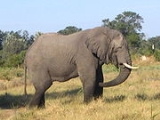
Loxodonta

Encyclopedia
African elephants are the species of elephant
s in the genus
Loxodonta (Greek for 'oblique-sided tooth'), one of the two existing genera in Elephantidae
. Although it is commonly believed that the genus was named by Georges Cuvier
in 1825, Cuvier spelled it Loxodonte. An anonymous author romanized the spelling to Loxodonta and the International Code of Zoological Nomenclature
(ICZN) recognizes this as the proper authority.
Fossil
members of Loxodonta have only been found in Africa
, where they developed in the middle Pliocene
.
trunk ends in a single lip. African elephants are bigger than Asian elephants. Males stand 3.2–4 m (10.5–13.1 ft) tall at the shoulder and weigh 4700–6048 kg (10,361.7–13,333.6 lb), while females stand 2.2–2.6 m (7.2–8.5 ft) tall and weigh 2160–3232 kg (4,762–7,125.3 lb).
The largest individual recorded stood four metres to the shoulders and weighed ten tonnes.
Their tusks are teeth; the second set of incisors become the tusks. They are used for digging for roots and stripping the bark off trees for food, for fighting each other during mating season, and for defending themselves against predators. The tusks weigh from 23–45 kg (50.7–99.2 lb) and can be from 1.5–2.4 m (4.9–7.9 ft) long. Unlike Asian elephants, both male and female African elephants have tusks. They are curved forward and
continue to grow throughout the elephant's lifetime. The enamel plates
of the molars are fewer in number than in Asian elephants.
s, mopane and miombo woodland
s, Sahelian scrub
or desert
s.
Bush and forest elephants were formerly considered subspecies
of the same species Loxodonta africana. As described in the entry for the forest elephant in the third edition of Mammal Species of the World
(MSW3), there is now morphological and genetic evidence they should be considered as separate species.
Much of the evidence cited in MSW3 is morphological. The African forest elephant has a longer and narrower mandible, rounder ears, a different number of toenails, straighter and downward tusks, and considerably smaller size. With regard to the number of toenails: the African bush elephant normally has four toenails on the front foot and three on the hind feet, the African forest elephant normally has five toenails on the front foot and four on the hind foot (like the Asian elephant), but hybrids between the two species commonly occur.
MSW3 lists the two forms as full species and does not list any subspecies in its entry for Loxodonta africana. However, this approach is not taken by the United Nations Environment Programme
's World Conservation Monitoring Centre
nor by the International Union for Conservation of Nature (IUCN), both of which list L. cyclotis as a synonym (not even a subspecies) of L.africana.
A consequence of the IUCN taking this view is that the IUCN Red List
makes no independent assessment of the conservation status of the two forms of African elephant. It merely assesses the two forms taken together as a unit as vulnerable
.
A study of nuclear DNA sequences published in 2010 indicated that the divergence date between forest and savanna elephants is 2.6–5.6 million years ago, which is virtually the same as the divergence date estimated between the Asian elephant and woolly mammoth
s (2.5–5.4 million years ago), strongly supporting their status as separate species. Forest elephants were found to have a high degree of genetic diversity, perhaps reflecting periodic fragmentation of their habitat during the climatic changes of the Pleistocene
.
, male elephants tend to form alliances with other males.
Elephants are at their most fertile
between the ages of 25 and 45. Calves are born after a gestation
period of nearly two years. They are cared for by their mother and other young females in the group, known as allomothers.
Elephants use some vocalisations that are beyond the hearing range of humans, to communicate across large distances.
, a trait also shared by humans, apes and certain dolphin
species. They are amongst the world's most intelligent species. With a mass of just over 5 kg (11 lb), elephant brains are larger than those of any other land animal, and although the largest whale
s have body masses twenty-fold those of a typical elephant
, whale brains are barely twice the mass of an elephant's brain. The elephant's brain is similar to that of humans in terms of structure and complexity - such as the elephant's cortex
having as many neurons as a human brain, suggesting convergent evolution
.
Elephants exhibit a wide variety of behaviors, including those associated with grief
, learning, allomothering
, mimicry, art
, play, a sense of humor, altruism
, use of tools, compassion
, cooperation
, self-awareness
, memory
and possibly language
. All point to a highly intelligent species that are thought to be equal with cetaceans and primate
s.
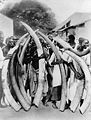 Poaching significantly reduced the population of Loxodonta in certain regions during the 20th century. In the ten years preceding an international ban in the trade in ivory in 1990 the African elephant population was more than halved from 1.3 million to around 600,000. An example of how the ivory trade causes poaching pressure is in the eastern region of Chad—elephant herds where as recently as 1970 there was an estimated population of 400,000; however, by 2006 the number had dwindled to about 10,000. The African elephant nominally has governmental protection, but poaching
for the ivory trade
can devastate populations. Kenya was one of the worst affected countries with populations declining by as much as 85 percent between 1973 and 1989.
Protection of African elephants has become high profile in many countries. The Kenyan wildlife service burnt a stockpile of tusks in protest against the ivory trade. But a number of states still permit sport hunting of elephants. A major issue in elephant conservation is the conflicts between elephants and a growing human population. Human encroachment into or adjacent to natural areas where bush elephants occur has led to recent research into methods of safely driving groups of elephants away from humans, including the discovery that playback of the recorded sounds of angry honey bees is remarkably effective at prompting elephants to flee an area.
The International Union for Conservation of Nature (IUCN) African elephant specialist group has set up a human elephant conflict working group to look at conserving a species that has potential to be detrimental to human populations. They believe that different approaches are needed in different countries and regions, and so develop conservation strategies at National and Regional levels.
Elephant
Elephants are large land mammals in two extant genera of the family Elephantidae: Elephas and Loxodonta, with the third genus Mammuthus extinct...
s in the genus
Genus
In biology, a genus is a low-level taxonomic rank used in the biological classification of living and fossil organisms, which is an example of definition by genus and differentia...
Loxodonta (Greek for 'oblique-sided tooth'), one of the two existing genera in Elephantidae
Elephantidae
Elephantidae is a taxonomic family, collectively elephants and mammoths. These are terrestrial large mammals with a trunk and tusks. Most genera and species in the family are extinct...
. Although it is commonly believed that the genus was named by Georges Cuvier
Georges Cuvier
Georges Chrétien Léopold Dagobert Cuvier or Jean Léopold Nicolas Frédéric Cuvier , known as Georges Cuvier, was a French naturalist and zoologist...
in 1825, Cuvier spelled it Loxodonte. An anonymous author romanized the spelling to Loxodonta and the International Code of Zoological Nomenclature
International Code of Zoological Nomenclature
The International Code of Zoological Nomenclature is a widely accepted convention in zoology that rules the formal scientific naming of organisms treated as animals...
(ICZN) recognizes this as the proper authority.
Fossil
Fossil
Fossils are the preserved remains or traces of animals , plants, and other organisms from the remote past...
members of Loxodonta have only been found in Africa
Africa
Africa is the world's second largest and second most populous continent, after Asia. At about 30.2 million km² including adjacent islands, it covers 6% of the Earth's total surface area and 20.4% of the total land area...
, where they developed in the middle Pliocene
Pliocene
The Pliocene Epoch is the period in the geologic timescale that extends from 5.332 million to 2.588 million years before present. It is the second and youngest epoch of the Neogene Period in the Cenozoic Era. The Pliocene follows the Miocene Epoch and is followed by the Pleistocene Epoch...
.
Description
The African elephant is the largest living terrestrial animal. Its thickset body rests on stocky legs and it has a concave back. Its large ears enable heat loss. Its upper lip and nose forms a trunk. The trunk acts as a fifth limb, a sound amplifier and an important method of touch. The African elephant's trunk ends in two opposing lips, whereas the Asian elephantAsian Elephant
The Asian or Asiatic elephant is the only living species of the genus Elephas and distributed in Southeast Asia from India in the west to Borneo in the east. Three subspecies are recognized — Elephas maximus maximus from Sri Lanka, the Indian elephant or E. m. indicus from mainland Asia, and E. m....
trunk ends in a single lip. African elephants are bigger than Asian elephants. Males stand 3.2–4 m (10.5–13.1 ft) tall at the shoulder and weigh 4700–6048 kg (10,361.7–13,333.6 lb), while females stand 2.2–2.6 m (7.2–8.5 ft) tall and weigh 2160–3232 kg (4,762–7,125.3 lb).
The largest individual recorded stood four metres to the shoulders and weighed ten tonnes.
Teeth
Elephants have four molars; each weighs about 5 kg (11 lb) and measures about 30 cm (11.8 in) long. As the front pair wears down and drops out in pieces, the back pair shifts forward, and two new molars emerge in the back of the mouth. Elephants replace their teeth six times. At about 40 to 60 years of age, the elephant no longer has teeth and will likely die of starvation, a common cause of death.Their tusks are teeth; the second set of incisors become the tusks. They are used for digging for roots and stripping the bark off trees for food, for fighting each other during mating season, and for defending themselves against predators. The tusks weigh from 23–45 kg (50.7–99.2 lb) and can be from 1.5–2.4 m (4.9–7.9 ft) long. Unlike Asian elephants, both male and female African elephants have tusks. They are curved forward and
continue to grow throughout the elephant's lifetime. The enamel plates
Tooth enamel
Tooth enamel, along with dentin, cementum, and dental pulp is one of the four major tissues that make up the tooth in vertebrates. It is the hardest and most highly mineralized substance in the human body. Tooth enamel is also found in the dermal denticles of sharks...
of the molars are fewer in number than in Asian elephants.
Distribution and habitat
The African elephant can be found in Eastern Southern and West Africa, either in dense forestForest
A forest, also referred to as a wood or the woods, is an area with a high density of trees. As with cities, depending where you are in the world, what is considered a forest may vary significantly in size and have various classification according to how and what of the forest is composed...
s, mopane and miombo woodland
Woodland
Ecologically, a woodland is a low-density forest forming open habitats with plenty of sunlight and limited shade. Woodlands may support an understory of shrubs and herbaceous plants including grasses. Woodland may form a transition to shrubland under drier conditions or during early stages of...
s, Sahelian scrub
Scrub
Scrub or Scrubber may refer to:* Scrub, low shrub and grass characteristic of scrubland* Scrubs , worn by medical staff* Scrubs , an American television program...
or desert
Desert
A desert is a landscape or region that receives an extremely low amount of precipitation, less than enough to support growth of most plants. Most deserts have an average annual precipitation of less than...
s.
Classification
- African bush elephantAfrican Bush ElephantThe African Bush Elephant or African Savanna Elephant is the larger of the two species of African elephant. Both it and the African Forest Elephant have usually been classified as a single species, known simply as the African Elephant...
(Loxodonta africana). - African forest elephantAfrican Forest ElephantThe African Forest Elephant is a forest dwelling elephant of the Congo Basin. Formerly considered either a synonym or a subspecies of the African Savanna Elephant , a 2010 study established that the two are distinct species...
(Loxodonta cyclotis). - Loxodonta adauroraLoxodonta adauroraLoxodonta adaurora is an extinct species of elephant in the Loxodonta genus, that of the African elephants. Fossils of Loxodonta adaurora have only been found in Africa, where they developed in the Pliocene. It is presumed to be the genetic antecedent of the two modern African elephant species....
, extinct, presumed antecedent of the modern African elephants. - Loxodonta atlantica, extinct.
- Loxodonta exaptata, extinct.
- North African elephantNorth African ElephantThe North African Elephant was a possible subspecies of the African Bush Elephant , or possibly a separate elephant species, that existed in North Africa until becoming extinct in Ancient Roman times. These were the famous war elephants used by Carthage in the Punic Wars, their conflict with the...
(Loxodonta africana pharaoensis), extinct. Presumed subspecies north of the Sahara from the Atlas to Ethiopia.
Bush and forest elephants were formerly considered subspecies
Subspecies
Subspecies in biological classification, is either a taxonomic rank subordinate to species, ora taxonomic unit in that rank . A subspecies cannot be recognized in isolation: a species will either be recognized as having no subspecies at all or two or more, never just one...
of the same species Loxodonta africana. As described in the entry for the forest elephant in the third edition of Mammal Species of the World
Mammal Species of the World
Mammal Species of the World, now in its 3rd edition, is a standard reference work in zoology giving descriptions and bibliographic data for the known species of mammals.An updated Third Edition of Mammal Species of the World was published late in 2005:...
(MSW3), there is now morphological and genetic evidence they should be considered as separate species.
Much of the evidence cited in MSW3 is morphological. The African forest elephant has a longer and narrower mandible, rounder ears, a different number of toenails, straighter and downward tusks, and considerably smaller size. With regard to the number of toenails: the African bush elephant normally has four toenails on the front foot and three on the hind feet, the African forest elephant normally has five toenails on the front foot and four on the hind foot (like the Asian elephant), but hybrids between the two species commonly occur.
MSW3 lists the two forms as full species and does not list any subspecies in its entry for Loxodonta africana. However, this approach is not taken by the United Nations Environment Programme
United Nations Environment Programme
The United Nations Environment Programme coordinates United Nations environmental activities, assisting developing countries in implementing environmentally sound policies and practices. It was founded as a result of the United Nations Conference on the Human Environment in June 1972 and has its...
's World Conservation Monitoring Centre
World Conservation Monitoring Centre
The United Nations Environment Programme's World Conservation Monitoring Centre is an executive agency of the United Nations Environment Programme, based in Cambridge in the United Kingdom. UNEP-WCMC has been part of UNEP since 2000, and has responsibility for biodiversity assessment and support...
nor by the International Union for Conservation of Nature (IUCN), both of which list L. cyclotis as a synonym (not even a subspecies) of L.africana.
A consequence of the IUCN taking this view is that the IUCN Red List
IUCN Red List
The IUCN Red List of Threatened Species , founded in 1963, is the world's most comprehensive inventory of the global conservation status of biological species. The International Union for Conservation of Nature is the world's main authority on the conservation status of species...
makes no independent assessment of the conservation status of the two forms of African elephant. It merely assesses the two forms taken together as a unit as vulnerable
Vulnerable species
On 30 January 2010, the IUCN Red List of Threatened Species identified 9694 Vulnerable species, subspecies and varieties, stocks and sub-populations.-References:...
.
A study of nuclear DNA sequences published in 2010 indicated that the divergence date between forest and savanna elephants is 2.6–5.6 million years ago, which is virtually the same as the divergence date estimated between the Asian elephant and woolly mammoth
Woolly mammoth
The woolly mammoth , also called the tundra mammoth, is a species of mammoth. This animal is known from bones and frozen carcasses from northern North America and northern Eurasia with the best preserved carcasses in Siberia...
s (2.5–5.4 million years ago), strongly supporting their status as separate species. Forest elephants were found to have a high degree of genetic diversity, perhaps reflecting periodic fragmentation of their habitat during the climatic changes of the Pleistocene
Pleistocene
The Pleistocene is the epoch from 2,588,000 to 11,700 years BP that spans the world's recent period of repeated glaciations. The name pleistocene is derived from the Greek and ....
.
Behavior
African elephant society is arranged around family units. In each family unit are around ten individuals made up of closely related females and their calves. Each family unit is led by an old female known as the matriarch. When separate family units bond, they form kinship groups or bond groups. After pubertyPuberty
Puberty is the process of physical changes by which a child's body matures into an adult body capable of reproduction, as initiated by hormonal signals from the brain to the gonads; the ovaries in a girl, the testes in a boy...
, male elephants tend to form alliances with other males.
Elephants are at their most fertile
Fertility
Fertility is the natural capability of producing offsprings. As a measure, "fertility rate" is the number of children born per couple, person or population. Fertility differs from fecundity, which is defined as the potential for reproduction...
between the ages of 25 and 45. Calves are born after a gestation
Gestation
Gestation is the carrying of an embryo or fetus inside a female viviparous animal. Mammals during pregnancy can have one or more gestations at the same time ....
period of nearly two years. They are cared for by their mother and other young females in the group, known as allomothers.
Elephants use some vocalisations that are beyond the hearing range of humans, to communicate across large distances.
Feeding
African elephants can eat up to 450 kilograms of vegetation per day though their digestive system is not very efficient and only 40% of this food is properly digested. They use their trunk to pluck at leaves and their tusks to tear at branches, which can cause enormous damage.Intelligence
African elephants are highly intelligent, and they have a very large and highly convoluted neocortexNeocortex
The neocortex , also called the neopallium and isocortex , is a part of the brain of mammals. It is the outer layer of the cerebral hemispheres, and made up of six layers, labelled I to VI...
, a trait also shared by humans, apes and certain dolphin
Dolphin
Dolphins are marine mammals that are closely related to whales and porpoises. There are almost forty species of dolphin in 17 genera. They vary in size from and , up to and . They are found worldwide, mostly in the shallower seas of the continental shelves, and are carnivores, mostly eating...
species. They are amongst the world's most intelligent species. With a mass of just over 5 kg (11 lb), elephant brains are larger than those of any other land animal, and although the largest whale
Whale
Whale is the common name for various marine mammals of the order Cetacea. The term whale sometimes refers to all cetaceans, but more often it excludes dolphins and porpoises, which belong to suborder Odontoceti . This suborder also includes the sperm whale, killer whale, pilot whale, and beluga...
s have body masses twenty-fold those of a typical elephant
Elephant
Elephants are large land mammals in two extant genera of the family Elephantidae: Elephas and Loxodonta, with the third genus Mammuthus extinct...
, whale brains are barely twice the mass of an elephant's brain. The elephant's brain is similar to that of humans in terms of structure and complexity - such as the elephant's cortex
Cerebral cortex
The cerebral cortex is a sheet of neural tissue that is outermost to the cerebrum of the mammalian brain. It plays a key role in memory, attention, perceptual awareness, thought, language, and consciousness. It is constituted of up to six horizontal layers, each of which has a different...
having as many neurons as a human brain, suggesting convergent evolution
Convergent evolution
Convergent evolution describes the acquisition of the same biological trait in unrelated lineages.The wing is a classic example of convergent evolution in action. Although their last common ancestor did not have wings, both birds and bats do, and are capable of powered flight. The wings are...
.
Elephants exhibit a wide variety of behaviors, including those associated with grief
Grief
Grief is a multi-faceted response to loss, particularly to the loss of someone or something to which a bond was formed. Although conventionally focused on the emotional response to loss, it also has physical, cognitive, behavioral, social, and philosophical dimensions...
, learning, allomothering
Allomothering
Allomothering, or non-maternal infant care, can be performed by males such as a child’s father, non-reproductive males in polyandrous systems, or older siblings interested in abetting their own genetic material via their siblings ....
, mimicry, art
Art
Art is the product or process of deliberately arranging items in a way that influences and affects one or more of the senses, emotions, and intellect....
, play, a sense of humor, altruism
Altruism
Altruism is a concern for the welfare of others. It is a traditional virtue in many cultures, and a core aspect of various religious traditions, though the concept of 'others' toward whom concern should be directed can vary among cultures and religions. Altruism is the opposite of...
, use of tools, compassion
Compassion
Compassion is a virtue — one in which the emotional capacities of empathy and sympathy are regarded as a part of love itself, and a cornerstone of greater social interconnection and humanism — foundational to the highest principles in philosophy, society, and personhood.There is an aspect of...
, cooperation
Cooperation
Cooperation or co-operation is the process of working or acting together. In its simplest form it involves things working in harmony, side by side, while in its more complicated forms, it can involve something as complex as the inner workings of a human being or even the social patterns of a...
, self-awareness
Self-awareness
Self-awareness is the capacity for introspection and the ability to reconcile oneself as an individual separate from the environment and other individuals...
, memory
Memory
In psychology, memory is an organism's ability to store, retain, and recall information and experiences. Traditional studies of memory began in the fields of philosophy, including techniques of artificially enhancing memory....
and possibly language
Language
Language may refer either to the specifically human capacity for acquiring and using complex systems of communication, or to a specific instance of such a system of complex communication...
. All point to a highly intelligent species that are thought to be equal with cetaceans and primate
Primate
A primate is a mammal of the order Primates , which contains prosimians and simians. Primates arose from ancestors that lived in the trees of tropical forests; many primate characteristics represent adaptations to life in this challenging three-dimensional environment...
s.
Conservation
Poaching
Poaching is the illegal taking of wild plants or animals contrary to local and international conservation and wildlife management laws. Violations of hunting laws and regulations are normally punishable by law and, collectively, such violations are known as poaching.It may be illegal and in...
for the ivory trade
Ivory trade
The ivory trade is the commercial, often illegal trade in the ivory tusks of the hippopotamus, walrus, narwhal, mammoth, and most commonly, Asian and African elephants....
can devastate populations. Kenya was one of the worst affected countries with populations declining by as much as 85 percent between 1973 and 1989.
Protection of African elephants has become high profile in many countries. The Kenyan wildlife service burnt a stockpile of tusks in protest against the ivory trade. But a number of states still permit sport hunting of elephants. A major issue in elephant conservation is the conflicts between elephants and a growing human population. Human encroachment into or adjacent to natural areas where bush elephants occur has led to recent research into methods of safely driving groups of elephants away from humans, including the discovery that playback of the recorded sounds of angry honey bees is remarkably effective at prompting elephants to flee an area.
The International Union for Conservation of Nature (IUCN) African elephant specialist group has set up a human elephant conflict working group to look at conserving a species that has potential to be detrimental to human populations. They believe that different approaches are needed in different countries and regions, and so develop conservation strategies at National and Regional levels.
External links
- Elephant Information Repository - An in-depth resource on elephants
- "Elephant caves" of Mt Elgon National Park
- ElephantVoices - Resource on elephant vocal communications
- Amboseli Trust for Elephants - Interactive web site
- David Quammen: " Family ties - The elephants of Samburu" National Geographic MagazineNational Geographic MagazineNational Geographic, formerly the National Geographic Magazine, is the official journal of the National Geographic Society. It published its first issue in 1888, just nine months after the Society itself was founded...
September 2008 link - EIA 25 yrs investigating the ivory trade, reports etc
- EIA (in the USA) reports etc
- International Elephant Foundation