

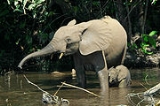
African Forest Elephant

Encyclopedia
The African Forest Elephant (Loxodonta cyclotis) is a forest dwelling elephant
of the Congo Basin
. Formerly considered either a synonym or a subspecies
of the African Savanna Elephant (Loxodonta africana), a 2010 study established that the two are distinct species. The disputed Pygmy Elephant
s of the Congo basin
, often assumed to be a separate species (Loxodonta pumilio) by cryptozoologists
, are probably Forest Elephants whose diminutive size and/or early maturity is due to environmental conditions.
Differences include the African Forest Elephant's long, narrow mandible
(the African Bush Elephant's is short and wide), its rounded ears (an African Bush Elephant's ears are more pointed), straighter and downward tusk
s, considerably smaller size, and number of toenails. The male African Forest Elephant rarely exceeds 2.5 metres (8 ft) in height, while the African Bush Elephant is usually over 3 metres (just under 10 feet) and sometimes almost 4 metres (13 ft) tall. With regard to the number of toenails: the African Bush Elephant normally has 4 toenails on the frontfoot and 3 on the hindfoot, the African Forest Elephant normally has 5 toenails on the frontfoot and 4 on the hindfoot (like the Asian elephant), but hybrids between the two species occur. The African Forest Elephant is a herbivore
and commonly eats leaves
, fruit
, and bark
, with occasional visits to mineral licks. They eat a high proportion of fruit and are sometimes the only disperser of some tree species such as Balanites wilsoniana and Omphalocarpum spp.
Owing to poaching
and the high demand for ivory
, the African Forest Elephant population approached critical levels in the 1990s and early 2000s. Late in the 20th century, conservation workers established a DNA identification system to trace the origin of poached ivory. It had long been known that the ivory of the African Forest Elephant was particularly hard, with a pinkish tinge, and straight (whereas that of the African Bush Elephant is curved). The DNA
tests, however, indicated that the two populations were much more different than previously appreciated — indeed, in its genetic makeup, the African Forest Elephant is almost two-thirds as distinct from the African Bush Elephant as the Asian Elephant is.
Elephant
Elephants are large land mammals in two extant genera of the family Elephantidae: Elephas and Loxodonta, with the third genus Mammuthus extinct...
of the Congo Basin
Congo Basin
The Congo Basin is the sedimentary basin that is the drainage of the Congo River of west equatorial Africa. The basin begins in the highlands of the East African Rift system with input from the Chambeshi River, the Uele and Ubangi Rivers in the upper reaches and the Lualaba River draining wetlands...
. Formerly considered either a synonym or a subspecies
Subspecies
Subspecies in biological classification, is either a taxonomic rank subordinate to species, ora taxonomic unit in that rank . A subspecies cannot be recognized in isolation: a species will either be recognized as having no subspecies at all or two or more, never just one...
of the African Savanna Elephant (Loxodonta africana), a 2010 study established that the two are distinct species. The disputed Pygmy Elephant
Pygmy Elephant
So-called pygmy elephants are reported to be living in both Africa and Asia. The African pygmy elephant, formerly described as "Loxodonta pumilio", is currently considered to be a tiny morph of the African Forest Elephant So-called pygmy elephants are reported to be living in both Africa and Asia....
s of the Congo basin
Congo Basin
The Congo Basin is the sedimentary basin that is the drainage of the Congo River of west equatorial Africa. The basin begins in the highlands of the East African Rift system with input from the Chambeshi River, the Uele and Ubangi Rivers in the upper reaches and the Lualaba River draining wetlands...
, often assumed to be a separate species (Loxodonta pumilio) by cryptozoologists
Cryptozoology
Cryptozoology refers to the search for animals whose existence has not been proven...
, are probably Forest Elephants whose diminutive size and/or early maturity is due to environmental conditions.
Differences include the African Forest Elephant's long, narrow mandible
Mandible
The mandible pronunciation or inferior maxillary bone forms the lower jaw and holds the lower teeth in place...
(the African Bush Elephant's is short and wide), its rounded ears (an African Bush Elephant's ears are more pointed), straighter and downward tusk
Tusk
Tusks are elongated, continuously growing front teeth, usually but not always in pairs, that protrude well beyond the mouth of certain mammal species. They are most commonly canines, as with warthogs, wild boar, and walruses, or, in the case of elephants and narwhals, elongated incisors...
s, considerably smaller size, and number of toenails. The male African Forest Elephant rarely exceeds 2.5 metres (8 ft) in height, while the African Bush Elephant is usually over 3 metres (just under 10 feet) and sometimes almost 4 metres (13 ft) tall. With regard to the number of toenails: the African Bush Elephant normally has 4 toenails on the frontfoot and 3 on the hindfoot, the African Forest Elephant normally has 5 toenails on the frontfoot and 4 on the hindfoot (like the Asian elephant), but hybrids between the two species occur. The African Forest Elephant is a herbivore
Herbivore
Herbivores are organisms that are anatomically and physiologically adapted to eat plant-based foods. Herbivory is a form of consumption in which an organism principally eats autotrophs such as plants, algae and photosynthesizing bacteria. More generally, organisms that feed on autotrophs in...
and commonly eats leaves
Leaves
-History:Vocalist Arnar Gudjonsson was formerly the guitarist with Mower, and he was joined by Hallur Hallsson , Arnar Ólafsson , Bjarni Grímsson , and Andri Ásgrímsson . Late in 2001 they played with Emiliana Torrini and drew early praise from the New York Times...
, fruit
Fruit
In broad terms, a fruit is a structure of a plant that contains its seeds.The term has different meanings dependent on context. In non-technical usage, such as food preparation, fruit normally means the fleshy seed-associated structures of certain plants that are sweet and edible in the raw state,...
, and bark
Bark
Bark is the outermost layers of stems and roots of woody plants. Plants with bark include trees, woody vines and shrubs. Bark refers to all the tissues outside of the vascular cambium and is a nontechnical term. It overlays the wood and consists of the inner bark and the outer bark. The inner...
, with occasional visits to mineral licks. They eat a high proportion of fruit and are sometimes the only disperser of some tree species such as Balanites wilsoniana and Omphalocarpum spp.
Owing to poaching
Poaching
Poaching is the illegal taking of wild plants or animals contrary to local and international conservation and wildlife management laws. Violations of hunting laws and regulations are normally punishable by law and, collectively, such violations are known as poaching.It may be illegal and in...
and the high demand for ivory
Ivory
Ivory is a term for dentine, which constitutes the bulk of the teeth and tusks of animals, when used as a material for art or manufacturing. Ivory has been important since ancient times for making a range of items, from ivory carvings to false teeth, fans, dominoes, joint tubes, piano keys and...
, the African Forest Elephant population approached critical levels in the 1990s and early 2000s. Late in the 20th century, conservation workers established a DNA identification system to trace the origin of poached ivory. It had long been known that the ivory of the African Forest Elephant was particularly hard, with a pinkish tinge, and straight (whereas that of the African Bush Elephant is curved). The DNA
DNA
Deoxyribonucleic acid is a nucleic acid that contains the genetic instructions used in the development and functioning of all known living organisms . The DNA segments that carry this genetic information are called genes, but other DNA sequences have structural purposes, or are involved in...
tests, however, indicated that the two populations were much more different than previously appreciated — indeed, in its genetic makeup, the African Forest Elephant is almost two-thirds as distinct from the African Bush Elephant as the Asian Elephant is.
External links
- BBC Wildlife Finder - video clips from the BBC archive
- ARKive - Images and movies of the forest elephant (Loxodonta cyclotis)
- PBS Nature: Tracking Forest Elephants
- Forest Elephant Program
- Elephant Information Repository - An in-depth resource on elephants
- The Elephant Listening Project - Information on forest elephants and their vocalizations.