

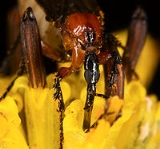
Love bug

Encyclopedia
The lovebug, Plecia nearctica, is a member of the family
of march flies
. It is also known as the honeymoon fly, kissingbug, or double-headedbug. The adult is a small, flying insect
common to parts of Central America
and the southeastern United States
, especially along the Gulf Coast. During and after mating, adult pairs remain coupled, even in flight, for up to several days.
The lovebug was first described in 1940 by D. E. Hardy
from Galveston
, Texas
. At that time, he reported the incidence of lovebugs to be widespread, but most common in Texas and Louisiana
. However, by the end of the 20th century the species had spread heavily to all areas bordering the Gulf of Mexico
, as well as Georgia
, and South Carolina
. L. A. Hetrick, writing in 1970, found it very widespread in central and northern Florida
and described its flights as reaching altitudes of 300 to 450 m (984.3 to 1,476.4 ) and extending several kilometers over the Gulf. In 2006, it was reported as far north as Wilmington
, North Carolina
.
The larva
e (maggot
s) feed on partially decayed vegetation in the landscape and, in this respect, are beneficial. Adults feed only on nectar during their brief lifespan.
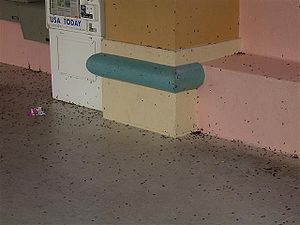 This species' reputation as a public nuisance is due not to any bite or sting (it is incapable of either), but to its slightly acid
ic body chemistry. Because airborne lovebugs can exist in enormous numbers near highways, they die en masse on automobile
windshields, hoods, and radiator grills when the vehicles travel at high speeds. If left for more than an hour or two, the remains become dried and extremely difficult to remove. Their body chemistry has a nearly neutral 6.5 pH
but may become acidic at 4.25 pH if left on the car for a day. In the past, the acidity of the dead adult body, especially the female's egg masses, often resulted in pits and etches in automotive paint and chrome if not quickly removed. However, advances in automotive paints and protective coatings have reduced this threat significantly. Now the greatest concern is excessive clogging of vehicle radiator air passages with the bodies of the adults, with the reduction of the cooling effect on engines, and the obstruction of windshields when the remains of the adults and egg masses are smeared on the glass.
Lovebug adults are attracted to light-colored surfaces, especially if they are freshly painted, but the adults can congregate almost anywhere by reacting to the effects of sunlight on automobile fumes, asphalt, and other products affected by environmental factors still not completely understood.
genetics
experiment gone wrong.
Much speculation about the lovebug still thrives. This is partly because the immature stage of this insect is an unseen factor, where it lives and feeds in the thatch of grasses for most of the year. As a result, most scientists are not as concerned with the details of this insect's life cycle, biology, and other facets of its existence as they are with more serious pests. While various fungi are known or suspected of being natural controls for this species, time and funding do not allow for more study, except as a side interest.
Research of L. L. Buschman showed that migration explained the introduction of the lovebug into Florida and other southeastern states, contrary to the urban myth that the University of Florida created them by manipulating DNA
to control mosquito populations.
are usually not far behind. While it often took decades, lovebug flights are no longer present in the huge numbers that once existed simply because their natural controls (mostly fungi) caught up with established populations. In many areas, local lovebug flights may only be present in excessively large numbers due to occasional local conditions that may not be repeated in successive years.
While lovebugs are not a favored food of most insectivore
s due to their acidic taste, lovebug larvae—and some adults—are food for birds such as quail
and robins
. Arthropod predators include spiders, some predatory insects such as earwig
s and at least two species of beetle larvae, and a centipede
.
Family (biology)
In biological classification, family is* a taxonomic rank. Other well-known ranks are life, domain, kingdom, phylum, class, order, genus, and species, with family fitting between order and genus. As for the other well-known ranks, there is the option of an immediately lower rank, indicated by the...
of march flies
Bibionidae
Bibionidae is a family of flies . Approximately 650-700 species are known worldwide.-Biology:...
. It is also known as the honeymoon fly, kissingbug, or double-headedbug. The adult is a small, flying insect
Insect
Insects are a class of living creatures within the arthropods that have a chitinous exoskeleton, a three-part body , three pairs of jointed legs, compound eyes, and two antennae...
common to parts of Central America
Central America
Central America is the central geographic region of the Americas. It is the southernmost, isthmian portion of the North American continent, which connects with South America on the southeast. When considered part of the unified continental model, it is considered a subcontinent...
and the southeastern United States
United States
The United States of America is a federal constitutional republic comprising fifty states and a federal district...
, especially along the Gulf Coast. During and after mating, adult pairs remain coupled, even in flight, for up to several days.
The lovebug was first described in 1940 by D. E. Hardy
D. Elmo Hardy
Dilbert Elmo Hardy was an American entomologist who specialized in Diptera systematics.-Career:In over 70 years of research Hardy published 437 articles and notes in which he named and described nearly 2,000 species in 34 different families of Diptera...
from Galveston
Galveston, Texas
Galveston is a coastal city located on Galveston Island in the U.S. state of Texas. , the city had a total population of 47,743 within an area of...
, Texas
Texas
Texas is the second largest U.S. state by both area and population, and the largest state by area in the contiguous United States.The name, based on the Caddo word "Tejas" meaning "friends" or "allies", was applied by the Spanish to the Caddo themselves and to the region of their settlement in...
. At that time, he reported the incidence of lovebugs to be widespread, but most common in Texas and Louisiana
Louisiana
Louisiana is a state located in the southern region of the United States of America. Its capital is Baton Rouge and largest city is New Orleans. Louisiana is the only state in the U.S. with political subdivisions termed parishes, which are local governments equivalent to counties...
. However, by the end of the 20th century the species had spread heavily to all areas bordering the Gulf of Mexico
Gulf of Mexico
The Gulf of Mexico is a partially landlocked ocean basin largely surrounded by the North American continent and the island of Cuba. It is bounded on the northeast, north and northwest by the Gulf Coast of the United States, on the southwest and south by Mexico, and on the southeast by Cuba. In...
, as well as Georgia
Georgia (U.S. state)
Georgia is a state located in the southeastern United States. It was established in 1732, the last of the original Thirteen Colonies. The state is named after King George II of Great Britain. Georgia was the fourth state to ratify the United States Constitution, on January 2, 1788...
, and South Carolina
South Carolina
South Carolina is a state in the Deep South of the United States that borders Georgia to the south, North Carolina to the north, and the Atlantic Ocean to the east. Originally part of the Province of Carolina, the Province of South Carolina was one of the 13 colonies that declared independence...
. L. A. Hetrick, writing in 1970, found it very widespread in central and northern Florida
Florida
Florida is a state in the southeastern United States, located on the nation's Atlantic and Gulf coasts. It is bordered to the west by the Gulf of Mexico, to the north by Alabama and Georgia and to the east by the Atlantic Ocean. With a population of 18,801,310 as measured by the 2010 census, it...
and described its flights as reaching altitudes of 300 to 450 m (984.3 to 1,476.4 ) and extending several kilometers over the Gulf. In 2006, it was reported as far north as Wilmington
Wilmington, North Carolina
Wilmington is a port city in and is the county seat of New Hanover County, North Carolina, United States. The population is 106,476 according to the 2010 Census, making it the eighth most populous city in the state of North Carolina...
, North Carolina
North Carolina
North Carolina is a state located in the southeastern United States. The state borders South Carolina and Georgia to the south, Tennessee to the west and Virginia to the north. North Carolina contains 100 counties. Its capital is Raleigh, and its largest city is Charlotte...
.
The larva
Larva
A larva is a distinct juvenile form many animals undergo before metamorphosis into adults. Animals with indirect development such as insects, amphibians, or cnidarians typically have a larval phase of their life cycle...
e (maggot
Maggot
In everyday speech the word maggot means the larva of a fly ; it is applied in particular to the larvae of Brachyceran flies, such as houseflies, cheese flies, and blowflies, rather than larvae of the Nematocera, such as mosquitoes and Crane flies...
s) feed on partially decayed vegetation in the landscape and, in this respect, are beneficial. Adults feed only on nectar during their brief lifespan.
Semi-annual pest status
Lovebug flights can number in the hundreds of thousands. The slow, drifting movement of the insects is almost reminiscent of snow fall except the flies also rise in the air. Two major flights occur each year, first in late spring, then again in late summer. In south Florida, a third (but smaller) flight can occur in December. The spring flight occurs during late April and May, the summer during late August and September. Flights extend over periods of four to five weeks. Mating takes place almost immediately after emergence of the females. Adult females live only three to four days, while males live a little longer.Acid
An acid is a substance which reacts with a base. Commonly, acids can be identified as tasting sour, reacting with metals such as calcium, and bases like sodium carbonate. Aqueous acids have a pH of less than 7, where an acid of lower pH is typically stronger, and turn blue litmus paper red...
ic body chemistry. Because airborne lovebugs can exist in enormous numbers near highways, they die en masse on automobile
Automobile
An automobile, autocar, motor car or car is a wheeled motor vehicle used for transporting passengers, which also carries its own engine or motor...
windshields, hoods, and radiator grills when the vehicles travel at high speeds. If left for more than an hour or two, the remains become dried and extremely difficult to remove. Their body chemistry has a nearly neutral 6.5 pH
PH
In chemistry, pH is a measure of the acidity or basicity of an aqueous solution. Pure water is said to be neutral, with a pH close to 7.0 at . Solutions with a pH less than 7 are said to be acidic and solutions with a pH greater than 7 are basic or alkaline...
but may become acidic at 4.25 pH if left on the car for a day. In the past, the acidity of the dead adult body, especially the female's egg masses, often resulted in pits and etches in automotive paint and chrome if not quickly removed. However, advances in automotive paints and protective coatings have reduced this threat significantly. Now the greatest concern is excessive clogging of vehicle radiator air passages with the bodies of the adults, with the reduction of the cooling effect on engines, and the obstruction of windshields when the remains of the adults and egg masses are smeared on the glass.
Lovebug adults are attracted to light-colored surfaces, especially if they are freshly painted, but the adults can congregate almost anywhere by reacting to the effects of sunlight on automobile fumes, asphalt, and other products affected by environmental factors still not completely understood.
Folklore
Urban legend holds that lovebugs are synthetic—the result of a University of FloridaUniversity of Florida
The University of Florida is an American public land-grant, sea-grant, and space-grant research university located on a campus in Gainesville, Florida. The university traces its historical origins to 1853, and has operated continuously on its present Gainesville campus since September 1906...
genetics
Genetics
Genetics , a discipline of biology, is the science of genes, heredity, and variation in living organisms....
experiment gone wrong.
Much speculation about the lovebug still thrives. This is partly because the immature stage of this insect is an unseen factor, where it lives and feeds in the thatch of grasses for most of the year. As a result, most scientists are not as concerned with the details of this insect's life cycle, biology, and other facets of its existence as they are with more serious pests. While various fungi are known or suspected of being natural controls for this species, time and funding do not allow for more study, except as a side interest.
Research of L. L. Buschman showed that migration explained the introduction of the lovebug into Florida and other southeastern states, contrary to the urban myth that the University of Florida created them by manipulating DNA
DNA
Deoxyribonucleic acid is a nucleic acid that contains the genetic instructions used in the development and functioning of all known living organisms . The DNA segments that carry this genetic information are called genes, but other DNA sequences have structural purposes, or are involved in...
to control mosquito populations.
Management
Lovebugs are subject to some significant natural controls, such as various parasitic fungi, and dry weather—which dries out the thatch resulting in a higher mortality rate for the larvae. As the lovebug migrated around the Gulf Coast, first to Texas, then Louisiana, then further eastward, the initial populations for many years were so excessive that they caused public concern and initiated rumors of their origin. However, as pest populations migrate naturally, their natural controlsBiological pest control
Biological control of pests in agriculture is a method of controlling pests that relies on predation, parasitism, herbivory, or other natural mechanisms...
are usually not far behind. While it often took decades, lovebug flights are no longer present in the huge numbers that once existed simply because their natural controls (mostly fungi) caught up with established populations. In many areas, local lovebug flights may only be present in excessively large numbers due to occasional local conditions that may not be repeated in successive years.
While lovebugs are not a favored food of most insectivore
Insectivore
An insectivore is a type of carnivore with a diet that consists chiefly of insects and similar small creatures. An alternate term is entomophage, which also refers to the human practice of eating insects....
s due to their acidic taste, lovebug larvae—and some adults—are food for birds such as quail
New World quail
The New World quails or Odontophorids are small birds only distantly related to the Old World Quails, but named for their similar appearance and habits. The American species are in their own family Odontophoridae, whereas Old World Quail are in the pheasant family Phasianidae...
and robins
American Robin
The American Robin or North American Robin is a migratory songbird of the thrush family. It is named after the European Robin because of its reddish-orange breast, though the two species are not closely related, with the European robin belonging to the flycatcher family...
. Arthropod predators include spiders, some predatory insects such as earwig
Earwig
Earwigs make up the insect order Dermaptera, found throughout the Americas, Africa, Eurasia, Australia and New Zealand. With 1,800 species in 12 families, they are one of the smaller insect orders...
s and at least two species of beetle larvae, and a centipede
Centipede
Centipedes are arthropods belonging to the class Chilopoda of the subphylum Myriapoda. They are elongated metameric animals with one pair of legs per body segment. Despite the name, centipedes can have a varying number of legs from under 20 to over 300. Centipedes have an odd number of pairs of...
.