
Home      Discussion      Topics      Dictionary      Almanac
Signup       Login
Earwig

Earwig

Overview


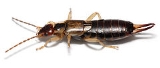
Earwig is the common name given to the insect
Insect
Insects are arthropods, having a hard exoskeleton, a three-part body , three pairs of jointed legs, compound eyes, and two antennae. They are the most diverse group of animals on the planet and include more than a million species that are already described. Insects represent more than half of all...

 order
Order (biology)
In scientific classification used in biology, the order is# a taxonomic rank used in the classification of organisms. Other well-known ranks are life, domain, kingdom, phylum, class, family, genus, and species, with order fitting in between class and family...

 Dermaptera, characterized by membranous wings
Insect wing
Insect wings are outgrowths of the insect exoskeleton that enable insects to fly. They are found on the second and third thoracic segments , and the two pairs are often referred to as the forewings and hindwings, respectively, though a few insects lack hindwings, even rudiments...

 folded underneath short forewings, hence the literal translation of the order being "skin wings". The abdomen
Abdomen
In vertebrates such as mammals the abdomen constitutes the part of the body between the thorax and pelvis. The region enclosed by the abdomen is termed the abdominal cavity...

 extends beyond the wings, and frequently ends in a pair of forceps
Forceps
Forceps are a handheld, hinged instrument used for grasping and holding objects. Forceps are used when fingers are too large to grasp small objects or when many objects need to be held at one time while the hands are used to perform a task. The term forceps is used almost exclusively within the...

-like structures called cerci
Cercus
Cerci are paired appendages on the rear-most segments of many arthropods, including insects and arachnids but not crustaceans. Cerci often serve as sensory organs, but they may also be used as weapons or copulation aids, or they may simply be vestigial structures.Typical cerci may appear to be...

. The order is relatively small among Insecta, with about 1,800 recorded species in 12 families.
Discussion
Ask a question about 'Earwig'
Start a new discussion about 'Earwig'
Answer questions from other users
Full Discussion Forum
 
Encyclopedia


Earwig is the common name given to the insect
Insect
Insects are arthropods, having a hard exoskeleton, a three-part body , three pairs of jointed legs, compound eyes, and two antennae. They are the most diverse group of animals on the planet and include more than a million species that are already described. Insects represent more than half of all...

 order
Order (biology)
In scientific classification used in biology, the order is# a taxonomic rank used in the classification of organisms. Other well-known ranks are life, domain, kingdom, phylum, class, family, genus, and species, with order fitting in between class and family...

 Dermaptera, characterized by membranous wings
Insect wing
Insect wings are outgrowths of the insect exoskeleton that enable insects to fly. They are found on the second and third thoracic segments , and the two pairs are often referred to as the forewings and hindwings, respectively, though a few insects lack hindwings, even rudiments...

 folded underneath short forewings, hence the literal translation of the order being "skin wings". The abdomen
Abdomen
In vertebrates such as mammals the abdomen constitutes the part of the body between the thorax and pelvis. The region enclosed by the abdomen is termed the abdominal cavity...

 extends beyond the wings, and frequently ends in a pair of forceps
Forceps
Forceps are a handheld, hinged instrument used for grasping and holding objects. Forceps are used when fingers are too large to grasp small objects or when many objects need to be held at one time while the hands are used to perform a task. The term forceps is used almost exclusively within the...

-like structures called cerci
Cercus
Cerci are paired appendages on the rear-most segments of many arthropods, including insects and arachnids but not crustaceans. Cerci often serve as sensory organs, but they may also be used as weapons or copulation aids, or they may simply be vestigial structures.Typical cerci may appear to be...

. The order is relatively small among Insecta, with about 1,800 recorded species in 12 families. Earwigs are found in the Americas
Americas
The Americas, or America, are lands in the Western hemisphere or New World, comprising the continents of North America and South America with their associated islands and regions. America may be ambiguous in English, as it is more commonly used to refer to the United States of America...

 and Europe
Europe
Europe is, by convention, one of the world's seven continents. Comprising the westernmost peninsula of Eurasia, Europe is generally divided from Asia to its east by the water divide of the Ural Mountains, the Ural River, the Caspian Sea, the Caucasus Mountains , and the Black Sea to the southeast...

. There is no evidence that they transmit disease to humans or other animals.

Etymology


The scientific name
Biological classification
Biological classification or scientific classification in biology, is a method by which biologists group and categorize organisms by biological type, such as genus or species. Biological classification is a form of scientific taxonomy, but should be distinguished from folk taxonomy, which lacks...

 for the order, Dermaptera, is Greek
Ancient Greek
Ancient Greek is the historical stage in the development of the Greek language spanning across the Archaic , Classical , and Hellenistic periods of ancient Greece and the ancient world. It is predated in the 2nd millennium BC by Mycenaean Greek...

 in origin, stemming from the words dermatos, meaning skin, and pteron, or wing. It was coined by Charles De Geer
Charles De Geer
Baron Charles de Geer was a Swedish industrialist and entomologist.- Life :...

 in 1773. The far more common term, earwig, is derived from the Old English
Old English language
Old English , also called Anglo-Saxon, is an early form of the English language that was spoken and written in parts of what are now England and south-eastern Scotland between at least the mid-5th century and the mid-12th century. What survives through writing represents primarily the literary...

 ēare, which means "ear", and wicga, which means "insect." The name comes from the old wives' tale
Old wives' tale
An old wives' tale is a type of urban legend, similar to a proverb, which is generally passed down by old wives to a younger generation. Such 'tales' usually consist of superstition, folklore or unverified claims with exaggerated and/or untrue details....

 that earwigs burrowed into the brains of humans through the ear and therein lay their eggs.

Wicga is in turn related to wiggle, and ultimately to other words implying movement, including way and vehicle, all from PIE
Proto-Indo-European language
The Proto-Indo-European language is the unattested, reconstructed common ancestor of the Indo-European languages, spoken by the Proto-Indo-Europeans. The existence of such a language has been accepted by linguists for over a century, and there have been many attempts at reconstruction...

 *wegh-. Other languages have words based on the same premises: German
German language
German is a West Germanic language, thus related to and classified alongside English and Dutch. It is one of the world's major languages and the most widely spoken first language in the European Union. Around the world, German is spoken by approximately 105 million native speakers and also by...

 Ohrenkneifer, Ohrwurm, or Ohrenhöhler; Dutch
Dutch language
Dutch is a West Germanic language spoken by over 22 million people as a native language, and over 5 million people as a second language.
"1% of the EU population claims to speak Dutch well enough in order to have a conversation." Outside the European Union the number of second language...

 oorwormen or oorwurmen; French
French language
French is a Romance language globally spoken by about 65 million people as a first language , by 50 million as a second language, and by about another 200 million people as an acquired foreign language, with significant speakers in 57 countries. Most native speakers of the language live in France,...

 perce-oreille; Danish
Danish language
Danish is one of the North Germanic languages , a sub-group of the Germanic branch of the Indo-European languages. It is spoken by around 6 million people, mainly in Denmark; the language is also used by the 50,000 Danes in the northern parts of Schleswig-Holstein in Germany where it holds the...

 ørentviste; Slovak
Slovak language
The Slovak language , is an Indo-European language that belongs to the West Slavic languages ....

 ucholak (ucho = ear, lak = scare); Romanian
Romanian language
Romanian or Daco-Romanian is a Romance language spoken by around 24 to 28 million people, primarily in Romania and Moldova. It has official status in Romania, Republic of Moldova, and the Autonomous Province of Vojvodina in Serbia...

 urechelniță; and Hungarian
Hungarian language
Hungarian is a Uralic language unrelated to most other languages in Europe. It is mainly spoken in Hungary and by the Hungarian minorities in the seven neighbouring countries...

 fülbemászó ("crawler-into-the-ear"). English has derived a verb from this, to earwig, meaning "to fill someone's mind with prejudice
Prejudice
A prejudice is a preconceived belief, opinion or judgment especially toward a group of people characterized by their race, social class, gender, ethnicity, sexual orientation, age or religion...

 by insinuations" or "to attempt to influence by persistent confidential argument
Argument
* In logic, an argument is a set of one or more meaningful declarative sentences known as the premises along with another meaningful declarative sentence known as the conclusion...

 or talk".

The German word Ohrwurm has the derived meaning of earworm
Earworm
Earworm, a loan translation of the German Ohrwurm, is a term for a portion of a song or other musical material that repeats compulsively within one's mind, known colloquially as "music being stuck in one's head". Use of the English translation was popularized by James Kellaris and Daniel Levitin...

. Hungarian also uses the phrase fülbemászó dallam, meaning "a catchy melody".
Some dialects of Swedish
Swedish language
Swedish is a North Germanic language, spoken by approximately 10 million people, predominantly in Sweden and parts of Finland, especially along the coast and on the Åland islands. It is to a considerable extent mutually intelligible with Norwegian and to a lesser extent with Danish...

 have related names for the earwig, but standard Swedish, by contrast, uses the word tvestjärt, which translates as "two-tail", not unlike the Geordie
Geordie
Geordie is a regional nickname for a person from the Tyneside region of England, or the name of the dialect of English spoken by these people. Depending on who is using the term, the catchment area for Geordie can be used for some parts of the north east of England, or as small as the city of...

 forkytail.

Characteristics


Most earwigs are elongated, flattened, and are dark brown. Lengths are mostly in the quarter- to half-inch range (10–14 mm), with the Saint Helena earwig reaching three inches long (80 mm). Cerci range from nonexistent to long arcs up to one-third as long as the rest of the body. Their mouthparts are designed for chewing, as in other orthopteroid
Orthopteroid
The term orthopteroid is used to denote insects which historically would have been included in the order Orthoptera. When Linnaeus started the system for classifying animals in 1758 there were very few animals included in the scheme, and consequently very few groups...

 insects. Flight capability in Dermaptera is varied, as there are species with and without wings. In those earwigs that have wings (are not apterous
Aptery
Aptery is the anatomical condition of an animal completely lacking any kind of wings. An animal with this condition is said to be apterous.Most animal species belong to and are phylogenetic descendants of apterous taxa...

), the hindwings are folded in a complex fashion, so that they fit under the forewings. Most species of winged earwigs are capable of flight, yet they rarely do.

The abdomen of the earwig is flexible and muscular. It is capable of maneuvering as well as opening and closing the forceps. The forceps are used for a variety of purposes. In some species, the forceps have been observed in use for holding prey, and in copulation. The forceps tend to be more curved in males than in females.

Behavior


Most earwigs found in Europe and North America are of the species
Species
In biology, a species is:* a taxonomic rank or* a unit at that rank ....

 Forficula auricularia
Forficula auricularia
Forficula auricularia, the Common earwig or European earwig, is an omnivorous insect in the family Forficulidae. The European earwig is a common household pest in North America. Though they frighten many, they are harmless but tend to take up habitation within the home...

, the European or common earwig, which is distributed throughout the cooler parts of the northern hemisphere. This species feeds on other arthropod
Arthropod
An arthropod is an invertebrate that has an exoskeleton , a segmented body, and jointed attachments called appendages. Arthropods are animals belonging to the Phylum Arthropoda , and include the insects, arachnids, crustaceans, and others...

s, plants, ripe fruit, and garbage. Plants that they feed on typically include clover
Clover
Clover , or trefoil, is a genus of about 300 species of plants in the pea family Fabaceae. The genus has a cosmopolitan distribution; the highest diversity is found in the temperate Northern Hemisphere, but many species also occur in South America and Africa, including at high altitudes on...

, dahlia
Dahlia
Dahlia is a genus of bushy, tuberous, perennial plants native to Mexico, Central America, and Colombia. There are at least 36 species of dahlia. Dahlia hybrids are commonly grown as garden plants. The Aztecs gathered and cultivated the dahlia for food, ceremonies, as well as decorative purposes,...

s,zinnia
Zinnia
Zinnia is a genus of 20 species of annual and perennial plants of family Asteraceae, originally from scrub and dry grassland in an area stretching from the American Southwest to South America, but primarily Mexico, and notable for their solitary long-stemmed flowers that come in a variety of bright...

s, butterfly bush, hollyhock
Hollyhock
The hollyhocks comprise about 60 species of flowering plants in the genus Alcea in the mallow family Malvaceae, native to southwest and central Asia...

, lettuce
Lettuce
Lettuce is a temperate annual or biennial plant of the daisy family Asteraceae. It is most often grown as a leaf vegetable. In many countries, it is typically eaten cold, raw, in salads, sandwiches, hamburgers, tacos, and in many other dishes...

, cauliflower
Cauliflower
Cauliflower is one of several vegetables in the species Brassica oleracea, in the family Brassicaceae. It is an annual plant that reproduces by seed. Typically, only the head is eaten while the stalk and surrounding thick, green leaves are used in vegetable broth or discarded...

, strawberry
Strawberry
Fragaria is a genus of flowering plants in the rose family, Rosaceae, commonly known as strawberries for their edible fruits. There are more than 20 described species and many hybrids and cultivars. The most common strawberries grown commercially are cultivars of the Garden strawberry...

,sunflowers, celery
Celery
Apium graveolens is a plant species in the family Apiaceae commonly known as celery or celeriac depending on whether the petioles or roots are eaten.- Taxonomy :...

, peach
Peach
The peach is known as a species of Prunus native to China that bears an edible juicy fruit also called a peach. It is a deciduous tree growing to 4–10 m tall, belonging to the subfamily Prunoideae of the family Rosaceae...

es, plum
Plum
A plum or gage is a stone fruit tree in the genus Prunus, subgenus Prunus. The subgenus is distinguished from other subgenera in the shoots having a terminal bud and the side buds solitary , the flowers being grouped 1-5 together on short stems, and the fruit having a groove running down one side,...

s, grapes, potato
Potato
The potato is a starchy, tuberous crop from the perennial Solanum tuberosum of the Solanaceae family . The word potato may refer to the plant itself as well. In the region of the Andes, there are some other closely related cultivated potato species. Potatoes are the world's fourth largest food...

es, rose
Rose
A rose is a perennial flower shrub or vine of the genus Rosa, within the family Rosaceae, that contains over 100 species and comes in a variety of colours. The species form a group of erect shrubs, and climbing or trailing plants, with stems that are often armed with sharp prickles...

s, seedling bean
Bean
Bean is a common name for large plant seeds of several genera of the family Fabaceae used for human food or animal feed....

s and beet
Beet
The beet is a plant in the amaranth family. It is best known in its numerous cultivated varieties, the most well known of which is probably the red root vegetable known as the beetroot or garden beet...

s, and tender grass
Grass
Grasses, or more technically graminoids, are monocotyledonous, usually herbaceous plants with narrow leaves growing from the base. They include the "true grasses", of the Poaceae family, as well as the sedges and the rushes . The true grasses include cereals, bamboo and the grasses of lawns...

 shoots and roots; they have also been known to eat corn
Maize
Maize , is a herbaceous plant domesticated in Mesoamerica and subsequently spread throughout the American continents...

 silk, damaging the corn. Typically they are a nuisance because of their diet, but normally do not present serious hazards to crops. Some tropical species are brightly colored. Occasionally earwigs are confused with cockroach
Cockroach
Cockroaches are insects of the order Blattaria. This name derives from the Latin name for the insect, Blatta....

es because of their cerci and their long antennae.

Earwigs are generally nocturnal, and typically spend the daytime hours hiding in small, dark, and often moist areas. They can usually be seen patrolling household walls and ceilings. Interaction with earwigs at this time results in a defensive free fall to the ground below, and the subsequent scramble to a nearby cleft or crevice. Earwigs are also drawn to damp conditions. During the summer, they can be found around sinks and in bathrooms. Earwigs tend to gather in shady cracks or openings or anywhere that they can remain concealed during daylight hours. Picnic tables, compost and waste bins, patios, lawn furniture, window frames, or anything with minute spaces (even artichoke
Artichoke
A globe artichoke is a partially edible perennial thistle originating in southern Europe around the Mediterranean.Artichoke may also refer to:*Artichoke , a creative company specialising in arts events...

 blossoms) can potentially harbor them. Upon gaining entry to the basement and living areas of the home, earwigs can easily find cover in undisturbed magazine and newspaper piles, furniture/wickerwork, base boards, carpeted stairways, pet food dishes, and even inside DVD cases and keyboards.

The only insect predator that preys on the earwig is the tachinidae
Tachinidae
Tachinidae is a large and rather variable family of true flies within the insect order Diptera, with more than 8,200 known species and many more to be discovered. There are over 1300 species in North America. Insects in this family are commonly called tachina flies or simply tachinids.They occur in...

, or tachinid fly, whose larvae live like parasites in the earwig's body. The eggs and nymphs can also be cannibalized by other earwigs.

Life cycle


Females generally lay eggs in early spring
Spring (season)
Spring is one of the four temperate seasons, the transition period between winter and summer. Its days are close to twelve hours long with increasing day length, as it occurs near the time of an equinox. In the Northern Hemisphere, spring runs from March into May, and in the Southern Hemisphere it...

 or autumn
Autumn
Autumn is one of the four temperate seasons. Autumn marks the transition from summer into winter, usually in March or September when the arrival of night becomes noticeably earlier.The equinoxes might be expected to be in the middle of their seasons, but temperature lag Autumn (also known as...

, in batches of 20 to 100 each, depending on the species. The mother will guard her eggs while they develop, clean them, protect them from predators, and eat fungi that begins to grow on them. The eggs usually incubate for about two weeks before hatching, but this period may last for a longer time if the eggs are laid over winter. When first laid, the eggs are white or cream-colored and oval-shaped, but right before hatching, they become kidney-shaped and brown. Each egg is approximately tall and wide.

About ten days after the nymphs emerge, the mother will cease to care for them. Nymphs are similar in shape to adults, but are noticeably smaller. They are also wingless, and both genders have straight forceps
Forceps
Forceps are a handheld, hinged instrument used for grasping and holding objects. Forceps are used when fingers are too large to grasp small objects or when many objects need to be held at one time while the hands are used to perform a task. The term forceps is used almost exclusively within the...

, even though the males will develop curved forceps later on. Their abdomen
Abdomen
In vertebrates such as mammals the abdomen constitutes the part of the body between the thorax and pelvis. The region enclosed by the abdomen is termed the abdominal cavity...

 consists of ten segments throughout this stage in life, but their antenna
Antenna (biology)
Antennae in biology have historically been paired appendages used for sensing in arthropods and crustaceans. More recently, the term has also been applied to cilium structures present in many cell types of eukaryotes....

 will grow as the nymphs pass through various instar
Instar
An instar is a developmental stage of arthropods, such as insects, between each moult , until sexual maturity is reached. Arthropods must shed the exoskeleton in order to grow or assume a new form. Differences between instars can often be seen in altered body proportions or changes in the number of...

s.

After five to six instars, the nymphs will molt into adults. The adults range from to tall, although this can differ depending on the species. The male's forceps will become curved, while the females remain straight. They will also develop their natural color, which can be anything from a light brown (as in the Tawny earwig) to a dark black (as in the Ringlegged earwig
Ringlegged earwig
Euborellia annulipes, commonly known as the Ringlegged earwig, is a species of earwig in the genus Euborellia, the family Anisolabididae, the suborder Forficulina, and the order Dermaptera.- Characteristics :...

). Wings may also develop, though these are rarely used unless the earwig is disturbed. If the wings are present, the forewings are short and thick, covering the hindwings.

Classification


The order Dermaptera contains around 1,800 species, despite a record of fossilization that began 208 million years ago and numerous extant species. Although this fossil record is very sparse, four suborders within Dermaptera have been established. The actual phylogeny of the suborders remains a topic of debate, however, as all three extant suborders have distinct morphologies yet molecular evidence suggests Forficulina is paraphyletic through the exclusion of Hemimerina.
  • Archidermaptera
    Archidermaptera
    Archidermaptera is one of the four suborders of earwigs in the order Dermaptera. The other three are Arixeniina, Forficulina, and Hemimerina. It is the only extinct suborder of earwigs, and contains one family, with six genera and ten species, known only from Jurassic fossils. The suborder is...

    : An extinct group whose fossil record is known only from the Jurassic
    Jurassic
    The Jurassic is a geologic period and system that extends from about Ma to  Ma, that is, from the end of the Triassic to the beginning of the Cretaceous. The Jurassic constitutes the middle period of the Mesozoic era, also known as the "Age of Reptiles". The start of the period is marked by...

    , and is believed to be sister to the remaining earwig species. This suborder has tarsi
    Arthropod leg
    The arthropod leg is a form of jointed appendage of arthropods, usually used for walking. Many of the terms used for arthropod leg segments are of Latin origin, and may be confused with terms for bones: coxa , trochanter , femur, tibia, tarsus, ischium, metatarsus, carpus, dactylus The arthropod...

     with five segments (unlike the three found in the other suborders) as well as unsegmented cerci.
  • Arixeniina
    Arixeniina
    Arixeniina is one of the four suborders of earwigs, in the order Dermaptera. The other three are Archidermaptera, which is extinct, Forficulina, the largest of the four, and Hemimerina. It is represented by two genera, Arixenia and Xeniaria with a total of six species in them: Arixenia esau, and...

    : Represented by two genera, Arixenia
    Arixenia
    Arixenia is a genus of earwigs, in the family Arixeniidae, the suborder Arixeniina, and the order Dermaptera. It is one of two genera in the family Arixeniidae, and contains three species.- External links :* *...

     and Xeniaria
    Xeniaria
    Xeniaria is a genus of earwigs, in the family Arixeniidae, the suborder Arixeniina, and the order Dermaptera. It is one of two genera in the family Arixeniidae, and contains three species....

    , with a total of five species in them. As with Hemimerina, they are blind and wingless, with filiform segmented cerci. They are ectoparasites of various Southeast Asian bats, preferring guano from the genus Cheiromeles
    Cheiromeles
    There are only two species in the genus Cheiromeles. They are commonly referred to as Naked Bats, Hairless Bats, or Naked Bulldog Bats, as they are almost completely devoid of hair, except for very fine coat on the tail, head, and in a collar about the neck.The skin is remarkably thickened, black...

    (i.e., "naked bulldog bats").
  • Forficulina
    Forficulina
    Forficula is the largest of the four suborders of earwigs, in the order Dermaptera. The other three are Archidermaptera, which is extinct, Arixeniina, and Hemimerina. They make up the largest and most familiar group. The cerci are unsegmented, and modified into large, forcep-like structures...

    : Contains the overwhelming majority of earwig species, grouped into nine families of 180 genera, including Forficula auricularia
    Forficula auricularia
    Forficula auricularia, the Common earwig or European earwig, is an omnivorous insect in the family Forficulidae. The European earwig is a common household pest in North America. Though they frighten many, they are harmless but tend to take up habitation within the home...

    , the common European Earwig. Species within Forficulina have functional wings and are not parasites. The cerci are unsegmented and modified into large, forcep-like structures.
  • Hemimerina
    Hemimerina
    Hemimerina is one of the four suborders of earwigs, in the order Dermaptera. The other three are Archidermaptera, which is extinct, Arixeniina, and Forficulina, the largest of the four. They are represented by two genera, Hemimerus, and Araeomerus and have filiform segmented cerci...

    : Represented by two genera, Hemimerus
    Hemimerus
    Hemimerus is a genus of earwigs, in the family Hemimeridae, the suborder Hemimerina, and the order Dermaptera. It one of two genera in the family Hemimeridae, and contains eleven species.- External links :* *...

    and Araeomerus
    Araeomerus
    Araeomerus is a genus of earwigs, in the family Hemimeridae, the suborder Hemimerina, and the order Dermaptera. It one of two genera in the family Hemimeridae, and contains two species....

    , with a total of 11 species. They are wingless and blind, with filiform segmented cerci. Hemimerina are viviparous ectoparasites, preferring the fur of African rodents in either Cricetomys or Beamys
    Beamys
    Beamys is a genus of rodent in the Nesomyidae family.It contains the following species:* Lesser Hamster-rat * Greater Hamster-rat -References:...

    genera.


In 1985, biologist E.J. Popham developed a chart, shown on the right, explaining the approximate phylogenetic relationships between different families and suborders of earwigs. His system was based primarily on the characteristics of the earwig's genitalia.

Distribution


Approximately 99% of extant earwig species belong to the suborder Forficulina
Forficulina
Forficula is the largest of the four suborders of earwigs, in the order Dermaptera. The other three are Archidermaptera, which is extinct, Arixeniina, and Hemimerina. They make up the largest and most familiar group. The cerci are unsegmented, and modified into large, forcep-like structures...

, and those that do not are small and parasitic. Thus, nearly all human encounters with earwigs are with Forficulina. For example, the European earwig, Forficula auricularia
Forficula auricularia
Forficula auricularia, the Common earwig or European earwig, is an omnivorous insect in the family Forficulidae. The European earwig is a common household pest in North America. Though they frighten many, they are harmless but tend to take up habitation within the home...

, was introduced to North America
North America
North America is the northern continent of the Americas, situated in the Earth's northern hemisphere and in the western hemisphere. It is bordered on the north by the Arctic Ocean, on the east by the North Atlantic Ocean, on the southeast by the Caribbean Sea, and on the west by the North Pacific...

 from Europe
Europe
Europe is, by convention, one of the world's seven continents. Comprising the westernmost peninsula of Eurasia, Europe is generally divided from Asia to its east by the water divide of the Ural Mountains, the Ural River, the Caspian Sea, the Caucasus Mountains , and the Black Sea to the southeast...

 in 1907, and has since spread to every continent except Antarctica. Although they tend to prefer warmer, more tropical regions, they have still become a cosmopolitan
Cosmopolitan distribution
In biogeography, cosmopolitan distribution is a state of being found almost anywhere around the world. A cosmopolitan biological category, e.g. genus, may be called a cosmopolite.Examples of cosmopolitan species:* Humans* House dust mite...

 species. Other examples of cosmopolitan species in Dermaptera include the Tawny earwig and the Ringlegged earwig
Ringlegged earwig
Euborellia annulipes, commonly known as the Ringlegged earwig, is a species of earwig in the genus Euborellia, the family Anisolabididae, the suborder Forficulina, and the order Dermaptera.- Characteristics :...

.

External links