


Lists of tropical cyclone names

Encyclopedia
Due to their long-term persistence, and the need for a unique identifier
in issuing forecasts and warnings, tropical cyclone
s and subtropical cyclone
s are given names according to policy (see Tropical cyclone naming
). The following are lists from which these tropical and subtropical cyclone names are derived.
 Within the North Atlantic ocean, tropical or subtropical cyclones are named by the National Hurricane Center
(NHC/RSMC Miami) when they are judged to have intensified into a tropical storm with winds of at least 65 km/h, (40 mph). Six lists of names are used in alphabetical order, and maintained by the World Meteorological Organization with them rotating on a yearly basis. Significant tropical cyclones have their names retired from the lists with a replacement name selected at the next World Meteorological Organization
(WMO), Regional Association IV Hurricane Committee meeting. If all of the names on a list are used, storms are named after the letters of the Greek alphabet (Alpha, Beta, Gamma, etc.). Greek names, unlike the names in the regular lists, cannot be retired. If a storm ever reached the magnitude that might otherwise have led to retirement, the storm would be listed with the retired names with a footnote indicating the Greek letter would still be available for future storms.
(CPHC/RSMC Honolulu). Significant tropical cyclones have their names retired from the lists and a replacement name selected at the next World Meteorological Organization Regional Association IV Hurricane Committee meeting. Should a tropical cyclone pass from the NHC's area of responsibility in to the CPHC's or vice versa it will retain its original name.
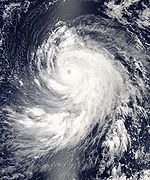 When a tropical depression intensifies into a tropical storm to the north of the Equator between 140°W and 180° it is named by the CPHC. Four lists of names are maintained by the World Meteorological Organization, rotating without regard to year, with the first name for a new year being the next name in sequence that was not used the previous year. Significant tropical cyclones have their names retired from the lists, with a replacement name selected at the next World Meteorological Organization Regional Association IV Hurricane Committee meeting. The last name to be used from this list was Omeka, while the next one will be Pewa.
and 100°E
. The Philippine Atmospheric, Geophysical and Astronomical Services Administration assigns names to tropical cyclones which move into or form as a tropical depression in their area of responsibility located between 135°E and 115°E and between 5°N and 25°N even if the cyclone has had a name assigned to it by the Japan Meteorological Agency.
in Tokyo, Japan, once they reach tropical storm strength. Names are contributed by members of the ESCAP/WMO Typhoon Committee. Each of the 14 nations or territories submitted 10 names, which are used in alphabetical order, by the English name of the country.
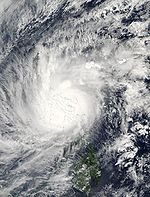 The Philippine Atmospheric, Geophysical and Astronomical Services Administration
uses its own naming scheme for tropical cyclones in their area of responsibility. PAGASA assigns names to tropical depressions that form within their area of responsibility, and any tropical cyclone that moves into their area of responsibility. Should the list of names for a given year prove to be insufficient, names are taken from an auxiliary list of names, with the first ten published every year.
started to assign names in September 2004. There is no retirement of tropical cyclone names in this basin as the list of names is only scheduled to be used once before a new list of names is drawn up. Should a named tropical cyclone move into the basin, from the Western Pacific then it will retain its original name.
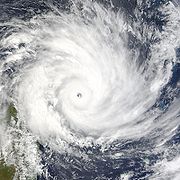 Within the South-west Indian Ocean, tropical and subtropical depressions that are judged to have 10-minute sustained windspeeds of 65 km/h, (40 mph) or more for at least 6 hours by the Regional Specialized Meteorological Center
on La Réunion Island
, France are named. However it is the Sub-Regional Tropical Cyclone Advisory Centers in Mauritius and Madagascar who name the systems. The Sub-Regional Tropical Cyclone Advisory Center in Mauritius names the storm should it intensify into a moderate tropical storm between 55°E and 90°E
; if the storm should intensify into a moderate tropical storm between 30°E and 55°E
then the Sub-Regional Tropical Cyclone Advisory Center in Madagascar assigns the appropriate name to the storm. New name lists are used every year, whilst a name is normally only used once so thus no names are retired.
of Australia, only 3 lists of names exist. A tropical low or a tropical depression will be judged to have intensified into a tropical cyclone if winds reach 65 km/h, (40 mph) and it is evident that gales are occurring more than halfway around the center. Significant tropical cyclones have their names retired from the lists and a replacement name selected at the next WMO Regional Association V Tropical Cyclone Committee meeting.
When a tropical depression intensifies into a tropical cyclone between the Equator
and 10°S
and between 90°E
and 141°E
then it will be named by TCWC Jakarta. Should a tropical low intensify into a tropical cyclone between the Equator and 10°S and between 141°E
and 160°E
are assigned names by the Tropical Cyclone Warning Center in Port Moresby, Papua New Guinea. Tropical lows intensifying into tropical cyclones in all other areas between 90°E
and 160°E
as well as the Equator and 40°S are named by the Bureau of Meteorology of Australia.
and 10°S
and between 90°E
and 141°E
it will be named by the Tropical Cyclone Warning Center in Jakarta, Indonesia. Names are currently assigned in sequence from list A, whilst list B details names that will replace names on list A that are retired.
and 40°S
and between 90°E
and 160°E
, then it will be named by one of the Tropical Cyclone Warning Centers
in Perth, Darwin, or Brisbane. Starting with Anika, the names are assigned in alphabetical order with the lists used in rotating order without regard to year.
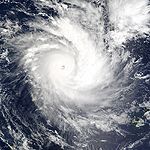 Within the Southern Pacific a tropical depression is judged to have reach tropical cyclone intensity should it reach winds of 65 km/h (40 mph), and it is evident that gales are occurring at least halfway around the center. Tropical depressions that should intensify into a tropical cyclone between the Equator and 25°S and between 160°E and 120°W are named by the Regional Specialized Meteorological Center
in Nadi, Fiji (RSMC Nadi). Should a Tropical Depression intensify to the south of 25°S between 160°E and 120°W, it will be named in conjunction with RSMC Nadi by the Tropical Cyclone Warning Center in Wellington, New Zealand (TCWC Wellington). Significant tropical cyclones have their names retired from the lists and a replacement name selected at the next World Meteorological Organization Regional Association V Tropical Cyclone Committee meeting, whilst tropical cyclones that move into the Australian region will retain its original name.
Unique identifier
With reference to a given set of objects, a unique identifier is any identifier which is guaranteed to be unique among all identifiers used for those objects and for a specific purpose...
in issuing forecasts and warnings, tropical cyclone
Tropical cyclone
A tropical cyclone is a storm system characterized by a large low-pressure center and numerous thunderstorms that produce strong winds and heavy rain. Tropical cyclones strengthen when water evaporated from the ocean is released as the saturated air rises, resulting in condensation of water vapor...
s and subtropical cyclone
Subtropical cyclone
A subtropical cyclone is a weather system that has some characteristics of a tropical and an extratropical cyclone. As early as the 1950s, meteorologists were unclear whether they should be characterized as tropical or extratropical cyclones. They were officially recognized by the National...
s are given names according to policy (see Tropical cyclone naming
Tropical cyclone naming
Tropical cyclones have officially been named since 1945 and are named for a variety of reasons, which include to facilitate communications between forecasters and the public when forecasts, watches, and warnings are issued. Names also reduce confusion about what storm is being described, as more...
). The following are lists from which these tropical and subtropical cyclone names are derived.
North Atlantic
National Hurricane Center
The National Hurricane Center , located at Florida International University in Miami, Florida, is the division of the National Weather Service responsible for tracking and predicting weather systems within the tropics between the Prime Meridian and the 140th meridian west poleward to the 30th...
(NHC/RSMC Miami) when they are judged to have intensified into a tropical storm with winds of at least 65 km/h, (40 mph). Six lists of names are used in alphabetical order, and maintained by the World Meteorological Organization with them rotating on a yearly basis. Significant tropical cyclones have their names retired from the lists with a replacement name selected at the next World Meteorological Organization
World Meteorological Organization
The World Meteorological Organization is an intergovernmental organization with a membership of 189 Member States and Territories. It originated from the International Meteorological Organization , which was founded in 1873...
(WMO), Regional Association IV Hurricane Committee meeting. If all of the names on a list are used, storms are named after the letters of the Greek alphabet (Alpha, Beta, Gamma, etc.). Greek names, unlike the names in the regular lists, cannot be retired. If a storm ever reached the magnitude that might otherwise have led to retirement, the storm would be listed with the retired names with a footnote indicating the Greek letter would still be available for future storms.
| 2011 | Arlene | Bret | Cindy | Don | Emily | Franklin | Gert | Harvey | Irene | Jose | Katia |
| Lee | Maria | Nate | Ophelia | Philippe | Rina | Sean | Tammy | Vince | Whitney | ||
| 2012 | Alberto | Beryl | Chris | Debby | Ernesto | Florence | Gordon | Helene | Isaac | Joyce | Kirk |
| Leslie | Michael | Nadine | Oscar | Patty | Rafael | Sandy | Tony | Valerie | William | ||
| 2013 | Andrea | Barry | Chantal | Dorian | Erin | Fernand | Gabrielle | Humberto | Ingrid | Jerry | Karen |
| Lorenzo | Melissa | Nestor | Olga | Pablo | Rebekah | Sebastien | Tanya | Van | Wendy | ||
| 2014 | Arthur | Bertha | Cristobal | Dolly | Edouard | Fay | Gonzalo | Hanna | Isaias | Josephine | Kyle |
| Laura | Marco | Nana | Omar | Paulette | Rene | Sally | Teddy | Vicky | Wilfred | ||
| 2015 | Ana | Bill | Claudette | Danny | Erika | Fred | Grace | Henri | Ida | Joaquin | Kate |
| Larry | Mindy | Nicholas | Odette | Peter | Rose | Sam | Teresa | Victor | Wanda | ||
| 2016 | Alex | Bonnie | Colin | Danielle | Earl | Fiona | Gaston | Hermine | Ian | Julia | Karl |
| Lisa | Matthew | Nicole | Otto | Paula | Richard | Shary | Tobias | Virginie | Walter | ||
| Sources for tropical cyclone names. | |||||||||||
|---|---|---|---|---|---|---|---|---|---|---|---|
Eastern Pacific Ocean
Within the Eastern Pacific Ocean there are two Regional Specialized Meteorological Centers (RSMC's) who assign names to tropical cyclones when they are judged to have intensified into a tropical storm with winds of at least 65 km/h, (40 mph). Tropical cyclones that intensify into tropical storms between the coast of Americas and 140°W are named by the National Hurricane Center (NHC/RSMC Miami), whilst tropical cyclones intensifying into tropical storms between 140°W and 180° are named by the Central Pacific Hurricane CenterCentral Pacific Hurricane Center
The Central Pacific Hurricane Center of the United States National Weather Service is the official body responsible for tracking and issuing tropical cyclone warnings, watches, advisories, discussions, and statements for the Central North Pacific Basin...
(CPHC/RSMC Honolulu). Significant tropical cyclones have their names retired from the lists and a replacement name selected at the next World Meteorological Organization Regional Association IV Hurricane Committee meeting. Should a tropical cyclone pass from the NHC's area of responsibility in to the CPHC's or vice versa it will retain its original name.
North Pacific east of 140°W
When a tropical depression intensifies into a tropical storm to the north of the Equator between the coastline of the Americas and 140°W then it will be named by the NHC. Six lists of names are maintained by the World Meteorological Organization with them rotating on a yearly basis. Significant tropical cyclones have their names retired from the lists with a replacement name selected at the next World Meteorological Organization Regional Association IV Hurricane Committee meeting. If all of the names on a list are used, storms are then named after the letters of the Greek alphabet (Alpha, Beta, Gamma, etc.). Greek names, unlike the names in the regular lists, cannot be retired. If a storm ever reached the magnitude that might otherwise have led to retirement, the storm would be listed with the retired names with a footnote indicating the Greek letter would still be available for future storms.| 2011 | Adrian | Beatriz | Calvin | Dora | Eugene | Fernanda | Greg | Hilary | Irwin | Jova | Kenneth | Lidia |
| Max | Norma | Otis | Pilar | Ramon | Selma | Todd | Veronica | Wiley | Xina | York | Zelda | |
| 2012 | Aletta | Bud | Carlotta | Daniel | Emilia | Fabio | Gilma | Hector | Ileana | John | Kristy | Lane |
| Martin | Norman | Olivia | Paul | Rosa | Sergio | Tara | Vicente | Willa | Xavier | Yolanda | Zeke | |
| 2013 | Alvin | Barbara | Cosme | Dalila | Erick | Flossie | Gil | Henriette | Ivo | Juliette | Kiko | Lorena |
| Manuel | Narda | Octave | Priscilla | Raymond | Sonia | Tico | Velma | Wallis | Xina | York | Zelda | |
| 2014 | Amanda | Boris | Cristina | Douglas | Elida | Fausto | Genevieve | Hernan | Iselle | Julio | Karina | Lowell |
| Marie | Norbert | Odile | Polo | Rachel | Simon | Trudy | Vance | Winnie | Xavier | Yolanda | Zeke | |
| 2015 | Andres | Blanca | Carlos | Dolores | Enrique | Felicia | Guillermo | Hilda | Ignacio | Jimena | Kevin | Linda |
| Marty | Nora | Olaf | Patricia | Rick | Sandra | Terry | Vivian | Waldo | Xina | York | Zelda | |
| 2016 | Agatha | Blas | Celia | Darby | Estelle | Frank | Georgette | Howard | Isis | Javier | Kay | Lester |
| Madeline | Newton | Orlene | Paine | Roslyn | Seymour | Tina | Virgil | Winifred | Xavier | Yolanda | Zeke | |
| Sources for tropical cyclone names. | ||||||||||||
|---|---|---|---|---|---|---|---|---|---|---|---|---|
Central North Pacific (140°W to 180°)
| List 1 | Akoni | Ema | Hone | Iona | Keli | Lala | Moke | Nolo | Olana | Pena | Ulana | Wale | |
| List 2 | Aka | Ekeka | Hene | Iolana | Keoni | Lino | Mele | Nona | Oliwa | Pama | Upana | Wene | |
| List 3 | Alika | Ele | Huko | Iopa | Kika | Lana | Maka | Neki | Omeka | Pewa | Unala | Wali | |
| List 4 | Ana | Ela | Halola | Iune | Kilo | Loke | Malia | Niala | Oho | Pali | Ulika | Walaka | |
| Sources for tropical cyclone names. | |||||||||||||
|---|---|---|---|---|---|---|---|---|---|---|---|---|---|
Western Pacific Ocean (180° to 100°E)
Within the Northwestern Pacific Ocean there are two separate agencies who assign names to tropical cyclones which often results in a cyclone having two names. The Japan Meteorological Agency names tropical cyclones should they be judged to have 10-minute sustained windspeeds of 65 km/h, (40 mph), to the north of the equator between the 180°180th meridian
The 180th meridian or antimeridian is the meridian which is 180° east or west of the Prime Meridian passing through the Royal Observatory, Greenwich. It is common to both east longitude and west longitude. It is used as the basis for the International Date Line because it for the most part passes...
and 100°E
100th meridian east
The meridian 100° east of Greenwich is a line of longitude that extends from the North Pole across the Arctic Ocean, Asia, the Indian Ocean, the Southern Ocean, and Antarctica to the South Pole....
. The Philippine Atmospheric, Geophysical and Astronomical Services Administration assigns names to tropical cyclones which move into or form as a tropical depression in their area of responsibility located between 135°E and 115°E and between 5°N and 25°N even if the cyclone has had a name assigned to it by the Japan Meteorological Agency.
International names
Tropical Cyclones are named from the following lists by the Regional Specialized Meteorological CentreRegional Specialized Meteorological Centre
A Regional Specialized Meteorological Centre is responsible for the distribution of information, advisories, and warnings regarding the specific program they have a part of, agreed by consensus at the World Meteorological Organization as part of the World Weather Watch.-Tropical...
in Tokyo, Japan, once they reach tropical storm strength. Names are contributed by members of the ESCAP/WMO Typhoon Committee. Each of the 14 nations or territories submitted 10 names, which are used in alphabetical order, by the English name of the country.
Philippines
Philippine Atmospheric, Geophysical and Astronomical Services Administration
The Philippine Atmospheric, Geophysical and Astronomical Services Administration is a Philippine national institution dedicated to provide flood and typhoon warnings, public weather forecasts and advisories, meteorological, astronomical, climatological, and other specialized information and...
uses its own naming scheme for tropical cyclones in their area of responsibility. PAGASA assigns names to tropical depressions that form within their area of responsibility, and any tropical cyclone that moves into their area of responsibility. Should the list of names for a given year prove to be insufficient, names are taken from an auxiliary list of names, with the first ten published every year.
| 2011 | Amang | Bebeng | Chedeng | Dodong | Egay | Falcon | Goring | Hanna | Ineng | Juaning | Kabayan | Lando | Mina | Nonoy | Onyok | Pedring | Quiel | Ramon | |
|---|---|---|---|---|---|---|---|---|---|---|---|---|---|---|---|---|---|---|---|
| Sendong | Tisoy | Ursula | Viring | Weng | Yoyoy | Zigzag | Abe | Berto | Charo | Dado | Estoy | Felion | Gening | Herman | Irma | Jaime | |||
| 2012 | Ambo | Butchoy | Cosme | Dindo | Enteng | This name was retired after its last use but no name has been selected to replace it yet | Gener | Helen | Igme | Julian | Karen | Lawin | Marce | Nina | Ofel | Pablo | Quinta | Rolly | |
| Siony | Tonyo | Ulysses | Vicky | Warren | Yoyong | Zosimo | Alakdan | Baldo | Clara | Dencio | Estong | Felipe | Gardo | Heling | Ismael | Julio | |||
| 2013 | Auring | Bising | Crising | Dante | Emong | Feria | Gorio | Huaning | Isang | Jolina | Kiko | Labuyo | Maring | Nando | Quedan | Ramil | |||
| Santi | Tino | Urduja | Vinta | Wilma | Yolanda | Zoraida | Alamid | Bruno | Conching | Dolor | Ernie | Florante | Gerardo | Hernan | Isko | Jerome | |||
| 2014 | Agaton | Basyang | Caloy | Domeng | Ester | Florita | Glenda | Henry | Inday | Juan | Katring | Luis | Mario | Neneng | Ompong | Paeng | Queenie | Ruby | |
| Seniang | Tomas | Usman | Venus | Waldo | Yayang | Zeny | Agila | Bagwis | Chito | Diego | Elena | Felino | Gunding | Harriet | Indang | Jessa | |||
| Sources for tropical cyclone names. | |||||||||||||||||||
North Indian Ocean (45°E – 100°E)
Within this basin, a tropical cyclone is assigned a name when it is judged to have reached Cyclonic Storm intensity with winds of 65 km/h (40 mph). The names were selected by members of the ESCAP/WMO panel on Tropical Cyclones between 2000 and May 2004, before the Regional Specialized Meteorological Center in New DelhiIndia Meteorological Department
The India Meteorological Department , also referred to as the Met Office, is an agency of the Ministry of Earth Sciences of the Government of India. It is the principal agency responsible for meteorological observations, weather forecasting and seismology...
started to assign names in September 2004. There is no retirement of tropical cyclone names in this basin as the list of names is only scheduled to be used once before a new list of names is drawn up. Should a named tropical cyclone move into the basin, from the Western Pacific then it will retain its original name.
| ContributingNations | List 1 | List 2 | List 3 | List 4 | List 5 | List 6 | List 7 | List 8 | ||
|---|---|---|---|---|---|---|---|---|---|---|
| Bangladesh | Onil Cyclone Onil Severe Cyclonic Storm Onil was the first tropical cyclone to be named in the northern Indian Ocean... |
Ogni | Nisha | Giri Cyclone Giri Cyclone Giri was a powerful tropical cyclone which caused catastrophic damage in parts of Myanmar in late October 2010... |
Helen | Chapala | Ockhi | Fani | ||
| India | Agni Cyclone Agni Severe Cyclonic Storm Agni was a tropical cyclone of the 2004 North Indian Ocean cyclone season notable for its record proximity to the equator. It was the second North Indian Ocean cyclone to receive a name, after Onil earlier in the year... |
Akash Cyclone Akash Cyclone Akash was the first named tropical cyclone of the 2007 North Indian Ocean cyclone season... |
Bijli Cyclone Bijli Cyclone Bijli , was the first tropical cyclone to form during the 2009 North Indian Ocean cyclone season. Cyclonic Storm Bijli formed from an area of Low Pressure on April 14. Later that evening, RSMC New Delhi upgraded the Low Pressure into a Deep Depression... |
Jal Cyclone Jal Severe Cyclonic Storm Jal , also known as Cyclone Jal, is the fifth named cyclonic storm and the fourth Severe Cyclonic Storm of the 2010 North Indian Ocean cyclone season. Jal developed from a low pressure area in the South China Sea that organized into a Tropical Depression on . Jal is a Sanskrit... |
Leher | Megh | Sagar | Vayu | ||
| Maldives | Hibaru | Gonu Cyclone Gonu Cyclone Gonu is the strongest tropical cyclone on record in the Arabian Sea, and is also the strongest named cyclone in the northern Indian Ocean... |
Aila Cyclone Aila Cyclone Aila was the second tropical cyclone of the 2009 North Indian Ocean cyclone season... |
Keila Cyclone Keila Cyclonic Storm Keila , also known as Cyclone Keila, is the first named cyclonic storm and the first storm to reach cyclone intensity of the 2011 North Indian Ocean cyclone season. Keila developed from a low pressure area in the Arabian Sea that organized into a tropical depression on October 29... |
Madi | Roanu | Makunu | Hikaa | ||
| Myanmar | Pyarr | Yemyin Cyclone Yemyin Cyclone Yemyin was a deadly tropical cyclone that made landfalls on India and Pakistan. The Pakistan Meteorological Department referred to Tropical Cyclone 03B as "Tropical Cyclone Yemyin"... |
Phyan Cyclone Phyan Cyclonic Storm Phyan developed as a tropical disturbance to the southwest of Colombo in Sri Lanka on November 4, 2009. Over the next couple of days, the disturbance gradually developed before weakening as it made landfall on Southern India on November 7... |
Thane | Na−nauk | Kyant | Daye | Kyarr | ||
| Oman | Baaz | Sidr Cyclone Sidr Cyclone Sidr was the strongest named cyclone in the Bay of Bengal... |
Ward | Murjan | Hudhud | Nada | Luban | Maha | ||
| Pakistan | Fanoos | Nargis Cyclone Nargis Cyclone Nargis , was a strong tropical cyclone that caused the worst natural disaster in the recorded history of Burma. The cyclone made landfall in Burma on Friday, May 2, 2008, causing catastrophic destruction and at least 138,000 fatalities... |
Laila Cyclone Laila Cyclonic Storm Laila named by Pakistan is the first cyclonic storm to affect southeastern India in May since the 1990 Andhra Pradesh cyclone. The first tropical cyclone of the 2010 North Indian Ocean cyclone season, Laila developed on May 17 in the Bay of Bengal from a persistent area of... |
Nilam | Nilofar | Vardah | Titli | Bulbul | ||
| Sri Lanka | Mala Cyclone Mala Cyclone Mala, also known as Very Severe Cyclonic Storm Mala, was the strongest tropical cyclone of the 2006 North Indian Ocean cyclone season... |
Rashmi Cyclone Rashmi Cyclone Rashmi was the seventh tropical cyclone of the 2008 North Indian Ocean cyclone season and second cyclonic storm, as well as the fifth tropical cyclone in the Bay of Bengal that year... |
Bandu | Mahasen | Priya | Asiri | Gigum | Soba | ||
| Thailand | Mukda | Khai−Muk | Phet Cyclone Phet Cyclone Phet was the third named cyclone of the 2010 North Indian Ocean cyclone season. Phet developed from a low pressure area in the Arabian Sea that organized into a tropical cyclone on May 31... |
Phailin | Komen | Mora | Phethai | Amphan | ||
| Sources for tropical cyclone names. | ||||||||||
South-West Indian Ocean (90°E – 30°E)
Regional Specialized Meteorological Center
A Regional Specialized Meteorological Centre is responsible for the distribution of information, advisories, and warnings regarding the specific program they have a part of, agreed by consensus at the World Meteorological Organization as part of the World Weather Watch.-Tropical...
on La Réunion Island
Réunion
Réunion is a French island with a population of about 800,000 located in the Indian Ocean, east of Madagascar, about south west of Mauritius, the nearest island.Administratively, Réunion is one of the overseas departments of France...
, France are named. However it is the Sub-Regional Tropical Cyclone Advisory Centers in Mauritius and Madagascar who name the systems. The Sub-Regional Tropical Cyclone Advisory Center in Mauritius names the storm should it intensify into a moderate tropical storm between 55°E and 90°E
90th meridian east
The meridian 90° east of Greenwich is a line of longitude that extends from the North Pole across the Arctic Ocean, Asia, the Indian Ocean, the Southern Ocean, and Antarctica to the South Pole.The Ninety East Ridge is named after the meridian....
; if the storm should intensify into a moderate tropical storm between 30°E and 55°E
55th meridian east
The meridian 55° east of Greenwich is a line of longitude that extends from the North Pole across the Arctic Ocean, Europe, Asia, the Indian Ocean, the Southern Ocean, and Antarctica to the South Pole....
then the Sub-Regional Tropical Cyclone Advisory Center in Madagascar assigns the appropriate name to the storm. New name lists are used every year, whilst a name is normally only used once so thus no names are retired.
| 2011-12 2011–12 South-West Indian Ocean cyclone season The 2011–12 South-West Indian Ocean cyclone season is an event in the annual cycle of tropical cyclone formation. It began on November 15, 2011, and will end on April 30, 2012, with the exception for Mauritius and the Seychelles, for which it will end on May 15, 2012... |
Alenga | Benilde | Chanda | Dando | Ethel | Funso | Giovanna | Hilwa | Irina | Joni | Kuena | Lesego | Michel | ||||||
| Noyana | Olivier | Pokera | Quincy | Rebaone | Salama | Tristan | Ursula | Violet | Wilson | Xavier | Yekela | Zaina | |||||||
| 2012-13 | Anais | Boldwin | Claudia | Dumile | Emang | Felleng | Gino | Haruna | Imelda | Jamala | Kachay | Luciano | Mariam | ||||||
| Njazi | Onias | Pelagie | Quiliro | Richard | Solani | Tamim | Urilia | Vuyane | Wagner | Xusa | Yarona | Zacarias | |||||||
| Sources for tropical cyclone names. | |||||||||||||||||||
|---|---|---|---|---|---|---|---|---|---|---|---|---|---|---|---|---|---|---|---|
Australian Region (90°E – 160°E)
Within the Australian Region there are five different official Tropical Cyclone Warning Centers who assign names to tropical cyclones. However as three of the warning centers are run by the Bureau of MeteorologyBureau of Meteorology
The Bureau of Meteorology is an Executive Agency of the Australian Government responsible for providing weather services to Australia and surrounding areas. It was established in 1906 under the Meteorology Act, and brought together the state meteorological services that existed before then...
of Australia, only 3 lists of names exist. A tropical low or a tropical depression will be judged to have intensified into a tropical cyclone if winds reach 65 km/h, (40 mph) and it is evident that gales are occurring more than halfway around the center. Significant tropical cyclones have their names retired from the lists and a replacement name selected at the next WMO Regional Association V Tropical Cyclone Committee meeting.
When a tropical depression intensifies into a tropical cyclone between the Equator
Equator
An equator is the intersection of a sphere's surface with the plane perpendicular to the sphere's axis of rotation and containing the sphere's center of mass....
and 10°S
10th parallel south
The 10th parallel south is a circle of latitude that is 10 degrees south of the Earth's equatorial plane. It crosses the Atlantic Ocean, Africa, the Indian Ocean, Australasia, the Pacific Ocean and South America....
and between 90°E
90th meridian east
The meridian 90° east of Greenwich is a line of longitude that extends from the North Pole across the Arctic Ocean, Asia, the Indian Ocean, the Southern Ocean, and Antarctica to the South Pole.The Ninety East Ridge is named after the meridian....
and 141°E
141st meridian east
The 141st meridian east of Greenwich is a line of longitude that extends extends from the North Pole across the Arctic Ocean, Asia, the Pacific Ocean, Australasia, the Indian Ocean, the Southern Ocean, and Antarctica to the South Pole....
then it will be named by TCWC Jakarta. Should a tropical low intensify into a tropical cyclone between the Equator and 10°S and between 141°E
141st meridian east
The 141st meridian east of Greenwich is a line of longitude that extends extends from the North Pole across the Arctic Ocean, Asia, the Pacific Ocean, Australasia, the Indian Ocean, the Southern Ocean, and Antarctica to the South Pole....
and 160°E
160th meridian east
The meridian 160° east of Greenwich is a line of longitude that extends from the North Pole across the Arctic Ocean, Asia, the Pacific Ocean, the Southern Ocean, and Antarctica to the South Pole....
are assigned names by the Tropical Cyclone Warning Center in Port Moresby, Papua New Guinea. Tropical lows intensifying into tropical cyclones in all other areas between 90°E
90th meridian east
The meridian 90° east of Greenwich is a line of longitude that extends from the North Pole across the Arctic Ocean, Asia, the Indian Ocean, the Southern Ocean, and Antarctica to the South Pole.The Ninety East Ridge is named after the meridian....
and 160°E
160th meridian east
The meridian 160° east of Greenwich is a line of longitude that extends from the North Pole across the Arctic Ocean, Asia, the Pacific Ocean, the Southern Ocean, and Antarctica to the South Pole....
as well as the Equator and 40°S are named by the Bureau of Meteorology of Australia.
Indonesia
When a tropical depression intensifies into a tropical cyclone between the EquatorEquator
An equator is the intersection of a sphere's surface with the plane perpendicular to the sphere's axis of rotation and containing the sphere's center of mass....
and 10°S
10th parallel south
The 10th parallel south is a circle of latitude that is 10 degrees south of the Earth's equatorial plane. It crosses the Atlantic Ocean, Africa, the Indian Ocean, Australasia, the Pacific Ocean and South America....
and between 90°E
90th meridian east
The meridian 90° east of Greenwich is a line of longitude that extends from the North Pole across the Arctic Ocean, Asia, the Indian Ocean, the Southern Ocean, and Antarctica to the South Pole.The Ninety East Ridge is named after the meridian....
and 141°E
141st meridian east
The 141st meridian east of Greenwich is a line of longitude that extends extends from the North Pole across the Arctic Ocean, Asia, the Pacific Ocean, Australasia, the Indian Ocean, the Southern Ocean, and Antarctica to the South Pole....
it will be named by the Tropical Cyclone Warning Center in Jakarta, Indonesia. Names are currently assigned in sequence from list A, whilst list B details names that will replace names on list A that are retired.
| List A | Anggrek | Bakung | Cempaka | Dahlia | Flamboyan | Kenanga | Lili | Mawar | Seroja | Teratai |
| List B | Anggur | Belimbing | Duku | Jambu | Lengkeng | Mangga | Nangka | Pisang | Rambutan | Sawo |
| Sources for tropical cyclone names. | ||||||||||
|---|---|---|---|---|---|---|---|---|---|---|
Australia
When a tropical low intensifies into a tropical cyclone between 10°S10th parallel south
The 10th parallel south is a circle of latitude that is 10 degrees south of the Earth's equatorial plane. It crosses the Atlantic Ocean, Africa, the Indian Ocean, Australasia, the Pacific Ocean and South America....
and 40°S
40th parallel south
The 40th parallel south is a circle of latitude that is 40 degrees south of the Earth's equatorial plane. It crosses the Atlantic Ocean, the Indian Ocean, Australasia, the Pacific Ocean and South America....
and between 90°E
90th meridian east
The meridian 90° east of Greenwich is a line of longitude that extends from the North Pole across the Arctic Ocean, Asia, the Indian Ocean, the Southern Ocean, and Antarctica to the South Pole.The Ninety East Ridge is named after the meridian....
and 160°E
160th meridian east
The meridian 160° east of Greenwich is a line of longitude that extends from the North Pole across the Arctic Ocean, Asia, the Pacific Ocean, the Southern Ocean, and Antarctica to the South Pole....
, then it will be named by one of the Tropical Cyclone Warning Centers
Bureau of Meteorology
The Bureau of Meteorology is an Executive Agency of the Australian Government responsible for providing weather services to Australia and surrounding areas. It was established in 1906 under the Meteorology Act, and brought together the state meteorological services that existed before then...
in Perth, Darwin, or Brisbane. Starting with Anika, the names are assigned in alphabetical order with the lists used in rotating order without regard to year.
| Anika | Billy | Charlotte | Dominic | Ellie | Freddy | Gabrielle | Herman | Ilsa | Jasper | Kirrily |
| Lincoln | Megan | Neville | Olga | Paul | Robyn | Sean | Tasha | Vince | Zelia | ------ |
| Anthony | Bianca | Carlos | Dianne | Errol | Fina | Grant | Heidi | Iggy | Jasmine | Koji |
| Lua | Mitchell | Narelle | Oswald | Peta | Rusty | Sandra | Tim | Victoria | Zane | |
| Alessia | Bruce | Christine | Dylan | Edna | Fletcher | Gillian | Hadi | Ita | Jack | Kate |
| Lam | Marcia | Nathan | Olwyn | Quang | Raquel | Stan | Tatjana | Uriah | Yvette | |
| Alfred | Blanche | Caleb | Debbie | Ernie | Frances | Greg | Hilda | Ira | Joyce | Kelvin |
| Linda | Marcus | Nora | Owen | Penny | Riley | Savannah | Trevor | Veronica | Wallace | |
| Ann | Blake | Claudia | Damien | Esther | Ferdinand | Gretel | Harold | Imogen | Joshua | Kimi |
| Lucas | Marian | Noah | Odette | Paddy | Ruby | Seth | Tiffany | Verdun | ||
| Sources for tropical cyclone names. | ||||||||||
|---|---|---|---|---|---|---|---|---|---|---|
Papua New Guinea
When a tropical low intensifies into a tropical cyclone between the equator and 10°S and between 141°E and 160°E then it will be named by the Tropical Cyclone Warning Centers in Port Moresby, New Guinea. Names are assigned randomly by TCWC Port Moresby whilst list B details replacement names for list A which will be added in the bottom of list A to maintain the alphabetical order. As tropical cyclones rarely form in TCWC Port Moresby's area of responsibility when one does form the name is retired regardless of any impact reported.| List A | Alu | Buri | Dodo | Emau | Fere | Hibu | Ila | Kama | Lobu | Maila |
| List B | Nou | Obaha | Paia | Ranu | Sabi | Tau | Ume | Vali | Wau | Auram |
| Source for tropical cyclone names. | ||||||||||
|---|---|---|---|---|---|---|---|---|---|---|
Southern Pacific Ocean (160°E – 120°W)
Regional Specialized Meteorological Center
A Regional Specialized Meteorological Centre is responsible for the distribution of information, advisories, and warnings regarding the specific program they have a part of, agreed by consensus at the World Meteorological Organization as part of the World Weather Watch.-Tropical...
in Nadi, Fiji (RSMC Nadi). Should a Tropical Depression intensify to the south of 25°S between 160°E and 120°W, it will be named in conjunction with RSMC Nadi by the Tropical Cyclone Warning Center in Wellington, New Zealand (TCWC Wellington). Significant tropical cyclones have their names retired from the lists and a replacement name selected at the next World Meteorological Organization Regional Association V Tropical Cyclone Committee meeting, whilst tropical cyclones that move into the Australian region will retain its original name.
Other areas
Tropical cyclone formation is rare within the Mediterranean sea, South Atlantic and to the east of 120W in the Southern Pacific, as a result there are no official naming lists for these areas although in 2004, 2010 & 2011 when tropical cyclones formed within the South Atlantic they were named as Catarina, Anita and Arani.See also
- List of previous tropical cyclone names
- European windstorm names
- List of Atlantic hurricane seasons
- List of Pacific hurricane seasons
- List of Pacific typhoon seasons
- List of North Indian Ocean cyclone seasons
- List of Southern Hemisphere tropical cyclone seasons
- List of Australian region cyclone seasons
- List of South-West Indian Ocean cyclone seasons
- List of South Pacific cyclone seasons
External links
- United States National Hurricane Center – RSMC Miami
- United States Central Pacific Hurricane Center – RSMC Honolulu
- Japan Meteorological Agency – RSMC Tokyo
- India Meteorological Department – RSMC New Delhi
- Météo-France – RSMC La Reunion
- Indonesia Badan Meteorologi & Geofisika – TCWC Jakarta
- Australia Bureau of Meteorology – TCWC Perth, Darwin, Brisbane
- Fiji Meteorological Service – RSMC Nadi
- Meteorological Service of New Zealand – TCWC Wellington