

Liquid mirror

Encyclopedia
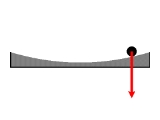
Liquid mirror telescopes are telescopes made with a reflective liquid. The most common liquid used is mercury
, but other liquids will work as well (for example, low melting alloys of gallium
). The container for the liquid is rotating so that the liquid assumes a paraboloidal
shape. A paraboloidal shape is precisely the shape needed for the primary mirror of a telescope
. The rotating liquid assumes the paraboloidal shape regardless of the container's shape. To reduce the amount of liquid metal needed, and thus weight, a rotating mercury mirror uses a container that is as close to the necessary parabolic shape as possible. Liquid mirrors can be a low cost alternative to conventional large telescope
s. Compared to a solid glass mirror that must be cast, ground, and polished, a rotating liquid metal mirror is much less expensive to manufacture.
Isaac Newton
noted that the free surface
of a rotating liquid forms a circular paraboloid
and can therefore be used as a telescope, but he could not actually build one because he had no way to stabilize the speed of rotation (the electric motor
did not exist yet). The concept was further developed by Ernesto Capocci of the Naples Observatory (1850), but it was not until 1872 that Henry Skey of Dunedin
, New Zealand
constructed the first working laboratory liquid mirror telescope.
Another difficulty is that a telescope with a liquid metal mirror can only be used in zenith telescope
s that look straight up at the zenith
, so it is not suitable for investigations where the telescope must remain pointing at the same location of space (a possible exception to this rule may exist for a mercury mirror space telescope, where the effect of Earth's gravity is replaced by artificial gravity
, perhaps by rotating the telescope on a very long tether, or propelling it gently forward with rockets).
Currently, the mercury mirror of the Large Zenith Telescope
in Canada is the largest liquid metal mirror in operation. It has a diameter of six meters, and rotates at a rate of about 8.5 revolutions per minute
.
, and rotational kinetic energy. When a fluid is in solid body rotation it is the lowest state of energy that is available, because in a state of solid body rotation there is no friction to dissipate
any of the energy.
In an inertial reference frame, the dynamic equilibrium cannot be understood in terms of an equilibrium of forces. This is because when the mercury mirror is rotating, there is an unbalanced force acting on the mercury – the force of gravity is acting in a vertical direction on the mercury, and the surface of the parabolic dish exerts a normal force
on the mercury resting on it. The resultant force is a net centripetal force toward the axis of rotation.
The following discussion is for the case of the mercury mirror as it is rotating in solid body rotation.
The kinetic energy of a parcel of mercury given by the formula:
In the case of circular motion the relation holds, hence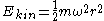
The gravitational potential energy is given by
where is the acceleration of gravity and
  is the height of the mercury's surface above some arbitrary elevation, for instance, we can set
  to be the lowest mercury surface.
We set the potential energy equal to the kinetic energy to find the mirror's shape:

which is, by definition, a parabola
.
, such as Kevlar
. The cylinder is spun until it reaches a few revolutions per minute. The liquid gradually forms a paraboloid
, the shape of a conventional telescopic mirror. The mirror's surface is very precise and small imperfections in the cylinder's shape do not affect it. The amount of mercury used is small, less than a millimeter in thickness.
s (below 130 kelvin
s) have been proposed as the fluid base for an extremely large diameter spinning liquid mirror telescope to be based on the Earth's moon. Low temperature is advantageous in imaging long wave infrared light which is the form of light (extremely red-shifted
) that arrives from the most distant parts of the visible universe. Such a liquid base would be covered by a thin metallic film that forms the reflective surface.
design is similar to conventional liquid mirror telescopes. It will only work in space; but in orbit, gravity will not distort the mirror's shape into a paraboloid. The design features a liquid stored in a flat-bottomed ring-shaped container with raised interior edges. The central focal area would be rectangular, but a secondary rectangular-parabolic mirror would gather the light to a focal point. Otherwise the optics are similar to other optical telescopes. The light gathering power of a Rice telescope is equivalent to approximately the width times the diameter of the ring, minus a percentage based on optics, superstructure design, etc.
's 6 meter Large Zenith Telescope
cost about a fiftieth as much as a conventional telescope with a glass mirror. Unfortunately, the mirror can only be pointed straight up. If it tilts from the zenith
, it loses its shape. The mirror's view changes as the Earth
rotates and objects cannot be physically tracked. An object can be briefly electronically tracked while in the field of view by applying a voltage to the CCD
to shift electrons across it at the same speed as the image moves; this tactic is called "drift scanning." However, some types of astronomical
research are unaffected by these limitations, such as long-term sky surveys and supernova
searches. Since the Universe
is believed to be isotropic and homogeneous
(this is called the Cosmological Principle
), the investigation of its structure by cosmologists can also use liquid mirror telescopes. However, research is underway to develop telescopes that can be tilted.
Since mercury metal and its vapor are both toxic
to humans and animals there remains a problem for its use in any telescope where it may affect its users and others in its area. The less toxic metal gallium
may be used instead of mercury but has the disadvantage of high cost. Recently Canadian researchers have proposed the substitution of magnetically deformable liquid mirrors composed of a suspension of iron
and silver
nanoparticle
s in ethylene glycol
. In addition to low toxicity and relatively low cost, such a mirror would have the advantage of being easily and rapidly deformable using variations of magnetic field strength.
Mercury (element)
Mercury is a chemical element with the symbol Hg and atomic number 80. It is also known as quicksilver or hydrargyrum...
, but other liquids will work as well (for example, low melting alloys of gallium
Gallium
Gallium is a chemical element that has the symbol Ga and atomic number 31. Elemental gallium does not occur in nature, but as the gallium salt in trace amounts in bauxite and zinc ores. A soft silvery metallic poor metal, elemental gallium is a brittle solid at low temperatures. As it liquefies...
). The container for the liquid is rotating so that the liquid assumes a paraboloidal
Parabolic reflector
A parabolic reflector is a reflective device used to collect or project energy such as light, sound, or radio waves. Its shape is that of a circular paraboloid, that is, the surface generated by a parabola revolving around its axis...
shape. A paraboloidal shape is precisely the shape needed for the primary mirror of a telescope
Telescope
A telescope is an instrument that aids in the observation of remote objects by collecting electromagnetic radiation . The first known practical telescopes were invented in the Netherlands at the beginning of the 1600s , using glass lenses...
. The rotating liquid assumes the paraboloidal shape regardless of the container's shape. To reduce the amount of liquid metal needed, and thus weight, a rotating mercury mirror uses a container that is as close to the necessary parabolic shape as possible. Liquid mirrors can be a low cost alternative to conventional large telescope
Telescope
A telescope is an instrument that aids in the observation of remote objects by collecting electromagnetic radiation . The first known practical telescopes were invented in the Netherlands at the beginning of the 1600s , using glass lenses...
s. Compared to a solid glass mirror that must be cast, ground, and polished, a rotating liquid metal mirror is much less expensive to manufacture.
Isaac Newton
Isaac Newton
Sir Isaac Newton PRS was an English physicist, mathematician, astronomer, natural philosopher, alchemist, and theologian, who has been "considered by many to be the greatest and most influential scientist who ever lived."...
noted that the free surface
Free surface
In physics, a free surface is the surface of a fluid that is subject to constant perpendicular normal stress and zero parallel shear stress,such as the boundary between two homogenous fluids,for example liquid water and the air in the Earth's atmosphere...
of a rotating liquid forms a circular paraboloid
Paraboloid
In mathematics, a paraboloid is a quadric surface of special kind. There are two kinds of paraboloids: elliptic and hyperbolic. The elliptic paraboloid is shaped like an oval cup and can have a maximum or minimum point....
and can therefore be used as a telescope, but he could not actually build one because he had no way to stabilize the speed of rotation (the electric motor
Electric motor
An electric motor converts electrical energy into mechanical energy.Most electric motors operate through the interaction of magnetic fields and current-carrying conductors to generate force...
did not exist yet). The concept was further developed by Ernesto Capocci of the Naples Observatory (1850), but it was not until 1872 that Henry Skey of Dunedin
Dunedin
Dunedin is the second-largest city in the South Island of New Zealand, and the principal city of the Otago Region. It is considered to be one of the four main urban centres of New Zealand for historic, cultural, and geographic reasons. Dunedin was the largest city by territorial land area until...
, New Zealand
New Zealand
New Zealand is an island country in the south-western Pacific Ocean comprising two main landmasses and numerous smaller islands. The country is situated some east of Australia across the Tasman Sea, and roughly south of the Pacific island nations of New Caledonia, Fiji, and Tonga...
constructed the first working laboratory liquid mirror telescope.
Another difficulty is that a telescope with a liquid metal mirror can only be used in zenith telescope
Zenith telescope
A zenith telescope is a type of telescope that is designed to point straight up at or near the zenith. They are used for precision measurement of star positions, to simplify telescope construction, or both....
s that look straight up at the zenith
Zenith
The zenith is an imaginary point directly "above" a particular location, on the imaginary celestial sphere. "Above" means in the vertical direction opposite to the apparent gravitational force at that location. The opposite direction, i.e...
, so it is not suitable for investigations where the telescope must remain pointing at the same location of space (a possible exception to this rule may exist for a mercury mirror space telescope, where the effect of Earth's gravity is replaced by artificial gravity
Artificial gravity
Artificial gravity is the varying of apparent gravity via artificial means, particularly in space, but also on the Earth...
, perhaps by rotating the telescope on a very long tether, or propelling it gently forward with rockets).
Currently, the mercury mirror of the Large Zenith Telescope
Large Zenith Telescope
The Large Zenith Telescope is a 6.0 m diameter liquid mirror telescope located in the University of British Columbia's Malcolm Knapp Research Forest, about east of Vancouver...
in Canada is the largest liquid metal mirror in operation. It has a diameter of six meters, and rotates at a rate of about 8.5 revolutions per minute
Revolutions per minute
Revolutions per minute is a measure of the frequency of a rotation. It annotates the number of full rotations completed in one minute around a fixed axis...
.
Explanation of the equilibrium
In fluid mechanics, the state when no part of the fluid has motion relative to any other part of the fluid is called 'solid body rotation'. When the mercury mirror has reached a state of solid body rotation, then the dynamic equilibrium can be understood as a balance of two energies: gravitational potential energyPotential energy
In physics, potential energy is the energy stored in a body or in a system due to its position in a force field or due to its configuration. The SI unit of measure for energy and work is the Joule...
, and rotational kinetic energy. When a fluid is in solid body rotation it is the lowest state of energy that is available, because in a state of solid body rotation there is no friction to dissipate
Dissipation
In physics, dissipation embodies the concept of a dynamical system where important mechanical models, such as waves or oscillations, lose energy over time, typically from friction or turbulence. The lost energy converts into heat, which raises the temperature of the system. Such systems are called...
any of the energy.
In an inertial reference frame, the dynamic equilibrium cannot be understood in terms of an equilibrium of forces. This is because when the mercury mirror is rotating, there is an unbalanced force acting on the mercury – the force of gravity is acting in a vertical direction on the mercury, and the surface of the parabolic dish exerts a normal force
Normal force
In mechanics, the normal force F_n\ is the component, perpendicular to the surface of contact, of the contact force exerted on an object by, for example, the surface of a floor or wall, preventing the object from penetrating the surface.The normal force is one of the components of the ground...
on the mercury resting on it. The resultant force is a net centripetal force toward the axis of rotation.
The following discussion is for the case of the mercury mirror as it is rotating in solid body rotation.
The kinetic energy of a parcel of mercury given by the formula:
In the case of circular motion the relation
holds, henceThe gravitational potential energy is given by
where
is the acceleration of gravity and is the height of the mercury's surface above some arbitrary elevation, for instance, we can set to be the lowest mercury surface.We set the potential energy equal to the kinetic energy to find the mirror's shape:
which is, by definition, a parabola
Parabola
In mathematics, the parabola is a conic section, the intersection of a right circular conical surface and a plane parallel to a generating straight line of that surface...
.
Conventional land-based liquid mirror telescopes
These are made of liquid stored in a cylindrical container made of a composite materialComposite material
Composite materials, often shortened to composites or called composition materials, are engineered or naturally occurring materials made from two or more constituent materials with significantly different physical or chemical properties which remain separate and distinct at the macroscopic or...
, such as Kevlar
Kevlar
Kevlar is the registered trademark for a para-aramid synthetic fiber, related to other aramids such as Nomex and Technora. Developed at DuPont in 1965, this high strength material was first commercially used in the early 1970s as a replacement for steel in racing tires...
. The cylinder is spun until it reaches a few revolutions per minute. The liquid gradually forms a paraboloid
Paraboloid
In mathematics, a paraboloid is a quadric surface of special kind. There are two kinds of paraboloids: elliptic and hyperbolic. The elliptic paraboloid is shaped like an oval cup and can have a maximum or minimum point....
, the shape of a conventional telescopic mirror. The mirror's surface is very precise and small imperfections in the cylinder's shape do not affect it. The amount of mercury used is small, less than a millimeter in thickness.
Moon-based liquid mirror telescopes
Low temperature ionic liquidIonic liquid
An ionic liquid is a salt in the liquid state. In some contexts, the term has been restricted to salts whose melting point is below some arbitrary temperature, such as . While ordinary liquids such as water and gasoline are predominantly made of electrically neutral molecules, ILs are largely made...
s (below 130 kelvin
Kelvin
The kelvin is a unit of measurement for temperature. It is one of the seven base units in the International System of Units and is assigned the unit symbol K. The Kelvin scale is an absolute, thermodynamic temperature scale using as its null point absolute zero, the temperature at which all...
s) have been proposed as the fluid base for an extremely large diameter spinning liquid mirror telescope to be based on the Earth's moon. Low temperature is advantageous in imaging long wave infrared light which is the form of light (extremely red-shifted
Redshift
In physics , redshift happens when light seen coming from an object is proportionally increased in wavelength, or shifted to the red end of the spectrum...
) that arrives from the most distant parts of the visible universe. Such a liquid base would be covered by a thin metallic film that forms the reflective surface.
Space-based ring liquid mirror telescopes
The Rice liquid mirror telescopeLiquid mirror space telescope
A liquid mirror space telescope is a concept for a type of reflecting space telescope which uses a reflecting liquid such as mercury as its primary reflector.There are several designs for such a telescope:1...
design is similar to conventional liquid mirror telescopes. It will only work in space; but in orbit, gravity will not distort the mirror's shape into a paraboloid. The design features a liquid stored in a flat-bottomed ring-shaped container with raised interior edges. The central focal area would be rectangular, but a secondary rectangular-parabolic mirror would gather the light to a focal point. Otherwise the optics are similar to other optical telescopes. The light gathering power of a Rice telescope is equivalent to approximately the width times the diameter of the ring, minus a percentage based on optics, superstructure design, etc.
Advantages and disadvantages
The greatest advantage of a liquid mirror telescopic is its small cost, about 1% of a conventional mirror. This cuts down the cost of the entire telescope at least 95%. The University of British ColumbiaUniversity of British Columbia
The University of British Columbia is a public research university. UBC’s two main campuses are situated in Vancouver and in Kelowna in the Okanagan Valley...
's 6 meter Large Zenith Telescope
Large Zenith Telescope
The Large Zenith Telescope is a 6.0 m diameter liquid mirror telescope located in the University of British Columbia's Malcolm Knapp Research Forest, about east of Vancouver...
cost about a fiftieth as much as a conventional telescope with a glass mirror. Unfortunately, the mirror can only be pointed straight up. If it tilts from the zenith
Zenith
The zenith is an imaginary point directly "above" a particular location, on the imaginary celestial sphere. "Above" means in the vertical direction opposite to the apparent gravitational force at that location. The opposite direction, i.e...
, it loses its shape. The mirror's view changes as the Earth
Earth
Earth is the third planet from the Sun, and the densest and fifth-largest of the eight planets in the Solar System. It is also the largest of the Solar System's four terrestrial planets...
rotates and objects cannot be physically tracked. An object can be briefly electronically tracked while in the field of view by applying a voltage to the CCD
Charge-coupled device
A charge-coupled device is a device for the movement of electrical charge, usually from within the device to an area where the charge can be manipulated, for example conversion into a digital value. This is achieved by "shifting" the signals between stages within the device one at a time...
to shift electrons across it at the same speed as the image moves; this tactic is called "drift scanning." However, some types of astronomical
Astronomy
Astronomy is a natural science that deals with the study of celestial objects and phenomena that originate outside the atmosphere of Earth...
research are unaffected by these limitations, such as long-term sky surveys and supernova
Supernova
A supernova is a stellar explosion that is more energetic than a nova. It is pronounced with the plural supernovae or supernovas. Supernovae are extremely luminous and cause a burst of radiation that often briefly outshines an entire galaxy, before fading from view over several weeks or months...
searches. Since the Universe
Universe
The Universe is commonly defined as the totality of everything that exists, including all matter and energy, the planets, stars, galaxies, and the contents of intergalactic space. Definitions and usage vary and similar terms include the cosmos, the world and nature...
is believed to be isotropic and homogeneous
Homogeneity (physics)
In general, homogeneity is defined as the quality or state of being homogeneous . For instance, a uniform electric field would be compatible with homogeneity...
(this is called the Cosmological Principle
Cosmological Principle
In modern physical cosmology, the cosmological principle is the working assumption that observers on Earth do not occupy an unusual or privileged location within the universe as a whole, judged as observers of the physical phenomena produced by uniform and universal laws of physics...
), the investigation of its structure by cosmologists can also use liquid mirror telescopes. However, research is underway to develop telescopes that can be tilted.
Since mercury metal and its vapor are both toxic
Mercury poisoning
Mercury poisoning is a disease caused by exposure to mercury or its compounds. Mercury is a heavy metal occurring in several forms, all of which can produce toxic effects in high enough doses...
to humans and animals there remains a problem for its use in any telescope where it may affect its users and others in its area. The less toxic metal gallium
Gallium
Gallium is a chemical element that has the symbol Ga and atomic number 31. Elemental gallium does not occur in nature, but as the gallium salt in trace amounts in bauxite and zinc ores. A soft silvery metallic poor metal, elemental gallium is a brittle solid at low temperatures. As it liquefies...
may be used instead of mercury but has the disadvantage of high cost. Recently Canadian researchers have proposed the substitution of magnetically deformable liquid mirrors composed of a suspension of iron
Iron
Iron is a chemical element with the symbol Fe and atomic number 26. It is a metal in the first transition series. It is the most common element forming the planet Earth as a whole, forming much of Earth's outer and inner core. It is the fourth most common element in the Earth's crust...
and silver
Silver
Silver is a metallic chemical element with the chemical symbol Ag and atomic number 47. A soft, white, lustrous transition metal, it has the highest electrical conductivity of any element and the highest thermal conductivity of any metal...
nanoparticle
Nanoparticle
In nanotechnology, a particle is defined as a small object that behaves as a whole unit in terms of its transport and properties. Particles are further classified according to size : in terms of diameter, coarse particles cover a range between 10,000 and 2,500 nanometers. Fine particles are sized...
s in ethylene glycol
Ethylene glycol
Ethylene glycol is an organic compound widely used as an automotive antifreeze and a precursor to polymers. In its pure form, it is an odorless, colorless, syrupy, sweet-tasting liquid...
. In addition to low toxicity and relatively low cost, such a mirror would have the advantage of being easily and rapidly deformable using variations of magnetic field strength.
List of liquid mirror telescopes
Various prototypes exist historically. Following a resurgence of interest in the technology in the 1980s, several projects came to fruition.- UBC/Laval LMT, 2.65 m, 1992
- NASA-LMT, 3 m, 1995-2002
- LZT, 6 m, 2003-
- ILMT, 4 m, 2011 test
See also
- List of telescope parts and construction
- List of telescope types
- Mercury glassMercury glassMercury glass is the common term for silvered glass, which describes glass that was blown double walled, then silvered between the layers with a liquid silvering solution, and sealed. Although mercury was originally used to provide the reflective coating for mirrors, elemental mercury was never...
, internally-silvered decorative glass products named for their resemblance to mercury - Mercury silveringMercury silveringMercury silvering or fire gilding is a silvering technique for applying a thin layer of precious metal such as silver or gold to a base metal object. The process was invented during the Middle Ages and is documented in Vannoccio Biringuccio's 1540 book De la pirotechnia...
, a technique to apply a thin layer of a precious metal to a base metal object - Rotating furnaceRotating furnaceA rotating furnace is a device used to create lenses or primary mirrors for optical telescopes. It was known already to Newton that the centrifugal-force-induced shape of a spinning liquid is a paraboloid, the same as the shape of a telescope's primary focusing mirror...
, used to make large glass mirrors - Liquid mirror space telescopeLiquid mirror space telescopeA liquid mirror space telescope is a concept for a type of reflecting space telescope which uses a reflecting liquid such as mercury as its primary reflector.There are several designs for such a telescope:1...
- Liquid mirrorLiquid mirrorLiquid mirror telescopes are telescopes made with a reflective liquid. The most common liquid used is mercury, but other liquids will work as well . The container for the liquid is rotating so that the liquid assumes a paraboloidal shape. A paraboloidal shape is precisely the shape needed for the...
External links
- Large Zenith Telescope A 6 meter diameter mercury mirror telescope.