


Leukotriene

Encyclopedia





Leukotriene D4
Leukotriene D4 is a leukotriene....
) is to trigger contractions in the smooth muscles lining the trachea; their overproduction is a major cause of inflammation in asthma and allergic rhinitis. Leukotriene antagonist
Leukotriene antagonist
A leukotriene antagonist is a drug that inhibits leukotrienes, which are fatty compounds produced by the immune system that cause inflammation in asthma and bronchitis, and constrict airways....
s are used to treat these diseases by inhibiting the production or activity of leukotrienes.
Leukotrienes produced within a cell convey signals that act either on the cell producing them (autocrine signalling
Autocrine signalling
Autocrine signaling is a form of signalling in which a cell secretes a hormone or chemical messenger that binds to autocrine receptors on the same cell, leading to changes in the cell...
) or on neighboring cells (paracrine signalling
Paracrine signalling
Paracrine signalling is a form of cell signalling in which the target cell is near the signal-releasing cell.-Local action:Some signalling molecules degrade very quickly, limiting the scope of their effectiveness to the immediate surroundings...
) to regulate the immune response.
Leukotrienes are naturally produced eicosanoid
Eicosanoid
In biochemistry, eicosanoids are signaling molecules made by oxidation of twenty-carbon essential fatty acids, ....
lipid mediators
Lipid signaling
Lipid signaling, broadly defined, refers to any biological signaling event involving a lipid messenger that binds a protein target, such as a receptor, kinase or phosphatase, which in turn mediate the effects of these lipids on specific cellular responses...
. They are produced in the body from arachidonic acid
Arachidonic acid
Arachidonic acid is a polyunsaturated omega-6 fatty acid 20:4.It is the counterpart to the saturated arachidic acid found in peanut oil, Arachidonic acid (AA, sometimes ARA) is a polyunsaturated omega-6 fatty acid 20:4(ω-6).It is the counterpart to the saturated arachidic acid found in peanut oil,...
by the enzyme
Enzyme
Enzymes are proteins that catalyze chemical reactions. In enzymatic reactions, the molecules at the beginning of the process, called substrates, are converted into different molecules, called products. Almost all chemical reactions in a biological cell need enzymes in order to occur at rates...
5-lipoxygenase
Lipoxygenase
Lipoxygenases are a family of iron-containing enzymes that catalyse the dioxygenation of polyunsaturated fatty acids in lipids containing a cis,cis-1,4- pentadiene structure. It catalyses the following reaction:...
. Their production usually accompanies the production of histamine
Histamine
Histamine is an organic nitrogen compound involved in local immune responses as well as regulating physiological function in the gut and acting as a neurotransmitter. Histamine triggers the inflammatory response. As part of an immune response to foreign pathogens, histamine is produced by...
.
Types
Examples of leukotrienes are LTA4, LTB4, LTC4, LTD4, LTE4, and LTF4.LTC4, LTD4 and LTE4 are often called cysteinyl leukotrienes due to the presence of the amino acid cysteine
Cysteine
Cysteine is an α-amino acid with the chemical formula HO2CCHCH2SH. It is a non-essential amino acid, which means that it is biosynthesized in humans. Its codons are UGU and UGC. The side chain on cysteine is thiol, which is polar and thus cysteine is usually classified as a hydrophilic amino acid...
in their structure. Together, the cysteinyl leukotrienes make up the slow-reacting substance of anaphylaxis (SRS-A).
There has also been postulated the existence of LTG4, a metabolite of LTE4 in which the cysteinyl moiety has been oxidized to an alpha-keto-acid (i.e., the cysteine has been replaced by a pyruvate). Very little is known about this putative leukotriene.
History and name
The name leukotriene, introduced by Swedish biochemist Bengt Samuelsson in 1979, comes from the words leukocyte and triene (indicating the compound's three conjugated double bondsConjugated system
In chemistry, a conjugated system is a system of connected p-orbitals with delocalized electrons in compounds with alternating single and multiple bonds, which in general may lower the overall energy of the molecule and increase stability. Lone pairs, radicals or carbenium ions may be part of the...
).
What would be later named leukotriene C, "slow reaction smooth muscle-stimulating substance" (SRS) was originally described between 1938 and 1940 by Feldberg and Kellaway.
The researchers isolated SRS from lung tissue after a prolonged period following exposure to snake venom
Venom
Venom is the general term referring to any variety of toxins used by certain types of animals that inject it into their victims by the means of a bite or a sting...
and histamine
Histamine
Histamine is an organic nitrogen compound involved in local immune responses as well as regulating physiological function in the gut and acting as a neurotransmitter. Histamine triggers the inflammatory response. As part of an immune response to foreign pathogens, histamine is produced by...
.
Leukotrienes are commercially available to the research community.
Synthesis
Arachidonic acid
Arachidonic acid is a polyunsaturated omega-6 fatty acid 20:4.It is the counterpart to the saturated arachidic acid found in peanut oil, Arachidonic acid (AA, sometimes ARA) is a polyunsaturated omega-6 fatty acid 20:4(ω-6).It is the counterpart to the saturated arachidic acid found in peanut oil,...
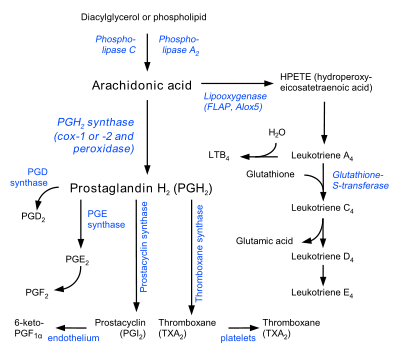
by 5-lipoxygenase. The catalytic mechanism involves the insertion of an oxygen
Oxygen
Oxygen is the element with atomic number 8 and represented by the symbol O. Its name derives from the Greek roots ὀξύς and -γενής , because at the time of naming, it was mistakenly thought that all acids required oxygen in their composition...
moiety at a specific position in the arachidonic acid
Arachidonic acid
Arachidonic acid is a polyunsaturated omega-6 fatty acid 20:4.It is the counterpart to the saturated arachidic acid found in peanut oil, Arachidonic acid (AA, sometimes ARA) is a polyunsaturated omega-6 fatty acid 20:4(ω-6).It is the counterpart to the saturated arachidic acid found in peanut oil,...
backbone.
The lipoxygenase pathway is active in leukocytes, including mast cell
Mast cell
A mast cell is a resident cell of several types of tissues and contains many granules rich in histamine and heparin...
s, eosinophils, neutrophils, monocyte
Monocyte
Monocytes are a type of white blood cell and are part of the innate immune system of vertebrates including all mammals , birds, reptiles, and fish. Monocytes play multiple roles in immune function...
s, and basophils. When such cells are activated, arachidonic acid is liberated from cell membrane phospholipids by phospholipase A2
Phospholipase A2
Phospholipases A2 are enzymes that release fatty acids from the second carbon group of glycerol. This particular phospholipase specifically recognizes the sn-2 acyl bond of phospholipids and catalytically hydrolyzes the bond releasing arachidonic acid and lysophospholipids...
, and donated by the 5-lipoxygenase-activating protein (FLAP) to 5-lipoxygenase.
5-Lipoxygenase
Lipoxygenase
Lipoxygenases are a family of iron-containing enzymes that catalyse the dioxygenation of polyunsaturated fatty acids in lipids containing a cis,cis-1,4- pentadiene structure. It catalyses the following reaction:...
(5-LO) uses FLAP to convert arachidonic acid
Arachidonic acid
Arachidonic acid is a polyunsaturated omega-6 fatty acid 20:4.It is the counterpart to the saturated arachidic acid found in peanut oil, Arachidonic acid (AA, sometimes ARA) is a polyunsaturated omega-6 fatty acid 20:4(ω-6).It is the counterpart to the saturated arachidic acid found in peanut oil,...
into 5-hydroperoxyeicosatetraenoic acid (5-HPETE), which spontaneously reduces
Redox
Redox reactions describe all chemical reactions in which atoms have their oxidation state changed....
to 5-hydroxyeicosatetraenoic acid
5-hydroxyeicosatetraenoic acid
5-Hydroxyeicosatetraenoic acid is an endogenous eicosanoid. 5-HETE is an intermediate in the pathway of leukotriene synthesis. In addition, it is a modulator of tubuloglomerular feedback.-See also:* 12-Hydroxyeicosatetraenoic acid...
(5-HETE). The enzyme 5-LO acts again on 5-HETE to convert it into leukotriene A4
Leukotriene A4
Leukotriene A4 is a leukotriene.Leukotriene A4 hydrolase converts it to Leukotriene B4....
(LTA4), an unstable epoxide.
In cells equipped with LTA4 hydrolase, such as neutrophils and monocytes, LTA4 is converted to the dihydroxy acid leukotriene LTB4, which is a powerful chemoattractant for neutrophils acting at BLT1 and BLT2 receptors on the plasma membrane of these cells.
In cells that express LTC4 synthase
Leukotriene C4 synthase
Leukotriene C4 synthase is an enzyme that in humans is encoded by the LTC4S gene.The protein encoded by this gene, LTC4S is an enzyme that converts leukotriene A4 and glutathione to create leukotriene C4. This is a member of MAPEG family of transmembrane proteins...
, such as mast cells and eosinophils, LTA4 is conjugated with the tripeptide glutathione
Glutathione
Glutathione is a tripeptide that contains an unusual peptide linkage between the amine group of cysteine and the carboxyl group of the glutamate side-chain...
to form the first of the cysteinyl-leukotrienes, LTC4. Outside the cell, LTC4 can be converted by ubiquitous enzymes to form successively LTD4 and LTE4, which retain biological activity.
The cysteinyl-leukotrienes act at their cell-surface receptors CysLT1 and CysLT2 on target cells to contract bronchial and vascular smooth muscle, to increase permeability of small blood vessels, to enhance secretion of mucus in the airway and gut, and to recruit leukocytes to sites of inflammation.
Both LTB4 and the cysteinyl-leukotrienes (LTC4, LTD4, LTE4) are partly degraded in local tissues, and ultimately become inactive metabolites in the liver.
Function
Leukotrienes act principally on a subfamily of G protein-coupled receptorG protein-coupled receptor
G protein-coupled receptors , also known as seven-transmembrane domain receptors, 7TM receptors, heptahelical receptors, serpentine receptor, and G protein-linked receptors , comprise a large protein family of transmembrane receptors that sense molecules outside the cell and activate inside signal...
s. They may also act upon peroxisome proliferator-activated receptor
Peroxisome proliferator-activated receptor
In the field of molecular biology, the peroxisome proliferator-activated receptors are a group of nuclear receptor proteins that function as transcription factors regulating the expression of genes...
s. Leukotrienes are involved in asthmatic and allergic reactions and act to sustain inflammatory reactions. Several leukotriene receptor antagonists such as montelukast
Montelukast
Montelukast is a leukotriene receptor antagonist used for the maintenance treatment of asthma and to relieve symptoms of seasonal allergies. It is usually administered orally...
and zafirlukast
Zafirlukast
Zafirlukast is an oral leukotriene receptor antagonist for the maintenance treatment of asthma, often used in conjunction with an inhaled steroid and/or long-acting bronchodilator. It is available as a tablet and is usually dosed twice daily. Another leukotriene receptor antagonist is montelukast...
are used to treat asthma
Asthma
Asthma is the common chronic inflammatory disease of the airways characterized by variable and recurring symptoms, reversible airflow obstruction, and bronchospasm. Symptoms include wheezing, coughing, chest tightness, and shortness of breath...
. Recent research points to a role of 5-lipoxygenase in cardiovascular and neuropsychiatric illnesses.
Leukotrienes are very important agents in the inflammatory
Inflammation
Inflammation is part of the complex biological response of vascular tissues to harmful stimuli, such as pathogens, damaged cells, or irritants. Inflammation is a protective attempt by the organism to remove the injurious stimuli and to initiate the healing process...
response. Some such as LTB4 have a chemotactic effect on migrating neutrophils, and as such help to bring the necessary cells to the tissue. Leukotrienes also have a powerful effect in bronchoconstriction
Bronchoconstriction
Bronchoconstriction is the constriction of the airways in the lungs due to the tightening of surrounding smooth muscle, with consequent coughing, wheezing, and shortness of breath. Bronchoconstriction can also be due to an accumulation of thick mucus....
and increase vascular permeability
Vascular permeability
Vascular permeability, often in the form of capillary permeability, characterizes the capacity of a blood vessel wall to allow for the flow of small molecules or even whole cells in and out of the vessel. Blood vessel walls are lined by a single layer of endothelial cells...
.
Leukotrienes in asthma
Leukotrienes contribute to the pathophysiologyPathophysiology
Pathophysiology is the study of the changes of normal mechanical, physical, and biochemical functions, either caused by a disease, or resulting from an abnormal syndrome...
of asthma
Asthma
Asthma is the common chronic inflammatory disease of the airways characterized by variable and recurring symptoms, reversible airflow obstruction, and bronchospasm. Symptoms include wheezing, coughing, chest tightness, and shortness of breath...
, causing or potentiating
Potentiator
In clinical terms, a potentiator is a reagent that enhances sensitization of an antigen. Potentiators are used in the clinical laboratory for performing blood banking procedures that require enhancement of agglutination in order to detect the presence of antibodies or antigens in a patient's blood...
the following symptom
Symptom
A symptom is a departure from normal function or feeling which is noticed by a patient, indicating the presence of disease or abnormality...
s:
- airflow obstruction
- increased secretion of mucus
- mucosal accumulation
- bronchoconstriction
- infiltration of inflammatory cells in the airway wall
Role of cysteinyl leukotrienes
Cysteinyl leukotriene receptors CysLT1 and CysLT2 are present on mast cells, eosinophil, and endothelial cells. During cysteinyl leukotriene interaction, they can stimulate proinflammatory activities such as endothelial cell adherence and chemokine production by mast cells. As well as mediating inflammationInflammation
Inflammation is part of the complex biological response of vascular tissues to harmful stimuli, such as pathogens, damaged cells, or irritants. Inflammation is a protective attempt by the organism to remove the injurious stimuli and to initiate the healing process...
, they induce asthma and other inflammatory disorders, thereby reducing the airflow to the alveoli.
In excess, the cysteinyl leukotrienes can induce anaphylactic shock
Anaphylaxis
Anaphylaxis is defined as "a serious allergic reaction that is rapid in onset and may cause death". It typically results in a number of symptoms including throat swelling, an itchy rash, and low blood pressure...
.
See also
- A chemical synthesis of Leukotriene A methyl ester
Eoxins (14,15-leukotrienes)