

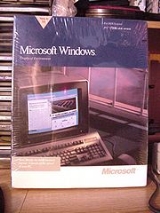
Windows 3.0

Encyclopedia
Windows 3.0, a graphical environment, is the third major release of Microsoft Windows
, and was released on 22 May 1990. It became the first widely successful version of Windows and a rival to Apple Macintosh
and the Commodore Amiga on the GUI
front. It was followed by Windows 3.1
.
and included a significantly revamped user interface
as well as technical improvements to make better use of the memory management
capabilities of Intel's 80286
and 80386
processors. Text-mode programs written for MS-DOS
could be run within a window (a feature previously available in a more limited form with Windows/386 2.1), making the system usable as a crude multitasking
base for legacy programs. However, this was of limited use for the home market, where most games and entertainment programs continued to require raw DOS access.
The MS-DOS Executive file manager/program launcher was replaced with the icon-based Program Manager
and the list-based File Manager, thereby simplifying the launching of applications. The MS-DOS Executive is also included as an alternative to these. The Control Panel, previously available as a standard-looking applet
, was re-modeled after the one in Mac OS
. It centralized system settings, including limited control over the color scheme of the interface.
A number of simple applications were included, such as the text editor Notepad and the word processor Write (both inherited from earlier versions of Windows), a macro recorder (new; later dropped), the paint program Paintbrush (inherited but substantially improved), and a calculator (also inherited). Also, the earlier Reversi
game was complemented with the card game
Solitaire.
The Windows icons and graphics were redesigned to take advantage of VGA
's 16-color mode. Earlier versions only supported eight colors though could run on monochrome video adapters. Windows 3.0 also allowed the user to use a 256 color video adapter, whereas previous versions only supported 16 colors.
Windows 3.0 includes a Protected/Enhanced mode which allows Windows applications to use more memory in a more painless manner than their DOS counterparts could. It can run in any of Real, Standard, or 386 Enhanced modes, and is compatible with any Intel processor from the 8086
/8088
up to 80286
and 80386
. Windows 3.0 tries to auto detect which mode to run in, although it can be forced to run in a specific mode using the switches: /r (real mode
), /s ("standard" 286 protected mode
) and /3 (386 enhanced protected mode
) respectively. Due to this backward compatibility of the whole system, Windows 3.0 applications also must be compiled for 16-bit
mode, without ever using the full 32-bit
capabilities of the 386 CPU.
This was the first version to run Windows programs in protected mode, although the 386 enhanced mode kernel
was an enhanced version of the protected mode kernel for Windows/286.
A "multimedia" version, Windows 3.0 with Multimedia Extensions 1.0, was released later in 1991. This was bundled with "multimedia upgrade kits", comprising a CD-ROM drive and a sound card
, such as the Creative Labs Sound Blaster Pro. This version was the precursor to the multimedia features available in Windows 3.1 and later, and was part of Microsoft's specification for the Multimedia PC
.
Windows 3.0 was the last version of Windows to advertise 100% compatibility with older Windows applications. This only applies to real mode.
Also, a Microsoft-compatible mouse is recommended.
Real mode primarily existed as a way to run Windows 2.x
applications. It was removed in Windows 3.1x
. Almost all applications designed for Windows 3.0 had to be run in Standard or 386 Enhanced modes. However, it was necessary to load Windows 3.0 in Real mode to run SWAPFILE.EXE, which allowed users to change virtual memory settings.
Standard mode was used most often as its requirements were more in-line with an average PC of that era – a 286 processor with at least 1 MB of memory. Incidentally, not all 286 and 386 computers remapped memory between 640 KB (the upper limit of Conventional memory
) and 1 MB as extended memory — some did not show memory between 640 KB and 1 MB at all — so on some systems with 1 MB of RAM, there is no extended memory and memory was limited to 640 KB. On such a system, Windows was limited to real mode. Many 386 computers ran Windows 3.0 in Standard mode due to a lack of memory.
386 Enhanced mode implemented all the benefits of Standard mode, plus 32-bit addressing and paging for faster memory access, and virtual 8086 mode
for safer execution of MS-DOS programs: each of them now ran in a virtual machine. In the previous modes, multiple MS-DOS programs could only be run in full-screen, and only the program currently active was executing; but in 386 enhanced mode, they could be run simultaneously in separate windows. This mode required a 386 processor and 1 MB of extended memory (in addition to the base 640KB) – beyond the specifications of most PCs sold in 1990.
s, as well as CD-ROM
drives, which were then becoming increasingly available. The Multimedia Extensions were released to Original Equipment Manufacturers (OEMs)
, mainly CD-ROM drive and sound card manufacturers, and added basic multimedia
support for audio input and output and a CD
audio player application to Windows 3.0. The Multimedia Extensions' new features were not available in Windows 3.0 real mode. Windows 3.1x
would later incorporate many of its features. Microsoft developed the Windows Sound System
sound card specification to complement these extensions.
The MME API was the first universal and standardized Windows audio API. Wave sound events played in Windows (up to Windows XP
) and MIDI I/O use MME. The devices listed in the Multimedia/Sounds and Audio control panel applet represent the MME API of the sound card
driver.
MME lacks channel mixing, so only one audio stream can be rendered at a time. MME supports sharing the audio device for playback between multiple applications starting with Windows 2000
, up to two channels of recording, 16-bit audio bit depth
and sampling rate
s of up to 44.1 kHz with all the audio being mixed and sampled to 44.1 kHz.
had previously shipped all of its computers with Windows 1.0 or later 2.x on diskettes but committed early in the development of Windows 3.0 to shipping it pre-installed. Indeed, the Zenith division had pushed Microsoft hard to develop the graphical user interface because of Zenith's direct competition with Apple
in the college and university market.
Windows 3.0 was not available as a run-time version, as was the case with its predecessors. A limited-use version of Windows 2.x was often bundled with other applications (i.e. Ami Pro) due to the low market penetration of Windows itself. It again was unsupported after December 31, 2001.
Microsoft Windows
Microsoft Windows is a series of operating systems produced by Microsoft.Microsoft introduced an operating environment named Windows on November 20, 1985 as an add-on to MS-DOS in response to the growing interest in graphical user interfaces . Microsoft Windows came to dominate the world's personal...
, and was released on 22 May 1990. It became the first widely successful version of Windows and a rival to Apple Macintosh
Macintosh
The Macintosh , or Mac, is a series of several lines of personal computers designed, developed, and marketed by Apple Inc. The first Macintosh was introduced by Apple's then-chairman Steve Jobs on January 24, 1984; it was the first commercially successful personal computer to feature a mouse and a...
and the Commodore Amiga on the GUI
Graphical user interface
In computing, a graphical user interface is a type of user interface that allows users to interact with electronic devices with images rather than text commands. GUIs can be used in computers, hand-held devices such as MP3 players, portable media players or gaming devices, household appliances and...
front. It was followed by Windows 3.1
Windows 3.1x
Windows 3.1x is a series of 16-bit operating systems produced by Microsoft for use on personal computers. The series began with Windows 3.1, which was first sold during March 1992 as a successor to Windows 3.0...
.
Features
Windows 3.0 succeeded Windows 2.1xWindows 2.1x
Windows 2.1x is a family of Microsoft Windows graphical user interface-based operating environments.Windows/286 2.10 and Windows/386 2.10 were released on May 27, 1988, less than a year after the release of Windows 2.0...
and included a significantly revamped user interface
User interface
The user interface, in the industrial design field of human–machine interaction, is the space where interaction between humans and machines occurs. The goal of interaction between a human and a machine at the user interface is effective operation and control of the machine, and feedback from the...
as well as technical improvements to make better use of the memory management
Memory management
Memory management is the act of managing computer memory. The essential requirement of memory management is to provide ways to dynamically allocate portions of memory to programs at their request, and freeing it for reuse when no longer needed. This is critical to the computer system.Several...
capabilities of Intel's 80286
Intel 80286
The Intel 80286 , introduced on 1 February 1982, was a 16-bit x86 microprocessor with 134,000 transistors. Like its contemporary simpler cousin, the 80186, it could correctly execute most software written for the earlier Intel 8086 and 8088...
and 80386
Intel 80386
The Intel 80386, also known as the i386, or just 386, was a 32-bit microprocessor introduced by Intel in 1985. The first versions had 275,000 transistors and were used as the central processing unit of many workstations and high-end personal computers of the time...
processors. Text-mode programs written for MS-DOS
MS-DOS
MS-DOS is an operating system for x86-based personal computers. It was the most commonly used member of the DOS family of operating systems, and was the main operating system for IBM PC compatible personal computers during the 1980s to the mid 1990s, until it was gradually superseded by operating...
could be run within a window (a feature previously available in a more limited form with Windows/386 2.1), making the system usable as a crude multitasking
Computer multitasking
In computing, multitasking is a method where multiple tasks, also known as processes, share common processing resources such as a CPU. In the case of a computer with a single CPU, only one task is said to be running at any point in time, meaning that the CPU is actively executing instructions for...
base for legacy programs. However, this was of limited use for the home market, where most games and entertainment programs continued to require raw DOS access.
The MS-DOS Executive file manager/program launcher was replaced with the icon-based Program Manager
Program Manager
Program Manager is the shell of Windows 3.x and Windows NT 3.x operating systems. This shell exposed a task-oriented graphical user interface , consisting of icons arranged into program groups. It replaced MS-DOS Executive, a file manager, as the default Windows shell.The program derives from the...
and the list-based File Manager, thereby simplifying the launching of applications. The MS-DOS Executive is also included as an alternative to these. The Control Panel, previously available as a standard-looking applet
Applet
In computing, an applet is any small application that performs one specific task that runs within the scope of a larger program, often as a plug-in. An applet typically also refers to Java applets, i.e., programs written in the Java programming language that are included in a web page...
, was re-modeled after the one in Mac OS
Mac OS
Mac OS is a series of graphical user interface-based operating systems developed by Apple Inc. for their Macintosh line of computer systems. The Macintosh user experience is credited with popularizing the graphical user interface...
. It centralized system settings, including limited control over the color scheme of the interface.
A number of simple applications were included, such as the text editor Notepad and the word processor Write (both inherited from earlier versions of Windows), a macro recorder (new; later dropped), the paint program Paintbrush (inherited but substantially improved), and a calculator (also inherited). Also, the earlier Reversi
Reversi
Reversi is a board game involving abstract strategy and played by two players on a board with 8 rows and 8 columns and a set of distinct pieces for each side. Pieces typically are disks with a light and a dark face, each face belonging to one player...
game was complemented with the card game
Card game
A card game is any game using playing cards as the primary device with which the game is played, be they traditional or game-specific. Countless card games exist, including families of related games...
Solitaire.
The Windows icons and graphics were redesigned to take advantage of VGA
Video Graphics Array
Video Graphics Array refers specifically to the display hardware first introduced with the IBM PS/2 line of computers in 1987, but through its widespread adoption has also come to mean either an analog computer display standard, the 15-pin D-subminiature VGA connector or the 640×480 resolution...
's 16-color mode. Earlier versions only supported eight colors though could run on monochrome video adapters. Windows 3.0 also allowed the user to use a 256 color video adapter, whereas previous versions only supported 16 colors.
Windows 3.0 includes a Protected/Enhanced mode which allows Windows applications to use more memory in a more painless manner than their DOS counterparts could. It can run in any of Real, Standard, or 386 Enhanced modes, and is compatible with any Intel processor from the 8086
Intel 8086
The 8086 is a 16-bit microprocessor chip designed by Intel between early 1976 and mid-1978, when it was released. The 8086 gave rise to the x86 architecture of Intel's future processors...
/8088
Intel 8088
The Intel 8088 microprocessor was a variant of the Intel 8086 and was introduced on July 1, 1979. It had an 8-bit external data bus instead of the 16-bit bus of the 8086. The 16-bit registers and the one megabyte address range were unchanged, however...
up to 80286
Intel 80286
The Intel 80286 , introduced on 1 February 1982, was a 16-bit x86 microprocessor with 134,000 transistors. Like its contemporary simpler cousin, the 80186, it could correctly execute most software written for the earlier Intel 8086 and 8088...
and 80386
Intel 80386
The Intel 80386, also known as the i386, or just 386, was a 32-bit microprocessor introduced by Intel in 1985. The first versions had 275,000 transistors and were used as the central processing unit of many workstations and high-end personal computers of the time...
. Windows 3.0 tries to auto detect which mode to run in, although it can be forced to run in a specific mode using the switches: /r (real mode
Real mode
Real mode, also called real address mode, is an operating mode of 80286 and later x86-compatible CPUs. Real mode is characterized by a 20 bit segmented memory address space and unlimited direct software access to all memory, I/O addresses and peripheral hardware...
), /s ("standard" 286 protected mode
Protected mode
In computing, protected mode, also called protected virtual address mode, is an operational mode of x86-compatible central processing units...
) and /3 (386 enhanced protected mode
Protected mode
In computing, protected mode, also called protected virtual address mode, is an operational mode of x86-compatible central processing units...
) respectively. Due to this backward compatibility of the whole system, Windows 3.0 applications also must be compiled for 16-bit
16-bit
-16-bit architecture:The HP BPC, introduced in 1975, was the world's first 16-bit microprocessor. Prominent 16-bit processors include the PDP-11, Intel 8086, Intel 80286 and the WDC 65C816. The Intel 8088 was program-compatible with the Intel 8086, and was 16-bit in that its registers were 16...
mode, without ever using the full 32-bit
32-bit
The range of integer values that can be stored in 32 bits is 0 through 4,294,967,295. Hence, a processor with 32-bit memory addresses can directly access 4 GB of byte-addressable memory....
capabilities of the 386 CPU.
This was the first version to run Windows programs in protected mode, although the 386 enhanced mode kernel
Kernel (computing)
In computing, the kernel is the main component of most computer operating systems; it is a bridge between applications and the actual data processing done at the hardware level. The kernel's responsibilities include managing the system's resources...
was an enhanced version of the protected mode kernel for Windows/286.
A "multimedia" version, Windows 3.0 with Multimedia Extensions 1.0, was released later in 1991. This was bundled with "multimedia upgrade kits", comprising a CD-ROM drive and a sound card
Sound card
A sound card is an internal computer expansion card that facilitates the input and output of audio signals to and from a computer under control of computer programs. The term sound card is also applied to external audio interfaces that use software to generate sound, as opposed to using hardware...
, such as the Creative Labs Sound Blaster Pro. This version was the precursor to the multimedia features available in Windows 3.1 and later, and was part of Microsoft's specification for the Multimedia PC
Multimedia PC
The Multimedia PC, or MPC, was a recommended configuration for a PC with a CD-ROM drive. The standard was set and named by the "Multimedia PC Marketing Council", which was a working group of the Software Publishers Association . The MPMC comprised companies including Microsoft, Creative Labs,...
.
Windows 3.0 was the last version of Windows to advertise 100% compatibility with older Windows applications. This only applies to real mode.
System requirements
The official system requirements for Windows 3.0:- 8086Intel 8086The 8086 is a 16-bit microprocessor chip designed by Intel between early 1976 and mid-1978, when it was released. The 8086 gave rise to the x86 architecture of Intel's future processors...
/8088Intel 8088The Intel 8088 microprocessor was a variant of the Intel 8086 and was introduced on July 1, 1979. It had an 8-bit external data bus instead of the 16-bit bus of the 8086. The 16-bit registers and the one megabyte address range were unchanged, however...
processor or better - 384K of free conventional memory (real mode, protected modes require more)
- Hard disk with 6-7MB of free space
- CGAColor Graphics AdapterThe Color Graphics Adapter , originally also called the Color/Graphics Adapter or IBM Color/Graphics Monitor Adapter, introduced in 1981, was IBM's first color graphics card, and the first color computer display standard for the IBM PC....
/EGAEnhanced Graphics AdapterThe Enhanced Graphics Adapter is the IBM PC computer display standard specification which is between CGA and VGA in terms of color and space resolution. Introduced in October 1984 by IBM shortly after its new PC/AT, EGA produces a display of 16 simultaneous colors from a palette of 64 at a...
/VGAVideo Graphics ArrayVideo Graphics Array refers specifically to the display hardware first introduced with the IBM PS/2 line of computers in 1987, but through its widespread adoption has also come to mean either an analog computer display standard, the 15-pin D-subminiature VGA connector or the 640×480 resolution...
/HerculesHercules Graphics CardThe Hercules Graphics Card was a computer graphics controller made by Hercules Computer Technology, Inc. which, through its popularity, became a widely supported display standard. It was common on IBM PC compatibles connected to a monochrome monitor . It supported one high resolution text mode and...
/8514/A graphics and an appropriate and compatible monitor
- MS-DOSMS-DOSMS-DOS is an operating system for x86-based personal computers. It was the most commonly used member of the DOS family of operating systems, and was the main operating system for IBM PC compatible personal computers during the 1980s to the mid 1990s, until it was gradually superseded by operating...
version 3.1 or higher
Also, a Microsoft-compatible mouse is recommended.
Memory modes
Windows 3.0 was the only version of Windows that could be run in three different memory modes:- Real mode, intended for older computers with a CPU below Intel 80286Intel 80286The Intel 80286 , introduced on 1 February 1982, was a 16-bit x86 microprocessor with 134,000 transistors. Like its contemporary simpler cousin, the 80186, it could correctly execute most software written for the earlier Intel 8086 and 8088...
, and corresponding to its real modeReal modeReal mode, also called real address mode, is an operating mode of 80286 and later x86-compatible CPUs. Real mode is characterized by a 20 bit segmented memory address space and unlimited direct software access to all memory, I/O addresses and peripheral hardware...
; - Standard mode, intended for computers with an 80286 processor, and corresponding to its protected modeProtected modeIn computing, protected mode, also called protected virtual address mode, is an operational mode of x86-compatible central processing units...
; - 386 Enhanced mode, intended for newer computers with an Intel 80386Intel 80386The Intel 80386, also known as the i386, or just 386, was a 32-bit microprocessor introduced by Intel in 1985. The first versions had 275,000 transistors and were used as the central processing unit of many workstations and high-end personal computers of the time...
processor or above, and corresponding to its protected mode and virtual 8086 modeVirtual 8086 modeIn the 80386 microprocessor and later, virtual 8086 mode allows the execution of real mode applications that are incapable of running directly in protected mode while the processor is running a protected mode operating system.VM86 mode uses a segmentation scheme identical to that of real mode In...
.
Real mode primarily existed as a way to run Windows 2.x
Windows 2.x
Windows 2.x can refer to either an individual or all of the following versions of Microsoft Windows:* Windows 2.0* Windows 2.1x...
applications. It was removed in Windows 3.1x
Windows 3.1x
Windows 3.1x is a series of 16-bit operating systems produced by Microsoft for use on personal computers. The series began with Windows 3.1, which was first sold during March 1992 as a successor to Windows 3.0...
. Almost all applications designed for Windows 3.0 had to be run in Standard or 386 Enhanced modes. However, it was necessary to load Windows 3.0 in Real mode to run SWAPFILE.EXE, which allowed users to change virtual memory settings.
Standard mode was used most often as its requirements were more in-line with an average PC of that era – a 286 processor with at least 1 MB of memory. Incidentally, not all 286 and 386 computers remapped memory between 640 KB (the upper limit of Conventional memory
Conventional memory
In DOS memory management, conventional memory, also called base memory, is the first 640 kilobytes of the memory on IBM PC or compatible systems. It is the read-write memory usable by the operating system and application programs...
) and 1 MB as extended memory — some did not show memory between 640 KB and 1 MB at all — so on some systems with 1 MB of RAM, there is no extended memory and memory was limited to 640 KB. On such a system, Windows was limited to real mode. Many 386 computers ran Windows 3.0 in Standard mode due to a lack of memory.
386 Enhanced mode implemented all the benefits of Standard mode, plus 32-bit addressing and paging for faster memory access, and virtual 8086 mode
Virtual 8086 mode
In the 80386 microprocessor and later, virtual 8086 mode allows the execution of real mode applications that are incapable of running directly in protected mode while the processor is running a protected mode operating system.VM86 mode uses a segmentation scheme identical to that of real mode In...
for safer execution of MS-DOS programs: each of them now ran in a virtual machine. In the previous modes, multiple MS-DOS programs could only be run in full-screen, and only the program currently active was executing; but in 386 enhanced mode, they could be run simultaneously in separate windows. This mode required a 386 processor and 1 MB of extended memory (in addition to the base 640KB) – beyond the specifications of most PCs sold in 1990.
Multimedia Extensions
The Multimedia Extensions were released in autumn 1991 to support sound cardSound card
A sound card is an internal computer expansion card that facilitates the input and output of audio signals to and from a computer under control of computer programs. The term sound card is also applied to external audio interfaces that use software to generate sound, as opposed to using hardware...
s, as well as CD-ROM
CD-ROM
A CD-ROM is a pre-pressed compact disc that contains data accessible to, but not writable by, a computer for data storage and music playback. The 1985 “Yellow Book” standard developed by Sony and Philips adapted the format to hold any form of binary data....
drives, which were then becoming increasingly available. The Multimedia Extensions were released to Original Equipment Manufacturers (OEMs)
Original Equipment Manufacturer
An original equipment manufacturer, or OEM, manufactures products or components that are purchased by a company and retailed under that purchasing company's brand name. OEM refers to the company that originally manufactured the product. When referring to automotive parts, OEM designates a...
, mainly CD-ROM drive and sound card manufacturers, and added basic multimedia
Multimedia
Multimedia is media and content that uses a combination of different content forms. The term can be used as a noun or as an adjective describing a medium as having multiple content forms. The term is used in contrast to media which use only rudimentary computer display such as text-only, or...
support for audio input and output and a CD
Compact Disc
The Compact Disc is an optical disc used to store digital data. It was originally developed to store and playback sound recordings exclusively, but later expanded to encompass data storage , write-once audio and data storage , rewritable media , Video Compact Discs , Super Video Compact Discs ,...
audio player application to Windows 3.0. The Multimedia Extensions' new features were not available in Windows 3.0 real mode. Windows 3.1x
Windows 3.1x
Windows 3.1x is a series of 16-bit operating systems produced by Microsoft for use on personal computers. The series began with Windows 3.1, which was first sold during March 1992 as a successor to Windows 3.0...
would later incorporate many of its features. Microsoft developed the Windows Sound System
Windows Sound System
Windows Sound System was a sound card specification developed by Microsoft for use in their Windows 3.0 with MPC extensions. WSS featured support for up to 16-bit 48 kHz digital sampling, better than the contemporary Sound Blaster Pro...
sound card specification to complement these extensions.
The MME API was the first universal and standardized Windows audio API. Wave sound events played in Windows (up to Windows XP
Windows XP
Windows XP is an operating system produced by Microsoft for use on personal computers, including home and business desktops, laptops and media centers. First released to computer manufacturers on August 24, 2001, it is the second most popular version of Windows, based on installed user base...
) and MIDI I/O use MME. The devices listed in the Multimedia/Sounds and Audio control panel applet represent the MME API of the sound card
Sound card
A sound card is an internal computer expansion card that facilitates the input and output of audio signals to and from a computer under control of computer programs. The term sound card is also applied to external audio interfaces that use software to generate sound, as opposed to using hardware...
driver.
MME lacks channel mixing, so only one audio stream can be rendered at a time. MME supports sharing the audio device for playback between multiple applications starting with Windows 2000
Windows 2000
Windows 2000 is a line of operating systems produced by Microsoft for use on personal computers, business desktops, laptops, and servers. Windows 2000 was released to manufacturing on 15 December 1999 and launched to retail on 17 February 2000. It is the successor to Windows NT 4.0, and is the...
, up to two channels of recording, 16-bit audio bit depth
Audio bit depth
In digital audio, bit depth describes the number of bits of information recorded for each sample. Bit depth directly corresponds to the resolution of each sample in a set of digital audio data...
and sampling rate
Sampling rate
The sampling rate, sample rate, or sampling frequency defines the number of samples per unit of time taken from a continuous signal to make a discrete signal. For time-domain signals, the unit for sampling rate is hertz , sometimes noted as Sa/s...
s of up to 44.1 kHz with all the audio being mixed and sampled to 44.1 kHz.
Marketing
This version of Windows was the first to be pre-installed on hard drives by PC-compatible manufacturers. Zenith Data SystemsZenith Data Systems
Zenith Data Systems was a division of Zenith founded in 1979 after Zenith acquired Heathkit, which had, in 1977, entered the personal computer market. Headquartered in Benton Harbor, Michigan, Zenith sold personal computers under both the Heath/Zenith and Zenith Data Systems names...
had previously shipped all of its computers with Windows 1.0 or later 2.x on diskettes but committed early in the development of Windows 3.0 to shipping it pre-installed. Indeed, the Zenith division had pushed Microsoft hard to develop the graphical user interface because of Zenith's direct competition with Apple
Apple Computer
Apple Inc. is an American multinational corporation that designs and markets consumer electronics, computer software, and personal computers. The company's best-known hardware products include the Macintosh line of computers, the iPod, the iPhone and the iPad...
in the college and university market.
Windows 3.0 was not available as a run-time version, as was the case with its predecessors. A limited-use version of Windows 2.x was often bundled with other applications (i.e. Ami Pro) due to the low market penetration of Windows itself. It again was unsupported after December 31, 2001.
External links
- GUIdebook: Windows 3.0 Gallery - A website dedicated to preserving and showcasing Graphical User Interfaces
- Windows 3.1 Rocks Mailing List Support, links and freeware downloads for users of Windows 3x.
- Windows 3.0 Modes and Memory Requirements