


Kubera

Encyclopedia
Kubera also spelt Kuber, is the Lord of wealth and the god-king of the semi-divine Yakshas in Hindu mythology
. He is regarded as the regent of the North
(Dik-pala), and a protector of the world (Lokapala
) His many epithets extol him as the overlord of numerous semi-divine species and the owner of the treasures of the world. Kubera is often depicted as a fat man, adorned with jewels and carrying a money-pot or money-bag, and a club.
Originally described as the chief of evil spirits in Vedic-era texts, Kubera acquired the status of a Deva
(god) only in the Puranas and the Hindu epics. The scriptures describe that Kubera once ruled Lanka
, but was overthrown by his demon stepbrother Ravana
, later settling in the city of Alaka
in the Himalayas
. Descriptions of the "glory" and "splendours" of Kubera's city are found in many scriptures.
Kubera has also been assimilated into the Buddhist and Jain pantheons. In Buddhism, he is known as Vaisravana
, the patronymic used of the Hindu Kubera and is also equated with Pañcika
, while in Jainism, he is known as Sarvanubhuti.
or a money bag in his hand. He may also carry a sheaf of jewels or a mongoose
with him. In Tibet, the mongoose is considered a symbol of Kubera's victory over Nāga
s—the guardians of treasures. Kubera is usually depicted with a mongoose in Buddhist iconography.
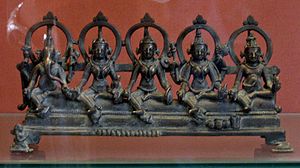 In the Vishnudharmottara Purana
, Kubera is described as the embodiment of both Artha
("wealth, prosperity, glory") and Arthashastra
s, the treatises related to it—and his iconography mirrors it. Kubera's complexion is described as that of lotus leaves. He rides a man—the state
personified, adorned in golden clothes and ornaments, symbolizing his wealth. His left eye is yellow. He wears an armour and a necklace down to his large belly. The Vishnudharmottara Purana further describes his face to be inclined to the left, sporting a beard and mustache, and with two small tusks protruding from the ends of his mouth, representing his powers to punish and to bestow favours. His wife Riddhi, representing the journey of life, is seated on his left lap, with her left hand on the back of Kubera and the right holding a ratna-patra (jewel-pot). Kubera should be four-armed, holding a gada (mace: symbol of dandaniti—administration of justice) and a shakti
(power) in his left pair, and standards bearing a lion—representing Artha and a shibika (a club, the weapon of Kubera). The nidhi
treasures Padma and Shankha stand beside him in human form, with their heads emerging from a lotus and a conch respectively.
The Agni Purana
states that Kubera should be installed in temples as seated on a goat, and with a club in his hand. Kubera's image is prescribed to be that of gold, with multi-coloured attributes. In some sources, especially in Jain depictions, Kubera is depicted as a drunkard, signified by the "nectar vessel" in his hand.
As the son of Vishrava ("Fame"), Kubera is called Vaisravana (in the Pali language
, Vessavana) and as the son of Ilavila, Ailavila. Vaisravana is sometimes translated as the "Son of Fame". The Sutta Nitapa commentary says that Vaisravana is derived from a name of Kubera's kingdom, Visana. Once, Kubera looked at Shiva and his wife Parvati
with jealousy, so he lost one of his eyes. Parvati also turned this deformed eye yellow. So, Kubera gained the name Ekaksipingala ("one who has one yellow eye"). He is also called Bhutesha ("Lord of spirits") like Shiva. Kubera usually is drawn by spirits or men (nara), so is called Nara-vahana, one whose vahana
(mount) is nara. Hopkins
interprets naras as being water-spirits, although Mani translates nara as men. Kubera also rides the elephant called Sarvabhauma as a loka-pala.
Kubera also enjoys the titles "king of the whole world", "king of kings" (Rajaraja), "Lord of wealth" (Dhanadhipati) and "giver of wealth" (Dhanada). His titles are sometimes related to his subjects: "king of Yaksha
s" (Yaksharajan), "Lord of Rakshasa
s" (Rakshasadhipati), "Lord of Guhyakas" (Guhyakadhipa), "king of Kinnara
s"(Kinnararaja), "king of animals resembling men" (Mayuraja), and "king of men" (Nararaja). Kubera is also called Guhyadhipa ("Lord of the hidden"). The Atharvaveda
calls him the "god of hiding".
, Kubera is the chief of evil spirits or spirits of darkness, and son of Vaishravana. The Shatapatha Brahmana calls him the Lord of thieves and criminals. In the Manusmriti, he becomes a respectable Loka-pala ("world protector") and the patron of merchants. In the epic Mahabharata
, Kubera is described as the son of Prajapati
Pulastya
and his wife Idavida and the brother of sage Vishrava
. Kubera is described as born from a cow. However, from the Puranas, he is described as the grandson of Pulastya and the son of Vishrava and his wife Ilavida
(or Ilivila or Devavarnini), daughter of the sage Bharadvaja or Trinabindu.
By this time, though still described as an asura
(demon), Kubera is offered prayers at the end of all ritual sacrifices. His titles, such as "best of kings" and "Lord of kings" (Harivamsa
indicate that Kubera is made "Lord of kings"), in contrast to the god-king of heaven, Indra
, whose title of "best of gods" led to the later belief that Kubera was a man. The early texts Gautama Dharmashastra
and Apastamba
describe him as a man. Only the Grihyasutras of Shankhayana and Hiranyakesin call him a god, and suggest offerings of meat, sesame seeds and flowers to him.
grant Kubera unquestioned godhood. Kubera also acquired the status of the "Lord of riches" and the wealthiest Deva. He also becomes a Loka-pala ("world protector") and guardian (dik-pala) of the North direction
, although he is also sometimes associated with the East. Kubera's status as a Loka-pala and a dik-pala is assured in the Ramayana, but in the Mahabharata, some lists do not include Kubera. Thus, Kubera is considered a later addition to the original list of Loka-palas, where the gods Agni
or Soma
appear in his place. This status, the Ramayana records, was granted to Kubera by Brahma
—the creator-god and father of Pulastya—as a reward for his severe penance. Brahma also conferred upon Kubera the riches of the world (Nidhi
s), "equality with gods", and the Pushpaka Vimana, a flying chariot. Kubera then ruled in the golden city of Lanka
, identified with modern-day Sri Lanka
. The Mahabharata says that Brahma conferred upon Kubera the lordship of wealth, friendship with Shiva, godhood, status as a world-protector, a son called Nalakubera/Nalakubara, the Pushpaka Vimana and the lordship of the Nairrata demons.
Both the Puranas and the Ramayana feature the half-blood siblings of Kubera. Vishrava, Kubera's father, also married the Rakshasa
(demon) princess Kaikesi
, who mothered four Rakshasa children: Ravana
, the chief antagonist of the Ramayana, Kumbhakarna
, Vibhishana
and Soorpanaka. The Mahabharata regards Vishrava as the brother of Kubera, so Kubera is described as the uncle of Ravana and his siblings. It records that when Kubera approached Brahma for the favour of superseding his father Pulastya, Pulastya created Vishrava. To seek the favour of Vishrava, Kubera sent three women to him, by whom Vishrava begot his demon children. Ravana, after acquiring a boon of Brahma, drove Kubera away from Lanka and seized his Pushpaka Vimana, which was returned to Kubera after Ravana's death. Kubera then settled on Gandhamandana mountain, near Mount Kailash
— the cosmological abode of the god Shiva
—in the Himalayas
. Sometimes, Kailash itself is called Kubera's residence. His city is usually called Alaka
or Alaka-puri ("curl-city"), but also Prabha ("splendour"), Vasudhara ("bejeweled") and Vasu-sthali ("abode of treasures"). There, Kubera had a grove called Caitraratha, where the leaves were jewels and the fruits were girls of heaven. There is also a charming lake called Nalini in the grove. Kubera is often described as a friend of Shiva in the epics. The Padma Purana
says that Kubera prayed to Shiva for many years, and Shiva granted him the kingship of Yakshas.
A description of Kubera's magnificent court appears in the Mahabharata as well as the Meghaduta
. Here, Gandharvas and Apsara
s entertain Kubera. Shiva and his wife Parvati
often frequent Kubera's court, which is attended by semi-divine beings like the Vidyadhara
s; Kimpurusha
s; Rakshasas; Pishacha
s; as well as Padma and Shankha; personified treasures (nidhi
); and Manibhadra, Kubera's chief attendant and chief of his army. Like every world-protector, Kubera has seven seers of the North in residence. Alaka is recorded to be plundered by Ravana once, and attacked by the Pandava
prince, Bhima
once. Kubera's Nairrata army is described to have defeated king Mucukunda, who then defeated them by the advice of his guru Vashishta. Shukra
, the preceptor of the demons, is also recorded to have defeated Kubera and stolen his wealth. Another major tale in the scriptures records how Kubera entertained the sage Ashtavakra
in his palace.
Kubera is the treasurer of the gods and overlord of the semi-divine Yaksha
s, the Guhyakas, Kinnara
s and Gandharva
s, who act as his assistants and protectors of the jewels of the earth, as well as guardians of his city. Kubera is also the guardian of travelers and the giver of wealth to individuals, who please him. The Rakshasas also serve Kubera, however, some cannibalistic Rakshasas are described to have sided with Ravana in the battle against Kubera. Kubera also developed as minor marriage-divinity. He is invoked with Shiva at weddings and is described as Kameshvara ("Lord of Kama
– pleasure, desire etc."). He is associated with fertility of the aquatic type.
The Puranas and the Mahabharata record that Kubera married Bhadra ("auspicious"), or Kauberi ("wife of Kubera"), daughter of the demon
Mura. She is also called Yakshi – a female Yaksha and Charvi ("splendour"). They had three sons: Nalakubara ("Reed-axle"), Manigriva ("Bejewled-neck") or Varna-kavi ("Colourful poet"), and Mayuraja ("king of animals resembling men"); and a daughter called Minakshi ("fish-eyed"). The Mahabharata calls his wife Riddhi ("prosperity") and Nalakubara his son. The goddess of wealth Lakshmi
is sometimes described as his consort.
(a form of the god Vishnu) for his marriage with Padmavati
. In remembrance of this, the reason devotees go to Tirupati
to donate money in Venkateshwara's Hundi ("Donation pot"), is so that he can pay it back to Kubera. Kubera is worshipped with Lakshmi
, the goddess of wealth during Diwali
, which is primarily dedicated to her – usually on the Dhanteras
day.
While Kubera still enjoys prayers as the god of wealth, his role is largely taken by the god of wisdom, fortune and obstacle-removal, Ganesha
, with whom he is generally associated.
Dr. Nagendra Kumar Singh remarked that, "Every Indian religion has a Kubera after the Hindu prototype". He is his namesake in the Buddhist Vaisravana or Jambhala, and the Japanese Bishamon. The Buddhist Vaisravana, like the Hindu Kubera, is the reagent of the North, a Loka-pala and the Lord of Yakshas. He is one of the Four Heavenly Kings
, each associated with a cardinal direction. In Buddhist legends, Kubera is also equated with Pañcika, whose wife Hariti
is the symbol of abundance. The iconography of Kubera and Pancika is so similar that in certain cases, A. Getty comments, it is extremely difficult to distinguish between Pancika and Kubera.
In Jainism, Kubera is the attendant Yaksha of the 19th Tirthankar
Mallinath
. He is usually called Sarvanubhuti or Sarvahna, and may be depicted with four faces, rainbow colours and eight arms. The Digambara
sect of Jainism gives him six weapons and three heads; while the Svetambara
s portray him with four to six arms, numerous choices of weapons, though his attributes, the money bag and citron fruit are consistent. He may ride a man or an elephant. He is related to the Buddhist Jambhala rather than the Hindu Kubera. A pious Jain is expected to worship him daily.
Hindu mythology
Hindu religious literature is the large body of traditional narratives related to Hinduism, notably as contained in Sanskrit literature, such as the Sanskrit epics and the Puranas. As such, it is a subset of Nepali and Indian culture...
. He is regarded as the regent of the North
Guardians of the directions
The Guardians of the Directions are the deities who rule the specific directions of space according to Hinduism and Buddhism—especially...
(Dik-pala), and a protector of the world (Lokapala
Lokapala
Lokapāla, Sanskrit and Pāli for "guardian of the world", has different uses depending on whether it is found in a Hindu or Buddhist context....
) His many epithets extol him as the overlord of numerous semi-divine species and the owner of the treasures of the world. Kubera is often depicted as a fat man, adorned with jewels and carrying a money-pot or money-bag, and a club.
Originally described as the chief of evil spirits in Vedic-era texts, Kubera acquired the status of a Deva
Deva (Hinduism)
' is the Sanskrit word for god or deity, its related feminine term is devi. In modern Hinduism, it can be loosely interpreted as any benevolent supernatural beings. The devs in Hinduism, also called Suras, are often juxtaposed to the Asuras, their half brothers. Devs are also the maintainers of...
(god) only in the Puranas and the Hindu epics. The scriptures describe that Kubera once ruled Lanka
Lanka
Sri Lanka is the name given in Hindu mythology to the island fortress capital of the legendary king Ravana in the great Hindu epics, the Ramayana and the Mahabharata...
, but was overthrown by his demon stepbrother Ravana
Ravana
' is the primary antagonist character of the Hindu legend, the Ramayana; who is the great king of Lanka. In the classic text, he is mainly depicted negatively, kidnapping Rama's wife Sita, to claim vengeance on Rama and his brother Lakshmana for having cut off the nose of his sister...
, later settling in the city of Alaka
Alaka
-In Hinduism:In Hinduism, Alaka , which is also sometimes called Alakapuri, is a mythical city. It is the home of Kubera, the king of Yakshas and the lord of wealth, and his attendants called yakshas. The Mahabharata mentions this city as the capital of the Yaksha Kingdom...
in the Himalayas
Himalayas
The Himalaya Range or Himalaya Mountains Sanskrit: Devanagari: हिमालय, literally "abode of snow"), usually called the Himalayas or Himalaya for short, is a mountain range in Asia, separating the Indian subcontinent from the Tibetan Plateau...
. Descriptions of the "glory" and "splendours" of Kubera's city are found in many scriptures.
Kubera has also been assimilated into the Buddhist and Jain pantheons. In Buddhism, he is known as Vaisravana
Vaisravana
' or ' also known as Jambhala in Tibet and Bishamonten in Japan is the name of the chief of the Four Heavenly Kings and an important figure in Buddhist mythology.-Names:...
, the patronymic used of the Hindu Kubera and is also equated with Pañcika
Pancika
Pañcika was the consort of the Buddhist goddess of children, Hariti. He is himself a Buddhist god, and is said to have fathered 500 children....
, while in Jainism, he is known as Sarvanubhuti.
Iconography
Kubera is often depicted as a dwarf, with fair complexion and a big belly. He is described as having three legs, only eight teeth, one eye, and being adorned with jewels. He is sometimes depicted riding a man. The description of deformities like the broken teeth, three legs, three heads and four arms appear only in the later Puranic texts. Kubera holds a mace, a pomegranatePomegranate
The pomegranate , Punica granatum, is a fruit-bearing deciduous shrub or small tree growing between five and eight meters tall.Native to the area of modern day Iran, the pomegranate has been cultivated in the Caucasus since ancient times. From there it spread to Asian areas such as the Caucasus as...
or a money bag in his hand. He may also carry a sheaf of jewels or a mongoose
Mongoose
Mongoose are a family of 33 living species of small carnivorans from southern Eurasia and mainland Africa. Four additional species from Madagascar in the subfamily Galidiinae, which were previously classified in this family, are also referred to as "mongooses" or "mongoose-like"...
with him. In Tibet, the mongoose is considered a symbol of Kubera's victory over Nāga
Naga
Naga or NAGA may refer to:* Nāga, a group of serpent deities in Hindu and Buddhist mythology.-People:* Nayan / Nayar/Nair people of Kerala Society* Naga people, a diverse ethnic identity in Northeast India...
s—the guardians of treasures. Kubera is usually depicted with a mongoose in Buddhist iconography.
Vishnudharmottara Purana
The Vishnudharmottara Purana is a Hindu text, encyclopedic in nature. Along with the narratives, it also deals with cosmology, cosmogony, geography, astronomy, astrology, division of time, pacification of unfavourbale planets and stars, genealogies , manners and customs, penances, duties of...
, Kubera is described as the embodiment of both Artha
Artha
Artha is a Sanskrit term meaning "purpose, cause, motive, meaning, notion".It refers to the idea of material prosperity. In Hinduism, artha is one of the four goals of life, known as purusharthas. It is considered to be a noble goal as long as it follows the dictates of Vedic morality...
("wealth, prosperity, glory") and Arthashastra
Arthashastra
The Arthashastra is an ancient Indian treatise on statecraft, economic policy and military strategy which identifies its author by the names Kautilya and , who are traditionally identified with The Arthashastra (IAST: Arthaśāstra) is an ancient Indian treatise on statecraft, economic policy and...
s, the treatises related to it—and his iconography mirrors it. Kubera's complexion is described as that of lotus leaves. He rides a man—the state
State (polity)
A state is an organized political community, living under a government. States may be sovereign and may enjoy a monopoly on the legal initiation of force and are not dependent on, or subject to any other power or state. Many states are federated states which participate in a federal union...
personified, adorned in golden clothes and ornaments, symbolizing his wealth. His left eye is yellow. He wears an armour and a necklace down to his large belly. The Vishnudharmottara Purana further describes his face to be inclined to the left, sporting a beard and mustache, and with two small tusks protruding from the ends of his mouth, representing his powers to punish and to bestow favours. His wife Riddhi, representing the journey of life, is seated on his left lap, with her left hand on the back of Kubera and the right holding a ratna-patra (jewel-pot). Kubera should be four-armed, holding a gada (mace: symbol of dandaniti—administration of justice) and a shakti
Shakti
Shakti from Sanskrit shak - "to be able," meaning sacred force or empowerment, is the primordial cosmic energy and represents the dynamic forces that are thought to move through the entire universe in Hinduism. Shakti is the concept, or personification, of divine feminine creative power, sometimes...
(power) in his left pair, and standards bearing a lion—representing Artha and a shibika (a club, the weapon of Kubera). The nidhi
Nidhi
In the context of Hindu mythology, Nidhi, that is, a treasure, constituted of nine treasures belonging to Kubera , the god of wealth. According to the tradition, each nidhi is personified as having a guardian spirit, and some tantrikas worship them...
treasures Padma and Shankha stand beside him in human form, with their heads emerging from a lotus and a conch respectively.
The Agni Purana
Agni Purana
The Agni Purana, one of the 18 Mahapuranas, a genre of Hindu religious texts, contains descriptions and details of various incarnations of Vishnu. It also has details account about Rama, Krishna, Prithvi, and the stars...
states that Kubera should be installed in temples as seated on a goat, and with a club in his hand. Kubera's image is prescribed to be that of gold, with multi-coloured attributes. In some sources, especially in Jain depictions, Kubera is depicted as a drunkard, signified by the "nectar vessel" in his hand.
Names
The exact origins of the name Kubera are unknown. "Kubera" or "Kuvera" (कुवेर) as spelt in later Sanskrit, means "deformed or monstrous" or "ill-shaped one"; indicating his deformities. Another theory suggests that Kubera may be derived from the verb root kumba, meaning to conceal. Kuvera is also split as ku (earth), and vira (hero).As the son of Vishrava ("Fame"), Kubera is called Vaisravana (in the Pali language
Pali language
Pāli is a Middle Indo-Aryan language of the Indian subcontinent. It is best known as the language of many of the earliest extant Buddhist scriptures, as collected in the Pāi Canon or Tipitaka, and as the liturgical language of Theravada Buddhism.-Etymology of the name:The word Pali itself...
, Vessavana) and as the son of Ilavila, Ailavila. Vaisravana is sometimes translated as the "Son of Fame". The Sutta Nitapa commentary says that Vaisravana is derived from a name of Kubera's kingdom, Visana. Once, Kubera looked at Shiva and his wife Parvati
Parvati
Parvati is a Hindu goddess. Parvati is Shakti, the wife of Shiva and the gentle aspect of Mahadevi, the Great Goddess...
with jealousy, so he lost one of his eyes. Parvati also turned this deformed eye yellow. So, Kubera gained the name Ekaksipingala ("one who has one yellow eye"). He is also called Bhutesha ("Lord of spirits") like Shiva. Kubera usually is drawn by spirits or men (nara), so is called Nara-vahana, one whose vahana
Vahana
Vāhana denotes the being, typically an animal or mythical entity, a particular deva is said to use as a vehicle. In this capacity, the vāhana is often called the deity's mount. Upon the partnership between the deva and his vāhana is woven much iconography and mythology...
(mount) is nara. Hopkins
Edward Washburn Hopkins
Edward Washburn Hopkins, Ph.D., LL.D. , American Sanskrit scholar, was born in Northampton, Massachusetts.He graduated at Columbia University in 1878, studied at Leipzig, where he received the degree of Ph.D...
interprets naras as being water-spirits, although Mani translates nara as men. Kubera also rides the elephant called Sarvabhauma as a loka-pala.
Kubera also enjoys the titles "king of the whole world", "king of kings" (Rajaraja), "Lord of wealth" (Dhanadhipati) and "giver of wealth" (Dhanada). His titles are sometimes related to his subjects: "king of Yaksha
Yaksha
Yaksha is the name of a broad class of nature-spirits, usually benevolent, who are caretakers of the natural treasures hidden in the earth and tree roots. They appear in Hindu, Jain and Buddhist mythology. The feminine form of the word is ' or Yakshini .In Hindu, Jain, and Buddhist mythology,...
s" (Yaksharajan), "Lord of Rakshasa
Rakshasa
A Rakshasa or alternatively rakshas, is a race of mythological humanoid beings or unrighteous spirit in Hindu and Buddhist religion...
s" (Rakshasadhipati), "Lord of Guhyakas" (Guhyakadhipa), "king of Kinnara
Kinnara
In Buddhist mythology and Hindu mythology, a kinnara is a paradigmatic lover, a celestial musician, half-human and half-horse or half-bird...
s"(Kinnararaja), "king of animals resembling men" (Mayuraja), and "king of men" (Nararaja). Kubera is also called Guhyadhipa ("Lord of the hidden"). The Atharvaveda
Atharvaveda
The Atharvaveda is a sacred text of Hinduism and one of the four Vedas, often called the "fourth Veda"....
calls him the "god of hiding".
Early descriptions and parentage
In the Atharvaveda—where he first appears—and the Shatapatha BrahmanaShatapatha Brahmana
The Shatapatha Brahmana is one of the prose texts describing the Vedic ritual, associated with the Shukla Yajurveda. It survives in two recensions, Madhyandina and Kanva , with the former having the eponymous 100 adhyayas,7624 kandikas in 14 books, and the latter 104 adhyayas,6806 kandikas in 17...
, Kubera is the chief of evil spirits or spirits of darkness, and son of Vaishravana. The Shatapatha Brahmana calls him the Lord of thieves and criminals. In the Manusmriti, he becomes a respectable Loka-pala ("world protector") and the patron of merchants. In the epic Mahabharata
Mahabharata
The Mahabharata is one of the two major Sanskrit epics of ancient India and Nepal, the other being the Ramayana. The epic is part of itihasa....
, Kubera is described as the son of Prajapati
Prajapati
In Hinduism, Prajapati "lord of creatures" is a Hindu deity presiding over procreation, and protector of life. He appears as a creator deity or supreme God Viswakarma Vedic deities in RV 10 and in Brahmana literature...
Pulastya
Pulastya
Pulatsya was one of the ten Prajapati or mind-born sons of Brahma, and one of the Saptarishis in the first Manvantara....
and his wife Idavida and the brother of sage Vishrava
Vishrava
Vishrava was the son of Pulastya and the grandson of Brahma, the Creator, and a powerful Rishi as described in a scripture epic of Ancient India. A scholar par excellence, he earned great powers through Tapasya, which in turn, earned him great name and fame amongst his fellow Rishis...
. Kubera is described as born from a cow. However, from the Puranas, he is described as the grandson of Pulastya and the son of Vishrava and his wife Ilavida
Ilavida
Ilavida or Idavida is a character in the Ramayana, as the stepmother of Ravana and the first wife of Vishrava, the son of Brahma, the Creator....
(or Ilivila or Devavarnini), daughter of the sage Bharadvaja or Trinabindu.
By this time, though still described as an asura
Asura
-In Hinduism:In Hinduism, the Asuras constitute a group of power-seeking deities, sometimes considered sinful and materialistic. The Daityas and Danavas were combinedly known as Asuras. The Asura were opposed to the Devas. Both groups are children of Kasyapa...
(demon), Kubera is offered prayers at the end of all ritual sacrifices. His titles, such as "best of kings" and "Lord of kings" (Harivamsa
Harivamsa
The Harivamsha is an important work of Sanskrit literature, containing 16,374 verses, mostly in metre. The text is also known as . This text is believed as a khila to the Mahabharata and is traditionally ascribed to Krishna Dvaipayana Veda Vyasa...
indicate that Kubera is made "Lord of kings"), in contrast to the god-king of heaven, Indra
Indra
' or is the King of the demi-gods or Devas and Lord of Heaven or Svargaloka in Hindu mythology. He is also the God of War, Storms, and Rainfall.Indra is one of the chief deities in the Rigveda...
, whose title of "best of gods" led to the later belief that Kubera was a man. The early texts Gautama Dharmashastra
Dharmasastra
Dharmaśāstra is a genre of Sanskrit texts and refers to the śāstra, or Indic branch of learning, pertaining to Hindu dharma, religious and legal duty. The voluminous textual corpus of Dharmaśāstra is primarily a product of the Brahmanical tradition in India and represents the elaborate scholastic...
and Apastamba
Apastamba
The Dharmasutra of Āpastamba forms a part of the larger Kalpasūtra of Āpastamba. It contains thirty praśnas, which literally means ‘questions’ or books. The subjects of this Dharmasūtra are well organized and preserved in good condition...
describe him as a man. Only the Grihyasutras of Shankhayana and Hiranyakesin call him a god, and suggest offerings of meat, sesame seeds and flowers to him.
Puranic and epic descriptions: Godhood acquired
The Puranas and the epics Mahabharata and RamayanaRamayana
The Ramayana is an ancient Sanskrit epic. It is ascribed to the Hindu sage Valmiki and forms an important part of the Hindu canon , considered to be itihāsa. The Ramayana is one of the two great epics of India and Nepal, the other being the Mahabharata...
grant Kubera unquestioned godhood. Kubera also acquired the status of the "Lord of riches" and the wealthiest Deva. He also becomes a Loka-pala ("world protector") and guardian (dik-pala) of the North direction
Guardians of the directions
The Guardians of the Directions are the deities who rule the specific directions of space according to Hinduism and Buddhism—especially...
, although he is also sometimes associated with the East. Kubera's status as a Loka-pala and a dik-pala is assured in the Ramayana, but in the Mahabharata, some lists do not include Kubera. Thus, Kubera is considered a later addition to the original list of Loka-palas, where the gods Agni
Agni
Agni is a Hindu deity, one of the most important of the Vedic gods. He is the god of fire and the acceptor of sacrifices. The sacrifices made to Agni go to the deities because Agni is a messenger from and to the other gods...
or Soma
Soma
Soma , or Haoma , from Proto-Indo-Iranian *sauma-, was a ritual drink of importance among the early Indo-Iranians, and the subsequent Vedic and greater Persian cultures. It is frequently mentioned in the Rigveda, whose Soma Mandala contains 114 hymns, many praising its energizing qualities...
appear in his place. This status, the Ramayana records, was granted to Kubera by Brahma
Brahma
Brahma is the Hindu god of creation and one of the Trimurti, the others being Vishnu and Shiva. According to the Brahma Purana, he is the father of Mānu, and from Mānu all human beings are descended. In the Ramayana and the...
—the creator-god and father of Pulastya—as a reward for his severe penance. Brahma also conferred upon Kubera the riches of the world (Nidhi
Nidhi
In the context of Hindu mythology, Nidhi, that is, a treasure, constituted of nine treasures belonging to Kubera , the god of wealth. According to the tradition, each nidhi is personified as having a guardian spirit, and some tantrikas worship them...
s), "equality with gods", and the Pushpaka Vimana, a flying chariot. Kubera then ruled in the golden city of Lanka
Lanka
Sri Lanka is the name given in Hindu mythology to the island fortress capital of the legendary king Ravana in the great Hindu epics, the Ramayana and the Mahabharata...
, identified with modern-day Sri Lanka
Sri Lanka
Sri Lanka, officially the Democratic Socialist Republic of Sri Lanka is a country off the southern coast of the Indian subcontinent. Known until 1972 as Ceylon , Sri Lanka is an island surrounded by the Indian Ocean, the Gulf of Mannar and the Palk Strait, and lies in the vicinity of India and the...
. The Mahabharata says that Brahma conferred upon Kubera the lordship of wealth, friendship with Shiva, godhood, status as a world-protector, a son called Nalakubera/Nalakubara, the Pushpaka Vimana and the lordship of the Nairrata demons.
Both the Puranas and the Ramayana feature the half-blood siblings of Kubera. Vishrava, Kubera's father, also married the Rakshasa
Rakshasa
A Rakshasa or alternatively rakshas, is a race of mythological humanoid beings or unrighteous spirit in Hindu and Buddhist religion...
(demon) princess Kaikesi
Kaikesi
In Hinduism, Kaikesi was the mother of Ravana.The daughter of Sumali and Thataka and the sister of Maricha and Subahu, she schemed with her parents to seduce the Rishi Vishrava and through him, produce powerful, demonic offspring...
, who mothered four Rakshasa children: Ravana
Ravana
' is the primary antagonist character of the Hindu legend, the Ramayana; who is the great king of Lanka. In the classic text, he is mainly depicted negatively, kidnapping Rama's wife Sita, to claim vengeance on Rama and his brother Lakshmana for having cut off the nose of his sister...
, the chief antagonist of the Ramayana, Kumbhakarna
Kumbhakarna
Kumbhakarna , is a rakshasa and brother of Ravana in the Indian Ramayana epic...
, Vibhishana
Vibhishana
Vibhishana or Bibhishan is a character in the epic Ramayana. He was the younger brother of the demon Ravana. Though a half-demon himself, Vibhishana was of a noble character and advised Ravana, who kidnapped and abducted Sita, to return her to her husband Rama in an orderly fashion...
and Soorpanaka. The Mahabharata regards Vishrava as the brother of Kubera, so Kubera is described as the uncle of Ravana and his siblings. It records that when Kubera approached Brahma for the favour of superseding his father Pulastya, Pulastya created Vishrava. To seek the favour of Vishrava, Kubera sent three women to him, by whom Vishrava begot his demon children. Ravana, after acquiring a boon of Brahma, drove Kubera away from Lanka and seized his Pushpaka Vimana, which was returned to Kubera after Ravana's death. Kubera then settled on Gandhamandana mountain, near Mount Kailash
Mount Kailash
Mount Kailash is a peak in the Gangdisê Mountains, which are part of the Himalayas in Tibet...
— the cosmological abode of the god Shiva
Shiva
Shiva is a major Hindu deity, and is the destroyer god or transformer among the Trimurti, the Hindu Trinity of the primary aspects of the divine. God Shiva is a yogi who has notice of everything that happens in the world and is the main aspect of life. Yet one with great power lives a life of a...
—in the Himalayas
Himalayas
The Himalaya Range or Himalaya Mountains Sanskrit: Devanagari: हिमालय, literally "abode of snow"), usually called the Himalayas or Himalaya for short, is a mountain range in Asia, separating the Indian subcontinent from the Tibetan Plateau...
. Sometimes, Kailash itself is called Kubera's residence. His city is usually called Alaka
Alaka
-In Hinduism:In Hinduism, Alaka , which is also sometimes called Alakapuri, is a mythical city. It is the home of Kubera, the king of Yakshas and the lord of wealth, and his attendants called yakshas. The Mahabharata mentions this city as the capital of the Yaksha Kingdom...
or Alaka-puri ("curl-city"), but also Prabha ("splendour"), Vasudhara ("bejeweled") and Vasu-sthali ("abode of treasures"). There, Kubera had a grove called Caitraratha, where the leaves were jewels and the fruits were girls of heaven. There is also a charming lake called Nalini in the grove. Kubera is often described as a friend of Shiva in the epics. The Padma Purana
Padma Purana
Padma Purana , one of the major eighteen Puranas, a Hindu religious text, is divided into five parts.In the first part of the text, sage Pulastya explains to Bhishma about religion and the essence of the religion. The second part describes in detail Prithvi...
says that Kubera prayed to Shiva for many years, and Shiva granted him the kingship of Yakshas.
A description of Kubera's magnificent court appears in the Mahabharata as well as the Meghaduta
Meghaduta
Meghadūta is a lyric poem written by Kālidāsa, considered to be one of the greatest Sanskrit poets.A short poem of 111 stanzas, it is one of Kālidāsa's most famous works...
. Here, Gandharvas and Apsara
Apsara
An Apsara , also known as Vidhya Dhari or Tep Apsar in Khmer, Accharā or A Bố Sa La Tư , Bidadari , Biradali , Widodari and Apson , is a female spirit of the clouds and waters in...
s entertain Kubera. Shiva and his wife Parvati
Parvati
Parvati is a Hindu goddess. Parvati is Shakti, the wife of Shiva and the gentle aspect of Mahadevi, the Great Goddess...
often frequent Kubera's court, which is attended by semi-divine beings like the Vidyadhara
Vidyadhara
Vidyadhara are a group of supernatural beings in Hindu mythology. They possess magical powers and dwell in the Himalayas. They also attend God Shiva, who lives in the Himalayas. They are considered as Upa-devas, semi-gods.-In Hindu epics:...
s; Kimpurusha
Kimpurusha Kingdom
Kimpurusha Kingdom refers to the territory of a tribe called Kimpurushas who were one among the Exotic Tribes of Ancient India. These exotic tribes lived in inaccessible regions like the Himalaya mountains and had limited interaction with the Vedic civilization of ancient India...
s; Rakshasas; Pishacha
Pishacha
Pishachas are flesh eating demons, according to Hindu mythology. Their origin is obscure, although some believe that they were created by Brahma. Another legend describes them as the sons of either Krodh or of Daksha’s daughter Pishach. They have been described to have a dark complexion with...
s; as well as Padma and Shankha; personified treasures (nidhi
Nidhi
In the context of Hindu mythology, Nidhi, that is, a treasure, constituted of nine treasures belonging to Kubera , the god of wealth. According to the tradition, each nidhi is personified as having a guardian spirit, and some tantrikas worship them...
); and Manibhadra, Kubera's chief attendant and chief of his army. Like every world-protector, Kubera has seven seers of the North in residence. Alaka is recorded to be plundered by Ravana once, and attacked by the Pandava
Pandava
In the Hindu epic Mahābhārata, the Pandava are the five acknowledged sons of Pandu , by his two wives Kunti and Madri. Their names are Yudhisthira, Bhima, Arjuna, Nakula and Sahadeva. Although, Karna is told by Lord Krishna that according to the laws and ethics he is the first son of Kunti making...
prince, Bhima
Bhima
In the Mahābhārata, Bhima is one of the central characters of Mahabharata and the second of the Pandava brothers...
once. Kubera's Nairrata army is described to have defeated king Mucukunda, who then defeated them by the advice of his guru Vashishta. Shukra
Shukra
Shukra , the Sanskrit for "clear, pure" or "brightness, clearness", is the name of the son of Bhrigu, and preceptor of the Daityas, and the guru of the Asuras, identified with the planet Venus, one of the Navagrahas...
, the preceptor of the demons, is also recorded to have defeated Kubera and stolen his wealth. Another major tale in the scriptures records how Kubera entertained the sage Ashtavakra
Ashtavakra
Ashtavakra is a sage mentioned in Hindu scriptures. He is described as one born with deformities in eight limbs of the body . In Sanskrit, Ashtavakra means "one having eight bends". Ashta means eight, while Vakra means bend or deformity...
in his palace.
Kubera is the treasurer of the gods and overlord of the semi-divine Yaksha
Yaksha
Yaksha is the name of a broad class of nature-spirits, usually benevolent, who are caretakers of the natural treasures hidden in the earth and tree roots. They appear in Hindu, Jain and Buddhist mythology. The feminine form of the word is ' or Yakshini .In Hindu, Jain, and Buddhist mythology,...
s, the Guhyakas, Kinnara
Kinnara
In Buddhist mythology and Hindu mythology, a kinnara is a paradigmatic lover, a celestial musician, half-human and half-horse or half-bird...
s and Gandharva
Gandharva
Gandharva is a name used for distinct mythological beings in Hinduism and Buddhism; it is also a term for skilled singers in Indian classical music.-In Hinduism:...
s, who act as his assistants and protectors of the jewels of the earth, as well as guardians of his city. Kubera is also the guardian of travelers and the giver of wealth to individuals, who please him. The Rakshasas also serve Kubera, however, some cannibalistic Rakshasas are described to have sided with Ravana in the battle against Kubera. Kubera also developed as minor marriage-divinity. He is invoked with Shiva at weddings and is described as Kameshvara ("Lord of Kama
Kama
Kāma is often translated from Sanskrit as sexual desire, sexual pleasure, sensual gratification, sexual fulfillment, or eros54654564+more broadly mean desire, wish, passion, longing, pleasure of the senses, the aesthetic enjoyment of life, affection, or love, without sexual connotations.-Kama in...
– pleasure, desire etc."). He is associated with fertility of the aquatic type.
The Puranas and the Mahabharata record that Kubera married Bhadra ("auspicious"), or Kauberi ("wife of Kubera"), daughter of the demon
Danava
Danava is an American hard rock band from Portland, Oregon. Their music fits into the categories of heavy metal, progressive, and psychedelic rock. They take influence from early hard rock, progressive rock and heavy metal.- Biography :...
Mura. She is also called Yakshi – a female Yaksha and Charvi ("splendour"). They had three sons: Nalakubara ("Reed-axle"), Manigriva ("Bejewled-neck") or Varna-kavi ("Colourful poet"), and Mayuraja ("king of animals resembling men"); and a daughter called Minakshi ("fish-eyed"). The Mahabharata calls his wife Riddhi ("prosperity") and Nalakubara his son. The goddess of wealth Lakshmi
Lakshmi
Lakshmi or Lakumi is the Hindu goddess of wealth, prosperity , light, wisdom, fortune, fertility, generosity and courage; and the embodiment of beauty, grace and charm. Representations of Lakshmi are also found in Jain monuments...
is sometimes described as his consort.
Worship
As the treasurer of the riches of the world, Kubera is prescribed to be worshipped. Kubera also credited money to the god VenkateshwaraVenkateshwara
Venkateswara also known as Srinivasa, Balaji, Venkata and Venkatachalapati , is a form of the Hindu god Vishnu. Venkateswara means the Lord who destroys the sins of the people...
(a form of the god Vishnu) for his marriage with Padmavati
Alamelu
Alamelu also known as Alamelmanga and Padmavati , is a Hindu devi. Believed to be a form of Lakshmi, the Hindu devi of wealth and good fortune, Alamelu is the consort of Sri Venkateshwara...
. In remembrance of this, the reason devotees go to Tirupati
Tirumala Venkateswara Temple
Tirumala Venkateswara Temple ), is a Hindu temple in the hill town of Tirumala, near Tirupati in the Chittoor district of Andhra Pradesh, South India. It is around from Chennai, from Hyderabad, and from Bangalore....
to donate money in Venkateshwara's Hundi ("Donation pot"), is so that he can pay it back to Kubera. Kubera is worshipped with Lakshmi
Lakshmi
Lakshmi or Lakumi is the Hindu goddess of wealth, prosperity , light, wisdom, fortune, fertility, generosity and courage; and the embodiment of beauty, grace and charm. Representations of Lakshmi are also found in Jain monuments...
, the goddess of wealth during Diwali
Diwali
Diwali or DeepavaliThe name of the festival in various regional languages include:, , , , , , , , , , , , , popularly known as the "festival of lights," is a festival celebrated between mid-October and mid-December for different reasons...
, which is primarily dedicated to her – usually on the Dhanteras
Dhanteras
Dhanteras is the first day of the five-day Diwali Festival as celebrated in parts of north India. The festival, also known as "Dhantrayodashi" or "Dhanvantari Triodasi", falls on the auspicious thirteenth lunar day of Krishna paksha in the Hindu calendar month of Kartik .The Dhan in Dhanteras means...
day.
While Kubera still enjoys prayers as the god of wealth, his role is largely taken by the god of wisdom, fortune and obstacle-removal, Ganesha
Ganesha
Ganesha , also spelled Ganesa or Ganesh, also known as Ganapati , Vinayaka , and Pillaiyar , is one of the deities best-known and most widely worshipped in the Hindu pantheon. His image is found throughout India and Nepal. Hindu sects worship him regardless of affiliations...
, with whom he is generally associated.
Beyond Hinduism
Kubera is recognized outside India and Hinduism as well. Kubera is a popular figure in Buddhist as well as Jain mythology. The OrientalistOriental studies
Oriental studies is the academic field of study that embraces Near Eastern and Far Eastern societies and cultures, languages, peoples, history and archaeology; in recent years the subject has often been turned into the newer terms of Asian studies and Middle Eastern studies...
Dr. Nagendra Kumar Singh remarked that, "Every Indian religion has a Kubera after the Hindu prototype". He is his namesake in the Buddhist Vaisravana or Jambhala, and the Japanese Bishamon. The Buddhist Vaisravana, like the Hindu Kubera, is the reagent of the North, a Loka-pala and the Lord of Yakshas. He is one of the Four Heavenly Kings
Four Heavenly Kings
In the Buddhist faith, the Four Heavenly Kings are four gods, each of whom watches over one cardinal direction of the world.The Kings are collectively named as follows:...
, each associated with a cardinal direction. In Buddhist legends, Kubera is also equated with Pañcika, whose wife Hariti
Hariti
Hārītī , is a Gandharan ogeress and Bactrian mythological figure who was later transformed in to a symbol for the protection of children, easy delivery, happy child rearing and parenting, harmony between husband and wife, love, and the well-being and safety of the family...
is the symbol of abundance. The iconography of Kubera and Pancika is so similar that in certain cases, A. Getty comments, it is extremely difficult to distinguish between Pancika and Kubera.
In Jainism, Kubera is the attendant Yaksha of the 19th Tirthankar
Tirthankar
In Jainism, a ' |ford]]-Maker", ) is a human being who achieves moksa through asceticism and who then becomes a role-model and teacher for those seeking spiritual guidance....
Mallinath
Mallinath
Mallinath was the nineteenth Tīrthaṅkara "Ford-Maker" of the present avasarpiṇī age in Jainism. According to Jain beliefs, Mallinath became a siddha - a liberated soul which has destroyed all of its karma. Śvētāmbara Jaina beliefs hold that Mallinath was female, making her the only woman to become...
. He is usually called Sarvanubhuti or Sarvahna, and may be depicted with four faces, rainbow colours and eight arms. The Digambara
Digambara
Digambara "sky-clad" is one of the two main sects of Jainism. "Sky-clad" has many different meaning and associations throughout Indian religions. Many representations of deities within these traditions are depicted as sky-clad, e.g. Samantabhadra/Samantabhadrī in Yab-Yum...
sect of Jainism gives him six weapons and three heads; while the Svetambara
Svetambara
The Śvētāmbara is one of the two main sects of Jainism, the other being the Digambar. Śvētāmbara "white-clad" is a term describing its ascetics' practice of wearing white clothes, which sets it apart from the Digambara "sky-clad" Jainas, whose ascetic practitioners go naked...
s portray him with four to six arms, numerous choices of weapons, though his attributes, the money bag and citron fruit are consistent. He may ride a man or an elephant. He is related to the Buddhist Jambhala rather than the Hindu Kubera. A pious Jain is expected to worship him daily.