


Harivamsa

Encyclopedia

Sanskrit
Sanskrit , is a historical Indo-Aryan language and the primary liturgical language of Hinduism, Jainism and Buddhism.Buddhism: besides Pali, see Buddhist Hybrid Sanskrit Today, it is listed as one of the 22 scheduled languages of India and is an official language of the state of Uttarakhand...
"the lineage of Hari
Hari
Hari is an Avatar, another name of and , and appears as the 650th name in the Vishnu sahasranama of Mahabharata. In Sanskrit "hari" sometimes refers to a colour, green, yellow, or fawn-coloured/khaki. It is the colour of the Sun and of Soma...
(Vishnu
Vishnu
Vishnu is the Supreme god in the Vaishnavite tradition of Hinduism. Smarta followers of Adi Shankara, among others, venerate Vishnu as one of the five primary forms of God....
)") is an important work of Sanskrit literature
Sanskrit literature
Literature in Sanskrit begins with the Vedas, and continues with the Sanskrit Epics of Iron Age India; the golden age of Classical Sanskrit literature dates to late Antiquity . Literary production saw a late bloom in the 11th century before declining after 1100 AD...
, containing 16,374 verses
Shloka
A ' is a category of verse line developed from the Vedic Anuṣṭubh. It is the basis for Indian Epic verse, and may be considered the Indian verse form par excellence, occurring, as it does, far more frequently than any other meter in classical Sanskrit poetry. The Mahabharata and Ramayana, for...
, mostly in metre. The text is also known as . This text is believed as a khila (appendix or supplement) to the Mahabharata
Mahabharata
The Mahabharata is one of the two major Sanskrit epics of ancient India and Nepal, the other being the Ramayana. The epic is part of itihasa....
and is traditionally ascribed to Krishna Dvaipayana Veda Vyasa
Vyasa
Vyasa is a central and revered figure in most Hindu traditions. He is also sometimes called Veda Vyasa , or Krishna Dvaipayana...
. The most celebrated commentary of the Mahabharata by Nīlakaṇṭha, the covered the too. According to a tradition mentioned in the Mahabharata (Adi Parva, II. 69,233), the is divided into two parvas, and . But the available text consists of three sections (called parvas) – , and . The first book describes the creation of the cosmos and the legendary history of the kings of the Solar and Lunar dynasties leading up to the birth of Krishna
Krishna
Krishna is a central figure of Hinduism and is traditionally attributed the authorship of the Bhagavad Gita. He is the supreme Being and considered in some monotheistic traditions as an Avatar of Vishnu...
. The next book recounts the history of Krishna down to the events prior to the Mahabharata. The last section provides a list of future kings and a description of Kaliyuga. Thus the book provides a sort of universal history
Universal history
Universal history is basic to the Western tradition of historiography, especially the Abrahamic wellspring of that tradition. Simply stated, universal history is the presentation of the history of humankind as a whole, as a coherent unit.-Ancient authors:...
of the Hindu
Hindu
Hindu refers to an identity associated with the philosophical, religious and cultural systems that are indigenous to the Indian subcontinent. As used in the Constitution of India, the word "Hindu" is also attributed to all persons professing any Indian religion...
s. While the has been regarded as an important source of information on the origin of Visnu's incarnation Krishna, there has been speculation as to whether this text was derived from an earlier text and what its relationship is to the Brahma Purana
Brahma Purana
The Brahma Purana is one of the major eighteen Mahapuranas, a genre of Hindu religious texts. The extant text comprises 246 chapters. It is divided into two parts, namely the Purvabhaga and the Uttarabhaga . The first part narrates the story behind the creation of the cosmos, details the life and...
, another text that deals with the origins of Krishna.
Date
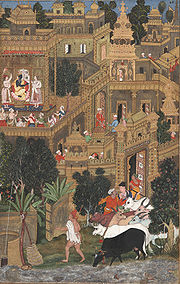
Jataka
The Jātakas refer to a voluminous body of literature native to India concerning the previous births of the Buddha....
) and his affairs with the gopis, presenting him as a tribal hero.
The text is complex, containing layers that may go back to the 1st or 2nd centuries BCE. The origin of this appendix is not precisely known but it is apparent that it was a part of the Mahabharata by the 1st century CE because "the poet Ashvaghosha quotes a couple of verses, attributing them to the Mahabharata, which are now only found in the Harivamsa" (Datta 1858).
Hopkins considers the latest parva of Mahabharata. Hazra has dated the Purana to the 4th century CE on the basis of the description of Rasa lila
Rasa lila
The Rasa lila or Rasa dance is part of the traditional story of Krishna described in Hindu scriptures such as the Bhagavata Purana and literature such as the Gita Govinda, where he dances with Radha and her sakhis...
in it. According to him, the Visnu Purana and the Bhagavata Purana
Bhagavata purana
The Bhāgavata Purāṇa is one of the "Maha" Puranic texts of Hindu literature, with its primary focus on bhakti to the incarnations of Vishnu, particularly Krishna...
belong to the 5th century CE and 6th century CE respectively. According to Dikshit, the date of Matsya Purana
Matsya Purana
Matsya Purana is the sixteenth purana of the Hindu scriptures. During the period of mahapralaya, Lord Vishnu had taken Matsya Avatar to save the seeds of all lives and Manu...
is the 3rd century CE. When we compare the biography of Krishna, the account of Raji and some other episodes as depicted in the , it appears to be anterior to the former. Therefore the and the can be dated to at least the 3rd century CE.
By its style and contents, the appears to be anterior to the and . The verses quoted by Asvaghosa
Asvaghosa
' was an Indian philosopher-poet, born in Saketa in northern India to a Brahmin family. He is believed to have been the first Sanskrit dramatist, and is considered the greatest Indian poet prior to Kālidāsa. He was the most famous in a group of Buddhist court writers, whose epics rivaled the...
belong to this parva. On this basis, we can safely assume the (except for the later interpolations) to be at least as old as the 1st century CE.
Editions
The is available in two editions. The vulgate text of the has total 271 s (chapters), divided into three parvas, (55 chapters), (81 chapters) and (135 chapters). The Critical Edition or CE (1969–71, Ed. P.L.Vaidya) is around a third (118 chapters in 6073 slokas) of this vulgate edition. Like the vulgate, the chapters in the CE are divided into three parvas, (chapters 1-45), (chapters 46-113) and (chapters 114 -118). Vaidya suggests that even the CE represents an expanded text and proposes that the oldest form of probably began with chapter 20 (which is where Agni PuranaAgni Purana
The Agni Purana, one of the 18 Mahapuranas, a genre of Hindu religious texts, contains descriptions and details of various incarnations of Vishnu. It also has details account about Rama, Krishna, Prithvi, and the stars...
12 places its start) and must have ended with chapter 98 of his text.
Contents
The last chapter of the text gives a brief description of the subjects narrated in it as follows.The opens in the manner common to the Mahabharata with Janamejaya asking Vaisampayana to narrate the genealogy of the Vrisni race from the beginning. After the primal creation and the production of the creatures (Chapters 1-3), the text tells the story of Prithu, the son of Vena (Chapters 4-6). Thereafter follows the description of the reigns of Manu
Manu
-Geography:*Manú Province, a province of Peru, in the Madre de Dios Region*Manú National Park, Peru*Manú River, in southeastern Peru*Manu River, Tripura, which originates in India and flows into Bangladesh...
s (Chapters 7-8), the origin of the dynasty of Vaivasvata (Chapter 9-10) and the history of Dhundumara (Chapter 11). Next follows the story of Galava (Chapter 12) and the history of the family of Ikshvaku and Sagara (Chapters 13-15). Chapters 16-24 deal with the Pitrkalpa (the beatification of the manes) which includes the story of Brahmadatta and his seven sons. The genealogy of Soma occupies a significant portion of the rest of the - the story of Soma, Budha and Pururava (Chapters 25-27), the dynasty of Amavasu and Raji (Chapters 27-28), the race of Kshatravriddha and the legend of Divodasa (Chapter 29), the legend of Yayati (Chapter 30) and the family of Puru (Chapters 31-32). The history of the Yadavas follows next (Chapters 33-39) which includes the tale of the Syamantaka gem (Chapters 38-39). Then in response to Janamejaya’s question follows the history of the incarnations of Visnu (Chapters 40-41) and the Tarakamaya battle between the gods & the titans (Chapters 42-48). Chapters 49-52 describe the plea of Brahma and Goddess Earth resulting in the partial incarnation of the gods (Chapters 53-55).
The begins with Narada’s warning to Kamsa
Kamsa
In Hinduism, Kamsa or Kansa , often known as Kans in Hindi, is the brother of Devaki, and ruler of the Vrishni kingdom with its capital at Mathura. His father was King Ugrasena and mother was Queen Padmavati...
(Chapter 1), who gives orders to guard Devaki
Devaki
In Hinduism, Devaki is the wife of Vasudeva and biological mother of Krishna.She was the daughter of Devaka, the younger brother of King Ugrasena of Mathura. She was a partial incarnation of Aditi, the mother of the Devas.-Imprisonment :...
and kill all children born to her (Chapters 2-3). The birth of Krishna and his exchange for the daughter of Nanda
Nanda
Nanda is a surname of Punjabis . Nanda is a Tarkhan , Ahluwalia and Kamboj surname. All the clans of Tarkhan , Lohar, Gujjar, Kamboj, Ahluwalia tribes have a close genetic and ancestral relationship with each other, and together they form the Khatri/Rajput caste.-Among Kamboj people:*Nanda is a...
and Yashoda is then narrated along with a description of the cowherds’ camp (Chapters 4-5). Then follow Krishna’s and Samkarsana’s childhood exploits (Chapters 6-30) including the overturning of the cart and killing of Putana in Chapter 6, the uprooting of the two arjuna trees in Chapter 7, the victory over Kaliya in Chapter s 11-12, the slaying of Dhenuka the donkey and Pralamba in Chapter 13-14, and the lifting of Mount Govardhana in defiance of Indra in Chapters 15-19. Thereafter the Rasa dance (Chapter 20), the slaying of Arishta the bull (Chapter 21), the Council of Kamsa (Chapter 22-23) and the slaying of Keshi the steed (Chapter 24) are described. Chapters 25-28 narrate in detail the journey of the heroes to Kamsa’s court accompanied by Akrura. Then follow the death of the elephant Kuvalayapida (Chapter 29), the slaying of Chanura and Andhra and the death of Kamsa (Chapter 30), the lament of Kamsa’s wives (Chapter 31) and the funeral of Kamsa and the consecration of Ugrasena on the throne of Mathura (Chapter 32).
The parva goes on to narrate the rescue of the children of Sandipani
Sandipani
Sandipani, which means "Sage of Gods", was a guru of Lord Krishna. Sandipani was a rishi/muni/saint of Ujjain, previously known as Avantipura....
, the teacher of Krishna and Balarama (Chapter 33), the attack on Mathura by the Jarasandha
Jarasandha
Jarasandha was a great and legendary king of Magadha. He was the son of a vedic king named Brihadratha. He was also a great devotee of Lord Shiva. But he is generally held in negative light owing to his enmity with the Yadav clan in the Mahābhārata....
of Magadha
Magadha
Magadha formed one of the sixteen Mahājanapadas or kingdoms in ancient India. The core of the kingdom was the area of Bihar south of the Ganga; its first capital was Rajagriha then Pataliputra...
and his defeat (Chapters 34-36), the discourse of Vikadru (Chapters 37-38), the meeting of Krishna and Balarama with Parasurama (Chapter 39), the ascension on Mount Gomanta (Chapters 40-41), the burning of Gomanta (Chapter 42), the end of Srigala (Chapter 43-44), the return to Mathura (Chapter 42), Samkarsana dragging the Yamuna river with his ploughshare (Chapter 46), the swayamvara of Rukmini
Rukmini
In Hinduism, Rukmini is the principal wife and queen of Krishna at his city of Dwarka. Krishna heroically kidnaps her from an un-wanted marriage at her request . Of Krishna's 16,108 queens, Rukmini is the first and most prominent...
and the conspiracy of Jarasandha and his allies (Chapters 47-54), the move from Mathura to Dwarka (Chapters 55-56), Kalayavana’s attack on Krishna and his killing (Chapter 57), the foundation of Dwarka
Dwarka
Dwarka also spelled Dvarka, Dwaraka, and Dvaraka, is a city and a municipality of Jamnagar district in the Gujarat state in India. Dwarka , also known as Dwarawati in Sanskrit literature is rated as one of the seven most ancient cities in the country...
(Chapter 58), Krishna’s abduction of and marriage with Rukmini and their progeny (Chapters 59-61), the exploits of Balarama
Balarama
Balarama , also known as Baladeva, Balabhadra and Halayudha, is the elder brother of the divine being, Krishna in Hinduism. Within Vaishnavism Hindu traditions Balarama is worshipped as an Avatar of Vishnu, and he is also listed as such in the Bhagavata Purana...
(Chapter 62), the slaying of Naraka (Chapters 63-64) and the removal of parijata tree from Indra’s heaven (Chapters 65-76).
There follow some pieces which definitely appear to be interpolations into the text. First comes a long and extensive piece (Chapters 77-81) on the observance of Punyakavidhi, i.e. ceremonies, celebrations and vows by means of which a wife can make her body pleasant to her husband and ensure his favor to herself. After this rather strange digression, the text continues with further adventures of Krishna and his progeny including the slaying of the demons of Shatpura (Chapters 82-85), the slaying of Andhaka by Mahadeva (Chapters 86-87), the sport of the Yadavas in ocean (Chapters 88-89), the abduction of Bhanumati (Chapter 90) and the marriage of Pradyumna
Pradyumna
Pradyumna is a form of the Hindu god Vishnu. He is one in 24 Keshava Namas , praised in all pujas. It is also the only name in Sanskrit with all the 3 letters joint...
and Prabhavati (Chapters 91-97).
The text again resumes the narrative from where it had apparently broken off (Chapter 76). The text narrates the rebuilding of Dwarka (Chapters 98), the entry into Dwarka (Chapter 99), the entry into the hall (Chapter 100), the discourse of Narada (Chapters 101-102) and the tradition of the dynasty of Vrishnis (Chapter 103). Next follow the legend of Pradyumna and the slaying of Sambara (Chapters 104-109), the tale of Samba (Chapter 110), Krishna’s recovering of the four dead sons of a brahman (Chapters 111-115) and Krishna’s fight with Bana and the marriage of Bana’s daughter, Usa with Aniruddha, the grandson of Krishna (Chapters 116-128).
The contain the genealogy of Janamejaya and his performance of an aswamedha (Chapters 1-2), the characteristics of Kaliyuga (Chapters 3-4) and the reconciliation between Janamejaya and his queen, following Indra’s intervention in the aswamedha (Chapter 5). Chapter 6 contains the formal benediction which suggests that at some point of time this chapter used to close the text (which is what the CE does, i.e. the narrative comes to an end at this chapter).
In answer to a further enquiry of Janamejaya, Vaisampayana gives a detailed description of the origin of Puskara which includes a rather confused account of creation (Chapters 7-28). Then follow an account of the boar, the man-lion and the dwarf incarnations of Visnu (Chapters 29-72). The text then narrates some additional adventures of Krishna – Krishna’s journey to Kailasa (Chapters 73-90), the slaying of Paundraka (Chapters 91-102) and the tale of Hamsa and Dimbhaka (Chapters 103-129) and Krishna’s meeting the cowherds of Vrindavana on Mount Govardhana (Chapter 130). A long chapter (Chapter 131) then tells of the religious merit of reading the Mahabharata and the . Strangely enough, after the book has actually already come to an end, a further chapter narrates the legend of the destruction of the three heavenly fortresses of the demons by Shiva. The book finally closes with a short summary of the contents of and an enumeration of the religious merits that one acquires by hearing this Purana.
Translations
There have been translations of the Harivamsa in many Indian vernacular languages, EnglishEnglish language
English is a West Germanic language that arose in the Anglo-Saxon kingdoms of England and spread into what was to become south-east Scotland under the influence of the Anglian medieval kingdom of Northumbria...
(Manmatha Nath Dutt, 1897), French
French language
French is a Romance language spoken as a first language in France, the Romandy region in Switzerland, Wallonia and Brussels in Belgium, Monaco, the regions of Quebec and Acadia in Canada, and by various communities elsewhere. Second-language speakers of French are distributed throughout many parts...
(M. A. Langlois, Paris, 1834–35), and other languages.
Jaina Harivamsas
There are also JainaJainism
Jainism is an Indian religion that prescribes a path of non-violence towards all living beings. Its philosophy and practice emphasize the necessity of self-effort to move the soul towards divine consciousness and liberation. Any soul that has conquered its own inner enemies and achieved the state...
Harivamsas in various languages that present Jaina traditions of the Krishna story. One of the earliest of these is the (783 AD) of Jinasena
Jinasena
Jinasena is the name of several famous Jain Acharyas of the Digambar tradition.* The author of Harivamsha Purana in the 8th century. He belonged to the Punnata branch of Jain monks....
. It is divided into 66 cantos and contains 12,000 slokas. The book aims to narrate the life of Arishtanemi, the twenty-second Tirthankara of the Jainas. According to the Jaina sources, Arishtanemi is the first cousin of Krishna. Therefore, Krishna’s adventures too occupy a significant portion of the book. An outline of Jinasena’s work is as follows.
The description of the dynasty of the Yadus is spread over the cantos 19-63. The 32nd canto contains the description of Balarama. The tale of the birth of Krishna begins from canto 35. The description of the youthful exploits of Krishna is similar to the Hindu
Hindu
Hindu refers to an identity associated with the philosophical, religious and cultural systems that are indigenous to the Indian subcontinent. As used in the Constitution of India, the word "Hindu" is also attributed to all persons professing any Indian religion...
lore. There follows the description of the slaying of Kamsa at the festival of consecration of the bow. Then Jarasandha sends his brother and his son to attack Mathura, both of them killed by Krishna. The birth of Arishtanemi takes place in Sauryapura amidst great celebrations. Jarasandha then lays siege of Mathura resulting in the migration of Krishna and his kinsmen to Dwarka. The marriage with Rukmini and the birth and abduction of Pradyumna follows. Then the account of the Pandavas is narrated which bears significant differences from the Hindu accounts. The reunion of Krishna and Pradyumna is narrated next. The text then describes the final combat between Jarasandha and Krishna with the Kauravas acting as allies to the former while the Pandavas to the latter. The war ends with the death of Jarasandha and the deification of Krishna as Narayana
Narayana
Narayana or Narayan or Naraina is an important Sanskrit name for Vishnu, and in many contemporary vernaculars a common Indian name. Narayana is also identified as the original man, Purusha. The Puranas present divergent views on Narayana...
. Thereafter the Pandavas retreat to south to establish Pandu Mathura (modern Madurai
Madurai
Madurai is the third largest city in the Indian state of Tamil Nadu and one of the oldest continuously inhabited cities in the world. It served as the capital city of the Pandyan Kingdom. It is the administrative headquarters of Madurai District and is famous for its temples built by Pandyan and...
). This is followed by the account of the attainment of arhathood by Arishtanemi, the destruction of Dwarka by Krishna Dwaipayana’s curse, the demise of Krishna and Balarama and the ascent of the Pandavas to the heavens. The book closes with and account of the dynasty of Yadu propagated by Jaratkumara.
Although styled as a Purana, the text follows the techniques of classical Sanskrit poetry and is more a kavya
Kavya
Kavya refers to the Sanskrit literary style used by Indian court poets flourishing from the first half of the seventh century AD. This literary style is characterised by abundant usage of figures of speech, metaphors, similes, and hyperbole to create its emotional effects...
than a Purana.