

King-Byng Affair

Encyclopedia
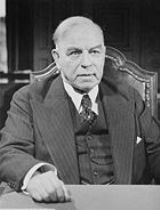
The King–Byng Affair was a Canadian
constitutional crisis
that occurred in 1926, when the Governor General of Canada
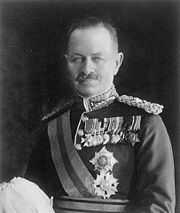
, the Lord Byng of Vimy
, refused a request by his prime minister
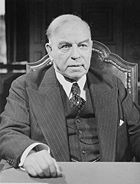
, William Lyon Mackenzie King
, to dissolve parliament and call a general election
.
The crisis came to redefine the role of governor general, not only in Canada but throughout the Dominion
s, becoming a major impetus in negotiations at Imperial Conferences held in the late 1920s that led to the adoption of the Statute of Westminster
in 1931. According to British Empire
constitutional convention, the governor general once represented both the sovereign in his
British council
and in his Canadian council
, but the convention had evolved with Byng's predecessors, the Canadian government, and the Canadian people, into a tradition of non-interference in Canadian political affairs on the part of the British government. After 1931, the governor general remained an important figure in Canadian governance as a constitutional watchdog, but it is one that has shed its previous imperial duties.
 In September 1925, William Lyon Mackenzie King, then Prime Minister of Canada
, advised the governor general, the Lord Byng of Vimy
, to dissolve parliament and drop the writ
for a general election
, to which Lord Byng agreed. In the subsequent election
, Arthur Meighen
's Conservative Party
won 116 seats in the House of Commons
to 101 for King's Liberals
. Counting on the support of the Progressive Party
, with its 28 seats, to overcome the Conservative plurality, King (who had lost his seat in the election) did not resign and remained in office as head of a minority government
. Strictly speaking, this was not a coalition government
, as the Progressives were not given any Cabinet
seats and were thus not a part of the government.
On 30 October, King visited Byng after consulting with the rest of Cabinet and informed the Governor General that his government would continue until parliament decided otherwise. Byng, who had suggested to King that he ought to resign with such a tenuous mandate, later claimed to have told the Prime Minister: "Well, in any event you must not at any time ask for a dissolution unless Mr Meighen is first given a chance to show whether or not he is able to govern," to which King acquiesced.
While Meighen and other Conservatives expressed public outrage at what they viewed as a desperate attempt on the part of King to cling to power, some Conservatives were privately relieved by King's decision; they seriously doubted whether the Tories could convince the Progressives to support a Conservative government, were confident that King's attempt to remain in power would eventually fail, and thought the expected debacle would be so damaging to the Liberals' reputation that the Conservatives would then be swept into office with a large majority.
, with Georges Henri Boivin
, but recommended that Byng appoint Bureau to the Senate
. This further alienated the members of the Progressive Party. The Progressives were already distancing themselves from the government because of its failure to transfer control of Alberta
's natural resources from the federal government to the province, but in June had saved the government from defeat in a no-confidence motion on the matter.
 The Progressive Party's support was temporarily retained by the formation of a special committee to investigate the corruption in the customs department. Its report, which was presented to the House of Commons, acknowledged that there was widespread fraud in the department but did not specifically criticise the government. A Conservative Member of Parliament
(MP), H. H. Stevens
, proposed an amendment to the report which would effectively censure the government and compel it to resign. However, Labour MP J.S. Woodsworth proposed amending Stevens' amendment to remove the censure of the government and set up a Royal Commission
to investigate the customs department further. The motion was defeated, despite the full support of the government. A Progressive MP, W. R. Fansher, then proposed that a Royal Commission be combined with the original motion of censure. The Speaker of the House
ruled the motion out of order, but, on division, the members over-ruled the speaker and the Cabinet was defeated again. After a motion that the House adjourn, put forward by a Progressive member at King's behest, was subsequently also voted down, King announced that he would accept Fansher's amendment and secured an adjournment.
s, refused the request, reminding King of their agreement made the previous October and arguing that the Conservatives, as the biggest single party in parliament, should have a chance to form a government before an election was called. For the next two days, the Prime Minister and the Governor General discussed the matter, with Byng asking King not to request a dissolution which he could not give and King twice requesting that Byng consult the British government prior to making any decision. Byng again refused, saying the matter should be settled in Canada, without resort to London. With Byng remaining steadfast, King then, on 28 June, formally presented the Governor General with an Order in Council for the dissolution of parliament, which Byng declined to sign, on the grounds that the House of Commons should first be given the opportunity to decide if it could support an alternate government. Thus, believing that he no longer had enough support to stay in office, King resigned, as per convention that requires a prime minister who has lost the support of the House of Commons to either step down or advise the governor general to drop the writs
for an election.
Byng then invited Conservative leader Arthur Meighen
, who had been prime minister from 1920 to 1921, to form a government. Although many Conservatives privately preferred an election, Meighen believed he was bound by honour and convention to accept Byng's invitation. Meighen thus formed a new Cabinet, but made his ministers only "acting" ones; they were not sworn into office because the government still had to win a confidence vote in the House of Commons and, under the laws of the time, new ministers would have to seek re-election. The Liberals were furious and were able to get the Progressives to join them in a successful drive to bring down the Conservative minority government, Meighen's government losing confidence by only one vote. Meighen subsequently requested a dissolution of parliament, which was granted by Byng, and an election
was called. King's Liberals won a majority in the House of Commons, while Meighen lost his seat.
, Byng expressed surprise that the Liberal leader, a staunch nationalist, had requested that Byng consult the Colonial Office
in London over the matter. Byng said: "I have to await the verdict of history to prove my having adopted a wrong course, and this I do with an easy conscience that, right or wrong, I have acted in the interests of Canada and implicated no one else in my decision." The Colonial Secretary, Leo Amery, privately informed Byng that had he appealed to the British government for an answer, "I could only have replied... that in my view it would not be proper for the Secretary of State to issue instructions to the Governor with regard to the exercise of his constitutional duties."
Much was made of the "Byng–King Thing" during the election campaign, which King conducted rhetorically as a campaign for Canadian independence from Britain, even though it was King who demanded that Byng consult London. King also painted the matter as one relating to democracy, insisting that the Governor General had had no right to refuse his prime minister's advice, while Meighen denounced King's actions as "a shameless attempt to hang onto power and avoid imminent defeat by the people's elected representatives." However, the Liberals were returned to power with King as prime minister. Once in power, King's government sought at an imperial conference to redefine the role of the governor general as a personal representative of the sovereign in his Canadian council and not of the British government, the king in his British council. The change was agreed to at the Imperial Conference of 1926 and came to be official as a result of the Balfour Declaration of 1926 and Statute of Westminster 1931
.
Byng returned to the United Kingdom, leaving Canada on 30 September 1926 a much respected man, despite the political crisis. Some authorities have held that Byng was constitutionally obligated to refuse King's request; for example, Eugene Forsey
argued that King's advice to Byng was "utterly unprecedented" and said further: "It was tantamount to allowing a prisoner to discharge the jury by which he was being tried.... If the Governor-General had granted the request, he would have become an accomplice in a flagrant act of contempt for Parliament." The relatively brief time that King had served in office prior to seeking a dissolution has also been cited as a reason for denying his request. Other authorities agreed with King, since by custom the Lord Byng of Vimy was obligated to heed the Prime Minister's request to call the election. In 1997, then Governor-General of New Zealand
Sir Michael Hardie Boys
expressed the opinion that Byng had been in error in not re-appointing King as prime minister and then granting the dissolution of parliament to King instead of Meighen.
The King–Byng Affair was the most controversial use of a governor general's reserve powers until the Australian constitutional crisis of 1975, in which the Governor-General of Australia
, John Kerr, dismissed Prime Minister
Gough Whitlam
.
Canada
Canada is a North American country consisting of ten provinces and three territories. Located in the northern part of the continent, it extends from the Atlantic Ocean in the east to the Pacific Ocean in the west, and northward into the Arctic Ocean...
constitutional crisis
Constitutional crisis
A constitutional crisis is a situation that the legal system's constitution or other basic principles of operation appear unable to resolve; it often results in a breakdown in the orderly operation of government...
that occurred in 1926, when the Governor General of Canada
Governor General of Canada
The Governor General of Canada is the federal viceregal representative of the Canadian monarch, Queen Elizabeth II...
, the Lord Byng of Vimy
Julian Byng, 1st Viscount Byng of Vimy
Field Marshal Julian Hedworth George Byng, 1st Viscount Byng of Vimy was a British Army officer who served as Governor General of Canada, the 12th since Canadian Confederation....
, refused a request by his prime minister
Prime Minister of Canada
The Prime Minister of Canada is the primary minister of the Crown, chairman of the Cabinet, and thus head of government for Canada, charged with advising the Canadian monarch or viceroy on the exercise of the executive powers vested in them by the constitution...
, William Lyon Mackenzie King
William Lyon Mackenzie King
William Lyon Mackenzie King, PC, OM, CMG was the dominant Canadian political leader from the 1920s through the 1940s. He served as the tenth Prime Minister of Canada from December 29, 1921 to June 28, 1926; from September 25, 1926 to August 7, 1930; and from October 23, 1935 to November 15, 1948...
, to dissolve parliament and call a general election
General election
In a parliamentary political system, a general election is an election in which all or most members of a given political body are chosen. The term is usually used to refer to elections held for a nation's primary legislative body, as distinguished from by-elections and local elections.The term...
.
The crisis came to redefine the role of governor general, not only in Canada but throughout the Dominion
Dominion
A dominion, often Dominion, refers to one of a group of autonomous polities that were nominally under British sovereignty, constituting the British Empire and British Commonwealth, beginning in the latter part of the 19th century. They have included Canada, Australia, New Zealand, Newfoundland,...
s, becoming a major impetus in negotiations at Imperial Conferences held in the late 1920s that led to the adoption of the Statute of Westminster
Statute of Westminster 1931
The Statute of Westminster 1931 is an Act of the Parliament of the United Kingdom. Passed on 11 December 1931, the Act established legislative equality for the self-governing dominions of the British Empire with the United Kingdom...
in 1931. According to British Empire
British Empire
The British Empire comprised the dominions, colonies, protectorates, mandates and other territories ruled or administered by the United Kingdom. It originated with the overseas colonies and trading posts established by England in the late 16th and early 17th centuries. At its height, it was the...
constitutional convention, the governor general once represented both the sovereign in his
Queen-in-Council
The Queen-in-Council is, in each of the Commonwealth realms, the technical term of constitutional law that refers to the exercise of executive authority, denoting the monarch acting by and with the advice and consent of his or her privy council or executive council The Queen-in-Council (during...
British council
Privy Council of the United Kingdom
Her Majesty's Most Honourable Privy Council, usually known simply as the Privy Council, is a formal body of advisers to the Sovereign in the United Kingdom...
and in his Canadian council
Queen's Privy Council for Canada
The Queen's Privy Council for Canada ), sometimes called Her Majesty's Privy Council for Canada or simply the Privy Council, is the full group of personal consultants to the monarch of Canada on state and constitutional affairs, though responsible government requires the sovereign or her viceroy,...
, but the convention had evolved with Byng's predecessors, the Canadian government, and the Canadian people, into a tradition of non-interference in Canadian political affairs on the part of the British government. After 1931, the governor general remained an important figure in Canadian governance as a constitutional watchdog, but it is one that has shed its previous imperial duties.
The affair
Prime Minister of Canada
The Prime Minister of Canada is the primary minister of the Crown, chairman of the Cabinet, and thus head of government for Canada, charged with advising the Canadian monarch or viceroy on the exercise of the executive powers vested in them by the constitution...
, advised the governor general, the Lord Byng of Vimy
Julian Byng, 1st Viscount Byng of Vimy
Field Marshal Julian Hedworth George Byng, 1st Viscount Byng of Vimy was a British Army officer who served as Governor General of Canada, the 12th since Canadian Confederation....
, to dissolve parliament and drop the writ
Dropping the writ
Dropping the writ is the informal term for a procedure in some parliamentary government systems, where the head of government goes to the head of state and formally advises him or her to dissolve parliament...
for a general election
Elections in Canada
Canada holds elections for several levels of government: nationally , provincially and territorially, and municipally. Elections are also held for self governing First Nations and for many other public and private organizations including corporations and trade unions...
, to which Lord Byng agreed. In the subsequent election
Canadian federal election, 1925
The Canadian federal election of 1925 was held on October 29 to elect members of the Canadian House of Commons of the 15th Parliament of Canada. Prime Minister William Lyon Mackenzie King's Liberal Party formed a minority government. This precipitated the "King-Byng Affair".The Liberals under...
, Arthur Meighen
Arthur Meighen
Arthur Meighen, PC, QC was a Canadian lawyer and politician. He served two terms as the ninth Prime Minister of Canada: from July 10, 1920 to December 29, 1921; and from June 29 to September 25, 1926. He was the first Prime Minister born after Confederation, and the only one to represent a riding...
's Conservative Party
Conservative Party of Canada (historical)
The Conservative Party of Canada has gone by a variety of names over the years since Canadian Confederation. Initially known as the "Liberal-Conservative Party", it dropped "Liberal" from its name in 1873, although many of its candidates continued to use this name.As a result of World War I and the...
won 116 seats in the House of Commons
Canadian House of Commons
The House of Commons of Canada is a component of the Parliament of Canada, along with the Sovereign and the Senate. The House of Commons is a democratically elected body, consisting of 308 members known as Members of Parliament...
to 101 for King's Liberals
Liberal Party of Canada
The Liberal Party of Canada , colloquially known as the Grits, is the oldest federally registered party in Canada. In the conventional political spectrum, the party sits between the centre and the centre-left. Historically the Liberal Party has positioned itself to the left of the Conservative...
. Counting on the support of the Progressive Party
Progressive Party of Canada
The Progressive Party of Canada was a political party in Canada in the 1920s and 1930s. It was linked with the provincial United Farmers parties in several provinces and, in Manitoba, ran candidates and formed governments as the Progressive Party of Manitoba...
, with its 28 seats, to overcome the Conservative plurality, King (who had lost his seat in the election) did not resign and remained in office as head of a minority government
Minority government
A minority government or a minority cabinet is a cabinet of a parliamentary system formed when a political party or coalition of parties does not have a majority of overall seats in the parliament but is sworn into government to break a Hung Parliament election result. It is also known as a...
. Strictly speaking, this was not a coalition government
Coalition government
A coalition government is a cabinet of a parliamentary government in which several political parties cooperate. The usual reason given for this arrangement is that no party on its own can achieve a majority in the parliament...
, as the Progressives were not given any Cabinet
Cabinet of Canada
The Cabinet of Canada is a body of ministers of the Crown that, along with the Canadian monarch, and within the tenets of the Westminster system, forms the government of Canada...
seats and were thus not a part of the government.
On 30 October, King visited Byng after consulting with the rest of Cabinet and informed the Governor General that his government would continue until parliament decided otherwise. Byng, who had suggested to King that he ought to resign with such a tenuous mandate, later claimed to have told the Prime Minister: "Well, in any event you must not at any time ask for a dissolution unless Mr Meighen is first given a chance to show whether or not he is able to govern," to which King acquiesced.
While Meighen and other Conservatives expressed public outrage at what they viewed as a desperate attempt on the part of King to cling to power, some Conservatives were privately relieved by King's decision; they seriously doubted whether the Tories could convince the Progressives to support a Conservative government, were confident that King's attempt to remain in power would eventually fail, and thought the expected debacle would be so damaging to the Liberals' reputation that the Conservatives would then be swept into office with a large majority.
Scandal
A few months later, one of King's appointees in the Department of Customs and Excise was revealed to have taken bribes, after which the Conservatives alleged that the corruption extended to the highest levels of government, including the prime minister. King had already replaced the Minister of Customs and Excise, Jacques BureauJacques Bureau
Jacques Bureau, PC was a Canadian politician.Born in Trois-Rivières, Canada East, the son of J. Napoleon Bureau and Sophie Gingras, Bureau was educated at Nicolet College and received a Bachelor of Laws degree in 1881 from Laval University. A lawyer, he was elected to the Canadian House of Commons...
, with Georges Henri Boivin
Georges Henri Boivin
Georges Henri Boivin, PC was a Canadian politician.Born in Granby, Quebec, the son of Henri Boivin and Sarah Bray, Boivin was educated at Granby Academy, St. Joseph's College, and Granby Mannoir College in Marieville. He received a Bachelor of Arts degree in 1902 from Laval University in Montreal...
, but recommended that Byng appoint Bureau to the Senate
Canadian Senate
The Senate of Canada is a component of the Parliament of Canada, along with the House of Commons, and the monarch . The Senate consists of 105 members appointed by the governor general on the advice of the prime minister...
. This further alienated the members of the Progressive Party. The Progressives were already distancing themselves from the government because of its failure to transfer control of Alberta
Alberta
Alberta is a province of Canada. It had an estimated population of 3.7 million in 2010 making it the most populous of Canada's three prairie provinces...
's natural resources from the federal government to the province, but in June had saved the government from defeat in a no-confidence motion on the matter.
Member of Parliament
A Member of Parliament is a representative of the voters to a :parliament. In many countries with bicameral parliaments, the term applies specifically to members of the lower house, as upper houses often have a different title, such as senate, and thus also have different titles for its members,...
(MP), H. H. Stevens
Henry Herbert Stevens
Henry Herbert Stevens, PC was a Canadian politician and businessman. A member of R.B. Bennett's cabinet, he split with the Conservative Prime Minister to found the Reconstruction Party of Canada.-Early life:...
, proposed an amendment to the report which would effectively censure the government and compel it to resign. However, Labour MP J.S. Woodsworth proposed amending Stevens' amendment to remove the censure of the government and set up a Royal Commission
Royal Commission
In Commonwealth realms and other monarchies a Royal Commission is a major ad-hoc formal public inquiry into a defined issue. They have been held in various countries such as the United Kingdom, Australia, Canada, New Zealand, and Saudi Arabia...
to investigate the customs department further. The motion was defeated, despite the full support of the government. A Progressive MP, W. R. Fansher, then proposed that a Royal Commission be combined with the original motion of censure. The Speaker of the House
Speaker of the Canadian House of Commons
The Speaker of the House of Commons of Canada is the presiding officer of the lower house of the Parliament of Canada and is elected at the beginning of each new parliament by fellow Members of Parliament...
ruled the motion out of order, but, on division, the members over-ruled the speaker and the Cabinet was defeated again. After a motion that the House adjourn, put forward by a Progressive member at King's behest, was subsequently also voted down, King announced that he would accept Fansher's amendment and secured an adjournment.
Request for dissolution
To avoid the inevitable vote on the Fansher amendment, which would either force his government's resignation or bring his administration into disrepute, King went to Byng on 26 June 1926 seeking a dissolution of parliament. Byng, though, using his reserve powerReserve power
In a parliamentary or semi-presidential system of government, a reserve power is a power that may be exercised by the head of state without the approval of another branch of the government. Unlike a presidential system of government, the head of state is generally constrained by the cabinet or the...
s, refused the request, reminding King of their agreement made the previous October and arguing that the Conservatives, as the biggest single party in parliament, should have a chance to form a government before an election was called. For the next two days, the Prime Minister and the Governor General discussed the matter, with Byng asking King not to request a dissolution which he could not give and King twice requesting that Byng consult the British government prior to making any decision. Byng again refused, saying the matter should be settled in Canada, without resort to London. With Byng remaining steadfast, King then, on 28 June, formally presented the Governor General with an Order in Council for the dissolution of parliament, which Byng declined to sign, on the grounds that the House of Commons should first be given the opportunity to decide if it could support an alternate government. Thus, believing that he no longer had enough support to stay in office, King resigned, as per convention that requires a prime minister who has lost the support of the House of Commons to either step down or advise the governor general to drop the writs
Dropping the writ
Dropping the writ is the informal term for a procedure in some parliamentary government systems, where the head of government goes to the head of state and formally advises him or her to dissolve parliament...
for an election.
Byng then invited Conservative leader Arthur Meighen
Arthur Meighen
Arthur Meighen, PC, QC was a Canadian lawyer and politician. He served two terms as the ninth Prime Minister of Canada: from July 10, 1920 to December 29, 1921; and from June 29 to September 25, 1926. He was the first Prime Minister born after Confederation, and the only one to represent a riding...
, who had been prime minister from 1920 to 1921, to form a government. Although many Conservatives privately preferred an election, Meighen believed he was bound by honour and convention to accept Byng's invitation. Meighen thus formed a new Cabinet, but made his ministers only "acting" ones; they were not sworn into office because the government still had to win a confidence vote in the House of Commons and, under the laws of the time, new ministers would have to seek re-election. The Liberals were furious and were able to get the Progressives to join them in a successful drive to bring down the Conservative minority government, Meighen's government losing confidence by only one vote. Meighen subsequently requested a dissolution of parliament, which was granted by Byng, and an election
Canadian federal election, 1926
The Canadian federal election of 1926 was held on September 14 to elect members of the Canadian House of Commons of the 16th Parliament of Canada. The election was called following an event known as the King-Byng Affair...
was called. King's Liberals won a majority in the House of Commons, while Meighen lost his seat.
Legacy
In a letter to King George VGeorge V of the United Kingdom
George V was King of the United Kingdom and the British Dominions, and Emperor of India, from 6 May 1910 through the First World War until his death in 1936....
, Byng expressed surprise that the Liberal leader, a staunch nationalist, had requested that Byng consult the Colonial Office
Secretary of State for the Colonies
The Secretary of State for the Colonies or Colonial Secretary was the British Cabinet minister in charge of managing the United Kingdom's various colonial dependencies....
in London over the matter. Byng said: "I have to await the verdict of history to prove my having adopted a wrong course, and this I do with an easy conscience that, right or wrong, I have acted in the interests of Canada and implicated no one else in my decision." The Colonial Secretary, Leo Amery, privately informed Byng that had he appealed to the British government for an answer, "I could only have replied... that in my view it would not be proper for the Secretary of State to issue instructions to the Governor with regard to the exercise of his constitutional duties."
Much was made of the "Byng–King Thing" during the election campaign, which King conducted rhetorically as a campaign for Canadian independence from Britain, even though it was King who demanded that Byng consult London. King also painted the matter as one relating to democracy, insisting that the Governor General had had no right to refuse his prime minister's advice, while Meighen denounced King's actions as "a shameless attempt to hang onto power and avoid imminent defeat by the people's elected representatives." However, the Liberals were returned to power with King as prime minister. Once in power, King's government sought at an imperial conference to redefine the role of the governor general as a personal representative of the sovereign in his Canadian council and not of the British government, the king in his British council. The change was agreed to at the Imperial Conference of 1926 and came to be official as a result of the Balfour Declaration of 1926 and Statute of Westminster 1931
Statute of Westminster 1931
The Statute of Westminster 1931 is an Act of the Parliament of the United Kingdom. Passed on 11 December 1931, the Act established legislative equality for the self-governing dominions of the British Empire with the United Kingdom...
.
Byng returned to the United Kingdom, leaving Canada on 30 September 1926 a much respected man, despite the political crisis. Some authorities have held that Byng was constitutionally obligated to refuse King's request; for example, Eugene Forsey
Eugene Forsey
Eugene Alfred Forsey, served in the Canadian Senate from 1970 to 1979. He was considered to be one of Canada's foremost constitutional experts.- Biography :...
argued that King's advice to Byng was "utterly unprecedented" and said further: "It was tantamount to allowing a prisoner to discharge the jury by which he was being tried.... If the Governor-General had granted the request, he would have become an accomplice in a flagrant act of contempt for Parliament." The relatively brief time that King had served in office prior to seeking a dissolution has also been cited as a reason for denying his request. Other authorities agreed with King, since by custom the Lord Byng of Vimy was obligated to heed the Prime Minister's request to call the election. In 1997, then Governor-General of New Zealand
Governor-General of New Zealand
The Governor-General of New Zealand is the representative of the monarch of New Zealand . The Governor-General acts as the Queen's vice-regal representative in New Zealand and is often viewed as the de facto head of state....
Sir Michael Hardie Boys
Michael Hardie Boys
-External links:*-References:...
expressed the opinion that Byng had been in error in not re-appointing King as prime minister and then granting the dissolution of parliament to King instead of Meighen.
The King–Byng Affair was the most controversial use of a governor general's reserve powers until the Australian constitutional crisis of 1975, in which the Governor-General of Australia
Governor-General of Australia
The Governor-General of the Commonwealth of Australia is the representative in Australia at federal/national level of the Australian monarch . He or she exercises the supreme executive power of the Commonwealth...
, John Kerr, dismissed Prime Minister
Prime Minister of Australia
The Prime Minister of the Commonwealth of Australia is the highest minister of the Crown, leader of the Cabinet and Head of Her Majesty's Australian Government, holding office on commission from the Governor-General of Australia. The office of Prime Minister is, in practice, the most powerful...
Gough Whitlam
Gough Whitlam
Edward Gough Whitlam, AC, QC , known as Gough Whitlam , served as the 21st Prime Minister of Australia. Whitlam led the Australian Labor Party to power at the 1972 election and retained government at the 1974 election, before being dismissed by Governor-General Sir John Kerr at the climax of the...
.
See also
- Lascelles PrinciplesLascelles PrinciplesThe Lascelles Principles are a constitutional convention in the United Kingdom under which the Sovereign could wisely refuse a request of the Prime Minister to dissolve Parliament, if the existing Parliament is "still vital, viable, and capable of doing its job", if "a General Election would be...
- Easter Crisis of 1920Easter Crisis of 1920The Easter Crisis of 1920 was a constitutional crisis and a significant event in the development of constitutional monarchy in Denmark. It began with the dismissal of the elected government by the reigning monarch, King Christian X, a reserve power which was granted to him by the Danish constitution...
- 2008–2009 Canadian parliamentary dispute2008–2009 Canadian parliamentary disputeThe 2008–2009 Canadian parliamentary dispute was a political dispute during the 40th Canadian Parliament. It was triggered by the expressed intention of the opposition parties to defeat the Conservative minority government on a motion of non-confidence six weeks after the federal election on...
Further reading
- Esberey, J. E. "Personality and Politics: A New Look at the King–Byng Dispute," Canadian Journal of Political Science 1973 6(1): 37–55 Also under and .
- Neatby, H. Blair. William Lyon Mackenzie King, 1924–1932: The Lonely Heights (1963)
- Thompson John H., and Allan Seager. Canada 1922–1939 Toronto: McClelland and Stewart, 1985.
- Bruce Ricketts, "The King–Byng Affair — Canada's Government in Minority" (2007) online version
External links
- The King–Byng Affair at Marianopolis College
- King–Byng Affair at The Canadian EncyclopediaThe Canadian EncyclopediaThe Canadian Encyclopedia is a source of information on Canada. It is available online, at no cost. The Canadian Encyclopedia is available in both English and French and includes some 14,000 articles in each language on a wide variety of subjects including history, popular culture, events, people,...
- CBC's Up the skirt or in the till: Top ten scandals in Canadian political history
- http://archives.cbc.ca/politics/federal_politics/clips/11688/