
All Topics  
Canadian House of Commons

 
Canadian House of Commons

   Email Print
   Bookmark   Link


Canadian House of Commons


The House of Commons is a component of the Parliament of Canada
Parliament of Canada

The Parliament of Canada is Canada's legislature, seated at Parliament Hill in Ottawa, Ontario. The Governor General of Canada appoints the 105 members of the upper house, the Canadian Senate, on the recommendation of the Prime Minister of Canada....
, along with the Sovereign (represented by the Governor General
Governor General of Canada

The Governor General of Canada is the viceroy representative in Canada of the Monarchy of Canada, who is the head of state. Canada is one of sixteen Commonwealth realms, all of which share the same person as their respective sovereign....
) and the Senate. The House of Commons is a democratically
Democracy

Democracy is a form of government in which power is held directly or indirectly by citizens under a free electoral system. It is derived from the Greek language d?????at?a , "popular government" which was coined from d???? , "people" and ???t?? , "rule, strength" in the middle of the 5th-4th century BC to denote the political syst...
 elected body, consisting of 308 members
40th Canadian Parliament

The 40th Canadian Parliament is the current Parliament of Canada, with the membership of its Canadian House of Commons determined by the results of the Canadian federal election, 2008 held on October 14, 2008, and it opened on November 18, 2008....
 known as Members of Parliament (MPs). Members are elected by simple plurality ('first-past-the-post' system)
Plurality voting system

The plurality voting system is a single-winner voting system often used to elect executive officers or to elect members of a legislative assembly which is based on single-member Constituency....
 in each of the country's electoral districts
Electoral district (Canada)

An electoral district in Canada, also known as a constituency or a Riding in Canadian English political jargon, is a geographically-based constituency upon which Canada's representative democracy is based....
, which are colloquially known as riding
Electoral district (Canada)

An electoral district in Canada, also known as a constituency or a Riding in Canadian English political jargon, is a geographically-based constituency upon which Canada's representative democracy is based....
s
. MPs hold office until Parliament is dissolved and serve for limited terms of up to five years after an election, but historically this has been four or fewer years after.


Discussion
Ask a question about 'Canadian House of Commons'
Start a new discussion about 'Canadian House of Commons'
Answer questions from other users
Full Discussion Forum


Encyclopedia


The House of Commons is a component of the Parliament of Canada
Parliament of Canada

The Parliament of Canada is Canada's legislature, seated at Parliament Hill in Ottawa, Ontario. The Governor General of Canada appoints the 105 members of the upper house, the Canadian Senate, on the recommendation of the Prime Minister of Canada....
, along with the Sovereign (represented by the Governor General
Governor General of Canada

The Governor General of Canada is the viceroy representative in Canada of the Monarchy of Canada, who is the head of state. Canada is one of sixteen Commonwealth realms, all of which share the same person as their respective sovereign....
) and the Senate. The House of Commons is a democratically
Democracy

Democracy is a form of government in which power is held directly or indirectly by citizens under a free electoral system. It is derived from the Greek language d?????at?a , "popular government" which was coined from d???? , "people" and ???t?? , "rule, strength" in the middle of the 5th-4th century BC to denote the political syst...
 elected body, consisting of 308 members
40th Canadian Parliament

The 40th Canadian Parliament is the current Parliament of Canada, with the membership of its Canadian House of Commons determined by the results of the Canadian federal election, 2008 held on October 14, 2008, and it opened on November 18, 2008....
 known as Members of Parliament (MPs). Members are elected by simple plurality ('first-past-the-post' system)
Plurality voting system

The plurality voting system is a single-winner voting system often used to elect executive officers or to elect members of a legislative assembly which is based on single-member Constituency....
 in each of the country's electoral districts
Electoral district (Canada)

An electoral district in Canada, also known as a constituency or a Riding in Canadian English political jargon, is a geographically-based constituency upon which Canada's representative democracy is based....
, which are colloquially known as riding
Electoral district (Canada)

An electoral district in Canada, also known as a constituency or a Riding in Canadian English political jargon, is a geographically-based constituency upon which Canada's representative democracy is based....
s
. MPs hold office until Parliament is dissolved and serve for limited terms of up to five years after an election, but historically this has been four or fewer years after. Seats in the House of Commons are distributed roughly in proportion to the population of each province and territory
Provinces and territories of Canada

The provinces and territories of Canada combine to make up the List of countries and outlying territories by total area. The major difference between a Canada province and a territory is that a province receives its power and authority directly from the Monarchy in Canada, via the Constitution Act, 1867, whereas territories derive their manda...
. However, some ridings are more populous than others and the Canadian constitution
Constitution of Canada

The Constitution of Canada is the supreme law in Canada; the country's constitution is an amalgamation of codified Act of Parliaments and uncodified constitution traditions and constitutional convention s....
 contains some special provisions regarding provincial representation; thus, there is some interprovincial and regional malapportionment based on population.

The House of Commons was established in 1867, when the British North America Act 1867
Constitution Act, 1867

The Constitution Act, 1867 , constitutes a major part of Canada's Constitution of Canada. The Act entails the original creation of a federation dominion and defines much of the operation of the Government of Canada, including its Canadian federalism, the Canadian House of Commons, the Canadian Senate, the justice system, and the taxation sys...
 created the Dominion of Canada, and was modelled on the British House of Commons
British House of Commons

The House of Commons is the lower house of the Parliament of the United Kingdom, which also comprises the British monarchy and the House of Lords ....
. The "lower"
Lower house

A lower house is one of two chambers of a bicameral legislature, the other chamber being the upper house.Despite its theoretical position "below" the upper house, in many legislatures worldwide the lower house has come to wield more power....
 of the two houses making up the parliament, the House of Commons in practice holds far more power than the upper house
Upper house

An upper house is one of two chambers of a bicameral legislature, the other chamber being the lower house....
, the Senate. Although the approval of both Houses is necessary for legislation, the Senate very rarely rejects bills passed by the Commons (though the Senate does occasionally amend bills). Moreover, the Government of Canada is responsible solely to the House of Commons through a system of responsible government
Responsible government

Responsible government is a conception of a system of government that embodies the principle of parliamentary accountability which is the foundation of the Westminster system of parliamentary democracy....
. The Prime Minister
Prime Minister of Canada

The Prime Minister of Canada is the primary Minister of the Crown, chairman of the Cabinet of Canada, and thus head of government of Canada. The office is not outlined in any of the documents that constitute the written portion of the constitution of Canada; executive authority is formally vested in the Monarchy of Canada and exercised on hi...
 stays in office only as long as he or she retains the support of the lower house.

It is widely thought that "Commons" is a shortening of the word "commoners". However, the term derives from the Anglo-Norman
Anglo-Norman language

The Anglo-Norman language is a term traditionally used to refer to the variety of French used in England and to some extent elsewhere in the British Isles following the Norman conquest in 1066....
 word communes, referring to the geographic and collective "communities" of their parliamentary representatives and not the third estate, the commonality. This distinction is made clear in the official French
French language

French is a Romance language spoken around the world by around 80 million people as first language, by 190 million as second language, and by about another 200 million people as an acquired tongue, with significant speakers in 54 countries....
 name of the body, la Chambre des communes. Canada remains the only country besides the United Kingdom
United Kingdom

The United Kingdom of Great Britain and Northern Ireland, commonly known as the United Kingdom , the UK or Britain,is a sovereign state located off the northwestern coast of continental Europe....
 to use the name "House of Commons
House of Commons

The House of Commons is the name of the elected lower house of the bicameral parliaments of the United Kingdom and Canada.In the UK and Canada, the Commons holds much more legislative power than the upper house of parliament ....
" for the Lower House of Parliament.

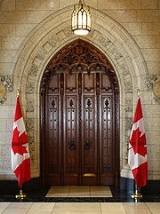
The Canadian House of Commons chamber is located in the Centre Block
Centre Block

File:Parliament Building in Ottawa.jpgThe Centre Block is the main building of the Parliament of Canada complex on Parliament Hill, in Ottawa, Ontario, containing the Canadian House of Commons and Senate of Canada chambers, as well as the offices of a number of Member of Parliament#Canada and senators, as well as senior administration for b...
 of the Parliament Buildings on Parliament Hill
Parliament Hill

File:Model of Parliament Hill.jpgParliament Hill is an area of Crown land on the southern banks of the Ottawa River in downtown Ottawa, Ontario....
, in Ottawa
Ottawa

Ottawa is the Capital of Canada. The city has population of 812,000, the List of the 100 largest municipalities in Canada by population municipality in the country and second largest in Ontario....
, Ontario
Ontario

Ontario is a Provinces and territories of Canada located in the Central Canada part of Canada, the largest by population and second largest, after Quebec, in total area....
.

History

The House of Commons came into existence in 1867, when the Parliament of the United Kingdom
Parliament of the United Kingdom

The Parliament of the United Kingdom of Great Britain and Northern Ireland is the supreme legislature in the United Kingdom and British overseas territories....
 passed the British North America Act
British North America Act 1867

The British North America Act 1867 is an Act of Parliament of the Parliament of the United Kingdom that established the Dominion of Canada. It is known in Canada as the Constitution Act, 1867....
, uniting the Province of Canada (which was separated into Quebec
Quebec

Quebec , in French language, Qu?bec , is a Provinces and territories of Canada in the Central Canada and Eastern Canada regions of Canada....
 and Ontario
Ontario

Ontario is a Provinces and territories of Canada located in the Central Canada part of Canada, the largest by population and second largest, after Quebec, in total area....
), Nova Scotia
Nova Scotia

Nova Scotia is a Canadian Provinces and territories of Canada located on Canada's southeastern coast. It is the most populous province in Atlantic Canada....
 and New Brunswick
New Brunswick

New Brunswick is one of Canada's three Maritime provinces and is the only Constitution of Canada bilingual province in the federation. The provincial capital is Fredericton....
 into a single federation called the Dominion of Canada. The new Parliament of Canada consisted of the Queen
British monarchy

The Monarchy of the United Kingdom is the constitutional monarchy of the United Kingdom and its British overseas territory.The present monarch, Queen Elizabeth II of the United Kingdom, has reigned since 6 February 1952....
 (represented by the Governor General), the Senate and the House of Commons. The Parliament of Canada was based on the Westminster model
Westminster System

The Westminster system is a Democracy parliamentary system of government modelled after the British government . The term comes from the Palace of Westminster, the seat of the UK Parliament....
 (that is, the model of the Parliament of the United Kingdom). Unlike the Parliament of the United Kingdom, the powers of the Parliament of Canada were limited in that other powers were assigned exclusively to the provincial legislatures. The Parliament of Canada also remained subordinate to the Governor-general (representing both the Crown and the Foreign Office) and the Westminster Parliament, the supreme legislative authority for the entire British Empire. Greater autonomy was granted by the Statute of Westminster 1931
Statute of Westminster 1931

The Statute of Westminster 1931 is an Act of Parliament of the Parliament of the United Kingdom which established a status of legislative equality between the self-governing dominions of the British Empire and the United Kingdom, with a few residual exceptions....
, under which the United Kingdom recognized Canada as sovereign. More autonomy was granted by the Canada Act 1982
Canada Act 1982

The Canada Act 1982 is an Act of Parliament passed by the British Parliament that severed all remaining legislative dependence of Canada on the United Kingdom, in a process known as "patriation"....
, under which the Parliament of the United Kingdom relinquished all authority to legislate for Canada.

Members and electoral districts

The House of Commons is composed of 308 members, each of whom represents a single electoral district
Electoral district (Canada)

An electoral district in Canada, also known as a constituency or a Riding in Canadian English political jargon, is a geographically-based constituency upon which Canada's representative democracy is based....
 (also called a riding). Law requires that there be a minimum of 282 electoral districts; there are currently 308. Seats are distributed among the provinces
Provinces and territories of Canada

The provinces and territories of Canada combine to make up the List of countries and outlying territories by total area. The major difference between a Canada province and a territory is that a province receives its power and authority directly from the Monarchy in Canada, via the Constitution Act, 1867, whereas territories derive their manda...
 in proportion to population, as determined by each decennial census, subject to the following exceptions made by the constitution. Firstly, the "senatorial clause" guarantees that each province will have at least as many MPs as Senators
Canadian Senate

The Senate of Canada is a component of the Parliament of Canada, along with the Canadian monarchy and the Canadian House of Commons. The Senate consists of 105 members appointed by the Governor General of Canada on the Advice of the Prime Minister of Canada....
. Secondly, the "grandfather clause" guarantees each province has at least as many Members of Parliament now as it had in 1976. Finally, no province may lose more than fifteen per cent of its seats after a single decennial census.

As a result of these three clauses, smaller provinces and provinces that have experienced a relative decline in population are over-represented in the House. Ontario
Ontario

Ontario is a Provinces and territories of Canada located in the Central Canada part of Canada, the largest by population and second largest, after Quebec, in total area....
, British Columbia
British Columbia

British Columbia is the westernmost of Canada's Provinces and territories of Canada and is famed for its natural beauty, as reflected in its Latin motto, Splendor sine occasu ....
, and Alberta
Alberta

Alberta is one of Canada Canadian Prairies Provinces and territories of Canada. It became a province on September 1, 1905.Alberta is located in western Canada, bounded by the provinces of British Columbia to the west and Saskatchewan to the east, the Northwest Territories to the north, and the U.S....
 are under-represented in proportion to their populations, while all of the other provinces are over-represented. Provincial boundary commissions are responsible for drawing the boundaries of the electoral districts. Territorial representation is independent of population; each territory is entitled to only one seat. The calculation is done by taking the minimum 282 seats and subtracting the three territories to equal 279 seats. The population of Canada
Canada

Canada is a country occupying most of northern North America, extending from the Atlantic Ocean in the east to the Pacific Ocean in the west and northward into the Arctic Ocean....
 is then divided by 279 to equal the electoral quotient. The population of the province is then divided by the electoral quotient to equal the provincial seat allocation. Representation in the House of Commons is summarised in the table at the end of this section.

Province or Territory Minimum number of seats in accordance with the Constitution Act, 1867 Calculations Electoral Quotient (Average population per electoral district)
Population 2001 National Quotient Rounded result Special clauses Total
Newfoundland and Labrador

Newfoundland and Labrador is a Provinces and territories of Canada of Canada, on the country's Atlantic Ocean coast in northeastern North America....
7512 930107 22052773 276
Prince Edward Island

Prince Edward Island is a Canada Provinces and territories of Canada consisting of an island of the same name. The Maritimes is the smallest in the nation in both land area and population ....
4135 294107 22013433 824
Nova Scotia
Nova Scotia

Nova Scotia is a Canadian Provinces and territories of Canada located on Canada's southeastern coast. It is the most populous province in Atlantic Canada....
11908 007107 220831182 546
New Brunswick
New Brunswick

New Brunswick is one of Canada's three Maritime provinces and is the only Constitution of Canada bilingual province in the federation. The provincial capital is Fredericton....
10729 498107 220731072 950
Quebec
Quebec

Quebec , in French language, Qu?bec , is a Provinces and territories of Canada in the Central Canada and Eastern Canada regions of Canada....
757 237 479107 2206877596 500
Ontario
Ontario

Ontario is a Provinces and territories of Canada located in the Central Canada part of Canada, the largest by population and second largest, after Quebec, in total area....
9511 410 046107 2201060106107 642
Manitoba
Manitoba

Manitoba is a prairie provinces in Canada, which has an area of 647,797 square kilometres and a population of 1,207,959 , with more than half located within the Winnipeg Capital Region ....
141 119 583107 2201041479 970
Saskatchewan
Saskatchewan

Saskatchewan is a prairie provinces in Canada, which has an area of 588,276.09 square kilometres and a population of 1,015,895 , mostly living in the southern half of the province....
14978 933107 220951469 924
Alberta
Alberta

Alberta is one of Canada Canadian Prairies Provinces and territories of Canada. It became a province on September 1, 1905.Alberta is located in western Canada, bounded by the provinces of British Columbia to the west and Saskatchewan to the east, the Northwest Territories to the north, and the U.S....
212 974 807107 22028028106 243
British Columbia
British Columbia

British Columbia is the westernmost of Canada's Provinces and territories of Canada and is famed for its natural beauty, as reflected in its Latin motto, Splendor sine occasu ....
283 907 738107 22036036108 548
Nunavut
Nunavut

Nunavut is the largest and newest Provinces and territories of Canada of Canada; it was separated officially from the Northwest Territories on April 1, 1999 via the Nunavut Act and the Nunavut Land Claims Agreement Act, though the actual boundaries had been established in 1993....
126 745126 745
Northwest Territories

The Northwest Territories are a provinces and territories of Canada of Canada.Located in northern Canada, it borders Canada's two other territories, Yukon to the west and Nunavut to the east, and three provinces: British Columbia to the southwest, Alberta and Saskatchewan to the south....
137 360137 360
Yukon Territory128 674128 674
TOTAL28230 007 094   30897 426


Elections


General election
General election

A general election is an election in which all or most members of a given political body are up for election. The term is usually used to refer to elections held for a nation's primary legislative body, as distinguished from by-elections and local elections....
s occur whenever Parliament is dissolved by the Governor General
Governor General of Canada

The Governor General of Canada is the viceroy representative in Canada of the Monarchy of Canada, who is the head of state. Canada is one of sixteen Commonwealth realms, all of which share the same person as their respective sovereign....
 on The Queen's behalf. The timing of the dissolution is normally chosen by the Prime Minister
Prime Minister of Canada

The Prime Minister of Canada is the primary Minister of the Crown, chairman of the Cabinet of Canada, and thus head of government of Canada. The office is not outlined in any of the documents that constitute the written portion of the constitution of Canada; executive authority is formally vested in the Monarchy of Canada and exercised on hi...
. A parliamentary term may not last for more than five years. Canadian law states that all federal elections must be held on a Monday (except on statutory holidays), and the campaign must be at least 36 days long. Candidates are usually nominated by political parties
List of political parties in Canada

This article lists political party in Canada....
. It is possible for a candidate to run independently, although it is rare for such a candidate to win. Most successful independent candidates have been incumbents who were expelled from their political party (for example, John Nunziata
John Nunziata

John Nunziata is a Canada politician. He served in the Canadian House of Commons from 1984 to 2000, initially as a Liberal Party of Canada and later as an independent member....
 in 1997) or who failed to win their party's nomination (for example, Chuck Cadman
Chuck Cadman

Charles "Chuck" Cadman was a Politics of Canada and Members of the Canadian House of Commons of Canadian House of Commons from 1997 to 2005, representing the electoral district of Surrey North in Surrey, British Columbia, British Columbia....
 in 2004). The most recent exception to this was the election of André Arthur
André Arthur

Andr? Arthur Member of Parliament , is a Canada radio host and politician. He was elected as an Independent Member of Parliament in the riding of Portneuf?Jacques-Cartier in the 2006 Canadian federal election, 2006....
 in a Quebec City
Quebec City

Qu?bec or Quebec, also Quebec City or Qu?bec City , is the Capital of the Canada Provinces and territories of Canada of Quebec and is located within the Capitale-Nationale region....
 district in 2006. Most Canadian candidates are chosen in meetings called by their party's local association. In practice, the candidate who signs up the most local party members generally wins the nomination.

To run for a seat in the House, candidates must file nomination papers bearing the signatures of at least 50 or 100 constituents (depending on the size of the electoral district). Each electoral district returns one member; the First Past the Post electoral system, under which the candidate with a plurality
Plurality

In voting, a plurality is the largest number of Voting to be received by any candidate or proposition when three or more choices are possible. With only two choices the winner would have a majority, barring a strong showing from a write-in....
 of votes wins, is used. To vote, one must be a citizen of Canada and at least eighteen years of age.

Once elected, a Member of Parliament normally continues to serve until the next dissolution of Parliament. If a member dies, resigns, or ceases to be qualified, his or her seat falls vacant. It is also possible for the House of Commons to expel a member, but this power is only exercised when the member has engaged in serious misconduct or criminal activity. Formerly, MPs appointed to cabinet were expected to resign their seats, though this practice ceased in 1931. In each case, a vacancy may be filled by a by-election
By-election

A by-election or bye-election is an election held to fill a political office that has become vacant between regularly-scheduled elections....
 in the appropriate electoral district. The first past the post electoral system is used in by-elections, as in general elections.

The term "Member of Parliament
Member of Parliament

A Member of Parliament, or MP, is a representative of the voters to a parliament. In many countries the term applies specifically to members of the lower house, as upper houses often have a unique title, such as senate, and thus also have unique titles for its members, such as senators....
" is usually used only to refer to members of the House of Commons, even though the Senate
Canadian Senate

The Senate of Canada is a component of the Parliament of Canada, along with the Canadian monarchy and the Canadian House of Commons. The Senate consists of 105 members appointed by the Governor General of Canada on the Advice of the Prime Minister of Canada....
 is also a part of Parliament. Members of the House of Commons may use the post-nominal letters "MP". The annual salary of each Member of Parliament, as of 2008, is $155,400; members may receive additional salaries in right of other offices they hold (for instance, the Speakership
Speaker of the Canadian House of Commons

In Canada the Speaker of the Canadian House of Commons is the Presiding Officer of the lower house and is elected at the beginning of each new parliament by fellow MPs....
). MPs rank immediately below senators in the order of precedence
Canadian order of precedence

The Canadian order of precedence is a nominal and symbolic hierarchy of important positions within the Government of Canada. It has no legal standing but is used to dictate ceremonial Protocol ....
.

Qualifications

Under the Constitution Act, 1867, Parliament is empowered to determine the qualifications of members of the House of Commons. The present qualifications are outlined in the Canada Elections Act
Canada Elections Act

Canada Elections Act is an Statute of the Parliament of Canada respecting the election of member of parliament to the Canadian House of Commons, repealing other Acts relating to elections and making consequential amendments to other List of Acts of Parliament of Canada....
, which was passed in 2000. Under the act, an individual must be an eligible voter, as of the day on which he or she is nominated, in order to stand as a candidate. Thus, minors and individuals who are not citizens of Canada are not allowed to become candidates. The Canada Elections Act also bars prisoners from standing for election (although they may vote). Moreover, individuals found guilty of election-related crimes are prohibited from becoming members for five years (in some cases, seven years) after conviction.

The act also prohibits certain officials from standing for the House of Commons. These officers include members of provincial and territorial legislatures (although this was not always the case), sheriffs, crown attorney
Crown attorney

Crown Attorneys or Crown Counsel are the public prosecutors in the Canadian law system of Canada.Crown Attorneys represent the Crown and act as prosecutor in proceedings under the Criminal Code of Canada....
s, most judges, and election officers. The Chief Electoral Officer
Chief Electoral Officer (Canada)

The Chief Electoral Officer is the person responsible for overseeing elections in Canada.The position of Chief Electoral Officer was created in 1920 by the Dominion Elections Act ....
 and Assistant Chief Electoral Officer (the heads of Elections Canada
Elections Canada

Elections Canada is an independent, non-partisan agency reporting directly to the Parliament of Canada. Its ongoing responsibility is to ensure that Canadians can exercise their choices in elections in Canada and referendum through an open and impartial process....
, the federal agency responsible for conducting elections) are prohibited not only from standing as candidates, but also from voting. Finally, under the Constitution Act, 1867, a member of the Senate may not also become a member of the House of Commons and MPs must give up their seats when appointed to the Senate or the bench.

Officers

The House of Commons elects a presiding officer, known as the Speaker
Speaker of the Canadian House of Commons

In Canada the Speaker of the Canadian House of Commons is the Presiding Officer of the lower house and is elected at the beginning of each new parliament by fellow MPs....
, at the beginning of each new parliamentary term, and also whenever a vacancy arises. Formerly, the Prime Minister determined who would serve as Speaker. Although the House voted on the matter, the voting constituted a mere formality. Since 1986, however, the House has elected Speakers by secret ballot. The Speaker is assisted by a Deputy Speaker, who also holds the title of Chair of Committees of the Whole. Two other deputies—the Deputy Chair of Committees of the Whole and the Assistant Deputy Chair of Committees of the Whole—also preside. The duties of presiding over the House are divided between the four officers aforementioned; however, the Speaker usually presides over Question Period
Question Period

Question Period, known officially as Oral Questions occurs each sitting day in the Parliament of Canada. According to the Canadian House of Commons Compendium, ?The primary purpose of Question Period is to seek information from the Government and to call it to account for its actions.?...
 and over the most important debates.

The Speaker controls debates by calling on members to speak. If a member believes that a rule (or Standing Order) has been breached, he or she may raise a "point of order
Point of order

A point of order is a matter raised during consideration of a motion concerning the rules of parliamentary procedure.Explanation and uses...
", on which the Speaker makes a ruling that is not subject to any debate or appeal. The Speaker may also discipline members who fail to observe the rules of the House. When presiding, the Speaker must remain impartial. The Speaker also oversees the administration of the House and is Chair of the Board of Internal Economy, the governing body for the House of Commons. The current Speaker of the House of Commons is the Honourable Peter Milliken, MP
Peter Milliken

Peter Andrew Stewart Milliken, Member of the Canadian House of Commons is a Canada lawyer and politician. He has been a member of the Canadian House of Commons since 1988, and has served as Speaker of the Canadian House of Commons since 2001....
.

The member of the Government responsible for steering legislation through the House is Leader of the Government in the House of Commons
Leader of the Government in the House of Commons (Canada)

The Leader of the Government in the House of Commons , more commonly known as the Government House Leader, is the Canadian cabinet minister responsible for planning and managing the government's legislative program in the Canadian House of Commons....
. The Government House Leader (as he or she is more commonly known) is a Member of Parliament selected by the Prime Minister and holds cabinet rank. The Leader manages the schedule of the House of Commons, and attempts to secure the Opposition's support for the Government's legislative agenda.

Officers of the House who are not members include the Clerk of the House of Commons, the Deputy Clerk, the Law Clerk and Parliamentary Counsel, and several other clerks. These officers advise the Speaker and members on the rules and procedure of the House in addition to exercising senior management functions within the House administration. Another important officer is the Sergeant-at-Arms
Serjeant-at-Arms

A Serjeant at Arms is an officer appointed by a deliberative body, usually a legislature, to keep order during its meetings. The word serjeant is derived from the Latin serviens, which means "servant"....
, whose duties include the maintenance of order and security on the House's premises and inside the buildings of the Parliamentary precinct. (The RCMP patrol Parliament Hill but are not allowed into the buildings unless asked by the Speaker). The Sergeant-at-Arms also carries the ceremonial mace
Ceremonial mace

The ceremonial mace is a highly ornamented staff of metal and wood, carried before a Head of state or other high official in civic ceremonies by a mace-bearer, intended to represent the official's authority....
, a symbol of the authority of the Crown and of the House of Commons, into the House each sitting. The mace is subsequently laid upon the Table of the House of Commons for the duration of the sitting. The House is also staffed by parliamentary pages
Canadian House of Commons Page Program

A Page is a non-partisan employee of the Canadian House of Commons. They perform both ceremonial and administrative duties including:* Participation in the Speaker of the Canadian House of Commons' Parade and Royal Assent...
, who carry messages to the members in the Chamber and otherwise provide assistance to the House.

Related links


  • List of Clerks of the Canadian House of Commons
    List of Clerks of the Canadian House of Commons

    The Clerk of the House of Commons is the senior administrative officer in the Canadian House of Commons.The Clerk of the House of Commons advises the Speaker of the House of Commons and Member of Parliament on matters of parliamentary procedure....
  • List of Deputy Clerks of the Canadian House of Commons
    List of Deputy Clerks of the Canadian House of Commons

    This is a list of Deputy Clerks of the Canadian House of Commons.The current Deputy Clerk is:* Marc Bosc, 2005 - presentPast Deputy Clerks are:...
  • List of Law Clerks and Parliamentary Counsel of the Canadian House of Commons
    List of Law Clerks and Parliamentary Counsel of the Canadian House of Commons

    This is a list of Law Clerks and Parliamentary Counsel of the Canadian House of Commons.The current Law Clerks and Parliamentary Counsel is:...
  • List of Clerks Assistants of the Canadian House of Commons
    List of Clerks Assistants of the Canadian House of Commons

    This is a list of Clerks Assistant of the Canadian House of Commons.The current Clerks Assistant are:* Janse, Eric 2005 - present* Gagnon, Andr? 2005 - present...
  • List of Sergeants-at-Arms of the Canadian House of Commons
    List of Sergeants-at-Arms of the Canadian House of Commons

    List of Sergeants-at-Arms of the Canadian House of Commons who are senior officials of the House appointed by Governor in Council, the Sergeant-at Arms assists the Clerk as head of parliamentary precinct services, performing certain ceremonial functions and being responsible for security and building services....


Procedure

Like the Senate, the House of Commons meets on Parliament Hill in Ottawa. The Commons Chamber is modestly decorated in green, in contrast with the more lavishly furnished red Senate Chamber. The arrangement is similar to the design of the Chamber of the British House of Commons. The seats are evenly divided between both sides of the Chamber, three sword-lengths apart (about three metres). The Speaker's chair (which can be adjusted for height) is at the north end of the Chamber. In front of it is the Table of the House, on which rests the ceremonial mace
Ceremonial mace

The ceremonial mace is a highly ornamented staff of metal and wood, carried before a Head of state or other high official in civic ceremonies by a mace-bearer, intended to represent the official's authority....
. Various "Table Officers"—clerks and other officials—sit at the Table, ready to advise the Speaker on procedure when necessary. Members of the Government sit on the benches on the Speaker's right, while members of the Opposition occupy the benches on the Speaker's left. Government ministers sit around the Prime Minister, who is traditionally assigned the 11th seat in the front row on the Speaker's right-hand side. The leader of the Official Opposition sits directly across from the prime minister and is surrounded by a shadow cabinet, or critics for the government portfolios. The remaining party leaders sit in the front rows. Other Members of Parliament who do not hold any kind of special responsibilities are known as "backbenchers".

The House usually sits Monday to Friday from late January to mid-June and from mid-September to mid-December according to an established calendar, though it can modify the calendar if additional or fewer sittings are required. During these periods, the House generally rises for one week per month to allow members to work in their constituencies. Sittings of the House are open to the public. Proceedings are broadcast over cable and satellite television and over live streaming video
Streaming media

Streaming media is multimedia that is constantly received by, and normally presented to, an End-user while it is being delivered by a streaming provider ....
 on the Internet by CPAC
CPAC

CPAC , is a Canada cable television specialty channel service devoted to coverage of public and government affairs, including carrying a full, uninterrupted feed of proceedings of the Canadian House of Commons, with two separate audio channels; one in English and the other in French....
, the Cable Public Affairs Channel, owned by a consortium of Canadian cable companies. They are also recorded in text form in print and online in Hansard
Hansard

Hansard is the traditional name for the printed Transcription of parliamentary debates in the Westminster system of government. In addition to the Parliament of the United Kingdom and the UK's devolved institutions, a Hansard is maintained for the Parliament of Canada and the Canadian provincial legislatures, the Parliament of Australia and...
, the official report of parliamentary debates.

The Constitution Act, 1867 establishes a quorum
Quorum

In law, a quorum is the minimum number of members of a deliberative body necessary to conduct the business of that group. Ordinarily, this is a majority of the people expected to be there, although many bodies may have a lower or higher quorum....
 of twenty members (including the member presiding) for the House of Commons. Any member may request a count of the members to ascertain the presence of a quorum; if, however, the Speaker feels that at least twenty members are clearly in the Chamber, he or she may deny the request. If a count does occur, and reveals that fewer than twenty members are present, the Speaker orders bells to be rung, so that other members on the parliamentary precincts may come to the Chamber. If, after a second count, a quorum is still not present, the Speaker must adjourn the House until the next sitting day.

During debates, members may only speak if called upon by the Speaker (or, as is most often the case, the deputy presiding). The Speaker is responsible for ensuring that members of all parties have an opportunity to be heard. The Speaker also determines who is to speak if two or more members rise simultaneously, but his or her decision may be altered by the House. Motions must be moved by one member and seconded by another before debate may begin. Some motions, however, are non-debatable.

Speeches may be made in either of Canada's official languages (English and French). Members must address their speeches to the presiding officer, not the House, using the words "Mr. Speaker" ("Monsieur le Président") or "Madam Speaker" ("Madame la Présidente"). Other members must be referred to in the third person. Traditionally, Members do not refer to each other by name, but by constituency or cabinet post, using forms such as "the honourable member for [electoral district]" or "the Minister of..."

Canadian House of Commons   March 10 1938
No member may speak more than once on the same question (except that the mover of a motion is entitled to make one speech at the beginning of the debate and another at the end). Moreover, tediously repetitive or irrelevant remarks are prohibited, as are written remarks read into the record (although this behaviour is creeping into modern debate). The presiding officer may order a member making such remarks to cease speaking. The Standing Orders of the House of Commons prescribe time limits for speeches. The limits depend on the nature of the motion, but are most commonly between ten and twenty minutes. However, under certain circumstances, the Prime Minister, the Leader of the Official Opposition
Leader of the Opposition (Canada)

The Leader of the Official Opposition , or simply the Leader of the Opposition, in Canada is the Member of Parliament in the Canadian House of Commons who leads Official Opposition , the party in Parliament of Canada that has the most seats in Opposition to the ruling party....
, and others are entitled to make longer speeches. Debate may be further restricted by the passage of "time allocation" motions. Alternatively, the House may end debate more quickly by passing a motion for "closure
Cloture

In parliamentary procedure, cloture is a motion or process aimed at bringing debate to a quick end.The procedure originated in the National Assembly of France, from which the name is taken....
".

When the debate concludes, the motion in question is put to a vote. The House first votes by voice vote; the presiding officer puts the question, and members respond either "yea" (in favour of the motion) or "nay" (against the motion). The presiding officer then announces the result of the voice vote, but five or more members may challenge his or her assessment, thereby forcing a recorded vote (known as a division
Division (vote)

A division is a parliamentary mechanism which calls for a rising vote, wherein the members of the house literally divide into groups indicating a vote in favour of or in opposition to a motion on the floor....
, although, in fact, the House does not divide for votes the way the British House of Commons does). First, members in favour of the motion rise, so that the clerks may record their names and votes. Then, the same procedure is repeated for members who oppose the motion. There is no formal means for recording an abstention, though a member may informally abstain by remaining seated during the division. If there is an equality of votes, the Speaker has a casting vote.

The outcome of most votes is largely known beforehand, since political parties normally instruct members on how to vote. A party normally entrusts some Members of Parliament, known as whips
Whip (politics)

Whip is a role in party-based politics whose primary purpose is to ensure control of the formal decision-making process in a parliamentary legislature....
, with the task of ensuring that all party members vote as desired. Members of Parliament do not tend to vote against such instructions, since those who do so are unlikely to reach higher political ranks in their parties. Errant members may be deselected as official party candidates during future elections, and, in serious cases, may be expelled from their parties outright. Thus, the independence of Members of Parliament tends to be extremely low, and "backbench rebellions" by members discontent with their party's policies are rare. In some circumstances, however, parties announce "free votes", allowing Members to vote as they please. This may be done on moral issues.

Committees

The Parliament of Canada uses committees for a variety of purposes. Committees consider bills in detail, and may make amendments. Other committees scrutinize various Government agencies and ministries.

Potentially, the largest of the Commons committees are the Committees of the Whole, which, as the name suggests, consist of all the members of the House. A Committee of the Whole meets in the Chamber of the House, but proceeds under slightly modified rules of debate. (For example, a member may make more than one speech on a motion in a Committee of the Whole, but not during a normal session of the House.) Instead of the Speaker, the Chairman, Deputy Chairman, or Assistant Deputy Chairman presides. The House resolves itself into a Committee of the Whole to discuss appropriation bills, and sometimes for other legislation.

The House of Commons also has several standing committees, each of which has responsibility for a particular area of government (for example, finance or transport). These committees oversee the relevant government departments, may hold hearings and collect evidence on governmental operations and review departmental spending plans. Standing committees may also consider and amend bills. Standing committees consist of between sixteen and eighteen members each, and elect their own chairmen.

Some bills are considered by legislative committees, each of which consists of up to fifteen members. The membership of each legislative committee roughly reflects the strength of the parties in the whole House. A legislative committee is appointed on an ad hoc basis to study and amend a specific bill. In addition, the Chairman of a legislative committee is not elected by the members of the committee, but is instead appointed by the Speaker, normally from among his deputies. Most bills, however, are referred to standing committees rather than legislative committees.

The House may also create ad hoc committees to study matters other than bills. Such committees are known as special committees. Each such body, like a legislative committee, may consist of no more than fifteen members. Other committees include joint committees, which include both members of the House of Commons and senators; such committees may hold hearings and oversee government, but do not revise legislation.

Legislative functions

Although legislation may be introduced in either House, most bills originate in the House of Commons.

In conformity with the British model, the Lower House alone is authorised to originate bills imposing taxes or appropriating public funds. This restriction on the power of the Senate is not merely a matter of convention, but is explicitly stated in the Constitution Act, 1867. Otherwise, the power of the two Houses of Parliament is theoretically equal; the approval of each is necessary for a bill's passage.

In practice, however, the House of Commons is the dominant chamber of Parliament
Parliament

A parliament is a legislature, especially in those countries whose system of government is based on the Westminster system modeled after that of the United Kingdom....
, with the Senate very rarely exercising its powers in a way that opposes the will of the democratically elected chamber. The last major bill defeated in the Senate came in 1991, when a bill passed by the Commons restricting abortion
Abortion

An abortion is the termination of a pregnancy by the removal or expulsion of an embryo or fetus from the uterus, resulting in or caused by its death....
 was rejected in the Upper House by a tied vote.

A clause in the Constitution Act, 1867 permits the Governor General (with the approval of the Queen) to appoint up to eight extra senators to resolve a deadlock between the two houses. The clause was invoked only once, in 1990, when Prime Minister
Prime minister

A prime minister is the most senior minister of Cabinet in the Executive branch of government in a parliamentary system. The position is usually held by, but need not always be held by, a politician....
 Brian Mulroney
Brian Mulroney

Martin Brian Mulroney, Queen's Privy Council for Canada, Order of Canada, National Order of Quebec was the List of Prime Ministers of Canada Prime Minister of Canada from September 17, 1984, to June 25, 1993 and was leader of the Progressive Conservative Party of Canada from 1983 to 1993....
 advised the appointment of an additional eight senators in order to secure the Upper House's approval for the Goods and Services Tax
Goods and Services Tax (Canada)

The Canada Goods and Services Tax is a multi-level value-added tax introduced in Canada on January 1, 1991, by Prime Minister of Canada Brian Mulroney and finance minister Michael Wilson ....
.

Relationship with the Government

Though it does not formally elect the Prime Minister, the House of Commons indirectly controls the premiership. By convention, the Prime Minister is answerable to, and must maintain the support of, the House of Commons. Thus, whenever the office of Prime Minister falls vacant, the Governor General is supposed to appoint the person most likely to command the support of the House—normally, the leader of the largest party in the Lower House, although the system allows a coalition of two or more parties. This has not happened in the Canadian federal parliament, but has occurred in Canadian provinces. The leader of the second-largest party (or in the case of a coalition, the largest party out of government) usually becomes the Leader of the Official Opposition. Moreover, the Prime Minister is, by unwritten convention, a member of the House of Commons, rather than of the Senate. The only two Prime Ministers who governed from the Senate were Sir John Abbott (1891–1892) and Sir Mackenzie Bowell
Mackenzie Bowell

Sir Mackenzie Bowell, Queen's Privy Council of Canada , Order of St. Michael and St. George was the fifth Prime Minister of Canada from December 21, 1894 to April 27, 1896....
 (1894–1896). Both men got the job following the death of a Prime Minister, and did not contest elections.

The Prime Minister may only stay in office as long as he or she retains the confidence of the House of Commons. The Lower House may indicate its lack of support for the Government by rejecting a motion of confidence
Motion of Confidence

A Motion of Confidence is a motion of support proposed by a government in a parliament or other assembly of elected representatives to give members of parliament a chance to register their confidence in the government....
, or by passing a motion of no confidence
Motion of no confidence

A motion of no confidence is a parliamentary motion traditionally put before a parliament by the parliamentary opposition in the hope of defeating or weakening a Executive , or, rarely by an erstwhile supporter who has lost confidence in the government....
. Important bills that form a part of the Government's agenda are generally considered matters of confidence, as is any taxation or spending bill and the annual budget. When a Government has lost the confidence of the House of Commons, the Prime Minister is obliged to either resign, or request the Governor General to dissolve Parliament, thereby precipitating a general election. The Governor General may theoretically refuse to dissolve Parliament, thereby forcing the Prime Minister to resign. The last instance of a Governor General refusing to grant a dissolution was in 1926.

Except when compelled to request a dissolution by an adverse vote on a confidence issue, the Prime Minister is allowed to choose the timing of dissolutions, and consequently the timing of general elections. The time chosen reflects political considerations, and is generally most opportune for the Prime Minister's party. However, no parliamentary term can last for more than five years from the first sitting of Parliament; a dissolution is automatic upon the expiry of this period. Normally, Parliaments do not last for full five-year terms; Prime Ministers typically ask for dissolutions after about three or four years. The 2006 Conservative government introduced a bill to set fixed election dates every four years, although snap election
Snap election

A snap election is an election called earlier than scheduled. Generally it refers to an election called when no one expects it, usually to capitalize on a unique electoral opportunity or to decide a pressing issue....
s are still permitted. This bill was approved by Parliament and has now become law.

Whatever the reason—the expiry of Parliament's five year term, the choice of the Prime Minister, or a Government defeat in the House of Commons—a dissolution is followed by general elections. If the Prime Minister's party retains its majority in the House of Commons, then the Prime Minister may remain in power. On the other hand, if his or her party has lost its majority, the prime minister may resign, or may attempt to stay in power by winning support from members of other parties. A Prime Minister may resign even if he or she is not defeated at the polls (for example, for personal health reasons); in such a case, the premiership goes to the new leader of the outgoing Prime Minister's party.

The House of Commons scrutinizes the Government through "Question Period", a daily forty-five minute period during which members have the opportunity to ask questions of the Prime Minister and of other Cabinet ministers. Questions must relate to the responding minister's official Government activities, not to his or her activities as a party leader or as a private Member of Parliament. Members may also question Committee Chairmen on the work of their respective committees. Members of each party are entitled to a number of questions proportional to the party caucus' strength in the House. In addition to questions asked orally during Question Period, Members of Parliament may also make inquiries in writing.

In times where there is a majority government, the House of Commons' scrutiny of the government is weak. Since the first-past-the-post electoral system is employed in elections, the governing party tends to enjoy a large majority in the Commons; there is often limited need to compromise with other parties. (Minority government
Minority government

A minority government or a minority cabinet is a Cabinet of a parliamentary system formed when the governing political party or Coalition government of parties does not have a majority of overall seats in the parliament....
s, however, are not uncommon.) Modern Canadian political parties are so tightly organised that they leave relatively little room for free action by their MPs. In many cases, MPs may be expelled from their parties for voting against the instructions of party leaders. As well, the major parties require candidates' nominations to be signed by party leaders, thus giving the leaders the power to, effectively, end a politician's career. Thus, defeats of majority governments on issues of confidence are very rare. Paul Martin
Paul Martin

Paul Edgar Philippe Martin, Queen's Privy Council for Canada was the 21st Prime Minister of Canada, as well as leader of the Liberal Party of Canada....
's Liberal
Liberal Party of Canada

The Liberal Party of Canada , colloquially known as the Grits, is a major political party in Canada. The party is positioned in the centre-left of the Politics of Canada....
 minority government lost a vote of no confidence in 2005; the last time this had occurred was in 1979, when Joe Clark
Joe Clark

Charles Joseph "Joe" Clark, Queen's Privy Council for Canada, Order of Canada, Alberta Order of Excellence is a Canadian journalist, politician, statesman, businessman, and university professor....
's Tory
Progressive Conservative Party of Canada

The Progressive Conservative Party of Canada was a Canada political party with a centre-right stance on economic issues and a centrism stance on social issues....
 minority government was defeated after a term of just six months.

Current composition


On September 7, 2008, the House of Commons was dissolved for the Canadian federal election, 2008.

Affiliation Dissolution Members Dissolution Percentage Post Election Members Post Election Percentage
Conservative Party
Conservative Party of Canada

The Conservative Party of Canada , colloquially known as the Tories, is a major political party in Canada, formed by the merger of the Canadian Alliance and the Progressive Conservative Party of Canada....
12741.2%14346.4% Liberal Party
Liberal Party of Canada

The Liberal Party of Canada , colloquially known as the Grits, is a major political party in Canada. The party is positioned in the centre-left of the Politics of Canada....
9530.8%7725.0% Bloc Québécois
Bloc Québécois

The Bloc Qu?b?cois is a federal political party in Canada that defines itself as devoted to both the protection of Quebec interests on a federal level as well as the promotion of its Quebec sovereignty movement....
4815.6%4915.9% New Democratic Party
New Democratic Party

The New Democratic Party is a political party in Canada with a progressivism social democracy philosophy that contests elections at both the federal and provincial levels....
309.7%3712.0% Green Party
Green Party of Canada

The Green Party of Canada is a Canadian political parties of Canada political party founded in 1983 in Canada with 10,000?12,000 registered members as of October 2008....
10.3%00.0% Independent
Independent (politician)

In politics, an independent is a politician who is not affiliated with any political party. Independents may hold a Centrism viewpoint between those of major political parties, or they may have a viewpoint based on issues that they do not feel that any major party addresses....

30.1%20.7% Vacant
41.3%00.0%
 Total
308100%308100%


See also

  • List of Canadian federal general elections
  • Elections Canada
    Elections Canada

    Elections Canada is an independent, non-partisan agency reporting directly to the Parliament of Canada. Its ongoing responsibility is to ensure that Canadians can exercise their choices in elections in Canada and referendum through an open and impartial process....
  • List of Canadian federal parliaments
    List of Canadian federal parliaments

    Canadian Parliaments are the legislature of the Government of Canada. They are composed of the Canadian House of Commons , the Canadian Senate , and the Sovereign, represented by the Governor General of Canada....
  • List of Members of the Canadian House of Commons with military service
  • Members of the Canadian House of Commons
  • Women in the 40th Canadian Parliament
    Women in the 40th Canadian Parliament

    The 40th Canadian Parliament will contain a record number of female Member of Parliament , with 69 women elected to the House of Commons in the Canadian federal election, 2008....
  • Women in the 39th Canadian Parliament
    Women in the 39th Canadian Parliament

    Upon the dissolution of the 39th Canadian Parliament, 65 of the 308 seats were held by women. Canada ranks 45th in the world in representation of women in the national lower house....
  • 39th Canadian Parliament
    39th Canadian Parliament

    The 39th Canadian Parliament was in session from April 3, 2006 until September 7, 2008. The membership was set by the Canadian federal election, 2006 on January 23, 2006, and it has changed only somewhat due to resignations and by-elections....
  • Political parties of Canada
  • Party standings in the Canadian House of Commons
    Party standings in the Canadian House of Commons

    In the party standings in the Canadian House of Commons, Member of Parliament are generally seated as a group with members of the caucus of their political party....
  • Canadian Senate
    Canadian Senate

    The Senate of Canada is a component of the Parliament of Canada, along with the Canadian monarchy and the Canadian House of Commons. The Senate consists of 105 members appointed by the Governor General of Canada on the Advice of the Prime Minister of Canada....
  • joint address
  • Centre Block
    Centre Block

    File:Parliament Building in Ottawa.jpgThe Centre Block is the main building of the Parliament of Canada complex on Parliament Hill, in Ottawa, Ontario, containing the Canadian House of Commons and Senate of Canada chambers, as well as the offices of a number of Member of Parliament#Canada and senators, as well as senior administration for b...