


Khmer classical dance

Encyclopedia
The Royal Ballet of Cambodia is a form of performing arts established in the royal courts of Cambodia
for the purpose of entertainment as well as ceremonial propitiation
. It is the dominant genre of dance theatre in Cambodia that features the classical dance style and is analogous to Thai dance theatre of the inner court, the .
It is performed during public occasions
and ceremonies in Cambodia as well as among Cambodians in other countries.Public performances of Cambodian classical dance occasionally makes occurrences in Cambodian news and Western news outlets as photographs and video footage. See for example, editorial photographs on Norodom Sihamoni's coronation at
and the enactment of traditional stories and epic poems such as the Ramayana
. The music is played by an ensemble of xylophones, metallophones, woodwind instruments, drums, and gong chime
s accompanied by a chorus.
, Cravath, Brandon, and others in the academic field; although this term may also refer to the royal ballet as a corps, the National Dance Company of Cambodia. The term 'Khmer classical dance' is also used alongside 'Royal Ballet of Cambodia' in the publications by UNESCO and mentioned authors.
In Khmer, it is formally known as or .UNESCO mentions lakhaon preah reach troap, while it is also written as 'របាំព្រះរាជទ្រព្យ' (robam preah reach trop) on websites of the government of Cambodia including the Ministry of Culture and Fine Arts. For example, see:
of Cambodia, the dance tradition was referred to as , a term alienating it from its royal legacy.
Khmer classical dancers, as a whole, are frequently referred to as apsara dancers by laymen; in the modern sense, this usage would be incorrect in the present-form of the dance as the apsara is just one type of character among others in the repertoire. Regardless, the romanticized affiliation of Royal Ballet of Cambodia with the apsaras and devatas of the ruins of Angkor
still persists.
Angkor and Pre-Angkor Era
One of the earliest records of dance in Cambodia is from the 7th century, where performances were used as a funeral rite for kings. In the 20th century, the use of dancers is also attested in funerary processions, such as that for King Sisowath Monivong
. During the Angkor
period, dance was ritually performed at temples. The temple dancers came to be considered as apsaras, who served as entertainers and messengers to divinities. Ancient stone inscriptions, describe thousands of apsara dancers assigned to temples and performing divine rites as well as for the public. The tradition of temple dancers declined during the 15th century, as the Siamese kingdom of Ayutthaya
raided Angkor. When Angkor fell, its artisans, Brahmins, and dancers were taken captive to Ayutthaya.
Post-Angkor Era
In the 19th century, King Ang Duong
, who had spent 27 years as a captive prince in the Siamese court in Bangkok (i.e. the Grand Palace), restructured his royal court in Cambodia with Siamese innovations from the Ratanakosin period. Court dancers under the patronage of the royal court of Siam were sent to the royal court in Cambodia during this period.
French Colonial Era
Dancers of the court of King Sisowath
were exhibited at the 1906 Colonial Exposition in Marseilles at the suggestion of George Bois, a French representative in the Cambodian court. Auguste Rodin was captivated by the Cambodian dancers and painted a series of water colors of the dancers.
Post-Independent Cambodia
Queen Sisowath Kossomak Nearirath became a patron of the Royal Ballet of Cambodia. Under the Queen's guidance, several reforms were made to the royal ballet, including choreography. Dance dramas were dramatically shortened from all-night spectacles to about 1 hour length. Prince Norodom Sihanouk
featured the dances of the royal ballet in his films.
The dance tradition received a detriment during the Khmer Rouge
regime during which many dancers were put to death in the genocide.jumpcut.com Cambodian Royal Court Dancing;. Retrieved July 21, 2007. Although 90 percent of all Cambodian classical artists perished between 1975 and 1979 after the fall of the Khmer Rouge, those who did survive wandered out from hiding, found one another, and formed "colonies" in order to revive their sacred traditions.Alliance for California Traditional Arts Classical Cambodian Dance Sophiline Cheam Shapiro and Socheata Heng. Retrieved July 21, 2007. Khmer classical dance training was resurrected in the refugee camps in eastern Thailand with the few surviving Khmer dancers. Many dances and dance dramas were also recreated at the Royal University of Fine Arts
in Cambodia.
In 2003 it was inducted into the UNESCO Intangible Cultural Heritage Lists.
and the Silver Pagoda and Throne Hall of the Royal Palace
.This can be noted in vintage photographs and film. UNESCO's video presentation of the Royal Ballet of Cambodia depicts a modern-day propitiation ceremony at Wat Phnom. For entertainment, performances were often staged inside the pavilions of royal palaces. In Phnom Penh, the Moonlight Pavilion was built for and is still used occasionally for classical dance performances. Nowadays, venues for performances by the Royal Ballet includes the Chenla Theatre and the Chaktomuk Conference Hall, designed by architect Vann Molyvann
during the Sangkum Reastr Niyum era.These venues are mentioned on news reels on Cambodian news programs. See this article for an example: http://www.phnompenhpost.com/index.php/2011031447331/Lifestyle/discover-classic-dance-outdoors-by-chaktomuk.html Tourist restaurants in Cambodia, notably in Siem Reap
, also serve as venues for classical dance performances by amateur troupes.This can be seen in many photographs posted on Flickr and videos on Youtube. Restaurants include 'Jasmine Angkor' and 'Koulen'. Canby Publications has a section on this at.
In many dance dramas, characters often wield weapons such as bows, swords, staves, and clubs.This is notable in many media provided by laymen online as well as photos provided in this article. See http://www.jiras.se/preahsamuth/index.html which shows the dance drama Preah Samut and characters wielding bows and staves. In some dances, dancers hold items such as flower garlands, fans, and gold and silver flowers as a tribute (see ).See [File:Cambodian_Classical_Dance_of_Tribute.ogv] as an example where dancers hold gold flowers as a tribute. Performance of (the makara
dance) entails devas dancing in leisure and using fans to represent the scales of the mythical makara while the goddess Manimekhala
leads on this mimicry with her crystal ball of magic.As seen in the Khmer classical dance video posted on this webpage: and many others.
s to convey meaning and tell a story. These gestures are often vague and abstract while some may be easily understood. Dancers do not sing or generally speak except for some dance dramas where there are brief instances of speech by the dancers.
Hand gestures in Khmer classical dance are called (meaning style). These hand gestures form a sort of alphabet and represent various things from nature such as fruit, flowers, and leaves. They are used in different combinations and transitions with accompanying movement of the legs and feet, to convey different thoughts and concepts. The way in which they are presented, the position of the arm, and the position of the hand relative to the arm can also affect their meaning. Gestures are performed in different manners depending on the character type.
In the Royal Ballet of Cambodia, most roles are performed by female dancers, but the role of monkeys was transferred to men under the guidance of Queen Sisowath Kosssamak. Other roles performed by men include hermits and animals such as horses and mythical lions.
-like garment called a (also known as the , literally 'back cover'), it is the most decorative part of the female costume, embroidered extensively with tiny beads and sequins; the usual embroidery pattern for the sbai these days is a diamond-shaped floral pattern, but in the past there were more variations of floral patterns. Under the sbai is a silk undershirt or bodice worn with a short sleeve exposed on the left arm. Around the neck is an embroidered collar called a .
Jewelry of the female role includes a large, filigree square pendant of which is hung by the corner, various types of ankle and wrists bracelets and bangles, an armlet
on the right arm, and body chains of various styles.
around the knees. For the top, they wear long sleeved shirts with rich embroidering, along with a collar, or , around their neck. On the end of their shoulders are a sort of epaulette
that is arching upwards like Indra
's bow (known as ). Another component of the male costumes are three richly embroidered banners worn around the front waist. The center piece is known as a while the two side pieces are known as a , while for monkeys and yaksha characters, they wear another piece in the back called a .
Male characters also wear an x-like strap around the body called a , often it is made of gold-colored silk and sometimes it is made from chains of gold with square ornaments, in which case the latter is reserved for more important characters. The males also wear the same ankle and wrist jewelry as the female, but with the addition of an extra set of bangles on the wrist and no armlets. They also wear a kite-shaped ornament called a (named after the Bo tree leaf) which serves as center point for their .
which denote the ranks of the character. Commonly worn by female characters of the lowest rank is the ; it is also worn by Brahmin characters with ornaments around a bun of hair. Divinities
and royal characters of the highest ranks wear a tall single-spire crown called a for male characters and a for female characters. The (Groslier romanizes this as ), reserved for princes and generals , is a circlet-like crown with a faux knot in the back. The is worn by princess' and, often, maidens of significance in a dance if they happen to not be of royal rank. Some characters' headdressings include ear ornaments as well as earrings. Characters such as ogres and monkeys wear masks. Ogres and monkeys of royal rank wear masks with a attached.
strung together with Michelia
flowers, being either Michelia × alba or Michelia champaca
. The (female) role wears a rose above the right ear and a floral tassel attached to the left side of the crown while the (male) role wears a rose on the left ear and a floral tassel to the right side. Sometimes, dancers will wear jasmine garlands fit for the wrists. The apsara role is most often adorned with the flowers of either Plumeria obtusa
or white cultivars of Plumeria rubra
; sometimes plumerias are tied along the back of their hair.
The music used for Khmer classical dance is played by a pinpeat ensemble. This type of orchestra consists of several types of xylophones, drum
s, oboe
s, gong
s, and other musical instrument
s. The chorus consists of several singers and mainly sing in the absence of music. The lyrics are in poetry form and are sung interspersed with the grammatical particles eu [əː], eung [əːŋ], and euy [əːj] in various patterns.
Below is a select list of music pieces used in the repertoire
has also introduced new repertory to Khmer classical dance although they are not part of the traditional royal repertoire and mainly have been performed in Western venues. Her works include dramas such as , an adaptation of Shakespeare's Othello
and , an adaptation of Mozart's The Magic Flute
.
The plot of many dance dramas are often that of a male character who rescues a damsel in distress
or of destined love presented with obstacles. The traditional repertoire portrays mythology, traditional tales and may sometimes include religious concepts such as karma
.
The 'apsara dance' of today was created under the guidance of Queen Kossamak Nearireath. Its costume is based on the bas-relief of apsaras on temple ruins but much of it, including its music and gesture is not unique from other classical Khmer dances which probably do not date back to the Angkor
period.
Cambodia
Cambodia , officially known as the Kingdom of Cambodia, is a country located in the southern portion of the Indochina Peninsula in Southeast Asia...
for the purpose of entertainment as well as ceremonial propitiation
Propitiation
Propitiation is appeasing or making well disposed , especially a deity, thus incurring divine favor or avoiding Divine retribution.-Christian theology:...
. It is the dominant genre of dance theatre in Cambodia that features the classical dance style and is analogous to Thai dance theatre of the inner court, the .
It is performed during public occasions
Public holidays in Cambodia
-Public holidays:-References:* Cambodian Ministry of Foreign Affairs and International Cooperation * Cambodian Embassy in Australia...
and ceremonies in Cambodia as well as among Cambodians in other countries.Public performances of Cambodian classical dance occasionally makes occurrences in Cambodian news and Western news outlets as photographs and video footage. See for example, editorial photographs on Norodom Sihamoni's coronation at
Invocation
An invocation may take the form of:*Supplication or prayer.*A form of possession.*Command or conjuration.*Self-identification with certain spirits....
and the enactment of traditional stories and epic poems such as the Ramayana
Ramayana
The Ramayana is an ancient Sanskrit epic. It is ascribed to the Hindu sage Valmiki and forms an important part of the Hindu canon , considered to be itihāsa. The Ramayana is one of the two great epics of India and Nepal, the other being the Mahabharata...
. The music is played by an ensemble of xylophones, metallophones, woodwind instruments, drums, and gong chime
Gong chime
A gong chime is a generic term for a set of small, high-pitched bossed pot gongs. The gongs are ordinarily placed in order of pitch, with the boss upward on cords held in a low wooden frame. The frames can be rectangular or circular , and may have one or two rows of gongs...
s accompanied by a chorus.
Etymology
Western names for this dance tradition often make reference to the royal court; including 'Cambodian court dance' as it was performed and maintained by the attendants of the royal palaces. As a performing art, it is formally referred to as the Royal Ballet of Cambodia (and as le ballet royal du Cambodge in French) by UNESCOUNESCO
The United Nations Educational, Scientific and Cultural Organization is a specialized agency of the United Nations...
, Cravath, Brandon, and others in the academic field; although this term may also refer to the royal ballet as a corps, the National Dance Company of Cambodia. The term 'Khmer classical dance' is also used alongside 'Royal Ballet of Cambodia' in the publications by UNESCO and mentioned authors.
In Khmer, it is formally known as or .UNESCO mentions lakhaon preah reach troap, while it is also written as 'របាំព្រះរាជទ្រព្យ' (robam preah reach trop) on websites of the government of Cambodia including the Ministry of Culture and Fine Arts. For example, see:
Cambodian coup of 1970
The Cambodian coup of 1970 refers to the removal of the Cambodian Head of State, Prince Norodom Sihanouk, after a vote in the National Assembly on 18 March 1970. Emergency powers were subsequently invoked by the Prime Minister Lon Nol, who became effective head of state...
of Cambodia, the dance tradition was referred to as , a term alienating it from its royal legacy.
Khmer classical dancers, as a whole, are frequently referred to as apsara dancers by laymen; in the modern sense, this usage would be incorrect in the present-form of the dance as the apsara is just one type of character among others in the repertoire. Regardless, the romanticized affiliation of Royal Ballet of Cambodia with the apsaras and devatas of the ruins of Angkor
Angkor
Angkor is a region of Cambodia that served as the seat of the Khmer Empire, which flourished from approximately the 9th to 15th centuries. The word Angkor is derived from the Sanskrit nagara , meaning "city"...
still persists.
History
The origins of Khmer classical dance in the style seen today is disputed. Cambodians scholars, such as Pech Tum Kravel, and French scholar George Groslier have claimed Khmer classical dance as a tradition maintained since the Angkor period. Other scholars theorize that Khmer classical dance, as seen today, developed from, or was at least highly influenced by, Siamese classical dance innovations during the 19th century and precedent forms of Cambodian dance were different from the present form. According to Brandon, the lakhon nai of Siam was the main influence on Cambodian court dance in the 1800s. Banham also mentions performers from Thailand were brought to restructure the dance tradition for the royal court of Cambodia during the same period. Indeed, there were Siamese performers in the royal court of Cambodia according to most renown sources on the royal ballet, Groslier included; this suggests a strong connection to the court dances of Siam and it's influences. Sasagawa mentions Groslier's acknowledgement of Siamese performers in the royal dance troupe and also mentions Norodom Sihanouk claim that the Siamese taught Cambodia it's lost art form which they had preserved after sacking Angkor,' however, Sasagawa notes that the Siamese innovations (such as the story of Inao, an adaptation of the Malay version of Panji ) were not present in the Angkorian dance tradition.Angkor and Pre-Angkor Era
One of the earliest records of dance in Cambodia is from the 7th century, where performances were used as a funeral rite for kings. In the 20th century, the use of dancers is also attested in funerary processions, such as that for King Sisowath Monivong
Sisowath Monivong
Sisowath Monivong was the king of Cambodia from 1927 until his death in 1941.Sisowath Monivong was the second son of King Sisowath. He was born in Phnom Penh in 1875. During this time, his uncle, King Norodom was ruling from Odong, the capital at that time, as a puppet king for the French...
. During the Angkor
Angkor
Angkor is a region of Cambodia that served as the seat of the Khmer Empire, which flourished from approximately the 9th to 15th centuries. The word Angkor is derived from the Sanskrit nagara , meaning "city"...
period, dance was ritually performed at temples. The temple dancers came to be considered as apsaras, who served as entertainers and messengers to divinities. Ancient stone inscriptions, describe thousands of apsara dancers assigned to temples and performing divine rites as well as for the public. The tradition of temple dancers declined during the 15th century, as the Siamese kingdom of Ayutthaya
Ayutthaya kingdom
Ayutthaya was a Siamese kingdom that existed from 1350 to 1767. Ayutthaya was friendly towards foreign traders, including the Chinese, Vietnamese , Indians, Japanese and Persians, and later the Portuguese, Spanish, Dutch and French, permitting them to set up villages outside the walls of the...
raided Angkor. When Angkor fell, its artisans, Brahmins, and dancers were taken captive to Ayutthaya.
Post-Angkor Era
In the 19th century, King Ang Duong
Ang Duong
Ang Duong was king of Cambodia.Ang Duong was younger son of king Ang Eng, who 1779-1797 was ruler of Cambodia at the then capital Oudong, by one of his Thai consorts, Ros, 'queen Vara' , whom he had taken as concubine in 1793 from Bangkok.He is regarded as the Great-King of Cambodia who...
, who had spent 27 years as a captive prince in the Siamese court in Bangkok (i.e. the Grand Palace), restructured his royal court in Cambodia with Siamese innovations from the Ratanakosin period. Court dancers under the patronage of the royal court of Siam were sent to the royal court in Cambodia during this period.
French Colonial Era
Dancers of the court of King Sisowath
Sisowath of Cambodia
Sisowath I was king of Cambodia from 1904 to his death in 1927.Sisowath was born in Battambang in Cambodia. He was the son of King Ang Duong and half brother of Prince Si Votha and King Norodom....
were exhibited at the 1906 Colonial Exposition in Marseilles at the suggestion of George Bois, a French representative in the Cambodian court. Auguste Rodin was captivated by the Cambodian dancers and painted a series of water colors of the dancers.
Post-Independent Cambodia
Queen Sisowath Kossomak Nearirath became a patron of the Royal Ballet of Cambodia. Under the Queen's guidance, several reforms were made to the royal ballet, including choreography. Dance dramas were dramatically shortened from all-night spectacles to about 1 hour length. Prince Norodom Sihanouk
Norodom Sihanouk
Norodom Sihanouk regular script was the King of Cambodia from 1941 to 1955 and again from 1993 until his semi-retirement and voluntary abdication on 7 October 2004 in favor of his son, the current King Norodom Sihamoni...
featured the dances of the royal ballet in his films.
The dance tradition received a detriment during the Khmer Rouge
Khmer Rouge
The Khmer Rouge literally translated as Red Cambodians was the name given to the followers of the Communist Party of Kampuchea, who were the ruling party in Cambodia from 1975 to 1979, led by Pol Pot, Nuon Chea, Ieng Sary, Son Sen and Khieu Samphan...
regime during which many dancers were put to death in the genocide.jumpcut.com Cambodian Royal Court Dancing;. Retrieved July 21, 2007. Although 90 percent of all Cambodian classical artists perished between 1975 and 1979 after the fall of the Khmer Rouge, those who did survive wandered out from hiding, found one another, and formed "colonies" in order to revive their sacred traditions.Alliance for California Traditional Arts Classical Cambodian Dance Sophiline Cheam Shapiro and Socheata Heng. Retrieved July 21, 2007. Khmer classical dance training was resurrected in the refugee camps in eastern Thailand with the few surviving Khmer dancers. Many dances and dance dramas were also recreated at the Royal University of Fine Arts
Royal University of Fine Arts
The Royal University of Fine Arts is a university in Phnom Penh, Cambodia. Its origins date to the establishment of the École des Arts Cambodgiens in Phnom Penh in 1918...
in Cambodia.
In 2003 it was inducted into the UNESCO Intangible Cultural Heritage Lists.
Performance
During the era of the French Protectorate of Cambodia and before, it was customary for guests of the royal palace to receive a performance of the royal ballet. In propitiation ceremonies , it was performed at Wat PhnomWat Phnom
Wat Phnom is a Buddhist temple located in Phnom Penh, Cambodia. It was built in 1373, and stands 27 metres above the ground. It is the tallest religious structure in the city.-History:...
and the Silver Pagoda and Throne Hall of the Royal Palace
Royal Palace, Phnom Penh
The Royal Palace , in Phnom Penh, Cambodia, is a complex of buildings which serves as the royal residence of the king of Cambodia. Its full name in the Khmer language is Preah Barum Reachea Veang Chaktomuk...
.This can be noted in vintage photographs and film. UNESCO's video presentation of the Royal Ballet of Cambodia depicts a modern-day propitiation ceremony at Wat Phnom. For entertainment, performances were often staged inside the pavilions of royal palaces. In Phnom Penh, the Moonlight Pavilion was built for and is still used occasionally for classical dance performances. Nowadays, venues for performances by the Royal Ballet includes the Chenla Theatre and the Chaktomuk Conference Hall, designed by architect Vann Molyvann
Vann Molyvann
Vann Molyvann is a Cambodian architect. During the Sangkum Reastr Niyum regime Prince Norodom Sihanouk enacted a development policy encompassing the whole kingdom with the construction of new towns, infrastructure and architecture...
during the Sangkum Reastr Niyum era.These venues are mentioned on news reels on Cambodian news programs. See this article for an example: http://www.phnompenhpost.com/index.php/2011031447331/Lifestyle/discover-classic-dance-outdoors-by-chaktomuk.html Tourist restaurants in Cambodia, notably in Siem Reap
Siem Reap
Siem Reap is the capital city of Siem Reap Province in northwestern Cambodia, and is the gateway to Angkor region.Siem Reap has colonial and Chinese-style architecture in the Old French Quarter, and around the Old Market...
, also serve as venues for classical dance performances by amateur troupes.This can be seen in many photographs posted on Flickr and videos on Youtube. Restaurants include 'Jasmine Angkor' and 'Koulen'. Canby Publications has a section on this at
Stage and Props
The traditional stage for classical dance drama performances contains a table with a decorative pillow and sometimes laid on an Oriental rug or carpet.As seen in this photograph:In many dance dramas, characters often wield weapons such as bows, swords, staves, and clubs.This is notable in many media provided by laymen online as well as photos provided in this article. See http://www.jiras.se/preahsamuth/index.html which shows the dance drama Preah Samut and characters wielding bows and staves. In some dances, dancers hold items such as flower garlands, fans, and gold and silver flowers as a tribute (see ).See [File:Cambodian_Classical_Dance_of_Tribute.ogv] as an example where dancers hold gold flowers as a tribute. Performance of (the makara
Makara (Hindu mythology)
Makara is a sea-creature in Hindu mythology. It is generally depicted as half terrestrial animal and in hind part as aquatic animal, in the tail part, as a fish tail or also as seal...
dance) entails devas dancing in leisure and using fans to represent the scales of the mythical makara while the goddess Manimekhala
Manimekhala
In Indic mythology, Manimekhala is a goddess regarded as a guardian of the seas; namely the Indian Ocean and the South China Sea as part of the mythology of Indochina. She was placed by Catummaharajika to protect virtuous beings from shipwreck...
leads on this mimicry with her crystal ball of magic.As seen in the Khmer classical dance video posted on this webpage:
Movement and gestures
Khmer classical dancers use stylized movements and gestureGesture
A gesture is a form of non-verbal communication in which visible bodily actions communicate particular messages, either in place of speech or together and in parallel with spoken words. Gestures include movement of the hands, face, or other parts of the body...
s to convey meaning and tell a story. These gestures are often vague and abstract while some may be easily understood. Dancers do not sing or generally speak except for some dance dramas where there are brief instances of speech by the dancers.
Hand gestures in Khmer classical dance are called (meaning style). These hand gestures form a sort of alphabet and represent various things from nature such as fruit, flowers, and leaves. They are used in different combinations and transitions with accompanying movement of the legs and feet, to convey different thoughts and concepts. The way in which they are presented, the position of the arm, and the position of the hand relative to the arm can also affect their meaning. Gestures are performed in different manners depending on the character type.
Characters
Four main types of roles exist in Khmer classical dance; (male), (female), (ogres or asuras), and the (monkeys). These four basic roles contain sub-classes to indicate character rank; a , for example, would be a leading male role and a (or ) would be a maiden-servant. The sub-classes of the four main roles all perform in the same type of dancing style of the class they belong to. However, the , or female ogre, is performed with a feminized dancing style of the male counterpart. Other female character types, such as the apsara, kinnari, or mermaid, follow the same dancing style as the role but with subtle differences in gestures; the main difference being costume. The character type, although male, is presented with a different dancing style than the .In the Royal Ballet of Cambodia, most roles are performed by female dancers, but the role of monkeys was transferred to men under the guidance of Queen Sisowath Kosssamak. Other roles performed by men include hermits and animals such as horses and mythical lions.
Costume
Classical dance costumes are highly ornate and heavily embroidered, sometimes including sequins and even semi-precious gems. Most of the costumes is thought to be what is representative of what divinities wear, this is reflected in the art style of the post-Angkor period. Various pieces of the costume (such as shirts) have to be sewn onto the dancers for a tight fit.Female costume
The typical female, or costume consists of a (or ); a type of woven fabric with two contrasting silk threads along with a metallic thread (gold or silver in color). The is wrapped around the lower body in a sarong-like fashion, then pleated into a band in the front and secured with a gold or brass belt. In the current style, part of the pleated brocade band hangs over the belt on the left side of the belt buckle, which is a clear distinction from Thai classical dance costumes where this pleated band is tucked into the belt to the right of the belt buckle. Worn over the left shoulder is a shawlShawl
A shawl is a simple item of clothing, loosely worn over the shoulders, upper body and arms, and sometimes also over the head. It is usually a rectangular or square piece of cloth, that is often folded to make a triangle but can also be triangular in shape...
-like garment called a (also known as the , literally 'back cover'), it is the most decorative part of the female costume, embroidered extensively with tiny beads and sequins; the usual embroidery pattern for the sbai these days is a diamond-shaped floral pattern, but in the past there were more variations of floral patterns. Under the sbai is a silk undershirt or bodice worn with a short sleeve exposed on the left arm. Around the neck is an embroidered collar called a .
Jewelry of the female role includes a large, filigree square pendant of which is hung by the corner, various types of ankle and wrists bracelets and bangles, an armlet
Arm ring
An arm ring, also known as an armlet or an armband, is a band of metal, usually a precious metal, worn as an ornament around the biceps of the upper arm...
on the right arm, and body chains of various styles.
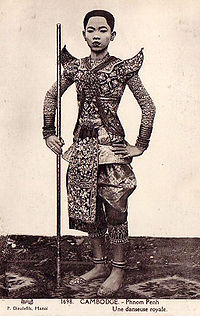
Male costume
Male characters wear costumes that are more intricate than the females, as it requires pieces, like sleeves, to be sewn together while being put on. They are dressed in a like their female counterpart, however it is worn differently. For the male, or neay rong, the is worn in the fashion, where the front is pleated and pulled under, between the legs, then tucked in the back and the remaining length of the pleat is stitched to the itself to form a draping 'fan' in the back. Knee-length pants are worn underneath displaying a wide, embroidered hemHem
To hem a piece of cloth is to sew a cut edge in such a way as to prevent unraveling of the fabric.There are many different styles of hems of varying complexities. The most common hem...
around the knees. For the top, they wear long sleeved shirts with rich embroidering, along with a collar, or , around their neck. On the end of their shoulders are a sort of epaulette
Epaulette
Epaulette is a type of ornamental shoulder piece or decoration used as insignia of rank by armed forces and other organizations.Epaulettes are fastened to the shoulder by a shoulder strap or "passant", a small strap parallel to the shoulder seam, and the button near the collar, or by laces on the...
that is arching upwards like Indra
Indra
' or is the King of the demi-gods or Devas and Lord of Heaven or Svargaloka in Hindu mythology. He is also the God of War, Storms, and Rainfall.Indra is one of the chief deities in the Rigveda...
's bow (known as ). Another component of the male costumes are three richly embroidered banners worn around the front waist. The center piece is known as a while the two side pieces are known as a , while for monkeys and yaksha characters, they wear another piece in the back called a .
Male characters also wear an x-like strap around the body called a , often it is made of gold-colored silk and sometimes it is made from chains of gold with square ornaments, in which case the latter is reserved for more important characters. The males also wear the same ankle and wrist jewelry as the female, but with the addition of an extra set of bangles on the wrist and no armlets. They also wear a kite-shaped ornament called a (named after the Bo tree leaf) which serves as center point for their .
Headdress
There are several types crownsCrown (headgear)
A crown is the traditional symbolic form of headgear worn by a monarch or by a deity, for whom the crown traditionally represents power, legitimacy, immortality, righteousness, victory, triumph, resurrection, honour and glory of life after death. In art, the crown may be shown being offered to...
which denote the ranks of the character. Commonly worn by female characters of the lowest rank is the ; it is also worn by Brahmin characters with ornaments around a bun of hair. Divinities
Divinity
Divinity and divine are broadly applied but loosely defined terms, used variously within different faiths and belief systems — and even by different individuals within a given faith — to refer to some transcendent or transcendental power or deity, or its attributes or manifestations in...
and royal characters of the highest ranks wear a tall single-spire crown called a for male characters and a for female characters. The (Groslier romanizes this as ), reserved for princes and generals , is a circlet-like crown with a faux knot in the back. The is worn by princess' and, often, maidens of significance in a dance if they happen to not be of royal rank. Some characters' headdressings include ear ornaments as well as earrings. Characters such as ogres and monkeys wear masks. Ogres and monkeys of royal rank wear masks with a attached.
Floral adornments
Dancers are traditionally adorned with fragrant flowers, although sometimes, fresh flowers are substituted with faux flowers. The floral tassel is traditionally made of Jasminum sambacJasminum sambac
Jasminum sambac is a species of jasmine native to South and Southeast Asia. It is a small shrub or vine growing up to in height. It is widely cultivated for its attractive and sweetly fragrant flowers. The flowers are also used for perfumes and for making tea. It is known as the Arabian jasmine in...
strung together with Michelia
Michelia
Michelia is a genus of flowering plants belonging to the Magnolia family . The genus includes about 50 species of evergreen trees and shrubs, native to tropical and subtropical south and southeast Asia , including southern China.-Description:The Magnoliaceae are an ancient family; fossil plants...
flowers, being either Michelia × alba or Michelia champaca
Michelia champaca
Magnolia champaca is a large evergreen tree, native to the Indomalaya ecozone . It is best known for its strongly fragrant yellow or white flowers. It is, however, primarily cultivated for its timber, and is also used in urban landscaping...
. The (female) role wears a rose above the right ear and a floral tassel attached to the left side of the crown while the (male) role wears a rose on the left ear and a floral tassel to the right side. Sometimes, dancers will wear jasmine garlands fit for the wrists. The apsara role is most often adorned with the flowers of either Plumeria obtusa
Plumeria obtusa
Plumeria obtusa is a species of the genus Plumeria , native from the Greater Antilles, northern Central America and southern Mexico. This large shrub or small tree grows up to tall....
or white cultivars of Plumeria rubra
Plumeria rubra
Plumeria rubra is a deciduous plant species belonging to the genus Plumeria. Its common names are Red Frangipani, Common Frangipani, Temple Tree, or simply Plumeria...
; sometimes plumerias are tied along the back of their hair.
Music
See main article; PinpeatPinpeat
The pinpeat orchestra or musical ensemble performs the ceremonial music of the royal cours and temples of Cambodia. The orchestra consists of approximately nine or ten instruments, mainly wind and percussion . It accompanies court dances, masked plays, shadow plays, and religious ceremonies...
The music used for Khmer classical dance is played by a pinpeat ensemble. This type of orchestra consists of several types of xylophones, drum
Drum
The drum is a member of the percussion group of musical instruments, which is technically classified as the membranophones. Drums consist of at least one membrane, called a drumhead or drum skin, that is stretched over a shell and struck, either directly with the player's hands, or with a...
s, oboe
Oboe
The oboe is a double reed musical instrument of the woodwind family. In English, prior to 1770, the instrument was called "hautbois" , "hoboy", or "French hoboy". The spelling "oboe" was adopted into English ca...
s, gong
Gong
A gong is an East and South East Asian musical percussion instrument that takes the form of a flat metal disc which is hit with a mallet....
s, and other musical instrument
Musical instrument
A musical instrument is a device created or adapted for the purpose of making musical sounds. In principle, any object that produces sound can serve as a musical instrument—it is through purpose that the object becomes a musical instrument. The history of musical instruments dates back to the...
s. The chorus consists of several singers and mainly sing in the absence of music. The lyrics are in poetry form and are sung interspersed with the grammatical particles eu [əː], eung [əːŋ], and euy [əːj] in various patterns.
Music instruments
Music pieces
Khmer classical dance uses a particular piece of music for a certain event, such as when a dancer enters a scene, performing certain actions, such as flying, or walking, and when leaving the stage. These musical pieces are arranged to form a suite. New pieces of music are rarely created.Below is a select list of music pieces used in the repertoire
- : a song of blessing used for propitiationPropitiationPropitiation is appeasing or making well disposed , especially a deity, thus incurring divine favor or avoiding Divine retribution.-Christian theology:...
, often used to commence a performance - : overture of the (ogre) characters, a display of power as they go into combatCombatCombat, or fighting, is a purposeful violent conflict meant to establish dominance over the opposition, or to terminate the opposition forever, or drive the opposition away from a location where it is not wanted or needed....
or battle - : used for the introduction of a character or a group of dancers in a scene
- : used to present a character's departure of the scene; leaving the stageStage (theatre)In theatre or performance arts, the stage is a designated space for the performance productions. The stage serves as a space for actors or performers and a focal point for the members of the audience...
- : lit., euphonic ; music characterized by the constant percussion of drums and small cup-shaped cymbals;Robert K. Headley 1997, Cambodian-English Dictionary used to present an action such as commencing a journey or flying
- : music used in tune with aquatic recreation (e.g. dancers miming the action of rowing a boatWatercraft rowingWatercraft rowing is the act of propelling a boat using the motion of oars in the water. The difference between paddling and rowing is that with rowing the oars have a mechanical connection with the boat whereas with paddling the paddles are hand-held with no mechanical connection.This article...
) - : lit., royal bathing of the MonMon peopleThe Mon are an ethnic group from Burma , living mostly in Mon State, Bago Division, the Irrawaddy Delta, and along the southern Thai–Burmese border. One of the earliest peoples to reside in Southeast Asia, the Mon were responsible for the spread of Theravada Buddhism in Burma and Thailand...
; a song used to represent a character dressing up their appearance - : ; a music piece use to present dancers marching (e.g. the beginning of )
- : used to show the grace and beauty of a character wielding his weapon
- : - lit., 'cream color' in reference to complexion, a soft and slow melody
- : - a music characterized by the , often used for certain actions such as combat, but not limited to such
Repertoire
According to The Cambridge Guide to Asian Theatre (1997) the Royal Ballet's repertoire contained approximately 40 dances and 60 dance dramas. Since the restoration of the Royal Ballet in the 1979, some of the old repertoire was recreated and several new dances were also created, most notably robam monosanhchettana by the late Chea Samy. As of recent years, new dance dramas have been created by the Royal Ballet, such as Apsara Mera. Sophiline Cheam ShapiroSophiline Cheam Shapiro
Sophiline Cheam Shapiro is a Cambodian dancer and choreographer.-Early life:At the age of eight she was forced to live in the countryside of Cambodia after her family was evacuated from the city by the Khmer Rouge...
has also introduced new repertory to Khmer classical dance although they are not part of the traditional royal repertoire and mainly have been performed in Western venues. Her works include dramas such as , an adaptation of Shakespeare's Othello
Othello
The Tragedy of Othello, the Moor of Venice is a tragedy by William Shakespeare, believed to have been written in approximately 1603, and based on the Italian short story "Un Capitano Moro" by Cinthio, a disciple of Boccaccio, first published in 1565...
and , an adaptation of Mozart's The Magic Flute
The Magic Flute
The Magic Flute is an opera in two acts composed in 1791 by Wolfgang Amadeus Mozart to a German libretto by Emanuel Schikaneder. The work is in the form of a Singspiel, a popular form that included both singing and spoken dialogue....
.
Dance Dramas
The Royal Ballet of Cambodia's repertoire of dance dramas consists of a myriad of stories unlike the which is limited only to the Ramayana. Many of the dance dramas have analogs in the lakhon nai dance genre of Thailand but do not share the same choreography or exact storyline. During the time of Queen Kossamak, several dance dramas were re-choreographed and shortened such as Roeung Preah Thong-Neang Neak; this drama would later be recreated again in 2003 among others.The plot of many dance dramas are often that of a male character who rescues a damsel in distress
Damsel in distress
The subject of the damsel in distress, or persecuted maiden, is a classic theme in world literature, art, and film. She is usually a beautiful young woman placed in a dire predicament by a villain or monster and who requires a hero to achieve her rescue. She has become a stock character of fiction,...
or of destined love presented with obstacles. The traditional repertoire portrays mythology, traditional tales and may sometimes include religious concepts such as karma
Karma
Karma in Indian religions is the concept of "action" or "deed", understood as that which causes the entire cycle of cause and effect originating in ancient India and treated in Hindu, Jain, Buddhist and Sikh philosophies....
.
Select repertory of dance dramas
Dances
In contrast to the dance dramas are shorter dances known as . They can serve several purposes such as honoring, ritualistic functions (e.g. securing the kingdom's fortune and prosperity), and blessing. Spanning about several minutes or so, these dances do not all have storylines. Although many robam are indeed excerpts from dances dramas such as and (the latter being from the ).The 'apsara dance' of today was created under the guidance of Queen Kossamak Nearireath. Its costume is based on the bas-relief of apsaras on temple ruins but much of it, including its music and gesture is not unique from other classical Khmer dances which probably do not date back to the Angkor
Angkor
Angkor is a region of Cambodia that served as the seat of the Khmer Empire, which flourished from approximately the 9th to 15th centuries. The word Angkor is derived from the Sanskrit nagara , meaning "city"...
period.
Select repertory of dances
Glossary
Gallery
Non-fiction
- Cravath, Paul (2008). Earth in Flower - The Divine Mystery of the Cambodian Dance Drama, DatAsia Press
- Groslier, George et al. (2011). Cambodian Dancers - Ancient and Modern, DatAsia Press
- Heywood, Denise (2009). Cambodian Dance Celebration of the Gods, River Books
- Loviny, Christophe (2003). The Apsaras of Angkor, Sipar: Jazz Editions
Fiction
- Meyer, Charles (2009). Saramani: Cambodian Dance, DatAsia Press
- Lee, Jeanne M. (1994). Silent Lotus, Farrar, Straus and Giroux
- Lord, Michael (2006). Little Sap and Monsieur Rodin, Lee & Low Books
Selected Discography
- Musical SourcesMusical SourcesMusical Sources is a series of recordings of traditional music that was made for the International Music Council by the International Institute for Comparative Music Studies and Documentation and released on the Philips label. Most of these recordings were later reissued on the Auvidis label. ...
– Royal Music Of Cambodia (1971) by Jacques Brunet; contains a condensed recording of the Buong Suong dance drama featuring the goddess Manimekhala - Homrong: Classical Music From Cambodia (2004) by Chum Ngek; contains music pieces and suites used by the royal ballet
See also
- Theatre of CambodiaTheatre of CambodiaTheatre of Cambodia known as Lakhon is composed of many different genres. There are three main categories: classical, folk, and modern. Many forms of theatre in Cambodia incorporates dance movement into performances and are referred to as dance dramas....
- Dance of CambodiaDance of CambodiaDance in Cambodia consists of three main categories: classical dance of the royal court used for invocation, entertainment and to pay homage, folk dance which portrays cultural traditions, and social dances performed in social gatherings.-Classical dance:...
- Dance of ThailandDance of ThailandDance in Thailand is the main dramatic art form of Thailand. Thai dance, like many forms of traditional Asian dance, can be divided into two major categories that correspond roughly to the high art and low art distinction....
- Earth in FlowerEarth in FlowerEarth in Flower is a comprehensive historical analysis of Southeast Asia’s most esoteric female performing art: the ancient Khmer classical dance formerly known as the Royal Ballet of Cambodia...
Unverified Notes
Notes in this section reference material produced by laymen or reference material not generally considered a legitimate source on the subject matter at hand. They are unverified and not peer-reviewed.General information
- Cambodian Classical Dance by Chamroeun Yin
- Nginn-Karet Foundation Teaches Sacred Dance at Banteay Srey
- The Language of Khmer Classical Dance | The Cambodia Daily
- The Near Extinction of Cambodian Classical Dance | UCLA Center fo Southeast Asian Studies
- The Khmer Dance Project
- NY Times | Auguste Rodin and the Royal Ballet of Cambodia
- Khmer Arts Academy | Founded by Sophiline Cheam Shapiro