


Watercraft rowing

Encyclopedia
Watercraft rowing is the act of propelling a boat using the motion of oar
s in the water. The difference between paddling
and rowing is that with rowing the oars have a mechanical connection with the boat whereas with paddling the paddles are hand-held with no mechanical connection.
This article deals with general rowing including the recreational, transportation and utility aspects of rowing, rather than the sport of competitive rowing
which is a specialized case of racing using strictly regulated equipment and a highly refined technique.
Rearward-facing systems:
This is probably the oldest system used in Europe and North America. A seated rower pulls on one or two oars, which lever the boat through the water. The pivot point of the oars (attached solidly to the boat) is the fulcrum. The motive force is applied through the rower's feet.
In traditional rowing craft, the pivot point of the oars is generally located on the boat's gunwale
. The actual fitting that holds the oar may be as simple as one or two pegs (or thole pins) or a metal oarlock (also called rowlock - "rollock"). In performance rowing craft, the rowlock is usually extended outboard on a "rigger" to allow using a longer oar for increased power.
Sculling
involves a seated rower who pulls on two oars or sculls, attached to the boat, thereby moving the boat in the direction opposite that which the rower faces. In some multiple-seat boats seated rowers each pull on a single "sweep
" oar, usually with both hands. Boats in which the rowers are coordinated by a coxswain
are referred to as a "coxed" pair/four/eight. Sometimes sliding seats are used to enable the rower to use the leg muscles, substantially increasing the power available. An alternative to the sliding seat, called a sliding rigger, uses a stationary seat and the rower moves the oarlocks with his feet. On a craft used in Italy, the catamaran moscone, the rower stands and takes advantage of his body weight to increase leverage while sculling.
Forward-facing systems:
Articulated or bow facing oars have two-piece oars and use a mechanical transmission to reverse the direction of the oar blade, enabling a seated rower to row facing forward with a pulling motion. Push rowing, also called back-watering if used in a boat not designed for forward motion, uses regular oars with a pushing motion to achieve forward-facing travel, sometimes seated and sometimes standing. This is a convenient method of manoeuvring in a narrow waterway or through a busy harbour. Another system uses inboard mounted oarlocks to achieve forward motion of the boat with a pulling motion on the oars.
Another system (also called sculling) involves using a single oar extending from the stern of the boat which is moved back and forth under water somewhat like a fish tail, such as the Chinese yuloh, by which quite large boats can be moved.
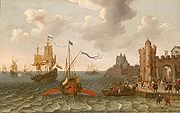 In ancient times, rowing vessels, especially galleys, were extensively used in naval warfare
and trade, in particular in the Mediterranean from classical antiquity
onwards. Galleys had advantages over sailing
ships; they were easier to maneuver, capable of short bursts of speed, and able to move independent of the wind. Galleys continued in use in the Mediterranean until the advent of steam propulsion
. Their use in northern Atlantic waters was less successful, finishing with their poor performance with the Spanish Armada
.
The Classical trireme
used 170 rowers; later galleys included even larger crews. Trireme oarsmen used leather cushions to slide over the seats, which allowed them to use their leg strength as a modern oarsman does with a sliding seat. Galleys usually had masts and sails, but when about to enter combat would lower them. Greek fleets would also leave their sails and masts on shore (as being unnecessary weight) if possible.
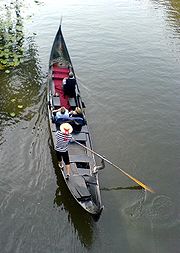 In Venice
, gondola
s and other similar flat bottomed boats are popular forms of transport propelled by oars which are held in place by an open wooden fòrcola. The Voga alla Veneta technique of rowing is considerably different from the style used in international sport rowing
, due to the oarsman facing forward in a standing position. This allows the boat to manoeuover very quickly and with agility - useful in the narrow and busy canals of Venice. Competitive regattas are also held using the Venetian rowing technique, using both gondolas and other types of vessels.
There are three different styles of Venetian rowing:
Even since the earliest recorded references to rowing, the sporting element has been present. An Egyptian funerary inscription of 1430 BC records that the warrior Amenhotep (Amenophis) II was also renowned for his feats of oarsmanship. In the Aeneid, Virgil mentions rowing forming part of the funeral games arranged by Aeneas in honour of his father.[7] In the 13th century, Venetian festivals called regata included boat races among others.[8]
The first known "modern" rowing races began from competition among the professional watermen that provided ferry and taxi service on the River Thames in London. Prizes for wager races were often offered by the London Guilds and Livery Companies or wealthy owners of riverside houses.[7] The oldest surviving such race, Doggett's Coat and Badge was first contested in 1715 and is still held annually from London Bridge to Chelsea.[9] During the nineteenth century these races were to become numerous and popular, attracting large crowds. Prize matches amongst professionals similarly became popular on other rivers throughout Great Britain in the nineteenth century, notably on the Tyne. In America, the earliest known race dates back to 1756 in New York, when a pettiauger defeated a Cape Cod whaleboat in a race. [10]
Amateur competition in England began towards the end of the eighteenth century. Documentary evidence from this period is sparse, but it is known that the Monarch Boat Club of Eton College and the Isis Club of Westminster School were both in existence in the 1790s. The Star Club and Arrow Club in London for gentlemen amateurs were also in existence before 1800. At the University of Oxford bumping races were first organised in 1815 when Brasenose College and Jesus College boat clubs had the first annual race[11] while at Cambridge the first recorded races were in 1827.[12] Brasenose won Oxford University's first Head of the River and claim to be the oldest established boat club in the world. The Boat Race between Oxford University and Cambridge University first took place in 1829, and was the second intercollegiate sporting event (following the first Varsity Cricket Match by 2 years). The interest in the first Boat Race and subsequent matches led the town of Henley to begin hosting an annual regatta in 1839.[13]
Founded in 1818, Leander Club is the world's oldest public rowing club.[14] The second oldest club which still exists is the Der Hamburger und Germania Ruder Club which was founded 1836 and marked the beginning of rowing as an organized sport in Germany.[15] During the Nineteenth Century, as in England, wager matches in North America between professionals became very popular attracting vast crowds. The Detroit Boat Club was established as the first rowing exclusive club in 1839 in the US.[16][17] In 1843, the first American college rowing club was formed at Yale University.[16] The Harvard-Yale Regatta is the oldest intercollegiate sporting event in the United States,[16][18] having been contested every year since 1852 (excepting interruptions for
Some hold that the Whitehall rowing boat design was introduced from England. However the famed nautical historian Howard I. Chapelle
, cites the opinion of the late W. P. Stephens that in New York City there is a Whitehall Street and this was where the Whitehall was first built. Chapelle, Stephens and others agree that the design came into existence some time in the 1820s in New York City, having first been built by navy yard apprentices who had derived their model to some extent from the old naval gig.
In Wooden Boats to Build and Use (1996), John Gardner of Mystic Seaport describes a 25-foot racing Whitehall, named American Star, which triumphed in an 1824 race in New York Harbor that according to newspapers of the time drew 50,000 spectators, more than any American sporting event ever until then. The following year the boat was gifted to an ageing General Lafayette, hero of the American Revolution, during his tour of the U.S. The American Star returned to Lafayette's estate in France where it was displayed in a specially constructed gazebo. During the mid 20th century the boat was rediscovered in storage there, and its lines have be preserved at Mystic Seaport where an exact replica was built in 1974-75, and still rows at Seaport events.
Dealing with these issues in more detail it can be seen that these details are a compromise between competing factors. Example if the waterline beam (width) is too narrow the boat will be tender and the occupant at risk of falling out, if the beam is too high the boat will be slow and be caught up with the waves. Another issue is windage and freeboard, if the freeboard (height of the gunnel above the waterline) is too high then windage will be high and as a result the boat will be caught by the wind and the rower will not be able to control the boat in high winds, if the freeboard is too low, water will enter the boat through waves.
Another issue is trim, if the boat is designed for one person then only a single rowing position is required. If the rower is to carry a passenger at the stern then the boat will be stern heavy and trim will be out. To correct this a weight can be added to the bow, alternatively the boat can supply a second rowing position further forward for this purpose. For a boat to carry three separate thwarts as described and with adequate space for each occupant then the boat has to be of a certain minimum size. It is oft quoted that the ideal size of a good rowboat is some 5 m (15ft).
Overall beam (width) is important too. If the rowlocks are too close together the oars will be difficult to use. If the rowlocks are too far apart then the boat will be overly large and rowing will be inefficient, wasting rower's effort. Sometimes on faster rowboats for protected waters outriggers are added to increase rowlock separation. Many traditional rowboats have a beam of about 135 cm (4.5ft). The Finnish Savonian type rowboat is very narrow and fast, having very sharp bow and stern, with beam around 110 cm (3.6ft), but also dangerously tender and prone to capsize easily in unexperienced hands.
Many old rowboats have very full ends (blunt ends), these may appear at first glance to be bad design as it looks slow, not fast. However a full ended rowboat will rise to a sea and not dig in as a finer hulled boat might do, thus a compromise needs to be made between the factors of speed and of seaworthiness.
Speed, a rowboat designed for carrying occupants to a boat berthed at a mooring might tend to be short and beamy, whilst a rowboat for use on rivers and to travel long distances might be long and narrow.
It can be seen that just by discussing a few issues that the design of a good classic rowboat is a very ingenious and sophisticated solution to the task of keeping people alive on the sea. Men who spent all their working lives at sea needed boats that would bring them safely home, the classic boats that were derived from this task, be they rowboats or otherwise are the end result of hundreds of years of evolution to the optimum solution
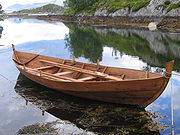
Oar
An oar is an implement used for water-borne propulsion. Oars have a flat blade at one end. Oarsmen grasp the oar at the other end. The difference between oars and paddles are that paddles are held by the paddler, and are not connected with the vessel. Oars generally are connected to the vessel by...
s in the water. The difference between paddling
Watercraft paddling
Paddling with regard to watercraft is the act of manually propelling or navigating a small boat using a blade that is joined to a shaft, known as paddle, in the water. The paddle is also used to steer the vessel and may either be a single bladed or double bladed...
and rowing is that with rowing the oars have a mechanical connection with the boat whereas with paddling the paddles are hand-held with no mechanical connection.
This article deals with general rowing including the recreational, transportation and utility aspects of rowing, rather than the sport of competitive rowing
Rowing (sport)
Rowing is a sport in which athletes race against each other on rivers, on lakes or on the ocean, depending upon the type of race and the discipline. The boats are propelled by the reaction forces on the oar blades as they are pushed against the water...
which is a specialized case of racing using strictly regulated equipment and a highly refined technique.
Types of rowing systems
In some localities, rear-facing systems prevail. In other localities, forward-facing systems prevail, especially in crowded areas such as in Venice, Italy and in Asian and Indonesian rivers and harbors. This is not strictly an "either-or", because in different situations it's useful to be able to row a boat facing either way. The current emphasis on the health aspects of rowing, has resulted in some new mechanical systems being developed, some very different from the traditional rowing systems of the past.Rearward-facing systems:
This is probably the oldest system used in Europe and North America. A seated rower pulls on one or two oars, which lever the boat through the water. The pivot point of the oars (attached solidly to the boat) is the fulcrum. The motive force is applied through the rower's feet.
In traditional rowing craft, the pivot point of the oars is generally located on the boat's gunwale
Gunwale
The gunwale is a nautical term describing the top edge of the side of a boat.Wale is the same word as the skin injury, a wheal, which, too, forms a ridge. Originally the gunwale was the "Gun ridge" on a sailing warship. This represented the strengthening wale or structural band added to the design...
. The actual fitting that holds the oar may be as simple as one or two pegs (or thole pins) or a metal oarlock (also called rowlock - "rollock"). In performance rowing craft, the rowlock is usually extended outboard on a "rigger" to allow using a longer oar for increased power.
Sculling
Sculling
Sculling generally refers to a method of using oars to propel watercraft in which the oar or oars touch the water on both the port and starboard sides of the craft, or over the stern...
involves a seated rower who pulls on two oars or sculls, attached to the boat, thereby moving the boat in the direction opposite that which the rower faces. In some multiple-seat boats seated rowers each pull on a single "sweep
Sweep (rowing)
Sweep or sweep-oar rowing is a type of rowing when a rower has one oar, usually held with both hands. As each rower has only one oar, the rowers have to be paired so that there is an oar on each side of the boat. This is in contrast to sculling when a rower has two oars, one in each hand. In the...
" oar, usually with both hands. Boats in which the rowers are coordinated by a coxswain
Coxswain (rowing)
In a crew, the coxswain is the member who sits in the stern facing the bow, steers the boat, and coordinates the power and rhythm of the rowers.- Role :The role of a coxswain within a crew is to:...
are referred to as a "coxed" pair/four/eight. Sometimes sliding seats are used to enable the rower to use the leg muscles, substantially increasing the power available. An alternative to the sliding seat, called a sliding rigger, uses a stationary seat and the rower moves the oarlocks with his feet. On a craft used in Italy, the catamaran moscone, the rower stands and takes advantage of his body weight to increase leverage while sculling.
Forward-facing systems:
Articulated or bow facing oars have two-piece oars and use a mechanical transmission to reverse the direction of the oar blade, enabling a seated rower to row facing forward with a pulling motion. Push rowing, also called back-watering if used in a boat not designed for forward motion, uses regular oars with a pushing motion to achieve forward-facing travel, sometimes seated and sometimes standing. This is a convenient method of manoeuvring in a narrow waterway or through a busy harbour. Another system uses inboard mounted oarlocks to achieve forward motion of the boat with a pulling motion on the oars.
Another system (also called sculling) involves using a single oar extending from the stern of the boat which is moved back and forth under water somewhat like a fish tail, such as the Chinese yuloh, by which quite large boats can be moved.
Ancient rowing
Naval warfare
Naval warfare is combat in and on seas, oceans, or any other major bodies of water such as large lakes and wide rivers.-History:Mankind has fought battles on the sea for more than 3,000 years. Land warfare would seem, initially, to be irrelevant and entirely removed from warfare on the open ocean,...
and trade, in particular in the Mediterranean from classical antiquity
Classical antiquity
Classical antiquity is a broad term for a long period of cultural history centered on the Mediterranean Sea, comprising the interlocking civilizations of ancient Greece and ancient Rome, collectively known as the Greco-Roman world...
onwards. Galleys had advantages over sailing
Sailing
Sailing is the propulsion of a vehicle and the control of its movement with large foils called sails. By changing the rigging, rudder, and sometimes the keel or centre board, a sailor manages the force of the wind on the sails in order to move the boat relative to its surrounding medium and...
ships; they were easier to maneuver, capable of short bursts of speed, and able to move independent of the wind. Galleys continued in use in the Mediterranean until the advent of steam propulsion
Steamboat
A steamboat or steamship, sometimes called a steamer, is a ship in which the primary method of propulsion is steam power, typically driving propellers or paddlewheels...
. Their use in northern Atlantic waters was less successful, finishing with their poor performance with the Spanish Armada
Spanish Armada
This article refers to the Battle of Gravelines, for the modern navy of Spain, see Spanish NavyThe Spanish Armada was the Spanish fleet that sailed against England under the command of the Duke of Medina Sidonia in 1588, with the intention of overthrowing Elizabeth I of England to stop English...
.
The Classical trireme
Trireme
A trireme was a type of galley, a Hellenistic-era warship that was used by the ancient maritime civilizations of the Mediterranean, especially the Phoenicians, ancient Greeks and Romans.The trireme derives its name from its three rows of oars on each side, manned with one man per oar...
used 170 rowers; later galleys included even larger crews. Trireme oarsmen used leather cushions to slide over the seats, which allowed them to use their leg strength as a modern oarsman does with a sliding seat. Galleys usually had masts and sails, but when about to enter combat would lower them. Greek fleets would also leave their sails and masts on shore (as being unnecessary weight) if possible.
Venetian rowing
Venice
Venice is a city in northern Italy which is renowned for the beauty of its setting, its architecture and its artworks. It is the capital of the Veneto region...
, gondola
Gondola
The gondola is a traditional, flat-bottomed Venetian rowing boat, well suited to the conditions of the Venetian Lagoon. For centuries gondolas were the chief means of transportation and most common watercraft within Venice. In modern times the iconic boats still have a role in public transport in...
s and other similar flat bottomed boats are popular forms of transport propelled by oars which are held in place by an open wooden fòrcola. The Voga alla Veneta technique of rowing is considerably different from the style used in international sport rowing
Sport rowing
Rowing is a sport in which athletes race against each other on rivers, on lakes or on the ocean, depending upon the type of race and the discipline. The boats are propelled by the reaction forces on the oar blades as they are pushed against the water...
, due to the oarsman facing forward in a standing position. This allows the boat to manoeuover very quickly and with agility - useful in the narrow and busy canals of Venice. Competitive regattas are also held using the Venetian rowing technique, using both gondolas and other types of vessels.
There are three different styles of Venetian rowing:
- Single oarsman with one oar, standing near the stern of the boat (the oar also acts as a rudder)
- One or two oarsman each with two crossed oars (known as a la valesàna)
- Two or more oarsmen, rowing on alternate sides of the boat
Even since the earliest recorded references to rowing, the sporting element has been present. An Egyptian funerary inscription of 1430 BC records that the warrior Amenhotep (Amenophis) II was also renowned for his feats of oarsmanship. In the Aeneid, Virgil mentions rowing forming part of the funeral games arranged by Aeneas in honour of his father.[7] In the 13th century, Venetian festivals called regata included boat races among others.[8]
The first known "modern" rowing races began from competition among the professional watermen that provided ferry and taxi service on the River Thames in London. Prizes for wager races were often offered by the London Guilds and Livery Companies or wealthy owners of riverside houses.[7] The oldest surviving such race, Doggett's Coat and Badge was first contested in 1715 and is still held annually from London Bridge to Chelsea.[9] During the nineteenth century these races were to become numerous and popular, attracting large crowds. Prize matches amongst professionals similarly became popular on other rivers throughout Great Britain in the nineteenth century, notably on the Tyne. In America, the earliest known race dates back to 1756 in New York, when a pettiauger defeated a Cape Cod whaleboat in a race. [10]
Amateur competition in England began towards the end of the eighteenth century. Documentary evidence from this period is sparse, but it is known that the Monarch Boat Club of Eton College and the Isis Club of Westminster School were both in existence in the 1790s. The Star Club and Arrow Club in London for gentlemen amateurs were also in existence before 1800. At the University of Oxford bumping races were first organised in 1815 when Brasenose College and Jesus College boat clubs had the first annual race[11] while at Cambridge the first recorded races were in 1827.[12] Brasenose won Oxford University's first Head of the River and claim to be the oldest established boat club in the world. The Boat Race between Oxford University and Cambridge University first took place in 1829, and was the second intercollegiate sporting event (following the first Varsity Cricket Match by 2 years). The interest in the first Boat Race and subsequent matches led the town of Henley to begin hosting an annual regatta in 1839.[13]
Founded in 1818, Leander Club is the world's oldest public rowing club.[14] The second oldest club which still exists is the Der Hamburger und Germania Ruder Club which was founded 1836 and marked the beginning of rowing as an organized sport in Germany.[15] During the Nineteenth Century, as in England, wager matches in North America between professionals became very popular attracting vast crowds. The Detroit Boat Club was established as the first rowing exclusive club in 1839 in the US.[16][17] In 1843, the first American college rowing club was formed at Yale University.[16] The Harvard-Yale Regatta is the oldest intercollegiate sporting event in the United States,[16][18] having been contested every year since 1852 (excepting interruptions for
Whitehall Rowboats
The origins of this distinctive and practical craft are unclear. In earlier times, however, builders were often sailors or seafaring men. Successful designs for large and small craft alike evolved slowly and as certain desirable qualities were attained and perfected they rarely changed.Some hold that the Whitehall rowing boat design was introduced from England. However the famed nautical historian Howard I. Chapelle
Howard I. Chapelle
Howard Irving Chapelle was an American naval architect, and curator of maritime history at the Smithsonian Institution, Washington, D.C.. In addition, he authored many books and articles books on maritime history and marine architecture.-Biography:...
, cites the opinion of the late W. P. Stephens that in New York City there is a Whitehall Street and this was where the Whitehall was first built. Chapelle, Stephens and others agree that the design came into existence some time in the 1820s in New York City, having first been built by navy yard apprentices who had derived their model to some extent from the old naval gig.
In Wooden Boats to Build and Use (1996), John Gardner of Mystic Seaport describes a 25-foot racing Whitehall, named American Star, which triumphed in an 1824 race in New York Harbor that according to newspapers of the time drew 50,000 spectators, more than any American sporting event ever until then. The following year the boat was gifted to an ageing General Lafayette, hero of the American Revolution, during his tour of the U.S. The American Star returned to Lafayette's estate in France where it was displayed in a specially constructed gazebo. During the mid 20th century the boat was rediscovered in storage there, and its lines have be preserved at Mystic Seaport where an exact replica was built in 1974-75, and still rows at Seaport events.
What makes a good rowboat
There are many considerations that go into selecting a good rowboat. A well designed rowboat will perform well in trying conditions. The classic shapes of rowboats reflect an evolution of hundreds of years old trial and error to get a good shape. Some factors that have to be considered are waterline length, speed, carrying capacity, stability, windage, weight, seaworthiness, cost, waterline beam, the fullness or fineness of the ends, trim and more.Dealing with these issues in more detail it can be seen that these details are a compromise between competing factors. Example if the waterline beam (width) is too narrow the boat will be tender and the occupant at risk of falling out, if the beam is too high the boat will be slow and be caught up with the waves. Another issue is windage and freeboard, if the freeboard (height of the gunnel above the waterline) is too high then windage will be high and as a result the boat will be caught by the wind and the rower will not be able to control the boat in high winds, if the freeboard is too low, water will enter the boat through waves.
Another issue is trim, if the boat is designed for one person then only a single rowing position is required. If the rower is to carry a passenger at the stern then the boat will be stern heavy and trim will be out. To correct this a weight can be added to the bow, alternatively the boat can supply a second rowing position further forward for this purpose. For a boat to carry three separate thwarts as described and with adequate space for each occupant then the boat has to be of a certain minimum size. It is oft quoted that the ideal size of a good rowboat is some 5 m (15ft).
Overall beam (width) is important too. If the rowlocks are too close together the oars will be difficult to use. If the rowlocks are too far apart then the boat will be overly large and rowing will be inefficient, wasting rower's effort. Sometimes on faster rowboats for protected waters outriggers are added to increase rowlock separation. Many traditional rowboats have a beam of about 135 cm (4.5ft). The Finnish Savonian type rowboat is very narrow and fast, having very sharp bow and stern, with beam around 110 cm (3.6ft), but also dangerously tender and prone to capsize easily in unexperienced hands.
Many old rowboats have very full ends (blunt ends), these may appear at first glance to be bad design as it looks slow, not fast. However a full ended rowboat will rise to a sea and not dig in as a finer hulled boat might do, thus a compromise needs to be made between the factors of speed and of seaworthiness.
Speed, a rowboat designed for carrying occupants to a boat berthed at a mooring might tend to be short and beamy, whilst a rowboat for use on rivers and to travel long distances might be long and narrow.
It can be seen that just by discussing a few issues that the design of a good classic rowboat is a very ingenious and sophisticated solution to the task of keeping people alive on the sea. Men who spent all their working lives at sea needed boats that would bring them safely home, the classic boats that were derived from this task, be they rowboats or otherwise are the end result of hundreds of years of evolution to the optimum solution
See also
- Rowing exerciseRowing exerciseIn strength training, rowing is a form of muscular resistance training exercise that shares many characteristics of rowing a boat without involving water or a boat...
- Rowing (sport)Rowing (sport)Rowing is a sport in which athletes race against each other on rivers, on lakes or on the ocean, depending upon the type of race and the discipline. The boats are propelled by the reaction forces on the oar blades as they are pushed against the water...
- Ocean rowingOcean rowingOcean rowing is the sport of rowing across oceans. The sport is as much a psychological as it is a physical challenge. Rowers often have to endure long periods at sea without help often many days if not weeks away. The challenge is especially acute for solo rowers who are held in especially high...
- Coastal and ocean rowingCoastal and ocean rowingCoastal and offshore rowing is a type of rowing performed at sea. Due to the harsher conditions encountered, the boats are wider and more robust than those used on rivers and lakes.-International competition:...
- ScullingScullingSculling generally refers to a method of using oars to propel watercraft in which the oar or oars touch the water on both the port and starboard sides of the craft, or over the stern...
- Racing shellRacing shellIn watercraft, a racing shell is an extremely narrow, and often disproportionately long, rowing boat specifically designed for racing or exercise. It is outfitted with long oars, outriggers to hold the oarlocks away from the boat, and sliding seats...