


Kaiparowits Formation

Encyclopedia
The Kaiparowits Formation is a sedimentary rock formation found in the Kaiparowits Plateau
in Grand Staircase-Escalante National Monument
, in the southern part of Utah
in the western United States
. It is over 2800 feet (850 m) thick, and is Campanian
in age. This Upper Cretaceous formation was formed from alluvial
floodplain
s of large river
s; sandstone
beds
represent rivers, and mudstone
beds represent floodplain deposits. It is fossil
iferous, with most specimens from the lower half of the formation, but exploration is only comparatively recent, with most work being done since 1982.
(sharks and rays), gars
, bowfin
, sturgeons
, frog
s, salamander
s, turtle
s, lizard
s, crocodilia
ns, coelurosauria
n theropods such as dromaeosaurid
s, troodontids
, and Ornithomimus velox
, armored dinosaurs
, the duckbill
Parasaurolophus cyrtocristatus
, and a variety of early mammal
s including multituberculates, marsupial
s, and insectivora
ns. Recent finds include large specimens of the duckbill Gryposaurus
, including the new species G. monumentensis, and the first described remains of the oviraptorosauria
n Hagryphus giganteus
.
Trace fossil
s are also known from the Kaiparowits, including an excellently preserved hadrosaur skin impression known from a recent analysis by Herrero and Farke.
Kaiparowits Plateau
right|Location of the Kaiparowits Plateau within UtahThe Kaiparowits Plateau is a large, elevated landform located in southern Utah, in the southwestern United States. Along with the Grand Staircase and the Canyons of the Escalante, it makes up a significant portion of the Grand...
in Grand Staircase-Escalante National Monument
Grand Staircase-Escalante National Monument
The Grand Staircase-Escalante National Monument contains 1.9 million acres of land in southern Utah, the United States. There are three main regions: the Grand Staircase, the Kaiparowits Plateau, and the Canyons of the Escalante. President Bill Clinton designated the area as a U.S. National...
, in the southern part of Utah
Utah
Utah is a state in the Western United States. It was the 45th state to join the Union, on January 4, 1896. Approximately 80% of Utah's 2,763,885 people live along the Wasatch Front, centering on Salt Lake City. This leaves vast expanses of the state nearly uninhabited, making the population the...
in the western United States
United States
The United States of America is a federal constitutional republic comprising fifty states and a federal district...
. It is over 2800 feet (850 m) thick, and is Campanian
Campanian
The Campanian is, in the ICS' geologic timescale, the fifth of six ages of the Late Cretaceous epoch . The Campanian spans the time from 83.5 ± 0.7 Ma to 70.6 ± 0.6 Ma ...
in age. This Upper Cretaceous formation was formed from alluvial
Alluvium
Alluvium is loose, unconsolidated soil or sediments, eroded, deposited, and reshaped by water in some form in a non-marine setting. Alluvium is typically made up of a variety of materials, including fine particles of silt and clay and larger particles of sand and gravel...
floodplain
Floodplain
A floodplain, or flood plain, is a flat or nearly flat land adjacent a stream or river that stretches from the banks of its channel to the base of the enclosing valley walls and experiences flooding during periods of high discharge...
s of large river
River
A river is a natural watercourse, usually freshwater, flowing towards an ocean, a lake, a sea, or another river. In a few cases, a river simply flows into the ground or dries up completely before reaching another body of water. Small rivers may also be called by several other names, including...
s; sandstone
Sandstone
Sandstone is a sedimentary rock composed mainly of sand-sized minerals or rock grains.Most sandstone is composed of quartz and/or feldspar because these are the most common minerals in the Earth's crust. Like sand, sandstone may be any colour, but the most common colours are tan, brown, yellow,...
beds
Bed (geology)
In geology a bed is the smallest division of a geologic formation or stratigraphic rock series marked by well-defined divisional planes separating it from layers above and below. A bed is the smallest lithostratigraphic unit, usually ranging in thickness from a centimeter to several meters and...
represent rivers, and mudstone
Mudstone
Mudstone is a fine grained sedimentary rock whose original constituents were clays or muds. Grain size is up to 0.0625 mm with individual grains too small to be distinguished without a microscope. With increased pressure over time the platey clay minerals may become aligned, with the...
beds represent floodplain deposits. It is fossil
Fossil
Fossils are the preserved remains or traces of animals , plants, and other organisms from the remote past...
iferous, with most specimens from the lower half of the formation, but exploration is only comparatively recent, with most work being done since 1982.
Paleofauna
Animals present include chondrichthyansChondrichthyes
Chondrichthyes or cartilaginous fishes are jawed fish with paired fins, paired nares, scales, two-chambered hearts, and skeletons made of cartilage rather than bone...
(sharks and rays), gars
Lepidotes
Lepidotes is an extinct genus of neopterygian ray-finned fish from the Jurassic and Cretaceous periods. Fossils have been found worldwide....
, bowfin
Amia
Amia, AMIA, or AMiA can refer to:*American Medical Informatics Association*Bowfin, a fish genus*Anglican Mission in the Americas*Asociación Mutual Israelita Argentina, a Jewish community center located in Buenos Aires, Argentina...
, sturgeons
Acipenser
Acipenser is genus of sturgeons. With about 19 species, many of which are threatened, it is the largest genus in the order Acipenseriformes.-Species:*Acipenser baerii J. F. Brandt, 1869**Acipenser baerii baerii J. F...
, frog
Frog
Frogs are amphibians in the order Anura , formerly referred to as Salientia . Most frogs are characterized by a short body, webbed digits , protruding eyes and the absence of a tail...
s, salamander
Salamander
Salamander is a common name of approximately 500 species of amphibians. They are typically characterized by a superficially lizard-like appearance, with their slender bodies, short noses, and long tails. All known fossils and extinct species fall under the order Caudata, while sometimes the extant...
s, turtle
Turtle
Turtles are reptiles of the order Testudines , characterised by a special bony or cartilaginous shell developed from their ribs that acts as a shield...
s, lizard
Lizard
Lizards are a widespread group of squamate reptiles, with nearly 3800 species, ranging across all continents except Antarctica as well as most oceanic island chains...
s, crocodilia
Crocodilia
Crocodilia is an order of large reptiles that appeared about 84 million years ago in the late Cretaceous Period . They are the closest living relatives of birds, as the two groups are the only known survivors of the Archosauria...
ns, coelurosauria
Coelurosauria
Coelurosauria is the clade containing all theropod dinosaurs more closely related to birds than to carnosaurs. In the past, it was used to refer to all small theropods, although this classification has been abolished...
n theropods such as dromaeosaurid
Dromaeosauridae
Dromaeosauridae is a family of bird-like theropod dinosaurs. They were small- to medium-sized feathered carnivores that flourished in the Cretaceous Period. The name Dromaeosauridae means 'running lizards', from Greek dromeus meaning 'runner' and sauros meaning 'lizard'...
s, troodontids
Troodontidae
Troodontidae is a family of bird-like theropod dinosaurs. During most of the 20th century, troodontid fossils were few and scrappy and they have therefore been allied, at various times, with many dinosaurian lineages...
, and Ornithomimus velox
Ornithomimus
Ornithomimus is a genus of ornithomimid dinosaur from the Late Cretaceous Period of what is now North America.In 1890 Ornithomimus velox was named by Othniel Charles Marsh on the basis of a foot and partial hand from the Maastrichtian Denver Formation. Another seventeen species have been named since...
, armored dinosaurs
Ankylosauria
Ankylosauria is a group of herbivorous dinosaurs of the order Ornithischia. It includes the great majority of dinosaurs with armor in the form of bony osteoderms. Ankylosaurs were bulky quadrupeds, with short, powerful limbs. They are first known to have appeared in the early Jurassic Period of...
, the duckbill
Hadrosaurid
Hadrosaurids or duck-billed dinosaurs are members of the family Hadrosauridae, and include ornithopods such as Edmontosaurus and Parasaurolophus. They were common herbivores in the Upper Cretaceous Period of what are now Asia, Europe and North America. They are descendants of the Upper...
Parasaurolophus cyrtocristatus
Parasaurolophus
Parasaurolophus is a genus of ornithopod dinosaur that lived in what is now North America during the Late Cretaceous Period, about 76.5–73 million years ago. It was an herbivore that walked both as a biped and a quadruped. Three species are recognized: P. walkeri , P. tubicen, and the...
, and a variety of early mammal
Mammal
Mammals are members of a class of air-breathing vertebrate animals characterised by the possession of endothermy, hair, three middle ear bones, and mammary glands functional in mothers with young...
s including multituberculates, marsupial
Marsupial
Marsupials are an infraclass of mammals, characterized by giving birth to relatively undeveloped young. Close to 70% of the 334 extant species occur in Australia, New Guinea, and nearby islands, with the remaining 100 found in the Americas, primarily in South America, but with thirteen in Central...
s, and insectivora
Insectivora
The order Insectivora is a now-abandoned biological grouping within the class of mammals...
ns. Recent finds include large specimens of the duckbill Gryposaurus
Gryposaurus
Gryposaurus was a genus of duckbilled dinosaur that lived about 83 to 75.5 million years ago, in the Late Cretaceous of North America...
, including the new species G. monumentensis, and the first described remains of the oviraptorosauria
Oviraptorosauria
Oviraptorosaurs are a group of feathered maniraptoran dinosaurs from the Cretaceous Period of what are now Asia and North America. They are distinct for their characteristically short, beaked, parrot - like skulls, with or without bony crests atop the head...
n Hagryphus giganteus
Hagryphus
Hagryphus is an oviraptorosaurian theropod dinosaur from the Upper Cretaceous Period of what is now Utah. To date, only a single species is known, H. giganteus...
.
Trace fossil
Trace fossil
Trace fossils, also called ichnofossils , are geological records of biological activity. Trace fossils may be impressions made on the substrate by an organism: for example, burrows, borings , urolites , footprints and feeding marks, and root cavities...
s are also known from the Kaiparowits, including an excellently preserved hadrosaur skin impression known from a recent analysis by Herrero and Farke.
Ornithischians
| Ornithischians reported from the Kaiparowits Formation | ||||||
|---|---|---|---|---|---|---|
| Genus | Species | Location | Stratigraphic position | Material | Notes | Images |
Euoplocephalus Euoplocephalus Euoplocephalus was one of the largest genera of ankylosaurian dinosaurs, at about the size of a small elephant. It is also the ankylosaurian with the best fossil record, so its extensive spiked armor, low-slung body and great club-like tail are well documented.-Description:Among the... |
Indeterminate |
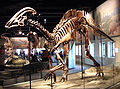 |
||||
Gryposaurus Gryposaurus Gryposaurus was a genus of duckbilled dinosaur that lived about 83 to 75.5 million years ago, in the Late Cretaceous of North America... |
G. monumentensis |
A saurolophine |
||||
Parasaurolophus Parasaurolophus Parasaurolophus is a genus of ornithopod dinosaur that lived in what is now North America during the Late Cretaceous Period, about 76.5–73 million years ago. It was an herbivore that walked both as a biped and a quadruped. Three species are recognized: P. walkeri , P. tubicen, and the... |
P. cyrtocristatus |
A lambeosaurine |
||||
Stegoceras Stegoceras Stegoceras is a genus of plant-eating pachycephalosaurid dinosaur that lived in what is now North America during the Late Cretaceous period.... |
Indeterminate |
|||||
Triceratops Triceratops Triceratops is a genus of herbivorous ceratopsid dinosaur which lived during the late Maastrichtian stage of the Late Cretaceous Period, around 68 to 65 million years ago in what is now North America. It was one of the last dinosaur genera to appear before the great Cretaceous–Paleogene... |
Indeterminate |
|||||
Kosmoceratops Kosmoceratops Kosmoceratops is a genus of herbivorous chasmosaurine ceratopsian dinosaur, which lived during the Late Cretaceous period in the part of the island continent Laramidia that is now Utah, United States... |
K. richardsoni |
A chasmosaurine |
||||
Utahceratops Utahceratops Utahceratops is a genus of herbivorous ceratopsian dinosaur. It is a chasmosaurine ceratopsian which lived during the Late Cretaceous period in what is now Utah. Its fossils have been recovered from the Kaiparowits Formation. It was first named by Scott D. Sampson, Mark A. Loewen, Andrew A.... |
U. gettyi |
A chasmosaurine |
||||
Theropods
| Theropods reported from the Kaiparowits Formation | ||||||
|---|---|---|---|---|---|---|
| Genus | Species | Location | Stratigraphic position | Material | Notes | Images |
Albertosaurus Albertosaurus Albertosaurus is a genus of tyrannosaurid theropod dinosaur that lived in western North America during the Late Cretaceous Period, more than 70 million years ago. The type species, A. sarcophagus, was apparently restricted in range to the modern-day Canadian province of Alberta, after which... |
Indeterminate |
|||||
Avisaurus Avisaurus Avisaurus is a genus of enantiornithine bird from the Late Cretaceous of North America.Two species are known; the type species A. archibaldi and A. gloriae... |
Unnamed |
A enantiornithine |
||||
Hagryphus Hagryphus Hagryphus is an oviraptorosaurian theropod dinosaur from the Upper Cretaceous Period of what is now Utah. To date, only a single species is known, H. giganteus... |
H. giganteus |
An elmisaurine |
||||
Ornithomimus Ornithomimus Ornithomimus is a genus of ornithomimid dinosaur from the Late Cretaceous Period of what is now North America.In 1890 Ornithomimus velox was named by Othniel Charles Marsh on the basis of a foot and partial hand from the Maastrichtian Denver Formation. Another seventeen species have been named since... |
O. velox |
An ornithomimid |
||||
Paronychodon Paronychodon Paronychodon was a theropod dinosaur genus. It is a tooth taxon, considered dubious because of the fragmentary nature of the fossils, which include "buckets" of teeth but no other remains... |
Indeterminate |
|||||
Ricardoestesia Ricardoestesia Richardoestesia is a medium-sized genus of theropod dinosaur from the late Cretaceous Period of what is now North America. It is known from a single pair of lower jaw bones and a large number of isolated teeth.... |
Indeterminate |
|||||
Talos |
T. sampsoni |
A troodontid |
||||
Teratophoneus Teratophoneus Teratophoneus is a genus of carnivorous tyrannosaurid theropod dinosaur which lived during the late Cretaceous period in what is now Utah, USA. It is known from an incomplete skull and postcranial skeleton recovered from the Kaiparowits Formation. Teratophoneus was named by Thomas D. Carr, Thomas E... |
T. curriei |
A tyrannosaurid |
||||
Troodon Troodon Troodon is a genus of relatively small, bird-like dinosaur from the Late Cretaceous period . Discovered in 1855, it was among the first dinosaurs found in North America... |
Indeterminate |
|||||