
All Topics  
Dromaeosauridae

 
Dromaeosauridae

   Email Print
   Bookmark   Link


Dromaeosauridae


Dromaeosauridae is a family of bird
Bird

Birds are wing, Bipedalismal, endothermic , vertebrate animals that lay egg . There are around 10,000 living species, making them the most numerous tetrapod vertebrates....
-like theropod dinosaur
Dinosaur

Dinosaurs were the dominant vertebrate animals of Landform ecosystems for over 160 million years, from the late Triassic Period until the end of the Cretaceous Period , when most of them became extinct in the Cretaceous?Tertiary extinction event....
s. They were small to medium-sized, feathered carnivore
Carnivore

A carnivore , meaning 'meat eater' , is any animal with a diet consisting mainly of meat, whether it comes from animals living or dead .In a more general sense, an animal may be considered a carnivore if it prefers feeding on animal matter over plant matter....
s that flourished in the Cretaceous
Cretaceous

The Cretaceous , usually abbreviated K for its German translation Kreide, is a geologic period from circa to million years ago . In the geologic timescale, the Cretaceous follows on the Jurassic period and is followed by the Paleogene period....
 Period. In informal usage they are often called "raptors" (after Velociraptor
Velociraptor

Velociraptor is a genus of dromaeosaurid Theropoda dinosaur that existed approximately 75 to 71 mya during the later part of the Cretaceous Period ....
), a term popularized by the film Jurassic Park
Jurassic Park (film)

Jurassic Park is a 1993 in film science fiction film Thriller film directed by Steven Spielberg and based on the Jurassic Park by Michael Crichton....
. The name Dromaeosauridae means 'running lizards', from Greek
Ancient Greek

Ancient Greek is the historical stage in the development of the Greek language spanning across the Archaic Greece , Classical Greece , and Hellenistic civilization periods of ancient Greece and the classical antiquity....
 dromeus (d??µe??) meaning 'runner' and sauros (sa????) meaning 'lizard'.

Dromaeosaurid fossils have been found in North America
North America

North America is the northern continent of the Americas, situated in the Earth's northern hemisphere and almost totally in the western hemisphere....
, Europe
Europe

Europe is, conventionally, one of the world's seven continents. Comprising the westernmost peninsula of Eurasia, Europe is generally divided from Asia to its east by the water divide of the Ural Mountains, the Ural , the Caspian Sea, and by the Caucasus Mountains to the southeast....
, North Africa
North Africa

North Africa or Northern Africa is the northernmost region of the African continent, separated by the Sahara from Sub-Saharan Africa.Geopolitically, the United Nations subregion of Northern Africa includes the following seven countries or territories:...
, Japan
Japan

Japan is an island country in East Asia. Located in the Pacific Ocean, it lies to the east of the Sea of Japan, People's Republic of China, North Korea, South Korea and Russia, stretching from the Sea of Okhotsk in the north to the East China Sea and Taiwan in the south....
, China
China

China is a Culture of China, an ancient civilization, and, depending on perspective, a national or multinational entity extending over a large area in East Asia....
, Mongolia
Mongolia

Mongolia is a landlocked country in East Asia and Central Asia. It borders Russia to the north and People's Republic of China to the south, east and west....
, Madagascar
Madagascar

Madagascar, or Republic of Madagascar , is an island nation in the Indian Ocean off the southeastern coast of Africa. The main island, also called Madagascar, is the List of islands by area, and is home to 5% of the world's plant and animal species, of which more than 80% are Endemism to Madagascar....
, Argentina
Argentina

Argentina, officially the Argentine Republic , is a country in South America, constituted as a federation of 23 provinces and an autonomous city....
, and Antarctica
Antarctica

Antarctica is Earth's southernmost continent, overlying the South Pole. It is situated in the Antarctica of the southern hemisphere, almost entirely south of the Antarctic Circle, and is surrounded by the Southern Ocean....
.


Discussion
Ask a question about 'Dromaeosauridae'
Start a new discussion about 'Dromaeosauridae'
Answer questions from other users
Full Discussion Forum


Encyclopedia


Dromaeosauridae is a family of bird
Bird

Birds are wing, Bipedalismal, endothermic , vertebrate animals that lay egg . There are around 10,000 living species, making them the most numerous tetrapod vertebrates....
-like theropod dinosaur
Dinosaur

Dinosaurs were the dominant vertebrate animals of Landform ecosystems for over 160 million years, from the late Triassic Period until the end of the Cretaceous Period , when most of them became extinct in the Cretaceous?Tertiary extinction event....
s. They were small to medium-sized, feathered carnivore
Carnivore

A carnivore , meaning 'meat eater' , is any animal with a diet consisting mainly of meat, whether it comes from animals living or dead .In a more general sense, an animal may be considered a carnivore if it prefers feeding on animal matter over plant matter....
s that flourished in the Cretaceous
Cretaceous

The Cretaceous , usually abbreviated K for its German translation Kreide, is a geologic period from circa to million years ago . In the geologic timescale, the Cretaceous follows on the Jurassic period and is followed by the Paleogene period....
 Period. In informal usage they are often called "raptors" (after Velociraptor
Velociraptor

Velociraptor is a genus of dromaeosaurid Theropoda dinosaur that existed approximately 75 to 71 mya during the later part of the Cretaceous Period ....
), a term popularized by the film Jurassic Park
Jurassic Park (film)

Jurassic Park is a 1993 in film science fiction film Thriller film directed by Steven Spielberg and based on the Jurassic Park by Michael Crichton....
. The name Dromaeosauridae means 'running lizards', from Greek
Ancient Greek

Ancient Greek is the historical stage in the development of the Greek language spanning across the Archaic Greece , Classical Greece , and Hellenistic civilization periods of ancient Greece and the classical antiquity....
 dromeus (d??µe??) meaning 'runner' and sauros (sa????) meaning 'lizard'.

Dromaeosaurid fossils have been found in North America
North America

North America is the northern continent of the Americas, situated in the Earth's northern hemisphere and almost totally in the western hemisphere....
, Europe
Europe

Europe is, conventionally, one of the world's seven continents. Comprising the westernmost peninsula of Eurasia, Europe is generally divided from Asia to its east by the water divide of the Ural Mountains, the Ural , the Caspian Sea, and by the Caucasus Mountains to the southeast....
, North Africa
North Africa

North Africa or Northern Africa is the northernmost region of the African continent, separated by the Sahara from Sub-Saharan Africa.Geopolitically, the United Nations subregion of Northern Africa includes the following seven countries or territories:...
, Japan
Japan

Japan is an island country in East Asia. Located in the Pacific Ocean, it lies to the east of the Sea of Japan, People's Republic of China, North Korea, South Korea and Russia, stretching from the Sea of Okhotsk in the north to the East China Sea and Taiwan in the south....
, China
China

China is a Culture of China, an ancient civilization, and, depending on perspective, a national or multinational entity extending over a large area in East Asia....
, Mongolia
Mongolia

Mongolia is a landlocked country in East Asia and Central Asia. It borders Russia to the north and People's Republic of China to the south, east and west....
, Madagascar
Madagascar

Madagascar, or Republic of Madagascar , is an island nation in the Indian Ocean off the southeastern coast of Africa. The main island, also called Madagascar, is the List of islands by area, and is home to 5% of the world's plant and animal species, of which more than 80% are Endemism to Madagascar....
, Argentina
Argentina

Argentina, officially the Argentine Republic , is a country in South America, constituted as a federation of 23 provinces and an autonomous city....
, and Antarctica
Antarctica

Antarctica is Earth's southernmost continent, overlying the South Pole. It is situated in the Antarctica of the southern hemisphere, almost entirely south of the Antarctic Circle, and is surrounded by the Southern Ocean....
. They first appeared in the mid-Jurassic Period (Bathonian
Bathonian

In the geologic timescale the Bathonian epoch is a stage during the Middle Jurassic, of the Mesozoic geologic era of the Phanerozoic geologic eon....
 stage, 167 million years ago) and survived until the end of the Cretaceous (Maastrichtian
Maastrichtian

The Maastrichtian is the last faunal stage of the Cretaceous geologic period, and therefore of the Mesozoic geologic era. It spanned from 70.6 ? 0.6 annum to 65.5 ? 0.3 Ma ....
 stage, 65.5 ma), existing for over 100 million years, up until the Cretaceous-Paleogene extinction event. The presence of dromaeosaurs as early as the Middle Jurassic has been confirmed by the discovery of isolated fossil teeth, though no dromaeosaurid body fossils have been found from this epoch.

Characteristics


Body plan

The distinctive dromaeosaurid bauplan
Body plan

A body plan, or bauplan, is essentially the blueprint for the way the body of an organism is laid out. An organism's symmetry , its number of body segments and number of Limb are all aspects of its body plan....
 helped to rekindle theories that dinosaurs may have been active, fast, and closely related to birds. Robert Bakker’s illustration for John Ostrom
John Ostrom

John H. Ostrom was an United States paleontologist who revolutionized modern understanding of dinosaurs in the 1960s, when he demonstrated that dinosaurs are more like big non-flying birds than they are like lizards , an idea first proposed by Thomas Henry Huxley in the 1860s, but which had garnered few supporters....
’s 1969 monograph, showing the dromaeosaurid Deinonychus
Deinonychus

Deinonychus was a genus of carnivore dromaeosauridae dinosaur. There is one described species, Deinonychus antirrhopus. This 3.4 metre long dinosaur lived during the early Cretaceous Period ....
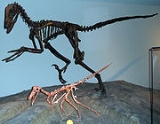
 in a fast run, is among the most influential paleontological reconstructions in history. The dromaeosaurid body plan includes a relatively large skull, serrated teeth, narrow snout, and forward-facing eyes which indicate some degree of binocular vision. Dromaeosaurids, like most other theropods, had a moderately long S-curved neck, and their trunk was relatively short and deep. Like other maniraptora
Maniraptora

Maniraptora is a clade of coelurosaurian dinosaurs which includes the birds and the dinosaurs that were more closely related to them than to Ornithomimus velox....
ns, they had long arms that could be folded against the body in some species, and relatively large hands with three long fingers (the middle finger being the longest and the first finger being the shortest) ending in large claws. The dromaeosaurid hip structure featured a characteristically large pubic boot projecting beneath the base of the tail. Dromaeosaurid feet bore a large, recurved claw on the second toe. Their tails were slender, with long, low, vertebrae lacking transverse process and neural spines after the 14th caudal vertebra. It is now known that at least some, and probably all, dromaeosaurids were covered in feathers, including large, vaned, wing and tail feathers. This development, first hypothesized in the mid-late 1980s and confirmed by fossil discoveries in 1999, represents a significant change in the way dromaeosaurids have historically been depicted in art and film (see “Feathers” below).

Diagnosis
Dromaeosaurs are diagnosed by the following features; short T-shaped frontals that form the rostral
Rostral

Rostral can refer to:* Anatomical terms of location#Directions, Top or cephaled, as opposed to caudal or down.* Rostral bone* Rostral column, a monumental scaled column, frequently decorated with ship bows...
 boundary of the supratemporal fenestra; a caudolateral overhanging shelf of the squamosal
Squamosal

The squamosal is a bone of the head of higher vertebrates. It is the principal component of the cheek region in the skull, lying below the temporal series and otic notch and bounded anteriorly by postorbital....
; a lateral process of the quadrate
Quadrate

Quadrate may refer to:* Quadrate bone* Quadrate ...
 that contacts the quadratojugal
Quadratojugal

The quadratojugal is a small jaw bone that is present in most amphibians, reptiles, and birds, but has been lost in mammals. It is connected to the jugal as well as other bones, though these may vary with species....
; raised, stalked, parapophyses on the dorsal vertebrae, a modified pedal digit II; chevrons and prezygapophyses of the caudal vertebrae
Caudal vertebrae

Caudal vertebrae are the bones in the tails of mammals. See Vertebra....
 elongate and spanning several vertebrae; the presence of a subglenoid fossa on the coracoid
Coracoid

The coracoid Process is a small hook-like structure on the lateral edge of the superior anterior portion of the scapula. Pointing laterally forward, it, together with the acromion, serves to stabilize the Glenohumeral joint....
.

The dromaeosaurid foot
Like other theropods, dromaeosaurids were bipedal; that is, they walked on their hind legs. However, whereas other theropods walked with three toes contacting the ground, fossilized footprint tracks show that dromaeosaurids apparently held the second toe off the ground in a hyperextended position, with only the third and fourth toes bearing the weight of the animal. This is called functional didactyly. The "retracted" second toe bore an unusually large, curved sickle-shaped claw, which is thought to have been used in killing prey (see "Predatory behavior" below).

The dromaeosaurid tail
Dromaeosaurids had long tails. Most of the tail vertebrae bear bony, rod-like extensions, as well as bony tendons in some species. In his study of Deinonychus
Deinonychus

Deinonychus was a genus of carnivore dromaeosauridae dinosaur. There is one described species, Deinonychus antirrhopus. This 3.4 metre long dinosaur lived during the early Cretaceous Period ....
, Ostrom proposed that these features stiffened the tail so that it could only flex at the base, and the whole tail would then move as a single, rigid, lever. However, one well – preserved specimen of Velociraptor mongoliensis (IGM 100/986) has an articulated tail skeleton that is curved laterally in a long S – shape. This suggests that, in life, the tail could bend from side to side with a substantial degree of flexibility. It has been proposed that this tail was used as a stabilizer and/or counterweight while running or in the air; in Microraptor
Microraptor

Microraptor is a genus of small, dromaeosaurid dinosaur. About two dozen well-preserved fossil specimens have been recovered from Liaoning, China....
 and a possible specimen of Sinornithosaurus
Sinornithosaurus

Sinornithosaurus is a genus of Feathered dinosaurs dromaeosaurid dinosaur from the Lower Cretaceous Period of the Yixian Formation in what is now China....
 (specimen NGMC 91, nicknamed "Dave"), elongate diamond-shaped fans of feathers are preserved on the end of the tail. In Microraptor, this may have been used as an aerodynamic stabilizer and rudder during gliding and/or powered flight (see "Flight and gliding" below).

Size

Dromaeosaurids were small to medium-sized dinosaurs, ranging from about 0.6 meters in length (2 ft, in the case of Microraptor) to over 6 m (20 ft, in Utahraptor
Utahraptor

Utahraptor is the largest known member of the theropod dinosaur family Dromaeosauridae, and dates from the upper Barremian faunal stage of the Early Cretaceous period ....
 and Achillobator
Achillobator

Achillobator is a genus of dromaeosaurid theropod dinosaur from the late Cretaceous Period of what is now Mongolia. It was probably an active bipedal predator, hunting with the large sickle-shaped claw on the second toe of each hind foot....
).

The most primitive dromaeosaurid ever described, Mahakala
Mahakala (dinosaur)

Mahakala is a genus of basal dromaeosauridae dinosaur from the Campanian-age Upper Cretaceous Djadokhta Formation of ?mn?govi Province, Mongolia....
, is also among the smallest, at just 70 cm long. This evidence, combined with the small size of other primitive relatives indicates that the common ancestor of dromaeosaurids, troodontids, and birds – which is called the ancestral paravian (‘’Paraves
Paraves

Paraves is a stem?based clade containing birds and other closely related dinosaurs. The paravians include the Avialae, such as Archaeopteryx, and the Deinonychosauria, which includes the dromaeosaurids and troodontids....
’’) – may have been very small, at around 65 cm in length and 600 to 700 grams of mass.

Relationship with birds

Dromaeosaurids share many features with early bird
Bird

Birds are wing, Bipedalismal, endothermic , vertebrate animals that lay egg . There are around 10,000 living species, making them the most numerous tetrapod vertebrates....
s (clade Avialae
Avialae

Avialae is a clade containing birds and their most immediate dinosaurian relatives....
 or Aves). The precise nature of their relationship to birds has undergone a great deal of study, and hypotheses about that relationship have changed as large amounts of new evidence became available. As late as 2001, Mark Norell and colleagues analyzed a large survey of coelurosaur fossils and produced the tentative result that dromaeosaurids were most closely related to birds, with troodontids as a more distant outgroup. they even suggested that Dromaeosauridae could be paraphyletic relative to Avialae. In 2002, Hwang and colleagues utilized the work of Norell et al., including new characters and better fossil evidence, to determine that birds (avialans) were better thought of as cousins to the dromaeosaurids and troodontids.

The current consensus among paleontologists agrees with the findings of Hwang et al (2002); that dromaeosaurids are most closely related to the troodontids, and together with the troodontids form the clade Deinonychosauria
Deinonychosauria

The Deinonychosauria were a successful clade of Theropoda in the Late Jurassic and Cretaceous Period . These carnivores are known for their switchblade-like second toes....
. Deinonychosaurians in turn are the sister taxon to avialans, and therefore the closest relatives of avialan birds. A consensus of paleontologists has concluded that there is not yet enough evidence to determine whether any dromaeosaurs could fly or glide, or whether they evolved from ancestors that could.

Alternative theories and flightlessness

Dromaeosaurids are so birdlike that they have led some researchers to argue that they would be better classified as birds. First, since they had feathers, dromaeosaurs (along with many other coelurosaurian theropod dinosaurs) are “birds” under traditional definitions of the word “bird”, or “Aves”, that are based on the possession of feathers. However, other scientists, such as Lawrence Witmer, have argued that calling a theropod like Caudipteryx
Caudipteryx

Caudipteryx is a genus of peacock-sized theropod dinosaurs that lived in the Barremian age of the early Cretaceous Period . They were feathered and remarkably birdlike in their overall appearance....
 a bird because it has feathers may stretch the word past any useful meaning. (See the article Avialae
Avialae

Avialae is a clade containing birds and their most immediate dinosaurian relatives....
 for a discussion about the definitions of the clades Aves and Avialae.) At least two schools of researchers have proposed that dromaeosaurs may actually be descended from flying ancestors. Hypotheses involving a flying ancestor for dromaeosaurs are sometimes called “Birds Came First” (BCF). George Olshevsky
George Olshevsky

George Olshevsky is a freelance editing, writer, publisher, paleontologist, and mathematician living in San Diego, California.Olshevsky maintains the comprehensive online Dinosaur Genera List....
 is usually credited as the first author of BCF. In his own work, Gregory S. Paul pointed out numerous features of the dromaeosaurid skeleton that he interpreted as evidence that the entire group had evolved from flying, dinosaurian, ancestors, perhaps something like Archaeopteryx
Archaeopteryx

Archaeopteryx, sometimes referred to by its German name Urvogel , is the earliest and most primitive bird known. The name is from the Ancient Greek archaios meaning 'ancient' and pteryx meaning 'feather' or 'wing'; ....
. In that case, the larger dromaeosaurids were secondarily flightless, like the modern ostrich
Ostrich

The ostrich Struthio camelus is a large flightless bird native to Africa . It is the only living species of its family , Struthionidae, and its genus, Struthio....
. In 1988, Paul suggested that dromaeosaurids may actually be more closely related to modern birds than to Archaeopteryx. By 2002, however, Paul placed dromaeosaurs and Archaeopteryx as the closest relatives to one another.

In 2002, Hwang et al. found that Microraptor was the most primitive dromaeosaur. Xu and colleagues in 2003 cited the basal position of Microraptor, along with feather and wing features, as evidence that the ancestral dromaeosaur could glide. In that case the larger dromaeosaurs would be secondarily terrestrial - having lost the ability to glide later in their evolutionary history.

Also in 2002, Steven Czerkas described Cryptovolans
Cryptovolans

Cryptovolans is a genus of Feathered dinosaurs, dromaeosaurid, dinosaur represented by a 90 cm long individual preserved in 3 fossils. Feduccia et al....
, though it is a probable junior synonym of Microraptor
Microraptor

Microraptor is a genus of small, dromaeosaurid dinosaur. About two dozen well-preserved fossil specimens have been recovered from Liaoning, China....
. He reconstructed the fossil inaccurately with only two wings and thus argued that dromaeosaurs were proper birds, rather than possible gliders. He later issued a revised reconstruction in agreement with that of Microraptor
Microraptor

Microraptor is a genus of small, dromaeosaurid dinosaur. About two dozen well-preserved fossil specimens have been recovered from Liaoning, China....


Other researchers, like Larry Martin
Larry Martin

Larry Martin is an American vertebrate paleontologist and curator of the Natural History Museum and Biodiversity Research Center at the University of Kansas....
 believe that dromaeosaurs, along with all maniraptorans are not dinosaurs at all. Martin asserted for decades that birds were unrelated to maniraptorans, but in 2004 he changed his position, and now he agrees that the two are the closest of relatives. Martin believes that maniraptorans are secondarily flightless birds, and that birds evolved from non–dinosaurian archosaurs, so that most of the species formerly called theropods would now not even be classified as dinosaurs. In 2005, Mayr and Peters described the anatomy of a very well preserved specimen of Archaeopteryx, and determined that its anatomy was more like non-avian theropods than previously understood. Specifically, they found that Archaeopteryx had a primitive palatine, unreversed hallux, and hyper-extendable second toe. Their phylogenetic analysis produced the controversial result that Confuciusornis
Confuciusornis

Confuciusornis is a genus of crow-sized, primitive, birds from the Early Cretaceous of China, approximately 120 million years ago. Like modern birds, Confuciusornis had a toothless beak, but close relatives of modern birds such as Hesperornis and Ichthyornis were toothed, indicating that the loss of teeth occurred convergently...
 was closer to Microraptor than to Archaeopteryx, making the Avialae a paraphyletic taxon. They also suggested that the ancestral paravian was able to fly or glide, and that the dromaeosaurs and troodontids were secondarily flightless (or had lost the ability to glide). Corfe and Butler criticized this work on methodological grounds.

A challenge to all of these alternative scenarios came when Turner and colleagues in 2007 described a new dromaeosaurid, Mahakala
Mahakala (dinosaur)

Mahakala is a genus of basal dromaeosauridae dinosaur from the Campanian-age Upper Cretaceous Djadokhta Formation of ?mn?govi Province, Mongolia....
, which they found to be the most basal and most primitive member of the Dromaeosauridae, more primitive than Microraptor. Mahakala had short arms and no ability to glide. Turner et al. also inferred that flight evolved only in the Avialae, and these two points suggested that the ancestral dromaeosaurid could not glide or fly. Based on this cladistic analysis, Mahakala suggests that the ancestral condition for dromaeosaurids is non-volant
Flight

Flight is the process by which an object moves either through the air, or movement beyond earth's atmosphere , by aerodynamically generating Lift , propulsion or Lighter than air using buoyancy, or by simple ballistic movement....
.

Systematics


Taxonomy

The authorship of the family Dromaeosauridae is credited to W.D. Matthew and Barnum Brown
Barnum Brown

Barnum Brown , born February 12, 1873 in Carbondale, Kansas. He was named after the circus showman P.T. Barnum, and was perhaps the most famous fossil hunter of the early twentieth century....
, who erected it as a subfamily (Dromaeosaurinae) of the now-defunct family Deinodontidae in 1922, containing only the new genus Dromaeosaurus
Dromaeosaurus

Dromaeosaurus was a genus of theropod dinosaur which lived during the Late Cretaceous period , about 76 - 72 million years ago, in the western United States and Alberta, Canada....
. Dromaeosauridae, along with Troodontidae
Troodontidae

Troodontidae is a Family of bird-like Theropoda dinosaurs. In previous decades, troodontid fossils were few and scrappy and they have therefore been allied, at various times, with nearly every major coelurosaurian lineage....
, make up the infraorder Deinonychosauria
Deinonychosauria

The Deinonychosauria were a successful clade of Theropoda in the Late Jurassic and Cretaceous Period . These carnivores are known for their switchblade-like second toes....
.

The subfamilies of Dromaeosauridae frequently shift in content based on new analysis, but typically consist of the following groups. A number of dromaeosaurids have not been assigned to any particular subfamily, often because they are too poorly preserved to be placed confidantly in phylogenetic analysis (see section Phylogeny below), or because they are basal relative to the primary subdivisions of Dromaeosauridae (Mahakala
Mahakala (dinosaur)

Mahakala is a genus of basal dromaeosauridae dinosaur from the Campanian-age Upper Cretaceous Djadokhta Formation of ?mn?govi Province, Mongolia....
, for example, is the most primitive known dromaeosaurid and falls outside any named sub-group). The most basal subfamily of dromaeosaurids is often found to be the Unenlagiinae. This enigmatic group is the most poorly-supported subfamily of dromaeosaurs and it is possible that some or all of its members belong outside of Dromaeosauridae. The larger, ground-dwelling members like Buitreraptor
Buitreraptor

Buitreraptor was a rooster-size predatory dinosaur belonging to the dromaeosaurid family. It was found in Argentina and was described in 2005....
 and Unenlagia
Unenlagia

Unenlagia was a genus of theropod dinosaur of the family Dromaeosauridae. Unenlagia, which lived in South America during the Late Cretaceous, was a member of the strange and extremely bird-like Gondwanan sub-family of dromaeosaurs called unenlagiines, and was closely related to dinosaurs such as Buitreraptor and Neuquenraptor...
 show strong flight adaptations, although they were probably too large to 'take off'. One member of this group, Rahonavis, is very small, with well-developed wings that show evidence of quill knobs (the attachment points for flight feathers) and it is very likely that it could fly. The next most primitive clade of dromaeosaurs is the Microraptoria. This group includes many of the smallest dromaeosaurs, which show adaptations for living in trees. All known dromaeosaur skin impressions hail from this group and all show an extensive covering of feathers and well-developed wings. Like the unenlagiines, some species may have been capable of active flight. The subfamily Velociraptorinae has traditionally included Velociraptor, Deinonychus
Deinonychus

Deinonychus was a genus of carnivore dromaeosauridae dinosaur. There is one described species, Deinonychus antirrhopus. This 3.4 metre long dinosaur lived during the early Cretaceous Period ....
, and Saurornitholestes
Saurornitholestes

Saurornitholestes is a genus of coyote-sized carnivorous dromaeosaurid dinosaur from the Upper Cretaceous of Alberta, Canada. Several partial skeletons, dozens of isolated bones, and scores of teeth are known from the badlands of Dinosaur Provincial Park in Alberta; most of these are housed at the Royal Tyrrell Museum of Palaeontology,...
, and while the discovery of Tsaagan
Tsaagan

Tsaagan is a genus of dromaeosaurid dinosaur from the Djadokhta Formation of late Cretaceous Mongolia. It lies within the subfamily Velociraptorinae....
 lent support to the this grouping, the inclusion of Saurornitholestes is still uncertain. The Dromaeosaurinae is usually found to consist of medium to giant-sized species, with generally box-shaped skulls (the other subfamilies generally have narrower snouts).
Dromaeosaurus Group Nhm2
Bambiraptor 4
Buitreraptor Skeleton1
Saurornitholestes Mor1
The following classification of the various genera of dromaeosaurids is based on studies by Sereno (2005), Senter (2004), Makovicky et al. (2005), Norell et al. (2006), and Turner et al. (2007).
  • Family Dromaeosauridae
    • Atrociraptor
      Atrociraptor

      Atrociraptor was a genus of Dromaeosauridae dinosaur from the Late Cretaceous of Alberta, Canada. The type species specimen was discovered in the Horseshoe Canyon Formation, near Drumheller, Alberta; it consists of parts of the upper and lower jaws and teeth....
    • Dromaeosauroides
      Dromaeosauroides

      Dromaeosauroides is a genus of dinosaur from the Early Cretaceous, discovered in the Jydegaard Formation on the island of Bornholm, Denmark....
    • Luanchuanraptor
      Luanchuanraptor

      Luanchuanraptor is a genus of dromaeosauridae theropod dinosaur from the Late Cretaceous of People's Republic of China. It is holotype a partial skeleton from the Qiupa Formation in Luanchuan, Henan....
    • Mahakala
      Mahakala (dinosaur)

      Mahakala is a genus of basal dromaeosauridae dinosaur from the Campanian-age Upper Cretaceous Djadokhta Formation of ?mn?govi Province, Mongolia....
    • Pyroraptor
      Pyroraptor

      Pyroraptor is a genus of Dromaeosauridae dinosaur from the late Cretaceous Period of France . It is known from a single specimen, estimated to have been 2.5 metres in length....
    • ?Unquillosaurus
      Unquillosaurus

      Unquillosaurus is a genus of maniraptoran dinosaur from the late Cretaceous Period, discovered in Argentina. Known only from a single fossilized pubis , its total body length may have reached 2-3 metre ....
    • Variraptor
      Variraptor

      Variraptor is a genus of theropod dinosaur named after the Var River in the Alpes-Maritimes Department in the Provence of southern France, It was a maniraptoran theropod found in the Gr?s ? Reptiles Formation at La Bastide Neuve, near Fox-Amphoux and described by Le Leouff and Buffetaut in 1998....
    • Subfamily Dromaeosaurinae
      • Achillobator
        Achillobator

        Achillobator is a genus of dromaeosaurid theropod dinosaur from the late Cretaceous Period of what is now Mongolia. It was probably an active bipedal predator, hunting with the large sickle-shaped claw on the second toe of each hind foot....
      • Adasaurus
        Adasaurus

        Adasaurus is a genus of dromaeosaurid theropod dinosaur from the Late Cretaceous Period of what is now Central Asia. It was a small bipedal carnivore with a sickle-shaped claw on the second toe of each hind foot....
      • Dromaeosaurus
        Dromaeosaurus

        Dromaeosaurus was a genus of theropod dinosaur which lived during the Late Cretaceous period , about 76 - 72 million years ago, in the western United States and Alberta, Canada....
      • Utahraptor
        Utahraptor

        Utahraptor is the largest known member of the theropod dinosaur family Dromaeosauridae, and dates from the upper Barremian faunal stage of the Early Cretaceous period ....
    • Subfamily Microraptorinae
      • Bambiraptor
        Bambiraptor

        Bambiraptor is a 75 million year old Origin of birds dinosaur discovered by scientists at the University of Kansas, Yale University, and the University of New Orleans....
      • Cryptovolans
        Cryptovolans

        Cryptovolans is a genus of Feathered dinosaurs, dromaeosaurid, dinosaur represented by a 90 cm long individual preserved in 3 fossils. Feduccia et al....
      • Graciliraptor
        Graciliraptor

        Graciliraptor is the name given to a genus of dinosaur from the early Cretaceous Period . It was a microraptorian dromaeosaurid first described in 2004....
      • Microraptor
        Microraptor

        Microraptor is a genus of small, dromaeosaurid dinosaur. About two dozen well-preserved fossil specimens have been recovered from Liaoning, China....
      • Sinornithosaurus
        Sinornithosaurus

        Sinornithosaurus is a genus of Feathered dinosaurs dromaeosaurid dinosaur from the Lower Cretaceous Period of the Yixian Formation in what is now China....
    • Subfamily Unenlagiinae
      • Austroraptor
        Austroraptor

        Austroraptor was a genus of dromaeosaur dinosaur that lived about 70 million years ago during the Cretaceous period in what is now modern Argentina....
      • Buitreraptor
        Buitreraptor

        Buitreraptor was a rooster-size predatory dinosaur belonging to the dromaeosaurid family. It was found in Argentina and was described in 2005....
      • Neuquenraptor
        Neuquenraptor

        Neuquenraptor was one of the first dromaeosauridae dinosaurs found in the southern hemisphere. It was discovered in Patagonia, Argentina early in 2005....
      • Rahonavis
        Rahonavis

        Rahonavis is a genus of dinosaur from the Late Cretaceous of what is now northwestern Madagascar. It is known from a partial skeleton found in Maevarano Formation rocks at a quarry near Berivotra, Mahajanga Province....
      • Shanag
        Shanag

        Shanag is a genus of dromaeosaurid dinosaur from the Early Cretaceous Period of Mongolia. Shanag bears a strong resemblance to primitive Chinese dromaeosauridaes such as Microraptor and Sinornithosaurus, suggesting a close similarity between the fauna of the ??sh deposits where Shanag was found, and the Jehol biota of Chi...
      • Unenlagia
        Unenlagia

        Unenlagia was a genus of theropod dinosaur of the family Dromaeosauridae. Unenlagia, which lived in South America during the Late Cretaceous, was a member of the strange and extremely bird-like Gondwanan sub-family of dromaeosaurs called unenlagiines, and was closely related to dinosaurs such as Buitreraptor and Neuquenraptor...
    • Subfamily Velociraptorinae
      • Deinonychus
        Deinonychus

        Deinonychus was a genus of carnivore dromaeosauridae dinosaur. There is one described species, Deinonychus antirrhopus. This 3.4 metre long dinosaur lived during the early Cretaceous Period ....
      • Nuthetes
        Nuthetes

        Nuthetes is the name given to a nomen dubium genus of theropod dinosaur, known only from fossil teeth and jaw fragments found in rocks of Berriasian age in the Wealdan group of England....
      • Saurornitholestes
        Saurornitholestes

        Saurornitholestes is a genus of coyote-sized carnivorous dromaeosaurid dinosaur from the Upper Cretaceous of Alberta, Canada. Several partial skeletons, dozens of isolated bones, and scores of teeth are known from the badlands of Dinosaur Provincial Park in Alberta; most of these are housed at the Royal Tyrrell Museum of Palaeontology,...
      • Tsaagan
        Tsaagan

        Tsaagan is a genus of dromaeosaurid dinosaur from the Djadokhta Formation of late Cretaceous Mongolia. It lies within the subfamily Velociraptorinae....
      • Velociraptor
        Velociraptor

        Velociraptor is a genus of dromaeosaurid Theropoda dinosaur that existed approximately 75 to 71 mya during the later part of the Cretaceous Period ....


Phylogeny

Dromaeosauridae was first defined as a clade
Clade

A clade is a term used in modern alpha taxonomy, the scientific classification of living and fossil organisms, to describe a monophyletic group, defined as a group consisting of a single common ancestor and all its descendants.The term "monophyletic group" is used in this article in the conventional sense of "an a...
 by Paul Sereno
Paul Sereno

Paul Callistus Sereno is an United States paleontology who is the discoverer of several new dinosaur species on several continents. He has conducted excavations at sites as varied as Inner Mongolia, Argentina, Morocco and Niger....
 in 1998, as the most inclusive natural group containing Dromaeosaurus but not Troodon
Troodon

Troodon is a genus of relatively small, bird-like dinosaur from the Late Cretaceous Period . Discovered in 1855, it was among the first dinosaurs found in North America....
, Ornithomimus
Ornithomimus

Ornithomimus is a genus of dinosaur from the Late Cretaceous Period of what is now North America. Ornithomimus velox was named on the basis of a foot and partial hand from the Maastrichtian Denver Formation, but better material has since been found in Canada, including the Edmontonian-age Ornithomimus edmontonicus and an excelle...
 or Passer
Passer

File:Passer melanurus .jpgPasser is a genus of Old World sparrows. Most of its members are found naturally in open habitats in the warmer climates of Africa and southern Eurasia....
. The various "subfamilies" have also been re-defined as clades, usually defined as all species closer to the groups namesake than to Dromaeosaurus or any namesakes of other sub-clades (for example, Makovicky defined the clade Unenlagiinae as all dromaeosaurids closer to Unenlagia than to Velociraptor). The Microraptoria is the only dromaeosaurid sub-clade not converted from a subfamily. Senter and colleagues expressly coined the name without the subfamily suffix -inae to avoid perceived issues with erecting a traditional family-group taxon, should the group be found to lie outside dromaeosauridae proper. Sereno offered a revised definition of the sub-group containing Microraptor to ensure that it would fall within Dromaeosauridae, and erected the subfamily Microraptorinae, attributing it to Senter et al., though this usage has only appeared on his online TaxonSearch database and has not been formally published.

The cladogram below follows a 2007 analysis by Turner and colleagues, with sub-clades labelled according to definitions by Sereno, 2005.

Paleobiology


Predatory behavior

Dromaeosaurus Feet
Achillobator Small
There is currently disagreement about the function of the enlarged "sickle claw" on the second toe. When John Ostrom described it for Deinonychus in 1969, he interpreted the claw as a blade-like slashing weapon, much like the canines of some saber-toothed cats
Homotherium

Homotherium is a genus of machairodontinae saber-toothed cats, often termed scimitar cats, that lived approximately 5 million to 10,000 years ago in North America, South America, Eurasia and Africa....
, used with powerful kicks to cut into prey. Adams (1987) suggested that the talon was used to disembowel large ceratopsian dinosaurs. The interpretation of the sickle claw as a killing weapon applied to all dromaeosaurids. However, Manning et al. argued that the claw instead served as a hook, reconstructing the keratinous sheath with an elliptical cross section, instead of the previously inferred inverted teardrop shape. In Manning's interpretation, the second toe claw would be used as a climbing aid when subduing bigger prey and also as stabbing weapon.

Ostrom compared Deinonychus to the ostrich
Ostrich

The ostrich Struthio camelus is a large flightless bird native to Africa . It is the only living species of its family , Struthionidae, and its genus, Struthio....
 and cassowary
Cassowary

The cassowary is a very large flightless bird native to the tropical forests of New Guinea and nearby islands, and northeastern Australia. The Southern Cassowary is the third tallest and second heaviest bird on the planet, smaller only than the Ostrich and Emu....
. He noted that the bird species can inflict serious injury with the large claw on the second toe. The cassowary
Cassowary

The cassowary is a very large flightless bird native to the tropical forests of New Guinea and nearby islands, and northeastern Australia. The Southern Cassowary is the third tallest and second heaviest bird on the planet, smaller only than the Ostrich and Emu....
 has claws up to long. Ostrom cited Gilliard (1958) in saying that they can sever an arm or disembowel a man. Kofron (1999 and 2003) studied 241 documented cassowary attacks and found that one human and two dogs had been killed, but no evidence that cassowaries
Cassowary

The cassowary is a very large flightless bird native to the tropical forests of New Guinea and nearby islands, and northeastern Australia. The Southern Cassowary is the third tallest and second heaviest bird on the planet, smaller only than the Ostrich and Emu....
 can disembowel or dismember other animals. Cassowaries
Cassowary

The cassowary is a very large flightless bird native to the tropical forests of New Guinea and nearby islands, and northeastern Australia. The Southern Cassowary is the third tallest and second heaviest bird on the planet, smaller only than the Ostrich and Emu....
 use their claws to defend themselves, to attack threatening animals, and in agonistic displays such as the Bowed Threat Display. The seriema
Seriema

The seriemas are the sole Extant taxon members of the small and ancient family Cariamidae, which is also the sole surviving family of the Cariamiformes....
 also has an enlarged second toe claw, and uses it to tear apart small prey items for swallowing.

Pack hunting and trackway
Deinonychus
Deinonychus

Deinonychus was a genus of carnivore dromaeosauridae dinosaur. There is one described species, Deinonychus antirrhopus. This 3.4 metre long dinosaur lived during the early Cretaceous Period ....
 fossils have been uncovered in small groups near the remains of the herbivore Tenontosaurus
Tenontosaurus

Tenontosaurus is a genus of medium- to large-sized ornithopod dinosaur. It was formerly thought to be a 'hypsilophodont', but since Hypsilophodontia is no longer considered a clade, it is now considered to be a very primitive iguanodont....
, a larger ornithischia
Ornithischia

Ornithischia or Predentata is an extinct order of beaked, herbivore dinosaurs. The name ornithischia is derived from the Ancient Greek ornitheos meaning 'of a bird' and ischion meaning 'hip joint'....
n dinosaur. This had been interpreted as evidence that these dromaeosaurs hunted in coordinated packs like some modern mammal
Mammal

Mammals are a class of vertebrate animals whose name is derived from their distinctive feature, mammary glands, with which they feed their young....
s. However, not all paleontologists found the evidence conclusive, and a subsequent study published in 2007 by Roach and Brinkman suggests that the Deinonychus may have actually displayed a disorganized mobbing behavior. Modern diapsid
Diapsid

Diapsids are a group of reptiles that developed two holes in each side of their skulls, about 300 million years ago during the late Carboniferous period....
s, including bird
Bird

Birds are wing, Bipedalismal, endothermic , vertebrate animals that lay egg . There are around 10,000 living species, making them the most numerous tetrapod vertebrates....
s and crocodile
Crocodile

A crocodile is any species belonging to the family Crocodylidae . The term can also be used more loosely to include all members of the order Crocodilia: i.e....
s (the closest relatives of dromaeosaurs), display minimal cooperative hunting; instead, they are usually either solitary hunters, or are drawn to previously-killed carcasses, where conflict often occurs between individuals of the same species. For example, in situations where groups of komodo dragon
Komodo dragon

The Komodo dragon is a species of lizard that inhabits the islands of Komodo , Rinca, Flores, and Gili Motang in Indonesia. A member of the monitor lizard family , it is the Largest organisms#Reptiles , growing to an average length of and weighing around ....
s are eating together, the largest individuals eat first and might attack smaller komodo dragons that attempt to feed; if the smaller animal dies, it is usually cannibalized
Cannibalism (zoology)

In zoology, cannibalism is the act of one individual of a species consuming all or part of another individual of the same species as food. Cannibalism is a common ecology interaction in the animal kingdom and has been recorded for more than 1500 species ....
. When this information is applied to the sites containing putative pack-hunting behavior in dromaeosaurs, it appears somewhat consistent with a komodo- or crocodile-like feeding strategy.Deinonychus skeletal remains found at these sites are from subadults, with missing parts that may have been eaten by other Deinonychus, which a study by Roach et al. presented as evidence against the idea that the animals cooperated in the hunt. In 2007, scientists described the first known extensive dromaeosaur trackway
Fossil trackway

A fossil trackway is a type of fossil impression, a trackway made by a once life organism, usually by its feet. The majority of known fossil trackways are made by fossil dinosauria, or tetrapods, or bipeds....
, in Shandong, China. In addition to confirming the hypothesis that the sickle-claw was held retracted off the ground, the trackway (made by a large, Achillobator
Achillobator

Achillobator is a genus of dromaeosaurid theropod dinosaur from the late Cretaceous Period of what is now Mongolia. It was probably an active bipedal predator, hunting with the large sickle-shaped claw on the second toe of each hind foot....
-sized species) showed evidence of six individuals of about equal size moving together along a shoreline. The individuals were spaced about one meter apart, and retained the same direction of travel, walking at a fairly slow pace. The authors of the paper describing these footprints interpreted the trackways as evidence that some species of dromaeosaurs lived in groups. While the trackways clearly do not represent hunting behavior, the idea that groups of dromaeosaurs may have hunted together could not be ruled out.

Feathers

There is a large body of evidence showing that dromaeosaurids were covered in feather
Feather

Feathers are one of the epidermal growths that form the distinctive outer covering, or plumage, on birds. They are considered the most complex integumentary structures found in vertebrates....
s. Some dromaeosaurid fossils preserve long, pennaceous feathers on the hands and arms (remiges) and tail (rectrices), as well as shorter, down-like feathers covering the body. Other fossils, which do not preserve actual impressions of feathers, still preserve the associated bumps on the forearm bones where long wing feathers would have attached in life. Overall, this feather pattern looks very much like Archaeopteryx
Archaeopteryx

Archaeopteryx, sometimes referred to by its German name Urvogel , is the earliest and most primitive bird known. The name is from the Ancient Greek archaios meaning 'ancient' and pteryx meaning 'feather' or 'wing'; ....
. The first known dromaeosaur with definitive evidence of feather
Feather

Feathers are one of the epidermal growths that form the distinctive outer covering, or plumage, on birds. They are considered the most complex integumentary structures found in vertebrates....
s was Sinornithosaurus
Sinornithosaurus

Sinornithosaurus is a genus of Feathered dinosaurs dromaeosaurid dinosaur from the Lower Cretaceous Period of the Yixian Formation in what is now China....
, reported from China
China

China is a Culture of China, an ancient civilization, and, depending on perspective, a national or multinational entity extending over a large area in East Asia....
 by Xu et al. in 1999. Many other dromaeosaurid fossils have been found with feathers covering their bodies, some with fully-developed feathered wings. Several even show evidence of a second pair of wings on the hind legs, including Microraptor
Microraptor

Microraptor is a genus of small, dromaeosaurid dinosaur. About two dozen well-preserved fossil specimens have been recovered from Liaoning, China....
 and Cryptovolans
Cryptovolans

Cryptovolans is a genus of Feathered dinosaurs, dromaeosaurid, dinosaur represented by a 90 cm long individual preserved in 3 fossils. Feduccia et al....
. While direct feather impressions are only possible in fine-grained sediments, some fossils found in coarser rocks show evidence of feathers by the presence of quill knobs, the attachment points for wing feathers possessed by some birds. The dromaeosaurids Rahonavis and Velociraptor have both been found with quill knobs, showing that these forms had feathers despite no impressions having been found. In light of this, it is most likely that even the larger ground-dwelling dromaeosaurids bore feathers, since even flightless birds today retain most of their plumage, and relatively large dromaeosaurids, like Velociraptor, are known to have retained pennaceous feathers. Though some scientists had suggested that the larger dromaeosaurids lost some or all of their insulatory covering, the discovery of feathers in Velociraptor specimens has been cited as evidence that all members of the family retained feathers.

Flying and gliding

The ability to fly or glide
Flying and gliding animals

A number of animals have evolution aerial locomotion, either by powered flight or by gliding . Flying and gliding animals have evolved separately many times, without any single ancestor....
 has been suggested for at least two dromaeosaurid species. The first, Rahonavis ostromi
Rahonavis

Rahonavis is a genus of dinosaur from the Late Cretaceous of what is now northwestern Madagascar. It is known from a partial skeleton found in Maevarano Formation rocks at a quarry near Berivotra, Mahajanga Province....
 (originally classified as avian bird, but found to be a dromaeosaurid in later studies) may have been capable of powered flight
Flight

Flight is the process by which an object moves either through the air, or movement beyond earth's atmosphere , by aerodynamically generating Lift , propulsion or Lighter than air using buoyancy, or by simple ballistic movement....
, as indicated by its long forelimbs with evidence of quill knob attachments for long sturdy flight feathers. The forelimbs of Rahonavis were more powerfully built than Archaeopteryx, and show evidence that they bore strong ligament attachments necessary for flapping flight. Luis Chiappe concluded that, given these adaptations, Rahonavis could probably fly but would have been more clumsy in the air than modern birds. Another species of dromaeosaurid, Microraptor gui
Microraptor

Microraptor is a genus of small, dromaeosaurid dinosaur. About two dozen well-preserved fossil specimens have been recovered from Liaoning, China....
, may have been capable of gliding using its well-developed wings on both the fore and hind limbs. A 2005 study by Sankar Chatterjee
Sankar Chatterjee

Sankar Chatterjee is a paleontology, and is the Paul W. Horn Professor of Earth science at Texas Tech University and Curator of Paleontology at the Museum of Texas Tech University....
 suggested that the wings of Microraptor functioned like a split-level "biplane
Biplane

A biplane is a fixed-wing aircraft with two main wings. The Wright brothers Wright Flyer used a biplane design, as did most aircraft in the early years of aviation....
", and that it likely employed a phugoid
Phugoid

A phugoid is an aircraft motion where the vehicle pitches up and climbs, and then pitches down and descends, accompanied by speeding up and slowing down as it goes "uphill" and "downhill." This is one of the basic flight dynamics modes of an Fixed-wing aircraft ....
 style of gliding, in which it would launch from a perch and swoop downward in a 'U' shaped curve, then lift again to land on another tree, with the tail and hind wings helping to control its position and speed. Chatterjee also found that Microraptor had the basic requirements to sustain level powered flight in addition to gliding.

Powered flight has also been suggested for the species Cryptovolans pauli (the name of which means "hidden flyer"), though Cryptovolans is probably synonymous with Microraptor.

In popular culture

Velociraptor
Velociraptor

Velociraptor is a genus of dromaeosaurid Theropoda dinosaur that existed approximately 75 to 71 mya during the later part of the Cretaceous Period ....
, a dromaeosaurid, gained much attention after it was featured prominently in the 1993 Steven Spielberg film Jurassic Park
Jurassic Park

Jurassic Park is a 1990 science fiction novel written by Michael Crichton. Often considered a cautionary tale on unconsidered biological tinkering in the same spirit as Mary Shelley's Frankenstein, it uses the mathematical concept of chaos theory and its philosophical implications to explain the collapse of an amusement park showcasin...
. However, the dimensions of the Velociraptor in the film are much larger than the largest members of that genus. Robert Bakker recalled that Spielberg had been disappointed with the dimensions of Velociraptor and so upsized it, adding that soon afterwards he named Utahraptor
Utahraptor

Utahraptor is the largest known member of the theropod dinosaur family Dromaeosauridae, and dates from the upper Barremian faunal stage of the Early Cretaceous period ....
 which was more the size depicted, or larger. Gregory S. Paul
Gregory S. Paul

Gregory S. Paul is a freelance paleontologist, author and illustrator. He is best known for his work and research on theropoda dinosaurs, and his detailed illustrations, both live and skeletal....
, in his book Predatory Dinosaurs of the World, considered Deinonychus antirrhopus a species of Velociraptor, and so rechristened the species Velociraptor antirrhopus. This taxonomic opinion has not been widely followed. Michael Crichton
Michael Crichton

John Michael Crichton, Doctor of Medicine , was an United States author, film producer, film director, and physician, best known for his work in the science fiction, medical fiction, and techno-thriller genres....
 adopted this synonymization
Synonym (taxonomy)

In scientific nomenclature, synonyms are different scientific names used for a single taxon. Usage and terminology are different for zoology and botany....
 of the two genera in his novels, on which the first two films were based. The depiction of the dromaeosaurid in the original Jurassic Park film, while accurate for its time, is now known to have been inaccurate in many respects, including the lack of feathers
Feathered dinosaurs

The realization that dinosaurs are closely related to birds raised the obvious possibility of feathered dinosaurs. Fossils of Archaeopteryx include well-preserved feathers, but it was not until the early 1990s that clearly nonavian dinosaur fossils were discovered with preserved feathers....
. While Jurassic Park III
Jurassic Park III

Jurassic Park III is the 2001 in film sequel to the 1997 in film film, The Lost World: Jurassic Park, and is the first in the series that is neither based on a book by Michael Crichton nor directed by Steven Spielberg....
 attempted to address this last oversight by adding quill-like structures around the head of some of its dromaeosaurs, they did not resemble the structure or distribution of actual dromaeosaurid feathers known from fossil remains.

External links

  • at DinoData.
  • , from the University of California Berkeley Museum of Paleontology.
  • , by Justin Tweet from Thescelosaurus.
  • - Complete and free online edition of the book "Dinosaurs" as written by W. D. Matthew (cited in this article with authorship of the family Dromaeosauridae), and former Curator of Vertebrate Paleontology at the American Museum of Natural History in New York; Originally published in 1915
  • , Dinosaur-world reference with in-depth description and pictures of many dromaeosauridae dinosaurs