

Oviraptorosauria

Encyclopedia
Oviraptorosaurs are a group of feathered maniraptora
n dinosaur
s from the Cretaceous
Period of what are now Asia
and North America
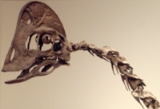
. They are distinct for their characteristically short, beaked, parrot - like skulls, with or without bony crests atop the head. They ranged in size from Caudipteryx
, which was the size of a turkey, to the 8 meter long, 1.4 ton Gigantoraptor
. The group (along with all maniraptora
n dinosaurs) is close to the ancestry of bird
s. Analyses like those of Osmólska et al. (2004) suggest that they may in fact represent primitive flightless birds. The most complete oviraptorosaur specimens have been found in Asia. The North American oviraptorosaur record is "unfortunately" sparse.
The earliest and most basal ("primitive") known oviraptorosaurs are Protarchaeopteryx robusta and Incisivosaurus gauthieri, both from the lower Yixian Formation
of China
, dating to about 125 million years ago during the Aptian
age of the early Cretaceous period. Some fragmentary species, such as Calamospondylus oweni and Thecocoelurus daviesi, may have been even earlier members of the Oviraptorosauria. A tiny neck vertebra reported from the Wadhurst Clay Formation of England
shares some features in common with oviraptorosaurs, and may represent an earlier occurrence of this group (at about 140 million years ago).
ns in the form of their skulls. They have shortened snouts, beak-like jaws with few or no teeth, and a large opening in the lower jaw bone. Some have bony crests atop the skull. The most primitive members have a few teeth in the front of the mouth; in Incisivosaurus
, they are enlarged and form bizarrely prominent "bucktoothed" incisors. The arms and hands are generally long (though very reduced in some advanced species) and the shoulder girdle is large and massive, with flexed coracoid bones and prominent attachments for strong arm muscles.
Their tails are very short compared to other maniraptorans. In Nomingia
and Similicaudipteryx
, the tail ends in four fused vertebrae which Osmólska, He, and others have referred to as a "pygostyle
", but which Witmer found was anatomically different and evolved separately from the pygostyle
of birds (a bone which serves as the attachment point for a fan of tail feathers).
, Protarchaeopteryx
, and Similicaudipteryx
) have been found with impressions of well developed feathers, most notably on the wings and tail, suggesting that they functioned at least partially for display. Secondly, at least two oviraptorosaur specimens (Nomingia and Similicaudipteryx) preserved tails ending in something like a pygostyle, a bony structure at the end of the tail that, in modern birds, is used to support a fan of feathers. Similarly, quill knobs (anchor points for wing feathers on the ulna) have been reported in the oviraptorosaurian species Avimimus portentosus
. Additionally, a number of oviraptorid specimens have famously been discovered in a nesting position similar to that of modern birds. The arms of these specimens are positioned in such a way that they could perfectly cover their eggs if they had small wings and a substantial covering of feathers.
, herbivorous
, mollusk-eating or egg-eating (the latter is no longer considered valid); these options are not necessarily incompatible.
Some ate small vertebrate
s. Evidence for this comes from a lizard
skeleton preserved in the body cavity of Oviraptor and two baby Troodontid skulls found in a Citipati nest. Evidence in favor of a herbivorous diet includes the presence of gastroliths preserved with Caudipteryx
. There are also arguments for the inclusion of mollusks in their diet.
Originally these animals were thought to be egg raiders, based on a Mongolian find showing Oviraptor on top of a nest. Recent studies have shown that in fact the animal was on top of its own nest.
specimens preserved in a brooding position over large clutches of up to a dozen or more eggs. The eggs are usually arranged in pairs, and forming a circular pattern within the nest. One oviraptorosaurian specimen from China
has been found with two unlaid eggs within the pelvic canal. This suggests that, unlike modern crocodilia
ns, oviraptorosaurs did not produce and lay many eggs at the same time. Rather, the eggs were produced within the reproductive organs in pairs, and laid two at a time, with the mother positioned in the center of the nest and rotating in a circle as each pair was laid. This behavior is supported by the fact that the eggs were shaped like highly elongated ovals, with the more pointed end pointing backward from the birth canal, and also oriented toward the center of the nest.
The presence of two shelled eggs within the birth canal shows that oviraptorosaurs were intermediate between the reproductive biology of crocodilians and modern birds. Like crocodilians, they had two oviduct
s. However, crocodilians produce multiple shelled eggs per oviduct at a time, whereas oviraptorosaurs, like birds, produced only one egg per oviduct at a time.
. Gregory S. Paul
has written extensively on this possibility, and Teresa Maryańska
and colleagues published a technical paper detailing this idea in 2002. Michael Benton
, in his widely-respected text Vertebrate Paleontology, also included oviraptorosaurs as an order within the class Aves. However, a number of researchers have disagreed with this classification, retaining oviraptorosaurs as non-avialan maniraptora
ns slightly more primitive than the deinonychosaurs.
itself is no longer considered part of this group, the subfamiliy is usually now termed the Elmisaurinae. The taxonomy below follows the one presented by Thomas Holtz, Jr. in 2010 unless otherwise noted.
(natural grouping) of maniraptora
ns more primitive than true birds. They found that the oviraptorosaurs are the sister group to the Therizinosauria and that the two, together, are more basal than any member of Paraves
. Several unofficial names for this group linking oviraptorosaurs and therizinosaurs were suggested online by scientists such as Paul Sereno
, including "Oviraptoriformes" and "Enigmosauria." However, a more recent study by Zanno and colleagues challenged that finding, showing therizinosaurs to be more primitive and not closely related to oviraptorosaurs.
The following cladogram
follows an analysis by Phil Senter, 2007.
s, massive, beaklike mandible
s, and long parietal
s. The most primitive members have four pairs of teeth in the premaxilla
e, in Incisivosaurus
they are enlarged and form bizarrely prominent bucktoothed incisors. The more advanced members have no teeth in the jaws. Pneumatization is extensive in the skulls and vertebrae of the more advanced members. Oviraptorosauria have thick, U - shaped furcula
e and a large sternal plates that are wider (together) than they are long, unlike in birds and dromaeosaurs. The arms are around half the length of the legs and over half the length of the presacral vertebral column
. The Hands are long, and tridactyl, with a reduced third finger in Caudipteryx
and Ingenia
. There are between 5 and 8 sacral vertebrae. The pubis
is vertical or subvertical. The tibia
is 15%-25% longer than the femur. The tail is short, with the number of vertebrae reduced to 24 or so, and proximally very thick, with broad transverse processes. The ischium retains the primitive character of a prominent, triangular obturator process
and lack the proximodorsal process
that is found in birds. The pectoral girdle is also primitive; the scapula
is a broad blade that is distally expanded, it lies on the lateral aspect of the thorax at an angle to the vertebral column, and the coracoid has the primitive coelurosaur shape with a proximal supracoracoidal nerve foramen and a moderate biceps tubercle.
Maniraptora
Maniraptora is a clade of coelurosaurian dinosaurs which includes the birds and the dinosaurs that were more closely related to them than to Ornithomimus velox. It contains the major subgroups Avialae, Deinonychosauria, Oviraptorosauria and Therizinosauria. Ornitholestes and the Alvarezsauroidea...
n dinosaur
Dinosaur
Dinosaurs are a diverse group of animals of the clade and superorder Dinosauria. They were the dominant terrestrial vertebrates for over 160 million years, from the late Triassic period until the end of the Cretaceous , when the Cretaceous–Paleogene extinction event led to the extinction of...
s from the Cretaceous
Cretaceous
The Cretaceous , derived from the Latin "creta" , usually abbreviated K for its German translation Kreide , is a geologic period and system from circa to million years ago. In the geologic timescale, the Cretaceous follows the Jurassic period and is followed by the Paleogene period of the...
Period of what are now Asia
Asia
Asia is the world's largest and most populous continent, located primarily in the eastern and northern hemispheres. It covers 8.7% of the Earth's total surface area and with approximately 3.879 billion people, it hosts 60% of the world's current human population...
and North America
North America
North America is a continent wholly within the Northern Hemisphere and almost wholly within the Western Hemisphere. It is also considered a northern subcontinent of the Americas...
. They are distinct for their characteristically short, beaked, parrot - like skulls, with or without bony crests atop the head. They ranged in size from Caudipteryx
Caudipteryx
Caudipteryx is a genus of peacock-sized theropod dinosaurs that lived in the Aptian age of the early Cretaceous Period . They were feathered and remarkably birdlike in their overall appearance....
, which was the size of a turkey, to the 8 meter long, 1.4 ton Gigantoraptor
Gigantoraptor
Gigantoraptor is a genus of giant oviraptorosaurian theropod dinosaur that lived 70 million years ago during the late Cretaceous Period. It was discovered in 2005 in the Iren Dabasu Formation, Erlian basin, in Inner Mongolia.-Discovery and naming:...
. The group (along with all maniraptora
Maniraptora
Maniraptora is a clade of coelurosaurian dinosaurs which includes the birds and the dinosaurs that were more closely related to them than to Ornithomimus velox. It contains the major subgroups Avialae, Deinonychosauria, Oviraptorosauria and Therizinosauria. Ornitholestes and the Alvarezsauroidea...
n dinosaurs) is close to the ancestry of bird
Bird
Birds are feathered, winged, bipedal, endothermic , egg-laying, vertebrate animals. Around 10,000 living species and 188 families makes them the most speciose class of tetrapod vertebrates. They inhabit ecosystems across the globe, from the Arctic to the Antarctic. Extant birds range in size from...
s. Analyses like those of Osmólska et al. (2004) suggest that they may in fact represent primitive flightless birds. The most complete oviraptorosaur specimens have been found in Asia. The North American oviraptorosaur record is "unfortunately" sparse.
The earliest and most basal ("primitive") known oviraptorosaurs are Protarchaeopteryx robusta and Incisivosaurus gauthieri, both from the lower Yixian Formation
Yixian Formation
The Yixian Formation is a geological formation in Jinzhou, Liaoning, People's Republic of China, that spans 11 million years during the early Cretaceous period...
of China
China
Chinese civilization may refer to:* China for more general discussion of the country.* Chinese culture* Greater China, the transnational community of ethnic Chinese.* History of China* Sinosphere, the area historically affected by Chinese culture...
, dating to about 125 million years ago during the Aptian
Aptian
The Aptian is an age in the geologic timescale or a stage in the stratigraphic column. It is a subdivision of the Early or Lower Cretaceous epoch or series and encompasses the time from 125.0 ± 1.0 Ma to 112.0 ± 1.0 Ma , approximately...
age of the early Cretaceous period. Some fragmentary species, such as Calamospondylus oweni and Thecocoelurus daviesi, may have been even earlier members of the Oviraptorosauria. A tiny neck vertebra reported from the Wadhurst Clay Formation of England
England
England is a country that is part of the United Kingdom. It shares land borders with Scotland to the north and Wales to the west; the Irish Sea is to the north west, the Celtic Sea to the south west, with the North Sea to the east and the English Channel to the south separating it from continental...
shares some features in common with oviraptorosaurs, and may represent an earlier occurrence of this group (at about 140 million years ago).
Description
Oviraptorosaurians are different from most other maniraptoraManiraptora
Maniraptora is a clade of coelurosaurian dinosaurs which includes the birds and the dinosaurs that were more closely related to them than to Ornithomimus velox. It contains the major subgroups Avialae, Deinonychosauria, Oviraptorosauria and Therizinosauria. Ornitholestes and the Alvarezsauroidea...
ns in the form of their skulls. They have shortened snouts, beak-like jaws with few or no teeth, and a large opening in the lower jaw bone. Some have bony crests atop the skull. The most primitive members have a few teeth in the front of the mouth; in Incisivosaurus
Incisivosaurus
Incisivosaurus is a genus of small, probably herbivorous theropod dinosaur from the early Cretaceous Period of what is now the People's Republic of China...
, they are enlarged and form bizarrely prominent "bucktoothed" incisors. The arms and hands are generally long (though very reduced in some advanced species) and the shoulder girdle is large and massive, with flexed coracoid bones and prominent attachments for strong arm muscles.
Their tails are very short compared to other maniraptorans. In Nomingia
Nomingia
Nomingia is a genus of oviraptorid theropod dinosaur hailing from the Late Cretaceous Bugin Tsav Beds of Mongolia.-Discovery and naming:...
and Similicaudipteryx
Similicaudipteryx
Similicaudipteryx, meaning "similar to Caudipteryx" , is a genus of theropod dinosaur of the family Caudipteridae. Its fossil remains were recovered from the Jiufotang and Yixian Formations of northeastern China, dating to the early Cretaceous Period between 124 and 120 million years ago...
, the tail ends in four fused vertebrae which Osmólska, He, and others have referred to as a "pygostyle
Pygostyle
Pygostyle refers to a number of the final few caudal vertebrae fused into a single ossification, supporting the tail feathers and musculature. In modern birds, the rectrices attach to these....
", but which Witmer found was anatomically different and evolved separately from the pygostyle
Pygostyle
Pygostyle refers to a number of the final few caudal vertebrae fused into a single ossification, supporting the tail feathers and musculature. In modern birds, the rectrices attach to these....
of birds (a bone which serves as the attachment point for a fan of tail feathers).
Feathers
Evidence for feathered oviraptorosaurs exists in several forms. Most directly, four species of primitive oviraptorosaurs (in the genera CaudipteryxCaudipteryx
Caudipteryx is a genus of peacock-sized theropod dinosaurs that lived in the Aptian age of the early Cretaceous Period . They were feathered and remarkably birdlike in their overall appearance....
, Protarchaeopteryx
Protarchaeopteryx
Protarchaeopteryx is a genus of turkey-sized feathered theropod dinosaur from China. Known from the Jianshangou bed of the Yixian Formation, it lived during the early Aptian age of the Early Cretaceous, approximately 124.6 million years ago...
, and Similicaudipteryx
Similicaudipteryx
Similicaudipteryx, meaning "similar to Caudipteryx" , is a genus of theropod dinosaur of the family Caudipteridae. Its fossil remains were recovered from the Jiufotang and Yixian Formations of northeastern China, dating to the early Cretaceous Period between 124 and 120 million years ago...
) have been found with impressions of well developed feathers, most notably on the wings and tail, suggesting that they functioned at least partially for display. Secondly, at least two oviraptorosaur specimens (Nomingia and Similicaudipteryx) preserved tails ending in something like a pygostyle, a bony structure at the end of the tail that, in modern birds, is used to support a fan of feathers. Similarly, quill knobs (anchor points for wing feathers on the ulna) have been reported in the oviraptorosaurian species Avimimus portentosus
Avimimus
Avimimus , meaning "bird mimic" , was a genus of bird-like maniraptoran dinosaur that lived in the late Cretaceous in what is now Mongolia, around 70 million years ago.-Description:...
. Additionally, a number of oviraptorid specimens have famously been discovered in a nesting position similar to that of modern birds. The arms of these specimens are positioned in such a way that they could perfectly cover their eggs if they had small wings and a substantial covering of feathers.
Diet
The eating habits of these animals are not fully known: they have been suggested to have been either carnivorousCarnivore
A carnivore meaning 'meat eater' is an organism that derives its energy and nutrient requirements from a diet consisting mainly or exclusively of animal tissue, whether through predation or scavenging...
, herbivorous
Herbivore
Herbivores are organisms that are anatomically and physiologically adapted to eat plant-based foods. Herbivory is a form of consumption in which an organism principally eats autotrophs such as plants, algae and photosynthesizing bacteria. More generally, organisms that feed on autotrophs in...
, mollusk-eating or egg-eating (the latter is no longer considered valid); these options are not necessarily incompatible.
Some ate small vertebrate
Vertebrate
Vertebrates are animals that are members of the subphylum Vertebrata . Vertebrates are the largest group of chordates, with currently about 58,000 species described. Vertebrates include the jawless fishes, bony fishes, sharks and rays, amphibians, reptiles, mammals, and birds...
s. Evidence for this comes from a lizard
Lizard
Lizards are a widespread group of squamate reptiles, with nearly 3800 species, ranging across all continents except Antarctica as well as most oceanic island chains...
skeleton preserved in the body cavity of Oviraptor and two baby Troodontid skulls found in a Citipati nest. Evidence in favor of a herbivorous diet includes the presence of gastroliths preserved with Caudipteryx
Caudipteryx
Caudipteryx is a genus of peacock-sized theropod dinosaurs that lived in the Aptian age of the early Cretaceous Period . They were feathered and remarkably birdlike in their overall appearance....
. There are also arguments for the inclusion of mollusks in their diet.
Originally these animals were thought to be egg raiders, based on a Mongolian find showing Oviraptor on top of a nest. Recent studies have shown that in fact the animal was on top of its own nest.
Reproduction
Several oviraptorosaurian nests are known, with several oviraptoridOviraptoridae
Oviraptoridae is a group of bird-like, herbivorous and omnivorous maniraptoran dinosaurs. Oviraptorids are characterized by their toothless, parrot-like beaks and, in some cases, elaborate crests. They were generally small, measuring between one and two metres long in most cases, though some...
specimens preserved in a brooding position over large clutches of up to a dozen or more eggs. The eggs are usually arranged in pairs, and forming a circular pattern within the nest. One oviraptorosaurian specimen from China
China
Chinese civilization may refer to:* China for more general discussion of the country.* Chinese culture* Greater China, the transnational community of ethnic Chinese.* History of China* Sinosphere, the area historically affected by Chinese culture...
has been found with two unlaid eggs within the pelvic canal. This suggests that, unlike modern crocodilia
Crocodilia
Crocodilia is an order of large reptiles that appeared about 84 million years ago in the late Cretaceous Period . They are the closest living relatives of birds, as the two groups are the only known survivors of the Archosauria...
ns, oviraptorosaurs did not produce and lay many eggs at the same time. Rather, the eggs were produced within the reproductive organs in pairs, and laid two at a time, with the mother positioned in the center of the nest and rotating in a circle as each pair was laid. This behavior is supported by the fact that the eggs were shaped like highly elongated ovals, with the more pointed end pointing backward from the birth canal, and also oriented toward the center of the nest.
The presence of two shelled eggs within the birth canal shows that oviraptorosaurs were intermediate between the reproductive biology of crocodilians and modern birds. Like crocodilians, they had two oviduct
Oviduct
In non-mammalian vertebrates, the passageway from the ovaries to the outside of the body is known as the oviduct. The eggs travel along the oviduct. These eggs will either be fertilized by sperm to become a zygote, or will degenerate in the body...
s. However, crocodilians produce multiple shelled eggs per oviduct at a time, whereas oviraptorosaurs, like birds, produced only one egg per oviduct at a time.
Relationship to birds
Oviraptorosaurs, like deinonychosaurs, are so bird-like that several scientists consider them to be true birds, more advanced than ArchaeopteryxArchaeopteryx
Archaeopteryx , sometimes referred to by its German name Urvogel , is a genus of theropod dinosaur that is closely related to birds. The name derives from the Ancient Greek meaning "ancient", and , meaning "feather" or "wing"...
. Gregory S. Paul
Gregory S. Paul
Gregory Scott Paul is a freelance researcher, author and illustrator who works in paleontology, and more recently has examined sociology and theology. He is best known for his work and research on theropod dinosaurs and his detailed illustrations, both live and skeletal...
has written extensively on this possibility, and Teresa Maryańska
Teresa Maryanska
Teresa Maryańska is a Polish paleontologist who has specialized in Mongolian dinosaurs, particularly pachycephalosaurians and ankylosaurians. A member of the 1964, 1965, 1970, and 1971 Polish–Mongolian expeditions to the Gobi Desert, she has described many finds from these rocks, often with...
and colleagues published a technical paper detailing this idea in 2002. Michael Benton
Michael Benton
Michael J. Benton is a British paleontologist, a Fellow of the Royal Society of Edinburgh, and professor of vertebrate palaeontology in the Department of Earth Sciences at the University of Bristol....
, in his widely-respected text Vertebrate Paleontology, also included oviraptorosaurs as an order within the class Aves. However, a number of researchers have disagreed with this classification, retaining oviraptorosaurs as non-avialan maniraptora
Maniraptora
Maniraptora is a clade of coelurosaurian dinosaurs which includes the birds and the dinosaurs that were more closely related to them than to Ornithomimus velox. It contains the major subgroups Avialae, Deinonychosauria, Oviraptorosauria and Therizinosauria. Ornitholestes and the Alvarezsauroidea...
ns slightly more primitive than the deinonychosaurs.
Classification
The internal classification of the oviraptorosaurs has also been controversial. Most early studies divided them into two primary sub-groups, the Caenagnathidae and the Oviraptoridae. The Oviraptoridae was further divided into the small, short-armed, and crestless subfamily Ingeniinae, and the larger, crested, long-armed Oviraptorinae. However, later phylogenetic studies showed that many traditional members of the Caenagnathidae were in fact more closely related to the crested oviraptorids. Because CaenagnathusCaenagnathus
Caenagnathus is a genus of oviraptorosaurian dinosaur from the late Cretaceous . It is known from a single lower jaw, found in the Dinosaur Park Formation of Alberta, Canada.-Taxonomic history:...
itself is no longer considered part of this group, the subfamiliy is usually now termed the Elmisaurinae. The taxonomy below follows the one presented by Thomas Holtz, Jr. in 2010 unless otherwise noted.
- Infraorder Oviraptorosauria
- IncisivosaurusIncisivosaurusIncisivosaurus is a genus of small, probably herbivorous theropod dinosaur from the early Cretaceous Period of what is now the People's Republic of China...
- ProtarchaeopteryxProtarchaeopteryxProtarchaeopteryx is a genus of turkey-sized feathered theropod dinosaur from China. Known from the Jianshangou bed of the Yixian Formation, it lived during the early Aptian age of the Early Cretaceous, approximately 124.6 million years ago...
- Superfamily CaenagnathoideaCaenagnathoideaCaenagnathoidea is a group of advanced oviraptorosaurian dinosaurs from the Cretaceous Period of what are now Asia and North America. They are distinct for their characteristically short, beaked, parrot - like skulls, often with bony crests atop the head...
- CaenagnathasiaCaenagnathasiaCaenagnathasia is a small oviraptorosaurian theropod dinosaur from the Late Cretaceous of Uzbekistan.The type species Caenagnathasia martinsoni was named and described in 1993/1994 by Philip Currie, Stephen Godfrey and Lev Nesov...
- CaenagnathusCaenagnathusCaenagnathus is a genus of oviraptorosaurian dinosaur from the late Cretaceous . It is known from a single lower jaw, found in the Dinosaur Park Formation of Alberta, Canada.-Taxonomic history:...
- Family CaudipteridaeCaudipteridaeCaudipteridae is a family of oviraptorosaurian dinosaurs known from the Early Cretaceous of China. Found in the Yixian and Jiufotang Formations, the group existed between 125-120 million years ago. Distinguishing characteristics of this group have been indicated as including a unique dagger-shaped...
- Family OviraptoridaeOviraptoridaeOviraptoridae is a group of bird-like, herbivorous and omnivorous maniraptoran dinosaurs. Oviraptorids are characterized by their toothless, parrot-like beaks and, in some cases, elaborate crests. They were generally small, measuring between one and two metres long in most cases, though some...
- Subfamily ElmisaurinaeElmisaurinaeElmisaurinae is a subfamily of bird-like maniraptoran theropod dinosaurs within the clade Oviraptorosauria or Oviraptoridae...
- Subfamily OviraptorinaeOviraptorinaeOviraptorinae is a subfamily of bird-like maniraptoran theropod dinosaurs within the clade Oviraptoridae.-Classification and species: The classification of the oviraptorids has been controversial...
- Subfamily Elmisaurinae
- Caenagnathasia
- Incisivosaurus
Phylogeny
The 2007 cladistic analysis of Turner and colleagues recovered the Oviraptorosauria as a maniraptoran cladeClade
A clade is a group consisting of a species and all its descendants. In the terms of biological systematics, a clade is a single "branch" on the "tree of life". The idea that such a "natural group" of organisms should be grouped together and given a taxonomic name is central to biological...
(natural grouping) of maniraptora
Maniraptora
Maniraptora is a clade of coelurosaurian dinosaurs which includes the birds and the dinosaurs that were more closely related to them than to Ornithomimus velox. It contains the major subgroups Avialae, Deinonychosauria, Oviraptorosauria and Therizinosauria. Ornitholestes and the Alvarezsauroidea...
ns more primitive than true birds. They found that the oviraptorosaurs are the sister group to the Therizinosauria and that the two, together, are more basal than any member of Paraves
Paraves
Paraves is a branch-based clade containing birds and other closely related dinosaurs. The paravians include the Avialae, including Archaeopteryx and modern birds, and the Deinonychosauria, which includes the dromaeosaurids and troodontids....
. Several unofficial names for this group linking oviraptorosaurs and therizinosaurs were suggested online by scientists such as Paul Sereno
Paul Sereno
Paul Callistus Sereno is an American paleontologist from the University of Chicago who discovered several new dinosaur species on several continents. He has conducted excavations at sites as varied as Inner Mongolia, Argentina, Morocco, and Niger...
, including "Oviraptoriformes" and "Enigmosauria." However, a more recent study by Zanno and colleagues challenged that finding, showing therizinosaurs to be more primitive and not closely related to oviraptorosaurs.
The following cladogram
Cladogram
A cladogram is a diagram used in cladistics which shows ancestral relations between organisms, to represent the evolutionary tree of life. Although traditionally such cladograms were generated largely on the basis of morphological characters, DNA and RNA sequencing data and computational...
follows an analysis by Phil Senter, 2007.
Technical description
Oviraptorosaurians have shortened rostrumRostrum (anatomy)
The term rostrum is used for a number of unrelated structures in different groups of animals:*In crustaceans, the rostrum is the forward extension of the carapace in front of the eyes....
s, massive, beaklike mandible
Mandible
The mandible pronunciation or inferior maxillary bone forms the lower jaw and holds the lower teeth in place...
s, and long parietal
Parietal bone
The parietal bones are bones in the human skull which, when joined together, form the sides and roof of the cranium. Each bone is roughly quadrilateral in form, and has two surfaces, four borders, and four angles. It is named from the Latin pariet-, wall....
s. The most primitive members have four pairs of teeth in the premaxilla
Premaxilla
The incisive bone is the portion of the maxilla adjacent to the incisors. It is a pair of small cranial bones at the very tip of the jaws of many animals, usually bearing teeth, but not always. They are connected to the maxilla and the nasals....
e, in Incisivosaurus
Incisivosaurus
Incisivosaurus is a genus of small, probably herbivorous theropod dinosaur from the early Cretaceous Period of what is now the People's Republic of China...
they are enlarged and form bizarrely prominent bucktoothed incisors. The more advanced members have no teeth in the jaws. Pneumatization is extensive in the skulls and vertebrae of the more advanced members. Oviraptorosauria have thick, U - shaped furcula
Furcula
The ' is a forked bone found in birds, formed by the fusion of the two clavicles. In birds, its function is the strengthening of the thoracic skeleton to withstand the rigors of flight....
e and a large sternal plates that are wider (together) than they are long, unlike in birds and dromaeosaurs. The arms are around half the length of the legs and over half the length of the presacral vertebral column
Vertebral column
In human anatomy, the vertebral column is a column usually consisting of 24 articulating vertebrae, and 9 fused vertebrae in the sacrum and the coccyx. It is situated in the dorsal aspect of the torso, separated by intervertebral discs...
. The Hands are long, and tridactyl, with a reduced third finger in Caudipteryx
Caudipteryx
Caudipteryx is a genus of peacock-sized theropod dinosaurs that lived in the Aptian age of the early Cretaceous Period . They were feathered and remarkably birdlike in their overall appearance....
and Ingenia
Ingenia
"Ingenia" is a genus of oviraptorid theropod dinosaurs, with one known species, "Ingenia" yanshini. Fossils have been found in several Late Cretaceous-age formations of Mongolia, most prominently in the Bugin Tsav beds of the Nemegt Formation, which has also yielded the holotype of Mononykus...
. There are between 5 and 8 sacral vertebrae. The pubis
Pubis (bone)
In vertebrates, the pubic bone is the ventral and anterior of the three principal bones composing either half of the pelvis.It is covered by a layer of fat, which is covered by the mons pubis....
is vertical or subvertical. The tibia
Tibia
The tibia , shinbone, or shankbone is the larger and stronger of the two bones in the leg below the knee in vertebrates , and connects the knee with the ankle bones....
is 15%-25% longer than the femur. The tail is short, with the number of vertebrae reduced to 24 or so, and proximally very thick, with broad transverse processes. The ischium retains the primitive character of a prominent, triangular obturator process
Obturator process
The obturator process is an anatomical feature on the pelvis of archosaurs. It is a raised area of the ischium bone of the pelvis. It is the origin of muscles that attach to the femur and aid in running. These muscles are called M. pubo-ischio-femoralis externus 1 and 2 in crocodylians. In birds...
and lack the proximodorsal process
Proximodorsal process
The proximodorsal process is a feature of the skeleton of archosaurs. It may be a pair of tabs or blade - shaped flanges on the pelvis, and serves as an anchor point for the attachment of leg muscles. This process is of particular importance in the anatomy and comparative morphology of Mesozoic...
that is found in birds. The pectoral girdle is also primitive; the scapula
Scapula
In anatomy, the scapula , omo, or shoulder blade, is the bone that connects the humerus with the clavicle ....
is a broad blade that is distally expanded, it lies on the lateral aspect of the thorax at an angle to the vertebral column, and the coracoid has the primitive coelurosaur shape with a proximal supracoracoidal nerve foramen and a moderate biceps tubercle.