


Hadrosaurid

Encyclopedia
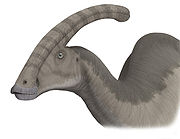
Hadrosaurids or duck-billed dinosaur
s are members of the family Hadrosauridae, and include ornithopod
s such as Edmontosaurus
and Parasaurolophus
. They were common herbivore
s in the Upper Cretaceous
Period of what are now Asia
, Europe
and North America
. They are descendants of the Upper Jurassic
/Lower Cretaceous iguanodontian dinosaurs and had similar body layout. They were ornithischia
ns.
Hadrosaurids are divided into two principal subfamilies. The lambeosaurines (Lambeosaurinae) had hollow cranial crests or tubes, and were generally less bulky. The saurolophines, identified as hadrosaurines in most pre-2010 works (Saurolophinae or Hadrosaurinae), lacked hollow cranial crests (solid crests were present in some forms) and were generally larger.
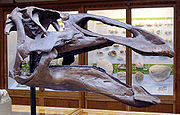 The hadrosaurs are known as the duck-billed dinosaurs due to the similarity of their head to that of modern duck
s. In some genera, most notably Anatotitan
, the whole front of the skull was flat and broadened out to form a beak, ideal for clipping leaves and twigs from the forest
s of Asia, Europe and North America. However, the back of the mouth contained literally thousands of teeth suitable for grinding food before it was swallowed. This has been hypothesized to have been a crucial factor in the success of this group in the Cretaceous, compared to the sauropods which were still largely dependent on gastrolith
s for grinding their food.
In 2009, paleontologist Mark Purnell
conducted a study into the chewing methods and diet of hadrosaurids from the Late Cretaceous period
. By analyzing hundreds of microscopic scratches on the teeth of a fossilized Edmontosaurus
jaw, the team determined hadrosaurs had a unique way of eating unlike any creature living today. In contrast to a flexible lower jaw joint prevalent in today's mammals, hadrosaurs had a unique hinge between the upper jaws and the rest of its skull. The team found the dinosaur's upper jaws pushed outwards and sideways while chewing, as the lower jaw slid against the upper teeth.
teeth. Joseph Leidy
examined the teeth, and erected the genera
Trachodon
and Thespesius
(others included Troodon
, Deinodon
and Palaeoscincus
). One species was named Trachodon mirabilis. Now it seems that the teeth genus Trachodon is a mixture of all sorts of cerapod dinosaurs, including ceratopsids. In 1858 the teeth were associated with Leidy's eponymous Hadrosaurus
foulkii, named after the fossil hobbyist William Parker Foulke
. More and more teeth were found, resulting in even more (now obsolete) genera.
A second duck-bill skeleton was unearthed, and was named Diclonius mirabilis in 1883 by Edward Drinker Cope
, which he incorrectly used in favor of Trachodon mirabilis. But Trachodon, together with other poorly typed genera, was used more widely and, when Cope's famous "Diclonius mirabilis" skeleton was mounted at the American Museum of Natural History
, it was labeled as "Trachodont dinosaur". The duck-billed dinosaur family was then named Trachodontidae.
A very well-preserved complete hadrosaurid specimen (Edmontosaurus annectens) was recovered in 1908 by the fossil collector Charles Hazelius Sternberg
and his three sons, in Converse County, Wyoming. Analyzed by Henry Osborn
in 1912, it has come to be known as the "Trachodon mummy
". This specimen's skin was almost completely preserved in the form of impressions.
 Lawrence Lambe
erected the genus Edmontosaurus ("lizard from Edmonton") in 1917 from a find in the lower Edmonton Formation (now Horseshoe Canyon Formation
), Alberta
. Hadrosaurid systematics were addressed in a 1942 monograph
by Richard Swann Lull and Nelda Wright. They proposed the genus Anatosaurus for several species of dubious genera. Cope's famous mount at the AMNH became Anatosaurus copei. In 1990, Anatosaurus was moved to Edmontosaurus. One former Anatosaurus species was distinct enough from Edmontosaurus to be placed in a separate genus, named Anatotitan
, so in 1990 the AMNH mount was re-labelled Anatotitan copei.
Paleontologists have found a hadrosaurid leg bone in Paleocene
rocks, but it was probably reworked from a Cretaceous
source.
One of the most complete fossilized specimens was found in 1999 in Hell Creek Formation
of North Dakota and now is nicknamed "Dakota
". The hadrosaur fossil is so well preserved that scientists have been able to calculate its muscle mass and learn that it was more muscular than thought, probably giving it the ability to outrun predators such as Tyrannosaurus rex. Unlike the collections of bones found in museums, this mummified hadrosaur fossil comes complete with skin (not merely skin impressions), ligaments, tendons and possibly some internal organs. It is being analyzed in the world's largest CT scanner, operated by the Boeing Co
. The machine usually is used for detecting flaws in space shuttle engines and other large objects, but previously none as large as this. Researchers hope the technology will help them learn more about the fossilized insides of the creature. They also found a gap of about a centimeter between each vertebra, indicating that there may have been a disk or other material between them, allowing more flexibility and meaning the animal was actually longer than what is shown in a museum.
in 1869. Since its creation, a major division has been recognized in the group, between the (generally crested) subfamily Lambeosaurinae
and (generally crestless) subfamily Saurolophinae (or Hadrosaurinae). Phylogenetic analysis has increased the resolution of hadrosaurid relationships considerably (see Phylogeny below), leading to the widespread usage of tribes (a taxonomic unit below subfamily) to describe the finer relationships within each group of hadrosaurids. However, many hadrosaurid tribes commonly recognized in online sources have not yet been formally defined or seen wide use in the literature. Several were briefly mentioned but not named as such in the first edition of The Dinosauria, under informal names. In this 1990 reference, "gryposaurs" included Aralosaurus
, Gryposaurus
, Hadrosaurus
, and Kritosaurus
; "brachylophosaurs" included Brachylophosaurus
and Maiasaura
; "saurolophs" included Lophorhothon
, Prosaurolophus
, and Saurolophus
; and "edmontosaurs" included Anatotitan
, Edmontosaurus
, and Shantungosaurus
.
Lambeosaurines have also been split into Parasaurolophini (Parasaurolophus
) and Corythosaurini (Corythosaurus
, Hypacrosaurus
, and Lambeosaurus
). Corythosaurini and Parasaurolophini as terms entered the formal literature in Evans and Reisz's 2007 redescription of Lambeosaurus magnicristatus. Corythosaurini is defined as all taxa
more closely related Corythosaurus casuarius than to Parasaurolophus walkeri, and Parasaurolophini as all those taxa closer to P. walkeri than to C. casuarius. In this study, Charonosaurus
and Parasaurolophus are parasaurolophins, and Corythosaurus, Hypacrosaurus, Lambeosaurus, Nipponosaurus
, and Olorotitan
are corythosaurins. The enigmatic genus Tsintaosaurus
may form a clade
in Lambeosaurine with Pararhabdodon
and its probable synonym Koutalisaurus
.
The use of the term Hadrosaurinae was questioned in a comprehensive study of hadrosaurid relationships by Albert Prieto-Márquez in 2010. Prieto-Márquez noted that, though the name Hadrosaurinae had been used for the clade of mostly crestless hadrosaurids by nearly all previous studies, its type species, Hadrosaurus foulkii, has almost always been excluded from the clade that bears its name, in violation of the rules for naming animals set out by the ICZN
. Prieto-Márquez defined Hadrosaurinae as only the lineage containing H. foulkii, and used the name Saurolophinae instead for the traditional grouping.
includes dinosaurs currently referred to the Hadrosauridae and its subfamilies. Hadrosaurids that were accepted as valid but were not placed in a cladogram
at the time of Prieto-Márquez's 2010 study are included at the highest level to which they were placed (either then, or in their description if they postdate the papers used here).
, by Forster in a 1997 abstract, as simply "Lambeosaurinae plus Hadrosaurinae and their most recent common ancestor." In 1998, Paul Sereno
defined the clade Hadrosauridae as the most inclusive possible group containing Saurolophus
(a well-known saurolophine) and Parasaurolophus
(a well-known lambeosaurine), later emending the definition to include Hadrosaurus
, the type genus of the family, which ICZN
rules state must be included, despite its status as a nomen dubium. According to Horner et al. (2004), Sereno's definition would place a few other well-known hadrosaurs (such as Telmatosaurus
and Bactrosaurus
) outside the family, which led them to define the family to include Telmatosaurus by default.
The following cladogram was recovered in a 2010 phylogenetic analysis by Prieto-Márquez.
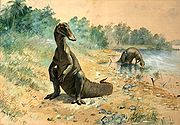 While studying into the chewing methods of hadrosaurids in 2009, the paleontologists Vincent Williams, Paul Barrett, and Mark Purnell
found that hadrosaurs likely grazed on horsetails and vegetation close to the ground, rather than browsing higher-growing leaves and twigs. This conclusion was based upon the evenness of scratches on hadrosaur teeth, which suggested the hadrosaur used the same series of jaw motions over and over again. As a result, the study determined that the hadrosaur diet was probably made of leaves and lacked the bulkier items such as twigs or stems, which might have required a different chewing method and created different wear patterns. However, Purnell said these conclusions were less secure than the more conclusive evidence regarding the motion of teeth while chewing.
The hypothesis that hadrosaurs were likely grazers rather than browsers appears to contradict previous findings from preserved stomach contents found in the fossilized guts in previous hadrosaurs studies. The most recent such finding before the publication of the Purnell study was conducted in 2008, when a team led by University of Colorado at Boulder
graduate student Justin S. Tweet found a homogeneous accumulation of millimeter-scale leaf fragments in the gut region of a well-preserved partially-grown Brachylophosaurus
. As a result of that finding, Tweet concluded in September 2008 that the animal was likely a browser, not a grazer. In response to such findings, Purnell said preserved stomach contents are questionable because they do not necessarily represent the usual diet of the animal. The issue remains a subject of debate.
Coprolite
s (fossilized droppings) of some Late Cretaceous
hadrosaurs show that the animals sometimes deliberately ate rotting wood. Wood itself is not nutritious, but decomposing wood would have contained fungi, decomposed wood material and detritus
-eating invertebrate
s, all of which would have been nutritious.
. Tiny hadrosaur footprints have been discovered in the Blackhawk Formation
of Utah
.
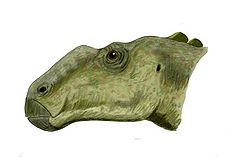 In 2001 Darren H. Tanke and M. K. Brett-Surman reviewed and described eggshell
and hatchling material from the Dinosaur Park Formation
of Dinosaur Provincial Park
. Eggshell is rare in the Park, being present in only two microfossil sites, both of which are predominated by the preserved shells of invertebrate life. The survival of hadrosaur eggshell fragments in the presence of these invertebrate shells may be result of calcium
in the invertebrate shells buffering contemporary acidic water which would have dissolved them. The hadrosaur eggshell fragments "show little to no stream abrasion" suggesting that the material did not originate far from their final burial place in the Park. The authors felt that their newly reported material corroborated the then-recent suggestion that hadrosaurs did not nest exclusively in upland areas, but also areas of lower elevation. Some recovered hadrosaur fossils might actually be from embryos. Hatchling and nestling-sized hadrosaur remains had been falsely considered rare in Dinosaur Park Formation
due to bias on the part of collectors seeking larger specimens and sometimes not recognizing what was encountered. Hadrosaurs had been speculated to be upland breeders due to the lack of preserved egg and hatchling material.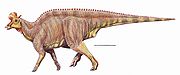 However young hadrosaur remains had been previously reported from lowland deposits. Darren Tanke
observed that an experienced collector could actually discover multiple juvenile hadrosaur specimens a day. During the 1992
field season a concerted effort was undertaken by the Royal Tyrell Museum to recover the remains of young hadrosaurs. The researchers describe the acquisition that season of 43 specimens as being a success. Most of the recovered fossils were of dentaries missing their teeth, bones from limbs and feet, as well as vertebral centra
. The material showed little or none of the abrasion
that would have resulted from transport, meaning the fossils were buried near their point of origin. The researchers conclude that this meant that hadrosaurs were nesting in the lowlands of the area represented by the strata containing the fossils and that previous workers hypotheses of lowland hadrosaur breeding were "confirmed." It was the slow dissolution of shells left by clams and snails releasing calcium carbonate
into the water that raised the water's pH
high enough to prevent the eggshells from dissolving. The no fragment's greatest dimension exceeds one cm. The eggshells' surface has a pebbly texture. Dinosaur Provincial Park eggshell is similar to the eggshells from the Two Medicine
and Judith River Formations of Montana as well as eggshell from the Devil's Coulee in southern Alberta
. Most hadrosaur neonate bones are incomplete due to their small size and vulnerability to the high erosion rates in the Dinosaur Provincial Park. Dentaries are common hadrosaur neonate fossils. Most specimens don't preserve all of the tooth replacement gooves. Most preserve "only about [ten] tooth files."
No neural arches are represented among the vertebrae fossils. Although some limb bones show signs of transport wear, the distances traveled before burial were probably not far as such small bones would be unlikely to survive the great diversity of scavengers and acidic water conditions. The breakdown of tannins from coniferous vegetation would have caused the pH of the waters in the park to be acidic. Dinosaur eggshell is lacking from the bone beds producing the hadrosaur juvenile bones.
The authors concluded that hadrosaurs nested in both upland or lowland area, although described factors influencing the division of breeding locations as unknown. They suggested that "diet, soil conditions, habits, [and] competition" between dinosaur genera might have played roles. Some of the less common hadrosaurs in the Dinosaur Park Formation of Dinosaur Provincial Park like Brachylophosaurus
or Parasaurolophus
may have had a more upland habitat where they may have nested or fed.
s of several hadrosaur genera (Corythosaurus
, Prosaurolophus
, and Saurolophus
) and modern birds and reptiles suggest that they may have been cathemeral
, active throughout the day at short intervals.
of Utah
.
Dinosaur
Dinosaurs are a diverse group of animals of the clade and superorder Dinosauria. They were the dominant terrestrial vertebrates for over 160 million years, from the late Triassic period until the end of the Cretaceous , when the Cretaceous–Paleogene extinction event led to the extinction of...
s are members of the family Hadrosauridae, and include ornithopod
Ornithopod
Ornithopods or members of the clade Ornithopoda are a group of ornithischian dinosaurs that started out as small, bipedal running grazers, and grew in size and numbers until they became one of the most successful groups of herbivores in the Cretaceous world, and dominated the North American...
s such as Edmontosaurus
Edmontosaurus
Edmontosaurus is a genus of crestless hadrosaurid dinosaur. It contains two species: Edmontosaurus regalis and Edmontosaurus annectens. Fossils of E. regalis have been found in rocks of western North America that date from the late Campanian stage of the Cretaceous Period 73 million years ago,...
and Parasaurolophus
Parasaurolophus
Parasaurolophus is a genus of ornithopod dinosaur that lived in what is now North America during the Late Cretaceous Period, about 76.5–73 million years ago. It was an herbivore that walked both as a biped and a quadruped. Three species are recognized: P. walkeri , P. tubicen, and the...
. They were common herbivore
Herbivore
Herbivores are organisms that are anatomically and physiologically adapted to eat plant-based foods. Herbivory is a form of consumption in which an organism principally eats autotrophs such as plants, algae and photosynthesizing bacteria. More generally, organisms that feed on autotrophs in...
s in the Upper Cretaceous
Cretaceous
The Cretaceous , derived from the Latin "creta" , usually abbreviated K for its German translation Kreide , is a geologic period and system from circa to million years ago. In the geologic timescale, the Cretaceous follows the Jurassic period and is followed by the Paleogene period of the...
Period of what are now Asia
Asia
Asia is the world's largest and most populous continent, located primarily in the eastern and northern hemispheres. It covers 8.7% of the Earth's total surface area and with approximately 3.879 billion people, it hosts 60% of the world's current human population...
, Europe
Europe
Europe is, by convention, one of the world's seven continents. Comprising the westernmost peninsula of Eurasia, Europe is generally 'divided' from Asia to its east by the watershed divides of the Ural and Caucasus Mountains, the Ural River, the Caspian and Black Seas, and the waterways connecting...
and North America
North America
North America is a continent wholly within the Northern Hemisphere and almost wholly within the Western Hemisphere. It is also considered a northern subcontinent of the Americas...
. They are descendants of the Upper Jurassic
Jurassic
The Jurassic is a geologic period and system that extends from about Mya to Mya, that is, from the end of the Triassic to the beginning of the Cretaceous. The Jurassic constitutes the middle period of the Mesozoic era, also known as the age of reptiles. The start of the period is marked by...
/Lower Cretaceous iguanodontian dinosaurs and had similar body layout. They were ornithischia
Ornithischia
Ornithischia or Predentata is an extinct order of beaked, herbivorous dinosaurs. The name ornithischia is derived from the Greek ornitheos meaning 'of a bird' and ischion meaning 'hip joint'...
ns.
Hadrosaurids are divided into two principal subfamilies. The lambeosaurines (Lambeosaurinae) had hollow cranial crests or tubes, and were generally less bulky. The saurolophines, identified as hadrosaurines in most pre-2010 works (Saurolophinae or Hadrosaurinae), lacked hollow cranial crests (solid crests were present in some forms) and were generally larger.
Characteristics
Duck
Duck is the common name for a large number of species in the Anatidae family of birds, which also includes swans and geese. The ducks are divided among several subfamilies in the Anatidae family; they do not represent a monophyletic group but a form taxon, since swans and geese are not considered...
s. In some genera, most notably Anatotitan
Anatotitan
Anatotitan is a genus of flat-headed or hadrosaurine hadrosaurid ornithopod dinosaur from the very end of the Cretaceous Period, in what is now North America...
, the whole front of the skull was flat and broadened out to form a beak, ideal for clipping leaves and twigs from the forest
Forest
A forest, also referred to as a wood or the woods, is an area with a high density of trees. As with cities, depending where you are in the world, what is considered a forest may vary significantly in size and have various classification according to how and what of the forest is composed...
s of Asia, Europe and North America. However, the back of the mouth contained literally thousands of teeth suitable for grinding food before it was swallowed. This has been hypothesized to have been a crucial factor in the success of this group in the Cretaceous, compared to the sauropods which were still largely dependent on gastrolith
Gastrolith
A gastrolith, also called a stomach stone or gizzard stones, is a rock held inside a gastrointestinal tract. Gastroliths are retained in the muscular gizzard and used to grind food in animals lacking suitable grinding teeth. The grain size depends upon the size of the animal and the gastrolith's...
s for grinding their food.
In 2009, paleontologist Mark Purnell
Mark Purnell
Dr Mark Andrew Purnell is a British palaeontologist, Reader of Geology at the University of Leicester.Purnell is an expert in conodont biostratigraphy and conodont palaeobiology, focussing especially on attempts to uncover the function of conodont elements...
conducted a study into the chewing methods and diet of hadrosaurids from the Late Cretaceous period
Late Cretaceous
The Late Cretaceous is the younger of two epochs into which the Cretaceous period is divided in the geologic timescale. Rock strata from this epoch form the Upper Cretaceous series...
. By analyzing hundreds of microscopic scratches on the teeth of a fossilized Edmontosaurus
Edmontosaurus
Edmontosaurus is a genus of crestless hadrosaurid dinosaur. It contains two species: Edmontosaurus regalis and Edmontosaurus annectens. Fossils of E. regalis have been found in rocks of western North America that date from the late Campanian stage of the Cretaceous Period 73 million years ago,...
jaw, the team determined hadrosaurs had a unique way of eating unlike any creature living today. In contrast to a flexible lower jaw joint prevalent in today's mammals, hadrosaurs had a unique hinge between the upper jaws and the rest of its skull. The team found the dinosaur's upper jaws pushed outwards and sideways while chewing, as the lower jaw slid against the upper teeth.
Discoveries
Hadrosaurids were the first dinosaur family to be identified in North America, the first traces being found in 1855-1856 with the discovery of fossilFossil
Fossils are the preserved remains or traces of animals , plants, and other organisms from the remote past...
teeth. Joseph Leidy
Joseph Leidy
Joseph Leidy was an American paleontologist.Leidy was professor of anatomy at the University of Pennsylvania, and later was a professor of natural history at Swarthmore College. His book Extinct Fauna of Dakota and Nebraska contained many species not previously described and many previously...
examined the teeth, and erected the genera
Genus
In biology, a genus is a low-level taxonomic rank used in the biological classification of living and fossil organisms, which is an example of definition by genus and differentia...
Trachodon
Trachodon
Trachodon is a dubious genus of hadrosaurid dinosaur based on teeth from the Campanian-age Upper Cretaceous Judith River Formation of Montana, U.S.A...
and Thespesius
Thespesius
Thespesius is a dubious genus of hadrosaurid dinosaur from the late Maastrichtian-age Upper Cretaceous Lance Formation of South Dakota....
(others included Troodon
Troodon
Troodon is a genus of relatively small, bird-like dinosaur from the Late Cretaceous period . Discovered in 1855, it was among the first dinosaurs found in North America...
, Deinodon
Deinodon
Deinodon is a name assigned to tyrannosaurid teeth of the Late Cretaceous of Montana by paleontologist Joseph Leidy in 1856...
and Palaeoscincus
Palaeoscincus
Palaeoscincus is a dubious genus of ankylosaurian dinosaur based on teeth from the mid-late Campanian-age Upper Cretaceous Judith River Formation of Montana...
). One species was named Trachodon mirabilis. Now it seems that the teeth genus Trachodon is a mixture of all sorts of cerapod dinosaurs, including ceratopsids. In 1858 the teeth were associated with Leidy's eponymous Hadrosaurus
Hadrosaurus
Hadrosaurus is a valid genus of hadrosaurid dinosaur. In 1858, a skeleton of a dinosaur from this genus was the first dinosaur skeleton known from more than isolated teeth to be found in North America. In 1868, it became the first ever mounted dinosaur skeleton...
foulkii, named after the fossil hobbyist William Parker Foulke
William Parker Foulke
William Parker Foulke discovered the first full dinosaur skeleton in North America in Haddonfield, New Jersey in 1858....
. More and more teeth were found, resulting in even more (now obsolete) genera.
A second duck-bill skeleton was unearthed, and was named Diclonius mirabilis in 1883 by Edward Drinker Cope
Edward Drinker Cope
Edward Drinker Cope was an American paleontologist and comparative anatomist, as well as a noted herpetologist and ichthyologist. Born to a wealthy Quaker family, Cope distinguished himself as a child prodigy interested in science; he published his first scientific paper at the age of nineteen...
, which he incorrectly used in favor of Trachodon mirabilis. But Trachodon, together with other poorly typed genera, was used more widely and, when Cope's famous "Diclonius mirabilis" skeleton was mounted at the American Museum of Natural History
American Museum of Natural History
The American Museum of Natural History , located on the Upper West Side of Manhattan in New York City, United States, is one of the largest and most celebrated museums in the world...
, it was labeled as "Trachodont dinosaur". The duck-billed dinosaur family was then named Trachodontidae.
A very well-preserved complete hadrosaurid specimen (Edmontosaurus annectens) was recovered in 1908 by the fossil collector Charles Hazelius Sternberg
Charles Hazelius Sternberg
Charles Hazelius Sternberg , was an American fossil collector and amateur paleontologist. His older brother, Dr. George M. Sternberg was a military surgeon assigned to Fort Harker near Ellsworth, Kansas and brought the rest of Sternberg family to Kansas to live on his ranch about 1868...
and his three sons, in Converse County, Wyoming. Analyzed by Henry Osborn
Henry Fairfield Osborn
Henry Fairfield Osborn, Sr. ForMemRS was an American geologist, paleontologist, and eugenicist.-Early life and career:...
in 1912, it has come to be known as the "Trachodon mummy
Trachodon mummy
The Trachodon mummy is a very well preserved fossil of Edmontosaurus annectens, a duckbilled dinosaur. It was found by Charles Hazelius Sternberg and his three sons near Lusk, Wyoming, USA in 1908...
". This specimen's skin was almost completely preserved in the form of impressions.
Lawrence Lambe
Lawrence Morris Lambe was a Canadian geologist and palaeontologist from the Geological Survey of Canada .His published work, describing the diverse and plentiful dinosaur discoveries from the fossil beds in Alberta, did much to bring dinosaurs into the public eye and helped usher in the Golden...
erected the genus Edmontosaurus ("lizard from Edmonton") in 1917 from a find in the lower Edmonton Formation (now Horseshoe Canyon Formation
Horseshoe Canyon Formation
The Horseshoe Canyon Formation is part of the Edmonton Group and is up to 230m in thickness. It is Late Campanian to Early Maastrichtian in age and is composed of mudstone, sandstone, and carbonaceous shales...
), Alberta
Alberta
Alberta is a province of Canada. It had an estimated population of 3.7 million in 2010 making it the most populous of Canada's three prairie provinces...
. Hadrosaurid systematics were addressed in a 1942 monograph
Monograph
A monograph is a work of writing upon a single subject, usually by a single author.It is often a scholarly essay or learned treatise, and may be released in the manner of a book or journal article. It is by definition a single document that forms a complete text in itself...
by Richard Swann Lull and Nelda Wright. They proposed the genus Anatosaurus for several species of dubious genera. Cope's famous mount at the AMNH became Anatosaurus copei. In 1990, Anatosaurus was moved to Edmontosaurus. One former Anatosaurus species was distinct enough from Edmontosaurus to be placed in a separate genus, named Anatotitan
Anatotitan
Anatotitan is a genus of flat-headed or hadrosaurine hadrosaurid ornithopod dinosaur from the very end of the Cretaceous Period, in what is now North America...
, so in 1990 the AMNH mount was re-labelled Anatotitan copei.
Paleontologists have found a hadrosaurid leg bone in Paleocene
Paleocene
The Paleocene or Palaeocene, the "early recent", is a geologic epoch that lasted from about . It is the first epoch of the Palaeogene Period in the modern Cenozoic Era...
rocks, but it was probably reworked from a Cretaceous
Cretaceous
The Cretaceous , derived from the Latin "creta" , usually abbreviated K for its German translation Kreide , is a geologic period and system from circa to million years ago. In the geologic timescale, the Cretaceous follows the Jurassic period and is followed by the Paleogene period of the...
source.
One of the most complete fossilized specimens was found in 1999 in Hell Creek Formation
Hell Creek Formation
The Hell Creek Formation is an intensely-studied division of Upper Cretaceous to lower Paleocene rocks in North America, named for exposures studied along Hell Creek, near Jordan, Montana...
of North Dakota and now is nicknamed "Dakota
Dakota (fossil)
Dakota is the nickname given to a fossil Edmontosaurus from the Hell Creek Formation in North Dakota. It is about 67 million years old, placing it in the Maastrichtian, the last stage of the Cretaceous period...
". The hadrosaur fossil is so well preserved that scientists have been able to calculate its muscle mass and learn that it was more muscular than thought, probably giving it the ability to outrun predators such as Tyrannosaurus rex. Unlike the collections of bones found in museums, this mummified hadrosaur fossil comes complete with skin (not merely skin impressions), ligaments, tendons and possibly some internal organs. It is being analyzed in the world's largest CT scanner, operated by the Boeing Co
Boeing
The Boeing Company is an American multinational aerospace and defense corporation, founded in 1916 by William E. Boeing in Seattle, Washington. Boeing has expanded over the years, merging with McDonnell Douglas in 1997. Boeing Corporate headquarters has been in Chicago, Illinois since 2001...
. The machine usually is used for detecting flaws in space shuttle engines and other large objects, but previously none as large as this. Researchers hope the technology will help them learn more about the fossilized insides of the creature. They also found a gap of about a centimeter between each vertebra, indicating that there may have been a disk or other material between them, allowing more flexibility and meaning the animal was actually longer than what is shown in a museum.
Classification
The family Hadrosauridae was first used by Edward Drinker CopeEdward Drinker Cope
Edward Drinker Cope was an American paleontologist and comparative anatomist, as well as a noted herpetologist and ichthyologist. Born to a wealthy Quaker family, Cope distinguished himself as a child prodigy interested in science; he published his first scientific paper at the age of nineteen...
in 1869. Since its creation, a major division has been recognized in the group, between the (generally crested) subfamily Lambeosaurinae
Lambeosaurinae
Lambeosaurinae is a group of crested hadrosaurid dinosaurs.-Classification:Lambeosaurines have been split into Parasaurolophini and Corythosaurini . Corythosaurini and Parasaurolophini as terms entered the formal literature in Evans and Reisz's 2007 redescription of Lambeosaurus magnicristatus...
and (generally crestless) subfamily Saurolophinae (or Hadrosaurinae). Phylogenetic analysis has increased the resolution of hadrosaurid relationships considerably (see Phylogeny below), leading to the widespread usage of tribes (a taxonomic unit below subfamily) to describe the finer relationships within each group of hadrosaurids. However, many hadrosaurid tribes commonly recognized in online sources have not yet been formally defined or seen wide use in the literature. Several were briefly mentioned but not named as such in the first edition of The Dinosauria, under informal names. In this 1990 reference, "gryposaurs" included Aralosaurus
Aralosaurus
Aralosaurus meaning "Aral Sea lizard", because it was found in the Aral Sea was a genus of hadrosaurid dinosaur which lived during the Late Cretaceous of what is now Kazakhstan...
, Gryposaurus
Gryposaurus
Gryposaurus was a genus of duckbilled dinosaur that lived about 83 to 75.5 million years ago, in the Late Cretaceous of North America...
, Hadrosaurus
Hadrosaurus
Hadrosaurus is a valid genus of hadrosaurid dinosaur. In 1858, a skeleton of a dinosaur from this genus was the first dinosaur skeleton known from more than isolated teeth to be found in North America. In 1868, it became the first ever mounted dinosaur skeleton...
, and Kritosaurus
Kritosaurus
Kritosaurus is an incompletely known but historically important genus of hadrosaurid dinosaur. It lived about 73 million years ago, in the Late Cretaceous of North America...
; "brachylophosaurs" included Brachylophosaurus
Brachylophosaurus
Brachylophosaurus was a mid-sized member of the hadrosaurid family of dinosaurs. It is known from several skeletons and bonebed material from the Judith River Formation of Montana and the Oldman Formation of Alberta, living about 76.5 million years ago....
and Maiasaura
Maiasaura
Maiasaura is a large duck-billed dinosaur genus that lived in the area currently covered by the state of Montana in the Upper Cretaceous Period , about 74 million years ago....
; "saurolophs" included Lophorhothon
Lophorhothon
Lophorhothon is a genus of hadrosauroid dinosaur from the Late Cretaceous, the first genus of dinosaur discovered in Alabama.-Discovery and naming:...
, Prosaurolophus
Prosaurolophus
Prosaurolophus is a genus of hadrosaurid dinosaur from the Late Cretaceous of North America. It is known from the remains of at least 25 individuals belonging to two species, including skulls and skeletons, but it remains obscure...
, and Saurolophus
Saurolophus
Saurolophus is a genus of large hadrosaurine duckbill that lived about 69.5-68.5 million years ago, in the Late Cretaceous of North America and Asia; it is one of the few genera of dinosaurs known from multiple continents. It is distinguished by a spike-like crest which projects up and back...
; and "edmontosaurs" included Anatotitan
Anatotitan
Anatotitan is a genus of flat-headed or hadrosaurine hadrosaurid ornithopod dinosaur from the very end of the Cretaceous Period, in what is now North America...
, Edmontosaurus
Edmontosaurus
Edmontosaurus is a genus of crestless hadrosaurid dinosaur. It contains two species: Edmontosaurus regalis and Edmontosaurus annectens. Fossils of E. regalis have been found in rocks of western North America that date from the late Campanian stage of the Cretaceous Period 73 million years ago,...
, and Shantungosaurus
Shantungosaurus
Shantungosaurus, meaning "Shandong Lizard", is a genus of saurolophine hadrosaurid dinosaurs found in the Late Cretaceous Wangshi Formation of the Shandong Peninsula in China.-Description:...
.
Lambeosaurines have also been split into Parasaurolophini (Parasaurolophus
Parasaurolophus
Parasaurolophus is a genus of ornithopod dinosaur that lived in what is now North America during the Late Cretaceous Period, about 76.5–73 million years ago. It was an herbivore that walked both as a biped and a quadruped. Three species are recognized: P. walkeri , P. tubicen, and the...
) and Corythosaurini (Corythosaurus
Corythosaurus
Corythosaurus is a genus of duck-billed dinosaur from the Upper Cretaceous Period, about 77-76.5 million years ago. It lived in what is now North America...
, Hypacrosaurus
Hypacrosaurus
Hypacrosaurus was a genus of duckbill dinosaur similar in appearance to Corythosaurus. Like Corythosaurus, it had a tall, hollow rounded crest, although not as large and straight...
, and Lambeosaurus
Lambeosaurus
Lambeosaurus is a genus of hadrosaurid dinosaur that lived about 76 to 75 million years ago, in the Late Cretaceous Period of North America. This bipedal/quadrupedal, herbivorous dinosaur is known for its distinctive hollow cranial crest, which in the best-known species resembled a hatchet...
). Corythosaurini and Parasaurolophini as terms entered the formal literature in Evans and Reisz's 2007 redescription of Lambeosaurus magnicristatus. Corythosaurini is defined as all taxa
Taxon
|thumb|270px|[[African elephants]] form a widely-accepted taxon, the [[genus]] LoxodontaA taxon is a group of organisms, which a taxonomist adjudges to be a unit. Usually a taxon is given a name and a rank, although neither is a requirement...
more closely related Corythosaurus casuarius than to Parasaurolophus walkeri, and Parasaurolophini as all those taxa closer to P. walkeri than to C. casuarius. In this study, Charonosaurus
Charonosaurus
Charonosaurus |Charon]]'s lizard") is the name of a genus of dinosaur whose fossils were discovered by Godefroit, Zan & Jin in 2000 on the south bank of the Amur River, dividing China from Russia.-Description:...
and Parasaurolophus are parasaurolophins, and Corythosaurus, Hypacrosaurus, Lambeosaurus, Nipponosaurus
Nipponosaurus
Nipponosaurus is a lambeosaurine hadrosaurid from Asia.The holotype was discovered in November 1934 during the construction of a hospital for the Kawakami colliery of the Mitsui Mining Company on Karafuto Prefecture , and additional material belonging to the specimen was recovered...
, and Olorotitan
Olorotitan
Olorotitan was a genus of lambeosaurine duckbilled dinosaur from the middle or latest Maastrichtian-age Late Cretaceous Tsagayan Formation beds located in Kundur, Amur Region, Far Eastern Russia. The remains, consisting of a nearly complete skeleton, were described by Pascal Godefroit et al. in...
are corythosaurins. The enigmatic genus Tsintaosaurus
Tsintaosaurus
Tsintaosaurus is a genus of hadrosaurid dinosaur from China. It was about long, tall and weighed 3 tons. The type species is T. spinorhinus, first described by C. C...
may form a clade
Clade
A clade is a group consisting of a species and all its descendants. In the terms of biological systematics, a clade is a single "branch" on the "tree of life". The idea that such a "natural group" of organisms should be grouped together and given a taxonomic name is central to biological...
in Lambeosaurine with Pararhabdodon
Pararhabdodon
Pararhabdodon was a genus of derived hadrosauroid or basal hadrosaurid dinosaur, from the Maastrichtian-age Upper Cretaceous Tremp Formation of Spain...
and its probable synonym Koutalisaurus
Koutalisaurus
Koutalisaurus was a genus of hadrosaurid dinosaur. It is based on a mostly complete dentary from the Maastrichtian-age Upper Cretaceous Tremp Formation near the town of Abella de la Conca, Lleida, Spain...
.
The use of the term Hadrosaurinae was questioned in a comprehensive study of hadrosaurid relationships by Albert Prieto-Márquez in 2010. Prieto-Márquez noted that, though the name Hadrosaurinae had been used for the clade of mostly crestless hadrosaurids by nearly all previous studies, its type species, Hadrosaurus foulkii, has almost always been excluded from the clade that bears its name, in violation of the rules for naming animals set out by the ICZN
International Code of Zoological Nomenclature
The International Code of Zoological Nomenclature is a widely accepted convention in zoology that rules the formal scientific naming of organisms treated as animals...
. Prieto-Márquez defined Hadrosaurinae as only the lineage containing H. foulkii, and used the name Saurolophinae instead for the traditional grouping.
Taxonomy
The following taxonomyLinnaean taxonomy
Linnaean taxonomy can mean either of two related concepts:# the particular form of biological classification set up by Carl Linnaeus, as set forth in his Systema Naturæ and subsequent works...
includes dinosaurs currently referred to the Hadrosauridae and its subfamilies. Hadrosaurids that were accepted as valid but were not placed in a cladogram
Cladogram
A cladogram is a diagram used in cladistics which shows ancestral relations between organisms, to represent the evolutionary tree of life. Although traditionally such cladograms were generated largely on the basis of morphological characters, DNA and RNA sequencing data and computational...
at the time of Prieto-Márquez's 2010 study are included at the highest level to which they were placed (either then, or in their description if they postdate the papers used here).
- Family Hadrosauridae
- ArkharaviaArkharaviaArkharavia is a genus of hadrosaurid dinosaur. It lived in what is now Russia, during the Late Cretaceous. It was described in 2010 by Alifanov and Bolotsky. The type species is A. heterocoelica.-Known material:...
- ClaosaurusClaosaurusClaosaurus is a genus of primitive hadrosaurid that lived during the Late Cretaceous Period .Evidence of its existence was first found near the Smoky Hill River in Kansas, USA in the form of partial skull fragments and as an articulated postcranial skeleton...
- LophorhothonLophorhothonLophorhothon is a genus of hadrosauroid dinosaur from the Late Cretaceous, the first genus of dinosaur discovered in Alabama.-Discovery and naming:...
- TelmatosaurusTelmatosaurusTelmatosaurus is a genus of basal hadrosaurid dinosaur from the Late Cretaceous. It was a relatively small hadrosaur, approximately five meters long, found in what is now Romania....
- Subfamily Hadrosaurinae
- HadrosaurusHadrosaurusHadrosaurus is a valid genus of hadrosaurid dinosaur. In 1858, a skeleton of a dinosaur from this genus was the first dinosaur skeleton known from more than isolated teeth to be found in North America. In 1868, it became the first ever mounted dinosaur skeleton...
- Hadrosaurus
- Subfamily Saurolophinae
- Subfamily LambeosaurinaeLambeosaurinaeLambeosaurinae is a group of crested hadrosaurid dinosaurs.-Classification:Lambeosaurines have been split into Parasaurolophini and Corythosaurini . Corythosaurini and Parasaurolophini as terms entered the formal literature in Evans and Reisz's 2007 redescription of Lambeosaurus magnicristatus...
- Hadrosaurids of uncertain placement (incertae sedis)
- KoutalisaurusKoutalisaurusKoutalisaurus was a genus of hadrosaurid dinosaur. It is based on a mostly complete dentary from the Maastrichtian-age Upper Cretaceous Tremp Formation near the town of Abella de la Conca, Lleida, Spain...
- Koutalisaurus
- DubiousNomen dubiumIn zoological nomenclature, a nomen dubium is a scientific name that is of unknown or doubtful application...
hadrosaurids- ArstanosaurusArstanosaurusArstanosaurus was a genus of hadrosaurid dinosaur from the Santonian-Campanian-age Upper Cretaceous Bostobinskaya Formation, Kazakhstan. It has had a confusing history, being considered both a hadrosaurid and a ceratopsid, or both at the same time .-History:The genus was based on a maxilla , with...
- CionodonCionodonCionodon was a genus of dinosaur from the Late Cretaceous Period. The type species, Cionodon arctatus lived in what is now present-day Colorado. It is classified as a hadrosaur, and was formally described by Edward Drinker Cope in 1874. It is a nomen dubium because it is based on very fragmentary...
- DicloniusDicloniusDiclonius is a genus of dinosaur from the Late Cretaceous. It was a hadrosaur based solely on teeth. Its fossils have been found in North America. The name is in reference to the method of tooth replacement, in which newly erupting replacement teeth could be in functional use at the same time as...
- DysganusDysganusDysganus is the name given to a dubious genus of dinosaur from the Late Cretaceous. It was a ceratopsian. Its fossils have been found in Montana....
- HypsibemaHypsibemaHypsibema is a little-known genus of dinosaur from the Late Cretaceous . Its giant fossils were found in the U.S. states of North Carolina and Missouri...
- MandschurosaurusMandschurosaurusMandschurosaurus is a hadrosaur taxon based on material from the Upper Cretaceous of Belye Kruchi, Manchuria. M. amurensis is based on a poorly preserved and incomplete skeleton collected by Russian scientists in 1914 from the banks of the Amur River...
- MicrohadrosaurusMicrohadrosaurusMicrohadrosaurus is a genus of duckbill dinosaur from the Campanian or Maastrichtian-age Upper Cretaceous Yuanpu Formation of Guangdong, China...
- OrthomerusOrthomerusOrthomerus is a genus of duckbill dinosaur from the Late Cretaceous of The Netherlands, Belgium and possibly Ukraine. It is today an obscure genus, but in the past was conflated with the much better known Telmatosaurus....
- PteropelyxPteropelyxPteropelyx is a dubious genus of Late Cretaceous hadrosaurid dinosaur from the Judith River Formation of Montana, named by Edward Drinker Cope in 1889. Historically, several species were assigned to it, all based on extremely fragmentary remains, but there is no evidence to support these assignments...
- ThespesiusThespesiusThespesius is a dubious genus of hadrosaurid dinosaur from the late Maastrichtian-age Upper Cretaceous Lance Formation of South Dakota....
- TrachodonTrachodonTrachodon is a dubious genus of hadrosaurid dinosaur based on teeth from the Campanian-age Upper Cretaceous Judith River Formation of Montana, U.S.A...
- Arstanosaurus
- Arkharavia
Phylogeny
Hadrosauridae was first defined as a cladeClade
A clade is a group consisting of a species and all its descendants. In the terms of biological systematics, a clade is a single "branch" on the "tree of life". The idea that such a "natural group" of organisms should be grouped together and given a taxonomic name is central to biological...
, by Forster in a 1997 abstract, as simply "Lambeosaurinae plus Hadrosaurinae and their most recent common ancestor." In 1998, Paul Sereno
Paul Sereno
Paul Callistus Sereno is an American paleontologist from the University of Chicago who discovered several new dinosaur species on several continents. He has conducted excavations at sites as varied as Inner Mongolia, Argentina, Morocco, and Niger...
defined the clade Hadrosauridae as the most inclusive possible group containing Saurolophus
Saurolophus
Saurolophus is a genus of large hadrosaurine duckbill that lived about 69.5-68.5 million years ago, in the Late Cretaceous of North America and Asia; it is one of the few genera of dinosaurs known from multiple continents. It is distinguished by a spike-like crest which projects up and back...
(a well-known saurolophine) and Parasaurolophus
Parasaurolophus
Parasaurolophus is a genus of ornithopod dinosaur that lived in what is now North America during the Late Cretaceous Period, about 76.5–73 million years ago. It was an herbivore that walked both as a biped and a quadruped. Three species are recognized: P. walkeri , P. tubicen, and the...
(a well-known lambeosaurine), later emending the definition to include Hadrosaurus
Hadrosaurus
Hadrosaurus is a valid genus of hadrosaurid dinosaur. In 1858, a skeleton of a dinosaur from this genus was the first dinosaur skeleton known from more than isolated teeth to be found in North America. In 1868, it became the first ever mounted dinosaur skeleton...
, the type genus of the family, which ICZN
International Code of Zoological Nomenclature
The International Code of Zoological Nomenclature is a widely accepted convention in zoology that rules the formal scientific naming of organisms treated as animals...
rules state must be included, despite its status as a nomen dubium. According to Horner et al. (2004), Sereno's definition would place a few other well-known hadrosaurs (such as Telmatosaurus
Telmatosaurus
Telmatosaurus is a genus of basal hadrosaurid dinosaur from the Late Cretaceous. It was a relatively small hadrosaur, approximately five meters long, found in what is now Romania....
and Bactrosaurus
Bactrosaurus
Bactrosaurus is a genus of herbivorous dinosaur that lived in east China during the late Cretaceous, about 70 mya. The position Bactrosaurus occupies in the Cretaceous makes it one of the earliest known hadrosaurs, and although it is not known from a full skeleton, Bactrosaurus is one of the best...
) outside the family, which led them to define the family to include Telmatosaurus by default.
The following cladogram was recovered in a 2010 phylogenetic analysis by Prieto-Márquez.
Saurolophine cladogram
Hadrosauridae has not been subjected to as many phylogenetic analyses as other dinosaur groups, so other workers may find quite different phylogenies. Gates and Sampson (2007) published the following alternate cladogram of Saurolophinae (identified as "Hadrosaurinae" in the study) in their description of Gryposaurus monumentensis:Lambeosaurine cladogram
The following cladogram is after the 2007 redescription of Lambeosaurus magnicristatus (Evans and Reisz, 2007):Diet
Mark Purnell
Dr Mark Andrew Purnell is a British palaeontologist, Reader of Geology at the University of Leicester.Purnell is an expert in conodont biostratigraphy and conodont palaeobiology, focussing especially on attempts to uncover the function of conodont elements...
found that hadrosaurs likely grazed on horsetails and vegetation close to the ground, rather than browsing higher-growing leaves and twigs. This conclusion was based upon the evenness of scratches on hadrosaur teeth, which suggested the hadrosaur used the same series of jaw motions over and over again. As a result, the study determined that the hadrosaur diet was probably made of leaves and lacked the bulkier items such as twigs or stems, which might have required a different chewing method and created different wear patterns. However, Purnell said these conclusions were less secure than the more conclusive evidence regarding the motion of teeth while chewing.
The hypothesis that hadrosaurs were likely grazers rather than browsers appears to contradict previous findings from preserved stomach contents found in the fossilized guts in previous hadrosaurs studies. The most recent such finding before the publication of the Purnell study was conducted in 2008, when a team led by University of Colorado at Boulder
University of Colorado at Boulder
The University of Colorado Boulder is a public research university located in Boulder, Colorado...
graduate student Justin S. Tweet found a homogeneous accumulation of millimeter-scale leaf fragments in the gut region of a well-preserved partially-grown Brachylophosaurus
Brachylophosaurus
Brachylophosaurus was a mid-sized member of the hadrosaurid family of dinosaurs. It is known from several skeletons and bonebed material from the Judith River Formation of Montana and the Oldman Formation of Alberta, living about 76.5 million years ago....
. As a result of that finding, Tweet concluded in September 2008 that the animal was likely a browser, not a grazer. In response to such findings, Purnell said preserved stomach contents are questionable because they do not necessarily represent the usual diet of the animal. The issue remains a subject of debate.
Coprolite
Coprolite
A coprolite is fossilized animal dung. Coprolites are classified as trace fossils as opposed to body fossils, as they give evidence for the animal's behaviour rather than morphology. The name is derived from the Greek words κοπρος / kopros meaning 'dung' and λιθος / lithos meaning 'stone'. They...
s (fossilized droppings) of some Late Cretaceous
Cretaceous
The Cretaceous , derived from the Latin "creta" , usually abbreviated K for its German translation Kreide , is a geologic period and system from circa to million years ago. In the geologic timescale, the Cretaceous follows the Jurassic period and is followed by the Paleogene period of the...
hadrosaurs show that the animals sometimes deliberately ate rotting wood. Wood itself is not nutritious, but decomposing wood would have contained fungi, decomposed wood material and detritus
Detritus
Detritus is a biological term used to describe dead or waste organic material.Detritus may also refer to:* Detritus , a geological term used to describe the particles of rock produced by weathering...
-eating invertebrate
Invertebrate
An invertebrate is an animal without a backbone. The group includes 97% of all animal species – all animals except those in the chordate subphylum Vertebrata .Invertebrates form a paraphyletic group...
s, all of which would have been nutritious.
Reproduction
Neonate sized hadrosaur fossils have been documented in the scientific literatureScientific literature
Scientific literature comprises scientific publications that report original empirical and theoretical work in the natural and social sciences, and within a scientific field is often abbreviated as the literature. Academic publishing is the process of placing the results of one's research into the...
. Tiny hadrosaur footprints have been discovered in the Blackhawk Formation
Blackhawk Formation
The Blackhawk Formation is a geological formation from which fossil pterosaur tracks have been recovered.-Vertebrate paleofauna:Tiny hadrosaur footprints have been discovered in the Blackhawk Formation of Utah. Pterodactyloid tracks have been found near North Horn.-References:* Lockley, M.; Harris,...
of Utah
Utah
Utah is a state in the Western United States. It was the 45th state to join the Union, on January 4, 1896. Approximately 80% of Utah's 2,763,885 people live along the Wasatch Front, centering on Salt Lake City. This leaves vast expanses of the state nearly uninhabited, making the population the...
.
In the Dinosaur Park Formation
Eggshell
An eggshell is the outer covering of a hard-shelled egg and of some forms of eggs with soft outer coats.- Insect eggs :Insects and other arthropods lay a variety of styles and shapes of eggs. Some have gelatinous or skin-like coverings, others have hard eggshells. Softer shells are mostly protein....
and hatchling material from the Dinosaur Park Formation
Dinosaur Park Formation
The Dinosaur Park Formation is the uppermost member of the Judith River Group, a major geologic unit in southern Alberta. It was laid down over a period of time between about 76.5 and 75 million years ago. The formation is made up of deposits of a high-sinuosity fluvial system, and is capped...
of Dinosaur Provincial Park
Dinosaur Provincial Park
Dinosaur Provincial Park is a UNESCO World Heritage Site located about two and a half hours drive southeast of Calgary, Alberta, Canada or , about a half hour drive, northeast of Brooks....
. Eggshell is rare in the Park, being present in only two microfossil sites, both of which are predominated by the preserved shells of invertebrate life. The survival of hadrosaur eggshell fragments in the presence of these invertebrate shells may be result of calcium
Calcium
Calcium is the chemical element with the symbol Ca and atomic number 20. It has an atomic mass of 40.078 amu. Calcium is a soft gray alkaline earth metal, and is the fifth-most-abundant element by mass in the Earth's crust...
in the invertebrate shells buffering contemporary acidic water which would have dissolved them. The hadrosaur eggshell fragments "show little to no stream abrasion" suggesting that the material did not originate far from their final burial place in the Park. The authors felt that their newly reported material corroborated the then-recent suggestion that hadrosaurs did not nest exclusively in upland areas, but also areas of lower elevation. Some recovered hadrosaur fossils might actually be from embryos. Hatchling and nestling-sized hadrosaur remains had been falsely considered rare in Dinosaur Park Formation
Dinosaur Park Formation
The Dinosaur Park Formation is the uppermost member of the Judith River Group, a major geologic unit in southern Alberta. It was laid down over a period of time between about 76.5 and 75 million years ago. The formation is made up of deposits of a high-sinuosity fluvial system, and is capped...
due to bias on the part of collectors seeking larger specimens and sometimes not recognizing what was encountered. Hadrosaurs had been speculated to be upland breeders due to the lack of preserved egg and hatchling material.
Darren Tanke
Darren H. Tanke is a Canadian fossil preparation technician of the Dinosaur Research Program at the Royal Tyrrell Museum of Palaeontology in Drumheller, Alberta. Born in Calgary, Tanke became interested in natural history at an early age. In 1979, Tanke began working for Philip J...
observed that an experienced collector could actually discover multiple juvenile hadrosaur specimens a day. During the 1992
1992 in paleontology
- Dinosaurs :* During the 1992 field season a concerted effort was undertaken by the Royal Tyrell Museum to recover the remains of young hadrosaurs. The researchers describe the acquisition that season of 43 specimens as being a success...
field season a concerted effort was undertaken by the Royal Tyrell Museum to recover the remains of young hadrosaurs. The researchers describe the acquisition that season of 43 specimens as being a success. Most of the recovered fossils were of dentaries missing their teeth, bones from limbs and feet, as well as vertebral centra
Centra
Centra is a convenience store chain in Ireland.The chain is run by Musgrave, the Irish food wholesaler, however the stores are all owned by individual franchisees. The chain has three different formats available to franchisees — smaller Quick Stop outlets, mid-sized Foodmarkets, and larger...
. The material showed little or none of the abrasion
Abrasion
In dermatology, an abrasion is a wound caused by superficial damage to the skin, no deeper than the epidermis. It is less severe than a laceration, and bleeding, if present, is minimal. Mild abrasions, also known as grazes or scrapes, do not scar or bleed, but deep abrasions may lead to the...
that would have resulted from transport, meaning the fossils were buried near their point of origin. The researchers conclude that this meant that hadrosaurs were nesting in the lowlands of the area represented by the strata containing the fossils and that previous workers hypotheses of lowland hadrosaur breeding were "confirmed." It was the slow dissolution of shells left by clams and snails releasing calcium carbonate
Calcium carbonate
Calcium carbonate is a chemical compound with the formula CaCO3. It is a common substance found in rocks in all parts of the world, and is the main component of shells of marine organisms, snails, coal balls, pearls, and eggshells. Calcium carbonate is the active ingredient in agricultural lime,...
into the water that raised the water's pH
PH
In chemistry, pH is a measure of the acidity or basicity of an aqueous solution. Pure water is said to be neutral, with a pH close to 7.0 at . Solutions with a pH less than 7 are said to be acidic and solutions with a pH greater than 7 are basic or alkaline...
high enough to prevent the eggshells from dissolving. The no fragment's greatest dimension exceeds one cm. The eggshells' surface has a pebbly texture. Dinosaur Provincial Park eggshell is similar to the eggshells from the Two Medicine
Two Medicine Formation
The Two Medicine Formation is a geologic formation, or rock body, that was deposited between 83.5 ± 0.7 Ma to 70.6 ± 0.6 Ma , during Campanian time, and is located in northwestern Montana...
and Judith River Formations of Montana as well as eggshell from the Devil's Coulee in southern Alberta
Alberta
Alberta is a province of Canada. It had an estimated population of 3.7 million in 2010 making it the most populous of Canada's three prairie provinces...
.
No neural arches are represented among the vertebrae fossils. Although some limb bones show signs of transport wear, the distances traveled before burial were probably not far as such small bones would be unlikely to survive the great diversity of scavengers and acidic water conditions. The breakdown of tannins from coniferous vegetation would have caused the pH of the waters in the park to be acidic. Dinosaur eggshell is lacking from the bone beds producing the hadrosaur juvenile bones.
The authors concluded that hadrosaurs nested in both upland or lowland area, although described factors influencing the division of breeding locations as unknown. They suggested that "diet, soil conditions, habits, [and] competition" between dinosaur genera might have played roles. Some of the less common hadrosaurs in the Dinosaur Park Formation of Dinosaur Provincial Park like Brachylophosaurus
Brachylophosaurus
Brachylophosaurus was a mid-sized member of the hadrosaurid family of dinosaurs. It is known from several skeletons and bonebed material from the Judith River Formation of Montana and the Oldman Formation of Alberta, living about 76.5 million years ago....
or Parasaurolophus
Parasaurolophus
Parasaurolophus is a genus of ornithopod dinosaur that lived in what is now North America during the Late Cretaceous Period, about 76.5–73 million years ago. It was an herbivore that walked both as a biped and a quadruped. Three species are recognized: P. walkeri , P. tubicen, and the...
may have had a more upland habitat where they may have nested or fed.
Development
The limbs of the juvenile hadrosaurs are anatomically and proportionally similar to those of adult animals. However, the joints often show "predepositional erosion or concave articular surfaces." Probably due to the cartilaginous cap covering the ends of the bones. The pelvis of a young hadrosaur was similar to that of an older individual.Daily activity patterns
Comparisons between the scleral ringSclerotic ring
Sclerotic rings are rings of bone found in the eyes of several groups of vertebrate animals, except for mammals and crocodilians. They can be made up of single bones or small bones together. They are believed to have a role in supporting the eye, especially in animals whose eyes are not spherical,...
s of several hadrosaur genera (Corythosaurus
Corythosaurus
Corythosaurus is a genus of duck-billed dinosaur from the Upper Cretaceous Period, about 77-76.5 million years ago. It lived in what is now North America...
, Prosaurolophus
Prosaurolophus
Prosaurolophus is a genus of hadrosaurid dinosaur from the Late Cretaceous of North America. It is known from the remains of at least 25 individuals belonging to two species, including skulls and skeletons, but it remains obscure...
, and Saurolophus
Saurolophus
Saurolophus is a genus of large hadrosaurine duckbill that lived about 69.5-68.5 million years ago, in the Late Cretaceous of North America and Asia; it is one of the few genera of dinosaurs known from multiple continents. It is distinguished by a spike-like crest which projects up and back...
) and modern birds and reptiles suggest that they may have been cathemeral
Cathemeral
A cathemeral organism is one that has sporadic and random intervals of activity during the day or night in which food is acquired, socializing with other organisms occurs, and any other activities necessary for livelihood are performed...
, active throughout the day at short intervals.
Ichnology
Tiny hadrosaur footprints have been discovered in the Blackhawk FormationBlackhawk Formation
The Blackhawk Formation is a geological formation from which fossil pterosaur tracks have been recovered.-Vertebrate paleofauna:Tiny hadrosaur footprints have been discovered in the Blackhawk Formation of Utah. Pterodactyloid tracks have been found near North Horn.-References:* Lockley, M.; Harris,...
of Utah
Utah
Utah is a state in the Western United States. It was the 45th state to join the Union, on January 4, 1896. Approximately 80% of Utah's 2,763,885 people live along the Wasatch Front, centering on Salt Lake City. This leaves vast expanses of the state nearly uninhabited, making the population the...
.