

Jutlandic

Encyclopedia
Jutlandic or Jutish is a term for the western dialect
s of Danish
, spoken on the peninsula
of Jutland
.
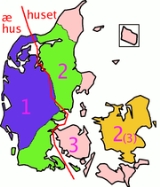
Generally, the eastern dialects are the closest to Standard Danish, while the southern dialect (Sønderjysk) is the one that differs mostly from the others, therefore it is sometimes described as a distinct dialect, thus Jutlandic is by that definition actually two different dialects: general Jutlandic (nørrejysk; further divided into western and eastern) and Southern Jutlandic (sønderjysk). However, the linguistic variation is considerably more complicated and well over 20 separate minor dialects can be easily found on Jutland. This map shows 9 larger dialectal regions which will be discussed in this article. What is also rather fascinating about the dialectology of Jutland is that variation occurs in all linguistic disciplines. There are major phonological differences between the dialects, but also very noteworthy morphological, syntactic, and semantic variations.
The different subdialects of Jutlandic differ somewhat from each other, and are generally grouped in three main dialects:
These are the abbreviations seen in the map linked above, which will be used throughout the rest of the article:
NJy: Northern Jysk, NVJy: North Western Jysk, NØJy: North Eastern Jysk, MVJy: Mid Western Jysk, MØJy: Mid Eastern Jysk, Sy(d)Jy: Southern Jysk, SønJy: South Jysk, Djurs: Djurs-dialect, Sslesv: South Schleswig
The major phonological process in jysk consonants is lenition. This is the weakening of originally voiceless consonants in either the coda of a syllable or word as well as intervocallically. The weakening causes voicing as well as the fall from a stop to a fricative and finally to a sonorant. The final step of lenition is then complete apocope. This phenomenon can be seen in all its stages in the jysk dialects, although it shows considerably more variability in the aveolars. The bilabials still have the approximant in one dialect, but no null phoneme and the velars have no sonorants, only a voiceless stop and fricative. The stages of the lenition as well as which dialects they occur in can be seen in the table below. Multiple possibilities for the same stage are shown separated by a semicolon. In Maps 4.0 and 4.2 the spread of the pronounciation of [d] and [g] are shown. The ÷ represents the null or zero morpheme in the maps, the -j and -r are [ɪ̯] and [ɐ̯] respectively and q is the devoiced velar stop [ɡ̊] while ch stands for the fricative [χ]. Vends and Læsø are regions usually belonging to the NJy dialectal region whereas Fjolds is the border region between Germany and Denmark, normally considered part of Sønderjysk.
eg. In Southern Jutlandic, Scandinavian post-vocalic p, k become [f, χ] word-finally, whereas Standard Danish has b, g, e.g. søge 'to seek' [ˈsøːχ] = Standard Danish [ˈsøː(ɪ̯)], tabe 'lose' [ˈtʰɑːf] = Standard Danish [ˈtˢæːbə, ˈtˢæːʊ]. In the northern part of Southern Jutland, these sounds are voiced fricatives between vowels, i.e. [v, ɣ]: e.g. søger 'seeks' [ˈsøːɣə] = Standard Danish [ˈsøːɐ], tabe 'loses' [ˈtʰɑːvə] = Standard Danish [ˈtˢæːˀbɐ, ˈtˢæʊ̯ˀɐ].
Jysk exhibits many diphthongs, which are not present in standard Danish. The long stressed mid vowels, /e:/, /ø:/, and /o:/ become /iə/, /yə/, and /uə/ respectively in central Jutland as well as SSlesv, e.g. ben [ˈbiˀən] = Standard Danish [ˈbeːˀn] 'leg', bonde 'farmer' [ˈbuəɲ] = Standard Danish [ˈbɔnə] (< bōndi). SønJy has the same vowel quality for these vowels, but exhibits a tonal distinction, which is present in place of the Danish stød. NJy raises them without diphthonging them to /i:/, /y:/, and /u:/ respectively. In a small area of Mid Western Jutland called Hards the vowels become diphthonged with a glide, much like in English and are pronounced as /ej/, /øj/, and /ow/. In Norther Jutland /i:/, /y:/, and /u:/ are also diphthonged in two syllable words with a glide. NJy always has the glide present (/ij/, /yj/, /uw/) and NVJy tends towards the glide, but it is not present for all speakers. Long a and å have been raised to [ɔː] and [oː] respectively in northern Jutlandic, e.g. sagde 'said' [ˈsɔː] = Standard Danish [ˈsæː(ə)], gå 'go, walk' [ˈɡoːˀ] = Standard Danish [ˈɡ̊ɔːˀ]. Map 2.2 shows the different possible pronounciations for the standard danish mid, stressed vowels which is further explained in the following table.
Outside of these diphthongs arising from changes in pronounciation from standard Danish long vowels, there are also the following diphthongs: [ow], [ɔw], [ej], [æj] [ɒw] [iw]/[yw], [ew]/[øw] and [æw]/[œw]. [ow] and [ɔw] are both present in Vends, NVJy and MVJy but only one occurs in Østjysk, SønJy and SydJy. There is a tendency towards [ɔw], but in MØJy [ow] can be found instead. The same sort of alternation is also seen with [ej] and [æj]. In MVJy, NJy and NVJy both diphthongs exist. In MØJy there is an alternation between the two, but each speaker only has one. In SydJy and SønJy only [æj] is found. [ɒw] is present as a diphthong in all of Jutland with the exception of the island of Fanø (off of South western Jutland), but has different pronounciations depending on length of the segments. The remaining diphthongs show a distribution based on rounding. In the majority of Jutland the unrounded diphthong is rounded. In South Eastern Jutland the rounded one is unrounded and only in certain parts of Sønderjylland are both diphthongs preserved. Map 2.7 shows the rounding alternation for the front, close dipthong [iw]/[yw].
An interesting phenomenon in West SønJy and MVJy, NVJy as well as NJy is the so called klusilspring. The klusilspring can be seen as a modified stød that only occurs on high vowels (/i:/, /y:/, and /u:/). These long vowels are shortened and then followed by a klusil, or plosive, or in some cases a spirant. (See Map 2.1) In Vends (NJy) and west Sønderjysk the three pronounciations become: [itj], [ytj], and [uk] and they have the same pronouciation but followed by a schwa if not in the coda. An area in NVJy designated on the map as Him-V has instead [ikj], [ykj] and [uk] and in MVJy it is similar with the /u:/ also containing a glide [ukw] and in all three cases a schwa is inserted if it is not in the coda of the syllable. The rest of NVJy along the coast has the schwa as well but a fricative instead of a stop, so the sounds are [iɕ], [yɕ], and [uɕ]. In the rest of the jysk dialects the vowel quality is overall the same, with gliding in NVJy (Han-V and Han-Ø) on the map and only unrounded front vowels in Djurs.
, Norwegian
and Sønderjysk, which can only occur once over the whole word. However, in contrast to the standard Danish stød, the jysk stød does not usually occur in monosyllabic words with a sonorant + voiceless consonant. Only Djurs and the city dialect of Aarhus have the stød in this environment. As mentionend before, most of north west Jutland does not have a stød after short high vowels, and instead has the klusilspring. The stød is still present on sonorants and mid and low vowels in the proper environment. Western jysk also has a stød on the vowel in originally two-syllable words with a geminate voiceless consonant such as {tt}, {kk}, or {pp} e.g. katte 'cats' [ˈkʰaˀt] = Standard Danish [ˈkʰæd̥ə]; ikke 'not' [ˈeˀ(t)] = Standard Danish [ˈeɡ̊ə].
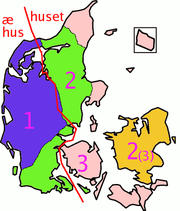 One of the hallmarks of the scandinavian languages is the postclitic definite marker. For example: en mand 'a man', mand-en 'the man'. In standard Danish this postclitic marker is only used when there is no adjective present, but if there is an adjective, a definite article is used instead: den store mand 'the big man'. Further, standard Danish has a two gender system, distinguishing between the neuter (intetkøn, -et) and "other" (fælleskøn, -en) genders. In Jutland, however, very few dialects match the standard in these two aspects. There are dialects with one, two and three genders, as well as dialects lacking the postclitic definite marker entirely.
There are also small areas in Jutland where predicate adjectives as well as adjectives in indefinite noun phrases have gender congruence in the neuter form. In SSlesv, easternmost Djurs and on the island of Samsø, adjectives take a -t ending which patterns with standard Danish: for example, et grønt glas and glaset er grønt. [æt gʁœːnt glas; glas.ət æ gʁœːnt] 'a green glass; the glass is green' In Vends (NJy) there is no congruence on adjectives in indefinite noun phrases, but the -t is still present in predicate adjectives. The variability in the examples also reflects differences between number of genders, postclitic versus enclitic article and apocope. [æ gʁœn' glas; glast æ gʁœnt] (same gloss) In the rest of Jutland, as a result of apocope, the -t disappears completely. [ æt (æn) gʁœn' glas; glas.ə(t) (æ glas) æ gʁœn'] (same gloss)
There is also a tendency to use hans or hendes instead of the "correct" sin when referring to the subject of the sentence. This means there is no longer a distinction between whether the possessive pronoun refers to the subject of the sentence or a third person, however, use of a word like egen/t 'own' can paraphrastically accomplish the same thing.
" are identical to the Copenhagen variety in most aspects and differs from it primarily with a distinct accent. Typical features are:
Dialect
The term dialect is used in two distinct ways, even by linguists. One usage refers to a variety of a language that is a characteristic of a particular group of the language's speakers. The term is applied most often to regional speech patterns, but a dialect may also be defined by other factors,...
s of Danish
Danish language
Danish is a North Germanic language spoken by around six million people, principally in the country of Denmark. It is also spoken by 50,000 Germans of Danish ethnicity in the northern parts of Schleswig-Holstein, Germany, where it holds the status of minority language...
, spoken on the peninsula
Peninsula
A peninsula is a piece of land that is bordered by water on three sides but connected to mainland. In many Germanic and Celtic languages and also in Baltic, Slavic and Hungarian, peninsulas are called "half-islands"....
of Jutland
Jutland
Jutland , historically also called Cimbria, is the name of the peninsula that juts out in Northern Europe toward the rest of Scandinavia, forming the mainland part of Denmark. It has the North Sea to its west, Kattegat and Skagerrak to its north, the Baltic Sea to its east, and the Danish–German...
.
Generally, the eastern dialects are the closest to Standard Danish, while the southern dialect (Sønderjysk) is the one that differs mostly from the others, therefore it is sometimes described as a distinct dialect, thus Jutlandic is by that definition actually two different dialects: general Jutlandic (nørrejysk; further divided into western and eastern) and Southern Jutlandic (sønderjysk). However, the linguistic variation is considerably more complicated and well over 20 separate minor dialects can be easily found on Jutland. This map shows 9 larger dialectal regions which will be discussed in this article. What is also rather fascinating about the dialectology of Jutland is that variation occurs in all linguistic disciplines. There are major phonological differences between the dialects, but also very noteworthy morphological, syntactic, and semantic variations.
The different subdialects of Jutlandic differ somewhat from each other, and are generally grouped in three main dialects:
- southern (sønderjysk)
- Sønderjysk is often seen as very difficult for other speakers of Danish, even other Jysk dialects to understand. Instead of the normal Danish stød, it has tonal accents like SwedishSwedish languageSwedish is a North Germanic language, spoken by approximately 10 million people, predominantly in Sweden and parts of Finland, especially along its coast and on the Åland islands. It is largely mutually intelligible with Norwegian and Danish...
. Many of the phonemes are also different, including velar fricatives much like in GermanGerman languageGerman is a West Germanic language, related to and classified alongside English and Dutch. With an estimated 90 – 98 million native speakers, German is one of the world's major languages and is the most widely-spoken first language in the European Union....
. It also has the definite article before the noun, as opposed to the standard Danish postclitic article.
- Sønderjysk is often seen as very difficult for other speakers of Danish, even other Jysk dialects to understand. Instead of the normal Danish stød, it has tonal accents like Swedish
- eastern (østjysk)
- Østjysk is the closest to the standard of the three jysk dialects, but still differs widely in the pronounciation of vowels and the voiced stops word initially or intervocallically. Some dialects of Østjysk also still have three genders, like the majority of SwedishSwedish languageSwedish is a North Germanic language, spoken by approximately 10 million people, predominantly in Sweden and parts of Finland, especially along its coast and on the Åland islands. It is largely mutually intelligible with Norwegian and Danish...
and NorwegianNorwegian languageNorwegian is a North Germanic language spoken primarily in Norway, where it is the official language. Together with Swedish and Danish, Norwegian forms a continuum of more or less mutually intelligible local and regional variants .These Scandinavian languages together with the Faroese language...
dialects.
- Østjysk is the closest to the standard of the three jysk dialects, but still differs widely in the pronounciation of vowels and the voiced stops word initially or intervocallically. Some dialects of Østjysk also still have three genders, like the majority of Swedish
- western (vestjysk)
- Vestjysk is also well known for this enclictic article as well as a complete lack of gender distinction. It also can exhibit the stød in slightly different environments from the standard.
These are the abbreviations seen in the map linked above, which will be used throughout the rest of the article:
NJy: Northern Jysk, NVJy: North Western Jysk, NØJy: North Eastern Jysk, MVJy: Mid Western Jysk, MØJy: Mid Eastern Jysk, Sy(d)Jy: Southern Jysk, SønJy: South Jysk, Djurs: Djurs-dialect, Sslesv: South Schleswig
Consonants
Standard Danish phonology contains nasal, aspirated voiceless and devoiced plosives (labial, alveolar, and velar). Four voiceless fricatives, [f], [s], [ɕ] and [h] are present, as well as approximated voiced fricatives: [ʊ̯], [ð̞], [ɪ̯], and [ɐ̯]. There are also three regular and a lateral approximate, [ʋ], [l], [j] and [ʁ]. Below is a table depicting the consonant inventory of Danish. Phonemes that appear in standard Danish are in black and phonemes which are only seen in the dialects of Jutland (jysk) are in bold. This table only includes phonemes, not all present allophones.| Bilabial | Labio-Dental | Dental | Alveolar | Alveo-Palatal | Palatal | Velar | Uvular | Glottal | |
| Nasal | m | - | - | n | - | ɲ | ŋ | - | - |
| Plosive | pʰ, b̥ | - | - | tˢ, d̥ | - | - | kʰ, ɡ̊ | - | - |
| Fricative | ß | f, v | - | s | ɕ | - | χ, ɣ | - | h |
| Approximate | - | ʋ; ʊ̯ | ð̞ | - | - | ç j; ɪ̯ | - | ʁ; ɐ̯ | - |
| Lat. Appr. | - | - | - | l | - | ʎ | - | - | - |
| Velar Coarticulation | ʍ, w | - | - | ɫ | - | - | - | - |
The major phonological process in jysk consonants is lenition. This is the weakening of originally voiceless consonants in either the coda of a syllable or word as well as intervocallically. The weakening causes voicing as well as the fall from a stop to a fricative and finally to a sonorant. The final step of lenition is then complete apocope. This phenomenon can be seen in all its stages in the jysk dialects, although it shows considerably more variability in the aveolars. The bilabials still have the approximant in one dialect, but no null phoneme and the velars have no sonorants, only a voiceless stop and fricative. The stages of the lenition as well as which dialects they occur in can be seen in the table below. Multiple possibilities for the same stage are shown separated by a semicolon. In Maps 4.0 and 4.2 the spread of the pronounciation of [d] and [g] are shown. The ÷ represents the null or zero morpheme in the maps, the -j and -r are [ɪ̯] and [ɐ̯] respectively and q is the devoiced velar stop [ɡ̊] while ch stands for the fricative [χ]. Vends and Læsø are regions usually belonging to the NJy dialectal region whereas Fjolds is the border region between Germany and Denmark, normally considered part of Sønderjysk.
| Standard Lenition | -v Stop [t] | +v Stop [d] | + or – v fricative [s, z, ð, θ] | Flapping [ɾ] | Approximant [ð̞, j, r] | zero |
| Old Danish | Standard Danish | NVJy, NJy, SydJy | MØJy; MVJy, SønJy1 | Vends, East SønJy | ||
| Jysk Alveolars | {t}, [t] | {d}, [d̥] | [ð̞] | - | [ɪ̯; ɐ̯] | null |
| Old Danish | Standard Danish, MØJy, Fjolde | NordJy, MØJy; Midt- and SydJy, North SønJy; SønJy | Læsø | |||
| Jysk Bilabials | {p}, [p] | {b}, [b̥] | [ß; v; f] | - | [w] | - |
| Old Danish | Standard Danish, Northern Jysk, North SønJy | SønJy | ||||
| Jysk Velars | {k}, [k] | {g}, [ɡ̊] | [χ] | - | - | - |
eg. In Southern Jutlandic, Scandinavian post-vocalic p, k become [f, χ] word-finally, whereas Standard Danish has b, g, e.g. søge 'to seek' [ˈsøːχ] = Standard Danish [ˈsøː(ɪ̯)], tabe 'lose' [ˈtʰɑːf] = Standard Danish [ˈtˢæːbə, ˈtˢæːʊ]. In the northern part of Southern Jutland, these sounds are voiced fricatives between vowels, i.e. [v, ɣ]: e.g. søger 'seeks' [ˈsøːɣə] = Standard Danish [ˈsøːɐ], tabe 'loses' [ˈtʰɑːvə] = Standard Danish [ˈtˢæːˀbɐ, ˈtˢæʊ̯ˀɐ].
Vowels
Standard Danish has a large vowel inventory and contrasts length on many vowels. Vowels can also be glottalized where the so called stød is present and many change their quality depending on whether or not it is preceded or followed by an /r/.| Front Unrounded | Front Rounded | Mid Unrounded | Mid Rounded | Back Unrounded | Back Rounded | |
| Close | i, i: | y, y: | - | - | - | u, u: |
| Near Close | ɪ | - | - | ʊ | - | - |
| Close Mid | e, eː | ø, ø: | - | - | - | o, o: |
| Open Mid | ɛ, ɛ: | œ, œː | ə | - | - | ɔ, ɔː |
| Near Open | æ, æ: | - | ɐ | ʌ | - | - |
| Open | a | ɶ, ɶː | - | - | ɑ, ɑː | ɒ, ɒː |
Jysk exhibits many diphthongs, which are not present in standard Danish. The long stressed mid vowels, /e:/, /ø:/, and /o:/ become /iə/, /yə/, and /uə/ respectively in central Jutland as well as SSlesv, e.g. ben [ˈbiˀən] = Standard Danish [ˈbeːˀn] 'leg', bonde 'farmer' [ˈbuəɲ] = Standard Danish [ˈbɔnə] (< bōndi). SønJy has the same vowel quality for these vowels, but exhibits a tonal distinction, which is present in place of the Danish stød. NJy raises them without diphthonging them to /i:/, /y:/, and /u:/ respectively. In a small area of Mid Western Jutland called Hards the vowels become diphthonged with a glide, much like in English and are pronounced as /ej/, /øj/, and /ow/. In Norther Jutland /i:/, /y:/, and /u:/ are also diphthonged in two syllable words with a glide. NJy always has the glide present (/ij/, /yj/, /uw/) and NVJy tends towards the glide, but it is not present for all speakers. Long a and å have been raised to [ɔː] and [oː] respectively in northern Jutlandic, e.g. sagde 'said' [ˈsɔː] = Standard Danish [ˈsæː(ə)], gå 'go, walk' [ˈɡoːˀ] = Standard Danish [ˈɡ̊ɔːˀ]. Map 2.2 shows the different possible pronounciations for the standard danish mid, stressed vowels which is further explained in the following table.
| Std. Danish | NJy | NVJy | MVJy | MØJy | SydJy | SønJy | SSlesv |
| /i:/ (2 Sylb) | [ij] | [i(j)] | [i:] | [i:] | [i:] | [i:] | [i:] |
| /y:/ (2 Sylb) | [yj] | [y(j)] | [y:] | [y:] | [y:] | [y:] | [y:] |
| /u:/ (2 Sylb) | [uw] | [u(w)] | [u:] | [u:] | [u:] | [u:] | [u:] |
| /e:/ | [i:] | [iə] | [ej] | [iə] | [iə] | [e:] | [iə] |
| /ø:/ | [y:] | [yə] | [øj] | [yə] | [yə] | [ø:] | [yə] |
| /o:/ | [u:] | [uə] | [ow] | [uə] | [uə] | [o:] | [uə] |
| /æː/ | [e:] | [œː] | [œː] | [œː] | [œː] | [œː] | [eœ] |
| /ɔː/ | [o:] | [o:] | [o:] | [o:] | [o:] | [ɔː] | [oɒ] |
| /ɑː/ | [o:] | [ɔː] | [ɔː] | [ɔː] | [ɔː] | [ɒː] | [ɒː] |
Outside of these diphthongs arising from changes in pronounciation from standard Danish long vowels, there are also the following diphthongs: [ow], [ɔw], [ej], [æj] [ɒw] [iw]/[yw], [ew]/[øw] and [æw]/[œw]. [ow] and [ɔw] are both present in Vends, NVJy and MVJy but only one occurs in Østjysk, SønJy and SydJy. There is a tendency towards [ɔw], but in MØJy [ow] can be found instead. The same sort of alternation is also seen with [ej] and [æj]. In MVJy, NJy and NVJy both diphthongs exist. In MØJy there is an alternation between the two, but each speaker only has one. In SydJy and SønJy only [æj] is found. [ɒw] is present as a diphthong in all of Jutland with the exception of the island of Fanø (off of South western Jutland), but has different pronounciations depending on length of the segments. The remaining diphthongs show a distribution based on rounding. In the majority of Jutland the unrounded diphthong is rounded. In South Eastern Jutland the rounded one is unrounded and only in certain parts of Sønderjylland are both diphthongs preserved. Map 2.7 shows the rounding alternation for the front, close dipthong [iw]/[yw].
An interesting phenomenon in West SønJy and MVJy, NVJy as well as NJy is the so called klusilspring. The klusilspring can be seen as a modified stød that only occurs on high vowels (/i:/, /y:/, and /u:/). These long vowels are shortened and then followed by a klusil, or plosive, or in some cases a spirant. (See Map 2.1) In Vends (NJy) and west Sønderjysk the three pronounciations become: [itj], [ytj], and [uk] and they have the same pronouciation but followed by a schwa if not in the coda. An area in NVJy designated on the map as Him-V has instead [ikj], [ykj] and [uk] and in MVJy it is similar with the /u:/ also containing a glide [ukw] and in all three cases a schwa is inserted if it is not in the coda of the syllable. The rest of NVJy along the coast has the schwa as well but a fricative instead of a stop, so the sounds are [iɕ], [yɕ], and [uɕ]. In the rest of the jysk dialects the vowel quality is overall the same, with gliding in NVJy (Han-V and Han-Ø) on the map and only unrounded front vowels in Djurs.
Stød
As mentioned earlier, the klusilspring is an alternate of the stød that occurs only with high vowels. In the other mainland scandinavian languages as well as SønJy there are two different tonemes which distinguish between words that were originally one or two syllables. Tone 1 is a simple rising then falling tone in most dialects and tone 2 is more complex, e.g. hus 'house' [ˈhúːs] = Standard Danish [ˈhuːˀs] ~ huse 'houses' [ˈhùːs] = Standard Danish [ˈhuːsə].. In standard Danish as well as jysk tone 1 is replaced with a nonsegmental glottalization and tone 2 disappears entirely. Glottalization can only occur on vowels or sonorants and only in one or two syllable words and is realized in transcription as a [']. However, in two syllable words the second syllable must be a derivational morpheme as the historical environement of Tone 1 was one syllable words and tone 2 only occurred on two syllable words. Due to apocope and the morphology, both tones and the stød can now be found on one and two syllable words. There can be multiple stød segments per word, if the word is a compound, which separates its phonetically from the tonemes of SwedishSwedish language
Swedish is a North Germanic language, spoken by approximately 10 million people, predominantly in Sweden and parts of Finland, especially along its coast and on the Åland islands. It is largely mutually intelligible with Norwegian and Danish...
, Norwegian
Norwegian language
Norwegian is a North Germanic language spoken primarily in Norway, where it is the official language. Together with Swedish and Danish, Norwegian forms a continuum of more or less mutually intelligible local and regional variants .These Scandinavian languages together with the Faroese language...
and Sønderjysk, which can only occur once over the whole word. However, in contrast to the standard Danish stød, the jysk stød does not usually occur in monosyllabic words with a sonorant + voiceless consonant. Only Djurs and the city dialect of Aarhus have the stød in this environment. As mentionend before, most of north west Jutland does not have a stød after short high vowels, and instead has the klusilspring. The stød is still present on sonorants and mid and low vowels in the proper environment. Western jysk also has a stød on the vowel in originally two-syllable words with a geminate voiceless consonant such as {tt}, {kk}, or {pp} e.g. katte 'cats' [ˈkʰaˀt] = Standard Danish [ˈkʰæd̥ə]; ikke 'not' [ˈeˀ(t)] = Standard Danish [ˈeɡ̊ə].
Other Phonological Characteristics
- Jysk also exhibits a strong tendency towards apocope, i.e. skipping the e [ə] often found in unstressed syllables, which is itself a weakening of an original North Germanic -i, -a or -u, which causes many words to be distinguished based purely on vowel length or the presence of the stød. Most unstressed syllables are dropped and in some cases final segments, often {r} e.g. kaste 'throw' [ˈkʰasd̥] = Standard Danish [ˈkʰæsd̥ə] (Swedish [ˈkʰasta]).
- Jysk is further known for lacking the diphthong in the first person nominative pronoun: jeg. It is pronounced in the majority of Jutland as [ɑ] but in SønJy and NVJy as [æ]. The difference goes back to different forms in Proto-Norse, namely ek and eka, both found in early Runic inscriptions. The latter form has a regular breaking of e to ja before an a in the following syllable. The short form, without breaking, is also found in NorwegianNorwegian languageNorwegian is a North Germanic language spoken primarily in Norway, where it is the official language. Together with Swedish and Danish, Norwegian forms a continuum of more or less mutually intelligible local and regional variants .These Scandinavian languages together with the Faroese language...
, FaroeseFaroese languageFaroese , is an Insular Nordic language spoken by 48,000 people in the Faroe Islands and about 25,000 Faroese people in Denmark and elsewhere...
and IcelandicIcelandic languageIcelandic is a North Germanic language, the main language of Iceland. Its closest relative is Faroese.Icelandic is an Indo-European language belonging to the North Germanic or Nordic branch of the Germanic languages. Historically, it was the westernmost of the Indo-European languages prior to the...
. - In Northern Jutlandic v is a labiovelar approximantVoiced labial-velar approximantThe voiced labiovelar approximant is a type of consonantal sound, used in certain spoken languages, including English. It is the sound denoted by the letter "w" in the English alphabet; likewise, the symbol in the International Phonetic Alphabet that represents this sound is , and the equivalent...
before back vowelBack vowelA back vowel is a type of vowel sound used in spoken languages. The defining characteristic of a back vowel is that the tongue is positioned as far back as possible in the mouth without creating a constriction that would be classified as a consonant. Back vowels are sometimes also called dark...
s (in the northernmost dialects also before front vowelFront vowelA front vowel is a type of vowel sound used in some spoken languages. The defining characteristic of a front vowel is that the tongue is positioned as far in front as possible in the mouth without creating a constriction that would be classified as a consonant. Front vowels are sometimes also...
s), whereas it is a Labiodental approximantLabiodental approximantThe labiodental approximant is a type of consonantal sound, similar to an English double-u pronounced with the teeth and lips held in the position used to articulate the letter vee, used in some spoken languages...
in Standard Danish, e.g. vaske 'wash' [ˈwasɡ] = Standard Danish [ˈʋæsɡ̊ə]. The same dialects have voiceless variants of v and j in the initial combinations hj and hv, e.g. hvem 'who' [ˈʍɛmˀ] = Standard Danish [ˈʋɛmˀ], hjerte 'heart' [ˈçaɐ̯d̥, ˈçɑːd̥] = Standard Danish [ˈjaɐ̯d̥ə]. - In most parts of Jutland, nd becomes [ɲ] (in the northernmost dialects [ɲ] with or without nasalisation), e.g. finde 'find' [ˈfeɲ] = Standard Danish [ˈfenə].
Grammar
Gender
Originally the Scandinavian languages, like modern German as well as Icelandic, had three genders. These three genders, masculine, feminine, and neuter are still present in many dialects, noteably most dialects of Norwegian. However, in all standard versions of the mainland Scandinavian languages, there are only two genders (Norwegian has three genders, but in Bokmål – one of two written standards – feminine nouns may be inflected like the masculine nouns, making it possible to use only two genders). The masculine and feminine fell together, taking the feminine article and the neuter stayed separate. Three genders remain in northern Jutland and far in the east, which could potentially be explained through dialect contact with both Norwegian and Swedish dialects which preserve all three genders. The loss of all gender distinction in the west, though, is unique to jysk.| 3 Genders | 2 Genders | 1 Gender | |
| Region | Vends, Djurs | East Jutland, SønJy | West Jutland |
| masculine 'a man' | i(n) mand | ||
| feminine 'a woman' | æn kone | ||
| fælleskøn | æn kone, æn mand | æn kone, æn mand, æn hus | |
| neuter 'a house' | æt hus | æt hus |
Article
The definite marker is also not consistent in the jysk dialects. In the west, where only one gender is present, as well as all of SydJy and SønJy the definite marker is a free morpheme that comes before the noun. It is not, however, the same as the free morpheme found in standard Danish when an adjective precedes a noun. It is phonetically realised as [æ].| West and South Jutland | East and North Jutland, Standard | |
| masculine 'the man' | æ mand | manden |
| neuter 'the house' | æ hus | huset |
| feminine 'the woman' | æ kone | konen |
| plural 'the men' | æ mænd | mændene |
There are also small areas in Jutland where predicate adjectives as well as adjectives in indefinite noun phrases have gender congruence in the neuter form. In SSlesv, easternmost Djurs and on the island of Samsø, adjectives take a -t ending which patterns with standard Danish: for example, et grønt glas and glaset er grønt. [æt gʁœːnt glas; glas.ət æ gʁœːnt] 'a green glass; the glass is green' In Vends (NJy) there is no congruence on adjectives in indefinite noun phrases, but the -t is still present in predicate adjectives. The variability in the examples also reflects differences between number of genders, postclitic versus enclitic article and apocope. [æ gʁœn' glas; glast æ gʁœnt] (same gloss) In the rest of Jutland, as a result of apocope, the -t disappears completely. [ æt (æn) gʁœn' glas; glas.ə(t) (æ glas) æ gʁœn'] (same gloss)
Semantics
The presence of a separate free morpheme definite marker in the western Jysk dialects [æ] has come to cause a contrastive semantic meaning difference with the standard Danish dem. Nouns that can be analyzed as mass nouns, as opposed to count nouns can take the [æ] article before an adjective. If the noun is, however, meant to be a count noun it uses the standard Danish plural article dem. An example of this would be dem små kartofler versus æ små kartofler 'the small potatos'. dem små kartofler refers to the small potatos in a set, ie. those 5 small potatos on the table. æ små kartofler refers instead to a mass noun, meaning potatos that are generally small. It is like saying "the yellow potatos" in English. It can either mean yellow potatos as a whole, a mass noun or the yellow potatos sitting on the table, as opposed to the red ones.There is also a tendency to use hans or hendes instead of the "correct" sin when referring to the subject of the sentence. This means there is no longer a distinction between whether the possessive pronoun refers to the subject of the sentence or a third person, however, use of a word like egen/t 'own' can paraphrastically accomplish the same thing.
| Standard Danish | Han ser sin hund 'He sees his (own) dog' | Han ser hans hund 'He sees his (another person's) dog' | Hans hund ser ham 'His dog sees him' (ambiguous) |
| Jysk | Han ser hans hund 'He sees his dog' (ambiguous) | Han ser hans hund 'He sees his dog' (ambiguous) | Hans hund ser ham 'His dog sees him' (ambiguous) |
Sociolinguistic
Today the old dialects, tied as they were to the rural districts, are yielding to new regional standards based on Standard Danish. Several factors have contributed to this process: The dialects — especially in the northernmost, western and southern regions — are often hard to understand for people originating outside Jutland. The dialects enjoy little prestige both nationally (the population of Zealand like to believe that the Jutlanders are slower not only in speech, but also in thought) and regionally (the dialect is associated with rural life). The Danish cultural, media and business life is centered around Copenhagen, and Jutland has only in recent decennia seen substantial economic growth. Through the 20th century dialects were usually suppressed by media, state institutions and schools. In recent decennia a more liberal attitude towards dialects has emerged, but since the number of speakers has decreased, and almost all of the remaining dialect speakers master a regional form of Standard Danish as well, dialects are now rather being ignored.Descriptions
The new Jutlandic "regiolectsDialectology
Dialectology is the scientific study of linguistic dialect, a sub-field of sociolinguistics. It studies variations in language based primarily on geographic distribution and their associated features...
" are identical to the Copenhagen variety in most aspects and differs from it primarily with a distinct accent. Typical features are:
- a higher tendency of apocope of unstressed [ə] (cf. above).
- a higher pitch towards the end of a stressed syllable.
- a slightly different distribution of stød, e.g. vej 'way' [ˈʋaɪ̯] = Standard Danish [ˈʋaɪ̯ˀ]; hammer 'hammer' [ˈhɑmˀɐ] = Standard Danish [ˈhɑmɐ].
- the ending -et (definite articleArticle (grammar)An article is a word that combines with a noun to indicate the type of reference being made by the noun. Articles specify the grammatical definiteness of the noun, in some languages extending to volume or numerical scope. The articles in the English language are the and a/an, and some...
or passive participleParticipleIn linguistics, a participle is a word that shares some characteristics of both verbs and adjectives. It can be used in compound verb tenses or voices , or as a modifier...
) is pronounced [-(ə)d̥] instead of [-ð̩], e.g. hented 'fetched' [ˈhɛnd̥əd̥] = Standard Danish [ˈhɛnd̥ð̩]; meget 'very, much' [ˈmaːɪ̯d̥] = Standard Danish [ˈmaːð̩, ˈmɑːð̩] - postvocalic d is pronounced [ɪ̯] or, before i, [d̥] in certain varieties of the regiolect, e.g. bade 'bath' [ˈb̥æːɪ̯] = Standard Danish ˈb̥æːð̩], stadig 'still' [ˈsd̥æːd̥i] = Standard Danish [ˈsd̥æːði]. This pronunciation is not favoured by the younger speakers.
- or is pronounced [ɒː] in words where Standard Danish has [oɐ̯] (in closed syllables), e.g. torn 'thorn' [ˈtˢɒːˀn] = Standard Danish [ˈtˢoɐ̯ˀn]. On the other hand, one also hears hypercorrectHypercorrectionIn linguistics or usage, hypercorrection is a non-standard usage that results from the over-application of a perceived rule of grammar or a usage prescription...
pronunciations like tårn 'tower' [ˈtˢoɐ̯ˀn] = Standard Danish [ˈtˢɒːˀn]. - the strong verbsGermanic strong verbIn the Germanic languages, a strong verb is one which marks its past tense by means of ablaut. In English, these are verbs like sing, sang, sung...
have -en in the past participleParticipleIn linguistics, a participle is a word that shares some characteristics of both verbs and adjectives. It can be used in compound verb tenses or voices , or as a modifier...
, not only in adjectivalAdjectiveIn grammar, an adjective is a 'describing' word; the main syntactic role of which is to qualify a noun or noun phrase, giving more information about the object signified....
use (as in Standard Danish), but also in the compound perfect, e.g. han har funden = SD han har fundet den. These forms belong to the low register of the Jutlandic regiolects. - a frequent use of hans, hendes 'his, her' instead of the reflexive pronounReflexive pronounA reflexive pronoun is a pronoun that is preceded by the noun, adjective, adverb or pronoun to which it refers within the same clause. In generative grammar, a reflexive pronoun is an anaphor that must be bound by its antecedent...
sin when referring to the subject of the sentence, e.g. han kyssede hans kone 'he kissed his wife' = Standard Danish han kyssede sin kone (the other sentence would mean that he kissed somebody else's wife). - a lack of distinction between transitiveTransitive verbIn syntax, a transitive verb is a verb that requires both a direct subject and one or more objects. The term is used to contrast intransitive verbs, which do not have objects.-Examples:Some examples of sentences with transitive verbs:...
and intransitiveIntransitive verbIn grammar, an intransitive verb is a verb that has no object. This differs from a transitive verb, which takes one or more objects. Both classes of verb are related to the concept of the transitivity of a verb....
forms of certain related verbs like ligge ~ lægge 'lie, lay', e.g. han lagde i sengen 'he lay in the bed' = Standard Danish han lå i sengen (eastern speakers don't distinguish the present and the infinitive of these verbs either). - remnants of a regional vocabulary; in Eastern Jutland these words include træls [ˈtˢʁɑls] 'annoying' (~ SD irriterende [i(ɐ̯)ˈtˢeɐ̯ˀnə]), og [ˈʌ] 'too' (~ SD også [ˈʌsə]), ikke og [eˈɡ̊ʌ] or, in higher style, ikke også [eˈɡ̊ʌsə] 'isn't it' (~ SD ikke, ikke sandt [ˈeɡ̊(ə), eɡ̊ˈsænˀd̥]).
See also
- Danish dialects
- South Jutlandic
- Steen Steensen BlicherSteen Steensen BlicherSteen Steensen Blicher was an author and poet born in Vium near Viborg, Denmark.- Biography :Blicher was the son of a literarily inclined Jutlandic parson whose family was distantly related to Martin Luther....
(wrote in Jutlandic)