


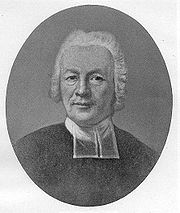
Johann August Ernesti

Encyclopedia
Germany
Germany , officially the Federal Republic of Germany , is a federal parliamentary republic in Europe. The country consists of 16 states while the capital and largest city is Berlin. Germany covers an area of 357,021 km2 and has a largely temperate seasonal climate...
Rationalist theologian
Theology
Theology is the systematic and rational study of religion and its influences and of the nature of religious truths, or the learned profession acquired by completing specialized training in religious studies, usually at a university or school of divinity or seminary.-Definition:Augustine of Hippo...
and philologist
Philology
Philology is the study of language in written historical sources; it is a combination of literary studies, history and linguistics.Classical philology is the philology of Greek and Classical Latin...
.
He was born at Bad Tennstedt
Bad Tennstedt
Bad Tennstedt is a town in the Unstrut-Hainich district, in Thuringia, Germany. It is situated 27 km east of Mühlhausen, and 24 km northwest of Erfurt....
in Thuringia
Thuringia
The Free State of Thuringia is a state of Germany, located in the central part of the country.It has an area of and 2.29 million inhabitants, making it the sixth smallest by area and the fifth smallest by population of Germany's sixteen states....
, where his father, Johann Christoph Ernesti, was pastor, besides being superintendent of the electoral dioceses of Thuringia, Salz and Sangerhausen. At the age of sixteen he was sent to the celebrated Saxon cloister school of Pforta
Pforta
Pforta, or Schulpforta, is a former Cistercian monastery, Pforta Abbey , near Naumburg on the Saale River in the German state of Saxony-Anhalt. It is now a celebrated German public boarding school, called Landesschule Pforta...
(Schulpforta). At twenty he entered the University of Wittenberg, and studied afterwards at the University of Leipzig
University of Leipzig
The University of Leipzig , located in Leipzig in the Free State of Saxony, Germany, is one of the oldest universities in the world and the second-oldest university in Germany...
. In 1730 he was made master in the faculty of philosophy. In the following year he accepted the office of conrector in the Thomas school of Leipzig, of which Johann Matthias Gesner
Johann Matthias Gesner
Johann Matthias Gesner was a German classical scholar and schoolmaster.He was born at Roth an der Rednitz near Ansbach. His father, Johann Samuel Gesner, a pastor in Auhausen, died in 1704, leaving the family in straitened circumstances...
was then rector, an office to which Ernesti succeeded in 1734. He was, in 1742, named professor extraordinarius of ancient literature in the university of Leipzig, and in 1756 professor ordinarius of rhetoric
Rhetoric
Rhetoric is the art of discourse, an art that aims to improve the facility of speakers or writers who attempt to inform, persuade, or motivate particular audiences in specific situations. As a subject of formal study and a productive civic practice, rhetoric has played a central role in the Western...
. In the same year he received the degree of doctor of theology
Theology
Theology is the systematic and rational study of religion and its influences and of the nature of religious truths, or the learned profession acquired by completing specialized training in religious studies, usually at a university or school of divinity or seminary.-Definition:Augustine of Hippo...
, and in 1759 was appointed professor ordinarius in the faculty of theology. Through his learning and his manner of discussion, he co-operated with S. J. Baumgarten
Siegmund Jakob Baumgarten
Siegmund Jakob Baumgarten was a German Protestant theologian. He was a brother to philosopher Alexander Gottlieb Baumgarten....
of Halle (1706–1757) in disengaging the current dogmatic theology from Lutheran Orthodoxy
Lutheran Orthodoxy
Lutheran orthodoxy was an era in the history of Lutheranism, which began in 1580 from the writing of the Book of Concord and ended at the Age of Enlightenment. Lutheran orthodoxy was paralleled by similar eras in Calvinism and tridentine Roman Catholicism after the...
, along with any Lutheran scholastic
Lutheran scholasticism
Lutheran scholasticism was a theological method that gradually developed during the era of Lutheran Orthodoxy. Theologians used the neo-Aristotelian form of presentation, already popular in academia, in their writings and lectures...
or mystical influences, and thus paved a way for a Rationalist revolution in theology. He died in Leipzig
Leipzig
Leipzig Leipzig has always been a trade city, situated during the time of the Holy Roman Empire at the intersection of the Via Regia and Via Imperii, two important trade routes. At one time, Leipzig was one of the major European centres of learning and culture in fields such as music and publishing...
, after a short illness, in his seventy-sixth year.
Apart from the quality of his own writing, Ernesti is notable for his influence on sacred and profane
Sacred and Profane
Sacred and Profane is a 1987 novel by Faye Kellerman. It is second in the Peter Decker/Rina Lazarus series.A Fawcett Crest Book published by Ballantine Books.Timeline: About six months after The Ritual Bath, starts Christmas Eve, Decker is 39....
criticism in Germany. With JS Semler
Johann Salomo Semler
Johann Salomo Semler was a German church historian and biblical commentator.-Youth and education:He was born at Saalfeld in Electoral Saxony, the son of a poor clergyman. He grew up in pietistic surroundings, which powerfully influenced him his life through, though he never became a Pietist...
he co-operated in the Rationalist revolution of Lutheran theology, and in conjunction with Gesner he instituted a new school in ancient literature. He detected grammatical niceties in Latin
Latin
Latin is an Italic language originally spoken in Latium and Ancient Rome. It, along with most European languages, is a descendant of the ancient Proto-Indo-European language. Although it is considered a dead language, a number of scholars and members of the Christian clergy speak it fluently, and...
, in regard to the consecution of tenses which had escaped preceding critics.
As an editor of the Greek classics, Ernesti does not compare with his Dutch contemporaries, Tiberius Hemsterhuis
Tiberius Hemsterhuis
Tiberius Hemsterhuis was a Dutch philologist and critic.-Life:He was born in Groningen. His father, a learned physician, gave him a good early education and he entered the university of his native city in his fifteenth year, where he proved himself the best student of mathematics...
, L. C. Valckenaer, David Ruhnken
David Ruhnken
David Ruhnken was a Dutch classical scholar of German origin.-Origins:Ruhnken was born in Bedlin near Stolp, Pomerania Province,...
or his colleague JJ Reiske
Johann Jakob Reiske
Johann Jakob Reiske was a German scholar and physician. He was a pioneer in the fields of Arabic and Byzantine philology as well as Islamic numismatics.-Biography:Reiske was born at Zörbig, in Electoral Saxony....
. The higher criticism was not even attempted by Ernesti. But to him and to Gesner is due the credit of having formed, by discipline and by example, philologists greater than themselves, and of having kindled the national enthusiasm for ancient learning.
It is chiefly in hermeneutics that Ernesti has any claim to eminence as a theologian. But here his merits are distinguished, and, at the period when his Institutio Interpretis Novi Testamenti (Principles of New Testament Interpretation) was published (1761), almost peculiar to himself. In it we find the principles of a general interpretation, formed without the assistance of any particular philosophy, but consisting of observations and rules which, though already enunciated, and applied in the criticism of the profane writers, had never rigorously been employed in biblical exegesis. He was, in fact, the founder of the grammatico-historical school. He admits in the sacred writings as in the classics only one acceptation, and that the grammatical, convertible into and the same with the logical and historical. Consequently he censures the opinion of those who in the illustration of the Scriptures refer everything to the illumination of the Holy Spirit, as well as that of others who, disregarding all knowledge of the languages, would explain words by things. The "analogy of faith," as a rule of interpretation, he greatly limits, and teaches that it can never afford of itself the explanation,of words, but only determine the choice among their possible meanings. At the same time he seems unconscious of any inconsistency between the doctrine of the inspiration of the Bible as usually received and his principles of hermeneutics.
Works on classical literature:
- Initia doctrinae Solidioris (1736), many subsequent editions
- Initia rhetorica (1750)
- editions, mostly annotated, of XenophonXenophonXenophon , son of Gryllus, of the deme Erchia of Athens, also known as Xenophon of Athens, was a Greek historian, soldier, mercenary, philosopher and a contemporary and admirer of Socrates...
's Memorabilia (1737) - CiceroCiceroMarcus Tullius Cicero , was a Roman philosopher, statesman, lawyer, political theorist, and Roman constitutionalist. He came from a wealthy municipal family of the equestrian order, and is widely considered one of Rome's greatest orators and prose stylists.He introduced the Romans to the chief...
(1737–1739) - SuetoniusLives of the Twelve CaesarsDe vita Caesarum commonly known as The Twelve Caesars, is a set of twelve biographies of Julius Caesar and the first 11 emperors of the Roman Empire written by Gaius Suetonius Tranquillus.The work, written in AD 121 during the reign of the emperor Hadrian, was the most popular work of Suetonius,...
(1748) - Tacitus (1752)
- the Clouds of AristophanesAristophanesAristophanes , son of Philippus, of the deme Cydathenaus, was a comic playwright of ancient Athens. Eleven of his forty plays survive virtually complete...
(1754) - HomerHomerIn the Western classical tradition Homer , is the author of the Iliad and the Odyssey, and is revered as the greatest ancient Greek epic poet. These epics lie at the beginning of the Western canon of literature, and have had an enormous influence on the history of literature.When he lived is...
(1759–1764) - CallimachusCallimachusCallimachus was a native of the Greek colony of Cyrene, Libya. He was a noted poet, critic and scholar at the Library of Alexandria and enjoyed the patronage of the Egyptian–Greek Pharaohs Ptolemy II Philadelphus and Ptolemy III Euergetes...
(1761) - PolybiusPolybiusPolybius , Greek ) was a Greek historian of the Hellenistic Period noted for his work, The Histories, which covered the period of 220–146 BC in detail. The work describes in part the rise of the Roman Republic and its gradual domination over Greece...
(1764) - the Quaestura of Corradus
- the Greek lexicon of Benjamin HedericusBenjamin HedericusBenjamin Hedericus is most notable as author of a Greek lexicon, which was widely used in the Roman Catholic Church in Europe.He was authored the following:* Notitia Auctorum Antiqua et Media* Progymnasmata Linguae Graecae...
- the Bibliotheca Latina of FabriciusJohann Albert FabriciusJohann Albert Fabricius was a German classical scholar and bibliographer.-Biography:Fabricius was born at Leipzig, son of Werner Fabricius, director of music in the church of St. Paul at Leipzig, who was the author of several works, the most important being Deliciae Harmonicae...
(unfinished) - Archaeologia lideraria (1768)
- HoratiusHoratiusHoratius is the nomen of the Roman gens Horatia. Some of its members were:* The Horatii, three members of the Horatia gens who fought to the death against the Curiatii during the reign of Tullus Hostilius.* Marcus Horatius M. f...
Tursellinus De particulis (1769)
Works on sacred literature:
- Antimuratorius sive confutatio disputationis Muratorianae de rebus liturgicis (1755–1758)
- Neue theologische Bibliothek, vols. i. to x. (1760–1769)
- Institutio interpretis Nov. Test. (3rd ed., 1775)
- Neueste theologische Bibliothek, vols. i. to x. (1771–1775).
Besides these, he published more than a hundred smaller works, many of which have been collected in the three following publications: Opuscula oratoria (1762); Opuscula philologica et critica (1764); Opuscula theologica (1773).