

Intelligence Corps

Encyclopedia
- For the Israel Defense Forces corps, see Intelligence Corps (Israel).
The Intelligence Corps (also known as the Int Corps) is one of the corps
Corps
A corps is either a large formation, or an administrative grouping of troops within an armed force with a common function such as Artillery or Signals representing an arm of service...
of the British Army
British Army
The British Army is the land warfare branch of Her Majesty's Armed Forces in the United Kingdom. It came into being with the unification of the Kingdom of England and Scotland into the Kingdom of Great Britain in 1707. The new British Army incorporated Regiments that had already existed in England...
. It is responsible for gathering, analysing and disseminating military intelligence
Military intelligence
Military intelligence is a military discipline that exploits a number of information collection and analysis approaches to provide guidance and direction to commanders in support of their decisions....
and also for counter-intelligence
Counter-intelligence
Counterintelligence or counter-intelligence refers to efforts made by intelligence organizations to prevent hostile or enemy intelligence organizations from successfully gathering and collecting intelligence against them. National intelligence programs, and, by extension, the overall defenses of...
and security
Security
Security is the degree of protection against danger, damage, loss, and crime. Security as a form of protection are structures and processes that provide or improve security as a condition. The Institute for Security and Open Methodologies in the OSSTMM 3 defines security as "a form of protection...
. The Director of the Intelligence Corps is a Brigadier
Brigadier
Brigadier is a senior military rank, the meaning of which is somewhat different in different military services. The brigadier rank is generally superior to the rank of colonel, and subordinate to major general....
.
History
Around the turn of the century, the first movements towards collecting military intelligence for the army were looked at, but it was viewed as not playing by the rules, and a bit underhand. By 1909, intelligence gathering had become greater understood, to the point where a counter-intelligence organisation was formed - MI5MI5
The Security Service, commonly known as MI5 , is the United Kingdom's internal counter-intelligence and security agency and is part of its core intelligence machinery alongside the Secret Intelligence Service focused on foreign threats, Government Communications Headquarters and the Defence...
by the Directorate of Military Intelligence
Directorate of Military Intelligence
The Directorate of Military Intelligence was a department of the British War Office.Over its lifetime the Directorate underwent a number of organisational changes, absorbing and shedding sections over time.- History :...
(DMI) under Captain (later Major-General) Vernon Kell. Overseas intelligence gathering began in 1912 by MI6
Secret Intelligence Service
The Secret Intelligence Service is responsible for supplying the British Government with foreign intelligence. Alongside the internal Security Service , the Government Communications Headquarters and the Defence Intelligence , it operates under the formal direction of the Joint Intelligence...
under Commander (later Captain) Mansfield Smith-Cumming
Mansfield Smith-Cumming
Captain Sir George Mansfield Smith-Cumming, KCMG, CB was the first director of what would become the Secret Intelligence Service , also known as MI6...
.
First World War
Although the first proposals to create an intelligence corps came in 1905, the first Intelligence Corps was formed in August 1914 and originally included only officers and their servants. It left for France on 12 August 1914. The Royal Flying CorpsRoyal Flying Corps
The Royal Flying Corps was the over-land air arm of the British military during most of the First World War. During the early part of the war, the RFC's responsibilities were centred on support of the British Army, via artillery co-operation and photographic reconnaissance...
was formed to monitor the ground, and provided aerial photographs for the Corps to analyse. Prisoner of war and refugee debriefing techniques were developed. The unit was rapidly run down after the First World War
World War I
World War I , which was predominantly called the World War or the Great War from its occurrence until 1939, and the First World War or World War I thereafter, was a major war centred in Europe that began on 28 July 1914 and lasted until 11 November 1918...
and was finally disbanded in 1929.
Second World War
On 19 July 1940 a new Intelligence Corps was created by Army Order 112 and has existed since that time. The Army had been unprepared for collecting intelligence for deployment to France, and the only intelligence had been collected by Major Sir Gerald Templar. The Corps trained its operatives to parachute at RAF RingwayRAF Ringway
RAF Ringway, was a Royal Air Force station near Manchester, UK, in the parish of Ringway, then in Cheshire. It was operational from 1939 until 1957.-Prewar years:...
, who were then dropped over France as part of the Special Operations Executive
Special Operations Executive
The Special Operations Executive was a World War II organisation of the United Kingdom. It was officially formed by Prime Minister Winston Churchill and Minister of Economic Warfare Hugh Dalton on 22 July 1940, to conduct guerrilla warfare against the Axis powers and to instruct and aid local...
(SOE). Intelligence Corps officers were involved in forming the highly-effective Long Range Desert Group
Long Range Desert Group
The Long Range Desert Group was a reconnaissance and raiding unit of the British Army during the Second World War. The commander of the German Afrika Corps, Field Marshal Erwin Rommel, admitted that the LRDG "caused us more damage than any other British unit of equal strength".Originally called...
, and the Corps officer Lt Col Peter Clayton was one of the four founders of the Special Air Service
Special Air Service
Special Air Service or SAS is a corps of the British Army constituted on 31 May 1950. They are part of the United Kingdom Special Forces and have served as a model for the special forces of many other countries all over the world...
(SAS). Around 40% of the staff at Bletchley Park
Bletchley Park
Bletchley Park is an estate located in the town of Bletchley, in Buckinghamshire, England, which currently houses the National Museum of Computing...
were in the Intelligence Corps, and another important function was analysing aerial photography for ground support.
Cold War
The Corps gained its regimental march in 1956, first played at Kneller HallKneller Hall
Kneller Hall is a stately home in the Twickenham area of west London, and takes its name from Sir Godfrey Kneller, court painter to British monarchs from Charles II to George I...
, the home of the Royal Military School of Music
Royal Military School of Music
The Royal Military School of Music in Twickenham, west London, trains musicians for the British Army's twenty-nine bands. It is part of the Corps of Army Music...
. From August 1957, the Corps first had a permanent cadre of officers; previously all personnel serving in the corps were officers from other parts of the Army, on occasional tours.
Designation
On 1 February 1985 the corps was officially declared an 'Arm' (combat support) instead of a 'Service' (rear support).Commanders
- Major TGJ Torrie August - September 1914
- Captain Archibald Wavell, 1st Earl WavellArchibald Wavell, 1st Earl WavellField Marshal Archibald Percival Wavell, 1st Earl Wavell GCB, GCSI, GCIE, CMG, MC, PC was a British field marshal and the commander of British Army forces in the Middle East during the Second World War. He led British forces to victory over the Italians, only to be defeated by the German army...
August - December 1914 - Major Dunnington Jefferson December 1914 - 1918
Corps traditions
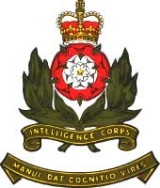
Intelligence Corps personnel wear a distinctive cypressCupressus
The genus Cupressus is one of several genera within the family Cupressaceae that have the common name cypress; for the others, see cypress. It is considered a polyphyletic group...
green beret
Green beret
The green beret was the official headdress of the British Commandos of World War II. It is still worn with pride by members of the Royal Marines after passing the Commando Course and any member of the British Military who has passed the All Arms Commando Course.There are certain other military...
with a cap badge
Cap badge
A cap badge, also known as head badge or hat badge, is a badge worn on uniform headgear and distinguishes the wearer's nationality and/or organisation. The wearing of cap badges is a convention commonly found among military and police forces, as well as uniformed civilian groups such as the Boy...
consisting of a union rose
Tudor rose
The Tudor Rose is the traditional floral heraldic emblem of England and takes its name and origins from the Tudor dynasty.-Origins:...
(a red rose with a white centre) between two laurel
Bay Laurel
The bay laurel , also known as sweet bay, bay tree, true laurel, Grecian laurel, laurel tree, or simply laurel, is an aromatic evergreen tree or large shrub with green, glossy leaves, native to the Mediterranean region. It is the source of the bay leaf used in cooking...
branches and surmounted by a crown. Their motto is Manui Dat Cognitio Vires (Knowledge gives strength to the arm). The corps' quick march is "The Rose & Laurel" while its slow march is Purcell
Henry Purcell
Henry Purcell – 21 November 1695), was an English organist and Baroque composer of secular and sacred music. Although Purcell incorporated Italian and French stylistic elements into his compositions, his legacy was a uniquely English form of Baroque music...
's "Trumpet Tune & Ayre".
Locations
Their headquarters, formerly at Maresfield, East Sussex, then Templer Barracks at Ashford, KentAshford, Kent
Ashford is a town in the borough of Ashford in Kent, England. In 2005 it was voted the fourth best place to live in the United Kingdom. It lies on the Great Stour river, the M20 motorway, and the South Eastern Main Line and High Speed 1 railways. Its agricultural market is one of the most...
, moved in 1997 to the former Royal Air Force
Royal Air Force
The Royal Air Force is the aerial warfare service branch of the British Armed Forces. Formed on 1 April 1918, it is the oldest independent air force in the world...
station at Chicksands
RAF Chicksands
RAF Chicksands was a Royal Air Force station in Bedfordshire, England, which closed in 1997 when responsibility for the camp was taken over by the British Army Intelligence Corps...
in Bedfordshire
Bedfordshire
Bedfordshire is a ceremonial county of historic origin in England that forms part of the East of England region.It borders Cambridgeshire to the north-east, Northamptonshire to the north, Buckinghamshire to the west and Hertfordshire to the south-east....
along with the Defence Intelligence and Security Centre
Defence Intelligence and Security Centre
Defence Intelligence and Security Centre is the location of the Headquarters of both the Defence College of Intelligence and the British Army Intelligence Corps...
and the Intelligence Corps Museum, in Campton and Chicksands
Campton and Chicksands
Campton and Chicksands is a civil parish in the English county of Bedfordshire.Forming part of Central Bedfordshire district, its main settlements are Campton and Chicksands.-External links:...
off a roundabout of the A507
A507 road
The A507 is an A-class road in England, linking the M1 motorway near Milton Keynes to the A10 at Buntingford. Beginning at junction 13 of the M1, the road heads east past Ridgmont to Ampthill. Here it passes between Ampthill and its close neighbour Flitwick, essentially separating the two. After...
near the junction with the A600 and the former offices of Mid Bedfordshire, now the headquarters of Central Bedfordshire
Central Bedfordshire
Central Bedfordshire is a unitary authority in the ceremonial county of Bedfordshire, England. It was created from the merger of Bedfordshire County Council, Mid Bedfordshire and South Bedfordshire on 1 April 2009...
.
Training and promotion
The corps has a particularly high proportion of commissioned officers, many of them commissioned from the ranks, and also a high percentage of female members. Non-commissioned personnel join as either as Operators Military Intelligence (OPMI) or Operator Military Intelligence (Linguist) (OPMI(L)). They do their basic 14-week military training at the Army Training Centre Pirbright. OPMI will complete their 27-week special-to-arm training at Templer Training Delivery Wing, Chicksands, at the end of which they are promoted to Lance CorporalLance Corporal
Lance corporal is a military rank, used by many armed forces worldwide, and also by some police forces and other uniformed organizations. It is below the rank of corporal, and is typically the lowest non-commissioned officer, usually equivalent to the NATO Rank Grade OR-3.- Etymology :The presumed...
. OPMI(L) will complete a 78-week language course at Chicksands, during which they will be promoted to Lance Corporal
Lance Corporal
Lance corporal is a military rank, used by many armed forces worldwide, and also by some police forces and other uniformed organizations. It is below the rank of corporal, and is typically the lowest non-commissioned officer, usually equivalent to the NATO Rank Grade OR-3.- Etymology :The presumed...
and also qualify for specialist pay.
Promotion continues to be more rapid than in most other corps. Officers complete their training at Sandhurst
Royal Military Academy Sandhurst
The Royal Military Academy Sandhurst , commonly known simply as Sandhurst, is a British Army officer initial training centre located in Sandhurst, Berkshire, England...
and then a Junior Officers Course (JOC) to qualify them as Intelligence Officers.
Structure
The main formation is 1 Military Intelligence Brigade. 1 MI Brigade has responsibility for three regular and two Territorial Army battalions:- 1 Military Intelligence Battalion - RheindahlenRheindahlenRheindahlen may refer to*RAF Rheindahlen*Rheindahlen Military Complex*Rheindahlen, Mönchengladbach...
- 2 Military Intelligence Battalion - NetheravonNetheravonNetheravon is a village and civil parish on the River Avon, about north of the town of Amesbury in Wiltshire.-Notable people:The writer Frank Sawyer , although born in Bulford, spent most of his life in Netheravon as river keeper River Avon and died on the banks of the river near the parish church...
- 3 Military Intelligence Battalion (Volunteer) - LondonLondonLondon is the capital city of :England and the :United Kingdom, the largest metropolitan area in the United Kingdom, and the largest urban zone in the European Union by most measures. Located on the River Thames, London has been a major settlement for two millennia, its history going back to its...
- 4 Military Intelligence Battalion - BulfordBulfordBulford is a village and civil parish in Wiltshire, England, close to Salisbury Plain. According to the 2001 census the parish had a population of 4,698.The name is derived from the Old English bulut ieg ford meaning 'ragged robin island ford'....
- 5 Military Intelligence Battalion (Volunteer) - Coulby NewhamCoulby NewhamCoulby Newham is a large housing estate in the borough of Middlesbrough and the ceremonial county of North Yorkshire, England, with a resident population of 10,700....
The tri-service 15 Psychological Operations Group is also based at Chicksands and comes under the remit of the Intelligence Corps and 1 MI Brigade.