

Turn coordinator

Encyclopedia
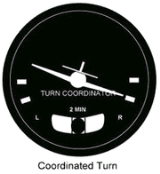
The turn coordinator is a flight instrument which displays to a pilot
information about the rate of yaw (turn), roll, and the coordination of the turn. The turn coordinator was developed to replace the older turn and bank indicator
, which displayed rate and quality of turn but not rate of roll.
A pilot corrects for uncoordinated flight with inputs to the rudder. During a coordinated turn, the ball will remain centered. Ball deflection in the direction of the turn indicates insufficient rudder input resulting in a slip
. Ball deflection opposite the direction of the turn indicates excessive rudder input resulting in a skid
. The mnemonic
device "step on the ball" aids the pilot to remember which rudder pedal requires additional pressure to return the aircraft to coordinated flight.
Unlike an attitude indicator
, the turn coordinator indicates only yaw rate and roll. The attitude indicator indicates pitch and roll. To avoid confusion, some turn coordinators are marked "No pitch information" on the face.
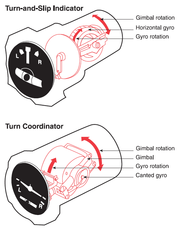 The turn coordinator is a gyroscopic instrument. An internal gyroscope spins at approximately 20,000 rpm with the spin axis perpendicular to the longitudinal axis of the airplane and the free axis tilted up 30° from it. As the aircraft rotates about the yaw or roll axis, the principle of gyroscopic inertia causes the gyro to resist the change in its rotational axis about the free axis. This resisting force works against a spring; thus, a slow rate of turn deflects the gyro slightly while a higher rate of roll or yaw deflects it more. The gimbal
is linked to the indicator dial on which is the rear view of the miniature airplane.
The quality of turn is indicated by an inclinometer
ball located below the miniature airplane. The inclinometer consists of a glass tube filled with kerosene, and a dense ball. The tube is curved such that its center is the lowest point. Normally, the ball will then sit in the center position of the tube, which represents a 'coordinated' turn. This position is marked by two vertical wires on the tube. The ball is said to be 'centered' when it sits perfectly evenly between the two wires.
in that the turn coordinator has the gyro mounted at a 30° tilt. This allows the turn coordinator to respond to roll as well as turn. The TC indication represents a sum of the roll rate and the yaw rate so it responds more quickly at the beginning and end of a turn than a turn and bank indicator. Pilots who are unfamiliar with this principle sometimes have difficulty using the turn coordinator properly, as they may see a roll indication and interpret it as a rate of turn.
The turn coordinator should be used as a performance instrument when the attitude indicator
has failed. Called "partial panel" operations, this can be unnecessarily difficult or even impossible if either the pilot does not understand that the instrument is showing roll rates at some times and turn rates at others, or the internal dashpot
is worn out. In the latter case the instrument is said to be underdamped; in turbulence it will indicate large full-scale deflections to the left and right, all of which are roll rate responses. In this condition it may not be possible for the pilot to maintain control of the aircraft in partial-panel operations in instrument meteorological conditions. For this and other reasons many highly experienced pilots prefer the "older" turn and bank indicator
design.
Aviator
An aviator is a person who flies an aircraft. The first recorded use of the term was in 1887, as a variation of 'aviation', from the Latin avis , coined in 1863 by G. de la Landelle in Aviation Ou Navigation Aérienne...
information about the rate of yaw (turn), roll, and the coordination of the turn. The turn coordinator was developed to replace the older turn and bank indicator
Turn and bank indicator
In aviation, the turn and bank indicator shows the rate of turn and the coordination of the turn. The rate of turn is indicated from a rate gyroscopically and the coordination of the turn is shown by either a pendulum or a heavy ball mounted in a curved sealed glass tube. No pitch information is...
, which displayed rate and quality of turn but not rate of roll.
History
The turn coordinator was initially developed as a single instrument used by autopilots to control the roll axis of an aircraft. The turn coordinator without autopilot sensing became popular in general aviation airplanes largely because of the newer look. The turn coordinator rarely appeared in jets or large airplanes.Use
The indicator includes a miniature airplane as seen from behind. When the miniature airplane wings are level, the yaw rate plus the roll rate is zero. When the wings are not level, the amount and direction of tilt indicates the rate of turn plus the rate of roll. The indicator includes hash marks to indicate "wings level" flight and standard rate turns of 3° per second.A pilot corrects for uncoordinated flight with inputs to the rudder. During a coordinated turn, the ball will remain centered. Ball deflection in the direction of the turn indicates insufficient rudder input resulting in a slip
Slip (aerodynamic)
A slip is an aerodynamic state where an aircraft is moving somewhat sideways as well as forward relative to the oncoming airflow. In other words, for a conventional aircraft, the nose will not be pointing directly into the relative wind .A slip is also a piloting maneuver where the pilot...
. Ball deflection opposite the direction of the turn indicates excessive rudder input resulting in a skid
Skid (aerodynamic)
In flying, a skid is a specific type of slip.It often means a turn where the sideways movement of the aircraft is outwards from the centre of the turn...
. The mnemonic
Mnemonic
A mnemonic , or mnemonic device, is any learning technique that aids memory. To improve long term memory, mnemonic systems are used to make memorization easier. Commonly encountered mnemonics are often verbal, such as a very short poem or a special word used to help a person remember something,...
device "step on the ball" aids the pilot to remember which rudder pedal requires additional pressure to return the aircraft to coordinated flight.
Unlike an attitude indicator
Attitude indicator
An attitude indicator , also known as gyro horizon or artificial horizon, is an instrument used in an aircraft to inform the pilot of the orientation of the aircraft relative to earth. It indicates pitch and bank or roll and is a primary instrument for flight in instrument meteorological conditions...
, the turn coordinator indicates only yaw rate and roll. The attitude indicator indicates pitch and roll. To avoid confusion, some turn coordinators are marked "No pitch information" on the face.
Operation
Gimbal
A gimbal is a pivoted support that allows the rotation of an object about a single axis. A set of two gimbals, one mounted on the other with pivot axes orthogonal, may be used to allow an object mounted on the innermost gimbal to remain immobile regardless of the motion of its support...
is linked to the indicator dial on which is the rear view of the miniature airplane.
The quality of turn is indicated by an inclinometer
Inclinometer
An inclinometer or clinometer is an instrument for measuring angles of slope , elevation or depression of an object with respect to gravity...
ball located below the miniature airplane. The inclinometer consists of a glass tube filled with kerosene, and a dense ball. The tube is curved such that its center is the lowest point. Normally, the ball will then sit in the center position of the tube, which represents a 'coordinated' turn. This position is marked by two vertical wires on the tube. The ball is said to be 'centered' when it sits perfectly evenly between the two wires.
Variations
The turn coordinator differs from the older turn and bank indicatorTurn and bank indicator
In aviation, the turn and bank indicator shows the rate of turn and the coordination of the turn. The rate of turn is indicated from a rate gyroscopically and the coordination of the turn is shown by either a pendulum or a heavy ball mounted in a curved sealed glass tube. No pitch information is...
in that the turn coordinator has the gyro mounted at a 30° tilt. This allows the turn coordinator to respond to roll as well as turn. The TC indication represents a sum of the roll rate and the yaw rate so it responds more quickly at the beginning and end of a turn than a turn and bank indicator. Pilots who are unfamiliar with this principle sometimes have difficulty using the turn coordinator properly, as they may see a roll indication and interpret it as a rate of turn.
The turn coordinator should be used as a performance instrument when the attitude indicator
Attitude indicator
An attitude indicator , also known as gyro horizon or artificial horizon, is an instrument used in an aircraft to inform the pilot of the orientation of the aircraft relative to earth. It indicates pitch and bank or roll and is a primary instrument for flight in instrument meteorological conditions...
has failed. Called "partial panel" operations, this can be unnecessarily difficult or even impossible if either the pilot does not understand that the instrument is showing roll rates at some times and turn rates at others, or the internal dashpot
Dashpot
A dashpot is a mechanical device, a damper which resists motion via viscous friction. The resulting force is proportional to the velocity, but acts in the opposite direction, slowing the motion and absorbing energy. It is commonly used in conjunction with a spring...
is worn out. In the latter case the instrument is said to be underdamped; in turbulence it will indicate large full-scale deflections to the left and right, all of which are roll rate responses. In this condition it may not be possible for the pilot to maintain control of the aircraft in partial-panel operations in instrument meteorological conditions. For this and other reasons many highly experienced pilots prefer the "older" turn and bank indicator
Turn and bank indicator
In aviation, the turn and bank indicator shows the rate of turn and the coordination of the turn. The rate of turn is indicated from a rate gyroscopically and the coordination of the turn is shown by either a pendulum or a heavy ball mounted in a curved sealed glass tube. No pitch information is...
design.