
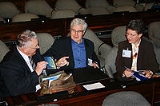
Susan Jocelyn Bell Burnell, DBE, FRS,
FRASThe Royal Astronomical Society is a learned society that began as the Astronomical Society of London in 1820 to support astronomical research . It became the Royal Astronomical Society in 1831 on receiving its Royal Charter from William IV...
(born 15 July 1943), is a
BritishThe British are citizens of the United Kingdom, of the Isle of Man, any of the Channel Islands, or of any of the British overseas territories, and their descendants...
astrophysicistAstrophysics is the branch of astronomy that deals with the physics of the universe, including the physical properties of celestial objects, as well as their interactions and behavior...
. As a postgraduate student she discovered the first radio
pulsarA pulsar is a highly magnetized, rotating neutron star that emits a beam of electromagnetic radiation. The radiation can only be observed when the beam of emission is pointing towards the Earth. This is called the lighthouse effect and gives rise to the pulsed nature that gives pulsars their name...
s with her thesis supervisor
Antony HewishAntony Hewish FRS is a British radio astronomer who won the Nobel Prize for Physics in 1974 for his work on the development of radio aperture synthesis and its role in the discovery of pulsars...
. She was president of the
Institute of PhysicsThe Institute of Physics is a scientific charity devoted to increasing the practice, understanding and application of physics. It has a worldwide membership of around 40,000....
from October 2008 until October 2010, and was interim president following the death of her successor,
Marshall StonehamArthur Marshall Stoneham, FRS , known as Marshall Stoneham, was a British physicist who worked for the United Kingdom Atomic Energy Authority, and from 1995 was Massey professor of physics at University College London...
, in early 2011. She was succeeded in October 2011 by
Sir Peter KnightSir Peter Knight, FRS is a British physicist, Professor of Quantum Optics and Senior Research Investigator Imperial College London, and Principal of the Kavli Royal Society International Centre. He was knighted in the Queen's Birthday Honours List of 2005. He was president of the Optical Society of...
.
The paper announcing the discovery had five authors, Hewish's name being listed first, Bell's second. Dr. Hewish was awarded the
Nobel PrizeThe Nobel Prizes are annual international awards bestowed by Scandinavian committees in recognition of cultural and scientific advances. The will of the Swedish chemist Alfred Nobel, the inventor of dynamite, established the prizes in 1895...
, along with Dr. Ryle, without the inclusion of Bell as a co-recipient, which was controversial, and was roundly condemned by Hewish's fellow astronomer Sir
Fred HoyleSir Fred Hoyle FRS was an English astronomer and mathematician noted primarily for his contribution to the theory of stellar nucleosynthesis and his often controversial stance on other cosmological and scientific matters—in particular his rejection of the "Big Bang" theory, a term originally...
. The Royal Swedish Academy of Sciences, in their press release announcing the 1974 Nobel Prize in Physics, cited Ryle and Hewish for their pioneering work in radio-astrophysics, with particular mention of Ryle's work on aperture-synthesis technique, and Hewish's decisive role in the discovery of pulsars. Dr.
Iosif ShklovskyIosif Samuilovich Shklovsky was a Soviet astronomer and astrophysicist...
, recipient of the 1972
Bruce MedalThe Catherine Wolfe Bruce Gold Medal is awarded every year by the Astronomical Society of the Pacific for outstanding lifetime contributions to astronomy. It is named after Catherine Wolfe Bruce, an American patroness of astronomy, and was first awarded in 1898...
, had sought out Bell at the 1970
International Astronomical UnionThe International Astronomical Union IAU is a collection of professional astronomers, at the Ph.D. level and beyond, active in professional research and education in astronomy...
's General Assembly, to tell her: "Miss Bell, you have made the greatest astronomical discovery of the twentieth century."
Background and family life
Susan Jocelyn Bell was born in
BelfastBelfast is the capital of and largest city in Northern Ireland. By population, it is the 14th biggest city in the United Kingdom and second biggest on the island of Ireland . It is the seat of the devolved government and legislative Northern Ireland Assembly...
,
Northern IrelandNorthern Ireland is one of the four countries of the United Kingdom. Situated in the north-east of the island of Ireland, it shares a border with the Republic of Ireland to the south and west...
. Her father was an architect at the
Armagh PlanetariumArmagh Planetarium is a planetarium located in Armagh, Northern Ireland close to the city centre and neighbouring Armagh Observatory in approximately fourteen acres of landscaped grounds known as the Armagh Astropark.- History :...
, she was encouraged to read. She was especially drawn to books on astronomy. She attended
Lurgan CollegeLurgan College is a selective age 14-19 grammar school situated in the town of Lurgan, County Armagh, Northern Ireland.- History :As befitted a growing industrial town, Lurgan had a strong educational establishment from the mid 19th Century. The opening of the Model School in 1863 had been the...
and lived in Lurgan as a child. She was one of the first girls at this college who was permitted to study science. Previously, the girls' curriculum had included such subjects as cross-stitching and cooking.
At age eleven, she failed the 11+ exam and her parents sent her to
the Mount School, YorkThe Mount School is a Quaker independent day and boarding school in York, England, for girls aged 11–18. It was founded in 1831. Its preparatory school is called Tregelles, and it accepts only girls from 2012 onwards and has a nursery department. There are two or three forms in Year 7 to 11 and...
, a Quaker girls' boarding school. There she was impressed by a physics teacher, Mr. Tillott, who taught her:
Bell Burnell was the subject of the first part of the
BBC FourBBC Four is a British television network operated by the British Broadcasting Corporation and available to digital television viewers on Freeview, IPTV, satellite and cable....
3-part series
Beautiful Minds, directed by Jacqui Farnham, in which her career and contributions to astronomy were explored.
Academic career
She graduated from the
University of GlasgowThe University of Glasgow is the fourth-oldest university in the English-speaking world and one of Scotland's four ancient universities. Located in Glasgow, the university was founded in 1451 and is presently one of seventeen British higher education institutions ranked amongst the top 100 of the...
with a B.Sc. in physics in 1965, and completed her
Ph.D.A Ph.D. is a Doctor of Philosophy, an academic degree.Ph.D. may also refer to:* Ph.D. , a 1980s British group*Piled Higher and Deeper, a web comic strip*PhD: Phantasy Degree, a Korean comic series* PhD Docbook renderer, an XML renderer...
from
New HallMurray Edwards College is a women-only constituent college of the University of Cambridge. It was founded as "New Hall" in 1954, at a time when Cambridge had the lowest proportion of women undergraduates of any university in the United Kingdom, and when only two other colleges admitted women...
(since renamed Murray Edwards College) of the
University of CambridgeThe University of Cambridge is a public research university located in Cambridge, United Kingdom. It is the second-oldest university in both the United Kingdom and the English-speaking world , and the seventh-oldest globally...
in 1969. At Cambridge, she worked with Hewish and others to construct a
radio telescopeA radio telescope is a form of directional radio antenna used in radio astronomy. The same types of antennas are also used in tracking and collecting data from satellites and space probes...
for using
interplanetary scintillationIn astronomy, interplanetary scintillation refers to random fluctuations in the intensity of radio waves of celestial origin, on the timescale of a few seconds. It is analogous to the twinkling one sees looking at stars in the sky at night, but in the radio part of the electromagnetic spectrum...
to study quasars, which had recently been discovered (interplanetary scintillation allows compact sources to be distinguished from extended ones). In July 1967, she detected a bit of "scruff" on her
chart-recorderA chart recorder is an electromechanical device that records an electrical or mechanical input trend onto a piece of paper . Chart recorders may record several inputs using different color pens and may record onto strip charts or circular charts...
papers that tracked across the sky with the stars. Ms. Bell found that the signal was pulsing with great regularity, at a rate of about one pulse per second. Temporarily dubbed "Little Green Man 1" (LGM-1) the source (now known as PSR B1919+21) was identified after several years as a rapidly rotating
neutron starA neutron star is a type of stellar remnant that can result from the gravitational collapse of a massive star during a Type II, Type Ib or Type Ic supernova event. Such stars are composed almost entirely of neutrons, which are subatomic particles without electrical charge and with a slightly larger...
.
After finishing her Ph.D degree, Bell Burnell worked at the
University of SouthamptonThe University of Southampton is a British public university located in the city of Southampton, England, a member of the Russell Group. The origins of the university can be dated back to the founding of the Hartley Institution in 1862 by Henry Robertson Hartley. In 1902, the Institution developed...
(1968–73),
University College LondonUniversity College London is a public research university located in London, United Kingdom and the oldest and largest constituent college of the federal University of London...
(1974–82), and the
Royal Observatory, EdinburghThe Royal Observatory, Edinburgh is an astronomical institution located on Blackford Hill in Edinburgh, Scotland. The site is owned by the Science and Technology Facilities Council...
(1982–91). In addition, from 1973 to 1987, Bell Burnell was also a tutor, consultant, examiner, and lecturer for the
Open UniversityThe Open University is a distance learning and research university founded by Royal Charter in the United Kingdom...
.
In 1991, she was appointed as a Professor of Physics at the Open University, a position that she held for ten years. She was also a visiting professor at
Princeton UniversityPrinceton University is a private research university located in Princeton, New Jersey, United States. The school is one of the eight universities of the Ivy League, and is one of the nine Colonial Colleges founded before the American Revolution....
in the
United StatesThe United States of America is a federal constitutional republic comprising fifty states and a federal district...
. Before retiring, she was Dean of Science at the
University of BathThe University of Bath is a campus university located in Bath, United Kingdom. It received its Royal Charter in 1966....
(2001-04), and she was the President of the
Royal Astronomical SocietyThe Royal Astronomical Society is a learned society that began as the Astronomical Society of London in 1820 to support astronomical research . It became the Royal Astronomical Society in 1831 on receiving its Royal Charter from William IV...
between 2002 and 2004. She is currently a Visiting Professor of Astrophysics at the
University of OxfordThe University of Oxford is a university located in Oxford, United Kingdom. It is the second-oldest surviving university in the world and the oldest in the English-speaking world. Although its exact date of foundation is unclear, there is evidence of teaching as far back as 1096...
and a Fellow of Mansfield College. She served two years as the President of the
Institute of PhysicsThe Institute of Physics is a scientific charity devoted to increasing the practice, understanding and application of physics. It has a worldwide membership of around 40,000....
, her term ended in October 2010.
Non-academic life
Bell is the house patron of Burnell House at
Cambridge House Grammar SchoolCambridge House Grammar School is a mixed, controlled grammar school in the County Antrim town of Ballymena, Northern Ireland within the North Eastern Education and Library Board area.-General:...
in
BallymenaBallymena is a large town in County Antrim, Northern Ireland and the seat of Ballymena Borough Council. Ballymena had a population of 28,717 people in the 2001 Census....
. She has campaigned to improve the status and number of women in professional and academic posts in the fields of physics and astronomy.
Quaker activities and beliefs
From her school days, she has been an active
QuakerThe Religious Society of Friends, or Friends Church, is a Christian movement which stresses the doctrine of the priesthood of all believers. Members are known as Friends, or popularly as Quakers. It is made of independent organisations, which have split from one another due to doctrinal differences...
and served as
ClerkWithin the Religious Society of Friends, a clerk is someone responsible for various administrative functions within a meeting for worship for church affairs or meeting for worship for business...
to the sessions of Britain Yearly Meeting in 1995, 1996 and 1997. She delivered a
Swarthmore LectureSwarthmore Lecture is one of a series of lectures, started in 1908, addressed to Britain Yearly Meeting of the Religious Society of Friends .The preface to the very first lecture explains the purpose of the series....
under the title
Broken for life, at
Yearly MeetingThe Yearly Meeting of the Religious Society of Friends in Britain, also known as Britain Yearly Meeting , is a religious organisation in England, Scotland, Wales, the Channel Islands and the Isle of Man, often defined as a denomination of Christianity.It is a part of the international religious...
in
AberdeenAberdeen is Scotland's third most populous city, one of Scotland's 32 local government council areas and the United Kingdom's 25th most populous city, with an official population estimate of ....
on 1 August 1989, and was the plenary speaker at the U.S.
Friends General ConferenceFriends General Conference is a North American Quaker organization primarily serving the Quaker yearly and monthly meetings in the United States and Canada that choose to be members...
Gathering in 2000.
She revealed her personal religious history and beliefs in an interview with
Joan Bakewell in 2006. She served on the
Quaker Peace and Social WitnessQuaker Peace & Social Witness , previously known as the Friends Service Council, and then as Quaker Peace and Service, is one of the central committees of Britain Yearly Meeting of the Religious Society of Friends - the national organisation of Quakers in Britain. It works to promote British...
Testimonies Committee, which produced
Engaging with the Quaker Testimonies: a Toolkit in February 2007. She was appointed
ClerkWithin the Religious Society of Friends, a clerk is someone responsible for various administrative functions within a meeting for worship for church affairs or meeting for worship for business...
of the Central Executive Committee of
Friends World Committee for ConsultationThe Friends World Committee for Consultation is a Quaker organization that works to communicate between all parts of Quakerism. FWCC's world headquarters is based in London. It has Consultative NGO status with the Economic and Social Council of the United Nations...
for 2008–12, in August 2007.
Nobel Prize
She did not share in the Nobel Prize, despite the fact that it was she, having helped build the four-acre
radio telescopeA radio telescope is a form of directional radio antenna used in radio astronomy. The same types of antennas are also used in tracking and collecting data from satellites and space probes...
over two years, who initially recorded and then noticed the anomaly, reviewing 96 feet of paper data per night, and, as she confirmed in the
Beautiful Minds programme, had to be persistent in recording and reporting it in the face of scorn from Hewish, who was initially insistent the anomaly was due to interference and man-made. She referred in the programme to meetings held by Hewish and Ryle which she should have been invited to, but was not. After Ryle and Hewish had concocted a "little green man" intelligent life theory to explain the initial single pulse, further persistent recording and study of the data on Bell Burnell's own initiative revealed the presence of other similar pulses, finally leading to the explanation of them as Pulsars.
Awards
Although she didn't share the 1974
Nobel PrizeThe Nobel Prizes are annual international awards bestowed by Scandinavian committees in recognition of cultural and scientific advances. The will of the Swedish chemist Alfred Nobel, the inventor of dynamite, established the prizes in 1895...
for Physics with Hewish for her discovery, she has been honoured by many other organisations:
- The Albert A. Michelson Medal of the Franklin Institute
The Franklin Institute is a museum in Philadelphia, Pennsylvania, and one of the oldest centers of science education and development in the United States, dating to 1824. The Institute also houses the Benjamin Franklin National Memorial.-History:On February 5, 1824, Samuel Vaughn Merrick and...
of Philadelphia (1973, jointly with Dr. Hewish).
- J. Robert Oppenheimer Memorial Prize from the Center for Theoretical Studies in Miami (1978).
- Beatrice M. Tinsley Prize
The Beatrice M. Tinsley Prize is awarded every other year by the American Astronomical Society in recognition of an outstanding research contribution to astronomy or astrophysics of an exceptionally creative or innovative character...
of the American Astronomical SocietyThe American Astronomical Society is an American society of professional astronomers and other interested individuals, headquartered in Washington, DC...
(1987).
- Herschel Medal
The Herschel Medal is a medal of the Royal Astronomical Society, awarded for outstanding work in the area of observational astrophysics.-Herschel Medalists:*1974 John Paul Wild*1977 Arno Penzias and Robert Woodrow Wilson*1980 Gérard de Vaucouleurs...
of the Royal Astronomical SocietyThe Royal Astronomical Society is a learned society that began as the Astronomical Society of London in 1820 to support astronomical research . It became the Royal Astronomical Society in 1831 on receiving its Royal Charter from William IV...
(1989).
- Karl G. Jansky
Karl Guthe Jansky was an American physicist and radio engineer who in August 1931 first discovered radio waves emanating from the Milky Way. He is considered one of the founding figures of radio astronomy.- Early life :...
Lectureship of the National Radio Astronomy ObservatoryThe National Radio Astronomy Observatory is a Federally Funded Research and Development Center of the United States National Science Foundation operated under cooperative agreement by Associated Universities, Inc for the purpose of radio astronomy...
(1995).
- Magellanic Premium
The Magellanic Premium, also known as the Magellanic Gold Medal and Magellanic Prize is awarded for major contributions in the field of navigation , astronomy, or natural philosophy....
of the American Philosophical SocietyThe American Philosophical Society, founded in 1743, and located in Philadelphia, Pa., is an eminent scholarly organization of international reputation, that promotes useful knowledge in the sciences and humanities through excellence in scholarly research, professional meetings, publications,...
(2000).
- Fellow of the Royal Society
The Royal Society of London for Improving Natural Knowledge, known simply as the Royal Society, is a learned society for science, and is possibly the oldest such society in existence. Founded in November 1660, it was granted a Royal Charter by King Charles II as the "Royal Society of London"...
(March 2003).
- On 19 August 2011, she received the Grote Reber Medal at the General Assembly of the International Radio Science Union in Istanbul.
She has been awarded numerous honorary degrees, for instance, recently:
- In 2007, Bell Burnell was awarded an honorary doctorate by Harvard University
Harvard University is a private Ivy League university located in Cambridge, Massachusetts, United States, established in 1636 by the Massachusetts legislature. Harvard is the oldest institution of higher learning in the United States and the first corporation chartered in the country...
.
- On 23 June 2007, Bell Burnell was awarded an Honorary Doctorate of Science from the University of Durham.
Honours
In 1999 she was appointed Commander of the Order of the British Empire (CBE). In June 2007 she was elevated to Dame Commander of the Order of the British Empire (DBE).
Beautiful Minds Documentary
In the
Beautiful Minds documentary she talks about how in science, "nothing is static, nothing is final, everything is held provisionally" and that "sometimes you have to abandon the picture". She demonstrates this with planetary orbits. Kepler recognised that orbits were elliptical, not circles on circles on circles and he made things simple again. She proposes that "our nice simple picture is getting messier and messier and messier" and the documentary ends with her telling us that we are all waiting for a new picture, "we need to picture cosmology, the evolution of the universe in a whole new way", she says. The documentary also looks at her schooling, the sexism and alienation she faced in a male dominated field as an undergraduate, and also how she built and operated the radio telescope which she used to discover the pulsars. By the end of her PhD she could swing a sledgehammer. During the documentary she also talks about how being a quaker is an important part of her life and how quaker practice is similar to the scientific method. "I find that quakerism and research science fit together very, very well. In quakerism you're expected to develop your own understanding of God from your experience in the world. There isn't a creed, there isn't a dogma. There's an understanding but nothing as formal as a dogma or creed and this idea that you develop your own understanding also means that you keep redeveloping your understanding as you get more experience, and it seems to me that's very like what goes on in "the scientific method." You have a model, of a star, its an understanding, and you develop that model in the light of experiments and observations, and so in both you're expected to evolve your thinking. Nothing is static, nothing is final, everything is held provisionally."
Personal life
Bell married Martin Burnell in 1968 (divorced, 1993); they have one son, Gavin Burnell (born 1973), who is also a physicist, and two grandchildren.
Selected works
Books (Swarthmore Lecture)
- dark matter: poems of space edited by Maurice Riordan and Jocelyn Bell Burnell. Calouste Gulbenkian Foundation
The Calouste Gulbenkian Foundation is a Portuguese private foundation of public utility whose statutory aims are in the fields of arts, charity, education, and science...
, 2008 ISBN 978-1-90308-10-8
Scientific papers
For additional titles
See Reference
Video
Audio
Text
- Contributions of 20th C women to physics: Burnell article. Procided by University of California at Los Angeles.
- Ferdinand V. Coroniti and Gary A. Williams (2006), "Jocelyn Bell Burnell" in Out of the Shadows: Contributions of 20th Century Women to Physics, Nina Byers and Gary Williams, ed., Cambridge University Press.
- Catalogue entry of Royal Society citation (accessed 24 December 2007).
- Gale - Free Resources: Article on Bell Burnell from Encyclopedia of World Biography 1998. (Accessed 24 December 2007).
- UK Resource Centre for Women in Science Engineering Technology biographical webpage. (Accessed 24 December 2007).
- Biographical article, indicating Bell Burnell's beliefs and personal life, from California State Polytechnic University NOVA project. (Accessed 24 December 2007).
- Nicholas Wade
Nicholas Wade is a British-born scientific reporter, editor and author who currently writes for the Science Times section of The New York Times.-Biography:Wade was born in Aylesbury, England and educated at Eton College and King's College, Cambridge...
and William BroadWilliam J. Broad is an author and a Senior Writer at The New York Times.-Awards:Broad has won two Pulitzer Prizes with Times colleagues, as well as an Emmy and a DuPont. He won the Pulitzers for coverage of the space shuttle Challenger disaster and the feasibility of antimissile arms...
. Betrayers of the Truth: Fraud and Deceit in the Halls of ScienceBetrayers of the Truth: Fraud and Deceit in the Halls of Science is a book by William Broad and Nicholas Wade, published in 1982 by Simon & Schuster in New York, and subsequently also by Century Publishing in London, and by Oxford University Press in 1985...
. New York: Simon & SchusterSimon & Schuster, Inc., a division of CBS Corporation, is a publisher founded in New York City in 1924 by Richard L. Simon and M. Lincoln Schuster. It is one of the four largest English-language publishers, alongside Random House, Penguin and HarperCollins...
, 1983, pp. 143–151.
- Women in Science
(TV Documentary on Jocelyn Bell Burnell's life) (Not accessible online 24 December 2007).
Transcripts