

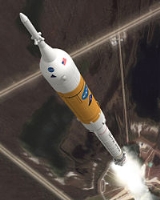
Ares I

Encyclopedia
Ares I was the crew launch vehicle
that was being developed by NASA
as part of the Constellation Program. The name "Ares" refers to the Greek deity Ares
, who is identified
with the Roman god Mars
. Ares I was originally known as the "Crew Launch Vehicle" (CLV).
NASA planned to use Ares I to launch Orion
, the spacecraft
intended for NASA human spaceflight
missions after the Space Shuttle
was retired in 2011. Ares I was to complement the larger, unmanned Ares V
, which was the cargo launch vehicle for Constellation. NASA selected the Ares designs for their anticipated overall safety, reliability and cost-effectiveness. However, the Constellation program, including Ares I was canceled in October 2010 by the passage of the 2010 NASA authorization bill. Existing Constellation contracts remain in place until Congress passes a new funding bill.
. A section of the ATSS report describes several possible vehicles much like the Ares I design, with liquid rocket second stages stacked above segmented solid rocket booster
(SRB) first stages. The variants that were considered included both the J-2S engines and Space Shuttle Main Engine
s (SSMEs) for the second stage. The variants also assumed use of the Advanced Solid Rocket Motor (ASRM) as a first stage, but the ASRM was cancelled in 1993 due to significant cost overruns.
had announced the Vision for Space Exploration
in January 2004, and NASA under Sean O'Keefe
had solicited plans for a Crew Exploration Vehicle
from multiple bidders, with the plan for having two competing teams. These plans were discarded by incoming administrator Michael Griffin
, and on April 29, 2005, NASA chartered the Exploration Systems Architecture Study
to accomplish specific goals:
A Shuttle-derived launch architecture was selected by NASA for the Ares I. Originally, the vehicle would have used a four-segment solid rocket booster (SRB) for the first stage, and a simplified Space Shuttle Main Engine (SSME) for the second stage. An unmanned version was to use the five-segment booster, but with the second stage using the single SSME. Shortly after the initial design was approved, additional tests revealed that the Orion spacecraft would be too heavy for the four-segment booster to lift, and in January 2006 NASA announced they would slightly reduce the size of the Orion spacecraft, add a fifth segment to the solid-rocket first stage, and replace the single SSME with the Apollo-derived J-2X motor. While the change from a four-segment first stage to a five-segment version would allow NASA to construct virtually identical motors (albeit with some interchangeable segments), the main reason for the change to the five-segment booster was the move to the J-2X.
The Exploration Systems Architecture Study concluded that the cost and safety of the Ares was superior to that of either of the Evolved Expendable Launch Vehicle (EELVs). The cost estimates in the study were based on the assumption that new launch pads would be needed for human-rated
EELVs. However, the facilities for the current EELVs (LC-37 for Delta IV, LC-41 for Atlas V) are in place and could be modified. The ESAS launch safety estimates for the Ares were based on the Space Shuttle, despite the differences, but included only launches after Challenger, and counted each of the remaining launches as two safe launches of the Ares booster. The safety of the Atlas V
and Delta IV was estimated from the failure rates of all Delta II
, Atlas-Centaur
, and Titan launches since 1992, although they are not similar designs.
In May 2009 the previously withheld appendices to the 2006 ESAS study were leaked, revealing a number of apparent flaws in the study, which gave safety exemptions to the selected Ares I design while using a faulty model which unfairly penalized the EELV-based designs.
. Unlike the Space Shuttle, where both crew and cargo were launched simultaneously on the same rocket, the plans for Project Constellation outlined having two separate launch vehicles, the Ares I and the Ares V, for crew and cargo, respectively. Having two separate launch vehicles allows for more specialized designs for the crew and heavy cargo launch rockets.
The Ares I rocket was specifically being designed to launch the Orion Multi-Purpose Crew Vehicle
. Orion is intended as a crew capsule, similar in design to the Apollo program capsule, to transport astronauts to the International Space Station
, the Moon
, and eventually Mars
. Ares I might have also delivered some (limited) resources to orbit
, including supplies for the International Space Station or subsequent delivery to the planned lunar base
.
s, as the prime contractor for the Ares I first stage. NASA announced that Rocketdyne
will be the main subcontractor for the J-2X rocket engine on July 16, 2007. NASA selected Boeing
to provide and install the avionics
for the Ares I rocket on December 12, 2007.
On August 28, 2007 NASA awarded the Ares I Upper Stage manufacturing contract to Boeing. Boeing built the S-IC stage of the Saturn V
rocket at Michoud Assembly Facility
in the 1960s. The upper stage of Ares I was to have been built at the NASA Michoud Assembly Facility, the construction site used for the Space Shuttle's External Tank and the Saturn V's S-IC
first stage.
20-25 million per engine, the Rocketdyne-designed and produced J-2X would have cost less than half as much as the more complex Space Shuttle Main Engine
(around $55 million). Unlike the Space Shuttle Main Engine, which was designed to start on the ground, the J-2X was designed from inception to be started in both mid-air and in near-vacuum. This air-start capability was critical, especially in the original J-2 engine used on the Saturn V's S-IVB
stage, to propel the Apollo spacecraft
to the Moon. The Space Shuttle Main Engine, on the other hand, would have required extensive modifications to add an air-start capability and have been able to restart in a near-vacuum. Near-vacuum restart capability was needed for the Ares I because it was intended to fly an Earth orbit rendezvous
, and because the Orion spacecraft has limited fuel reserves. Due to these design issues, a modified Space Shuttle Main Engine would have to be "pre-fired" in a manner similar to the "Main Engine tests" conducted on the Space Shuttle Main Engines prior to the maiden flights of each NASA orbiter, including the STS-26
return to flight in 1988.
, the new LH2 and LOX tanks would have been separated by a common bulkhead like that employed on the Saturn V S-II
and S-IVB stages. This would have provided a significant mass saving and eliminated the need to design a second stage interstage unit that would have had to carry the weight of the Orion spacecraft with it.
or Space Shuttle systems were during their development, it was normal for such problems to arise during the development stage. According to NASA, analysis of the data and telemetry from the Ares I-X flight showed that vibrations from thrust oscillation were within the normal range for a Space Shuttle flight.
A study released in July 2009 by the 45th Space Wing
of the US Air Force concluded that an abort 30–60 seconds after launch would have a ~100% chance of killing all crew, due to the capsule being engulfed until ground impact by a cloud of 4000 °F (2,204.4 °C) solid propellant fragments, which would melt the capsule's nylon parachute material. NASA's study showed the crew capsule would have flown beyond the more severe danger.
The Ares I igniter was an advanced version of the flight-proven igniter used on the Space Shuttle's solid rocket boosters. It was approximately 18 inches (46 cm) in diameter and 36 inches (91 cm) long, and took advantage of upgraded insulation materials that had improved thermal properties to protect the igniter's case from the burning solid propellant. NASA successfully completed test firing of the igniter for the Ares I engines on March 10, 2009 at ATK Launch Systems
test facilities near Promontory, Utah
. The igniter test generated a flame 200 feet (60 meters) in length, and preliminary data showed the igniter performed as planned.
Development of the Ares I propulsion elements continues to make strong progress. On September 10, 2009, the first Ares I development motor (DM-1) was successfully tested in a full-scale, full-duration test firing. This test was followed by two more development motor tests, DM-2 on August 31, 2010 and DM-3 on September 8, 2011. For DM-2 the motor was cooled to a core temperature of 40 degrees Fahrenheit, and for DM-3 it was heated to above 90 degrees Fahrenheit. In addition to other objectives, these two tests validated Ares motor performance at extreme temperatures. A series of tests to verify the J-2X engine functions as designed began in July 2011 at John C. Stennis Space Center.
The Ares I prototype, Ares I-X
, successfully completed a test launch on October 28, 2009. Launch Pad 39B was damaged more than with a Space Shuttle launch. During descent, one of the three parachutes of the Ares I-X’s first stage failed to open, and another opened only partially, causing the booster to splash down harder and suffer structural damage.
 NASA completed the Ares I system requirements review in January 2007. Project design was to have continued through the end of 2009, with development and qualification testing running concurrently through 2012. , flight articles were to have begun production towards the end of 2009 for a first launch in June 2011. Since 2006 the first launch of a human was planned for no later than 2014, which is four years after the planned retirement of the Space Shuttle.
Delays in the Ares I development schedule due to budgetary pressures and unforeseen engineering and technical difficulties would have increased the gap between the end of the Space Shuttle program and the first operational flight of Ares I. The total estimated cost to develop the Ares I through 2015 rose from $28 billion in 2006 to more than $40 billion in 2009.
Originally scheduled for first test flights in 2011, the independent analysis by the Augustine Commission
found in late 2009 that due to technical and financial problems Ares I was not likely to have had its first crewed launch until 2017-2019 under the current budget, or late 2016 with an unconstrained budget. The Augustine Commission also stated that Ares I and Orion would have an estimated recurring cost of almost $1 billion per flight. However, later financial analysis showed that the Ares I would have cost $1 billion or more to operate per flight had the Ares I flown just once a year. If the Ares I system were flown multiple times a year the marginal cost
s could have fallen to as low as $138 million per launch. The Ares I marginal cost was predicted to have been a fraction of the Shuttle's marginal costs even had it flown multiple times per year. By comparison, the cost of launching three astronauts on a manned Russian Soyuz is $153 million.
On February 8, 2011 it was reported that Alliant Techsystems
and Astrium proposed to use Ares I's first stage with the second stage from the Ariane 5
to form a new rocket named Liberty
.
announced a proposal to cancel the Constellation program effective with the U.S. 2011 fiscal year budget, but later announced changes to the proposal in a major space policy speech
at Kennedy Space Center on April 15, 2010. In October 2010, the NASA authorization bill for 2010 was signed into law which canceled Constellation. But previous legislation keeps Constellation contracts in force until a new funding bill is passed for 2011.
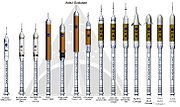 Ares I had a payload capability in the 25-metric-ton (28-short-ton; 25-long-ton) class and was comparable to vehicles such as the Delta IV and the Atlas V
. The NASA study group that selected what would become the Ares I rated the vehicle as almost twice as safe as an Atlas or Delta IV-derived design. The rocket was to have made use of an aluminum-lithium alloy which is lower in density but similar in strength compared to other aluminum alloys. The alloy is produced by Alcoa
.
(SRB). Compared with the Solid Rocket Booster, which had four segments, the most notable difference was the addition of a fifth segment. This fifth segment would have enabled the Ares I to produce more thrust. Other changes made to the Solid Rocket Booster were to have been the removal of the Space Shuttle External Tank
(ET) attachment points and the replacement of the Solid Rocket Booster nosecone with a new forward adapter that would have interfaced with the liquid-fueled second stage. The adapter was to have been equipped with solid-fueled separation motors to facilitate the disconnection of the stages during ascent. The grain design was also changed, and so were the insulation and liner. By the Ares I first stage ground test, the case, grain design, number of segments, insulation, liner, throat diameter, thermal protection systems and nozzle had all changed.
stage of the Saturn V, was to be propelled by a single J-2X rocket engine fueled by liquid hydrogen
(LH2) and liquid oxygen
(LOX). The J-2X was derived from the original J-2 engine used during the Apollo program, but with more thrust (~294,000 lbf) and fewer parts than the original engine. On July 16, 2007, NASA awarded Rocketdyne
a sole-source contract for the J-2X engines to be used for ground and flight tests. Rocketdyne was the prime contractor for the original J-2 engines used in the Apollo program.
Although its J-2X engine was derived from an established design, the upper stage itself would have been wholly new. Originally to have been based on both the internal and external structure of the ET, the original design called for separate fuel and oxidizer tanks, joined together by an "intertank" structure, and covered with the spray-on foam insulation to keep venting to a minimum. The only new hardware on the original ET-derived second stage would have been the thrust assembly for the J-2X engine, new fill/drain/vent disconnects for the fuel and oxidizer, and mounting interfaces for the solid-fueled first stage and the Orion spacecraft.
Using a concept going back to the Apollo program, the "intertank" structure was dropped to decrease mass, and in its place, a common bulkhead, similar to that used on both the S-II
and S-IVB stages of the Saturn V, would have been used between the tanks. The savings from these changes were used to increase propellant capacity, which was 297900 pounds (135,125.2 kg). The spray-on foam insulation was the only part of the Shuttle's ET that would have been be used on this new Saturn-derived upper stage.
Launch vehicle
In spaceflight, a launch vehicle or carrier rocket is a rocket used to carry a payload from the Earth's surface into outer space. A launch system includes the launch vehicle, the launch pad and other infrastructure....
that was being developed by NASA
NASA
The National Aeronautics and Space Administration is the agency of the United States government that is responsible for the nation's civilian space program and for aeronautics and aerospace research...
as part of the Constellation Program. The name "Ares" refers to the Greek deity Ares
Ares
Ares is the Greek god of war. He is one of the Twelve Olympians, and the son of Zeus and Hera. In Greek literature, he often represents the physical or violent aspect of war, in contrast to the armored Athena, whose functions as a goddess of intelligence include military strategy and...
, who is identified
Interpretatio graeca
Interpretatio graeca is a Latin term for the common tendency of ancient Greek writers to equate foreign divinities to members of their own pantheon. Herodotus, for example, refers to the ancient Egyptian gods Amon, Osiris and Ptah as "Zeus", "Dionysus" and "Hephaestus", respectively.-Roman...
with the Roman god Mars
Mars (mythology)
Mars was the Roman god of war and also an agricultural guardian, a combination characteristic of early Rome. He was second in importance only to Jupiter, and he was the most prominent of the military gods worshipped by the Roman legions...
. Ares I was originally known as the "Crew Launch Vehicle" (CLV).
NASA planned to use Ares I to launch Orion
Orion (spacecraft)
Orion is a spacecraft designed by Lockheed Martin for NASA, the space agency of the United States. Orion development began in 2005 as part of the Constellation program, where Orion would fulfill the function of a Crew Exploration Vehicle....
, the spacecraft
Spacecraft
A spacecraft or spaceship is a craft or machine designed for spaceflight. Spacecraft are used for a variety of purposes, including communications, earth observation, meteorology, navigation, planetary exploration and transportation of humans and cargo....
intended for NASA human spaceflight
Human spaceflight
Human spaceflight is spaceflight with humans on the spacecraft. When a spacecraft is manned, it can be piloted directly, as opposed to machine or robotic space probes and remotely-controlled satellites....
missions after the Space Shuttle
Space Shuttle
The Space Shuttle was a manned orbital rocket and spacecraft system operated by NASA on 135 missions from 1981 to 2011. The system combined rocket launch, orbital spacecraft, and re-entry spaceplane with modular add-ons...
was retired in 2011. Ares I was to complement the larger, unmanned Ares V
Ares V
The Ares V was the planned cargo launch component of the Constellation program, which was to have replaced the Space Shuttle after its retirement in 2011. Ares V was also planned to carry supplies for a human presence on Mars...
, which was the cargo launch vehicle for Constellation. NASA selected the Ares designs for their anticipated overall safety, reliability and cost-effectiveness. However, the Constellation program, including Ares I was canceled in October 2010 by the passage of the 2010 NASA authorization bill. Existing Constellation contracts remain in place until Congress passes a new funding bill.
Advanced Transportation System Studies
In 1995 Lockheed Martin produced an Advanced Transportation System Studies (ATSS) report for the Marshall Space Flight CenterMarshall Space Flight Center
The George C. Marshall Space Flight Center is the U.S. government's civilian rocketry and spacecraft propulsion research center. The largest center of NASA, MSFC's first mission was developing the Saturn launch vehicles for the Apollo moon program...
. A section of the ATSS report describes several possible vehicles much like the Ares I design, with liquid rocket second stages stacked above segmented solid rocket booster
Solid rocket booster
Solid rocket boosters or Solid Rocket Motors, SRM, are used to provide thrust in spacecraft launches from the launchpad up to burnout of the SRBs. Many launch vehicles include SRBs, including the Ariane 5, Atlas V , and the NASA Space Shuttle...
(SRB) first stages. The variants that were considered included both the J-2S engines and Space Shuttle Main Engine
Space Shuttle main engine
The RS-25, otherwise known as the Space Shuttle Main Engine , is a reusable liquid-fuel rocket engine built by Pratt & Whitney Rocketdyne for the Space Shuttle, running on liquid hydrogen and oxygen. Each Space Shuttle was propelled by three SSMEs mated to one powerhead...
s (SSMEs) for the second stage. The variants also assumed use of the Advanced Solid Rocket Motor (ASRM) as a first stage, but the ASRM was cancelled in 1993 due to significant cost overruns.
Exploration Systems Architecture Study
President George W. BushGeorge W. Bush
George Walker Bush is an American politician who served as the 43rd President of the United States, from 2001 to 2009. Before that, he was the 46th Governor of Texas, having served from 1995 to 2000....
had announced the Vision for Space Exploration
Vision for Space Exploration
The Vision for Space Exploration is the United States space policy which was announced on January 14, 2004 by President George W. Bush. It is seen as a response to the Space Shuttle Columbia disaster, the state of human spaceflight at NASA, and a way to regain public enthusiasm for space...
in January 2004, and NASA under Sean O'Keefe
Sean O'Keefe
Sean O'Keefe is the CEO of EADS North America, a subsidiary of the European aerospace firm EADS, a former Administrator of NASA, and former chancellor of Louisiana State University . O'Keefe is also a former member of the board of directors of DuPont...
had solicited plans for a Crew Exploration Vehicle
Crew Exploration Vehicle
The Crew Exploration Vehicle was the conceptual component of the U.S. NASA Vision for Space Exploration that later became known as the Orion spacecraft...
from multiple bidders, with the plan for having two competing teams. These plans were discarded by incoming administrator Michael Griffin
Michael D. Griffin
Michael Douglas Griffin is an American physicist and aerospace engineer. From April 13, 2005 to January 20, 2009 he served as Administrator of NASA, the space agency of the United States...
, and on April 29, 2005, NASA chartered the Exploration Systems Architecture Study
Exploration Systems Architecture Study
The Exploration Systems Architecture Study is the official title of a large-scale, system level study released by the National Aeronautics and Space Administration in November 2005 in response to American president George W...
to accomplish specific goals:
- determine the "top-level requirements and configurations for crew and cargo launch systems to support the lunar and Mars exploration programs"
- assess the "CEV requirements and plans to enable the CEV to provide crew transport to the ISS"
- "develop a reference lunar exploration architecture concept to support sustained human and robotic lunar exploration operations"
- "identify key technologies required to enable and significantly enhance these reference exploration systems"
A Shuttle-derived launch architecture was selected by NASA for the Ares I. Originally, the vehicle would have used a four-segment solid rocket booster (SRB) for the first stage, and a simplified Space Shuttle Main Engine (SSME) for the second stage. An unmanned version was to use the five-segment booster, but with the second stage using the single SSME. Shortly after the initial design was approved, additional tests revealed that the Orion spacecraft would be too heavy for the four-segment booster to lift, and in January 2006 NASA announced they would slightly reduce the size of the Orion spacecraft, add a fifth segment to the solid-rocket first stage, and replace the single SSME with the Apollo-derived J-2X motor. While the change from a four-segment first stage to a five-segment version would allow NASA to construct virtually identical motors (albeit with some interchangeable segments), the main reason for the change to the five-segment booster was the move to the J-2X.
The Exploration Systems Architecture Study concluded that the cost and safety of the Ares was superior to that of either of the Evolved Expendable Launch Vehicle (EELVs). The cost estimates in the study were based on the assumption that new launch pads would be needed for human-rated
Human-rating certification
Human-rated or man-rated are terms used to describe the certification of a spacecraft, launch vehicleor airplaneas worthy of transporting humans. NASA and the U.S. GAO now uses "Human-rating" when describing requirements for these systems...
EELVs. However, the facilities for the current EELVs (LC-37 for Delta IV, LC-41 for Atlas V) are in place and could be modified. The ESAS launch safety estimates for the Ares were based on the Space Shuttle, despite the differences, but included only launches after Challenger, and counted each of the remaining launches as two safe launches of the Ares booster. The safety of the Atlas V
Atlas V
Atlas V is an active expendable launch system in the Atlas rocket family. Atlas V was formerly operated by Lockheed Martin, and is now operated by the Lockheed Martin-Boeing joint venture United Launch Alliance...
and Delta IV was estimated from the failure rates of all Delta II
Delta II
Delta II was an American space launch system, originally designed and built by McDonnell Douglas. Delta II is part of the Delta rocket family and was in service from 1989 until November 1, 2011...
, Atlas-Centaur
Atlas-Centaur
The Atlas-Centaur was an American expendable launch system designed and built by General Dynamics Convair Division in San Diego, CA. It was derived from the SM-65 Atlas missile. It was a member of the Atlas family of rockets, and was used for 61 orbital launches between 1962 and 1983. It was...
, and Titan launches since 1992, although they are not similar designs.
In May 2009 the previously withheld appendices to the 2006 ESAS study were leaked, revealing a number of apparent flaws in the study, which gave safety exemptions to the selected Ares I design while using a faulty model which unfairly penalized the EELV-based designs.
Role in Constellation program
Ares I was the crew launch component of the Constellation program. Originally named the "Crew Launch Vehicle" or CLV, the Ares name was chosen from the Greek deity AresAres
Ares is the Greek god of war. He is one of the Twelve Olympians, and the son of Zeus and Hera. In Greek literature, he often represents the physical or violent aspect of war, in contrast to the armored Athena, whose functions as a goddess of intelligence include military strategy and...
. Unlike the Space Shuttle, where both crew and cargo were launched simultaneously on the same rocket, the plans for Project Constellation outlined having two separate launch vehicles, the Ares I and the Ares V, for crew and cargo, respectively. Having two separate launch vehicles allows for more specialized designs for the crew and heavy cargo launch rockets.
The Ares I rocket was specifically being designed to launch the Orion Multi-Purpose Crew Vehicle
Orion (spacecraft)
Orion is a spacecraft designed by Lockheed Martin for NASA, the space agency of the United States. Orion development began in 2005 as part of the Constellation program, where Orion would fulfill the function of a Crew Exploration Vehicle....
. Orion is intended as a crew capsule, similar in design to the Apollo program capsule, to transport astronauts to the International Space Station
International Space Station
The International Space Station is a habitable, artificial satellite in low Earth orbit. The ISS follows the Salyut, Almaz, Cosmos, Skylab, and Mir space stations, as the 11th space station launched, not including the Genesis I and II prototypes...
, the Moon
Moon
The Moon is Earth's only known natural satellite,There are a number of near-Earth asteroids including 3753 Cruithne that are co-orbital with Earth: their orbits bring them close to Earth for periods of time but then alter in the long term . These are quasi-satellites and not true moons. For more...
, and eventually Mars
Mars
Mars is the fourth planet from the Sun in the Solar System. The planet is named after the Roman god of war, Mars. It is often described as the "Red Planet", as the iron oxide prevalent on its surface gives it a reddish appearance...
. Ares I might have also delivered some (limited) resources to orbit
Orbit
In physics, an orbit is the gravitationally curved path of an object around a point in space, for example the orbit of a planet around the center of a star system, such as the Solar System...
, including supplies for the International Space Station or subsequent delivery to the planned lunar base
Lunar outpost (NASA)
A lunar outpost was an element of the George W. Bush era Vision for Space Exploration, which has been replaced with President Barack Obama's space policy. The outpost would have been an inhabited facility on the surface of the Moon. At the time it was proposed, NASA was to construct the outpost...
.
Contractor selection
NASA selected Alliant Techsystems, the builder of the Space Shuttle Solid Rocket BoosterSpace Shuttle Solid Rocket Booster
The Space Shuttle Solid Rocket Boosters were the pair of large solid rockets used by the United States' NASA Space Shuttle during the first two minutes of powered flight. Together they provided about 83% of liftoff thrust for the Space Shuttle. They were located on either side of the rusty or...
s, as the prime contractor for the Ares I first stage. NASA announced that Rocketdyne
Rocketdyne
Rocketdyne was a Rocket engine design and production company headquartered in Canoga Park, California, United States. The company was related to North American Aviation for most of its history. NAA merged with Rockwell International, which was then bought by Boeing in December, 1996...
will be the main subcontractor for the J-2X rocket engine on July 16, 2007. NASA selected Boeing
Boeing
The Boeing Company is an American multinational aerospace and defense corporation, founded in 1916 by William E. Boeing in Seattle, Washington. Boeing has expanded over the years, merging with McDonnell Douglas in 1997. Boeing Corporate headquarters has been in Chicago, Illinois since 2001...
to provide and install the avionics
Avionics
Avionics are electronic systems used on aircraft, artificial satellites and spacecraft.Avionic systems include communications, navigation, the display and management of multiple systems and the hundreds of systems that are fitted to aircraft to meet individual roles...
for the Ares I rocket on December 12, 2007.
On August 28, 2007 NASA awarded the Ares I Upper Stage manufacturing contract to Boeing. Boeing built the S-IC stage of the Saturn V
Saturn V
The Saturn V was an American human-rated expendable rocket used by NASA's Apollo and Skylab programs from 1967 until 1973. A multistage liquid-fueled launch vehicle, NASA launched 13 Saturn Vs from the Kennedy Space Center, Florida with no loss of crew or payload...
rocket at Michoud Assembly Facility
Michoud Assembly Facility
The Michoud Assembly Facility is an 832-acre site owned by NASA and located in New Orleans East, a large district within the city of New Orleans, Louisiana, United States. Organizationally, it is part of NASA's Marshall Space Flight Center...
in the 1960s. The upper stage of Ares I was to have been built at the NASA Michoud Assembly Facility, the construction site used for the Space Shuttle's External Tank and the Saturn V's S-IC
S-IC
The S-IC was the first stage of the Saturn V rocket. The S-IC first stage was built by The Boeing Company. Like the first stages of most rockets, most of its mass of over two thousand metric tonnes at launch was propellant, in this case RP-1 rocket fuel and liquid oxygen oxidizer...
first stage.
J-2X engines
At approximately US$United States dollar
The United States dollar , also referred to as the American dollar, is the official currency of the United States of America. It is divided into 100 smaller units called cents or pennies....
20-25 million per engine, the Rocketdyne-designed and produced J-2X would have cost less than half as much as the more complex Space Shuttle Main Engine
Space Shuttle main engine
The RS-25, otherwise known as the Space Shuttle Main Engine , is a reusable liquid-fuel rocket engine built by Pratt & Whitney Rocketdyne for the Space Shuttle, running on liquid hydrogen and oxygen. Each Space Shuttle was propelled by three SSMEs mated to one powerhead...
(around $55 million). Unlike the Space Shuttle Main Engine, which was designed to start on the ground, the J-2X was designed from inception to be started in both mid-air and in near-vacuum. This air-start capability was critical, especially in the original J-2 engine used on the Saturn V's S-IVB
S-IVB
The S-IVB was built by the Douglas Aircraft Company and served as the third stage on the Saturn V and second stage on the Saturn IB. It had one J-2 engine...
stage, to propel the Apollo spacecraft
Apollo spacecraft
The Apollo spacecraft was composed of five combined parts designed to accomplish the American Apollo program's goal of landing astronauts on the Moon by the end of the 1960s and returning them safely to Earth...
to the Moon. The Space Shuttle Main Engine, on the other hand, would have required extensive modifications to add an air-start capability and have been able to restart in a near-vacuum. Near-vacuum restart capability was needed for the Ares I because it was intended to fly an Earth orbit rendezvous
Earth orbit rendezvous
Earth orbit rendezvous is a type of space rendezvous and a spaceflight methodology most notable for enabling round trip human missions to the moon...
, and because the Orion spacecraft has limited fuel reserves. Due to these design issues, a modified Space Shuttle Main Engine would have to be "pre-fired" in a manner similar to the "Main Engine tests" conducted on the Space Shuttle Main Engines prior to the maiden flights of each NASA orbiter, including the STS-26
STS-26
STS-26 was the 26th NASA Space Shuttle mission and the seventh flight of the Discovery orbiter. The mission launched from Kennedy Space Center, Florida, on 29 September 1988, and landed four days later on 3 October. STS-26 was declared the "Return to Flight" mission, being the first mission after...
return to flight in 1988.
System requirements review
On January 4, 2007, NASA announced that the Ares I had completed its system requirements review, the first such review completed for any manned spacecraft design since the Space Shuttle. This review was the first major milestone in the design process, and was intended to ensure that the Ares I launch system met all the requirements necessary for the Constellation Program. In addition to the release of the review, NASA also announced that a redesign in the tank hardware was made. Instead of separate LH2 and LO2 tanks, separated by an "intertank" like that of the Space Shuttle External TankSpace Shuttle external tank
A Space Shuttle External Tank is the component of the Space Shuttle launch vehicle that contains the liquid hydrogen fuel and liquid oxygen oxidizer. During lift-off and ascent it supplies the fuel and oxidizer under pressure to the three Space Shuttle Main Engines in the orbiter...
, the new LH2 and LOX tanks would have been separated by a common bulkhead like that employed on the Saturn V S-II
S-II
The S-II was the second stage of the Saturn V rocket. It was built by North American Aviation. Using liquid hydrogen and liquid oxygen it had five J-2 engines in a cross pattern...
and S-IVB stages. This would have provided a significant mass saving and eliminated the need to design a second stage interstage unit that would have had to carry the weight of the Orion spacecraft with it.
Analysis and testing
In January 2008, NASA Watch revealed that the first stage solid rocket of the Ares I could have created high vibrations during the first few minutes of ascent. The vibrations would have been caused by thrust oscillations inside the first stage. NASA officials had identified the potential problem at the Ares I system design review in late October 2007, stating in a press release that it wanted to solve it by March 2008. NASA admitted that this problem was very severe, rating it four out of five on a risk scale. Still, NASA said it was very confident of solving this problem, referring to a long history of successful problem solving. The mitigation approach developed by the Ares engineering team included active and passive vibration damping, adding an active tuned-mass absorber and a passive "compliance structure" -- essentially a spring-loaded ring that would have detuned the stack—in the Ares 1 design concept. NASA also pointed out that, since this would have been a completely new transport system, like the ApolloApollo spacecraft
The Apollo spacecraft was composed of five combined parts designed to accomplish the American Apollo program's goal of landing astronauts on the Moon by the end of the 1960s and returning them safely to Earth...
or Space Shuttle systems were during their development, it was normal for such problems to arise during the development stage. According to NASA, analysis of the data and telemetry from the Ares I-X flight showed that vibrations from thrust oscillation were within the normal range for a Space Shuttle flight.
A study released in July 2009 by the 45th Space Wing
45th Space Wing
The 45th Space Wing is a United States Air Force unit. It is assigned to the Fourteenth Air Force, stationed at Patrick Air Force Base, Florida. It is also the host unit at Patrick AFB.-Overview:...
of the US Air Force concluded that an abort 30–60 seconds after launch would have a ~100% chance of killing all crew, due to the capsule being engulfed until ground impact by a cloud of 4000 °F (2,204.4 °C) solid propellant fragments, which would melt the capsule's nylon parachute material. NASA's study showed the crew capsule would have flown beyond the more severe danger.
The Ares I igniter was an advanced version of the flight-proven igniter used on the Space Shuttle's solid rocket boosters. It was approximately 18 inches (46 cm) in diameter and 36 inches (91 cm) long, and took advantage of upgraded insulation materials that had improved thermal properties to protect the igniter's case from the burning solid propellant. NASA successfully completed test firing of the igniter for the Ares I engines on March 10, 2009 at ATK Launch Systems
Alliant Techsystems
Alliant Techsystems Inc., most commonly known by its ticker symbol, ', is one of the largest aerospace and defense companies in the United States with more than 18,000 employees in 22 states, Puerto Rico and internationally, and 2010 revenues in excess of an estimated...
test facilities near Promontory, Utah
Promontory, Utah
Promontory in Box Elder County, Utah, United States, is notable as the location of Promontory Summit where the United States' Transcontinental Railroad was officially completed on May 10, 1869....
. The igniter test generated a flame 200 feet (60 meters) in length, and preliminary data showed the igniter performed as planned.
Development of the Ares I propulsion elements continues to make strong progress. On September 10, 2009, the first Ares I development motor (DM-1) was successfully tested in a full-scale, full-duration test firing. This test was followed by two more development motor tests, DM-2 on August 31, 2010 and DM-3 on September 8, 2011. For DM-2 the motor was cooled to a core temperature of 40 degrees Fahrenheit, and for DM-3 it was heated to above 90 degrees Fahrenheit. In addition to other objectives, these two tests validated Ares motor performance at extreme temperatures. A series of tests to verify the J-2X engine functions as designed began in July 2011 at John C. Stennis Space Center.
The Ares I prototype, Ares I-X
Ares I-X
Ares I-X was the first stage prototype and design concept demonstrator in the Ares I program, a launch system for human spaceflight developed by the United States space agency, NASA. Ares I-X was successfully launched on October 28, 2009...
, successfully completed a test launch on October 28, 2009. Launch Pad 39B was damaged more than with a Space Shuttle launch. During descent, one of the three parachutes of the Ares I-X’s first stage failed to open, and another opened only partially, causing the booster to splash down harder and suffer structural damage.
Schedule and cost
Delays in the Ares I development schedule due to budgetary pressures and unforeseen engineering and technical difficulties would have increased the gap between the end of the Space Shuttle program and the first operational flight of Ares I. The total estimated cost to develop the Ares I through 2015 rose from $28 billion in 2006 to more than $40 billion in 2009.
Originally scheduled for first test flights in 2011, the independent analysis by the Augustine Commission
Review of United States Human Space Flight Plans Committee
The Review of United States Human Space Flight Plans Committee was a group reviewing the human spaceflight plans of the United States...
found in late 2009 that due to technical and financial problems Ares I was not likely to have had its first crewed launch until 2017-2019 under the current budget, or late 2016 with an unconstrained budget. The Augustine Commission also stated that Ares I and Orion would have an estimated recurring cost of almost $1 billion per flight. However, later financial analysis showed that the Ares I would have cost $1 billion or more to operate per flight had the Ares I flown just once a year. If the Ares I system were flown multiple times a year the marginal cost
Marginal cost
In economics and finance, marginal cost is the change in total cost that arises when the quantity produced changes by one unit. That is, it is the cost of producing one more unit of a good...
s could have fallen to as low as $138 million per launch. The Ares I marginal cost was predicted to have been a fraction of the Shuttle's marginal costs even had it flown multiple times per year. By comparison, the cost of launching three astronauts on a manned Russian Soyuz is $153 million.
On February 8, 2011 it was reported that Alliant Techsystems
Alliant Techsystems
Alliant Techsystems Inc., most commonly known by its ticker symbol, ', is one of the largest aerospace and defense companies in the United States with more than 18,000 employees in 22 states, Puerto Rico and internationally, and 2010 revenues in excess of an estimated...
and Astrium proposed to use Ares I's first stage with the second stage from the Ariane 5
Ariane 5
Ariane 5 is, as a part of Ariane rocket family, an expendable launch system used to deliver payloads into geostationary transfer orbit or low Earth orbit . Ariane 5 rockets are manufactured under the authority of the European Space Agency and the Centre National d'Etudes Spatiales...
to form a new rocket named Liberty
Liberty (rocket)
Liberty is a 2011 launch vehicle concept proposed to NASA by Alliant Techsystems and Astrium under phase 2 of the NASA Commercial Crew Development program intended to stimulate development of privately operated crew vehicles to low Earth orbit....
.
Cancellation
On February 1, 2010, President Barack ObamaBarack Obama
Barack Hussein Obama II is the 44th and current President of the United States. He is the first African American to hold the office. Obama previously served as a United States Senator from Illinois, from January 2005 until he resigned following his victory in the 2008 presidential election.Born in...
announced a proposal to cancel the Constellation program effective with the U.S. 2011 fiscal year budget, but later announced changes to the proposal in a major space policy speech
Barack Obama space policy speech at Kennedy Space Center
The space policy of the Barack Obama administration was announced by U.S. President Barack Obama on April 15, 2010, at a major space policy speech at Kennedy Space Center. He committed to increasing NASA funding by $6 billion over five years and completing the design of a new heavy-lift launch...
at Kennedy Space Center on April 15, 2010. In October 2010, the NASA authorization bill for 2010 was signed into law which canceled Constellation. But previous legislation keeps Constellation contracts in force until a new funding bill is passed for 2011.
Design
Atlas V
Atlas V is an active expendable launch system in the Atlas rocket family. Atlas V was formerly operated by Lockheed Martin, and is now operated by the Lockheed Martin-Boeing joint venture United Launch Alliance...
. The NASA study group that selected what would become the Ares I rated the vehicle as almost twice as safe as an Atlas or Delta IV-derived design. The rocket was to have made use of an aluminum-lithium alloy which is lower in density but similar in strength compared to other aluminum alloys. The alloy is produced by Alcoa
Alcoa
Alcoa Inc. is the world's third largest producer of aluminum, behind Rio Tinto Alcan and Rusal. From its operational headquarters in Pittsburgh, Pennsylvania, Alcoa conducts operations in 31 countries...
.
First stage
The first stage was to have been a more powerful and reusable solid fuel rocket derived from the Space Shuttle Solid Rocket BoosterSpace Shuttle Solid Rocket Booster
The Space Shuttle Solid Rocket Boosters were the pair of large solid rockets used by the United States' NASA Space Shuttle during the first two minutes of powered flight. Together they provided about 83% of liftoff thrust for the Space Shuttle. They were located on either side of the rusty or...
(SRB). Compared with the Solid Rocket Booster, which had four segments, the most notable difference was the addition of a fifth segment. This fifth segment would have enabled the Ares I to produce more thrust. Other changes made to the Solid Rocket Booster were to have been the removal of the Space Shuttle External Tank
Space Shuttle external tank
A Space Shuttle External Tank is the component of the Space Shuttle launch vehicle that contains the liquid hydrogen fuel and liquid oxygen oxidizer. During lift-off and ascent it supplies the fuel and oxidizer under pressure to the three Space Shuttle Main Engines in the orbiter...
(ET) attachment points and the replacement of the Solid Rocket Booster nosecone with a new forward adapter that would have interfaced with the liquid-fueled second stage. The adapter was to have been equipped with solid-fueled separation motors to facilitate the disconnection of the stages during ascent. The grain design was also changed, and so were the insulation and liner. By the Ares I first stage ground test, the case, grain design, number of segments, insulation, liner, throat diameter, thermal protection systems and nozzle had all changed.
Upper stage
The upper stage, derived from the Shuttle's External Tank (ET) and based on the S-IVBS-IVB
The S-IVB was built by the Douglas Aircraft Company and served as the third stage on the Saturn V and second stage on the Saturn IB. It had one J-2 engine...
stage of the Saturn V, was to be propelled by a single J-2X rocket engine fueled by liquid hydrogen
Liquid hydrogen
Liquid hydrogen is the liquid state of the element hydrogen. Hydrogen is found naturally in the molecular H2 form.To exist as a liquid, H2 must be pressurized above and cooled below hydrogen's Critical point. However, for hydrogen to be in a full liquid state without boiling off, it needs to be...
(LH2) and liquid oxygen
Liquid oxygen
Liquid oxygen — abbreviated LOx, LOX or Lox in the aerospace, submarine and gas industries — is one of the physical forms of elemental oxygen.-Physical properties:...
(LOX). The J-2X was derived from the original J-2 engine used during the Apollo program, but with more thrust (~294,000 lbf) and fewer parts than the original engine. On July 16, 2007, NASA awarded Rocketdyne
Rocketdyne
Rocketdyne was a Rocket engine design and production company headquartered in Canoga Park, California, United States. The company was related to North American Aviation for most of its history. NAA merged with Rockwell International, which was then bought by Boeing in December, 1996...
a sole-source contract for the J-2X engines to be used for ground and flight tests. Rocketdyne was the prime contractor for the original J-2 engines used in the Apollo program.
Although its J-2X engine was derived from an established design, the upper stage itself would have been wholly new. Originally to have been based on both the internal and external structure of the ET, the original design called for separate fuel and oxidizer tanks, joined together by an "intertank" structure, and covered with the spray-on foam insulation to keep venting to a minimum. The only new hardware on the original ET-derived second stage would have been the thrust assembly for the J-2X engine, new fill/drain/vent disconnects for the fuel and oxidizer, and mounting interfaces for the solid-fueled first stage and the Orion spacecraft.
Using a concept going back to the Apollo program, the "intertank" structure was dropped to decrease mass, and in its place, a common bulkhead, similar to that used on both the S-II
S-II
The S-II was the second stage of the Saturn V rocket. It was built by North American Aviation. Using liquid hydrogen and liquid oxygen it had five J-2 engines in a cross pattern...
and S-IVB stages of the Saturn V, would have been used between the tanks. The savings from these changes were used to increase propellant capacity, which was 297900 pounds (135,125.2 kg). The spray-on foam insulation was the only part of the Shuttle's ET that would have been be used on this new Saturn-derived upper stage.
See also
- Ares IV, a proposed heavy-lift variant of Ares I and V combined.
- Boilerplate (spaceflight)
- DIRECTDIRECTDIRECT is a proposed alternative heavy lift launch vehicle architecture supporting NASA's Vision for Space Exploration, which would replace the space agency's planned Ares I and Ares V rockets...
, shuttle-derived launcher proposed as alternative to Ares I and Ares V. - List of Constellation missions