

STS-6

Encyclopedia
STS-6 was a NASA
Space Shuttle
mission conducted using Space Shuttle Challenger
, carrying the first Tracking and Data Relay Satellite
, TDRS-1
, into orbit. Launched on 4 April 1983, STS-6 was the sixth shuttle mission and the first of the ten missions flown by Challenger. The mission took off from Kennedy Space Center
's launch pad 39A, and landed at Edwards Air Force Base
on 9 April. This was the first Space Shuttle mission during which a spacewalk was conducted, and the first in which the Extravehicular Mobility Unit
(EMU) was used.
leak in one of the orbiter's main engines
was discovered. Later, after a flight readiness firing of the main engines on 25 January 1983, fuel line cracks were found in the other two engines. A spare engine replaced the engine with the hydrogen leak, and the other two engines were removed, repaired and reinstalled.
While the engine repairs were underway, a severe storm caused contamination of the mission's primary cargo, the first Tracking and Data Relay Satellite
, TDRS-1
, while it was in the Payload Change-out Room on the Rotating Service Structure at the launch pad. Consequently, the satellite had to be taken back to its checkout facility, where it was cleaned and rechecked. The Payload Change-out Room and the payload bay also had to be cleaned.
It was the last 4-person crew mission until STS-135
(Atlantis) which launched on 8 July 2011.
and lightweight SRB
casings.
STS-6 carried a crew of four – Paul J. Weitz
, commander; Karol J. Bobko
, pilot; Donald H. Peterson
and Story Musgrave
, both mission specialists. Using new spacesuits designed specifically for the Space Shuttle program, Peterson and Musgrave successfully accomplished the program's first extravehicular activity (EVA), performing various tests in the orbiter's payload bay. Their spacewalk lasted 4 hours and 17 minutes.
Although the 5,000-lb. TDRS was successfully deployed from Challenger, its two-stage booster rocket, the Inertial Upper Stage
(IUS), tumbled out of control, placing the satellite into a low elliptical orbit. Fortunately, the satellite contained extra propellant beyond what was needed for its attitude control system thrusters, and during the next several months the thrusters were fired at carefully-planned intervals gradually moving TDRS-l into its geosynchronous
operating orbit, thus saving the $100-million satellite.
Other STS-6 cargo included three GAS
canisters, and the continuation of the Mono-disperse Latex Reactor and Continuous Flow Electrophoresis experiments.
Challenger returned to Earth
on 9 April 1983 at 10:53 am PST, landing on Runway 22 at Edwards AFB. During the mission, it completed 80 orbits, traveling 2 million miles in 5 days, 23 minutes and 42 seconds. It was flown back to KSC on 16 April 1983.
. Each track is specially chosen, often by the astronauts' families, and usually has a special meaning to an individual member of the crew, or is applicable to their daily activities.
NASA
The National Aeronautics and Space Administration is the agency of the United States government that is responsible for the nation's civilian space program and for aeronautics and aerospace research...
Space Shuttle
Space Shuttle
The Space Shuttle was a manned orbital rocket and spacecraft system operated by NASA on 135 missions from 1981 to 2011. The system combined rocket launch, orbital spacecraft, and re-entry spaceplane with modular add-ons...
mission conducted using Space Shuttle Challenger
Space Shuttle Challenger
Space Shuttle Challenger was NASA's second Space Shuttle orbiter to be put into service, Columbia having been the first. The shuttle was built by Rockwell International's Space Transportation Systems Division in Downey, California...
, carrying the first Tracking and Data Relay Satellite
Tracking and Data Relay Satellite
A Tracking and Data Relay Satellite is a type of communications satellite that forms part of the Tracking and Data Relay Satellite System used by NASA and other United States government agencies for communications to and from independent "User Platforms" such as satellites, balloons, aircraft,...
, TDRS-1
TDRS-1
TDRS-1, known before launch as TDRS-A, is an American communications satellite which is operated by NASA as part of the Tracking and Data Relay Satellite System. It was constructed by TRW and launched by on its maiden flight, STS-6. While on the pad, problems were detected with the Shuttle's main...
, into orbit. Launched on 4 April 1983, STS-6 was the sixth shuttle mission and the first of the ten missions flown by Challenger. The mission took off from Kennedy Space Center
Kennedy Space Center
The John F. Kennedy Space Center is the NASA installation that has been the launch site for every United States human space flight since 1968. Although such flights are currently on hiatus, KSC continues to manage and operate unmanned rocket launch facilities for America's civilian space program...
's launch pad 39A, and landed at Edwards Air Force Base
Edwards Air Force Base
Edwards Air Force Base is a United States Air Force base located on the border of Kern County, Los Angeles County, and San Bernardino County, California, in the Antelope Valley. It is southwest of the central business district of North Edwards, California and due east of Rosamond.It is named in...
on 9 April. This was the first Space Shuttle mission during which a spacewalk was conducted, and the first in which the Extravehicular Mobility Unit
Extravehicular Mobility Unit
The Space Shuttle/International Space Station Extravehicular Mobility Unit is an independent anthropomorphic system that provides environmental protection, mobility, life support, and communications for a Space Shuttle or International Space Station crew member to perform extra-vehicular activity...
(EMU) was used.
Crew
Mission parameters
- MassMassMass can be defined as a quantitive measure of the resistance an object has to change in its velocity.In physics, mass commonly refers to any of the following three properties of matter, which have been shown experimentally to be equivalent:...
:- Orbiter Liftoff: 116457 kilograms (256,743.7 lb)
- Orbiter Landing: 86330 kilograms (190,325.1 lb)
- Payload: 21305 kilograms (46,969.5 lb)
- PerigeePerigeePerigee is the point at which an object makes its closest approach to the Earth.. Often the term is used in a broader sense to define the point in an orbit where the orbiting body is closest to the body it orbits. The opposite is the apogee, the farthest or highest point.The Greek prefix "peri"...
: 288 kilometres (179 mi) - Apogee: 295 kilometres (183.3 mi)
- InclinationInclinationInclination in general is the angle between a reference plane and another plane or axis of direction.-Orbits:The inclination is one of the six orbital parameters describing the shape and orientation of a celestial orbit...
: 28.5° - PeriodOrbital periodThe orbital period is the time taken for a given object to make one complete orbit about another object.When mentioned without further qualification in astronomy this refers to the sidereal period of an astronomical object, which is calculated with respect to the stars.There are several kinds of...
: 90.4 min
Spacewalk
- Musgrave and Peterson – EVA 1
- EVA 1 Start: 7 April 1983, 21:05 UTC
- EVA 1 End: 8 April 1983, 1:15 UTC
- Duration: 4 hours, 10 minutes
Mission background
The mission was originally scheduled to launch on 20 January 1983. However, a hydrogenHydrogen
Hydrogen is the chemical element with atomic number 1. It is represented by the symbol H. With an average atomic weight of , hydrogen is the lightest and most abundant chemical element, constituting roughly 75% of the Universe's chemical elemental mass. Stars in the main sequence are mainly...
leak in one of the orbiter's main engines
Space Shuttle main engine
The RS-25, otherwise known as the Space Shuttle Main Engine , is a reusable liquid-fuel rocket engine built by Pratt & Whitney Rocketdyne for the Space Shuttle, running on liquid hydrogen and oxygen. Each Space Shuttle was propelled by three SSMEs mated to one powerhead...
was discovered. Later, after a flight readiness firing of the main engines on 25 January 1983, fuel line cracks were found in the other two engines. A spare engine replaced the engine with the hydrogen leak, and the other two engines were removed, repaired and reinstalled.
While the engine repairs were underway, a severe storm caused contamination of the mission's primary cargo, the first Tracking and Data Relay Satellite
Tracking and Data Relay Satellite
A Tracking and Data Relay Satellite is a type of communications satellite that forms part of the Tracking and Data Relay Satellite System used by NASA and other United States government agencies for communications to and from independent "User Platforms" such as satellites, balloons, aircraft,...
, TDRS-1
TDRS-1
TDRS-1, known before launch as TDRS-A, is an American communications satellite which is operated by NASA as part of the Tracking and Data Relay Satellite System. It was constructed by TRW and launched by on its maiden flight, STS-6. While on the pad, problems were detected with the Shuttle's main...
, while it was in the Payload Change-out Room on the Rotating Service Structure at the launch pad. Consequently, the satellite had to be taken back to its checkout facility, where it was cleaned and rechecked. The Payload Change-out Room and the payload bay also had to be cleaned.
It was the last 4-person crew mission until STS-135
STS-135
STS-135 was the final mission of the American Space Shuttle program. It used the orbiter Atlantis and hardware originally processed for the STS-335 contingency mission, which was not flown. STS-135 launched on 8 July and was originally scheduled to land on 20 July 2011, but the mission was...
(Atlantis) which launched on 8 July 2011.
Mission summary
On 4 April 1983, STS-6, the first Challenger mission, lifted off at 13:30 EST. It marked the first use of a new lightweight external tankSpace Shuttle external tank
A Space Shuttle External Tank is the component of the Space Shuttle launch vehicle that contains the liquid hydrogen fuel and liquid oxygen oxidizer. During lift-off and ascent it supplies the fuel and oxidizer under pressure to the three Space Shuttle Main Engines in the orbiter...
and lightweight SRB
Space Shuttle Solid Rocket Booster
The Space Shuttle Solid Rocket Boosters were the pair of large solid rockets used by the United States' NASA Space Shuttle during the first two minutes of powered flight. Together they provided about 83% of liftoff thrust for the Space Shuttle. They were located on either side of the rusty or...
casings.
STS-6 carried a crew of four – Paul J. Weitz
Paul J. Weitz
Paul Joseph Weitz is an American former astronaut who flew in space twice.-Personal data:Born in Erie, Pennsylvania, on July 25, 1932. Married to the former Suzanne M. Berry of Harborcreek, Pennsylvania. Two children: Matthew and Cynthia. Hunting and fishing are among his hobbies. His mother, Mrs...
, commander; Karol J. Bobko
Karol J. Bobko
Karol Joseph "Bo" Bobko is an engineer, retired United States Air Force officer and a former USAF and NASA astronaut.-Personal:Bobko was born in New York City, New York to a Lithuanian-American family...
, pilot; Donald H. Peterson
Donald H. Peterson
Donald Herod Peterson is a retired United States Air Force officer and a former USAF and NASA astronaut. He was born in Winona, Mississippi, on October 22, 1933...
and Story Musgrave
Story Musgrave
Franklin Story Musgrave is an American physician and a retired NASA astronaut. He is currently a public speaker and consultant to both Disney's Imagineering group and Applied Minds in California.-Personal life:...
, both mission specialists. Using new spacesuits designed specifically for the Space Shuttle program, Peterson and Musgrave successfully accomplished the program's first extravehicular activity (EVA), performing various tests in the orbiter's payload bay. Their spacewalk lasted 4 hours and 17 minutes.
Although the 5,000-lb. TDRS was successfully deployed from Challenger, its two-stage booster rocket, the Inertial Upper Stage
Inertial Upper Stage
The Inertial Upper Stage , originally known as the Interim Upper Stage, is a two-stage solid-fueled booster rocket developed by the U.S...
(IUS), tumbled out of control, placing the satellite into a low elliptical orbit. Fortunately, the satellite contained extra propellant beyond what was needed for its attitude control system thrusters, and during the next several months the thrusters were fired at carefully-planned intervals gradually moving TDRS-l into its geosynchronous
Geosynchronous orbit
A geosynchronous orbit is an orbit around the Earth with an orbital period that matches the Earth's sidereal rotation period...
operating orbit, thus saving the $100-million satellite.
Other STS-6 cargo included three GAS
Getaway Special
Getaway Special was a NASA program that offered interested individuals, or groups, opportunities to fly small experiments aboard the Space Shuttle...
canisters, and the continuation of the Mono-disperse Latex Reactor and Continuous Flow Electrophoresis experiments.
Challenger returned to Earth
Earth
Earth is the third planet from the Sun, and the densest and fifth-largest of the eight planets in the Solar System. It is also the largest of the Solar System's four terrestrial planets...
on 9 April 1983 at 10:53 am PST, landing on Runway 22 at Edwards AFB. During the mission, it completed 80 orbits, traveling 2 million miles in 5 days, 23 minutes and 42 seconds. It was flown back to KSC on 16 April 1983.
Mission insignia
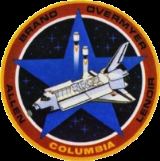
The six white stars in the upper blue field of the mission patch indicate the flight's numerical designation in the Space Transportation System's mission sequence.Wake-up calls
NASA began a tradition of playing music to astronauts during the Gemini program, and first used music to wake up a flight crew during Apollo 15Apollo 15
Apollo 15 was the ninth manned mission in the American Apollo space program, the fourth to land on the Moon and the eighth successful manned mission. It was the first of what were termed "J missions", long duration stays on the Moon with a greater focus on science than had been possible on previous...
. Each track is specially chosen, often by the astronauts' families, and usually has a special meaning to an individual member of the crew, or is applicable to their daily activities.
| Flight Day | Song | Artist/Composer |
|---|---|---|
| Day 2 | "Cadets on Parade" | Air Force Academy Band |
| Day 3 | "Teach Me Tiger" | April Stevens April Stevens April Stevens is an American singer.She has recorded since she was 15 years old. Her most popular solo recording was her RCA Victor recording of "I'm in Love Again" . Accompanied by an orchestra arranged and conducted by Henri René, Stevens' recording peaked at No... |
| Day 4 | "Theme from F-Troop" | |
| Day 5 | "The Poor Co-pilot" | Oscar Brand Oscar Brand Oscar Brand is a folk singer, songwriter, and author. In his career, spanning over 60 years, he has composed at least 300 songs and released nearly 100 albums, among them Canadian and American patriotic songs... |
| Day 6 | "Ode to the Lions" | Rusty Gordon |
See also
- SpaceflightSpaceflightSpaceflight is the act of travelling into or through outer space. Spaceflight can occur with spacecraft which may, or may not, have humans on board. Examples of human spaceflight include the Russian Soyuz program, the U.S. Space shuttle program, as well as the ongoing International Space Station...
- Space Shuttle programSpace Shuttle programNASA's Space Shuttle program, officially called Space Transportation System , was the United States government's manned launch vehicle program from 1981 to 2011...
- Space Shuttle ChallengerSpace Shuttle ChallengerSpace Shuttle Challenger was NASA's second Space Shuttle orbiter to be put into service, Columbia having been the first. The shuttle was built by Rockwell International's Space Transportation Systems Division in Downey, California...
- Space Shuttle Challenger disasterSpace Shuttle Challenger disasterThe Space Shuttle Challenger disaster occurred on January 28, 1986, when Space Shuttle Challenger broke apart 73 seconds into its flight, leading to the deaths of its seven crew members. The spacecraft disintegrated over the Atlantic Ocean, off the coast of central Florida at 11:38 am EST...
- List of space shuttle missions
- List of spacewalks and moonwalks
- List of human spaceflights chronologically