

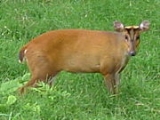
Indian Muntjac

Encyclopedia
The Common Muntjac also called the Red Muntjac, Indian Muntjac or Barking deer is the most numerous muntjac
deer species. It has soft, short, brownish or greyish hair, sometimes with creamy markings. This species is omnivorous, feeding on fruits, shoots, seeds, birds' eggs as well as small animals and even carrion
. It gives calls similar to barking, usually on sensing a predator (hence the common name for all muntjacs of barking deer).
The male Indian Muntjac has small antlers which attain 15 cm in length and have only 1 branch. They grow annually from a bony stalk on the head. Males are extremely territorial and can be fierce for their size. They will fight each other for territory using their antlers or their (more dangerous) tusk-like upper canine teeth, and can defend themselves against predators such as dogs.
. This species is distributed throughout South Asia, but more densely located in Southeastern Asia. Some specific countries the Indian Muntjac is found in are Northeastern India
, Bangladesh
, Sri Lanka
, Nepal
, Islamabad Pakistan
, Southern China
, Vietnam
, the Malay peninsula, Riau Archipelago
, Sumatra
, Bangka, Belitung Islands, Java
, Bali
, Cambodia
, and Borneo
. The Muntjac is usually found in plentiful forests and places with dense vegetation such as grasslands, savannas, tropical deciduous
forests, and tropical scrub forests. They are also very populated in the hilly country on the slopes of the Himalayas
. They are found at both sea level and medium height altitudes up to 9,800 ft. They never wander far from water. Also, males usually have their own territory which may overlap the territories of a few females but not of another male.
or some other predator. During the time of the rut
, territorial lines are temporarily disregarded and overlap while males roam constantly in search of a receptive female.
These deer are incredibly alert creatures. When put into a stressful situation or if a predator is sensed, Muntjacs will begin making a bark-like sound. Barking was originally thought of as a means of communication between the deer during mating season as well as an alert. However, in more recent studies it has been identified as a mechanism used solely in alarming situations meant to cause a predator to realize that it has been detected and move elsewhere or to reveal itself. The barking mechanism is used more frequently when visibility is reduced and can last for over an hour regarding one incident.
Muntjacs exhibit both diurnality and nocturnality.
Muntjac
Muntjac, also known as Barking Deer and Mastreani Deer, are small deer of the genus Muntiacus. Muntjac are the oldest known deer, appearing 15–35 million years ago, with remains found in Miocene deposits in France, Germany and Poland....
deer species. It has soft, short, brownish or greyish hair, sometimes with creamy markings. This species is omnivorous, feeding on fruits, shoots, seeds, birds' eggs as well as small animals and even carrion
Carrion
Carrion refers to the carcass of a dead animal. Carrion is an important food source for large carnivores and omnivores in most ecosystems. Examples of carrion-eaters include vultures, hawks, eagles, hyenas, Virginia Opossum, Tasmanian Devils, coyotes, Komodo dragons, and burying beetles...
. It gives calls similar to barking, usually on sensing a predator (hence the common name for all muntjacs of barking deer).
The male Indian Muntjac has small antlers which attain 15 cm in length and have only 1 branch. They grow annually from a bony stalk on the head. Males are extremely territorial and can be fierce for their size. They will fight each other for territory using their antlers or their (more dangerous) tusk-like upper canine teeth, and can defend themselves against predators such as dogs.
Introduction
The Indian Muntjac (Muntiacus muntjak) is also commonly called the "barking deer" due to the bark-like sound that it makes as an alarm when danger is present. It is also called "Karkar". Sometimes these deer will bark for an hour or more. This species is one of eleven different species of Muntjacs spread across Asia. The Indian Muntjacs specifically are widespread throughout Southern Asia, but are one of the least known Asian animals. Paleontological evidence proves that Indian Muntjacs have been around since the late Pleistocene epoch at least 12,000 years ago. Since then, they have played a major role in Southern Asia for sport hunting as well as being hunted for its meat and skin. Often, these animals are hunted around the outskirts of agricultural areas because they can be considered a nuisance damaging crops and ripping bark off of trees. However, this animal is still in an abundance in Southern Asia numbering anywhere from 140,000-150,000 in India alone as of 2004.Description
The Indian Muntjac has a short but very soft, thick, dense coat, especially those living in cooler regions. Coloration of the coat changes from dark brown to yellowish and grayish brown depending on the season. The Muntjacs' coat is golden tan on the dorsal side and white on the ventral side of the body, the limbs are dark brown to reddish brown, and the face is dark brown. However, the ears have very little hair which barely covers them. Male muntjacs have antlers that are very short, about 1-2 inches, usually consisting of only two or three points at the most and protrude from long body hair covered pedicels on the forehead. Females have tufts of fur and small bony knobs where the antlers are located in males. Males also have slightly elongated upper canines about an inch long that curve slightly outward from the lips and have the capability to inflict serious injury upon other animals or to other members of the population while exhibiting aggression. Males are generally larger than females. The body length of Muntjacs varies from 35-53 in wide and their height ranges from 15-26 in tall.Habitat
The Indian Muntjac is among the most widespread but least known of all the animals in South AsiaSouth Asia
South Asia, also known as Southern Asia, is the southern region of the Asian continent, which comprises the sub-Himalayan countries and, for some authorities , also includes the adjoining countries to the west and the east...
. This species is distributed throughout South Asia, but more densely located in Southeastern Asia. Some specific countries the Indian Muntjac is found in are Northeastern India
India
India , officially the Republic of India , is a country in South Asia. It is the seventh-largest country by geographical area, the second-most populous country with over 1.2 billion people, and the most populous democracy in the world...
, Bangladesh
Bangladesh
Bangladesh , officially the People's Republic of Bangladesh is a sovereign state located in South Asia. It is bordered by India on all sides except for a small border with Burma to the far southeast and by the Bay of Bengal to the south...
, Sri Lanka
Sri Lanka
Sri Lanka, officially the Democratic Socialist Republic of Sri Lanka is a country off the southern coast of the Indian subcontinent. Known until 1972 as Ceylon , Sri Lanka is an island surrounded by the Indian Ocean, the Gulf of Mannar and the Palk Strait, and lies in the vicinity of India and the...
, Nepal
Nepal
Nepal , officially the Federal Democratic Republic of Nepal, is a landlocked sovereign state located in South Asia. It is located in the Himalayas and bordered to the north by the People's Republic of China, and to the south, east, and west by the Republic of India...
, Islamabad Pakistan
Pakistan
Pakistan , officially the Islamic Republic of Pakistan is a sovereign state in South Asia. It has a coastline along the Arabian Sea and the Gulf of Oman in the south and is bordered by Afghanistan and Iran in the west, India in the east and China in the far northeast. In the north, Tajikistan...
, Southern China
China
Chinese civilization may refer to:* China for more general discussion of the country.* Chinese culture* Greater China, the transnational community of ethnic Chinese.* History of China* Sinosphere, the area historically affected by Chinese culture...
, Vietnam
Vietnam
Vietnam – sometimes spelled Viet Nam , officially the Socialist Republic of Vietnam – is the easternmost country on the Indochina Peninsula in Southeast Asia. It is bordered by China to the north, Laos to the northwest, Cambodia to the southwest, and the South China Sea –...
, the Malay peninsula, Riau Archipelago
Riau Archipelago
Not to be confused with Riau Islands Province, a province of Indonesia.The Riau Archipelago is the core group of islands within the Riau Islands Province in Indonesia, and located south of Singapore...
, Sumatra
Sumatra
Sumatra is an island in western Indonesia, westernmost of the Sunda Islands. It is the largest island entirely in Indonesia , and the sixth largest island in the world at 473,481 km2 with a population of 50,365,538...
, Bangka, Belitung Islands, Java
Java
Java is an island of Indonesia. With a population of 135 million , it is the world's most populous island, and one of the most densely populated regions in the world. It is home to 60% of Indonesia's population. The Indonesian capital city, Jakarta, is in west Java...
, Bali
Bali
Bali is an Indonesian island located in the westernmost end of the Lesser Sunda Islands, lying between Java to the west and Lombok to the east...
, Cambodia
Cambodia
Cambodia , officially known as the Kingdom of Cambodia, is a country located in the southern portion of the Indochina Peninsula in Southeast Asia...
, and Borneo
Borneo
Borneo is the third largest island in the world and is located north of Java Island, Indonesia, at the geographic centre of Maritime Southeast Asia....
. The Muntjac is usually found in plentiful forests and places with dense vegetation such as grasslands, savannas, tropical deciduous
Deciduous
Deciduous means "falling off at maturity" or "tending to fall off", and is typically used in reference to trees or shrubs that lose their leaves seasonally, and to the shedding of other plant structures such as petals after flowering or fruit when ripe...
forests, and tropical scrub forests. They are also very populated in the hilly country on the slopes of the Himalayas
Himalayas
The Himalaya Range or Himalaya Mountains Sanskrit: Devanagari: हिमालय, literally "abode of snow"), usually called the Himalayas or Himalaya for short, is a mountain range in Asia, separating the Indian subcontinent from the Tibetan Plateau...
. They are found at both sea level and medium height altitudes up to 9,800 ft. They never wander far from water. Also, males usually have their own territory which may overlap the territories of a few females but not of another male.
Diet
The Indian Muntjacs are classified as omnivores. They are considered both browsers and grazers with a diet consisting of grasses, ivy, prickly bushes, low growing leaves, bark, twigs, herbs, fruit, sprouts, seeds, tender shoots, bird eggs and small warm-blooded animals. Indian Muntjacs are typically found feeding at the edge of the forest or in abandoned clearings. Their large canine teeth help in the processes of retrieving and ingesting food.Reproduction
The Indian Muntjacs are polygamous animals. Females sexually mature during their first to second year of life. These females are polyestrous, with each cycle lasting about 14 to 21 days and an estrus lasting for 2 days. The gestation period is six to seven months and they usually bear one offspring at a time but sometimes produce twins. Females usually give birth in dense growth so that they are hidden from the rest of the herd and predators. The young leaves its mother after about six months to establish its own territory. Males often fight between one another for possession of a harem of females. Indian Muntjacs are distinguished from other ungulates in showing no evidence of a specific breeding season within the species.Behavior
Indian Muntjacs are regarded as extremely solitary animals, rarely observed with other muntjacs, except for a mother and her young and during the rutting season. Males acquire territories that they mark with scent markers by rubbing their frontal preorbital gland (located on their head) on the ground and on trees, scraping their hooves against the ground, and scraping the bark of trees with their lower incisors. These scent markers allow other Muntjacs to know whether a territory is occupied or not. Males will often fight with each other over these territories, sufficient vegetation, and for primary preference over females when mating using their short antlers and an even more dangerous weapon, their canines. If a male is not strong enough to acquire his own territory he will most likely become prey to a leopardLeopard
The leopard , Panthera pardus, is a member of the Felidae family and the smallest of the four "big cats" in the genus Panthera, the other three being the tiger, lion, and jaguar. The leopard was once distributed across eastern and southern Asia and Africa, from Siberia to South Africa, but its...
or some other predator. During the time of the rut
RUT
RUT may refer to:* Rol Único Tributario, the Chilean taxation unique contributor roll identification number* Rutland Railway, a former railroad in the northeastern United States...
, territorial lines are temporarily disregarded and overlap while males roam constantly in search of a receptive female.
These deer are incredibly alert creatures. When put into a stressful situation or if a predator is sensed, Muntjacs will begin making a bark-like sound. Barking was originally thought of as a means of communication between the deer during mating season as well as an alert. However, in more recent studies it has been identified as a mechanism used solely in alarming situations meant to cause a predator to realize that it has been detected and move elsewhere or to reveal itself. The barking mechanism is used more frequently when visibility is reduced and can last for over an hour regarding one incident.
Muntjacs exhibit both diurnality and nocturnality.
Subspecies
There are 15 subspecies:- M. m. annamensis, IndochinaIndochinaThe Indochinese peninsula, is a region in Southeast Asia. It lies roughly southwest of China, and east of India. The name has its origins in the French, Indochine, as a combination of the names of "China" and "India", and was adopted when French colonizers in Vietnam began expanding their territory...
- M. m. aureus, peninsular IndiaIndiaIndia , officially the Republic of India , is a country in South Asia. It is the seventh-largest country by geographical area, the second-most populous country with over 1.2 billion people, and the most populous democracy in the world...
- M. m. bancanus, Billiton and Banka IslandBankaBanka may refer to:* Banka, Bihar, a town in Bihar, India* Banka district, Bihar, India* Bankə, Azerbaijan*Banka, Cameroon* the Banka Gold Mining Project operated by Mwana Africa plc, in Ghana...
s - M. m. curvostylis, ThailandThailandThailand , officially the Kingdom of Thailand , formerly known as Siam , is a country located at the centre of the Indochina peninsula and Southeast Asia. It is bordered to the north by Burma and Laos, to the east by Laos and Cambodia, to the south by the Gulf of Thailand and Malaysia, and to the...
- M. m. grandicornis, Burmese Muntjac, Burma
- M. m. malabaricus, South India and Sri LankaSri LankaSri Lanka, officially the Democratic Socialist Republic of Sri Lanka is a country off the southern coast of the Indian subcontinent. Known until 1972 as Ceylon , Sri Lanka is an island surrounded by the Indian Ocean, the Gulf of Mannar and the Palk Strait, and lies in the vicinity of India and the...
- M. m. montanus, Mountain Muntjac, SumatraSumatraSumatra is an island in western Indonesia, westernmost of the Sunda Islands. It is the largest island entirely in Indonesia , and the sixth largest island in the world at 473,481 km2 with a population of 50,365,538...
- M. m. muntjak, Javan Muntjac, Java and south Sumatra
- M. m. nainggolani, BaliBaliBali is an Indonesian island located in the westernmost end of the Lesser Sunda Islands, lying between Java to the west and Lombok to the east...
and LombokLombokLombok is an island in West Nusa Tenggara province, Indonesia. It forms part of the chain of the Lesser Sunda Islands, with the Lombok Strait separating it from Bali to the west and the Alas Strait between it and Sumbawa to the east...
Islands - M. m. nigripes, Black-footed or Black-legged Muntjac, VietnamVietnamVietnam – sometimes spelled Viet Nam , officially the Socialist Republic of Vietnam – is the easternmost country on the Indochina Peninsula in Southeast Asia. It is bordered by China to the north, Laos to the northwest, Cambodia to the southwest, and the South China Sea –...
and HainanHainanHainan is the smallest province of the People's Republic of China . Although the province comprises some two hundred islands scattered among three archipelagos off the southern coast, of its land mass is Hainan Island , from which the province takes its name...
Island - M. m. peninsulae, Malaysia
- M. m. pleicharicus, South BorneoBorneoBorneo is the third largest island in the world and is located north of Java Island, Indonesia, at the geographic centre of Maritime Southeast Asia....
- M. m. robinsoni, BintanBintanBintan Island or Negeri Segantang Lada is an island in the Riau archipelago of Indonesia. It is part of the Riau Islands province, the capital of which, Tanjung Pinang, lies in the island's south and is the island's main community....
Island and Linga Archipelago - M. m. rubidus, North Borneo
- M. m. vaginalis, Burma to southwest ChinaChinaChinese civilization may refer to:* China for more general discussion of the country.* Chinese culture* Greater China, the transnational community of ethnic Chinese.* History of China* Sinosphere, the area historically affected by Chinese culture...