

IE 201 Class

Encyclopedia
The Iarnród Éireann
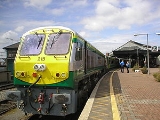
(IE) 201 Class locomotives are the newest and most powerful diesel locomotives operating in Ireland, and were built between 1994 and 1995 by General Motors. They are model type JT42HCW, fitted with an EMD 12-710G3B
engine of 3200 hp, weigh 112 tonnes and have a maximum speed of 164 km/h (102 mph). A freight version, the EMD Series 66
, with the same engine is used on privately operated British and European mainline freight duties.
in Ireland in the mid 1990s allowed Iarnród Éireann to begin significant investment in the infrastructure of the railways, which began with an order for 32 brand new express locomotives from GM-EMD. Northern Ireland Railways
also purchased 2. The first were delivered in 1994, with deliveries continuing until 1995.
To allow clearance tests and driver training to commence in advance of the delivery of the main order of 201s, it was decided to transport the first locomotive, number 201, to Dublin by air. An Antonov An-124
was used to transport the locomotive from London, Ontario
to Dublin Airport
, arriving on 9 June 1994. The first light-engine test run operated from Inchicore works to Kildare on the 14th.
* NPP = Non Push-Pull Capable; PP = Push-Pull Capable
equipped members of the 201 class were repainted in a new livery of Fern Green to coincide with the deployment of new MK4 carriages which were rolled out during 2006-2007 to serve on the Dublin-Cork line. Apart from the Enterprise Dublin-Belfast line, This is the only in Ireland were locomotive hauled coaches are in use.
, and are painted in a special livery of (Dark Grey (NCS
8502-Y), Light Grey (NCS 5502-Y), Dark Green (NCS 9005-G20Y), Purple (NCS 5040-R40B) & Bronze stripe (3M
180-229)).
Because of the shared nature of these services, 8208 and 209 are owned by Northern Ireland Railways
. This explains the different naming arrangements for these two locomotives. Enterprise services require electrical power to be supplied from the locomotive - head end power
.
, with the IÉ locomotives carrying two nameplates, one in Irish
and one in English
, on each side of the locomotive. As 8208 and 209 are owned by Northern Ireland Railways, they carry English language only nameplates. The nameplates are trapezium
shaped, with the names in upper case.
railcars on the vast majority of passenger services. This will leave the Dublin-Cork services, with the Mark 4
, as the only locomotive hauled passenger service operated by Iarnród Éireann
. The reduction in the number of locomotive hauled passenger workings, combined with the steady withdrawal of older GM locomotives, has seen 201 Class locomotives increasingly used on freight workings, while four push-pull capable units have been transferred to Enterprise to ease the strain on the four original units. Iarnród Éireann plans to store some of its remaining push-pull capable Mark 3 coaches, which could potentially be used with 201 Class locomotives to enhance Enterprise's service.
In October 2010 at the MRSI Model Railway Exhibition, Murphy Models announced plans to produce their own version of the class 201 to an all new tooling, complete with a sample model for production in the next year.
Model Irish Railways produce a resin body shell kit that includes nameplates, numbering, brass grills and the standard yellow / black livery line transfers.
Marks Models also released a resin kit for these locomotives in 00 gauge around the year 2000.
There is also speculation that Hornby, who now own the moulds for these models, may make a full production run of these models. This would be a first, as they have never made an Irish loco for the mainstream market before.
Studio Scale Models http://www.studio-scale-models.com make transfers for the full range of 201 liveries, No's 201-234, original and updated Orange, original and updated Enterprise and Green Intercity.
The 201 class has also been released in virtual form as a player driveable locomotive in the Microsoft Train Simulator
add-on, "Irish Enterprise North", by Making Tracks.http://www.makingtracks-online.co.uk/index.php?option=com_content&view=article&id=23&Itemid=46
Iarnród Éireann
Iarnród Éireann is the national railway system operator of Ireland. Established on 2 February 1987, it is a subsidiary of Córas Iompair Éireann . It operates all internal intercity, commuter and freight railway services in the Republic of Ireland, and, jointly with Northern Ireland Railways, the...
(IE) 201 Class locomotives are the newest and most powerful diesel locomotives operating in Ireland, and were built between 1994 and 1995 by General Motors. They are model type JT42HCW, fitted with an EMD 12-710G3B
EMD 710
The EMD 710 is a line of diesel engines built by Electro-Motive Diesel . The 710 series largely replaced the earlier EMD 645 series. The EMD 710 is a large two-stroke diesel engine that has a displacement per cylinder. Since its introduction, EMD has continually upgraded the 710G diesel engine...
engine of 3200 hp, weigh 112 tonnes and have a maximum speed of 164 km/h (102 mph). A freight version, the EMD Series 66
EMD Series 66
The Electro-Motive Diesel Class 66 is a series of Co-Co six axle diesel locomotives built by EMD for the European heavy freight market....
, with the same engine is used on privately operated British and European mainline freight duties.
History
By the early 1990s, the locomotives operating passenger services in Ireland were becoming increasingly obsolete, with the newest type in service being the 071 Class introduced in 1976. The economic boomCeltic Tiger
Celtic Tiger is a term used to describe the economy of Ireland during a period of rapid economic growth between 1995 and 2007. The expansion underwent a dramatic reversal from 2008, with GDP contracting by 14% and unemployment levels rising to 14% by 2010...
in Ireland in the mid 1990s allowed Iarnród Éireann to begin significant investment in the infrastructure of the railways, which began with an order for 32 brand new express locomotives from GM-EMD. Northern Ireland Railways
Northern Ireland Railways
NI Railways, also known as Northern Ireland Railways and for a brief period of time, Ulster Transport Railways , is the railway operator in Northern Ireland...
also purchased 2. The first were delivered in 1994, with deliveries continuing until 1995.
To allow clearance tests and driver training to commence in advance of the delivery of the main order of 201s, it was decided to transport the first locomotive, number 201, to Dublin by air. An Antonov An-124
Antonov An-124
The Antonov An-124 Ruslan is a strategic airlift jet aircraft. It was designed by the Ukrainian SSR's Antonov design bureau, then part of the Soviet Union. It is the world's largest ever serially-manufactured cargo airplane and world's second largest operating cargo aircraft...
was used to transport the locomotive from London, Ontario
London, Ontario
London is a city in Southwestern Ontario, Canada, situated along the Quebec City – Windsor Corridor. The city has a population of 352,395, and the metropolitan area has a population of 457,720, according to the 2006 Canadian census; the metro population in 2009 was estimated at 489,274. The city...
to Dublin Airport
Dublin Airport
Dublin Airport, , is operated by the Dublin Airport Authority. Located in Collinstown, in the Fingal part of County Dublin, 18.4 million passengers passed through the airport in 2010, making it the busiest airport in the Republic of Ireland, followed by Cork and Shannon...
, arriving on 9 June 1994. The first light-engine test run operated from Inchicore works to Kildare on the 14th.
Technical details
- Main Generator Assembly: AR8PHEH/CA6
- Head End Alternator (HEP): Dayton-Phoenix, model E7145, 438 kVA, 220/380VAC, 3-phase, 50 Hz
- Standby HEP: 220 kVA from AR8, available only when stationary
- Auxiliary Generator: 5A-8147http://www.dayton-phoenix.com/productfamily.php?family_key=49, 18 kW
- Air Compressor/Exhauster: Gardner Denver, model WLPA9B
- Multiple Working: All IE & NIR EMD locos
- Push Pull Working: Locos 206-209 & 215-234
- Curve Negotiation Capability:
- Yard: 80 m (262 ft)
- Running line: 115 m (377 ft)
- Coupled to train: 141 m (463 ft)
Equipment new to IÉ locos
- Air Dryer
- Teloc 2200 Event RecorderEvent recorderA Train event recorder is similar to the flight data recorder found on aircraft. It records data about the operation of train controls and performance in response to those controls and other train control systems.Data storage is provided by magnetic tape, battery-backed RAM and, most recently,...
http://www.haslerrail.com/main.php?act=content&rec=3 - Electrically heated windscreens
- Active noise controlActive noise controlActive noise control is a method for reducing unwanted sound.- Explanation :...
in both cabs - Enclosed body style, last seen on 1950s Metro-VicMetropolitan-VickersMetropolitan-Vickers, Metrovick, or Metrovicks, was a British heavy electrical engineering company of the early-to-mid 20th century formerly known as British Westinghouse. Highly diversified, they were particularly well known for their industrial electrical equipment such as generators, steam...
ACIE 001 ClassThe Córas Iompair Éireann 001 Class locomotive was manufactured by Metropolitan-Vickers at their Dukinfield Works in Manchester.The 001 Class locomotive was the backbone of mainline passenger and freight train services on the Irish railway network for forty years from 1955 until the mid-1990s when...
and CCIE 201 ClassThe Córas Iompair Éireann 201 Class was a class of 34 diesel electric locomotives manufactured by Metropolitan-Vickers at their Dukinfield Works in Manchester. They were a smaller, lighter and less powerful version of the 001 Class and were originally intended for branch line passenger and freight...
Classes - Head End PowerHead end powerHead end power or electric train supply is a rail transport term for the electrical power distribution system on a passenger train. The power source, usually a locomotive at the front or “head” of a train or a generator car, generates all the electricity used for lighting, electrical and other...
(HEP)- This system supplies AC power to the train for heating, battery charging, etc. and was intended to replace the existing Mk2 & Mk3 Generator Vans. In the event HEP is only used on the cross-border De Dietrich service. The later CAF MK4 trains include their own generators in the Driving Van TrailerDriving Van TrailerA Driving Van Trailer is a purpose-built railway vehicle that allows the driver to operate a locomotive at the opposite end of a train. Trains operating with a DVT therefore do not require the locomotive to be moved around to the other end of the train at terminal stations...
(DVT).
- This system supplies AC power to the train for heating, battery charging, etc. and was intended to replace the existing Mk2 & Mk3 Generator Vans. In the event HEP is only used on the cross-border De Dietrich service. The later CAF MK4 trains include their own generators in the Driving Van Trailer
- EM2000 digital traction computer
- Train (coach) door control
- D43 Traction Motors
- Super Series wheel creep controlhttp://www.railway-technical.com/elec-loco-bloc.html
- Cab mounted electronic fuel gauges
- Fire suppression system, FM200 extinguisher
Variants
There are three versions within the Class 201:- 201 to 205 & 210 to 214
- Fixed buffers, shackle coupling
- 215 to 226, 229, 232 and 234
- Retractable buffers, electronic fuel gauges, automatic or shackle coupling, Push-pullPush-pull trainPush–pull is a mode of operation for locomotive-hauled trains allowing them to be driven from either end.A push–pull train has a locomotive at one end of the train, connected via some form of remote control, such as multiple-unit train control, to a vehicle equipped with a control cab at the other...
capability.
- Retractable buffers, electronic fuel gauges, automatic or shackle coupling, Push-pull
- 206 to 209, 227, 228, 230, 231 & 233
- Retractable buffers, electronic fuel gauges, automatic or shackle coupling, Push-pullPush-pull trainPush–pull is a mode of operation for locomotive-hauled trains allowing them to be driven from either end.A push–pull train has a locomotive at one end of the train, connected via some form of remote control, such as multiple-unit train control, to a vehicle equipped with a control cab at the other...
capability, fitted with HaslerRail 2500 Event recorderEvent recorderA Train event recorder is similar to the flight data recorder found on aircraft. It records data about the operation of train controls and performance in response to those controls and other train control systems.Data storage is provided by magnetic tape, battery-backed RAM and, most recently,...
, NIR train radio and TPWS/AWSAutomatic Warning SystemThe Automatic Warning System is a form of limited cab signalling and train protection system introduced in 1956 in the United Kingdom to help train drivers observe and obey signals. It was based on a 1930 system developed by Alfred Ernest Hudd and marketed as the "Strowger-Hudd" system...
for cross-border service
- Retractable buffers, electronic fuel gauges, automatic or shackle coupling, Push-pull
Fleet
| Subclass | Number built | Number range | Operator | Notes |
|---|---|---|---|---|
| 201 (NPP) | 10 | 201-205, 210-214 | Intercity | In storage |
| 201 (PP) | 24 | 215-226, 229, 232, 234 | 215 & 216 in storage | |
| 206-209, 227, 228, 230, 231, 233 | Enterprise | 208-209 owned by NIR; others owned by IÉ |
Intercity
InterCity operated, push-pullPush-pull train
Push–pull is a mode of operation for locomotive-hauled trains allowing them to be driven from either end.A push–pull train has a locomotive at one end of the train, connected via some form of remote control, such as multiple-unit train control, to a vehicle equipped with a control cab at the other...
equipped members of the 201 class were repainted in a new livery of Fern Green to coincide with the deployment of new MK4 carriages which were rolled out during 2006-2007 to serve on the Dublin-Cork line. Apart from the Enterprise Dublin-Belfast line, This is the only in Ireland were locomotive hauled coaches are in use.
Enterprise
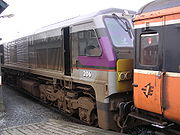
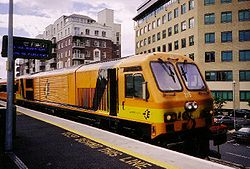
Numbers 206, 207, 8208, 209, 227, 228, 230, 231 & 233 are dedicated for use on the Enterprise passenger service between Dublin and BelfastBelfast
Belfast is the capital of and largest city in Northern Ireland. By population, it is the 14th biggest city in the United Kingdom and second biggest on the island of Ireland . It is the seat of the devolved government and legislative Northern Ireland Assembly...
, and are painted in a special livery of (Dark Grey (NCS
Natural Color System
The Natural Color System is a proprietary perceptual color model published by the Scandinavian Colour Institute of Stockholm, Sweden. It is based on the color opponency description of color vision, first proposed by German physiologist Ewald Hering...
8502-Y), Light Grey (NCS 5502-Y), Dark Green (NCS 9005-G20Y), Purple (NCS 5040-R40B) & Bronze stripe (3M
3M
3M Company , formerly known as the Minnesota Mining and Manufacturing Company, is an American multinational conglomerate corporation based in Maplewood, Minnesota, United States....
180-229)).
Because of the shared nature of these services, 8208 and 209 are owned by Northern Ireland Railways
Northern Ireland Railways
NI Railways, also known as Northern Ireland Railways and for a brief period of time, Ulster Transport Railways , is the railway operator in Northern Ireland...
. This explains the different naming arrangements for these two locomotives. Enterprise services require electrical power to be supplied from the locomotive - head end power
Head end power
Head end power or electric train supply is a rail transport term for the electrical power distribution system on a passenger train. The power source, usually a locomotive at the front or “head” of a train or a generator car, generates all the electricity used for lighting, electrical and other...
.
List of locomotive names
The entire class is named after Irish riversRivers of Ireland
The longest river in Ireland is the The longest river in [[Ireland]] is the The longest river in [[Ireland]] is the [[River Shannon, 386 km . The river develops into three lakes along its course, [[Lough Allen]], [[Lough Ree]] and [[Lough Derg |Lough Derg]]. Of these, Lough Derg is the...
, with the IÉ locomotives carrying two nameplates, one in Irish
Irish language
Irish , also known as Irish Gaelic, is a Goidelic language of the Indo-European language family, originating in Ireland and historically spoken by the Irish people. Irish is now spoken as a first language by a minority of Irish people, as well as being a second language of a larger proportion of...
and one in English
English language
English is a West Germanic language that arose in the Anglo-Saxon kingdoms of England and spread into what was to become south-east Scotland under the influence of the Anglian medieval kingdom of Northumbria...
, on each side of the locomotive. As 8208 and 209 are owned by Northern Ireland Railways, they carry English language only nameplates. The nameplates are trapezium
Trapezium
The word trapezium has several meanings:* - a quadrilateral with one pair of parallel sides ....
shaped, with the names in upper case.
| Number | Name | Push-pull capable |
Livery | |
|---|---|---|---|---|
| Irish | English | |||
| 201 | Abhainn na Sionnainne | River Shannon River Shannon The River Shannon is the longest river in Ireland at . It divides the west of Ireland from the east and south . County Clare, being west of the Shannon but part of the province of Munster, is the major exception... |
No | orange/black |
| 202 | Abhainn na Laoi | River Lee River Lee River Lee may refer to:*The River Lea or Lee in England*The River Lee in Ireland... |
No | orange/black |
| 203 | Abhainn na Coiribe | River Corrib River Corrib The River Corrib in the west of Ireland flows from Lough Corrib through Galway to Galway Bay. The river is among the shortest in Europe, with only a length of six kilometres from the lough to the Atlantic. It is popular with local whitewater kayakers and is the training ground of , as well as... |
No | orange/black |
| 204 | Abhainn na Bearu | River Barrow River Barrow The Barrow is a river in Ireland. It is one of The Three Sisters; the other two being the River Suir and the River Nore. The Barrow is the longest and most prominent of the three rivers... |
No | orange/black |
| 205 | Abhainn na Feoire | River Nore River Nore The River Nore is a long river located in south-east of Ireland. Along with the River Suir and River Barrow, it is one of the constituent rivers of the group known as the Three Sisters. The river drains approximately of Leinster. The river rises in the Devil's Bit Mountain, North Tipperary... |
No | orange/black |
| 206 | Abhainn na Life | River Liffey River Liffey The Liffey is a river in Ireland, which flows through the centre of Dublin. Its major tributaries include the River Dodder, the River Poddle and the River Camac. The river supplies much of Dublin's water, and a range of recreational opportunities.-Name:The river was previously named An Ruirthech,... |
Yes | Enterprise |
| 207 | Abhainn na Bóinne | River Boyne River Boyne The River Boyne is a river in Leinster, Ireland, the course of which is about long. It rises at Trinity Well, Newbury Hall, near Carbury, County Kildare, and flows towards the Northeast through County Meath to reach the Irish Sea between Mornington, County Meath and Baltray, County Louth. Salmon... |
Yes | Enterprise (Full yellow ends) |
| 8208 | - | River Lagan River Lagan The River Lagan is a major river in Northern Ireland which runs 40 miles from the Slieve Croob mountain in County Down to Belfast where it enters Belfast Lough, an inlet of the Irish Sea. The River Lagan forms much of the border between County Antrim and County Down. It rises as a tiny fast... |
Yes | Revised Enterprise |
| 8209 | - | River Foyle River Foyle The River Foyle is a river in west Ulster in the northwest of Ireland, which flows from the confluence of the rivers Finn and Mourne at the towns of Lifford in County Donegal, Republic of Ireland, and Strabane in County Tyrone, Northern Ireland. From here it flows to the City of Derry, where it... |
Yes | Enterprise |
| 210 | Abhainn na hEirne | River Erne River Erne The River Erne , in the northwest of Ireland, rises in Beaghy Lough, two miles south of Stradone in County Cavan and flows 64 miles through Lough Gowna, Lough Oughter and Upper and Lower Lough Erne, County Fermanagh, to the sea at Ballyshannon, County Donegal... |
No | orange/black |
| 211 | Abhainn na Suca | River Suck River Suck The River Suck is a river in Ireland, approx. in length.It is the main tributary of the River Shannon. It meets the River Swilly a few kilometres north of the village of Shannonbridge to form the Suck-Swilly, which becomes the River Shannon.... |
No | orange/black |
| 212 | Abhainn na Slaine | River Slaney River Slaney The Slaney is a river in the southeast of Ireland. It rises on Lugnaquilla Mountain in the western Wicklow Mountains and flows west and then south through counties Wicklow, Carlow and Wexford, before entering St George's Channel in the Irish Sea at Wexford town... |
No | orange/black |
| 213 | Abhainn na Muaidhe | River Moy River Moy The River Moy rises at the foot of Knocknashee in the Northwest of Ireland.- Geography :The River Moy rises at the foot of Knocknashee in the Ox Mountains in County Sligo. It flows for 110 km... |
No | orange/black |
| 214 | Abhainn na Broshai | River Brosna River Brosna The River Brosna is a river in Ireland, flowing through County Westmeath and County Offaly.The river rises in Lough Owel north of Mullingar and is a tributary of the River Shannon. It meets the Shannon at Shannon Harbour.-Course:... |
No | orange/black |
| 215 | An Abhainn Mhor | River Avonmore River Avonmore The Avonmore River also known as Abhainn Dé flows from Lough Dan in the Wicklow Mountains west of Roundwood. It flows in a generally southerly direction for approximately before joining the Avonbeg at the Meeting of the Waters to form the River Avoca, which in turn discharges into the Irish Sea... |
Yes | Intercity |
| 216 | Abhainn na Dothra | River Dodder River Dodder The River Dodder is one of the three main rivers of the Dublin region in Ireland, the others being the Liffey, of which the Dodder is the largest tributary, and the Tolka.-Course and system:... |
Yes | Intercity |
| 217 | Abhainn na Fleisce | River Flesk | Yes | Intercity |
| 218 | Abhainn na Garbhoige | River Garavogue River Garavogue The Garavogue is a short and small river located in County Sligo, Ireland. From Lough Gill, it winds its way through Sligo town and into Sligo Bay. The name, Garavogue, comes from the Irish "garbh óg" meaning "young rough".... |
Yes | Intercity |
| 219 | Abhainn na Tulchann | River Tolka River Tolka The River Tolka is one of Dublin's three main rivers, flowing from County Meath to Fingal, within the old County Dublin, and through the north of Dublin city, Ireland. It is one of Dublin's three main rivers, the others being the Liffey and the Dodder... |
Yes | Intercity |
| 220 | An Abhainn Dhubh | River Blackwater | Yes | Intercity |
| 221 | Abhainn na Feilge | River Fealge | Yes | Intercity |
| 222 | Abhainn na Dargaile | River Dargle | Yes | Intercity |
| 223 | Abhainn na hAinnire | River Anner | Yes | Intercity |
| 224 | Abhainn na Féile | River Feale River Feale The River Feale rises near Rockchapel in the Mullaghareirk Mountains of County Cork in the southwest of Ireland and flows northwestwards through Abbeyfeale and Listowel in County Kerry before finally emptying into the Mouth of the Shannon by Ballyduff.-External links:*... |
Yes | Intercity |
| 225 | Abhainn na Daoile | River Deel River Deel The River Deel is in County Limerick, Ireland.The river rises near Dromina in North County Cork and flows north into County Limerick for over 60 km to enter the Shannon Estuary at Askeaton.... |
Yes | Intercity |
| 226 | Abhainn na Siuire | River Suir River Suir The River Suir is a river in Ireland that flows into the Atlantic Ocean near Waterford after a distance of .Popular with anglers, it holds plentiful reserves of brown trout... |
Yes | Intercity |
| 227 | Abhainn na Leamhna | River Laune River Laune The River Laune is a river in County Kerry, Ireland which flows from Lough Leane , one of the Lakes of Killarney, through the town of Killorglin, and empties into the sea, first at Castlemaine harbour beside the river Maine and then out through Dingle Bay. The Laune is well known for salmon and... |
Yes | Intercity |
| 228 | An Abhainn Bhui | River Owen | Yes | Intercity |
| 229 | Abhainn na Mainge | River Maine | Yes | Intercity |
| 230 | Abhainn na Bandan | River Bandon River Bandon The River Bandon is a river in County Cork in Ireland. It rises at Nowen Hill , to the north of Drimoleague.The river then flows to Dunmanway, before turning eastward towards the twin villages of Ballineen and Enniskean... |
Yes | Enterprise |
| 231 | Abhainn na Maighe | River Maigue River Maigue The River Maigue, rises in the Milford area of North County Cork, Ireland.It is joined by the small River Glen and the larger River Loobagh in south County Limerick. It then flows north through Bruree, after which it augmented by the River Morning Star... |
Yes | Intercity |
| 232 | Abhainn na Chaomaraigh | River Cummeragh | Yes | Intercity |
| 233 | Abhainn na Chlair | River Clare River Clare The River Clare is a river in counties Mayo and Galway in Ireland. The long river rises north of Ballyhaunis in Mayo and descends past Dunmore, where it flows west, then turns south past Milltown, continuing down through Kilbennan Church near Tuam... |
Yes | Enterprise (Full yellow ends) |
| 234 | Abhainn na hEatharlai | River Aherlow | Yes | Intercity |
Future
The future of some of the class is currently unclear. All of the non push-pull locomotives (201-205 and 210-214) were placed in storage at Inchicore during 2009, the last being 214 in July. This is due to the withdrawal and replacement of the Mark 3 coaching fleet with the 22000 ClassIE 22000 Class
The 22000 Class "InterCity Railcar" is a Diesel multiple unit type in service with Iarnród Éireann in Ireland.In a new departure for Iarnród Éireann they will be the first railcars to have been built specifically to serve on InterCity routes and are capable of up to 100 mph .-History:In 2005,...
railcars on the vast majority of passenger services. This will leave the Dublin-Cork services, with the Mark 4
Mark 4 (Iarnród Éireann)
The CAF Mark 4 are trains operated by Iarnród Éireann in the Republic of Ireland on the InterCity service from Dublin to Cork. These trains have no connection to the BR Mk 4.-Description:...
, as the only locomotive hauled passenger service operated by Iarnród Éireann
Iarnród Éireann
Iarnród Éireann is the national railway system operator of Ireland. Established on 2 February 1987, it is a subsidiary of Córas Iompair Éireann . It operates all internal intercity, commuter and freight railway services in the Republic of Ireland, and, jointly with Northern Ireland Railways, the...
. The reduction in the number of locomotive hauled passenger workings, combined with the steady withdrawal of older GM locomotives, has seen 201 Class locomotives increasingly used on freight workings, while four push-pull capable units have been transferred to Enterprise to ease the strain on the four original units. Iarnród Éireann plans to store some of its remaining push-pull capable Mark 3 coaches, which could potentially be used with 201 Class locomotives to enhance Enterprise's service.
Model
In 2001, Murphy Models commissioned LIMA to produce an '00' gauge model of these locomotives.http://www.murphymodels.com/Models.html They were produced in IÉ orange (201, 216, 217, 219, 230) and Enterprise (206, 207, 208, 209) liveries, all in batches of 300 (the exception being 500 of #207).In October 2010 at the MRSI Model Railway Exhibition, Murphy Models announced plans to produce their own version of the class 201 to an all new tooling, complete with a sample model for production in the next year.
Model Irish Railways produce a resin body shell kit that includes nameplates, numbering, brass grills and the standard yellow / black livery line transfers.
Marks Models also released a resin kit for these locomotives in 00 gauge around the year 2000.
There is also speculation that Hornby, who now own the moulds for these models, may make a full production run of these models. This would be a first, as they have never made an Irish loco for the mainstream market before.
Studio Scale Models http://www.studio-scale-models.com make transfers for the full range of 201 liveries, No's 201-234, original and updated Orange, original and updated Enterprise and Green Intercity.
The 201 class has also been released in virtual form as a player driveable locomotive in the Microsoft Train Simulator
Microsoft Train Simulator
Microsoft Train Simulator is a train simulator for Microsoft Windows, released in July 2001 and developed by UK based Kuju Entertainment, and is available for purchase through Amazon.com.-Gameplay:...
add-on, "Irish Enterprise North", by Making Tracks.http://www.makingtracks-online.co.uk/index.php?option=com_content&view=article&id=23&Itemid=46