

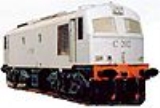
CIE 201 Class

Encyclopedia
The Córas Iompair Éireann
201 Class was a class of 34 diesel electric locomotives manufactured by Metropolitan-Vickers
at their Dukinfield Works in Manchester
. They were a smaller, lighter and less powerful version of the 001 Class
and were originally intended for branch line passenger and freight (mixed traffic) duties. They were introduced in 1956 and, although their duties changed over the years, were in regular service on the Irish railway network until the mid 1980s.
Replacement engines:
Because of the problems with the Crossley engines attempts were made to fit the locomotives with more suitable equipment. Between 1965 and 1980, Maybach
MD650 engines of 980 hp were fitted in Nos. 233 and 234. From 1969, however, a permanent solution was found by fitting the entire class with General Motors engines, a similar process that was also undergone by the 001 Class
).
New Duties:
From 1969 the class were given new duties, being partnered with former 2600 class
diesel multiple unit
s converted to four-car push-pull
carriage rakes to operate the suburban services around Dublin. In 1984 the Dublin suburban lines over which they worked were electrified and new electric multiple unit
s operated the renamed Dublin Area Rapid Transit
(DART) system.
The first member of the class to be withdrawn was No. 201, being bomb damaged in 1973. The remaining members of the class, except those sold to NIR, were withdrawn over the two years following the opening of the DART system having completed 30 years service for their operators.
Those locomotives sold to NIR carried their blue livery.
, which designated them 104 Class. They entered traffic for NIR in 1986-1987, except 105. Originally, CIÉ 224 was intended to become 105, but it was subsequently rejected by NIR and replaced by 218, which only entered traffic in 1991. 224 was left stored with NIR until it was scrapped in January 1996.
Of those that entered service, some had very short lives working for their new owners. They were stored as soon as any problems arose (e.g. a seized engine or traction motor), and the whole class was formally withdrawn in 1993 (107/109) or 1995 (the others). The locomotives involved, their new numbers and their withdrawal are set out below:
Córas Iompair Éireann
Córas Iompair Éireann , or CIÉ, is a statutory corporation of the Irish state, answerable to the Irish Government and responsible for most public transport in the Republic of Ireland and, jointly with its Northern Ireland counterpart, the Northern Ireland Transport Holding Company, between the...
201 Class was a class of 34 diesel electric locomotives manufactured by Metropolitan-Vickers
Metropolitan-Vickers
Metropolitan-Vickers, Metrovick, or Metrovicks, was a British heavy electrical engineering company of the early-to-mid 20th century formerly known as British Westinghouse. Highly diversified, they were particularly well known for their industrial electrical equipment such as generators, steam...
at their Dukinfield Works in Manchester
Manchester
Manchester is a city and metropolitan borough in Greater Manchester, England. According to the Office for National Statistics, the 2010 mid-year population estimate for Manchester was 498,800. Manchester lies within one of the UK's largest metropolitan areas, the metropolitan county of Greater...
. They were a smaller, lighter and less powerful version of the 001 Class
CIE 001 Class
The Córas Iompair Éireann 001 Class locomotive was manufactured by Metropolitan-Vickers at their Dukinfield Works in Manchester.The 001 Class locomotive was the backbone of mainline passenger and freight train services on the Irish railway network for forty years from 1955 until the mid-1990s when...
and were originally intended for branch line passenger and freight (mixed traffic) duties. They were introduced in 1956 and, although their duties changed over the years, were in regular service on the Irish railway network until the mid 1980s.
Problems and Solutions
Unfortunately, these locomotives suffered from two distinct problems:- During the late 1950s and early 1960s, following the publication of the Andrews Report, CIÉ followed a path of large-scale closures of branch lines, leaving them without a purpose.
- The locomotives were of insufficient power for their duties and their CrossleyCrossleyCrossley, based in Manchester, United Kingdom, was a pioneering company in the production of internal combustion engines. Since 1988 it has been part of the Rolls-Royce Power Engineering group.More than 100,000 Crossley oil and gas engines have been built....
engines suffered reliability problems.
Replacement engines:
Because of the problems with the Crossley engines attempts were made to fit the locomotives with more suitable equipment. Between 1965 and 1980, Maybach
Maybach
Maybach-Motorenbau GmbH is a German luxury car manufacturer. It was founded in 1909 by Wilhelm Maybach and his son. The company was originally a subsidiary of Luftschiffbau Zeppelin GmbH and was itself known as Luftfahrzeug-Motorenbau GmbH until 1912.Today, the ultra-luxury car brand is owned by...
MD650 engines of 980 hp were fitted in Nos. 233 and 234. From 1969, however, a permanent solution was found by fitting the entire class with General Motors engines, a similar process that was also undergone by the 001 Class
CIE 001 Class
The Córas Iompair Éireann 001 Class locomotive was manufactured by Metropolitan-Vickers at their Dukinfield Works in Manchester.The 001 Class locomotive was the backbone of mainline passenger and freight train services on the Irish railway network for forty years from 1955 until the mid-1990s when...
).
New Duties:
From 1969 the class were given new duties, being partnered with former 2600 class
CIÉ 2600 Class
The Córas Iompair Éireann 2600 Class were Associated Equipment Company –engined diesel multiple units that operated intercity and suburban services on the CIÉ system between 1951 and 1975...
diesel multiple unit
Diesel multiple unit
A diesel multiple unit or DMU is a multiple unit train consisting of multiple carriages powered by one or more on-board diesel engines. They may also be referred to as a railcar or railmotor, depending on country.-Design:...
s converted to four-car push-pull
Push-pull train
Push–pull is a mode of operation for locomotive-hauled trains allowing them to be driven from either end.A push–pull train has a locomotive at one end of the train, connected via some form of remote control, such as multiple-unit train control, to a vehicle equipped with a control cab at the other...
carriage rakes to operate the suburban services around Dublin. In 1984 the Dublin suburban lines over which they worked were electrified and new electric multiple unit
Electric multiple unit
An electric multiple unit or EMU is a multiple unit train consisting of self-propelled carriages, using electricity as the motive power. An EMU requires no separate locomotive, as electric traction motors are incorporated within one or a number of the carriages...
s operated the renamed Dublin Area Rapid Transit
Dublin Area Rapid Transit
The Dublin Area Rapid Transit is part of the suburban railway network in Ireland, running mainly along the coastline of Dublin Bay on the Trans-Dublin route, from Greystones in County Wicklow, through Dublin to Howth and Malahide in County Dublin.Trains are powered via a 1500V DC overhead catenary...
(DART) system.
The first member of the class to be withdrawn was No. 201, being bomb damaged in 1973. The remaining members of the class, except those sold to NIR, were withdrawn over the two years following the opening of the DART system having completed 30 years service for their operators.
Numbering
When built, these locomotives were numbered C201-C234, and as locomotives were re-engined, they were renumbered B201-B234 to reflect their increased power. However, the prefix letter was later dropped.Livery
Over the years the class has carried six different liveries. When introduced they were painted an all-over silver livery which unfortunately dirtied quickly and was not a good advert for dieselisation. This was followed by all-over CIE green livery with a thin lighter green band on the lower panels, giving a uniform appearance to the train sets. In the next change black became the base colour with just a white relief around the top panel, which opened to a squared-off 'V' between the cab windows. With the adaptation by CIE of its "Black and Tan" scheme in the mid 1960s, the locomotives received this livery with a white line at roof level to match the coaches. The last CIE livery was of Golden Brown with a very broad black band covering the upper panels at the level of, and as wide as, the cab windows.Those locomotives sold to NIR carried their blue livery.
NIR use
After withdrawal from CIÉ, six locomotives were sold to Northern Ireland RailwaysNorthern Ireland Railways
NI Railways, also known as Northern Ireland Railways and for a brief period of time, Ulster Transport Railways , is the railway operator in Northern Ireland...
, which designated them 104 Class. They entered traffic for NIR in 1986-1987, except 105. Originally, CIÉ 224 was intended to become 105, but it was subsequently rejected by NIR and replaced by 218, which only entered traffic in 1991. 224 was left stored with NIR until it was scrapped in January 1996.
Of those that entered service, some had very short lives working for their new owners. They were stored as soon as any problems arose (e.g. a seized engine or traction motor), and the whole class was formally withdrawn in 1993 (107/109) or 1995 (the others). The locomotives involved, their new numbers and their withdrawal are set out below:
| NIR number | Ex-CIÉ number | Stored | Scrapped |
|---|---|---|---|
| 104 | 216 | September 1994 | August 1997 |
| 105 | 218 | November 1993 | August 1997 |
| 106 | 227 | March 1995 | Preserved (see below) |
| 107 | 228 | June 1987 | January 1996 |
| 108 | 230 | December 1994 | August 1997 |
| 109 | 234 | August 1987 | March 1993 |
Preservation
- Two 201 Class locomotives, numbers 226 and 231, have been preserved by the Irish Traction GroupIrish Traction GroupThe Irish Traction Group is a railway preservation society dedicated to preserving diesel locomotives from Irish Railways. It was formed in 1989, with the intention of attempting to preserve at least one example of every type of diesel locomotive to have operated on Irish Rail.They currently own 13...
226 was the first mainline diesel to be preserved in Ireland. C231 is currently based at the West Clare Railway, painted in CIÉ Green livery, whilst 226 is undergoing restoration at Carrick-on-SuirCarrick-on-SuirCarrick-on-Suir is a town in South Tipperary in Ireland. As the name – meaning "the rock of the Suir" – suggests, the town is situated on the River Suir. The of the town gives the population as 5,906 and shows that it has grown by 5.7% since 2002...
. http://www.onirishrailways.fotopic.net/
- A third example, NIR 106/CIÉ 227 was preserved privately and displayed at CahirciveenCahirciveenCahersiveen —alternate spellings Cahirsiveen, Cahirciveen or Caherciveen—is a town in County Kerry, Ireland. It is located on the Iveragh Peninsula near Valentia Island. Cahersiveen is connected to the Irish road network by the N70 national secondary route...
, County KerryCounty KerryKerry means the "people of Ciar" which was the name of the pre-Gaelic tribe who lived in part of the present county. The legendary founder of the tribe was Ciar, son of Fergus mac Róich. In Old Irish "Ciar" meant black or dark brown, and the word continues in use in modern Irish as an adjective...
http://users.chariot.net.au/~nldoncas/nicspages/images/train%206.JPG http://users.chariot.net.au/~nldoncas/nicspages/the_irish_crossleys.htm and carries the number C202, which was supposedly the number of the locomotive hauling the last train from Cahirciveen in 1960 but it was in fact 227 which worked the train. Unfortunately, it has suffered almost continuous vandalism since being displayed in 1997.http://www.google.com/search?q=cache:Q7YRTZ1pgDkJ:www.unison.ie/irish_independent/stories.php3%3Fca%3D9%26si%3D1443335%26issue_id%3D12810+c202+acard&hl=en&ct=clnk&cd=5 It has now been moved to WaterfordWaterfordWaterford is a city in the South-East Region of Ireland. It is the oldest city in the country and fifth largest by population. Waterford City Council is the local government authority for the city and its immediate hinterland...
.

Models
- The C Class is available as a brass and white metal 00 gauge kit from No Nonsense Kits http://www.phoenix-paints.co.uk/mtkirish.asp, now acquired by Phoenix Paints.
- A resin version is available from Silver Fox Models.http://www.silverfoxmodels.co.uk/ie/201class.htm.
- A Rapid Prototyped N Scale body is available from Valve Design.http://www.shapeways.com/shops/valvedesign.