

Hogwarts

Encyclopedia
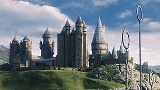
Hogwarts School of Witchcraft and Wizardry or simply Hogwarts is the primary setting for the first six books of the Harry Potter
series by J. K. Rowling
, with each book lasting the equivalent of one school year. It is a fictional boarding school
of magic
for witches and wizards between the ages of eleven and seventeen. In Harry Potter and the Deathly Hallows, however, most of the book is set outside Hogwarts as main characters Harry Potter
, Ron Weasley
, and Hermione Granger
do not attend their final year of school (though Rowling has stated that Hermione eventually returns to school to complete her N.E.W.T. examinations). The climactic battle of the book, and the series, however, is set at Hogwarts.
Rowling has suggested that she may have inadvertently taken the name from the hogwort
plant (Croton capitatus), which she had seen at Kew Gardens
some time before writing the Harry Potter series, although the names "The Hogwarts" and "Hoggwart" appear in the 1954 Nigel Molesworth
book How To Be Topp by Geoffrey Willans
.
Hogwarts school was voted as the 36th best Scottish educational establishment in a 2008 online ranking, outranking Edinburgh's Loretto School
. According to a director of the Independent Schools Network Rankings, it was added to the schools listing "for fun" and was then voted on.
 J. K. Rowling
says she visualises Hogwarts, in its entirety, to be:
In the novels, Hogwarts is somewhere in Scotland. (The film Prisoner of Azkaban
says that Dufftown
is near.) The school has numerous charms and spells on and around it that make it impossible for a Muggle
(i.e., a non-magical person) to locate it. Such people cannot see the school; rather, they see only ruins and several warnings of danger. The castle has extensive grounds with sloping lawns, flowerbeds and vegetable patches, a loch
(called The Black Lake), a large dense forest (called the Forbidden Forest), several greenhouse
s and other outbuildings, and a full-size Quidditch pitch. There is also an owlery, which houses all the owls owned by the school and those owned by students. Some rooms in the school tend to "move around", and so do the stairs in the grand staircase. Witches and wizards cannot Apparate or Disapparate in Hogwarts grounds, except when the Headmaster lifts the enchantment, whether only in certain areas or for the entire campus, so as to make the school less vulnerable when it serves the headmaster to allow Apparition. Electricity and electronic devices are not found at Hogwarts. In Harry Potter and the Goblet of Fire
, Hermione indicates that due to the high levels of magic, "substitutes for magic (that) Muggles use" such as computers, radar and electricity "go haywire" around Hogwarts. Radios however, make an exception. Rowling explains this by saying that the radios are not powered by electricity and are powered by magic.
Hogwarts is a coeducation
al, secondary boarding school
, taking children from ages eleven to eighteen. Education at Hogwarts is not compulsory, with some students being home schooled as stated in the seventh book. Rowling initially said there are about one thousand students at Hogwarts. She later suggested around six hundred, while acknowledging that this number was still inconsistent with the small number of people in Harry's year. She further explained that this had resulted from her creating only 40 characters for Harry's year.
The Headmaster or Headmistress, assisted by a Deputy Headmaster or Headmistress, undertakes management of the school. The Head is answerable to the twelve-member Board of Governors.
It is unclear how Hogwarts is funded. Various passages suggest that families pay to send their children to the school. In Harry Potter and the Half-Blood Prince
Tom Riddle says that he cannot afford to go to Hogwarts, to which Albus Dumbledore
replies, "There is a fund at Hogwarts for those who require assistance to buy books and robes," as students are required to buy their own textbooks, uniform, and other supplies. The Ministry of Magic
's efforts to take control of the school in Harry Potter and the Order of the Phoenix
imply that it is a publicly funded school, though no mention of where the Ministry receives its funds is made.
Rowling has said that Hogwarts is "a multifaith school".
Hogwarts is on the shore of a lake, sometimes called the Black Lake. In that lake are merpeople
, Grindylow
s, and a giant squid
. The giant squid does not attack humans and sometimes acts as a lifeguard
when students are in the lake.
because "you are either magical or you are not." Every year, a teacher checks this book and sends a letter to the children who are turning eleven. Acceptance or declination of a place at Hogwarts must be posted by 31 July. The letter also contains a list of supplies like spell books, uniform, and other things that the student will need. The prospective student is expected to buy all the necessary materials, normally from shops in Diagon Alley, a concealed street near Charing Cross Road
in London found behind a pub by the name of The Leaky Cauldron. Students who cannot afford their supplies can receive financial aid from the school, as happened with the young orphan Tom Riddle.
Letters to Muggle-born witches and wizards, who may not be aware of their powers and are unfamiliar with the concealed wizarding world, are delivered in person by a member of Hogwarts staff, who then explains to the parents or guardians about magical society, and reassures them regarding this news. They also assist the family in buying supplies and gaining access to Diagon Alley.
Each student is allowed to bring a cat, toad, rat or owl. Along with the acceptance letter, first year students are sent a list of required equipment which includes a wand, subject books, a standard size 2 pewter cauldron, a set of brass scales, a set of glass or crystal phials, a kit of basic potion ingredients (for Potions), and a telescope (for Astronomy). The Hogwarts uniform consists of plain work robes in black, a plain black hat, a pair of protective gloves, and a black winter cloak with silver fastenings. Each uniform must contain the wearer's nametag. First years are not allowed a broomstick of their own, though an exception to this rule is made for Harry in his first year after he demonstrates an excellent ability as a Seeker in Quidditch
.
Academic years are separated by holidays of about two months in the summer, and each year is divided into three terms by shorter holidays around Christmas and Easter.
From there, first year students are accompanied by the Keeper of the Keys, Game and Grounds (in Harry's case, Hagrid) – or another suitable teacher if he is absent – to small boats, which magically sail across the lake that get them near the entrance of Hogwarts. The older students ride up to the castle in carriages pulled by creatures called Thestrals who are invisible to many of the pupils. When the first-year students initially arrive at the castle, they wait in a small chamber off the entrance hall until the older students have taken their seats, and then enter the Great Hall for the Sorting Ceremony to determine their House assignments. As Minerva McGonagall said in Harry Potter and the Philosopher's Stone
,
After the Sorting Hat sings a song each student in turn is seated upon the stool in front of the rest of the student body. The Hat is placed on the student's head, whereupon it examines his or her mind and assigns them to one of the four Houses based on abilities, personality, and preferences. After the Sorting Ceremony, the students and teachers enjoy a feast, prepared by the Hogwarts house-elves. If Dumbledore is feeling cheerful, he will lead the students in singing the school song.
, each bearing the last name of its founder: Godric Gryffindor, Salazar Slytherin, Rowena Ravenclaw and Helga Hufflepuff. The houses compete throughout the school year, by earning and losing points for various events, for the House Cup (correctly answering a question in class, for example, may earn five or ten points; lateness to class may cost ten points). Each house also has its own Quidditch team that competes for the Quidditch Cup. These two competitions breed rivalries between the houses. Houses at Hogwarts are living and learning communities for their students. Each house is under the authority of one of the Hogwarts staff members. The Heads of the houses, as they are called, are in charge of giving their students important information, dealing with matters of severe punishment, and responding to emergencies in their houses, among other things. Each year, year level groups of every separate house share the same dormitory and classes. The dormitory and common room of a House are, barring rare exceptions, inaccessible to students belonging to other Houses.
In the early day of Hogwarts, the four founders hand-picked students for their Houses. When the founders worried how students would be selected after their deaths, Godric Gryffindor took his hat off and they each added knowledge to it, allowing the Sorting Hat to choose the students by judging each student's qualities and placing them in the most appropriate house. The student's own choices may affect the decision: the clearest example is the Hat telling Harry that he would do well in Slytherin in the first book, but ultimately selecting Gryffindor after Harry asks it not to put him in Slytherin.
The translators of the books’ foreign editions had difficulty translating the "house" concept; in countries where this system does not exist, no word could adequately convey the importance of belonging to a house, the loyalty owed to it, and the pride taken in prizes won by the house.
 Gryffindor values courage, bravery, loyalty, nerve and chivalry. Its mascot is the lion, and its colours are scarlet and gold. The Head of this house is the Transfiguration teacher, Minerva McGonagall, and the house ghost is Sir Nicholas de Mimsy-Porpington, more commonly known as Nearly Headless Nick. According to Rowling, Gryffindor corresponds roughly to the element of fire. The founder of the house is Godric Gryffindor.
The Gryffindor common room is located in one of the castle's highest towers, the entrance to which is located on the seventh floor in the east wing of the castle and is guarded by a painting of The Fat Lady, who is garbed in a pink dress. She permits entry only after being given the correct password, as was distinguished in the third book, when Sirius Black tried forcing entry into the tower, only to be blocked by The Fat Lady after he could not give the correct password. In the first book, Neville Longbottom tends to forget the password and must wait near the painting until other Gryffindors arrive to open the way.
 Hufflepuff values hard work, tolerance, loyalty, and fair play. The house mascot is the badger, and canary yellow and midnight black are its colours. The Head of this house is the Herbology teacher Pomona Sprout, and the house ghost is The Fat Friar. According to Rowling, Hufflepuff corresponds roughly to the element of earth
. The founder of this house is Helga Hufflepuff.
The Hufflepuff dormitories and common room are located somewhere in the basement. The entrance is found behind a still life painting somewhere near the kitchens, a password is required for entry. The Hufflepuff common room is filled with yellow hangings and fat armchairs and it has little underground tunnels leading to the dormitories, all of which have perfectly round doors, like barrel tops (much like a badger sett
).
 Ravenclaw values intelligence, creativity, learning, and wit. The house mascot is an eagle and the house colours are blue and bronze (blue and grey in the films). The head of this house is the Charms professor, Filius Flitwick, and the house ghost is The Grey Lady. According to Rowling, Ravenclaw corresponds roughly to the element of air
. The founder of this house is Rowena Ravenclaw.
The dormitories are located in Ravenclaw Tower on the west side of the school. The common room, which went undescribed in the series until the climax of Deathly Hallows, is round and filled with blue hangings and fat armchairs, has a domed ceiling painted with stars and features a replica statue of Rowena wearing her diadem
. Harry also notes that, by day, the Ravenclaws "would have a spectacular view of the surrounding mountains." A logical riddle must be solved to gain entry, whereas the Gryffindor, Hufflepuff and Slytherin common rooms only require a password, indicating that it may be easier for those students from other houses who possess a high degree of intelligence to enter this common room than others. Professor McGonagall, the head of the Gryffindor House, solves the riddle accurately.
 Slytherin house values ambition, cunning, leadership, and resourcefulness. The house mascot of Slytherin is the serpent, and the house colours are green and silver. Salazar Slytherin founded the house. The Head of House is Severus Snape
until near the end of the sixth book. Then, Horace Slughorn, the previous Head of House, comes out of retirement re-assuming authority. The ghost of Slytherin house is The Bloody Baron. According to Rowling, Slytherin corresponds roughly to the element of water. The Slytherin dormitories and common room are reached through a bare stone wall in the dungeons. The Slytherin common room is a long, low, dungeon-style room, located under the Hogwarts Lake, furnished with green lamps and carved armchairs. The room is described in the second book as having a greenish glow.
The Sorting Hat claims that blood purity is a factor in selecting Slytherins, although this is not mentioned until the fifth book. There is no reason to believe, however, that Muggle-born students are not sorted there, merely that pure-blooded students are more desirable to that house, as there are several examples of half-bloods in the house (such as Snape and Voldemort). In Deathly Hallows, a group of Snatchers claim that "not many Mudbloods" are sorted into Slytherin.
When believing Harry to be dead and thinking that he has final victory in his grasp, Voldemort proclaims his intention to abolish the other three houses and force all Hogwarts students into Slytherin. This design is foiled by his defeat and death, after which Slytherin becomes more diluted in its blood purity, no longer remaining the pure-blood bastion it once was. Its dark reputation, however, does linger.
Other than the breaks and weekends, students do not receive holidays. However, students third year and above may visit Hogsmeade, the local village, occasionally. There are normally four feasts per year: the start-of-term feast at the beginning of the school year, end-of-term feast at the end of the school year, and feasts at Halloween
and Christmas. Feasts are also called to mark special occasions, as in Goblet of Fire, when there was a feast to celebrate the beginning of the Triwizard Tournament.
and back in Philosopher's Stone.
The subject has an extraordinarily high turnover of staff members – throughout the series no Defence Against the Dark Arts teacher has retained the post for more than one school year. During the period the story takes place, the class is taught by Quirinus Quirrell (book one
), Gilderoy Lockhart (book two
), Remus Lupin (book three
), Bartemius Crouch Jr impersonating Alastor "Mad-eye" Moody (book four
), Dolores Umbridge (book five
), Severus Snape
(book six
), and Amycus Carrow (book seven). Hagrid suggests in Harry Potter and the Chamber of Secrets
that "They're startin' ter think the job's jinxed. No one's lasted long for a while now." In Half-Blood Prince, Dumbledore suggests that Voldemort cursed the position because his application for it was rejected. The existence of the jinx was eventually confirmed by Rowling. The position had also been coveted by Snape, but he was denied the position as well. Snape was finally appointed D.A.D.A. professor in Half-Blood Prince. Rowling announced in an interview that once Voldemort had died, the jinx he placed on the office was lifted and a permanent professor had been teaching the subject between the end of Deathly Hallows and the epilogue
, set nineteen years afterwards. Furthermore, she imagines that Harry Potter occasionally comes to the class to give lectures on the subject.
sequences in the books are set in Charms classes, which are on the second floor of Hogwarts. The class is taught by Professor Flitwick.
s. No astronomy lessons are shown in the books, but plenty of references to them. However, Rowling describes one of Harry's Astronomy exams in Harry Potter and the Order of the Phoenix. Also, bits of the Astronomy Tower are seen throughout the film series
, such as HP2 and HP3, and featured in The Half-Blood Prince, as the place where Dumbledore died, and seen in The Deathly Hallows. Known student homework activities include learning the names of stars, constellations and planets, and their location, movements, and environments.
studies it, little else is known about this subject. It is taught by Professor Bathsheda Babbling.
is the art of predicting the future. Various methods are described, including tea leaves
, fire omens
, crystal ball
s, palmistry, cartomancy
(including the reading of conventional playing cards and the tarot
), astrology
, and dream interpretation
s. Divination is described by Professor McGonagall as "one of the most imprecise branches of magic". Supporters of the subject claim that it is an inexact science that requires innate gifts like the "Inner Eye". Those opposed claim that the subject is irrelevant and fraudulent. Harry is first taught Divination by Professor Trelawney, and then later by Firenze after Trelawney is sacked by Dolores Umbridge in Harry's fifth year. In the sixth (and presumably seventh) year, Firenze and Professor Trelawney teach Divination.
to accept a teaching position along with his gamekeeping duties. Although Hagrid is obviously very experienced and knowledgeable, he consistently misjudges the risk that the animals he uses in his lessons pose to his students, which sometimes results in chaos. When Hagrid is absent, his lessons are taken over by Professor Grubbly-Plank, a witch and an acquaintance of Dumbledore's.
(non-magical) culture "from a wizarding point of view." The only need for witches and wizards to learn about Muggle ways
and means
, is to ensure they can blend in with Muggles while needing to do so (for example, at the 1994 Quidditch World Cup). As the class is only mentioned as being taken by Hermione
, and for just one year, little is known about its curriculum.
In the opening chapter of the final book, Voldemort murders Professor Charity Burbage because she portrays Muggles in a positive light and is opposed to limiting wizardry to only people of pure-blood origins. For the rest of the academic year covered by Deathly Hallows, the Death Eater Alecto Carrow teaches Muggle Studies. However, her lessons (which are made compulsory) mainly describe Muggles and Muggle-borns as subhuman and worthy of persecution.
.
in the Harry Potter
series. Lessons are optional to those in the sixth and seventh years. In the wizarding world, performing Apparition requires a license and may only be legally performed by people over seventeen years of age. The described reason for the restriction is that Apparition is dangerous if done improperly: insufficient concentration may lead to body parts being left behind in an unfortunate side-effect known as splinching. Although, as Hermione points out innumerable times throughout the series, magical enchantments on Hogwarts castle and grounds prevent Apparition and Disapparition inside the castle, Half-Blood Prince explains that these protections are temporarily relaxed within the Great Hall for short periods to permit students to practice Apparition. In Deathly Hallows, Harry, Ron, and Hermione flee the Ministry of Magic as Yaxley, one of Lord Voldemort's Death Eaters, chase them. Hermione panics as they Apparate, knowing that Yaxley will follow them to Number 12, Grimmauld Place and thus losing their hiding place, so instead they Apparate to the Forest of Dean at the last second, thus splinching Ron's arm. Wilkie Twycross, a Ministry of Magic Apparition Instructor, offers lessons in Apparition in Half-Blood Prince.
Most O.W.L.s consist of two parts, a written theoretical test and a practical demonstration of skills before the examiners. Subjects are graded on the following scale:
Passing Grades
Failing Grades
The O.W.L.s roughly corresponds to the General Certificate of Education GCSE (formerly the O-Level), and the N.E.W.T.s to the A-level, (sometimes replaced by the IB) examinations used in the English, Welsh and Northern Ireland secondary school system. To proceed to a N.E.W.T., a student usually needs to have achieved at least an E in the O.W.L. of the same subject, although some professors such as Professor Snape insist upon a grade of O. Students who fail in their exams or who do not achieve high enough grades do not continue with the subject in their sixth and seventh years.
At the end of their fifth year, students speak briefly with their head of house to decide which classes to continue in depending on their O.W.L. scores and their goals after school. The classes they decide to continue are considerably more advanced. Because they dropped one or more classes, students in their sixth and seventh year may get several class sessions off per week. The heavy workload that each class requires means that students usually spend these times studying and doing homework. At the end of their seventh and final year, students take the N.E.W.T. exams, which test what the student has learned over the past two years. Many professions require high grades in these tests, meaning that students must work hard to ensure that they pass.
Muggle British high schools do not have graduation ceremonies or award diplomas. Students may leave when they have reached age 16, though most stay on long enough to take the tests they need for jobs or entrance to university. Hogwarts follows this model.
There are two long morning classes with a short break in between them for students to get to their next class. After lunch, classes resume at 1 pm, and there is a break around afternoon teatime before another class period. The classes are about one hour in length, with occasional double periods lasting two hours. Classes end around five o'clock. First year students get Friday afternoons off, while sixth- and seventh-year students have several free periods during the week. In the evening, students eat their dinner in the Great Hall, after which they are expected to be in their common rooms. Astronomy classes take place late at night in the Astronomy Tower.
The four House dormitories have secret entrances, generally known only to members of that house and require a password to gain entrance. Inside is the common room, which contains armchairs and sofas for the pupils and tables for studying and homework. There are fireplaces to keep the rooms warm, and students either relax here in the evenings or else complete their homework. There are notice boards in each common room and at other strategic points throughout the school. The students sleep in their House dormitories, which branch off from the common rooms. Each dormitory gets at least two rooms; one for boys and one for girls (an enchantment prevents boys from entering the girls' area, although there is no spell to prevent the reverse from occurring). Each student sleeps in a large four-poster bed with bed covers and heavy curtains in the House colours, and thick white pillows. There is a bedside table for each bed, and each dormitory has a jug of water and goblets on a tray.
On designated weekends, Hogwarts students in their third year or higher, with a signed permission slip
, are permitted to walk to the nearby wizarding village of Hogsmeade, where they can relax and enjoy the pubs, restaurants and shops. There appears to be a good relationship between the school and the village, and the students get on well with the locals. Favourite places in Hogsmeade include Honeydukes Sweetshop, Zonko's Joke Shop, clothing stores such as Gladrags Wizardwear, the Shrieking Shack, rumoured to be the most haunted building in Britain (although this rumour was proven to be false in the third book), the pubs The Three Broomsticks and The Hog's Head, and Madam Puddifoot's coffee shop.
were served. The usual beverages include water, milk, tea, coffee, orange juice, and Pumpkin juice
. Butterbeer was served during the Yule Ball).
According to the school caretaker, Argus Filch, detention meant subjection to various forms of corporal punishment until recently. Arthur Weasley claimed still to bear physical scars inflicted by Apollyon Pringle, Filch's predecessor. In present times however, detention usually involves assisting staff or faculty with tedious tasks. Examples of detention include the one imposed on Harry by Umbridge in Order of the Phoenix. In this case, Harry was forced to write, "I must not tell lies" repeatedly using a magical quill which then carves what is written into the back of the writer's hand. However, sensible teachers at the school never use this cruel punishment. In another case, when Snape caught Harry using the Sectumsempra curse on Malfoy, he was forced to go through over a thousand boxes of files describing wrongdoers at Hogwarts and their punishments. Harry was supposed to order them in alphabetical order, and rewrite the cards whose words were hard to see or otherwise damaged. The Weasley twins Fred and George had a whole drawer of these cards.
For even more serious offences, students may be suspended or even expelled from Hogwarts. Harry and Ron are threatened with expulsion after crashing Ron's car into the Whomping Willow at the start of their second year, and Harry is expelled before the start of his fifth year (although the sentence is quickly changed to a disciplinary hearing) after he is detected using magic in the presence of Muggles, a serious offence among the wizarding community. Dumbledore argued in Harry's defence, stating that it was done in self-defence, and that the Ministry has no authority to expel students – such powers are invested in the Headmaster and the Board of Governors. Snape has attempted to have Harry expelled, and he attempted to have Harry's father, James Potter, expelled when they were at Hogwarts together. The only student known to have been expelled is Hagrid, for the murder of Myrtle with an acromantula believed to be the Monster of Slytherin and for opening the Chamber of Secrets – crimes for which Tom Riddle had framed him.
Professors seem to be able to punish students with relative impunity and can hand out detention, even for unsatisfactory grades. Enforcement of rules outside of class mainly falls to the caretaker, with the assistance of the prefects. A student's Head of House usually has the final say in disciplinary matters. However, during Umbridge's tenure at Hogwarts, she quickly obtains the power to have the final say in disciplinary actions, due to an Educational Decree (one of many) passed by Minister for Magic Cornelius Fudge.
In the summer before their fifth year, two fifth year students from each House are picked to be prefects, which grants them extra privileges and responsibilities (e.g. using the prefect's bathroom, controlling younger students) and disciplinary responsibilities; they remain Prefects, unless appointed Head Boy or Girl or stripped of their position, for the rest of their school career. There are four to six prefects per house, all from the fifth, sixth and seventh year students: if one of them has been appointed Head Boy
or Head Girl, they are not replaced as Prefects. The leaders of the student body, the Head Boy and Head Girl, are drawn from the seventh year students. A student may be chosen as Head without first being a Prefect as according to Hagrid, James Potter was Head Boy although he was not a Prefect. Prefects have the authority to give detentions for infractions. Quidditch house captains are given some of the same privileges as Prefects, such as the Prefect's bathroom. In the Half-Blood Prince Hermione points out that prefects are not given the power to dock points however in the Chamber of Secrets Percy Weasley docks points from Gryffindor from Ron Weasley
for being in a girls bathroom.
The only known cause for being suspended from Hogwarts is mentioned in passing by Snape in Prisoner of Azkaban. He tells Harry, Ron, and Hermione that they are in enough trouble and facing suspension for being out of bounds while they are in the Shrieking Shack, 'consorting with a werewolf and a convicted murderer.'
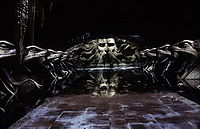 The Chamber of Secrets, which is deep under the school (probably under the lake), was home to an ancient Basilisk, intended to be used to purge the school of Muggle-born students. Salazar Slytherin, one of the founders of Hogwarts, built the Chamber before he left the school.
The Chamber is well-hidden and its entrance is in Moaning Myrtle's bathroom on the second floor, which leads down into a dark, slimy stone tunnel. There are many skeletons of small animals littering the floor and even a gigantic skin shed by the Basilisk. The tunnel leads to a solid wall, carved with two entwined serpents with emeralds for eyes. When Parseltongue is spoken they open into a long, dim corridor, lined with monumental statues of snakes, including two towering stone pillars with more carved serpents that brace the ceiling. A colossal statue of Salazar Slytherin, looking ancient and monkey-like, is at the centre. The Basilisk rested inside the statue and emerged from its mouth when the Heir of Slytherin, Tom Riddle, summoned it.
In his second year at Hogwarts, Harry uses Parseltongue to open the chamber and destroys the diary containing the embodied memory of a 16-year old Tom Riddle from his own days at Hogwarts. It is later revealed that the diary was a Horcrux.
In Deathly Hallows, Ron and Hermione enter the Chamber. Ron opens the door (despite not speaking Parseltongue) by imitating sounds he heard Harry use to open Slytherin's locket. They find a basilisk fang to use to destroy the Horcrux made from Helga Hufflepuff's cup.
Moaning Myrtle's bathroom contains the entrance to the Chamber of Secrets. The entrance is a sink with a snake scratched onto the tap, opened by speaking Parseltongue. This causes the sink to open into a pipe large enough for a person to slide down it. At the bottom of this chute is a tunnel leading to the Chamber of Secrets. When Tom Riddle opened the Chamber, Myrtle was sulking in a stall. When she heard him, she opened the door, saw the Basilisk, and died immediately, becoming a ghost. Her bathroom remains operational, but is rarely used by students because of Myrtle's disagreeable presence and her habit of flooding it when she is distraught.
A further link between two vanishing cabinets, one in the school and the other in Borgin and Burkes in Knockturn Alley presumably worked until Chamber of Secrets when Peeves (persuaded by Nearly Headless Nick) smashed the Hogwarts cabinet. The passage was reopened in Half-Blood Prince when Draco Malfoy
fixed the cabinet. This passage is not shown on the Marauder's Map as it is not part of the castle itself.
Dumbledore was first to mention the room, noting that he discovered it at five-thirty in the morning, filled with chamber pot
s when he was trying to find a toilet. However, Dumbledore did not appear to know the Room's secrets. Dobby later told Harry of the Room in detail and admitted to frequently bringing Winky to the room to cure her bouts of Butterbeer-induced drunkenness, finding it full of antidotes and a "nice elf-sized bed." Filch was said to find cleaning supplies here when he had run out; when Fred and George Weasley needed a place to hide, it would appear as a broom cupboard. Trelawney also makes a habit of using it to hide her empty sherry bottles after she is sacked in Order of the Phoenix. It would seem that when one wishes to hide something it produces the same room for everyone: the Room of Hidden Things, which is full of many centuries worth of abandoned objects, such as broken furniture, books, and in one case a dead quintaped (for more information see Fantastic Beasts and Where to Find Them
), which were presumably forgotten by their owners.
Harry learned of the room's abilities from Dobby, finding it the perfect location for his Dumbledore's Army
meetings, during which it would be filled with bookcases full of Defence Against the Dark Arts volumes, many different kinds of Dark Detectors, and a plethora of floor cushions for practising defensive spells. When the D.A. was betrayed, the room provided Pansy Parkinson with the list of members of the organisation. In Half-Blood Prince Harry used the Room of Hidden Things to stash his copy of Advanced Potion-Making, describing it as the size of a large cathedral and packed to overflowing with items hidden by Hogwarts inhabitants over the years, such as old potions, clothing, ruined furniture, an old tiara (which happened to be one of Voldemort's Horcruxes), or books which were "no doubt banned or graffitied or stolen." He later realised that Draco had been using the room in that state to hide and repair the Vanishing Cabinet to use it to smuggle Death Eaters into Hogwarts. Ironically, while Harry tries many times to get into the Room of Requirement to see what Malfoy is doing, the only time he succeeds to get into the room (and he is not thinking about Malfoy), he gains access to the room where Malfoy has been working.
In Deathly Hallows, the students who need a place to hide from the Carrows, two Death Eater professors, use the room. It is also revealed that the Room of Requirement's current version can change while still occupied, though should a completely different version be required (e.g. the Room of Hidden Things instead of DA Headquarters) the room must be empty. The Room can also answer to the desire of the wizard within the room, such as providing Harry with a whistle when he needed one during a Dumbledore's Army meeting, or creating a passage to the Hog's Head (as the room cannot produce food). Later, Ravenclaw's diadem is found to be one of Voldemort's Horcruxes and has been hidden in the Room of Hidden Things by Voldemort. Harry, Ron, and Hermione enter the Room, with Harry knowing that he must look for a place to hide things, and find the tiara; but they are ambushed by Draco, Crabbe and Goyle. The diadem is finally destroyed when Crabbe fills this version of the Room with what Hermione believes to have been Fiendfyre; a destructive magical fire. It is not known if the room continues to function after the events of Deathly Hallows; Ron expresses concern that it may have been ruined in all of its forms by the cursed fire.
Among the plant species within the Forest are trees such as beech, oak, pine, sycamore, yew and knotgrass and thorn undergrowth. Though the Forest is vastly dense and wild, there are a few paths and clearings. Hagrid, who frequently travels into the Forest for various reasons, mostly makes these trails. The Forest is also home to an assortment of creatures. The following is an incomplete list of beasts that inhabit the forest:
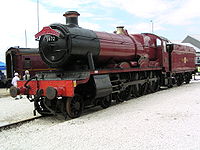 The Hogwarts Express is a magical train that carries students non-stop from Platform 9¾ at King's Cross station in London to Hogsmeade Station, near Hogwarts. Prefects of the school ride in a separate carriage near the front of the train. The compartments on the train appear to be lettered; in Half-Blood Prince, the "Slug Club" meets in compartment C. In Philosopher's Stone, Harry meets his two best friends, Ron and Hermione, on his first ride on the Hogwarts Express. In the books, he has been on the train ten times: twice each in the first, third, fourth, and fifth books, and once each in the second (in which he and Ron arrive instead in a flying car) and the sixth (which ends before Harry leaves Hogwarts).
The steam engine used in the film adaptations is the GWR 4900 Class 5972 Olton Hall
, but it was not the first locomotive to be disguised as the Hogwarts Express. To promote the books, the Southern Railway locomotive Taw Valley
was repainted and renamed temporarily, but was rejected by Chris Columbus as looking 'too modern' for the film. Filming locations for the Hogwarts Express sequences include Goathland
on the North Yorkshire Moors Railway
, Kings Cross railway station and the route of the Jacobite Express which follows the West Highland Line
from Fort William
to Mallaig
in Scotland, as it crosses the Glenfinnan Viaduct
.
Several model trains have been made of the Hogwarts Express. An 00 gauge is produced by Hornby
, though this is of a Castle Class
locomotive rather than the Hall Class
used in the films. A three-rail
H0 gauge model is produced by Märklin
, and a two-rail H0/00 was produced in the early 2000s by Bachmann
. Several now-discontinued L gauge models have been produced by LEGO
. Lionel
has released an O gauge
set in their 2007 catalogue and a G gauge
set for 2008.
it if necessary (for example Arabic = Hūghwūrts, Russian = Khogvarts, Japanese = Hoguwātsu, Bengali = Hogowarts, Greek
= Hóguarts), but some translate or otherwise adapt it (French ( = "bacon
"), Latvian
shortened from = "pig" + = "wart
s", Dutch
modified from = "pig rock", Norwegian Bokmål
(Nynorsk
keeps ""), Finnish
( = "wart
"), Hungarian , Slovenian ( = "warts")). The Ancient Greek translation of the school is "Ὑογοήτου Παιδευτήριον τὸ τῆς Γοητείας καὶ Μαγείας", loosely translating to "Hogwizard's School of Wizardry and Magic", Ὑογοήτου replacing "Hogwarts" and derived from the ancient Greek words ὑo- (hog) and γοητής (wizard).
Harry Potter
Harry Potter is a series of seven fantasy novels written by the British author J. K. Rowling. The books chronicle the adventures of the adolescent wizard Harry Potter and his best friends Ron Weasley and Hermione Granger, all of whom are students at Hogwarts School of Witchcraft and Wizardry...
series by J. K. Rowling
J. K. Rowling
Joanne "Jo" Rowling, OBE , better known as J. K. Rowling, is the British author of the Harry Potter fantasy series...
, with each book lasting the equivalent of one school year. It is a fictional boarding school
Boarding school
A boarding school is a school where some or all pupils study and live during the school year with their fellow students and possibly teachers and/or administrators. The word 'boarding' is used in the sense of "bed and board," i.e., lodging and meals...
of magic
Magic (Harry Potter)
In the Harry Potter series created by J. K. Rowling, magic is depicted as a natural force that can be used to override the usual laws of nature. Many fictional magical creatures exist in the series, while ordinary creatures sometimes exhibit new magical properties in the novels' world...
for witches and wizards between the ages of eleven and seventeen. In Harry Potter and the Deathly Hallows, however, most of the book is set outside Hogwarts as main characters Harry Potter
Harry Potter (character)
Harry James Potter is the title character and main protagonist of J. K. Rowling's Harry Potter series. The majority of the books' plot covers seven years in the life of the orphan Potter who, on his eleventh birthday, learns he is a wizard...
, Ron Weasley
Ron Weasley
Ronald Bilius "Ron" Weasley is a fictional character and one of the three protagonists in the Harry Potter book series written by J. K. Rowling. His first appearance was in the first book of the series, Harry Potter and the Philosopher's Stone as the best friend of Harry Potter and Hermione Granger...
, and Hermione Granger
Hermione Granger
Hermione Jean Granger is a fictional character and one of the three protagonists in J. K. Rowling's Harry Potter series. She initially appears in the first novel, Harry Potter and the Philosopher's Stone, as a new student on her way to Hogwarts...
do not attend their final year of school (though Rowling has stated that Hermione eventually returns to school to complete her N.E.W.T. examinations). The climactic battle of the book, and the series, however, is set at Hogwarts.
Rowling has suggested that she may have inadvertently taken the name from the hogwort
Hogwort
Croton capitatus, known as the hogwort or woolly croton, is an annual plant with erect, branched stems, densely covered with light brown, wooly hairs that give it a whitish appearance. It grows in dry, open areas, especially sandy and rocky soils...
plant (Croton capitatus), which she had seen at Kew Gardens
Royal Botanic Gardens, Kew
The Royal Botanic Gardens, Kew, usually referred to as Kew Gardens, is 121 hectares of gardens and botanical glasshouses between Richmond and Kew in southwest London, England. "The Royal Botanic Gardens, Kew" and the brand name "Kew" are also used as umbrella terms for the institution that runs...
some time before writing the Harry Potter series, although the names "The Hogwarts" and "Hoggwart" appear in the 1954 Nigel Molesworth
Nigel Molesworth
Nigel Molesworth is the supposed author of a series of books , with cartoon illustrations by Ronald Searle....
book How To Be Topp by Geoffrey Willans
Geoffrey Willans
Herbert Geoffrey Willans , an English author and journalist, is best known as the co-creator, with the illustrator Ronald Searle, of Nigel Molesworth, the "goriller of 3b and curse of St. Custard's"....
.
Hogwarts school was voted as the 36th best Scottish educational establishment in a 2008 online ranking, outranking Edinburgh's Loretto School
Loretto School
Loretto School is an independent school in Scotland, founded in 1827. The campus occupies in Musselburgh, near Edinburgh.-History:Loretto was founded by the Reverend Thomas Langhorne in 1827. Langhorne came from Crosby Ravensworth, near Kirkby Stephen. The school was later taken over by his son,...
. According to a director of the Independent Schools Network Rankings, it was added to the schools listing "for fun" and was then voted on.
School location and information
J. K. Rowling
Joanne "Jo" Rowling, OBE , better known as J. K. Rowling, is the British author of the Harry Potter fantasy series...
says she visualises Hogwarts, in its entirety, to be:
A huge, rambling, quite scary-looking castleCastleA castle is a type of fortified structure built in Europe and the Middle East during the Middle Ages by European nobility. Scholars debate the scope of the word castle, but usually consider it to be the private fortified residence of a lord or noble...
, with a jumble of towerTowerA tower is a tall structure, usually taller than it is wide, often by a significant margin. Towers are distinguished from masts by their lack of guy-wires....
s and battlementBattlementA battlement in defensive architecture, such as that of city walls or castles, comprises a parapet , in which portions have been cut out at intervals to allow the discharge of arrows or other missiles. These cut-out portions form crenels...
s. Like the Weasleys' house, it isn't a building that MuggleMuggleMuggle, a term from the Harry Potter book series by J. K. Rowling, refers to a person who lacks any sort of magical ability and was not born into the magical world...
s could build, because it is supported by magicMagic (Harry Potter)In the Harry Potter series created by J. K. Rowling, magic is depicted as a natural force that can be used to override the usual laws of nature. Many fictional magical creatures exist in the series, while ordinary creatures sometimes exhibit new magical properties in the novels' world...
.
In the novels, Hogwarts is somewhere in Scotland. (The film Prisoner of Azkaban
Harry Potter and the Prisoner of Azkaban (film)
Harry Potter and the Prisoner of Azkaban is a 2004 fantasy film directed by Alfonso Cuarón and based on the novel of the same name by J. K. Rowling. It is the third instalment in the Harry Potter film series, written by Steve Kloves and produced by Chris Columbus, David Heyman and Mark Radcliffe...
says that Dufftown
Dufftown
Dufftown is a burgh in Banffshire, Scotland.The town was originally named Mortlach in the Middle Ages, until the 19th century when the Earl of Fife built the town as a housing for soldiers returning home from war...
is near.) The school has numerous charms and spells on and around it that make it impossible for a Muggle
Muggle
Muggle, a term from the Harry Potter book series by J. K. Rowling, refers to a person who lacks any sort of magical ability and was not born into the magical world...
(i.e., a non-magical person) to locate it. Such people cannot see the school; rather, they see only ruins and several warnings of danger. The castle has extensive grounds with sloping lawns, flowerbeds and vegetable patches, a loch
Loch
Loch is the Irish and Scottish Gaelic word for a lake or a sea inlet. It has been anglicised as lough, although this is pronounced the same way as loch. Some lochs could also be called a firth, fjord, estuary, strait or bay...
(called The Black Lake), a large dense forest (called the Forbidden Forest), several greenhouse
Greenhouse
A greenhouse is a building in which plants are grown. These structures range in size from small sheds to very large buildings...
s and other outbuildings, and a full-size Quidditch pitch. There is also an owlery, which houses all the owls owned by the school and those owned by students. Some rooms in the school tend to "move around", and so do the stairs in the grand staircase. Witches and wizards cannot Apparate or Disapparate in Hogwarts grounds, except when the Headmaster lifts the enchantment, whether only in certain areas or for the entire campus, so as to make the school less vulnerable when it serves the headmaster to allow Apparition. Electricity and electronic devices are not found at Hogwarts. In Harry Potter and the Goblet of Fire
Harry Potter and the Goblet of Fire
Harry Potter and the Goblet of Fire is the fourth novel in the Harry Potter series written by J. K. Rowling, published on 8 July 2000.The novel won a Hugo Award in 2001, the only Harry Potter novel to do so...
, Hermione indicates that due to the high levels of magic, "substitutes for magic (that) Muggles use" such as computers, radar and electricity "go haywire" around Hogwarts. Radios however, make an exception. Rowling explains this by saying that the radios are not powered by electricity and are powered by magic.
Hogwarts is a coeducation
Coeducation
Mixed-sex education, also known as coeducation or co-education, is the integrated education of male and female persons in the same institution. It is the opposite of single-sex education...
al, secondary boarding school
Boarding school
A boarding school is a school where some or all pupils study and live during the school year with their fellow students and possibly teachers and/or administrators. The word 'boarding' is used in the sense of "bed and board," i.e., lodging and meals...
, taking children from ages eleven to eighteen. Education at Hogwarts is not compulsory, with some students being home schooled as stated in the seventh book. Rowling initially said there are about one thousand students at Hogwarts. She later suggested around six hundred, while acknowledging that this number was still inconsistent with the small number of people in Harry's year. She further explained that this had resulted from her creating only 40 characters for Harry's year.
The Headmaster or Headmistress, assisted by a Deputy Headmaster or Headmistress, undertakes management of the school. The Head is answerable to the twelve-member Board of Governors.
It is unclear how Hogwarts is funded. Various passages suggest that families pay to send their children to the school. In Harry Potter and the Half-Blood Prince
Harry Potter and the Half-Blood Prince
Harry Potter and the Half-Blood Prince is the sixth and penultimate novel in the Harry Potter series by British author J. K. Rowling...
Tom Riddle says that he cannot afford to go to Hogwarts, to which Albus Dumbledore
Albus Dumbledore
Professor Albus Percival Wulfric Brian Dumbledore is a major character in J. K. Rowling's Harry Potter series. For most of the series, he is the headmaster of the wizarding school Hogwarts...
replies, "There is a fund at Hogwarts for those who require assistance to buy books and robes," as students are required to buy their own textbooks, uniform, and other supplies. The Ministry of Magic
Ministry of Magic
The Ministry of Magic is the government of the fictional Magical community of Britain in J. K. Rowling's Harry Potter series. First mentioned in Harry Potter and the Philosopher's Stone, the Ministry makes its first proper appearance in Harry Potter and the Order of the Phoenix...
's efforts to take control of the school in Harry Potter and the Order of the Phoenix
Harry Potter and the Order of the Phoenix
Harry Potter and the Order of the Phoenix is the fifth in the Harry Potter series written by J. K. Rowling, and was published on 21 June 2003 by Bloomsbury in the United Kingdom, Scholastic in the United States, and Raincoast in Canada...
imply that it is a publicly funded school, though no mention of where the Ministry receives its funds is made.
Rowling has said that Hogwarts is "a multifaith school".
Hogwarts is on the shore of a lake, sometimes called the Black Lake. In that lake are merpeople
Merman
Mermen are mythical male equivalents of mermaids – legendary creatures who have the form of a human from the waist up and are fish-like from the waist down.-Mythology:...
, Grindylow
Grindylow
A grindylow or grundylow is a folkloric creature that originated from folktales in the English counties of Yorkshire and Lancashire. The name is thought to be connected to Grendel, a name or term most famously used in Beowulf but also found in many Old English charters where it is seen in...
s, and a giant squid
Kraken
Kraken are legendary sea monsters of giant proportions said to have dwelt off the coasts of Norway and Iceland.In modern German, Krake means octopus but can also refer to the legendary Kraken...
. The giant squid does not attack humans and sometimes acts as a lifeguard
Lifeguard
A lifeguard supervises the safety and rescue of swimmers, surfers, and other water sports participants such as in a swimming pool, water park, or beach. Lifeguards are strong swimmers and trained in first aid, certified in water rescue using a variety of aids and equipment depending on...
when students are in the lake.
Admission
Admission to Hogwarts is selective, in that children who show magical ability will automatically gain a place, and squibs cannot attend the school as students (though they can work there in other roles, as Argus Filch does). A magical quill at Hogwarts detects the birth of magical children and writes their names into a large parchment book, but there is no admission testSecondary School Admission Test
The Secondary School Admission Test, or SSAT, is an admissions test administered by the Secondary School Admission Test Board to students in grades 5-11 to help determine placement into independent or private junior high and high schools....
because "you are either magical or you are not." Every year, a teacher checks this book and sends a letter to the children who are turning eleven. Acceptance or declination of a place at Hogwarts must be posted by 31 July. The letter also contains a list of supplies like spell books, uniform, and other things that the student will need. The prospective student is expected to buy all the necessary materials, normally from shops in Diagon Alley, a concealed street near Charing Cross Road
Charing Cross Road
Charing Cross Road is a street in central London running immediately north of St Martin-in-the-Fields to St Giles Circus and then becomes Tottenham Court Road...
in London found behind a pub by the name of The Leaky Cauldron. Students who cannot afford their supplies can receive financial aid from the school, as happened with the young orphan Tom Riddle.
Letters to Muggle-born witches and wizards, who may not be aware of their powers and are unfamiliar with the concealed wizarding world, are delivered in person by a member of Hogwarts staff, who then explains to the parents or guardians about magical society, and reassures them regarding this news. They also assist the family in buying supplies and gaining access to Diagon Alley.
Each student is allowed to bring a cat, toad, rat or owl. Along with the acceptance letter, first year students are sent a list of required equipment which includes a wand, subject books, a standard size 2 pewter cauldron, a set of brass scales, a set of glass or crystal phials, a kit of basic potion ingredients (for Potions), and a telescope (for Astronomy). The Hogwarts uniform consists of plain work robes in black, a plain black hat, a pair of protective gloves, and a black winter cloak with silver fastenings. Each uniform must contain the wearer's nametag. First years are not allowed a broomstick of their own, though an exception to this rule is made for Harry in his first year after he demonstrates an excellent ability as a Seeker in Quidditch
Quidditch
Quidditch is a fictional sport developed by British author J. K. Rowling for the Harry Potter series of novels. It is described as an extremely rough, but very popular, semi-contact sport, played by wizards and witches around the world...
.
Academic years are separated by holidays of about two months in the summer, and each year is divided into three terms by shorter holidays around Christmas and Easter.
Arrival
The primary mode of transportation to Hogwarts is the Hogwarts Express that students take at the start of each school year. Students board the train from Platform 9¾ at King's Cross station in London. The train leaves at 11:00 am and arrives at Hogsmeade Station, near Hogwarts, some time after nightfall.From there, first year students are accompanied by the Keeper of the Keys, Game and Grounds (in Harry's case, Hagrid) – or another suitable teacher if he is absent – to small boats, which magically sail across the lake that get them near the entrance of Hogwarts. The older students ride up to the castle in carriages pulled by creatures called Thestrals who are invisible to many of the pupils. When the first-year students initially arrive at the castle, they wait in a small chamber off the entrance hall until the older students have taken their seats, and then enter the Great Hall for the Sorting Ceremony to determine their House assignments. As Minerva McGonagall said in Harry Potter and the Philosopher's Stone
Harry Potter and the Philosopher's Stone
Harry Potter and the Philosopher's Stone is the first novel in the Harry Potter series written by J. K. Rowling and featuring Harry Potter, a young wizard...
,
After the Sorting Hat sings a song each student in turn is seated upon the stool in front of the rest of the student body. The Hat is placed on the student's head, whereupon it examines his or her mind and assigns them to one of the four Houses based on abilities, personality, and preferences. After the Sorting Ceremony, the students and teachers enjoy a feast, prepared by the Hogwarts house-elves. If Dumbledore is feeling cheerful, he will lead the students in singing the school song.
Houses
Hogwarts is divided into four housesHouse system
The house system is a traditional feature of British schools, and schools in the Commonwealth. Historically, it was associated with established public schools, where a 'house' refers to a boarding house or dormitory of a boarding school...
, each bearing the last name of its founder: Godric Gryffindor, Salazar Slytherin, Rowena Ravenclaw and Helga Hufflepuff. The houses compete throughout the school year, by earning and losing points for various events, for the House Cup (correctly answering a question in class, for example, may earn five or ten points; lateness to class may cost ten points). Each house also has its own Quidditch team that competes for the Quidditch Cup. These two competitions breed rivalries between the houses. Houses at Hogwarts are living and learning communities for their students. Each house is under the authority of one of the Hogwarts staff members. The Heads of the houses, as they are called, are in charge of giving their students important information, dealing with matters of severe punishment, and responding to emergencies in their houses, among other things. Each year, year level groups of every separate house share the same dormitory and classes. The dormitory and common room of a House are, barring rare exceptions, inaccessible to students belonging to other Houses.
In the early day of Hogwarts, the four founders hand-picked students for their Houses. When the founders worried how students would be selected after their deaths, Godric Gryffindor took his hat off and they each added knowledge to it, allowing the Sorting Hat to choose the students by judging each student's qualities and placing them in the most appropriate house. The student's own choices may affect the decision: the clearest example is the Hat telling Harry that he would do well in Slytherin in the first book, but ultimately selecting Gryffindor after Harry asks it not to put him in Slytherin.
The translators of the books’ foreign editions had difficulty translating the "house" concept; in countries where this system does not exist, no word could adequately convey the importance of belonging to a house, the loyalty owed to it, and the pride taken in prizes won by the house.
Gryffindor
The Gryffindor common room is located in one of the castle's highest towers, the entrance to which is located on the seventh floor in the east wing of the castle and is guarded by a painting of The Fat Lady, who is garbed in a pink dress. She permits entry only after being given the correct password, as was distinguished in the third book, when Sirius Black tried forcing entry into the tower, only to be blocked by The Fat Lady after he could not give the correct password. In the first book, Neville Longbottom tends to forget the password and must wait near the painting until other Gryffindors arrive to open the way.
Hufflepuff
Earth (classical element)
Earth, home and origin of humanity, has often been worshipped in its own right with its own unique spiritual tradition.-European tradition:Earth is one of the four classical elements in ancient Greek philosophy and science. It was commonly associated with qualities of heaviness, matter and the...
. The founder of this house is Helga Hufflepuff.
The Hufflepuff dormitories and common room are located somewhere in the basement. The entrance is found behind a still life painting somewhere near the kitchens, a password is required for entry. The Hufflepuff common room is filled with yellow hangings and fat armchairs and it has little underground tunnels leading to the dormitories, all of which have perfectly round doors, like barrel tops (much like a badger sett
Sett
A badger sett or set is a badger's den, usually consisting of a network of tunnels. The largest setts are spacious enough to accommodate 15 or more animals, with up to of tunnels and as many as 40 openings. It takes many years for the animals to dig these large setts...
).
Ravenclaw
Air (classical element)
Air is often seen as a universal power or pure substance. Its supposed fundamental importance to life can be seen in words such as aspire, inspire, perspire and spirit, all derived from the Latin spirare.-Greek and Roman tradition:...
. The founder of this house is Rowena Ravenclaw.
The dormitories are located in Ravenclaw Tower on the west side of the school. The common room, which went undescribed in the series until the climax of Deathly Hallows, is round and filled with blue hangings and fat armchairs, has a domed ceiling painted with stars and features a replica statue of Rowena wearing her diadem
Diadem
Diadem may refer to:*Diadem, a type of crown-Military:*HMS Diadem was a 64-gun third rate ship of the line in the Royal Navy launched in 1782 at Chatham and participated in the Battle of Cape St Vincent in 1787...
. Harry also notes that, by day, the Ravenclaws "would have a spectacular view of the surrounding mountains." A logical riddle must be solved to gain entry, whereas the Gryffindor, Hufflepuff and Slytherin common rooms only require a password, indicating that it may be easier for those students from other houses who possess a high degree of intelligence to enter this common room than others. Professor McGonagall, the head of the Gryffindor House, solves the riddle accurately.
Slytherin
Severus Snape
Severus Snape is a fictional character in the Harry Potter book series written by J.K. Rowling. In the first novel of the series, he is hostile toward Harry and is built up to be the primary antagonist until the final chapters. As the series progresses, Snape's character becomes more layered and...
until near the end of the sixth book. Then, Horace Slughorn, the previous Head of House, comes out of retirement re-assuming authority. The ghost of Slytherin house is The Bloody Baron. According to Rowling, Slytherin corresponds roughly to the element of water. The Slytherin dormitories and common room are reached through a bare stone wall in the dungeons. The Slytherin common room is a long, low, dungeon-style room, located under the Hogwarts Lake, furnished with green lamps and carved armchairs. The room is described in the second book as having a greenish glow.
The Sorting Hat claims that blood purity is a factor in selecting Slytherins, although this is not mentioned until the fifth book. There is no reason to believe, however, that Muggle-born students are not sorted there, merely that pure-blooded students are more desirable to that house, as there are several examples of half-bloods in the house (such as Snape and Voldemort). In Deathly Hallows, a group of Snatchers claim that "not many Mudbloods" are sorted into Slytherin.
When believing Harry to be dead and thinking that he has final victory in his grasp, Voldemort proclaims his intention to abolish the other three houses and force all Hogwarts students into Slytherin. This design is foiled by his defeat and death, after which Slytherin becomes more diluted in its blood purity, no longer remaining the pure-blood bastion it once was. Its dark reputation, however, does linger.
Terms and holidays
Hogwarts' school year is structured in a similar way to other non-magical schools and colleges in the UK, with a three-term year punctuated by holidays at Christmas and Easter and bounded by the long summer holiday of nine weeks. Term begins every year on 1 September, and finishes at the end of June the following year. Students have the option of staying at Hogwarts for the winter and spring holidays. Those who choose to stay at the castle do not have lessons and attend a feast on Christmas Day. Students also do not have classes the week of Easter, but this is much less enjoyable due to the large amount of work that the teachers assign students at this time in preparation for final exams.Other than the breaks and weekends, students do not receive holidays. However, students third year and above may visit Hogsmeade, the local village, occasionally. There are normally four feasts per year: the start-of-term feast at the beginning of the school year, end-of-term feast at the end of the school year, and feasts at Halloween
Halloween
Hallowe'en , also known as Halloween or All Hallows' Eve, is a yearly holiday observed around the world on October 31, the night before All Saints' Day...
and Christmas. Feasts are also called to mark special occasions, as in Goblet of Fire, when there was a feast to celebrate the beginning of the Triwizard Tournament.
Subjects and teachers
Throughout the series, numerous lessons are described, instructing the students in various branches of magic. There are twelve named teachers (each referred to as Professor), each specialising in a single subject. Transfiguration, Defence Against the Dark Arts, Charms, Potions, Astronomy, History of Magic, and Herbology are compulsory subjects for the first five years. At the end of their second year, students are required to add at least two optional subjects to their syllabus for the start of the third year. The five choices are Arithmancy, Ancient Runes, Divination, Care of Magical Creatures, and Muggle Studies.Transfiguration
Transfiguration is essentially the art of changing the properties of an object. Transfiguration is a theory-based subject, including topics such as "Switching Spells" (altering only a part of some object, such as giving a human rabbit's ears); Vanishing Spells (causing an object to completely disappear); and Conjuring Spells (creating objects out of thin air). It is possible to change inanimate objects into animate ones and vice versa – Minerva McGonagall, the class's teacher, transfigures her desk into a pigDomestic pig
The domestic pig is a domesticated animal that traces its ancestry to the wild boar, and is considered a subspecies of the wild boar or a distinct species in its own right. It is likely the wild boar was domesticated as early as 13,000 BC in the Tigris River basin...
and back in Philosopher's Stone.
Defence Against the Dark Arts
Defence Against the Dark Arts, commonly shortened to D.A.D.A., is the class that teaches students defensive techniques to defend against the Dark Arts, and to be protected from Dark creatures.The subject has an extraordinarily high turnover of staff members – throughout the series no Defence Against the Dark Arts teacher has retained the post for more than one school year. During the period the story takes place, the class is taught by Quirinus Quirrell (book one
Harry Potter and the Philosopher's Stone
Harry Potter and the Philosopher's Stone is the first novel in the Harry Potter series written by J. K. Rowling and featuring Harry Potter, a young wizard...
), Gilderoy Lockhart (book two
Harry Potter and the Chamber of Secrets
Harry Potter and the Chamber of Secrets is the second novel in the Harry Potter series written by J. K. Rowling. The plot follows Harry's second year at Hogwarts School of Witchcraft and Wizardry, during which a series of messages on the walls on the school's corridors warn that the "Chamber of...
), Remus Lupin (book three
Harry Potter and the Prisoner of Azkaban
Harry Potter and the Prisoner of Azkaban is the third novel in the Harry Potter series written by J. K. Rowling. The book was published on 8 July 1999. The novel won the 1999 Whitbread Book Award, the Bram Stoker Award, the 2000 Locus Award for Best Fantasy Novel, and was short-listed for other...
), Bartemius Crouch Jr impersonating Alastor "Mad-eye" Moody (book four
Harry Potter and the Goblet of Fire
Harry Potter and the Goblet of Fire is the fourth novel in the Harry Potter series written by J. K. Rowling, published on 8 July 2000.The novel won a Hugo Award in 2001, the only Harry Potter novel to do so...
), Dolores Umbridge (book five
Harry Potter and the Order of the Phoenix
Harry Potter and the Order of the Phoenix is the fifth in the Harry Potter series written by J. K. Rowling, and was published on 21 June 2003 by Bloomsbury in the United Kingdom, Scholastic in the United States, and Raincoast in Canada...
), Severus Snape
Severus Snape
Severus Snape is a fictional character in the Harry Potter book series written by J.K. Rowling. In the first novel of the series, he is hostile toward Harry and is built up to be the primary antagonist until the final chapters. As the series progresses, Snape's character becomes more layered and...
(book six
Harry Potter and the Half-Blood Prince
Harry Potter and the Half-Blood Prince is the sixth and penultimate novel in the Harry Potter series by British author J. K. Rowling...
), and Amycus Carrow (book seven). Hagrid suggests in Harry Potter and the Chamber of Secrets
Harry Potter and the Chamber of Secrets
Harry Potter and the Chamber of Secrets is the second novel in the Harry Potter series written by J. K. Rowling. The plot follows Harry's second year at Hogwarts School of Witchcraft and Wizardry, during which a series of messages on the walls on the school's corridors warn that the "Chamber of...
that "They're startin' ter think the job's jinxed. No one's lasted long for a while now." In Half-Blood Prince, Dumbledore suggests that Voldemort cursed the position because his application for it was rejected. The existence of the jinx was eventually confirmed by Rowling. The position had also been coveted by Snape, but he was denied the position as well. Snape was finally appointed D.A.D.A. professor in Half-Blood Prince. Rowling announced in an interview that once Voldemort had died, the jinx he placed on the office was lifted and a permanent professor had been teaching the subject between the end of Deathly Hallows and the epilogue
Epilogue
An epilogue, epilog or afterword is a piece of writing at the end of a work of literature or drama, usually used to bring closure to the work...
, set nineteen years afterwards. Furthermore, she imagines that Harry Potter occasionally comes to the class to give lectures on the subject.
Charms
Charms is the class that teaches how to develop incantations for the uses of bewitchment. Rowling has described Charms as a type of magic spell concerned with giving an object new and unexpected properties. Charms classes are described as notoriously noisy and chaotic, as the lessons are largely practical. Many of the expositionExposition (literary technique)
At the beginning of a narrative, the exposition is the author's providing of some background information to the audience about the plot, characters' histories, setting, and theme. Exposition is considered one of four rhetorical modes of discourse, along with argumentation, description, and narration...
sequences in the books are set in Charms classes, which are on the second floor of Hogwarts. The class is taught by Professor Flitwick.
Potions
Potions is described as the art of creating mixtures with magical effects. It requires the correct mixing and stirring of ingredients at the right times and temperatures. As to the question of whether a Muggle could brew a potion, given the correct magical ingredients, Rowling has said, "Potions seems, on the face of it, to be the most Muggle-friendly subject. But there does come a point in which you need to do more than stir." Snape's lessons are depicted as unhappy, oppressing times set in a gloomy dungeon in the basement of the castle, whilst Slughorn's, who replaces Snape as Potions Master, is shown as more cheerful and even fun at times.Astronomy
Astronomy classes take place in the Astronomy Tower, the tallest tower in Hogwarts, and are taught by Professor Aurora Sinistra. Lessons involve observations of the night skies with telescopeTelescope
A telescope is an instrument that aids in the observation of remote objects by collecting electromagnetic radiation . The first known practical telescopes were invented in the Netherlands at the beginning of the 1600s , using glass lenses...
s. No astronomy lessons are shown in the books, but plenty of references to them. However, Rowling describes one of Harry's Astronomy exams in Harry Potter and the Order of the Phoenix. Also, bits of the Astronomy Tower are seen throughout the film series
Film series
A film series is a collection of related films in succession. Their relationship is not fixed, but generally share a common diegetic world. Sometimes the work is conceived as a multiple-film work, for example the Three Colours series, but in most cases the success of the original film inspires...
, such as HP2 and HP3, and featured in The Half-Blood Prince, as the place where Dumbledore died, and seen in The Deathly Hallows. Known student homework activities include learning the names of stars, constellations and planets, and their location, movements, and environments.
History of Magic
History of Magic is the study of magical history. Cuthbert Binns' lessons are depicted as some of the most boring at Hogwarts. They are only lectures, given without pause, about significant events in wizarding history. Topics have included goblin rebellions, giant wars, and the origins of wizarding secrecy. This is the only class at Hogwarts that is taught by a ghost, as the professor never noticed he had died and simply continued teaching as if nothing had changed.Herbology
Herbology is the study of magical plants and how to take care of, utilise and combat them. There are at least three greenhouses described in the books, holding a variety of magical plants of varying degrees of lethality. Herbology is also the only subject Neville excels in. The epilogue to Deathly Hallows explains that he later replaces Professor Sprout as the Herbology teacher.Arithmancy
Arithmancy is a branch of magic concerned with the magical properties of numbers. As neither Harry nor Ron take this class, almost nothing is known about it. It is, however, a favourite subject of Hermione. Arithmancy is reportedly difficult, as it requires memorising or working with many charts. The subject is taught by Professor Septima Vector.Ancient Runes
Ancient Runes is a generally theoretical subject that studies the ancient runic scripts. Because only HermioneHermione Granger
Hermione Jean Granger is a fictional character and one of the three protagonists in J. K. Rowling's Harry Potter series. She initially appears in the first novel, Harry Potter and the Philosopher's Stone, as a new student on her way to Hogwarts...
studies it, little else is known about this subject. It is taught by Professor Bathsheda Babbling.
Divination
DivinationDivination
Divination is the attempt to gain insight into a question or situation by way of an occultic standardized process or ritual...
is the art of predicting the future. Various methods are described, including tea leaves
Tasseography
Tasseography is a divination or fortune-telling method that interprets patterns in tea leaves, coffee grounds, or wine sediments....
, fire omens
Divination
Divination is the attempt to gain insight into a question or situation by way of an occultic standardized process or ritual...
, crystal ball
Crystal ball
A crystal ball is a crystal or glass ball believed by some people to aid in the performance of clairvoyance. It is sometimes known as a shew stone...
s, palmistry, cartomancy
Cartomancy
Cartomancy is fortune-telling or divination using a deck of cards. Forms of cartomancy appeared soon after playing cards were first introduced into Europe in the 14th century...
(including the reading of conventional playing cards and the tarot
Tarot
The tarot |trionfi]] and later as tarocchi, tarock, and others) is a pack of cards , used from the mid-15th century in various parts of Europe to play a group of card games such as Italian tarocchini and French tarot...
), astrology
Astrology
Astrology consists of a number of belief systems which hold that there is a relationship between astronomical phenomena and events in the human world...
, and dream interpretation
Dream interpretation
Dream interpretation is the process of assigning meaning to dreams. In many ancient societies, such as those of Egypt and Greece, dreaming was considered a supernatural communication or a means of divine intervention, whose message could be unravelled by people with certain powers...
s. Divination is described by Professor McGonagall as "one of the most imprecise branches of magic". Supporters of the subject claim that it is an inexact science that requires innate gifts like the "Inner Eye". Those opposed claim that the subject is irrelevant and fraudulent. Harry is first taught Divination by Professor Trelawney, and then later by Firenze after Trelawney is sacked by Dolores Umbridge in Harry's fifth year. In the sixth (and presumably seventh) year, Firenze and Professor Trelawney teach Divination.
Care of Magical Creatures
Care of Magical Creatures is the class which instructs students on how to care for magical beasts. Classes are held outside the castle. In Harry's first two years, the class is taken by Professor Silvanus Kettleburn who then retires "in order to enjoy more time with his remaining limbs". Dumbledore then recruits the gamekeeper Rubeus HagridRubeus Hagrid
Rubeus Hagrid is a fictional character in the Harry Potter book series written by J. K. Rowling. Hagrid is introduced in Harry Potter and the Philosopher's Stone as a half-giant who is the gamekeeper and Keeper of Keys and Grounds of Hogwarts, the primary setting for the first six novels...
to accept a teaching position along with his gamekeeping duties. Although Hagrid is obviously very experienced and knowledgeable, he consistently misjudges the risk that the animals he uses in his lessons pose to his students, which sometimes results in chaos. When Hagrid is absent, his lessons are taken over by Professor Grubbly-Plank, a witch and an acquaintance of Dumbledore's.
Muggle Studies
Muggle Studies is a class taught by Charity Burbage which involves the study of the MuggleMuggle
Muggle, a term from the Harry Potter book series by J. K. Rowling, refers to a person who lacks any sort of magical ability and was not born into the magical world...
(non-magical) culture "from a wizarding point of view." The only need for witches and wizards to learn about Muggle ways
Culture
Culture is a term that has many different inter-related meanings. For example, in 1952, Alfred Kroeber and Clyde Kluckhohn compiled a list of 164 definitions of "culture" in Culture: A Critical Review of Concepts and Definitions...
and means
Technology
Technology is the making, usage, and knowledge of tools, machines, techniques, crafts, systems or methods of organization in order to solve a problem or perform a specific function. It can also refer to the collection of such tools, machinery, and procedures. The word technology comes ;...
, is to ensure they can blend in with Muggles while needing to do so (for example, at the 1994 Quidditch World Cup). As the class is only mentioned as being taken by Hermione
Hermione Granger
Hermione Jean Granger is a fictional character and one of the three protagonists in J. K. Rowling's Harry Potter series. She initially appears in the first novel, Harry Potter and the Philosopher's Stone, as a new student on her way to Hogwarts...
, and for just one year, little is known about its curriculum.
In the opening chapter of the final book, Voldemort murders Professor Charity Burbage because she portrays Muggles in a positive light and is opposed to limiting wizardry to only people of pure-blood origins. For the rest of the academic year covered by Deathly Hallows, the Death Eater Alecto Carrow teaches Muggle Studies. However, her lessons (which are made compulsory) mainly describe Muggles and Muggle-borns as subhuman and worthy of persecution.
Flying
Flying is the class that teaches the use of broomsticks made for the use of flying and is taught only to Hogwarts first years by Rolanda Hooch. The subject is the only one that requires physicality. The only flying lesson depicted in the Harry Potter series is in Harry Potter and the Philosopher's StoneHarry Potter and the Philosopher's Stone (film)
Harry Potter and the Philosopher's Stone, released in the United States and India as Harry Potter and the Sorcerer's Stone, is a 2001 fantasy film directed by Chris Columbus and based on the novel of the same name by J. K. Rowling. The film is the first instalment in the Harry Potter film series,...
.
Apparition
Apparition is the magical form of teleportationTeleportation
Teleportation is the fictional or imagined process by which matter is instantaneously transferred from one place to another.Teleportation may also refer to:*Quantum teleportation, a method of transmitting quantum data...
in the Harry Potter
Harry Potter
Harry Potter is a series of seven fantasy novels written by the British author J. K. Rowling. The books chronicle the adventures of the adolescent wizard Harry Potter and his best friends Ron Weasley and Hermione Granger, all of whom are students at Hogwarts School of Witchcraft and Wizardry...
series. Lessons are optional to those in the sixth and seventh years. In the wizarding world, performing Apparition requires a license and may only be legally performed by people over seventeen years of age. The described reason for the restriction is that Apparition is dangerous if done improperly: insufficient concentration may lead to body parts being left behind in an unfortunate side-effect known as splinching. Although, as Hermione points out innumerable times throughout the series, magical enchantments on Hogwarts castle and grounds prevent Apparition and Disapparition inside the castle, Half-Blood Prince explains that these protections are temporarily relaxed within the Great Hall for short periods to permit students to practice Apparition. In Deathly Hallows, Harry, Ron, and Hermione flee the Ministry of Magic as Yaxley, one of Lord Voldemort's Death Eaters, chase them. Hermione panics as they Apparate, knowing that Yaxley will follow them to Number 12, Grimmauld Place and thus losing their hiding place, so instead they Apparate to the Forest of Dean at the last second, thus splinching Ron's arm. Wilkie Twycross, a Ministry of Magic Apparition Instructor, offers lessons in Apparition in Half-Blood Prince.
Grading and assessment
During their first four years, students need only to pass each subject before advancing to the next level the following year, Hermione is known to have received 112% in Charms in Philosopher's Stone, and 320% in Prisoner of Azkaban in Muggle Studies. If students fail in their year, they need to repeat it in the following school year. To qualify as a registered practitioner of magic, students must study for the compulsory Ordinary Wizarding Level (O.W.L.) examinations taken at the end of the fifth year. If a student scores well enough on an O.W.L., he or she may take advanced classes in that subject for the final two years in preparation for the Nastily Exhausting Wizarding Tests (N.E.W.T.), an in-depth examination given at the end of the seventh year. A U.K. student generally takes only three or four A-Level subjects and exams, just as a typical Hogwarts student takes only a few N.E.W.T.-level subjects.Most O.W.L.s consist of two parts, a written theoretical test and a practical demonstration of skills before the examiners. Subjects are graded on the following scale:
Passing Grades
- O = Outstanding
- E = Exceeds Expectations
- A = Acceptable
Failing Grades
- P = Poor
- D = Dreadful
- T = Troll
The O.W.L.s roughly corresponds to the General Certificate of Education GCSE (formerly the O-Level), and the N.E.W.T.s to the A-level, (sometimes replaced by the IB) examinations used in the English, Welsh and Northern Ireland secondary school system. To proceed to a N.E.W.T., a student usually needs to have achieved at least an E in the O.W.L. of the same subject, although some professors such as Professor Snape insist upon a grade of O. Students who fail in their exams or who do not achieve high enough grades do not continue with the subject in their sixth and seventh years.
At the end of their fifth year, students speak briefly with their head of house to decide which classes to continue in depending on their O.W.L. scores and their goals after school. The classes they decide to continue are considerably more advanced. Because they dropped one or more classes, students in their sixth and seventh year may get several class sessions off per week. The heavy workload that each class requires means that students usually spend these times studying and doing homework. At the end of their seventh and final year, students take the N.E.W.T. exams, which test what the student has learned over the past two years. Many professions require high grades in these tests, meaning that students must work hard to ensure that they pass.
Muggle British high schools do not have graduation ceremonies or award diplomas. Students may leave when they have reached age 16, though most stay on long enough to take the tests they need for jobs or entrance to university. Hogwarts follows this model.
Student life
The day begins at Hogwarts with breakfast in the Great Hall. Students sit at their own House table and can eat and socialise, or finish homework. The Headmaster or Headmistress eats with the professors at the High Table placed at the far end of the hall. During breakfast, owls bring in the students' post, generally consisting of The Daily Prophet, letters from parents or friends, or packages from home. A bell signals the start of the first class of the morning at 9 amThere are two long morning classes with a short break in between them for students to get to their next class. After lunch, classes resume at 1 pm, and there is a break around afternoon teatime before another class period. The classes are about one hour in length, with occasional double periods lasting two hours. Classes end around five o'clock. First year students get Friday afternoons off, while sixth- and seventh-year students have several free periods during the week. In the evening, students eat their dinner in the Great Hall, after which they are expected to be in their common rooms. Astronomy classes take place late at night in the Astronomy Tower.
The four House dormitories have secret entrances, generally known only to members of that house and require a password to gain entrance. Inside is the common room, which contains armchairs and sofas for the pupils and tables for studying and homework. There are fireplaces to keep the rooms warm, and students either relax here in the evenings or else complete their homework. There are notice boards in each common room and at other strategic points throughout the school. The students sleep in their House dormitories, which branch off from the common rooms. Each dormitory gets at least two rooms; one for boys and one for girls (an enchantment prevents boys from entering the girls' area, although there is no spell to prevent the reverse from occurring). Each student sleeps in a large four-poster bed with bed covers and heavy curtains in the House colours, and thick white pillows. There is a bedside table for each bed, and each dormitory has a jug of water and goblets on a tray.
On designated weekends, Hogwarts students in their third year or higher, with a signed permission slip
Permission slip
A permission slip in the United States is a form that a school or other organization sends home with a student to a parent in which the parent provides authorization for minor children to travel under the auspices of the school or organization for some type of event, such as a field trip.Permission...
, are permitted to walk to the nearby wizarding village of Hogsmeade, where they can relax and enjoy the pubs, restaurants and shops. There appears to be a good relationship between the school and the village, and the students get on well with the locals. Favourite places in Hogsmeade include Honeydukes Sweetshop, Zonko's Joke Shop, clothing stores such as Gladrags Wizardwear, the Shrieking Shack, rumoured to be the most haunted building in Britain (although this rumour was proven to be false in the third book), the pubs The Three Broomsticks and The Hog's Head, and Madam Puddifoot's coffee shop.
Food
The house-elves at Hogwarts amongst other duties provide all food to students and staff. They cook a wide variety of dishes especially at the feasts. The various dishes are prepared in the kitchens directly below the Great Hall; within the kitchen as four long tables directly aligned with the house tables in the great hall above. At meal times the food is magically transported up, giving the façade of appearing for the students. The majority of the food prepared are traditional British dishes. However the house elves can accommodate to visitors; during the Triwizard Tournament, foreign dishes such as bouillabaisseBouillabaisse
Bouillabaisse is a seafood soup made with various kinds of cooked fish and shellfish and vegetables, flavored with a variety of herbs and spices such as garlic, orange peel, basil, bay leaf, fennel and saffron. Bouillabaisse is a traditional Provençal fish stew originating from the port city of...
were served. The usual beverages include water, milk, tea, coffee, orange juice, and Pumpkin juice
Harry Potter universe
The fictional universe of J. K. Rowling's Harry Potter series of fantasy novels comprises two separate and distinct societies: the wizarding world and the Muggle world...
. Butterbeer was served during the Yule Ball).
Discipline and Prefecture
Apart from losing points from a house, serious misdeeds at Hogwarts are punishable by detention.According to the school caretaker, Argus Filch, detention meant subjection to various forms of corporal punishment until recently. Arthur Weasley claimed still to bear physical scars inflicted by Apollyon Pringle, Filch's predecessor. In present times however, detention usually involves assisting staff or faculty with tedious tasks. Examples of detention include the one imposed on Harry by Umbridge in Order of the Phoenix. In this case, Harry was forced to write, "I must not tell lies" repeatedly using a magical quill which then carves what is written into the back of the writer's hand. However, sensible teachers at the school never use this cruel punishment. In another case, when Snape caught Harry using the Sectumsempra curse on Malfoy, he was forced to go through over a thousand boxes of files describing wrongdoers at Hogwarts and their punishments. Harry was supposed to order them in alphabetical order, and rewrite the cards whose words were hard to see or otherwise damaged. The Weasley twins Fred and George had a whole drawer of these cards.
For even more serious offences, students may be suspended or even expelled from Hogwarts. Harry and Ron are threatened with expulsion after crashing Ron's car into the Whomping Willow at the start of their second year, and Harry is expelled before the start of his fifth year (although the sentence is quickly changed to a disciplinary hearing) after he is detected using magic in the presence of Muggles, a serious offence among the wizarding community. Dumbledore argued in Harry's defence, stating that it was done in self-defence, and that the Ministry has no authority to expel students – such powers are invested in the Headmaster and the Board of Governors. Snape has attempted to have Harry expelled, and he attempted to have Harry's father, James Potter, expelled when they were at Hogwarts together. The only student known to have been expelled is Hagrid, for the murder of Myrtle with an acromantula believed to be the Monster of Slytherin and for opening the Chamber of Secrets – crimes for which Tom Riddle had framed him.
Professors seem to be able to punish students with relative impunity and can hand out detention, even for unsatisfactory grades. Enforcement of rules outside of class mainly falls to the caretaker, with the assistance of the prefects. A student's Head of House usually has the final say in disciplinary matters. However, during Umbridge's tenure at Hogwarts, she quickly obtains the power to have the final say in disciplinary actions, due to an Educational Decree (one of many) passed by Minister for Magic Cornelius Fudge.
In the summer before their fifth year, two fifth year students from each House are picked to be prefects, which grants them extra privileges and responsibilities (e.g. using the prefect's bathroom, controlling younger students) and disciplinary responsibilities; they remain Prefects, unless appointed Head Boy or Girl or stripped of their position, for the rest of their school career. There are four to six prefects per house, all from the fifth, sixth and seventh year students: if one of them has been appointed Head Boy
Head boy
Head Boy and Head Girl are terms commonly used in the British education system, and in private schools throughout the Commonwealth.-United Kingdom:...
or Head Girl, they are not replaced as Prefects. The leaders of the student body, the Head Boy and Head Girl, are drawn from the seventh year students. A student may be chosen as Head without first being a Prefect as according to Hagrid, James Potter was Head Boy although he was not a Prefect. Prefects have the authority to give detentions for infractions. Quidditch house captains are given some of the same privileges as Prefects, such as the Prefect's bathroom. In the Half-Blood Prince Hermione points out that prefects are not given the power to dock points however in the Chamber of Secrets Percy Weasley docks points from Gryffindor from Ron Weasley
Ron Weasley
Ronald Bilius "Ron" Weasley is a fictional character and one of the three protagonists in the Harry Potter book series written by J. K. Rowling. His first appearance was in the first book of the series, Harry Potter and the Philosopher's Stone as the best friend of Harry Potter and Hermione Granger...
for being in a girls bathroom.
The only known cause for being suspended from Hogwarts is mentioned in passing by Snape in Prisoner of Azkaban. He tells Harry, Ron, and Hermione that they are in enough trouble and facing suspension for being out of bounds while they are in the Shrieking Shack, 'consorting with a werewolf and a convicted murderer.'
The hiding place of the Philosopher's Stone
Accessed by entering a trapdoor in the forbidden corridor on the third floor, and protected by a gauntlet of seven magical challenges set up by the teachers.- A giant three-headed dog named Fluffy placed specially to guard the trapdoor by Hagrid.
- Devil's Snare, grown by Professor Sprout.
- A room containing dozens of keys, charmed by Flitwick to sprout wings and fly near the ceiling. One of these keys will unlock the door to the next section. However, in the film adaptation, the keys attack the seeker of the Stone.
- A large chessChessChess is a two-player board game played on a chessboard, a square-checkered board with 64 squares arranged in an eight-by-eight grid. It is one of the world's most popular games, played by millions of people worldwide at home, in clubs, online, by correspondence, and in tournaments.Each player...
board with an army of large chessmen, transfigured by McGonagall. To continue to the door on the opposite side, the person in question must beat the chessmen at a game of wizards’ chess where the player must risk his life if he loses. Ron and Professor Quirrell are the only wizards to win the game of wizards’ chess. - A room with a large troll inside. This is Quirrell's challenge. In the book, Quirrell had knocked out his own troll to get to the last room and thus the trio did not have to fight it; in the film, it does not appear, but it appears in the PlayStation One version of the game.
- A series of potions, brewed by Snape. A logical riddle, not magic, has to be solved. There are two doors, blocked by fire. One potion will allow the person to exit the way he or she arrived, another will allow him or her to continue to the next chamber, two are nettle wine, and the other three are poison. This challenge does not appear in the film, but does in the video game adaptation.
- The Mirror of Erised can be found in the final chamber, further enchanted by Dumbledore to bestow the Philosopher's Stone upon a seeker only hoping to acquire the stone but not use it for selfish means.
Chamber of Secrets
The Chamber is well-hidden and its entrance is in Moaning Myrtle's bathroom on the second floor, which leads down into a dark, slimy stone tunnel. There are many skeletons of small animals littering the floor and even a gigantic skin shed by the Basilisk. The tunnel leads to a solid wall, carved with two entwined serpents with emeralds for eyes. When Parseltongue is spoken they open into a long, dim corridor, lined with monumental statues of snakes, including two towering stone pillars with more carved serpents that brace the ceiling. A colossal statue of Salazar Slytherin, looking ancient and monkey-like, is at the centre. The Basilisk rested inside the statue and emerged from its mouth when the Heir of Slytherin, Tom Riddle, summoned it.
In his second year at Hogwarts, Harry uses Parseltongue to open the chamber and destroys the diary containing the embodied memory of a 16-year old Tom Riddle from his own days at Hogwarts. It is later revealed that the diary was a Horcrux.
In Deathly Hallows, Ron and Hermione enter the Chamber. Ron opens the door (despite not speaking Parseltongue) by imitating sounds he heard Harry use to open Slytherin's locket. They find a basilisk fang to use to destroy the Horcrux made from Helga Hufflepuff's cup.
Moaning Myrtle's bathroom contains the entrance to the Chamber of Secrets. The entrance is a sink with a snake scratched onto the tap, opened by speaking Parseltongue. This causes the sink to open into a pipe large enough for a person to slide down it. At the bottom of this chute is a tunnel leading to the Chamber of Secrets. When Tom Riddle opened the Chamber, Myrtle was sulking in a stall. When she heard him, she opened the door, saw the Basilisk, and died immediately, becoming a ghost. Her bathroom remains operational, but is rarely used by students because of Myrtle's disagreeable presence and her habit of flooding it when she is distraught.
Passages
There are up to eight secret passages in and out of the school, and in addition the series describes the use of twin vanishing cabinets to create a ninth. Filch knows just four of these while the Marauders (Remus Lupin, Peter Pettrigrew, Sirius Black and James Potter) and the Weasley twins know of seven (The Hog's Head passage opened before the Battle of Hogwarts, and only would open if the Room of Requirement was asked for it), though where some lead is unknown. The others are:- A passage beneath the Whomping Willow, leading to the Shrieking Shack.
- A passage behind a mirror on the fourth floor, which is caved in. It leads to Hogsmeade, but where in Hogsmeade it leads to is unknown.
- A passage beneath a one-eyed witch statue by the stairs to the Defence Against the Dark Arts classroom, leading to the cellar of Honeydukes. Speaking aloud the word ‘Dissendium’ to the witch allows access to this passage; the hump on the statue then opens and reveals the hidden passageway.
- A passage in the Room of Requirement, leading to the Hog's Head bar, however due to the nature of the Room of Requirement, it is possible that several passages to different locations could be accessed from it. This passage is situated in the Room of Requirement, which is unplottable and is therefore not shown on the Marauder's Map.
- Numerous 'short-cuts' that lead from one part of the castle to another. These are often concealed in such fashions as a tapestry which hides a hole in the wall.
A further link between two vanishing cabinets, one in the school and the other in Borgin and Burkes in Knockturn Alley presumably worked until Chamber of Secrets when Peeves (persuaded by Nearly Headless Nick) smashed the Hogwarts cabinet. The passage was reopened in Half-Blood Prince when Draco Malfoy
Draco Malfoy
Draco Malfoy is a fictional character and a major antagonist in J. K. Rowling's Harry Potter series. He is a Slytherin student in Harry Potter's year. He is frequently accompanied by his two accomplices, Vincent Crabbe and Gregory Goyle, who act as henchmen...
fixed the cabinet. This passage is not shown on the Marauder's Map as it is not part of the castle itself.
Room of Requirement
Located on the seventh floor opposite an enormous tapestry depicting Barnabas the Barmy attempting to train trolls for the ballet, the Room of Requirement appears only when someone is in need of it. To make it appear, one must walk past its hidden entrance three times while concentrating on what is needed. The room will then appear, outfitted with whatever is required. To the Hogwarts house-elves, it is also known as the Come and Go Room.Dumbledore was first to mention the room, noting that he discovered it at five-thirty in the morning, filled with chamber pot
Chamber pot
A chamber pot is a bowl-shaped container with a handle, and often a lid, kept in the bedroom under a bed or in the cabinet of a nightstand and...
s when he was trying to find a toilet. However, Dumbledore did not appear to know the Room's secrets. Dobby later told Harry of the Room in detail and admitted to frequently bringing Winky to the room to cure her bouts of Butterbeer-induced drunkenness, finding it full of antidotes and a "nice elf-sized bed." Filch was said to find cleaning supplies here when he had run out; when Fred and George Weasley needed a place to hide, it would appear as a broom cupboard. Trelawney also makes a habit of using it to hide her empty sherry bottles after she is sacked in Order of the Phoenix. It would seem that when one wishes to hide something it produces the same room for everyone: the Room of Hidden Things, which is full of many centuries worth of abandoned objects, such as broken furniture, books, and in one case a dead quintaped (for more information see Fantastic Beasts and Where to Find Them
Fantastic Beasts and Where to Find Them
Fantastic Beasts and Where to Find Them is a 2001 book written by British author J. K. Rowling about the magical creatures in the Harry Potter universe...
), which were presumably forgotten by their owners.
Harry learned of the room's abilities from Dobby, finding it the perfect location for his Dumbledore's Army
Dumbledore's Army
Dumbledore's Army is a student organisation in J. K. Rowling's Harry Potter series that is founded by the main characters, Harry Potter, Ron Weasley and Hermione Granger, in order to stand up against the regime of Hogwarts High Inquisitor Dolores Umbridge, as well as to learn practical Defence...
meetings, during which it would be filled with bookcases full of Defence Against the Dark Arts volumes, many different kinds of Dark Detectors, and a plethora of floor cushions for practising defensive spells. When the D.A. was betrayed, the room provided Pansy Parkinson with the list of members of the organisation. In Half-Blood Prince Harry used the Room of Hidden Things to stash his copy of Advanced Potion-Making, describing it as the size of a large cathedral and packed to overflowing with items hidden by Hogwarts inhabitants over the years, such as old potions, clothing, ruined furniture, an old tiara (which happened to be one of Voldemort's Horcruxes), or books which were "no doubt banned or graffitied or stolen." He later realised that Draco had been using the room in that state to hide and repair the Vanishing Cabinet to use it to smuggle Death Eaters into Hogwarts. Ironically, while Harry tries many times to get into the Room of Requirement to see what Malfoy is doing, the only time he succeeds to get into the room (and he is not thinking about Malfoy), he gains access to the room where Malfoy has been working.
In Deathly Hallows, the students who need a place to hide from the Carrows, two Death Eater professors, use the room. It is also revealed that the Room of Requirement's current version can change while still occupied, though should a completely different version be required (e.g. the Room of Hidden Things instead of DA Headquarters) the room must be empty. The Room can also answer to the desire of the wizard within the room, such as providing Harry with a whistle when he needed one during a Dumbledore's Army meeting, or creating a passage to the Hog's Head (as the room cannot produce food). Later, Ravenclaw's diadem is found to be one of Voldemort's Horcruxes and has been hidden in the Room of Hidden Things by Voldemort. Harry, Ron, and Hermione enter the Room, with Harry knowing that he must look for a place to hide things, and find the tiara; but they are ambushed by Draco, Crabbe and Goyle. The diadem is finally destroyed when Crabbe fills this version of the Room with what Hermione believes to have been Fiendfyre; a destructive magical fire. It is not known if the room continues to function after the events of Deathly Hallows; Ron expresses concern that it may have been ruined in all of its forms by the cursed fire.
Forbidden Forest
The Forbidden Forest is a large, dark forest in the boundaries of the school grounds. It is usually referred to simply as "the Forest" and in the film series as the "Dark Forest". It is strictly forbidden to all students, except during Care of Magical Creatures lessons and, on rare occasions, detentions.Among the plant species within the Forest are trees such as beech, oak, pine, sycamore, yew and knotgrass and thorn undergrowth. Though the Forest is vastly dense and wild, there are a few paths and clearings. Hagrid, who frequently travels into the Forest for various reasons, mostly makes these trails. The Forest is also home to an assortment of creatures. The following is an incomplete list of beasts that inhabit the forest:
- A herd of at least fifty Centaurs, including Bane, Magorian, Ronan, and Firenze.
- A colony of Acromantula, Aragog and his family.
- Unicorns
- Thestrals
- Trolls
- Bowtruckles
- Fluffy, a three-headed dogCerberusCerberus , or Kerberos, in Greek and Roman mythology, is a multi-headed hound which guards the gates of the Underworld, to prevent those who have crossed the river Styx from ever escaping...
who was released into the forest after the events of Philosopher's Stone. - Grawp, a small giant, lived in the Forest during Order of the Phoenix. Dumbledore later arranged for him to move up to the mountains surrounding Hogwarts and live in a big cave, where he is "much happier than he was in the Forest"
Hogwarts Express
The steam engine used in the film adaptations is the GWR 4900 Class 5972 Olton Hall
GWR 4900 Class 5972 Olton Hall
The steam locomotive no. 5972 "Olton Hall" is a 4-6-0 Hall class locomotive.In the 2000s the locomotive achieved fame after it was used to haul the "Hogwarts Express" in the Harry Potter series of films.-Service:...
, but it was not the first locomotive to be disguised as the Hogwarts Express. To promote the books, the Southern Railway locomotive Taw Valley
SR West Country Class
The SR West Country and Battle of Britain classes, collectively known as Light Pacifics or informally as Spam Cans, are classes of air-smoothed 4-6-2 Pacific steam locomotive designed for the Southern Railway by its Chief Mechanical Engineer Oliver Bulleid...
was repainted and renamed temporarily, but was rejected by Chris Columbus as looking 'too modern' for the film. Filming locations for the Hogwarts Express sequences include Goathland
Goathland railway station
Goathland railway station is a station on the North Yorkshire Moors Railway and serves the village of Goathland in North Yorkshire, England. It is famous for appearing in the television series Heartbeat and as Hogsmeade station the Hogwarts Express stop at in the Harry Potter films...
on the North Yorkshire Moors Railway
North Yorkshire Moors Railway
The North Yorkshire Moors Railway is a heritage railway in North Yorkshire, England. First opened in 1836 as the Whitby and Pickering Railway, the railway was planned in 1831 by George Stephenson as a means of opening up trade routes inland from the then important seaport of Whitby. The line...
, Kings Cross railway station and the route of the Jacobite Express which follows the West Highland Line
West Highland Line
The West Highland Line is considered the most scenic railway line in Britain, linking the ports of Mallaig and Oban on the west coast of Scotland to Glasgow. The line was voted the top rail journey in the world by readers of independent travel magazine Wanderlust in 2009, ahead of the iconic...
from Fort William
Fort William, Scotland
Fort William is the second largest settlement in the highlands of Scotland and the largest town: only the city of Inverness is larger.Fort William is a major tourist centre with Glen Coe just to the south, Aonach Mòr to the north and Glenfinnan to the west, on the Road to the Isles...
to Mallaig
Mallaig railway station
Mallaig railway station is a railway station serving the ferry port of Mallaig, Lochaber, in the Highland region of Scotland. This station is a terminus on the West Highland Line, from and north of Glasgow Queen Street railway station.- History :...
in Scotland, as it crosses the Glenfinnan Viaduct
Glenfinnan Viaduct
Glenfinnan Viaduct is a railway viaduct on the West Highland Line in Glenfinnan, Lochaber, Highland, Scotland. It was built between 1897 and 1901...
.
Several model trains have been made of the Hogwarts Express. An 00 gauge is produced by Hornby
Hornby Railways
Hornby Railways is the leading brand of model railway in the United Kingdom. Its roots date back to 1901, when founder Frank Hornby received a patent for his Meccano construction toy. The first clockwork train was produced in 1920. In 1938, Hornby launched its first 00 gauge train...
, though this is of a Castle Class
GWR 4073 Class
The GWR 4073 Class or Castle class locomotives are a group of 4-6-0 steam locomotives of the Great Western Railway. They were originally designed by the railway's Chief Mechanical Engineer, Charles Collett, for working the company's express passenger trains.-History:A development of the earlier...
locomotive rather than the Hall Class
GWR 4900 Class
The Great Western Railway 4900 Class or Hall Class is a class of 4-6-0 mixed traffic steam locomotives designed by Charles Collett. A total of 259 were built, numbered 4900–4999, 5900–5999 and 6900–6958. The LMS Stanier Class 5 4-6-0 and LNER Thompson Class B1 both drew heavily on design features...
used in the films. A three-rail
Third rail
A third rail is a method of providing electric power to a railway train, through a semi-continuous rigid conductor placed alongside or between the rails of a railway track. It is used typically in a mass transit or rapid transit system, which has alignments in its own corridors, fully or almost...
H0 gauge model is produced by Märklin
Märklin
Gebr. Märklin & Cie. GmbH or Märklin is a German toy company. The company was founded in 1859 and is based at Göppingen in Baden-Wurttemberg. Although it originally specialised in doll house accessories, today it is best known for model railways and technical toys...
, and a two-rail H0/00 was produced in the early 2000s by Bachmann
Bachmann Industries
Bachmann Industries is a Bermuda registered Chinese owned company, globally head quartered in Hong Kong; specializing in model railroading....
. Several now-discontinued L gauge models have been produced by LEGO
Lego Group
The LEGO Group is a family-owned company based in Billund, Denmark, and best known for the manufacture of Lego-brand toys.The company was founded in 1932 by Ole Kirk Christiansen...
. Lionel
Lionel Corp.
Lionel Corporation was an American toy manufacturer and retailer that did business from 1900 to 1993. Founded as an electrical novelties company, Lionel specialized in various products throughout its existence, but toy trains and model railroads were its main claim to fame...
has released an O gauge
O scale
O scale is a scale commonly used for toy trains and model railroading. Originally introduced by German toy manufacturer Märklin around 1900, by the 1930s three-rail alternating current O gauge was the most common model railroad scale in the United States and remained so until the early 1960s...
set in their 2007 catalogue and a G gauge
G scale
G scale is a scale for model railways, and because of its size and durability, G scale is often used outdoors. Such installations are known as garden railways.-LGB:...
set for 2008.
Hogwarts in translations of the Harry Potter books
Most translations keep the name 'Hogwarts', transcribingTranscription (linguistics)
Transcription in the linguistic sense is the systematic representation of language in written form. The source can either be utterances or preexisting text in another writing system, although some linguists only consider the former as transcription.Transcription should not be confused with...
it if necessary (for example Arabic = Hūghwūrts, Russian = Khogvarts, Japanese = Hoguwātsu, Bengali = Hogowarts, Greek
Greek language
Greek is an independent branch of the Indo-European family of languages. Native to the southern Balkans, it has the longest documented history of any Indo-European language, spanning 34 centuries of written records. Its writing system has been the Greek alphabet for the majority of its history;...
= Hóguarts), but some translate or otherwise adapt it (French ( = "bacon
Bacon
Bacon is a cured meat prepared from a pig. It is first cured using large quantities of salt, either in a brine or in a dry packing; the result is fresh bacon . Fresh bacon may then be further dried for weeks or months in cold air, boiled, or smoked. Fresh and dried bacon must be cooked before eating...
"), Latvian
Latvian language
Latvian is the official state language of Latvia. It is also sometimes referred to as Lettish. There are about 1.4 million native Latvian speakers in Latvia and about 150,000 abroad. The Latvian language has a relatively large number of non-native speakers, atypical for a small language...
shortened from = "pig" + = "wart
Wart
A wart is generally a small, rough growth, typically on a human’s hands or feet but often other locations, that can resemble a cauliflower or a solid blister. They are caused by a viral infection, specifically by human papillomavirus 2 and 7. There are as many as 10 varieties of warts, the most...
s", Dutch
Dutch language
Dutch is a West Germanic language and the native language of the majority of the population of the Netherlands, Belgium, and Suriname, the three member states of the Dutch Language Union. Most speakers live in the European Union, where it is a first language for about 23 million and a second...
modified from = "pig rock", Norwegian Bokmål
Bokmål
Bokmål is one of two official Norwegian written standard languages, the other being Nynorsk. Bokmål is used by 85–90% of the population in Norway, and is the standard most commonly taught to foreign students of the Norwegian language....
(Nynorsk
Nynorsk
Nynorsk or New Norwegian is one of two official written standards for the Norwegian language, the other being Bokmål. The standard language was created by Ivar Aasen during the mid-19th century, to provide a Norwegian alternative to the Danish language which was commonly written in Norway at the...
keeps ""), Finnish
Finnish language
Finnish is the language spoken by the majority of the population in Finland Primarily for use by restaurant menus and by ethnic Finns outside Finland. It is one of the two official languages of Finland and an official minority language in Sweden. In Sweden, both standard Finnish and Meänkieli, a...
( = "wart
Wart
A wart is generally a small, rough growth, typically on a human’s hands or feet but often other locations, that can resemble a cauliflower or a solid blister. They are caused by a viral infection, specifically by human papillomavirus 2 and 7. There are as many as 10 varieties of warts, the most...
"), Hungarian , Slovenian ( = "warts")). The Ancient Greek translation of the school is "Ὑογοήτου Παιδευτήριον τὸ τῆς Γοητείας καὶ Μαγείας", loosely translating to "Hogwizard's School of Wizardry and Magic", Ὑογοήτου replacing "Hogwarts" and derived from the ancient Greek words ὑo- (hog) and γοητής (wizard).
External links
- The Harry Potter Lexicon's Hogwarts Atlas featuring numerous images of Hogwarts. hplex.info.
- The Marauder's Map from the Warner Bros website, harrypotter.warnerbros.co.uk