

.gif)
Hel (realm)

Encyclopedia
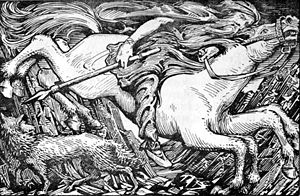
In Norse mythology
Norse mythology
Norse mythology, a subset of Germanic mythology, is the overall term for the myths, legends and beliefs about supernatural beings of Norse pagans. It flourished prior to the Christianization of Scandinavia, during the Early Middle Ages, and passed into Nordic folklore, with some aspects surviving...
, Hel, the location, shares a name with Hel
Hel (being)
In Norse mythology, Hel is a being who presides over a realm of the same name, where she receives a portion of the dead. Hel is attested in the Poetic Edda, compiled in the 13th century from earlier traditional sources, and the Prose Edda, written in the 13th century by Snorri Sturluson...
, a female figure associated with the location. In late Iceland
Iceland
Iceland , described as the Republic of Iceland, is a Nordic and European island country in the North Atlantic Ocean, on the Mid-Atlantic Ridge. Iceland also refers to the main island of the country, which contains almost all the population and almost all the land area. The country has a population...
ic sources, varying descriptions of Hel are given and various figures are described as being buried with items that will facilitate their journey to Hel after their death. In the Poetic Edda
Poetic Edda
The Poetic Edda is a collection of Old Norse poems primarily preserved in the Icelandic mediaeval manuscript Codex Regius. Along with Snorri Sturluson's Prose Edda, the Poetic Edda is the most important extant source on Norse mythology and Germanic heroic legends, and from the early 19th century...
, Brynhildr's
Brynhildr
Brynhildr is a shieldmaiden and a valkyrie in Norse mythology, where she appears as a main character in the Völsunga saga and some Eddic poems treating the same events. Under the name Brünnhilde she appears in the Nibelungenlied and therefore also in Richard Wagner's opera cycle Der Ring des...
trip to Hel after her death is described and Odin
Odin
Odin is a major god in Norse mythology and the ruler of Asgard. Homologous with the Anglo-Saxon "Wōden" and the Old High German "Wotan", the name is descended from Proto-Germanic "*Wodanaz" or "*Wōđanaz"....
, while alive, also visits Hel upon his horse Sleipnir
Sleipnir
In Norse mythology, Sleipnir is an eight-legged horse. Sleipnir is attested in the Poetic Edda, compiled in the 13th century from earlier traditional sources, and the Prose Edda, written in the 13th century by Snorri Sturluson...
. In Snorri Sturluson
Snorri Sturluson
Snorri Sturluson was an Icelandic historian, poet, and politician. He was twice elected lawspeaker at the Icelandic parliament, the Althing...
's Prose Edda
Prose Edda
The Prose Edda, also known as the Younger Edda, Snorri's Edda or simply Edda, is an Icelandic collection of four sections interspersed with excerpts from earlier skaldic and Eddic poetry containing tales from Nordic mythology...
, Baldr goes to Hel upon death and subsequently Hermóðr
Hermóðr
Hermóðr the Brave is a figure in Norse mythology, the son of god Odin.-Prose Edda:Hermóðr appears distinctly in section 49 of the Prose Edda book Gylfaginning. There, it is described that the gods were speechless and devastated at the death of Baldr, unable to react due to their grief...
uses Sleipnir to attempt to retrieve him. "Hel-shoes" are described in Gísla saga
Gísla saga
Gísla saga Súrssonar is one of the Sagas of Icelanders. It tells the story of Gisli, a tragic hero who must kill one of his brothers-in-law to avenge another brother-in-law. Gisli is outlawed and forced to stay on the run for thirteen years before he is finally hunted down and killed...
.
Etymology
The old Old NorseOld Norse
Old Norse is a North Germanic language that was spoken by inhabitants of Scandinavia and inhabitants of their overseas settlements during the Viking Age, until about 1300....
word Hęl derives from Proto-Germanic *khalija, which means "one who covers up or hides something", which itself derives from Proto-Indo-European
Proto-Indo-European language
The Proto-Indo-European language is the reconstructed common ancestor of the Indo-European languages, spoken by the Proto-Indo-Europeans...
*kel-, meaning "conceal". The cognate in English is the word Hell
Hell
In many religious traditions, a hell is a place of suffering and punishment in the afterlife. Religions with a linear divine history often depict hells as endless. Religions with a cyclic history often depict a hell as an intermediary period between incarnations...
which is from the Old English forms hel and helle. Related terms are Old Frisian
Old Frisian
Old Frisian is a West Germanic language spoken between the 8th and 16th centuries in the area between the Rhine and Weser on the European North Sea coast. The Frisian settlers on the coast of South Jutland also spoke Old Frisian but no medieval texts of this area are known...
, helle, German
German language
German is a West Germanic language, related to and classified alongside English and Dutch. With an estimated 90 – 98 million native speakers, German is one of the world's major languages and is the most widely-spoken first language in the European Union....
Hölle
Holle (goddess)
Holle is theorized as an ancient Germanic supreme goddess of birth, death and reincarnation who predates most of the Germanic pantheon, dating back to the Neolithic before Indo-European invasion of Europe. She also appears as "Frau Holle" in Grimm's Fairy Tale #24. Alternative names for this...
and Gothic
Gothic language
Gothic is an extinct Germanic language that was spoken by the Goths. It is known primarily from the Codex Argenteus, a 6th-century copy of a 4th-century Bible translation, and is the only East Germanic language with a sizable Text corpus...
halja. Other words more distantly related include hole, hollow, hall, helmet and cell, all from the aforementioned Indo-European root *kel-.
The word Hel is found in Norse words and phrases related to death such as Helför ("Hel-journey," a funeral) and Helsótt ("Hel-sickness," a fatal illness).
Poetic Edda
In reference to Hel, in the poem VöluspáVöluspá
Völuspá is the first and best known poem of the Poetic Edda. It tells the story of the creation of the world and its coming end related by a völva addressing Odin...
, a völva
Völva
A vǫlva or völva is a shamanic seeress in Norse paganism, and a recurring motif in Norse mythology....
states that Hel will play an important role in Ragnarök
Ragnarök
In Norse mythology, Ragnarök is a series of future events, including a great battle foretold to ultimately result in the death of a number of major figures , the occurrence of various natural disasters, and the subsequent submersion of the world in water...
. The Völva states that a crowing "sooty-red cock from the halls of Hel" is one of three cocks that will signal one of the beginning events of Ragnarök. The other two are Fjalar
Fjalar
In Norse mythology, Fjalar may refer to:* Fjalar and Galar, dwarf brothers who killed the god Kvasir and turned his blood into the mead of poetry* The other is a rooster that will crow to signify the beginning of Ragnarok...
in Jotunheim and Gullunkambi in Valhalla
Valhalla
In Norse mythology, Valhalla is a majestic, enormous hall located in Asgard, ruled over by the god Odin. Chosen by Odin, half of those that die in combat travel to Valhalla upon death, led by valkyries, while the other half go to the goddess Freyja's field Fólkvangr...
.
In Grímnismál
Grímnismál
Grímnismál is one of the mythological poems of the Poetic Edda. It is preserved in the Codex Regius manuscript and the AM 748 I 4to fragment. It is spoken through the voice of Grímnir, one of the many guises of the god Odin, who is tortured by King Geirröth...
stanza 31, Hel is listed as existing beneath one of three roots of the world tree Yggdrasil
Yggdrasil
In Norse mythology, Yggdrasil is an immense tree that is central in Norse cosmology. It was said to be the world tree around which the nine worlds existed...
. One of the other two leads to the frost jötnar and the third to Mankind. In Guðrúnarkviða I
Guðrúnarkviða I
Guðrúnarkviða I or the First Lay of Guðrún is simply called Guðrúnarkviða in Codex Regius where it was found together with the other heroic poems of the Poetic Edda. Henry Adams Bellows considered it to be one of the finest of the eddic poems with an "extraordinary emotional intensity and dramatic...
as Herborg tells of her grief in having prepared funeral arrangements for various members of her family, her children and her husbands, described it as "arranging their journey to Hel."
In the short poem Helreið Brynhildar
Helreið Brynhildar
Helreið Brynhildar or Brynhild's Hel-Ride is a short Old Norse poem that is found in the Poetic Edda. Most of the poem is also quoted in Norna-Gests þáttr....
, Hel is directly referenced as a location in the title, translating to "Brynhild's Hel-Ride." While riding along a road on the border of Hel in a lavish cart (the cart her corpse was burnt within), Brynhildr
Brynhildr
Brynhildr is a shieldmaiden and a valkyrie in Norse mythology, where she appears as a main character in the Völsunga saga and some Eddic poems treating the same events. Under the name Brünnhilde she appears in the Nibelungenlied and therefore also in Richard Wagner's opera cycle Der Ring des...
encounters a dead giantess at a burial mound belonging to her. This results in a heated exchange, during which Brynhildr tells of her life.
In Baldrs draumar
Baldrs draumar
Baldrs draumar or Vegtamskviða is an Eddic poem, contained in the manuscript AM 748 I 4to. It relates information on the myth of Baldr's death in a way consistent with Gylfaginning....
, Odin
Odin
Odin is a major god in Norse mythology and the ruler of Asgard. Homologous with the Anglo-Saxon "Wōden" and the Old High German "Wotan", the name is descended from Proto-Germanic "*Wodanaz" or "*Wōđanaz"....
rides to the edge of Hel to investigate nightmares Baldr has had. He brings to life the corpse of a Völva
Völva
A vǫlva or völva is a shamanic seeress in Norse paganism, and a recurring motif in Norse mythology....
with a spell. Odin introduces himself under a false name and pretense and asks for information from the völva relating to Baldr's dreams. The völva proceeds to reluctantly produce prophecies regarding the events of Ragnarök
Ragnarök
In Norse mythology, Ragnarök is a series of future events, including a great battle foretold to ultimately result in the death of a number of major figures , the occurrence of various natural disasters, and the subsequent submersion of the world in water...
.
The poem gives some information regarding the geographic location of Hel in parallel to the description in the Prose Edda, which may be related to the fact that it was not included in the Codex Regius but is instead a later addition. Niflhel
Niflhel
Niflhel is the name of a location in Norse mythology which appears in the eddic poems Vafþrúðnismál and Baldrs draumar, and also in Snorri Sturluson's Gylfaginning...
is mentioned as being just outside of Hel. The bloody Garmr makes an appearance, encountering Odin on Odin's ride to Hel. Odin continues down the road and approaches Hel, which is described as the "high hall of Hel." There he proceeds to the grave of the Völva near the eastern doors where the descriptions of Hel end.
Prose Edda
In the Prose EddaProse Edda
The Prose Edda, also known as the Younger Edda, Snorri's Edda or simply Edda, is an Icelandic collection of four sections interspersed with excerpts from earlier skaldic and Eddic poetry containing tales from Nordic mythology...
more detailed information is given about the location, including a detailed account of a venture to the region after the death of the god Baldr. Snorri
Snorri Sturluson
Snorri Sturluson was an Icelandic historian, poet, and politician. He was twice elected lawspeaker at the Icelandic parliament, the Althing...
's descriptions of Hel in the Prose Edda are not corroborated outside of Baldrs draumar
Baldrs draumar
Baldrs draumar or Vegtamskviða is an Eddic poem, contained in the manuscript AM 748 I 4to. It relates information on the myth of Baldr's death in a way consistent with Gylfaginning....
, which does not appear in the original Codex Regius
Codex Regius
Cōdex Rēgius is an Icelandic manuscript in which the Poetic Edda is preserved. It is made up of 45 vellum leaves, thought to have been written in the 1270s. It originally contained a further 8 leaves, which are now missing...
but is a later addition often included with modern editions of the Poetic Edda.
Gylfaginning
In the book GylfaginningGylfaginning
Gylfaginning, or the Tricking of Gylfi , is the first part of Snorri Sturluson's Prose Edda after Prologue. The Gylfaginning deals with the creation and destruction of the world of the Norse gods, and many other aspects of Norse mythology...
, Hel is introduced in chapter 3 as a location where "evil men" go upon death, and into Niflhel
Niflhel
Niflhel is the name of a location in Norse mythology which appears in the eddic poems Vafþrúðnismál and Baldrs draumar, and also in Snorri Sturluson's Gylfaginning...
. The chapter further details that Hel is in the ninth of the Nine Worlds
Norse cosmology
The cosmology of Norse mythology has 'nine homeworlds', unified by the world tree Yggdrasill. Mapping the nine worlds escapes precision because the Poetic Edda often alludes vaguely, and the Prose Edda may be influenced by medieval Christian cosmology...
.
In chapter 34, Hel, the being
Hel (being)
In Norse mythology, Hel is a being who presides over a realm of the same name, where she receives a portion of the dead. Hel is attested in the Poetic Edda, compiled in the 13th century from earlier traditional sources, and the Prose Edda, written in the 13th century by Snorri Sturluson...
is introduced. Snorri writes that Hel was cast down into Hel by Odin who "made her ruler over Nine Worlds." Snorri further writes that there Hel is located in Niflheim
Niflheim
Niflheim is one of the Nine Worlds and is a location in Norse mythology which overlaps with the notions of Niflhel and Hel...
. Here it is related that she could give out lodging and items to those sent to her that have died of disease or old age. A very large dwelling is described as existing in Niflheim owned by Hel with huge walls and gates. The hall is called - or inside of this huge hall there is a hall belonging to Hel called - Éljúðnir. Within this hall Hel is described as having a servant, a slave and various possessions.
At the end of chapter 49, the death of Baldr and Nanna
Nanna (Norse deity)
In Norse mythology, Nanna Nepsdóttir or simply Nanna is a goddess associated with the god Baldr. Accounts of Nanna vary greatly by source. In the Prose Edda, written in the 13th century by Snorri Sturluson, Nanna is the wife of Baldr and the couple produced a son, the god Forseti. After Baldr's...
is described. Hermóðr
Hermóðr
Hermóðr the Brave is a figure in Norse mythology, the son of god Odin.-Prose Edda:Hermóðr appears distinctly in section 49 of the Prose Edda book Gylfaginning. There, it is described that the gods were speechless and devastated at the death of Baldr, unable to react due to their grief...
, described as Baldr's brother in this source, sets out to Hel on horseback to retrieve the deceased Baldr. To enter Hel, Hermóðr rides for nine nights
Numbers in Norse mythology
The numbers three and nine are significant numbers in Norse mythology and paganism. Both numbers appear throughout surviving attestations of Norse paganism, in both mythology and cultic practice....
through "valleys so deep and dark that he saw nothing" until he arrives at the river Gjöll
Gjöll
In Norse mythology, Gjöll is one of the eleven rivers traditionally associated with the Élivágar, according to Gylfaginning, originating from the wellspring Hvergelmir in Niflheim, flowing through Ginnungagap, and thence into the worlds of existence...
("Noisy") and the Gjöll bridge
Gjallarbrú
In Norse mythology, Gjallarbrú is a bridge spanning the river Gjöll in the underworld, which must be crossed in order to reach Hel, according to Gylfaginning. It is described as a covered bridge, "thatched with glittering gold", and figures most prominently in the story of Baldr, specifically when...
. The bridge is described as having a roof made of shining gold. Hermóðr then proceeds to cross it. Hermóðr encounters Móðguð, who is the guard of the bridge ("Furious Battler").
Móðguð speaks to Hermóðr and comments that the bridge echoes beneath him more than the entire party of five people who had just passed. This is a reference to Baldr, Nanna and those that were burnt in their funeral pyre passing over the bridge upon death. Móðguð also says that the dead in Hel appear as a different color than the living and tells him that to get to Hel he must go "down and to the North" where he would find the Road to Hel.
Continuing along the Road to Hel, Hermóðr encounters the Gates of Hel. Hermóðr remounts, spurs Sleipnir, and the two bound far over it. Hermóðr proceeds further beyond the gates for some distance before arriving at the hall, dismounting and entering. There Hermóðr sees Baldr sitting in a "seat of honor" and Hermóðr spends a night in Hel. The following day, Hermóðr presses Hel, the being, to allow Baldr to leave. Hel gives him an offer and then Baldr leads him out of the hall. Baldr then gives Hermóðr various gifts from Nanna and himself to bring from Hel to the living Æsir. Hermóðr then retraces his path back to the land of the living. Hel's offer fails and in chapter 50, Loki
Loki
In Norse mythology, Loki or Loke is a god or jötunn . Loki is the son of Fárbauti and Laufey, and the brother of Helblindi and Býleistr. By the jötunn Angrboða, Loki is the father of Hel, the wolf Fenrir, and the world serpent Jörmungandr. By his wife Sigyn, Loki is the father of Nari or Narfi...
is blamed for Baldr remaining in Hel.
In chapter 53, Hel is mentioned a final time in the Prose Edda. Here, Höðr
Höðr
Höðr is the brother of Baldr in Norse mythology. Guided by Loki he shot the mistletoe missile which was to slay the otherwise invulnerable Baldr....
and Baldr are mentioned as returning from Hel in a post-Ragnarök
Ragnarök
In Norse mythology, Ragnarök is a series of future events, including a great battle foretold to ultimately result in the death of a number of major figures , the occurrence of various natural disasters, and the subsequent submersion of the world in water...
world:
Því næst koma þar Baldr ok Höðr frá Heljar, setjask þá allir samt ok talask við ok minnask á rúnar sínar ok rœða of tíðindi þau er fyrrum höfðu verit, of Miðgarðsorm ok um Fenrisúlf. - Eysteinn Björnsson's edition |
"After that Baldr shall come thither, and Hödr, from Hel; then all shall sit down together and hold speech with one another, and call to mind their secret wisdom, and speak of those happenings which have been before: of the Midgard Serpent and of Fenris-Wolf." - Brodeur's translation |
Gesta Danorum
Book I of Gesta DanorumGesta Danorum
Gesta Danorum is a patriotic work of Danish history, by the 12th century author Saxo Grammaticus . It is the most ambitious literary undertaking of medieval Denmark and is an essential source for the nation's early history...
contains an account of what has often been interpreted as a trip to Hel. While having dinner, King Hadingus
Hadingus
Hadingus was one of the earliest legendary Danish kings according to Saxo Grammaticus' Gesta Danorum where he has a detailed biography. Georges Dumézil and others have argued that Gram was partially modelled on the god Njörðr.-Gesta Danorum:...
is visited by a woman bearing stalks of hemlock
Conium
Conium is a genus of two species of highly poisonous perennial herbaceous flowering plants in the family Apiaceae, native to Europe and the Mediterranean region as Conium maculatum, and to southern Africa as Conium chaerophylloides....
who asks him if he knows where such fresh herbs grow in winter. Hadingus wants to know; so the woman muffles him with her cloak, pulls him into the ground, and they vanish. Saxo reasons that the gods wished for Hadingus to visit in the flesh where he will go when he dies.
The two penetrate a dark and misty cloud, and then continue along a path worn from heavy use over the ages. The two see men wearing rich-looking robes, and nobles wearing purple. Passing them, they finally reach sunny regions where the herbs the woman presented Hadingus grow.
Hadingus and the woman continue until they arrived at a river of blue-black water that is fast-moving, full of rapids, and filled with various weapons. They cross the bridge, and see two "strongly-matched" armies meeting. Hadingus asks the woman about their identity, and she responds that they are men that have met their death by sword, and that they present an everlasting display of their destruction while attempting to equal the activity of their past lives.
Moving forward, the two encounter a wall that they cannot find a way over. The woman attempts to leap over it, but despite her slender and wrinkled body, cannot. The woman removes the head of a cock that she was carrying and throws it over the wall. The bird immediately crows; it has returned to life. Hadingus returns to his wife, and foils a threat by pirates.
Theories
Hilda Ellis Davidson, writing on Snorri's unique description of Hel in his Prose Edda, states that "it seems likely that Snorri's account of the underworld is chiefly his own work" and that the idea that the dead entering Hel who have died of sickness and old age may have been an attempt on Snorri's part to reconcile the tradition with his description of ValhallaValhalla
In Norse mythology, Valhalla is a majestic, enormous hall located in Asgard, ruled over by the god Odin. Chosen by Odin, half of those that die in combat travel to Valhalla upon death, led by valkyries, while the other half go to the goddess Freyja's field Fólkvangr...
, citing that "the one detailed account of Hel" that Snorri gives is that of Baldr entering Hel without dying of old age or sickness.
Davidson writes that Snorri was potentially using a "rich source" unknown to us for his description of Hel, though it may not have told him very much about the location outside of that it was a hall and that Snorri's description of Hel may at times be influenced by Christian
Christianity
Christianity is a monotheistic religion based on the life and teachings of Jesus as presented in canonical gospels and other New Testament writings...
teachings about the after-life.
See also
- HelreginnHelreginnIn Norse Mythology, Helreginn is a jötunn listed in the þulur section of the Prose Edda book Skáldskaparmál. Other than their name, no additional information about the figure is provided...
, a jötunn whose name means "ruler over Hel" - NáströndNáströndIn Norse mythology, Náströnd is a place in Hel where Níðhöggr lives and sucks corpses.-Poetic Edda:The Völuspá says:-Prose Edda:...
- NiflheimNiflheimNiflheim is one of the Nine Worlds and is a location in Norse mythology which overlaps with the notions of Niflhel and Hel...
- NiflhelNiflhelNiflhel is the name of a location in Norse mythology which appears in the eddic poems Vafþrúðnismál and Baldrs draumar, and also in Snorri Sturluson's Gylfaginning...
- HeklaHeklaHekla is a stratovolcano located in the south of Iceland with a height of . Hekla is one of Iceland's most active volcanoes; over 20 eruptions have occurred in and around the volcano since 874. During the Middle Ages, Icelanders called the volcano the "Gateway to Hell."Hekla is part of a volcanic...