

Adi Granth

Encyclopedia
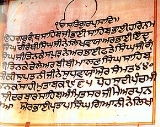
Adi Granth is the early compilation of the Sikh Scriptures by Sri Guru Arjan Dev
Ji, the fifth Sikh Guru, in 1604. This Granth ("book") is the Holy Scripture of the Sikh
s. The tenth Sikh Guru, Guru Gobind Singh
added further holy Shabads to this Granth during the period 1704 to 1706. Then in 1708, before his death, Guru Gobind Singh affirmed the Adi Granth as the perpetual Guru of the Sikhs and the Granth then became known as the Sri Guru Granth Sahib.
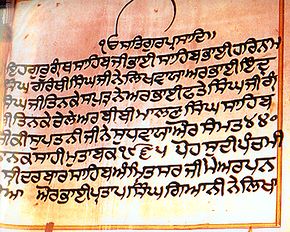
The original copy of the scripture, called Adi Granth, compiled and authenticated by Guru Arjan Dev
still exists today and is kept at Kartarpur
which is a town about 15 km. north west of the city of Jalandhar
, Punjab, India. It contains the hymns of both Hindu
and Muslim
saints.
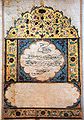 One of the classic simplifications of Sikh history pertains to the preparation of the sacred scripture, the Guru Granth Sahib
. The event is generally described in the briefest terms. The Holy Volume was compiled by Guru Arjan (AD 1563-1606) and the first copy was calligraphed by Bhai Gurdas
at his dictation — this is all we learn from most of the sources. What amount of planning, minute attention to detail and went into this work is slurred over.
An old text which gives some detailed information is the "Gurbilas Chhevin Patshahi". Written in A.D. 1718, this, in fact, is the oldest source. Although it does not go into the technical and literary minutiae, it narrates the entire process from the beginning of the transcription of the Holy Volume to its installation in the newly built Harimandir Sahib at Amritsar
.
Why Guru Arjan undertook the task is variously explained. One commonly accepted assumption is that the codification of the Gurus' compositions into authorized volume was begun by him with a view to preserving them from garbling by schismatic groups and others. According to the Mahima Prakash (A.D. 1776), he set to work with the announcement: "As the Panth (Community) has been revealed unto the world, so there must be the Granth (Book), too."
 The "Bani
", Gurus inspired utterance, had always been the object of highest reverence for the Sikh
s as well as for the Gurus themselves. It was equated with the Guru himself. "The bani is the Guru and the Guru bani" sang Guru Ram Das
in measure Nat Narain. By accumulating the canon, Guru Arjan wished to affix the seal on the sacred word. It was also to be the perennial fountain of inspiration and the means of self-perpetuation for the community.
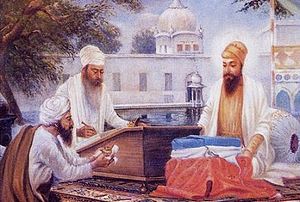
Guru Arjan called Bhai Gurdas
to his presence and expressed to him the wish that the compositions of the Gurus as well as those of some of the saints and sufis be collected. Massages were sent to the disciples to gather and transmit to him the hymns of his predecessors. Baba Mohan, son of Guru Amar Das
, Nanak III, had two manuscript collections of the Gurus' hymns inherited from his father.
Bhai Gurdas
travelled to Goindwal to bring these Pothis but the owner refused to see him. Baba Buddha, one of the oldest Sikhs from Guru Nanak's days, was similarly turned away from his door. Then Guru Arjan went himself. He sat on the street below Mohan's home, serenading him on his tambura. Mohan was disarmed to hear the hymn. He came downstairs with the pothis and presented these to the Guru. As says the Gurbilas, the pothis were placed on a palanquin bedecked with precious stones. The Sikhs carried it on their shoulders and Guru Arjan walked behind barefoot. He refused to ride his horse, saying that the pothis were the very spirit of the four Gurus — his predecessors.
, it was received by Hargobind, Guru Arjan's young son, accompanied by a large number of Sikhs. He bowed at his father's feet and showered petals in front of the pothis. Guru Arjan, Hargobind, Bhai Gurdas and Bhai Buddha now bore the palanquin on their shoulders and marched towards Amritsar, led by musicians, with flutes and drums.
In Amritsar
, Guru Arjan first went to the Harimandir Sahib to offer Karah Prasad in gratefulness. To quote the Gurbilas again, an attractive spot in the thick of a forest on the outskirts of Amritsar was marked out by Guru Arjan. So dense was the foliage that not even a moonbeam could pray into it. It was like Panchbati itself, peaceful and picturesque. A tent was hoisted in this idyllic setting. Here Guru Arjan and Bhai Gurdas started work on the sacred volume.
Guru Arjan carried out the work with extraordinary exactness. He arranged the hymns in thirty different ragas, or musical patterns. A precise method was followed in setting down the compositions. First came shabads by the Gurus in the order of their succession. Then came hands, var
s, and other poetic forms in a set order. The compositions of the Gurus in each raga were followed by those of the Bhaktas in the same format. Gurmukhi was the script used for the transcription.
A genius, unique in spiritual insight and not unconcerned with methodological design, had created a scripture with an exalted mystical tone and a high degree of organization. It was large in size—nearly 7,000 hymns, comprising compositions of the first five Sikhs Gurus and fifteen Bhaktas and Sufis from different parts of India
, including Sheikh Fariduddin Ganjshakar, Kabir
and Ravidas.
when there were not shabads enough to fill the section assigned to it. The site of these marvellous labours is now marked by a shrine called Gurdwara
Ramsar.
The completion of the Granth Sahib was, says the "Gurbilas", celebrated with much jubilation. In thanksgiving, Karah Prasad was prepared in huge quantities. Sikhs came in large numbers to see the Holy Book. They rejoiced in their hearts by a sight of it and bowed before it in veneration. Among the visitors was Bhai Banno, who had led a group of Sikhs from Mangat
, in western Punjab
.
As Bhai Banno left Amritsar
with his sacred charge, it occurred to him to have a second copy transcribed. The first copy, he argued, would remain with the Guru. There must be an additional one for the sangat
. The Guru's direction was that he should not stay longer than one night at a place, but he had said nothing about the time to be spent on the journey. So he proceeded with his plans and sent a Sikh to purchase paper.
He proposed to his companions that they should travel by easy marches of five miles a day. The time thus saved was utilized in transcribing the holy text. Sikhs wrote with love and devotion and nobody shirked his duty whether it was day or night. By the time they reached Lahore
, the second copy was ready. But Banno had added to it some apocryphal texts. He had both volumes bound and returned to Amritsar as fast as he could.
, Banno was received with due ceremony, though Guru Arjan was not a little surprised to see two volumes instead of one. Bhai Banno spoke truthfully: "Lord, there is nothing that is hidden from you. This second copy I have had made for the sake of the sangat
" But the Guru put his seal only on the volume written by Bhai Gurdas's
hand. He enjoined the Sikhs to own the Granth equal with the Guru and make no distinction between the two. "He who would wish to see the Guru, let him see the Granth. He who would seek the Guru's word, let him read the Granth with love and attention."
Guru Arjan asked his Sikhs where the Granth Sahib be installed. Bhai Buddha said, "You are omniscient, Master! But there is no place more suitable than the Harimandir." The Guru was happy to hear these words "like one who has sighted the new moon." He then recited the praise of the Harimandir: "There is nothing like it in all the three worlds. Harimandir is like the ship—the means for the people to cross over the worldly ocean triumphantly. A new joy pervades here every day. A sight of it annuls all sins."
the next morning. The Granth Sahib rested on a seat under the canopy, whereas the Guru and the Sikhs slept on the ground. A disciple had to be chosen to take charge of the Granth Sahib. As says the Gurbilas, Guru Arjan lay awake through the night reflecting on the question. His choice formally fell on old Bhai Buddha whose devotion was universally applauded.
As they awoke, the Guru and his Sikhs made ablutions in Ramsar. The former there upon practiced his wonted meditation. At dawn, the entire sangat
marched towards Harimandir. Bhai Buddha carried the Holy Book on his head and Guru Arjan walked behind swinging the whisk over it. Musicians sang shabads. Thus they reached the Harimandir. The Granth Sahib was ceremonially installed in the center of the inner sanctuary on Bhadon Sudi 1, 1661 sK/1 September 1604. Bhai Buddha opened it with reverence to obtain from it the divine command, as Guru Arjan stood in attendance behind.
The following hymn was read as God's own announcement for the occasion:
"He Himself hath succoured His saints in their work, He himself hath come to see their task fulfilled. Blessed is the earth, blessed the tank. Blessed is the tank with amrit filled. Amrit overfloweth the tank: He hath had the task completed; Eternal is the Perfect Being, His praises Vedas and Puranas sing. The Creator hath bestowed on me the nine treasures, and all the charisms, No lack do I suffer now. Enjoying His largesse, bliss have I attained, Ever-expanding is the Lord's bounty."
Guru Arjan Dev
Guru Arjan Dev Ji was the fifth of the Ten Gurus of Sikhism. He was born in Goindval, Punjab, India, the youngest son of Guru Ram Das and Bibi Bhani, the daughter of Guru Amar Das. He became the Guru of the Sikhs on 1 September 1581 after the death of his father Guru Ram Das. Guru Arjan died in...
Ji, the fifth Sikh Guru, in 1604. This Granth ("book") is the Holy Scripture of the Sikh
Sikh
A Sikh is a follower of Sikhism. It primarily originated in the 15th century in the Punjab region of South Asia. The term "Sikh" has its origin in Sanskrit term शिष्य , meaning "disciple, student" or शिक्ष , meaning "instruction"...
s. The tenth Sikh Guru, Guru Gobind Singh
Guru Gobind Singh
Guru Gobind Singh is the tenth and last Sikh guru in a sacred lineage of ten Sikh gurus. Born in Patna, Bihar in India, he was also a warrior, poet and philosopher. He succeeded his father Guru Tegh Bahadur as the leader of Sikhs at a young age of nine...
added further holy Shabads to this Granth during the period 1704 to 1706. Then in 1708, before his death, Guru Gobind Singh affirmed the Adi Granth as the perpetual Guru of the Sikhs and the Granth then became known as the Sri Guru Granth Sahib.
Timeline
- 30 August 1604: Completion of Adi Granth
- 1 September 1604: Adi Granth installed for the first time at Harmandir SahibHarmandir SahibThe Harmandir Sahib also Darbar Sahib , also referred to as the Golden Temple, is a prominent Sikh gurdwara located in the city of Amritsar, Punjab . Construction of the gurdwara was begun by Guru Ram Das, the fourth Sikh Guru, and completed by his successor, Guru Arjan Dev...
by Guru Arjan DevGuru Arjan DevGuru Arjan Dev Ji was the fifth of the Ten Gurus of Sikhism. He was born in Goindval, Punjab, India, the youngest son of Guru Ram Das and Bibi Bhani, the daughter of Guru Amar Das. He became the Guru of the Sikhs on 1 September 1581 after the death of his father Guru Ram Das. Guru Arjan died in...
ji
- 1705: The Takht Damdama Sahib Bir was completed by Guru Gobind SinghGuru Gobind SinghGuru Gobind Singh is the tenth and last Sikh guru in a sacred lineage of ten Sikh gurus. Born in Patna, Bihar in India, he was also a warrior, poet and philosopher. He succeeded his father Guru Tegh Bahadur as the leader of Sikhs at a young age of nine...
from memory
- 20 October 1708: Installation of the Guru Granth SahibGuru Granth SahibSri Guru Granth Sahib , or Adi Granth, is the religious text of Sikhism. It is the final and eternal guru of the Sikhs. It is a voluminous text of 1430 angs, compiled and composed during the period of Sikh gurus, from 1469 to 1708...
as eternal Guru
The original copy of the scripture, called Adi Granth, compiled and authenticated by Guru Arjan Dev
Guru Arjan Dev
Guru Arjan Dev Ji was the fifth of the Ten Gurus of Sikhism. He was born in Goindval, Punjab, India, the youngest son of Guru Ram Das and Bibi Bhani, the daughter of Guru Amar Das. He became the Guru of the Sikhs on 1 September 1581 after the death of his father Guru Ram Das. Guru Arjan died in...
still exists today and is kept at Kartarpur
Kartarpur, India
Kartarpur is a town near the city of Jalandhar and is located in the Doaba region of the state. It was founded by the fifth Guru of Sikhism, Guru Arjan Dev.-Geography:...
which is a town about 15 km. north west of the city of Jalandhar
Jalandhar
Jalandhar is a city in Jalandhar District in the state of Punjab, India. It is located 144 km northwest of the state capital, Chandigarh...
, Punjab, India. It contains the hymns of both Hindu
Hindu
Hindu refers to an identity associated with the philosophical, religious and cultural systems that are indigenous to the Indian subcontinent. As used in the Constitution of India, the word "Hindu" is also attributed to all persons professing any Indian religion...
and Muslim
Muslim
A Muslim, also spelled Moslem, is an adherent of Islam, a monotheistic, Abrahamic religion based on the Quran, which Muslims consider the verbatim word of God as revealed to prophet Muhammad. "Muslim" is the Arabic term for "submitter" .Muslims believe that God is one and incomparable...
saints.
Compilation
Guru Granth Sahib
Sri Guru Granth Sahib , or Adi Granth, is the religious text of Sikhism. It is the final and eternal guru of the Sikhs. It is a voluminous text of 1430 angs, compiled and composed during the period of Sikh gurus, from 1469 to 1708...
. The event is generally described in the briefest terms. The Holy Volume was compiled by Guru Arjan (AD 1563-1606) and the first copy was calligraphed by Bhai Gurdas
Bhai Gurdas
Bhai Gurdas was a Punjabi Sikh writer, historian, preacher and religious figure. He was the original scribe of the Guru Granth Sahib and a companion of four of the Sikh Gurus.-Early life:...
at his dictation — this is all we learn from most of the sources. What amount of planning, minute attention to detail and went into this work is slurred over.
An old text which gives some detailed information is the "Gurbilas Chhevin Patshahi". Written in A.D. 1718, this, in fact, is the oldest source. Although it does not go into the technical and literary minutiae, it narrates the entire process from the beginning of the transcription of the Holy Volume to its installation in the newly built Harimandir Sahib at Amritsar
Amritsar
Amritsar is a city in the northern part of India and is the administrative headquarters of Amritsar district in the state of Punjab, India. The 2001 Indian census reported the population of the city to be over 1,500,000, with that of the entire district numbering 3,695,077...
.
Why Guru Arjan undertook the task is variously explained. One commonly accepted assumption is that the codification of the Gurus' compositions into authorized volume was begun by him with a view to preserving them from garbling by schismatic groups and others. According to the Mahima Prakash (A.D. 1776), he set to work with the announcement: "As the Panth (Community) has been revealed unto the world, so there must be the Granth (Book), too."
Bani included in the Granth
Bani
Gurbani is the term used by Sikhs to refer to any compositions of the Sikh Gurus. Gurbani is composed of two words: 'Gur' meaning 'the Guru's' and 'bani' meaning 'word'....
", Gurus inspired utterance, had always been the object of highest reverence for the Sikh
Sikh
A Sikh is a follower of Sikhism. It primarily originated in the 15th century in the Punjab region of South Asia. The term "Sikh" has its origin in Sanskrit term शिष्य , meaning "disciple, student" or शिक्ष , meaning "instruction"...
s as well as for the Gurus themselves. It was equated with the Guru himself. "The bani is the Guru and the Guru bani" sang Guru Ram Das
Guru Ram Das
Guru Ram Das was the fourth of the Ten Gurus of Sikhism and was given the title of Sikh Guru on 30 August 1574.-Early life:Ram Das was born in Lahore, Punjab on 24 September 1534[1] to a Sodhi family of the Khatri clan. His father was Hari Das and his mother Anup Devi. His wife was Bibi Bhani,...
in measure Nat Narain. By accumulating the canon, Guru Arjan wished to affix the seal on the sacred word. It was also to be the perennial fountain of inspiration and the means of self-perpetuation for the community.
Guru Arjan called Bhai Gurdas
Bhai Gurdas
Bhai Gurdas was a Punjabi Sikh writer, historian, preacher and religious figure. He was the original scribe of the Guru Granth Sahib and a companion of four of the Sikh Gurus.-Early life:...
to his presence and expressed to him the wish that the compositions of the Gurus as well as those of some of the saints and sufis be collected. Massages were sent to the disciples to gather and transmit to him the hymns of his predecessors. Baba Mohan, son of Guru Amar Das
Guru Amar Das
Guru Amar Das was the third of the Ten Gurus of Sikhism and was given the title of Sikh Guru on 26 March 1552.-His life:...
, Nanak III, had two manuscript collections of the Gurus' hymns inherited from his father.
Bhai Gurdas
Bhai Gurdas
Bhai Gurdas was a Punjabi Sikh writer, historian, preacher and religious figure. He was the original scribe of the Guru Granth Sahib and a companion of four of the Sikh Gurus.-Early life:...
travelled to Goindwal to bring these Pothis but the owner refused to see him. Baba Buddha, one of the oldest Sikhs from Guru Nanak's days, was similarly turned away from his door. Then Guru Arjan went himself. He sat on the street below Mohan's home, serenading him on his tambura. Mohan was disarmed to hear the hymn. He came downstairs with the pothis and presented these to the Guru. As says the Gurbilas, the pothis were placed on a palanquin bedecked with precious stones. The Sikhs carried it on their shoulders and Guru Arjan walked behind barefoot. He refused to ride his horse, saying that the pothis were the very spirit of the four Gurus — his predecessors.
The journey with the Pothis
The cavalcade broke journey at Khadur Sahib to make obeisance at shrines sacred to Guru Angad. Two kos from AmritsarAmritsar
Amritsar is a city in the northern part of India and is the administrative headquarters of Amritsar district in the state of Punjab, India. The 2001 Indian census reported the population of the city to be over 1,500,000, with that of the entire district numbering 3,695,077...
, it was received by Hargobind, Guru Arjan's young son, accompanied by a large number of Sikhs. He bowed at his father's feet and showered petals in front of the pothis. Guru Arjan, Hargobind, Bhai Gurdas and Bhai Buddha now bore the palanquin on their shoulders and marched towards Amritsar, led by musicians, with flutes and drums.
In Amritsar
Amritsar
Amritsar is a city in the northern part of India and is the administrative headquarters of Amritsar district in the state of Punjab, India. The 2001 Indian census reported the population of the city to be over 1,500,000, with that of the entire district numbering 3,695,077...
, Guru Arjan first went to the Harimandir Sahib to offer Karah Prasad in gratefulness. To quote the Gurbilas again, an attractive spot in the thick of a forest on the outskirts of Amritsar was marked out by Guru Arjan. So dense was the foliage that not even a moonbeam could pray into it. It was like Panchbati itself, peaceful and picturesque. A tent was hoisted in this idyllic setting. Here Guru Arjan and Bhai Gurdas started work on the sacred volume.
The inscription of the Granth
The making of the Granth was not an easy task. It involved sustained labour and a rigorous intellectual discipline. Selections had to be made from a vast amount of material. Besides the compositions of the four preceding Gurus and the Guru Arjan who himself was a poet with a rare spiritual insight, there were songs and hymns by saints, both Hindu and Muslim. What was genuine had to be sifted from what was counterfeit. Then the selected material had to be assigned to appropriate musical measures and transcribed in a minutely laid out order.Guru Arjan carried out the work with extraordinary exactness. He arranged the hymns in thirty different ragas, or musical patterns. A precise method was followed in setting down the compositions. First came shabads by the Gurus in the order of their succession. Then came hands, var
Var
Var, VAR, VAr, VaR or var can mean:VAR* Varna Airport IATA airport code* Vacuum arc remelting, a process for production of steel and special alloys...
s, and other poetic forms in a set order. The compositions of the Gurus in each raga were followed by those of the Bhaktas in the same format. Gurmukhi was the script used for the transcription.
A genius, unique in spiritual insight and not unconcerned with methodological design, had created a scripture with an exalted mystical tone and a high degree of organization. It was large in size—nearly 7,000 hymns, comprising compositions of the first five Sikhs Gurus and fifteen Bhaktas and Sufis from different parts of India
India
India , officially the Republic of India , is a country in South Asia. It is the seventh-largest country by geographical area, the second-most populous country with over 1.2 billion people, and the most populous democracy in the world...
, including Sheikh Fariduddin Ganjshakar, Kabir
Kabir
Kabīr was a mystic poet and saint of India, whose writings have greatly influenced the Bhakti movement...
and Ravidas.
The Granth completed
The Sacred Volume consisted of 974 leaves, or 1948 pages, 12" X 8", with several blank ones at the end of a ragaRaga
A raga is one of the melodic modes used in Indian classical music.It is a series of five or more musical notes upon which a melody is made...
when there were not shabads enough to fill the section assigned to it. The site of these marvellous labours is now marked by a shrine called Gurdwara
Gurdwara
A Gurdwara , meaning the Gateway to the Guru, is the place of worship for Sikhs, the followers of Sikhism. A Gurdwara can be identified from a distance by tall flagpoles bearing the Nishan Sahib ....
Ramsar.
The completion of the Granth Sahib was, says the "Gurbilas", celebrated with much jubilation. In thanksgiving, Karah Prasad was prepared in huge quantities. Sikhs came in large numbers to see the Holy Book. They rejoiced in their hearts by a sight of it and bowed before it in veneration. Among the visitors was Bhai Banno, who had led a group of Sikhs from Mangat
Mangat
For the Article on Jat clan, see Mangat Mangat is a town and Union Council of Mandi Bahauddin District in the Punjab province of Pakistan. It is located at 32°31'0N 73°30'0E and has an altitude of 223 metres . Literacy rate is not high in this locality. Farming is main occupation....
, in western Punjab
Punjab region
The Punjab , also spelled Panjab |water]]s"), is a geographical region straddling the border between Pakistan and India which includes Punjab province in Pakistan and the states of the Punjab, Haryana, Himachal Pradesh, Chandigarh and some northern parts of the National Capital Territory of Delhi...
.
Binding the Granth
Guru Arjan wanted to have the finished holy scripture bound. He sent Bhai BAnno to Lahore to have this completed. Banno sought the Guru's permission to be allowed to take the Granth Sahib first to Mangat for the Sikhs there to see it. The Guru allowed this, but enjoined him not to stay at Mangat, or at any other place, more than a night.As Bhai Banno left Amritsar
Amritsar
Amritsar is a city in the northern part of India and is the administrative headquarters of Amritsar district in the state of Punjab, India. The 2001 Indian census reported the population of the city to be over 1,500,000, with that of the entire district numbering 3,695,077...
with his sacred charge, it occurred to him to have a second copy transcribed. The first copy, he argued, would remain with the Guru. There must be an additional one for the sangat
Sangat
Sangat is a Sikh term with its origin in the Sanskrit word 'sangh', which means company, fellowship and association. In Sikh vocabulary, the word has a special connotation. It stands for the body of men and women who meet religiously, especially in the presence of the Guru Granth Sahib...
. The Guru's direction was that he should not stay longer than one night at a place, but he had said nothing about the time to be spent on the journey. So he proceeded with his plans and sent a Sikh to purchase paper.
He proposed to his companions that they should travel by easy marches of five miles a day. The time thus saved was utilized in transcribing the holy text. Sikhs wrote with love and devotion and nobody shirked his duty whether it was day or night. By the time they reached Lahore
Lahore
Lahore is the capital of the Pakistani province of Punjab and the second largest city in the country. With a rich and fabulous history dating back to over a thousand years ago, Lahore is no doubt Pakistan's cultural capital. One of the most densely populated cities in the world, Lahore remains a...
, the second copy was ready. But Banno had added to it some apocryphal texts. He had both volumes bound and returned to Amritsar as fast as he could.
The Granth arrives
At AmritsarAmritsar
Amritsar is a city in the northern part of India and is the administrative headquarters of Amritsar district in the state of Punjab, India. The 2001 Indian census reported the population of the city to be over 1,500,000, with that of the entire district numbering 3,695,077...
, Banno was received with due ceremony, though Guru Arjan was not a little surprised to see two volumes instead of one. Bhai Banno spoke truthfully: "Lord, there is nothing that is hidden from you. This second copy I have had made for the sake of the sangat
Sangat
Sangat is a Sikh term with its origin in the Sanskrit word 'sangh', which means company, fellowship and association. In Sikh vocabulary, the word has a special connotation. It stands for the body of men and women who meet religiously, especially in the presence of the Guru Granth Sahib...
" But the Guru put his seal only on the volume written by Bhai Gurdas's
Bhai Gurdas
Bhai Gurdas was a Punjabi Sikh writer, historian, preacher and religious figure. He was the original scribe of the Guru Granth Sahib and a companion of four of the Sikh Gurus.-Early life:...
hand. He enjoined the Sikhs to own the Granth equal with the Guru and make no distinction between the two. "He who would wish to see the Guru, let him see the Granth. He who would seek the Guru's word, let him read the Granth with love and attention."
Guru Arjan asked his Sikhs where the Granth Sahib be installed. Bhai Buddha said, "You are omniscient, Master! But there is no place more suitable than the Harimandir." The Guru was happy to hear these words "like one who has sighted the new moon." He then recited the praise of the Harimandir: "There is nothing like it in all the three worlds. Harimandir is like the ship—the means for the people to cross over the worldly ocean triumphantly. A new joy pervades here every day. A sight of it annuls all sins."
Reverence and respect
It was decided to spend the night at Ramsar and return to AmritsarAmritsar
Amritsar is a city in the northern part of India and is the administrative headquarters of Amritsar district in the state of Punjab, India. The 2001 Indian census reported the population of the city to be over 1,500,000, with that of the entire district numbering 3,695,077...
the next morning. The Granth Sahib rested on a seat under the canopy, whereas the Guru and the Sikhs slept on the ground. A disciple had to be chosen to take charge of the Granth Sahib. As says the Gurbilas, Guru Arjan lay awake through the night reflecting on the question. His choice formally fell on old Bhai Buddha whose devotion was universally applauded.
As they awoke, the Guru and his Sikhs made ablutions in Ramsar. The former there upon practiced his wonted meditation. At dawn, the entire sangat
Sangat
Sangat is a Sikh term with its origin in the Sanskrit word 'sangh', which means company, fellowship and association. In Sikh vocabulary, the word has a special connotation. It stands for the body of men and women who meet religiously, especially in the presence of the Guru Granth Sahib...
marched towards Harimandir. Bhai Buddha carried the Holy Book on his head and Guru Arjan walked behind swinging the whisk over it. Musicians sang shabads. Thus they reached the Harimandir. The Granth Sahib was ceremonially installed in the center of the inner sanctuary on Bhadon Sudi 1, 1661 sK/1 September 1604. Bhai Buddha opened it with reverence to obtain from it the divine command, as Guru Arjan stood in attendance behind.
The following hymn was read as God's own announcement for the occasion:
"He Himself hath succoured His saints in their work, He himself hath come to see their task fulfilled. Blessed is the earth, blessed the tank. Blessed is the tank with amrit filled. Amrit overfloweth the tank: He hath had the task completed; Eternal is the Perfect Being, His praises Vedas and Puranas sing. The Creator hath bestowed on me the nine treasures, and all the charisms, No lack do I suffer now. Enjoying His largesse, bliss have I attained, Ever-expanding is the Lord's bounty."