

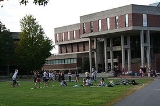
Hampshire College

Encyclopedia
Hampshire College is a private liberal arts college
in Amherst
, Massachusetts
. It was founded in 1965 as an experiment in alternative education, in association with four other colleges in the Pioneer Valley
: Amherst College
, Smith College
, Mount Holyoke College
, and the University of Massachusetts Amherst
. Together they are now known as the Five Colleges
, or the Five College Area.
The College is widely known for its alternative curriculum, focus on portfolios rather than distribution requirements, and reliance on narrative evaluations instead of grades and GPAs. It is known particularly for facilitating the study of film, music, theater, and the visual arts. In some fields, it is among the top undergraduate institutions in percentage of graduates who enroll in graduate school. Fifty-six percent of its alumni have at least one graduate degree and it is ranked 30th among all US colleges in the percentage of its graduates who go on to attain a doctorate degree (notably first among history doctorates). Its School of Cognitive Science was the first interdisciplinary undergraduate program in cognitive science
and has few peers.
 The College opened to students in 1970. Its history dates to the immediate aftermath of World War II
. The first The New College Plan
was drafted in 1958 by the presidents of the then-Four Colleges, and was revised several times after planning for the College began in the 1960s. Many original ideas for non-traditional arrangements for the College's curriculum, campus, and life were discarded along the way. Many new ideas generated during the planning process were not described in the original documents.
For several years immediately after its founding in the early 1970s, Hampshire College was among the most selective undergraduate programs in the United States. Its admissions selectivity declined thereafter, but the school's number of applications increased in the late 1990s, allowing for greater admissions selectivity since then. The college's rate of admissions is now comparable to that of many other small liberal arts colleges.
The school has struggled with financial difficulties since its founding. At some points, the administration seriously considered ceasing operations or merging into the University of Massachusetts Amherst
. In recent years, the school is on more solid financial footing, though without a sizable endowment. Its financial stability is often credited to the fundraising efforts of its most recent past presidents, Adele Simmons and Gregory S. Prince, Jr.
. The College has also distinguished itself recently with a draft for a "sustainable campus plan" and a "cultural village" through which organizations not directly affiliated with the school are located on its campus. The cultural village includes the National Yiddish Book Center
and the Eric Carle Museum of Picture Book Art
.
On April 1, 2004, president Gregory Prince announced he would retire at the end of the 2004-05 academic year. On April 5, 2005, the Board of Trustees named Ralph Hexter
, formerly a dean at University of California, Berkeley
's College of Letters and Science, as the college's next president, effective August 1, 2005. Hexter was inaugurated on October 15, 2005. The appointment made Hampshire one of a small number of colleges and universities in the United States with an openly gay
president.
Some of the most important founding documents of Hampshire College are collected in the book The Making of a College (MIT Press, 1967; ISBN 0-262-66005-9). The Making of a College is (as of 2003) out of print but available in electronic form from the Hampshire College Archives
 The curriculum is divided into three "divisions" rather than four years, and students complete these divisions in varying amounts of time. The administration has recently made efforts to encourage students to stick more closely to the traditional four-year model by requiring that students spend three semesters in Division I, three semesters in Division II, and that they complete Division III in a year.
Since 2002, the school has taken steps to expand and attract more academically conventional students. The most significant change was a revision of the Division I program for first year students. Before the fall of 2002, Division I consisted of four major exams, one in each of the academic departments and/or quantitative analysis. These exams took one of three forms: a "two-course option," where a student could take two sequential courses; a "one-plus-one," where a Hampshire course supplements an outside course (AP score of a four or five, or a summer college class); or a project, usually involving a primary or significant secondary research paper, or an art production (a short film, a sculpture, etc.), that stems from previous coursework. Students were required to complete at least two project-based exams, while transfer students usually had one project requirement waived. In the fall of 2002, a new first-year program was started in response to the high numbers of second- and third-year students who had not completed Division I. The program now mandates eight courses in the first year, at least one in each of the five schools. This reduces the required work for passing Division I significantly, as the old system could require up to 10 courses.
Effective in Fall of 2011, the first year requirements have been changed once more. Students most now fulfill FOUR of the FIVE distribution areas: Arts, Design, and Media (ADM), Culture, Humanities, and Languages (CHL),
Mind, Brain, and Information (MBI), Physical and Biological Sciences (PBS), Power, Community, and Social Justice (PCSJ. Students are expected to complete seven courses in their first year, four to fulfill distribution areas and three elective courses in areas of their own choosing.
 The Hampshire College faculty are organized broadly in defined Schools. The Schools function much as departments do at a traditional liberal arts college. The Schools' names and definitions have varied over the College's history, but they have always numbered between three and five. As of 2010, the Schools were:
The Five College Program in Peace and World Security Studies (PAWSS) is based at Hampshire; its director is Michael Klare
.
, Mt. Holyoke College, Smith College
and the University of Massachusetts Amherst
.
Students at each of the schools may take classes and borrow books at the other schools, generally without paying additional fees. They may use resources at the other schools, including internet access, dining halls, and so forth. The five colleges collectively offer over 5,300 courses, and the five libraries have over eight million books. The Pioneer Valley Transit Authority (PVTA) operates bus services between the schools and the greater Pioneer Valley
area.
There are two joint departments in the five-college consortium: Dance and Astronomy. Several certificate programs among the schools are available to students at any of the schools:
+ pending approval at Amherst College
^ pending approval at UMass Amherst
called The Re-Making of a College, which critiques what they see as a betrayal of Hampshire's founding ideas in alternative education and student-centered learning. On May 3, 2004, the group staged a demonstration that packed the hall outside the President's office during an administrative meeting. Response from the community has generally been amicable and Re-Rad has made some progress.
 The Re-Radicalization movement is responding in part to a new "First-Year Plan" that changes the structure of the first year of study. Beginning in the Fall of 2002, the requirements for passing Division I were changed so that first-year students no longer had to complete independent projects (see Curriculum above). Though still a major source of contention, this change is rapidly fading from memory as most students who entered under the old plan have graduated or are in their final year. Re-Rad submitted its own counter-proposal in both 2006 and 2007, but these proposals were not acted on, and no follow-up was attempted.
The Re-Radicalization of Hampshire College assisted the administration in launching a pilot program known as mentored independent study. This program paired ten third semester students with Division III students with similar academic interests to complete a small study—observed by, and subject to the approval of, a faculty member. The program was judged successful and has been institutionalized.
While some students worry about what they see as Hampshire's headlong plunge into normality, the circumstances of Hampshire's founding tends to perennially attract students who revive the questions about education the institution was founded on, and who challenge the administration to honor the founding mission. Unsurprisingly, then, Re-Rad was not the first student push of its type. Similar efforts have sprung up at Hampshire with some regularity, with varying impacts. In 1996, student Chris Kawecki spearheaded a similar push called the Radical Departure, calling for a more holistic, organic integration of education into students' lives. The most durable legacy of the Radical Departure was EPEC, a series of student-led non-credit courses. A more detailed account of movements such as these can be found in a history of Hampshire student activities, a Division III thesis written by alumnus Timothy Shary, subsequently a faculty member at Clark University
of Worcester, Massachusetts
, and University of Oklahoma
second). Legal and financial research undertaken by student Michael Current and faculty member Kurtis Gordon was promoted nationally by business activists Douglas Tooley and Debbie Knight.
In November 2001, a controversial All-Community Vote at Hampshire declared the school opposed to the recently-launched War on Terrorism
, another national first that drew national media attention, including scathing reports from Rupert Murdoch
's Fox News Channel
and the New York Post
("Kooky College Condemns War"). Saturday Night Live
had a regular sketch, "Jarret's Room," starring Jimmy Fallon
, which purports to take place at Hampshire College but is inaccurate. It refers to non-existent buildings ("McGuinn Hall," which is actually the Sociology and Social Work building at fellow cast member Amy Poehler
's alma mater, Boston College
) and features yearbooks, tests, seniors, fraternities, three-person dorm rooms, and a football team—none of which the school has ever had (though in the Fall 2005, 2006, and 2007 semesters the college experienced a higher than expected number of freshmen and temporarily had to convert some common spaces into three-person dorms). The sketch also claims that the college is actually in New Hampshire
(a common mistake).
Alumnus Ken Burns
wrote of the college: "Hampshire College is a perfect American place. If we look back at the history of our country, the things we celebrate were outside of the mainstream. Much of the world operated under a tyrannical model, but Americans said, 'We will govern ourselves.' So, too, Hampshire asked, at its founding, the difficult questions of how we might educate ourselves... When I entered Hampshire, I found it to be the most exciting place on earth." Loren Pope
wrote of Hampshire in the college guide Colleges That Change Lives
: "Today no college has students whose intellectual thyroids are more active or whose minds are more compassionately engaged." In 2006, the Princeton Review named Hampshire College one of the nation’s "best value" undergraduate institutions in its book "America’s Best Value Colleges."
Liberal arts colleges in the United States
Liberal arts colleges in the United States are certain undergraduate institutions of higher education in the United States. The Encyclopædia Britannica Concise offers a definition of the liberal arts as a "college or university curriculum aimed at imparting general knowledge and developing general...
in Amherst
Amherst, Massachusetts
Amherst is a town in Hampshire County, Massachusetts, United States in the Connecticut River valley. As of the 2010 census, the population was 37,819, making it the largest community in Hampshire County . The town is home to Amherst College, Hampshire College, and the University of Massachusetts...
, Massachusetts
Massachusetts
The Commonwealth of Massachusetts is a state in the New England region of the northeastern United States of America. It is bordered by Rhode Island and Connecticut to the south, New York to the west, and Vermont and New Hampshire to the north; at its east lies the Atlantic Ocean. As of the 2010...
. It was founded in 1965 as an experiment in alternative education, in association with four other colleges in the Pioneer Valley
Pioneer Valley
The Pioneer Valley is the colloquial name for the U.S. Commonwealth of Massachusetts's portion of the Connecticut River Valley. The Pioneer Valley consists of three counties in Massachusetts which collectively feature much of New England's most fertile farmland...
: Amherst College
Amherst College
Amherst College is a private liberal arts college located in Amherst, Massachusetts, United States. Amherst is an exclusively undergraduate four-year institution and enrolled 1,744 students in the fall of 2009...
, Smith College
Smith College
Smith College is a private, independent women's liberal arts college located in Northampton, Massachusetts. It is the largest member of the Seven Sisters...
, Mount Holyoke College
Mount Holyoke College
Mount Holyoke College is a liberal arts college for women in South Hadley, Massachusetts. It was the first member of the Seven Sisters colleges, and served as a model for some of the others...
, and the University of Massachusetts Amherst
University of Massachusetts Amherst
The University of Massachusetts Amherst is a public research and land-grant university in Amherst, Massachusetts, United States and the flagship of the University of Massachusetts system...
. Together they are now known as the Five Colleges
Five Colleges (Massachusetts)
The Five Colleges comprises four liberal arts colleges and one university in the Connecticut River Pioneer Valley of Western Massachusetts, totaling approximately 28,000 students. The schools belong to a consortium called Five Colleges, Incorporated, established in 1965...
, or the Five College Area.
The College is widely known for its alternative curriculum, focus on portfolios rather than distribution requirements, and reliance on narrative evaluations instead of grades and GPAs. It is known particularly for facilitating the study of film, music, theater, and the visual arts. In some fields, it is among the top undergraduate institutions in percentage of graduates who enroll in graduate school. Fifty-six percent of its alumni have at least one graduate degree and it is ranked 30th among all US colleges in the percentage of its graduates who go on to attain a doctorate degree (notably first among history doctorates). Its School of Cognitive Science was the first interdisciplinary undergraduate program in cognitive science
Cognitive science
Cognitive science is the interdisciplinary scientific study of mind and its processes. It examines what cognition is, what it does and how it works. It includes research on how information is processed , represented, and transformed in behaviour, nervous system or machine...
and has few peers.
History
World War II
World War II, or the Second World War , was a global conflict lasting from 1939 to 1945, involving most of the world's nations—including all of the great powers—eventually forming two opposing military alliances: the Allies and the Axis...
. The first The New College Plan
The New College Plan
The New College Plan resulted in the formation of Hampshire College.In 1958, the presidents of Amherst College, Smith College, Mount Holyoke College, and the University of Massachusetts Amherst , all located in the Pioneer Valley of Massachusetts, formed the Committee for an Experimental...
was drafted in 1958 by the presidents of the then-Four Colleges, and was revised several times after planning for the College began in the 1960s. Many original ideas for non-traditional arrangements for the College's curriculum, campus, and life were discarded along the way. Many new ideas generated during the planning process were not described in the original documents.
For several years immediately after its founding in the early 1970s, Hampshire College was among the most selective undergraduate programs in the United States. Its admissions selectivity declined thereafter, but the school's number of applications increased in the late 1990s, allowing for greater admissions selectivity since then. The college's rate of admissions is now comparable to that of many other small liberal arts colleges.
The school has struggled with financial difficulties since its founding. At some points, the administration seriously considered ceasing operations or merging into the University of Massachusetts Amherst
University of Massachusetts Amherst
The University of Massachusetts Amherst is a public research and land-grant university in Amherst, Massachusetts, United States and the flagship of the University of Massachusetts system...
. In recent years, the school is on more solid financial footing, though without a sizable endowment. Its financial stability is often credited to the fundraising efforts of its most recent past presidents, Adele Simmons and Gregory S. Prince, Jr.
Gregory S. Prince, Jr.
Gregory Smith Prince, Jr. became Hampshire College's fourth president in 1989 and retired in 2005.In his 15 years at the helm of Hampshire, Prince worked to broaden the public's awareness of the value and role of liberal arts education, reinforcing the understanding that the liberal arts are about...
. The College has also distinguished itself recently with a draft for a "sustainable campus plan" and a "cultural village" through which organizations not directly affiliated with the school are located on its campus. The cultural village includes the National Yiddish Book Center
National Yiddish Book Center
The National Yiddish Book Center in Amherst, Massachusetts, United States, on the campus of Hampshire College. It is a cultural institution dedicated to the preservation of books in the Yiddish language. It is a member of Museums10 and is a non-profit institution, and its cultural programs are...
and the Eric Carle Museum of Picture Book Art
Eric Carle Museum of Picture Book Art
The Eric Carle Museum of Picture Book Art is a museum devoted to the art of the picture book and especially the children's book. It is a member of Museums10 and is adjacent to the campus of Hampshire College in Amherst, Massachusetts...
.
On April 1, 2004, president Gregory Prince announced he would retire at the end of the 2004-05 academic year. On April 5, 2005, the Board of Trustees named Ralph Hexter
Ralph Hexter
Ralph J. Hexter is a professor of classics and the former president of Hampshire College.-Biography:Ralph Hexter received an A.B. from Harvard College, a B.A. and an M.A...
, formerly a dean at University of California, Berkeley
University of California, Berkeley
The University of California, Berkeley , is a teaching and research university established in 1868 and located in Berkeley, California, USA...
's College of Letters and Science, as the college's next president, effective August 1, 2005. Hexter was inaugurated on October 15, 2005. The appointment made Hampshire one of a small number of colleges and universities in the United States with an openly gay
Gay
Gay is a word that refers to a homosexual person, especially a homosexual male. For homosexual women the specific term is "lesbian"....
president.
Some of the most important founding documents of Hampshire College are collected in the book The Making of a College (MIT Press, 1967; ISBN 0-262-66005-9). The Making of a College is (as of 2003) out of print but available in electronic form from the Hampshire College Archives
Curriculum
Hampshire College describes itself as "experimenting" rather than "experimental," to emphasize the changing nature of its curriculum. From its inception, the curriculum has generally had certain non-traditional features:- An emphasis on project work as well as, or instead of, courses
- Detailed written evaluations (as well as portfolio evaluations) for completed courses and projects, rather than letter or number grades
- A curriculum centered on student interests, with students taking an active role in designing their own concentrations and projects
- An emphasis on independent motivation and student organization, both within and without the college's formal curriculum
- Division I, the distribution stage, requires students to complete one course in each of the five "Schools of Thought," plus three other courses, either on or off campus. (Until fall 2002, Division I required student-directed independent projects; the new system, designed for quicker and smoother student progress, has caused a great deal of controversy on campus.)
- Division II requires students to complete two years of course work in their selected area(s) of study (which may or may not be traditional academic fields.) Most students combine related subject matter to form an interdisciplinary concentration such as "The chemistry of oil painting." Still, some choose to concentrate in multiple areas without drawing such connections, instead simply concentrating in "Both Chemistry and Oil Painting." Some students complete an in-depth concentration in one field only. Students design their own Division II, in cooperation with a committee of at least two faculty members (subject to their approval). Many students choose a faculty committee whose members represent their own interdisciplinary interests. The Division II requirements also include a community service project and a multicultural perspectives requirement.
- Division III, the advanced project, requires students to complete an in-depth project in their field (which is generally related to the Division II field). Division III usually lasts one year and is completed while taking few or no courses, but two "advanced learning activities," which might be courses, internships or specific independent studies, and may or may not be related to the Division III, are required. A Division III topic can be a long written academic paper (in which case it is best considered as something between a traditional college's "bachelor's" or "honors" thesis and a Master's or other graduate thesis), but it can also be a collection of creative work (writing, painting, photography, and film are popular choices) or a hands-on engineering, invention, or social organizing project.
Since 2002, the school has taken steps to expand and attract more academically conventional students. The most significant change was a revision of the Division I program for first year students. Before the fall of 2002, Division I consisted of four major exams, one in each of the academic departments and/or quantitative analysis. These exams took one of three forms: a "two-course option," where a student could take two sequential courses; a "one-plus-one," where a Hampshire course supplements an outside course (AP score of a four or five, or a summer college class); or a project, usually involving a primary or significant secondary research paper, or an art production (a short film, a sculpture, etc.), that stems from previous coursework. Students were required to complete at least two project-based exams, while transfer students usually had one project requirement waived. In the fall of 2002, a new first-year program was started in response to the high numbers of second- and third-year students who had not completed Division I. The program now mandates eight courses in the first year, at least one in each of the five schools. This reduces the required work for passing Division I significantly, as the old system could require up to 10 courses.
Effective in Fall of 2011, the first year requirements have been changed once more. Students most now fulfill FOUR of the FIVE distribution areas: Arts, Design, and Media (ADM), Culture, Humanities, and Languages (CHL),
Mind, Brain, and Information (MBI), Physical and Biological Sciences (PBS), Power, Community, and Social Justice (PCSJ. Students are expected to complete seven courses in their first year, four to fulfill distribution areas and three elective courses in areas of their own choosing.
Schools and programs
- Cognitive ScienceCognitive scienceCognitive science is the interdisciplinary scientific study of mind and its processes. It examines what cognition is, what it does and how it works. It includes research on how information is processed , represented, and transformed in behaviour, nervous system or machine...
(CS): includes linguistics, most psychology, some philosophy, neuroscience, and computer science. - HumanitiesHumanitiesThe humanities are academic disciplines that study the human condition, using methods that are primarily analytical, critical, or speculative, as distinguished from the mainly empirical approaches of the natural sciences....
, ArtsARtsaRts, which stands for analog Real time synthesizer, is an audio framework that is no longer under development. It is best known for previously being used in KDE to simulate an analog synthesizer....
, and Cultural StudiesCultural studiesCultural studies is an academic field grounded in critical theory and literary criticism. It generally concerns the political nature of contemporary culture, as well as its historical foundations, conflicts, and defining traits. It is, to this extent, largely distinguished from cultural...
(HACU): includes film, some studio arts, literature, media studies, and most philosophy. - Critical Social Inquiry (CSI): includes most sociology and anthropology, economics, history, politics, and some psychology.
- Natural ScienceNatural scienceThe natural sciences are branches of science that seek to elucidate the rules that govern the natural world by using empirical and scientific methods...
(NS): includes most traditional sciences, mathematics, and biological anthropology. - Interdisciplinary ArtsARtsaRts, which stands for analog Real time synthesizer, is an audio framework that is no longer under development. It is best known for previously being used in KDE to simulate an analog synthesizer....
(IA): includes performing arts, some studio arts, and creative writing.
The Five College Program in Peace and World Security Studies (PAWSS) is based at Hampshire; its director is Michael Klare
Michael Klare
Michael T. Klare is a Five Colleges professor of Peace and World Security Studies, whose department is located at Hampshire College, defense correspondent of The Nation magazine, and author of Resource Wars and Blood and Oil: The Dangers and Consequences of America's Growing Petroleum Dependency...
.
Five College Consortium
Hampshire College is the youngest of the schools in the Five-College Consortium. The other schools are Amherst CollegeAmherst College
Amherst College is a private liberal arts college located in Amherst, Massachusetts, United States. Amherst is an exclusively undergraduate four-year institution and enrolled 1,744 students in the fall of 2009...
, Mt. Holyoke College, Smith College
Smith College
Smith College is a private, independent women's liberal arts college located in Northampton, Massachusetts. It is the largest member of the Seven Sisters...
and the University of Massachusetts Amherst
University of Massachusetts Amherst
The University of Massachusetts Amherst is a public research and land-grant university in Amherst, Massachusetts, United States and the flagship of the University of Massachusetts system...
.
Students at each of the schools may take classes and borrow books at the other schools, generally without paying additional fees. They may use resources at the other schools, including internet access, dining halls, and so forth. The five colleges collectively offer over 5,300 courses, and the five libraries have over eight million books. The Pioneer Valley Transit Authority (PVTA) operates bus services between the schools and the greater Pioneer Valley
Pioneer Valley
The Pioneer Valley is the colloquial name for the U.S. Commonwealth of Massachusetts's portion of the Connecticut River Valley. The Pioneer Valley consists of three counties in Massachusetts which collectively feature much of New England's most fertile farmland...
area.
There are two joint departments in the five-college consortium: Dance and Astronomy. Several certificate programs among the schools are available to students at any of the schools:
- African Studies
- Architectural Studies
- Asian/Pacific/American Studies
- Buddhist Studies
- Coastal and Marine Sciences+
- Cognitive Neuroscience+ ^
- Culture, Health, and Science
- International Relations
- Latin American, Caribbean, and Latino Studies
- Logic
- Middle Eastern Studies
- Native American Indian Studies
- Russian, East European, and Eurasian Studies (REEES)
+ pending approval at Amherst College
^ pending approval at UMass Amherst
Re-radicalization
In the spring of 2004, a student group calling itself Re-Radicalization of Hampshire College (Re-Rad) emerged with a manifestoManifesto
A manifesto is a public declaration of principles and intentions, often political in nature. Manifestos relating to religious belief are generally referred to as creeds. Manifestos may also be life stance-related.-Etymology:...
called The Re-Making of a College, which critiques what they see as a betrayal of Hampshire's founding ideas in alternative education and student-centered learning. On May 3, 2004, the group staged a demonstration that packed the hall outside the President's office during an administrative meeting. Response from the community has generally been amicable and Re-Rad has made some progress.
The Re-Radicalization of Hampshire College assisted the administration in launching a pilot program known as mentored independent study. This program paired ten third semester students with Division III students with similar academic interests to complete a small study—observed by, and subject to the approval of, a faculty member. The program was judged successful and has been institutionalized.
While some students worry about what they see as Hampshire's headlong plunge into normality, the circumstances of Hampshire's founding tends to perennially attract students who revive the questions about education the institution was founded on, and who challenge the administration to honor the founding mission. Unsurprisingly, then, Re-Rad was not the first student push of its type. Similar efforts have sprung up at Hampshire with some regularity, with varying impacts. In 1996, student Chris Kawecki spearheaded a similar push called the Radical Departure, calling for a more holistic, organic integration of education into students' lives. The most durable legacy of the Radical Departure was EPEC, a series of student-led non-credit courses. A more detailed account of movements such as these can be found in a history of Hampshire student activities, a Division III thesis written by alumnus Timothy Shary, subsequently a faculty member at Clark University
Clark University
Clark University is a private research university and liberal arts college in Worcester, Massachusetts.Founded in 1887, it is the oldest educational institution founded as an all-graduate university. Clark now also educates undergraduates...
of Worcester, Massachusetts
Worcester, Massachusetts
Worcester is a city and the county seat of Worcester County, Massachusetts, United States. Named after Worcester, England, as of the 2010 Census the city's population is 181,045, making it the second largest city in New England after Boston....
, and University of Oklahoma
University of Oklahoma
The University of Oklahoma is a coeducational public research university located in Norman, Oklahoma. Founded in 1890, it existed in Oklahoma Territory near Indian Territory for 17 years before the two became the state of Oklahoma. the university had 29,931 students enrolled, most located at its...
In the media
In 1979, Hampshire was the first college in the nation to divest from apartheid South Africa (with the nearby University of Massachusetts AmherstUniversity of Massachusetts Amherst
The University of Massachusetts Amherst is a public research and land-grant university in Amherst, Massachusetts, United States and the flagship of the University of Massachusetts system...
second). Legal and financial research undertaken by student Michael Current and faculty member Kurtis Gordon was promoted nationally by business activists Douglas Tooley and Debbie Knight.
In November 2001, a controversial All-Community Vote at Hampshire declared the school opposed to the recently-launched War on Terrorism
War on Terrorism
The War on Terror is a term commonly applied to an international military campaign led by the United States and the United Kingdom with the support of other North Atlantic Treaty Organisation as well as non-NATO countries...
, another national first that drew national media attention, including scathing reports from Rupert Murdoch
Rupert Murdoch
Keith Rupert Murdoch, AC, KSG is an Australian-American business magnate. He is the founder and Chairman and CEO of , the world's second-largest media conglomerate....
's Fox News Channel
Fox News Channel
Fox News Channel , often called Fox News, is a cable and satellite television news channel owned by the Fox Entertainment Group, a subsidiary of News Corporation...
and the New York Post
New York Post
The New York Post is the 13th-oldest newspaper published in the United States and is generally acknowledged as the oldest to have been published continuously as a daily, although – as is the case with most other papers – its publication has been periodically interrupted by labor actions...
("Kooky College Condemns War"). Saturday Night Live
Saturday Night Live
Saturday Night Live is a live American late-night television sketch comedy and variety show developed by Lorne Michaels and Dick Ebersol. The show premiered on NBC on October 11, 1975, under the original title of NBC's Saturday Night.The show's sketches often parody contemporary American culture...
had a regular sketch, "Jarret's Room," starring Jimmy Fallon
Jimmy Fallon
James Thomas "Jimmy" Fallon, Jr. is an American actor, comedian, singer, musician and television host. He currently hosts Late Night with Jimmy Fallon, a late-night talk show that airs Monday through Friday on NBC...
, which purports to take place at Hampshire College but is inaccurate. It refers to non-existent buildings ("McGuinn Hall," which is actually the Sociology and Social Work building at fellow cast member Amy Poehler
Amy Poehler
Amy Meredith Poehler is an American comedian, actress and voice actress. She was a cast member on the NBC television entertainment show Saturday Night Live from 2001 to 2008. In 2004, she starred in the film Mean Girls with Tina Fey, with whom she worked again in Baby Mama in 2008. She is...
's alma mater, Boston College
Boston College
Boston College is a private Jesuit research university located in the village of Chestnut Hill, Massachusetts, USA. The main campus is bisected by the border between the cities of Boston and Newton. It has 9,200 full-time undergraduates and 4,000 graduate students. Its name reflects its early...
) and features yearbooks, tests, seniors, fraternities, three-person dorm rooms, and a football team—none of which the school has ever had (though in the Fall 2005, 2006, and 2007 semesters the college experienced a higher than expected number of freshmen and temporarily had to convert some common spaces into three-person dorms). The sketch also claims that the college is actually in New Hampshire
New Hampshire
New Hampshire is a state in the New England region of the northeastern United States of America. The state was named after the southern English county of Hampshire. It is bordered by Massachusetts to the south, Vermont to the west, Maine and the Atlantic Ocean to the east, and the Canadian...
(a common mistake).
Alumnus Ken Burns
Ken Burns
Kenneth Lauren "Ken" Burns is an American director and producer of documentary films, known for his style of using archival footage and photographs...
wrote of the college: "Hampshire College is a perfect American place. If we look back at the history of our country, the things we celebrate were outside of the mainstream. Much of the world operated under a tyrannical model, but Americans said, 'We will govern ourselves.' So, too, Hampshire asked, at its founding, the difficult questions of how we might educate ourselves... When I entered Hampshire, I found it to be the most exciting place on earth." Loren Pope
Loren Pope
Loren Brooks Pope was an American writer and independent college placement counselor.In 1965, Pope, a former newspaperman and education editor of The New York Times, founded the College Placement Bureau, one of the first independent college placement counseling services in the United States...
wrote of Hampshire in the college guide Colleges That Change Lives
Colleges That Change Lives
Colleges That Change Lives is a college educational guide by Loren Pope. It was originally published in 1996, with a second edition in 2000, and a third edition in 2006...
: "Today no college has students whose intellectual thyroids are more active or whose minds are more compassionately engaged." In 2006, the Princeton Review named Hampshire College one of the nation’s "best value" undergraduate institutions in its book "America’s Best Value Colleges."
Notable alumni
- Joshua BeckmanJoshua BeckmanJoshua Beckman is an American poet. He is the author of six collections of poetry, including Take It, Shake, and Things Are Happening, which won the first annual Honickman-APR book award. He is also the author of two collaborations with New York–based poet Matthew Rohrer, including Nice Hat...
, poet - Xander BerkeleyXander BerkeleyAlexander Harper "Xander" Berkeley is an American actor. His roles include George Mason on the television series 24.-Early life:Berkeley was born in Brooklyn, New York, but has lived most of his life in New Jersey...
, actor - George BonannoGeorge BonannoGeorge A. Bonanno is a professor of clinical psychology at Columbia University, Teachers College. He is known as a pioneering researcher in the field of bereavement and trauma. The New York Times on February 15, 2011, stated that the current science of bereavement has been "driven primarily" by...
, psychologist, Columbia University, pioneered scientific methodology for studying grief, author of "The Other Side of Sadness: What the New Science of Bereavement Tells Us About Life After a Loss." - Heather BousheyHeather BousheyHeather Marie Boushey is a senior economist at the Center for American Progress.-Life and career:Boushey was born in Seattle and grew up in Mukilteo, Washington. She received her Ph.D. in Economics from the New School for Social Research and her B.A...
, economist - Dennis BoutsikarisDennis BoutsikarisDennis Boutsikaris is an American two-time Obie-Award winning character actor. He is a Broadway Actor and frequent television guest star and leading man in made-for-TV movies...
, screen and stage actor, "*batteries not included*batteries not included*batteries not included is a 1987 family-science fiction film directed by Matthew Robbins about small extraterrestrial living machines that save an apartment block under threat from property development....
, W.W. (film)W. is a 2008 American film based on the life and presidency of George W. Bush. It was produced and directed by Oliver Stone, written by Stanley Weiser, and stars Josh Brolin as Bush, with a cast that includes Ellen Burstyn, Elizabeth Banks, James Cromwell, Thandie Newton, Jeffrey Wright, Scott...
, Sight UnseenSight Unseen (play)Sight Unseen is a play by Donald Margulies. At its center is Jonathan Waxman, a Brooklyn Jew who has become a very wealthy critically acclaimed artist. Happily married, with a baby on the way, he travels to London for a retrospective of his work... - Ken BurnsKen BurnsKenneth Lauren "Ken" Burns is an American director and producer of documentary films, known for his style of using archival footage and photographs...
, documentary filmmaker, The Civil WarThe Civil War (documentary)The Civil War is a documentary film created by Ken Burns about the American Civil War. It was first broadcast on PBS on five consecutive nights from Sunday, September 23 to Thursday, September 27, 1990. Forty million viewers watched it during its initial broadcast, making it the most-watched...
, BaseballBaseball (documentary)Baseball is an 18½ hour, Emmy Award-winning documentary series by Ken Burns about the game of baseball. First broadcast on PBS, this was Burns' ninth documentary.- Format :...
, Jazz, The War, etc. - Nicholas CallawayNicholas CallawayNicholas Callaway is an app producer, publisher, television producer, writer, and photographer. He is the chairman and chief creative officer of Callaway Digital Arts, which publishes premium lifestyle and children’s applications for Apple’s iPad, iPhone, and iPod family of products.In 1980,...
, founder of Callaway Arts & EntertainmentCallaway Arts & EntertainmentCallaway Arts & Entertainment is a family entertainment company specializing in the design, production, and publication of illustrated books and multimedia products.... - Charlie ClouserCharlie ClouserCharles Alexander "Charlie" Clouser is an American musician whose activities include playing keyboard, synth, theremin, and drums. He is known for his abilities in music programming, engineering, mixing, and remixing. He was a member of the band Nine Inch Nails 1994–2000. Before he was in Nine...
, musician, former member of Nine Inch NailsNine Inch NailsNine Inch Nails is an American industrial rock project, founded in 1988 by Trent Reznor in Cleveland, Ohio. As its main producer, singer, songwriter, and instrumentalist, Reznor is the only official member of Nine Inch Nails and remains solely responsible for its direction... - Leah Hager CohenLeah Hager CohenLeah Hager Cohen is an American author who writes both fiction and nonfiction.Cohen's father was superintendent of the Lexington School for the Deaf in Queens, New York, and she became fluent in sign language there. She entered NYU at age 16, intending to study drama, but later transferred to...
, writer - Peter ColePeter ColePeter Cole is an American Jewish poet who lives in Jerusalem and New Haven.-Early life:Cole was born in 1957 in Paterson, New Jersey. He attended Williams College and Hampshire College, and moved to Jerusalem in 1981.-Literary career:...
, poet - Chuck CollinsChuck CollinsChuck Collins is an author and a senior scholar at the Institute for Policy Studies in Washington, DC, where he directs the Program on Inequality and the Common Good. He is also cofounder of . He is an expert on U.S...
, political activist, co-founder of United For a Fair EconomyUnited for a Fair EconomyUnited for a Fair Economy is a national Boston, Massachusetts-based movement support organization that highlights the detriments of uneven wealth distribution. UFE was co-founded by Chuck Collins and Felice Yeskel in 1995... - E. V. DayE. V. DayE. V. Day is a New York based installation artist and sculptor. Day’s work explores themes of feminism and sexuality, while employing various suspension techniques and reflecting upon popular culture...
, artist and sculptor - Toby DriverToby DriverToby Driver is a multi-instrumentalist, songwriter, and artist, best known for his work as the frontman of the experimental bands maudlin of the Well and Kayo Dot....
, musician and artist, Kayo DotKayo DotKayo Dot is an American avant-rock/experimental music group that was formed in 2003 by Toby Driver. They released their debut album Choirs of the Eye on John Zorn's Tzadik Records label that year. Tzadik's descriptive label on that album reads: "Kayo Dot powerfully integrates elements of modern...
and Maudlin of the WellMaudlin of the Wellmaudlin of the Well is an avant-garde metal band from Boston, Massachusetts. Their music contains elements from many different genres including doom metal, indie rock, jazz, progressive rock, post rock, progressive metal, death metal, gothic metal, as well as chamber music, ambient music and New... - Ed DrosteEd DrosteEdward "Ed" Droste is an original member of the Brooklyn-based indie-rock group, Grizzly Bear. The group began as the solo effort of Droste with the release of 2004's Horn of Plenty, originally released on Kanine Records. All songs were written and performed by Droste...
, singer/songwriter from the Brooklyn-based indie group Grizzly Bear (band)Grizzly Bear (band)Grizzly Bear is a Brooklyn-based indie rock band, composed of Edward Droste , Daniel Rossen , Chris Taylor and Christopher Bear . The band employs traditional and electronic instruments...
(transferred from Hampshire after one academic year) - John FalseyJohn FalseyJohn Henry Falsey, Jr. is an American television writer and producer.Falsey was born in New Haven, Connecticut, the son of Patricia Helene and John Henry Falsey...
, Emmy AwardEmmy AwardAn Emmy Award, often referred to simply as the Emmy, is a television production award, similar in nature to the Peabody Awards but more focused on entertainment, and is considered the television equivalent to the Academy Awards and the Grammy Awards .A majority of Emmys are presented in various...
-winning creator of St. ElsewhereSt. ElsewhereSt. Elsewhere is an American medical drama television series that originally ran on NBC from October 26, 1982 to May 25, 1988. The series is set at fictional St. Eligius, a decaying urban teaching hospital in Boston's South End neighborhood...
, I'll Fly AwayI'll Fly Away (TV series)I'll Fly Away is a television series set during the late 1950s and early 1960s, in an unspecified Southern U.S. state. It aired on NBC from 1991 to 1993 and starred Regina Taylor as Lilly Harper, a black housekeeper for district attorney Forrest Bedford and his family...
, and Northern ExposureNorthern ExposureNorthern Exposure is an American television series that ran on CBS from 1990 to 1995, with a total of 110 episodes.-Overview:The series was given a pair of consecutive Peabody Awards: in 1991–92 for the show's "depict[ion] in a comedic and often poetic way, [of] the cultural clash between a... - Noah FalsteinNoah FalsteinNoah Falstein is a freelance game designer and producer who has been in the video game industry since 1980. He was one of the first 10 employees at Lucasfilm Games , DreamWorks Interactive , and The 3DO Company...
, video game designer, SinistarSinistarSinistar is an arcade game released by Williams in 1982. It belongs to a class of video games from the 1980s called "twitch games". Other "twitch games" include Tempest, Defender, and Robotron: 2084. Sinistar was developed by Sam Dicker, Jack Haeger, Noah Falstein, RJ Mical and Richard Witt...
, and Indiana Jones and the Fate of AtlantisIndiana Jones and the Fate of AtlantisIndiana Jones and the Fate of Atlantis is a point-and-click adventure game by LucasArts originally released in 1992. Almost a year later, it was reissued on CD-ROM as an enhanced "talkie" edition with full voice acting and digitized sound effects... - Victor FrescoVictor FrescoVictor Fresco is an American television writer, producer and show creator. He is credited with creating the critically acclaimed television series Better Off Ted, which ran for two seasons on ABC. Fresco also created the FOX show Andy Richter Controls the Universe, for which he was nominated for a...
, television writer and producer, My Name Is EarlMy Name Is EarlMy Name Is Earl is an American television comedy series created by Greg Garcia that was originally broadcast on the NBC television network from September 20, 2005, to May 14, 2009, in the United States...
and Andy Richter Controls the UniverseAndy Richter Controls the UniverseAndy Richter Controls the Universe is a sitcom which aired from 2002–2003 on the Fox network. The series was Andy Richter's first starring role after leaving Late Night with Conan O'Brien in 2000.... - Tooker GombergTooker GombergTooker Gomberg was a Canadian politician and environmental activist.A native of Montreal, Quebec and a liberal-arts graduate of Hampshire College , Gomberg founded one of Canada's first curbside recycling programs in Montreal, and later moved to Edmonton, Alberta, where he created educational...
, municipal politician and environmentalist, 1980 graduate - Neil GustNeil GustNeil Jacob Gust is an American musician. He is best known for co-founding Heatmiser with Elliott Smith in 1992.-Music career:Gust and Smith first met in 1987 while the pair were attending Hampshire College, in Amherst, Massachusetts. Gust wrote songs for as well as played guitar and sang in the band...
, musician and artist - Tom HanwayTom HanwayTom Hanway was born on August 20, 1961 in Cleveland, Ohio, grew up in Larchmont, Westchester County, New York, and attended Hampshire College. He is an American 5-string banjoist, composer, author, and an originator of "Celtic fingerstyle" banjo...
, bluegrass and Celtic banjoist - Benjamin Mako HillBenjamin Mako HillBenjamin Mako Hill is a Debian hacker, intellectual property researcher, activist and author. He is a contributor and free software developer as part of the Debian and Ubuntu projects as well as the author of two best-selling technical books on the subject, Debian GNU/Linux 3.1 Bible and The...
, technologist, free softwareFree softwareFree software, software libre or libre software is software that can be used, studied, and modified without restriction, and which can be copied and redistributed in modified or unmodified form either without restriction, or with restrictions that only ensure that further recipients can also do...
developer and free cultureFree Culture movementThe free culture movement is a social movement that promotes the freedom to distribute and modify creative works in the form of free content by using the Internet and other forms of media....
advocate - Gary HirshbergGary HirshbergGary Hirshberg is chairman, president and CEO of Stonyfield Farm, an organic yogurt producer, based in Londonderry, New Hampshire. He has been with the company since 1983....
, Chairman, President, and "CE-Yo" of Stonyfield FarmStonyfield FarmStonyfield Farm, also simply called Stonyfield, is an organic yogurt maker located in Londonderry, New Hampshire, USA. Stonyfield Farm was founded by Samuel Kaymen in 1983, in Wilton, New Hampshire, as an organic farming school... - Jeffrey HollenderJeffrey HollenderJeffrey Hollender is an American businessperson, entrepreneur, author, and activist. He was well known for his roles as CEO, co-founder, and later Chief Inspired Protagonist and Executive Chairperson of Seventh Generation Inc., the country's largest distributor of non-toxic, all-natural cleaning,...
, President and CEO of Seventh Generation Inc.Seventh Generation Inc.Seventh Generation, Inc. is an American company that sells cleaning, paper, and personal care products. The company was founded in 1988 and is based in Burlington, Vermont. The company focuses its marketing and product development on sustainability and the conservation of natural resources... - Daniel HorowitzDaniel HorowitzDaniel Horowitz is an American defense attorney who has represented several high-profile clients including talk show host Michael Savage and is a frequent commentator in the media on criminal cases in the news.-Background:...
, noted criminal-defense attorney. - Edward HumesEdward Humes-Biography:Humes was born in Philadelphia and attended Hampshire College in Amherst, Massachusetts. In 1985 he moved to Southern California.In 1989 he received the Pulitzer Prize for specialized reporting for several investigative stories he wrote about the United States military...
, Pulitzer Prize-winning journalist - Jeph JacquesJeph JacquesJeph Jacques writes and illustrates the webcomic Questionable Content. He was born in Rockville, Maryland, and graduated from Hampshire College with a degree in music...
, artist, Questionable ContentQuestionable ContentQuestionable Content is a slice-of-life webcomic written and drawn by Jeph Jacques. It was launched on August 1, 2003. Jacques currently makes his living exclusively from QC merchandising and advertising, making him one of the few professional webcomic artists... - Patricia KlindienstPatricia KlindienstPatricia Klindienst is an American writer, and independent scholar.She graduated from Stanford University, with a Ph. D.She taught at Yale University.-Awards:* 2007 American Book Award...
, writer and former professor at Yale - Jon KrakauerJon KrakauerJon Krakauer is an American writer and mountaineer, primarily known for his writing about the outdoors and mountain-climbing...
, mountain climber and author, Into Thin AirInto Thin AirInto Thin Air: A Personal Account of the Mt. Everest Disaster is a 1997 bestselling non-fiction book written by Jon Krakauer. It details the author's presence at Mount Everest during the 1996 Mount Everest disaster when eight climbers were killed and several others were stranded by a 'rogue storm'...
, Into the Wild, and Under the Banner of Heaven - Mike LaddMike LaddMike Ladd is a hip-hop MC and producer. As an MC, he practices spoken-word and is known for his poetic lyrics. As a producer, he is known as the owner of the Likemadd label.-Biography:...
, Hip Hop MC and member of the Antipop ConsortiumAntipop ConsortiumAntipop Consortium are an American alternative hip hop group. The group formed in 1997, when Beans, High Priest, M. Sayyid and producer Earl Blaize met at a poetry slam in New York City... - Aaron LanskyAaron LanskyAaron Lansky is the founder of the National Yiddish Book Center, an organization he created to help salvage Yiddish language publications. When he began saving books in the early 1980s, most experts believe that there were fewer than 70,000 Yiddish volumes extant...
, founder of the National Yiddish Book CenterNational Yiddish Book CenterThe National Yiddish Book Center in Amherst, Massachusetts, United States, on the campus of Hampshire College. It is a cultural institution dedicated to the preservation of books in the Yiddish language. It is a member of Museums10 and is a non-profit institution, and its cultural programs are... - Ken Leavitt-Lawrence, rap artist a.k.a. "MC Hawking"
- lê thi diem thúyLê thi diem thúyLê Thị Diễm Thúy is an award-winning poet, novelist, and performer. Her pen name is lê thi diem thúy. She was born in the South Vietnamese village of Phan Thiết on January 12, 1972 during the heart of the Vietnam War.-Life:...
, writer and solo performance artist. - Daniel Lopatin/Oneohtrix Point NeverOneohtrix Point NeverOneohtrix Point Never is the recording name of Brooklyn-based experimental musician Daniel Lopatin, whose album Returnal was released by Editions Mego in June 2010...
, musician - Jeff MaguireJeff MaguireJeff Maguire is an American screenwriter. Regarded for his talent for writing sports films, Jeff Maguire got his first screenwriting break with his script Escape to Victory, a film about soccer directed by John Huston in 1981. His most recent contribution is Gridiron Gang, released in 2006...
, screenwriter, In the Line of FireIn the Line of FireIn the Line of Fire is a 1993 American thriller film about a disillusioned and obsessed former CIA agent who attempts to assassinate the President of the United States and the Secret Service agent who tracks him... - Daniel MarcusDaniel MarcusDaniel Marcus is a science fiction author from Berkeley, California. He has written numerous short stories that have appeared in Witness, Asimov's Science Fiction, Realms of Fantasy, The Magazine of Fantasy & Science Fiction, and other publications. Binding Energy, a collection of his short...
, science fiction author - Gary MarcusGary MarcusGary F. Marcus is a research psychologist whose work focuses on language, biology, and the mind. Dr. Marcus is a Professor in the Department of Psychology at New York University and Director of the NYU Infant Language Center...
, cognitive scientist - Fred MelamedFred MelamedFred Melamed is a U.S. actor and writer.He was born in New York City, and received his theatrical training at Hampshire College and the Yale School of Drama. At Yale, he was a Samuel F. B. Morse College Graduate Fellow. He was also a nominee for the Irene Ryan Award, a prize conferred upon the...
, actor, A Serious ManA Serious ManA Serious Man is a 2009 dark comedy written, produced, and directed by Joel and Ethan Coen. The film stars Michael Stuhlbarg as a Minnesota Jewish man whose life crumbles both professionally and personally, leading to questions about his faith...
(2009), writer - Eugene MirmanEugene MirmanEugene Boris Mirman is a Russian-born American comedian, writer, and filmmaker. Mirman currently plays Yvgeny Mirminsky on Delocated, and voices Gene Belcher for the animated comedy Bob's Burgers.-Early life:Mirman was born in Russia to Jewish parents...
, comedian - David MoscowDavid MoscowDavid Raphael Moscow is an American actor. His first major role was as the young Josh Baskin in the 1988 film Big, in which his character was magically transformed into an adult played by Tom Hanks.-Early life:...
, actor, BigBigBig is a 1988 romantic comedy film directed by Penny Marshall and stars Tom Hanks as Josh Baskin, a young boy who makes a wish "to be big" to a magical fortune-telling machine and is then aged to adulthood overnight... - John ReedJohn Reed (novelist)John Reed is an American novelist. He is the author of four novels: A Still Small Voice , Snowball's Chance with a preface by Alexander Cockburn, The Whole , and All the World's a Grave: A New Play by William Shakespeare...
, novelist, Snowball's ChanceSnowball's ChanceSnowball's Chance, is a parody of George Orwell's Animal Farm written by John Reed, in which Snowball the pig returns to the Manor Farm after many years' absence, to install capitalism — which proves to have its own pitfalls.- Background :... - Richard Rushfield, contributing editor of Vanity FairVanity Fair (magazine)Vanity Fair is a magazine of pop culture, fashion, and current affairs published by Condé Nast. The present Vanity Fair has been published since 1983 and there have been editions for four European countries as well as the U.S. edition. This revived the title which had ceased publication in 1935...
, West Coast editor of Gawker, author of Don't Follow Me, I'm Lost: A Memoir of Hampshire College in the Twilight of the '80s (2009) - Liev SchreiberLiev SchreiberIsaac Liev Schreiber , commonly known as Liev Schreiber, is an American actor, producer, director, and screenwriter. He became known during the late 1990s and early 2000s, having initially appeared in several independent films, and later mainstream Hollywood films, including the Scream trilogy of...
, stage and screen actor, The Manchurian CandidateThe Manchurian Candidate (2004 film)The Manchurian Candidate is a 2004 American thriller film based on the 1959 novel of the same name by Richard Condon, and a reimagining of the previous 1962 film....
(2004), director, Everything is IlluminatedEverything Is Illuminated (film)Everything Is Illuminated is a 2005 adventure/dramedy film, written and directed by Liev Schreiber and starring Elijah Wood and Eugene Hütz... - Joshua SethJoshua SethJoshua Seth Freedman is an American entertainer and voice actor. He was born in Kent, Ohio and attended the New York University film school. He has voiced dozens of well known anime characters and is sometimes credited as "Jeremiah Freedman", but has retired from voice acting in 2005...
, noted hypnotist and voice over actor, Akira (2001), Tetsuo, Digimon, Tai - Jeff SharletJeff SharletJeff Sharlet is an American journalist, bestselling author, and academic best known for writing about religious subcultures in the United States. He is a contributing editor for Harper's and Rolling Stone...
, journalist, Harper's - David ShulkinDavid ShulkinDavid Shulkin an internist, is currently President of Morristown Memorial Hospital, part of Atlantic Health in the United States.-Career:David Shulkin is the previous President and Chief Executive Officer of Beth Israel Medical Center in New York City...
, internist - Elliott SmithElliott SmithSteven Paul "Elliott" Smith was an American singer-songwriter and musician. Smith was born in Omaha, Nebraska, raised primarily in Texas, and resided for a significant portion of his life in Portland, Oregon, where he first gained popularity...
, musician and artist - Lee SmolinLee SmolinLee Smolin is an American theoretical physicist, a researcher at the Perimeter Institute for Theoretical Physics, and an adjunct professor of physics at the University of Waterloo. He is married to Dina Graser, a communications lawyer in Toronto. His brother is David M...
, theoretical physicistTheoretical physicsTheoretical physics is a branch of physics which employs mathematical models and abstractions of physics to rationalize, explain and predict natural phenomena...
at the Perimeter InstitutePerimeter Institute for Theoretical PhysicsPerimeter Institute for Theoretical Physics is an independent, resident-based research institute devoted to foundational issues in theoretical physics located in Waterloo, Ontario, Canada. Perimeter Institute was founded in 1999 by Mike Lazaridis... - Sonya SonesSonya SonesSonya Sones is an American poet and author. She has written four young adult novels in verse, as well as a novel in verse for adults and a picture book.-Biography:...
, author of What My Mother Doesn't KnowWhat My Mother Doesn't KnowWhat My Mother Doesn't Know is a novel in verse by Sonya Sones. The free verse novel follows ninth-grader Sophie Stein as she struggles through the daily grind of being a freshman in high school, her romantic crushes and family life....
and other young adult novels in verse - Barry SonnenfeldBarry SonnenfeldBarry Sonnenfeld is an American filmmaker and television director. He worked as cinematographer for the Coen brothers, then later he directed and produced big budget films such as Men in Black.-Life and career:...
, director, Men in BlackMen in Black (film)Men in Black is a 1997 science fiction comedy film directed by Barry Sonnenfeld, starring Tommy Lee Jones, Will Smith and Vincent D'Onofrio. The film was based on the Men in Black comic book series by Lowell Cunningham, originally published by Marvel Comics. The film featured the creature effects... - Danny TamberelliDanny TamberelliDaniel "Danny" Tamberelli is an American actor and musician.-Biography:Tamberelli played Jackie Radowski on the television series The Baby-Sitters Club shortly before more notably playing Little Pete on the Nickelodeon television show The Adventures of Pete & Pete and provided the voice for Arnold...
, actor, The Mighty Ducks and television series All ThatAll ThatAll That is an American live-action, sketch comedy-variety show that aired on the Nickelodeon cable television network featuring short comedic sketches and weekly musical guests. The theme song for All That was performed by TLC...
and The Adventures of Pete and Pete - Naomi WallaceNaomi WallaceNaomi Wallace is a playwright, screenwriter and poet from Prospect, Kentucky, United States.-Life:Wallace obtained her Bachelor of Arts from Hampshire College and did graduate studies at the University of Iowa....
, playwright, One Flea SpareOne Flea SpareOne Flea Spare, by Naomi Wallace, is an award-winning play set in plague-ravaged 17th Century London.Play synopsis from Eclipse Theater:A wealthy couple is preparing to flee their home when a mysterious sailor and a young girl appear sneaking into their boarded up house. Now, quarantined together...
, Slaugher City - Ken WardKen WardKen Ward is an environmental activist who served as Executive Director of NJPIRG and RIPIRG, Deputy Executive Director, Greenpeace USA, cofounder of a number of organizations, including Green Corps , National Environmental Law Center , Public Interest GRFX, Environmental Endowment for New Jersey,...
, climate campaigner - Jessamyn WestJessamyn West (librarian)Jessamyn Charity West is an American librarian and blogger, best known as the creator of librarian.net and for her unconventional views of her profession...
, well-known librarian and blogger - Christopher YoungChristopher YoungChristopher Young is an American music composer for both film and television.Many of his music compositions are for horror films, including Hellraiser, Tales from the Hood, A Nightmare on Elm Street 2: Freddy's Revenge, Urban Legend, and Drag Me to Hell...
, film composer, Spider-Man 3Spider-Man 3Spider-Man 3 is a 2007 American superhero film written and directed by Sam Raimi, with a screenplay by Ivan Raimi and Alvin Sargent. It is the third film in the Sam Raimi Spider-Man trilogy based on the fictional Marvel Comics character Spider-Man...
Fictional alumni
- Alice Kinnon and Charlotte Pingress, characters in the film The Last Days of DiscoThe Last Days of DiscoThe Last Days of Disco is a 1998 sardonic comedy-drama film written and directed by Whit Stillman and loosely based on his travels and experiences in various nightclubs in Manhattan, including Studio 54. The film concerns a group of Ivy League and Hampshire graduates falling in and out of love in...
- Jarret and Gobi, characters in the Saturday Night LiveSaturday Night LiveSaturday Night Live is a live American late-night television sketch comedy and variety show developed by Lorne Michaels and Dick Ebersol. The show premiered on NBC on October 11, 1975, under the original title of NBC's Saturday Night.The show's sketches often parody contemporary American culture...
skit Jarret's Room. In the same recurring sketch Al Gore once appeared as a professor. - In the webcomic Questionable ContentQuestionable ContentQuestionable Content is a slice-of-life webcomic written and drawn by Jeph Jacques. It was launched on August 1, 2003. Jacques currently makes his living exclusively from QC merchandising and advertising, making him one of the few professional webcomic artists...
, occasional run-ins with Hampshire students and faculty occur. - In Party of FiveParty of FiveParty of Five is an American teen drama television series that aired on Fox for six seasons, from September 12, 1994, until May 3, 2000.Critically acclaimed, the show suffered from low ratings and after its first season was slated for cancellation...
, Bailey is accepted to Hampshire College.
Notable past and present faculty
- Eqbal AhmadEqbal AhmadEqbal Ahmad was a Pakistani writer, journalist, and anti-war activist. He was strongly critical of the Middle East strategy of the United States as well as what he saw as the "twin curse" of nationalism and religious fanaticism in such countries as Pakistan.-Life:Ahmad was born in the village of...
, post-colonial political scholar - Diane ArbusDiane ArbusDiane Arbus March 14, 1923 – July 26, 1971) was an American photographer and writer noted for black-and-white square photographs of "deviant and marginal people or of people whose normality seems ugly or surreal." A friend said that Arbus said that she was "afraid.....
* (co-instructor of a photography class for a summer term), photographer - James BaldwinJames Baldwin (writer)James Arthur Baldwin was an American novelist, essayist, playwright, poet, and social critic.Baldwin's essays, for instance "Notes of a Native Son" , explore palpable yet unspoken intricacies of racial, sexual, and class distinctions in Western societies, most notably in mid-20th century America,...
, writer - Leonard BaskinLeonard BaskinLeonard Baskin was an American sculptor, book-illustrator, wood-engraver, printmaker, graphic artist, writer and teacher.-Life and work:...
, artist - Bill BrandBill Brand (film artist)Bill Brand is an experimental film and video artist, educator, activist and film preservationist.-Life and career:Brand's films and videos were first shown at Anthology Film Archives in New York City in 1973...
, experimental filmmaker - Ray CopelandRay CopelandRay Copeland was a jazz trumpet player and teacher. Throughout his career he participated on many swing and hard bop dates, appearing on the well known Monk's Music by Thelonious Monk in 1956...
, Jazz musician, trumpet - Susan Douglas, sociologist, writer
- Mark DresserMark DresserMark Dresser is an American double bass player and composer.-Biography:He has performed and recorded with many of the luminaries of "new" jazz composition and improvisation. For ten years he performed with the Anthony Braxton Quartet, as well as diverse groups led by Ray Anderson, Tim Berne,...
, jazz musician, contrabass virtuoso - David Anthony DurhamDavid Anthony DurhamDavid Anthony Durham is an American novelist, author of historical fiction and fantasy.Durham's first novel, Gabriel's Story, centered on African American settlers in the American West. Walk Through Darkness followed a runaway slave during the tense times leading up to the American Civil War...
, acclaimed historical and epic fantasy novelist - Marty EhrlichMarty EhrlichMarty Ehrlich is a multi-instrumentalist and is considered one of the leading figures in experimental or avant-garde jazz....
, jazz musician - Alan H. GoodmanAlan H. GoodmanAlan H. Goodman is a biological anthropologist and the author/editor of numerous publications, including , , and . He served as president of the American Anthropological Association from 2005 to 2007 and has been an important contributor to many of the organization's projects, including...
, anthropologist - Lynne HanleyLynne HanleyLynne Hanley is an American feminist author and literary critic. She is currently Professor of Writing and Literature at Hampshire College.-Background:...
, literary critic - Paul JenkinsPaul Jenkins (poet)Paul Jenkins is an American academic. He is currently Professor of Poetry at Hampshire College.Jenkins received an M.A. and Ph.D. from The University of Washington, Seattle...
, professor of poetry - Norton JusterNorton JusterNorton Juster is an American architect and author. He is best known as an author of children's books, including The Phantom Tollbooth and The Dot and the Line.- Biography :...
, architect and writer - David KellyDavid Kelly (mathematician)David C. Kelly is an associate professor of mathematics at Hampshire College in Amherst, Massachusetts. He directs the Hampshire College Summer Studies in Mathematics, and has been involved in the organization of "Yellow Pig's Day," an annual celebration of mathematics...
, professor of mathematics, founder and director of the 3-decade-old Hampshire College Summer Studies in MathematicsHampshire College Summer Studies in MathematicsThe Hampshire College Summer Studies in Mathematics is a residential program for mathematically talented high school students. The program has been conducted each summer since 1971, with the exceptions of 1981 and 1996, and has more than 1500 alumni....
program - Michael KlareMichael KlareMichael T. Klare is a Five Colleges professor of Peace and World Security Studies, whose department is located at Hampshire College, defense correspondent of The Nation magazine, and author of Resource Wars and Blood and Oil: The Dangers and Consequences of America's Growing Petroleum Dependency...
, scholar on U.S. defense policy - Yusef LateefYusef LateefDr. Yusef Lateef is an American Grammy Award-winning jazz multi-instrumentalist, composer, educator and a spokesman for the Ahmadiyya Muslim Community after his conversion to the Ahmadiyya sect of Islam in 1950.Although Lateef's main instruments are the tenor saxophone and flute, he is known for...
, musician - Michael LesyMichael LesyMichael Lesy is a writer and professor of literary journalism at Hampshire College in Amherst, Massachusetts. His books, which combine historical photographs with his own writing, include Wisconsin Death Trip , Time Frames: The Meaning of Family Pictures , Bearing Witness: A Photographic Chronicle...
, writer, author of Wisconsin Death Trip - Jerome LieblingJerome LieblingJerome Liebling was an American photographer, filmmaker, and teacher.He studied photography under Walter Rosenblum and Paul Strand, and joined New York's famed Photo League...
, filmmaker and photographer - Elaine MayesElaine MayesElaine Mayes is an American photographer.Known for her portraits of San Francisco's Haight-Ashbury residents in 1967-8 and for her iconic images of rock and roll performers in the late 1960s, Mayes' subject matter has also included landscapes and conceptual projects including her series,...
, filmmaker and photographer - Walid RaadWalid RaadWalid Raad is a contemporary media artist. The Atlas Group is a fictional collective, the work of which is produced by Walid Raad....
/Atlas GroupAtlas GroupThe Atlas Group is a diversified dealing in engineering, financial services and trading. The Atlas Group was laid in 1962, with the establishment of Shirazi Investments Limited...
, artist - David RobertsDavid Roberts (climber)David Roberts is a climber, mountaineer, and author of books and articles about climbing. He is particularly noted for his books The Mountain of My Fear and Deborah: A Wilderness Narrative, chronicling major ascents in Alaska in the 1960s, which had a major impact on the form of mountaineering...
, mountaineer and author - Eric SchocketEric SchocketEric Schocket was an Associate Professor of American literature at Hampshire College in Amherst, Massachusetts. He wrote primarily on issues of class...
, American studies scholar - Andrew SalkeyAndrew SalkeyAndrew Salkey was a novelist, poet, freelance writer and journalist of Jamaican and Haitian origin. Salkey was born in Panama but was raised in Jamaica...
, writer - Chase TwichellChase TwichellChase Twichell is an American poet, professor, and publisher, the founder in 1999, of Ausable Press. Her most recent poetry collection is Horses Where the Answers Should Have Been, which earned her Claremont Graduate University's prestigious $100,000 Kingsley Tufts Poetry Award....
, poet, founder of Ausable Press - Carrie Mae WeemsCarrie Mae WeemsCarrie Mae Weems is an award-winning photographer and artist. Her photographs, films, and videos have been displayed in over 50 exhibitions in the United States and abroad and focus on serious issues that face African Americans today, such as racism, gender relations, politics, and personal identity...
, photographer
Presidents of the college
- Franklin PattersonFranklin PattersonFranklin Kessel Patterson was a professor and author, and the first president of Hampshire College in Amherst, Massachusetts. He was also, along with the other presidents of the Five Colleges, a co-author of the New College Plan.-Early life:Patterson was born on September 14, 1916 in Ellsworth, Iowa...
(1966–1971) - Charles R. Longsworth (1971–1977)
- Adele Simmons (1977–1989)
- Gregory S. Prince, Jr.Gregory S. Prince, Jr.Gregory Smith Prince, Jr. became Hampshire College's fourth president in 1989 and retired in 2005.In his 15 years at the helm of Hampshire, Prince worked to broaden the public's awareness of the value and role of liberal arts education, reinforcing the understanding that the liberal arts are about...
(1989–2005) - Ralph HexterRalph HexterRalph J. Hexter is a professor of classics and the former president of Hampshire College.-Biography:Ralph Hexter received an A.B. from Harvard College, a B.A. and an M.A...
(2005–2010) - Marlene Gerber Fried (2010-2011)
- Jonathan LashJonathan LashJonathan Lash is the president of Hampshire College and former President of the World Resources Institute-Biography:Jonathan Lash received an A.B...
(2011-
See also
- Hampshire.edu Hampshire College Website
- Hampedia.org Hampshire's Own Wiki page*
- Non-Satis.org The Petition to Save Hampshire College
- Hampshire College Summer Studies in MathematicsHampshire College Summer Studies in MathematicsThe Hampshire College Summer Studies in Mathematics is a residential program for mathematically talented high school students. The program has been conducted each summer since 1971, with the exceptions of 1981 and 1996, and has more than 1500 alumni....
program for high-school students - Colleges That Change LivesColleges That Change LivesColleges That Change Lives is a college educational guide by Loren Pope. It was originally published in 1996, with a second edition in 2000, and a third edition in 2006...
External links
- http://www.nytimes.com/1990/06/10/magazine/what-s-new-at-frisbee-u.html An RAL-like profile of Hampshire College by The New York Times.
- Hampshire College
- Hampshire College Archives, featuring PDF text of The Making of a College and documents from Hampshire College history
- The Climax student newspaper
- The Hampshire College Daily Jolt
- The Princeton Review: Hampshire College
- The student website hosting the video of the all-community surveillance camera discussion.
- Hampedia.org A tool for documenting Hampshire's academics and life and culture.