

University of Massachusetts Amherst

Encyclopedia
The University of Massachusetts Amherst (otherwise known as UMass or UMass Amherst) is a public research and land-grant university
in Amherst
, Massachusetts
, United States
and the flagship of the University of Massachusetts system
. With 1,174 faculty members and more than 27,000 students, UMass Amherst is the largest public university in New England
.
The university offers bachelor's degrees, master's degrees, and doctoral degrees in 86 undergraduate and 72 graduate areas of study, through eight schools and colleges. The main campus is situated north of downtown Amherst, Massachusetts
. In a 2009 article for MSN.com Amherst was ranked 1st in Best College Towns in the United States.
The University of Massachusetts Amherst is categorized as a Research University with very high research activity by the Carnegie Foundation for the Advancement of Teaching. In 2009, UMass Amherst had research expenditures of $130 million.
UMass Amherst sports teams are called the Minutemen and Minutewomen
, the colors being maroon and white; the school mascot is Sam the Minuteman
. All teams participate in NCAA
Division I. The university is a member of the Atlantic 10 Conference, while playing ice hockey in Hockey East
. In football, UMass has completed their last season in the Colonial Athletic Association
(CAA) at the FCS level, and in 2012 they will upgrade to the FBS level and transition to the Mid-American Conference
(MAC), joining fellow A10 member Temple
.
to provide instruction to Massachusetts citizens in the "agricultural, mechanical, and military arts." Accordingly, the university was initially named the Massachusetts Agricultural College, popularly referred to as "Mass Aggie" or "M.A.C." In 1867, the college had yet to admit any students, had been through two Presidents, and still had not completed any college buildings. In that year, William S. Clark
was appointed President of the college and Professor of Botany. He quickly appointed a faculty, completed the construction plan, and in the fall of 1867 admitted the first class of approximately 50 students. Clark became the first functioning President and arguably the primary founding father of the college.
The original buildings consisted of Old South College (a dormitory located on the site of the present South College), North College (a second dormitory once located just south of today's Machmer Hall), the Chemistry Laboratory, also known as College Hall (once located on the present site of Machmer Hall), the Boarding House (a small dining hall located just north of the present Campus Parking Garage), the Botanic Museum (located on the north side of the intersection of Stockbridge Road and Chancellor's Hill Drive) and the Durfee Plant House (located on the site of the new Durfee Conservatory).
Although enrollment was slow during the 1870s, the fledgling college built momentum under the leadership of President Henry Hill Goodell. In the 1880s, Goodell implemented an expansion plan, adding the College Drill Hall in 1883 (the first gymnasium), the Old Chapel Library in 1885 (one of the oldest extant buildings on campus and an important symbol of the University), and the East and West Experiment Stations in 1886 and 1890. The Campus Pond, now the central focus of the University Campus, was created in 1893 by damming a small brook.
The early 20th century saw great expansion in terms of enrollment and the scope of the curriculum. The first female student was admitted in 1875 on a part time basis and the first full time female student was admitted in 1894. In 1903, Draper Hall was constructed for the dual purpose of a dining hall and female housing. The first female students graduated with the class of 1905. The first dedicated female dormitory, the Abigail Adams House (on the site of today's Lederle Tower) was built in 1920.
By the turn of the century, the college was thriving and quickly expanded its curriculum to include the liberal arts. In recognition of the higher enrollment and broader curriculum, the college was renamed Massachusetts State College in 1931.
Following World War II, the G.I. Bill, facilitating financial aid for veterans, led to an explosion of applicants. The college population soared and Presidents Hugh Potter Baker and Ralph Van Meter labored to push through major construction projects in the 1940s and 50s, particularly with regard to dormitories (now Northeast and Central Residential Areas). Accordingly, the name of the college was changed in 1947 to the "University of Massachusetts."
complete with a hotel, office space, fine dining restaurant, campus store, and passage way to the parking garage, the W. E. B. Du Bois Library, and the Fine Arts Center.
Over the course of the next two decades, the John W. Lederle Graduate Research Center
and the Conte National Polymer Research Center were built and UMass Amherst emerged as a major research facility. The Robsham Memorial Center for Visitors welcomed thousands of guests to campus after its dedication in 1989. For athletic and other large events, the Mullins Center
was opened in 1993, hosting capacity crowds as the Minutemen basketball team was ranked #1 for many weeks in the mid 1990s, and reached the Final Four
in 1996.
UMass Amherst entered the 21st century with close to 24,000 students enrolled. In 2003, for the first time, UMass Amherst was legally designated by the state legislature as a research university and the "flagship campus of the UMass system. UMass Faculty members are top performers in terms of the numbers of awards and recognitions they receive, and their supported research activities total more than $140 million per year. The campus facilities have undergone extensive renovations in recent years. New and newly renovated facilities include student apartment complexes, Berkshire Dining Commons, library Learning Commons, School of Management, Integrated Science Building, Nursing Building, Studio Arts Building, Heating Plant, track facility, and Recreation Center. In 2010 UMass Amherst broke ground on a new laboratory science building and a new home for the Minuteman Marching Band. Its current student body is the most high-achieving in UMass Amherst history (in terms of admissions test scores and grades) and the university was named a top producer of Fulbright Award
winners in the 2008–2009 academic year. Additionally, in 2010 UMass Amherst was named one of the "Top Colleges and Universities Contributing to Teach For America
's 2010 Teaching Corps."
" in 1970. The title "President of the University of Massachusetts" now refers to the president of the entire five-campus University of Massachusetts system
. The current Chancellor of the Amherst campus is Dr. Robert C. Holub
. The Chancellor resides in Hillside, the campus residence for chancellors.
There are 972 permanent faculty at the university. In 2010 the state budgeted $465 million for the UMass system. State funding is 25% of revenue. UMass offers bachelor's degrees, master's degrees, and doctoral degrees in over 90 undergraduate and 65 graduate areas of study. The university is organized into 9 schools and colleges:
Students interested in studying outside of a particular major can apply to enroll in the Bachelor's Degree with Individual Concentration (BDIC) program. This is a unique program which allows students to design their own area of study. A BDIC concentration must be interdisciplinary, drawing from at least three fields or disciplines, and it may not duplicate an existing major. Courses can be selected from any department within the university as well as the campuses in the Five College Consortium. Course selection is guided by the students chosen faculty sponsor and a BDIC faculty supervisor. BDIC students are assigned to one of five academic clusters- Arts and Cultural studies; Business and Law; Communication; Education and Human Development; Natural Health, Computer Sciences and Engineering.
Additionally, the university offers two programs designed for adult and continuing education students, known as University Without Walls
and Continuing and Professional Education.
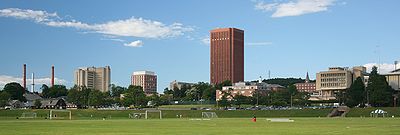
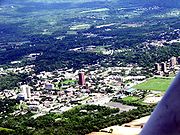
 The University's campus is situated on 1,450 acres, mainly in the town Amherst, but also partly in the neighboring town of Hadley. The campus extends about 1 miles (1.6 km) from the Campus Center
in all directions and may be thought of as a series of concentric rings, with innermost ring harboring academic buildings and research labs, surrounded by a ring of the six residential areas, which in turn is surrounded by a ring of athletic facilities and parking lots. The campus is also divided into "North Campus" and "South Campus."
The campus has its own Combined Heat and Power (CHP) generation facility. The plant, which was dedicated in 2009 after ten years of planning, replaced a coal burning power plant dating back to 1918 and has reduced the campus’ greenhouse gas emissions by approximately 75%. In 2011, the CHP was recognized as the cleanest plant of its size in New England and has been recognized for maintaining 80% efficiency over six consecutive quarters. In 2008, the CHP received the Combined Cycle Journal Pacesetter Award for the best Combined Heat and Power plant project in the US that year. The award refers to its innovative design, efficiency, reliability, system redundancy, and environmental benefits.In 2009, the CHP received the Sustainable Campus Leadership Award from the International District Energy Association. The award states it was given “In recognition of exemplary public leadership in advancing energy efficiency and global environmental stewardship through investment in an innovative district energy system.” The Environmental Protection Agency (EPA) presented the University of Massachusetts with the 2011 Combined Heat and Power Energy Star Award in an effort to recognize the reduced emissions and increased efficiency of the plant.
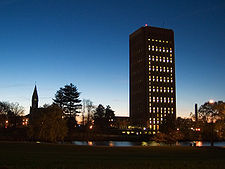
The W.E.B. Du Bois Library is the main library on campus and the tallest library in the United States
, consisting of 26 stories and 296 feet (90.32 m) tall. It is well regarded for its innovative architectural design, which incorporates the bookshelves into the structural support of the building. It is home of the memoirs and papers of the distinguished African-American activist and Massachusetts native W. E. B. Du Bois, as well as being the depository for other important collections, such as the papers of the late Congressman Silvio O. Conte
. The library's special collections include works on movements for social change, African American history and culture, labor and industry, literature and the arts, agriculture, and the history of the surrounding region.
The Science and Engineering Library is the other main library on campus. It is located on the second floor of the Lederle Graduate Research Center (occasionally referred to as the Lederle "low rise"). UMass is also home to the DEFA Film Library, the only archive and study collection of East German films outside of Europe, the Shirley Graham Du Bois Library in New Africa House, the Biological Sciences Library in Morrill Hall, the UMass Science Fiction Society (UMSFS) Library in the Campus Center, and the Music Reserve Lab in the Fine Arts Center.
The university has several buildings (constructed in the 1960s and 70s) of importance in the modernist style, including the Murray D. Lincoln Campus Center
and Hotel designed by Marcel Breuer
, the Southwest Residential Area designed by Hugh Stubbins Jr. of Skidmore, Owings and Merrill
, The Fine Arts Center by Kevin Roche
, the W.E.B. Du Bois Library by Edward Durell Stone
, and Warren McGuirk Alumni Stadium
by Gordon Bunshaft
. Many of the older dorms and lecture halls are built in a Georgian Revival style such as French Hall, Fernald Hall
and Flint Laboratory
.
The class of 2012 had an average high school GPA of 3.55, compared to previous year's 3.48 average high school GPA. Acceptance to the Commonwealth College honors program of UMass Amherst is more selective with an average SAT score of 1390 (math and critical reading) and an average high school class rank of top 6%.
 U.S. News and World Report's 2012 edition of America's Best Colleges ranked UMass Amherst 94th on their list of "Best National Universities", and 42nd among public universities. The computer science program is ranked 20th, tied with Brown, Purdue, Rice, UNC Chapel Hill, USC, and Yale. The artificial intelligence program is ranked 8th, computer systems is ranked at 18th while computer engineering is ranked 36th. The philosophy department is ranked 26th in the U.S. and 33rd in the world. US News and World Report ranks UMass Amherst 51st among graduate engineering schools, 47th among graduate education schools, 54th among nursing programs, and in the graduate arts and sciences, 30th for speech-language pathology, 31st for sociology, 46th for English, 48th for physics, 49th for earth sciences, 50th for psychology, 50th for chemistry, 64th for history, 64th for math, 28th for biology, 72nd for public affairs, and 81st for fine arts.
Times Higher Education World University Rankings
ranks the university as the 56th best university in the world in its World University Rankings 2010. It also ranks the university as the 19th in the world for its reputation in Top Universities By Reputation 2011.. UMass Amherst is ranked 26th among Engineering and Technology Universities.
The undergraduate engineering program is ranked by U.S. News as tied for 56th in the country among schools whose highest degree is a doctorate, ranked higher than other area schools, such as Boston University
, Tufts University
, Wentworth Institute of Technology
and Northeastern University.
The MBA program is highly ranked by the Princeton Review.
The National Research Council ranked computer science at UMass Amherst 18th in quality of Ph. D. education and polymer science, 2nd in quality of education and 7th in quality of scholarship among all U.S. materials departments. Where the Institute for Scientific Information ranked the Chemical Engineering program 5th, Computer Science Department 9th and Geosciences Department recognized for producing most cited paper on Global Warming.
In 2009, the Master of Fine Arts Program for Poets and Writers was rated 4th nationally among graduate creative writing programs by Poets & Writers Magazine.
In 2009, the undergraduate Writing Program was awarded the Conference on College Composition and Communication's (CCCC)
2008–09 Certificate of Excellence, the highest award given to writing programs in the United States.
In 2010, Spinner.com ranked UMass #18 in the "College Rankings of Rock", which is a top 20 countdown that "evaluated universities near and far, ordering them according to their matriculation of musicians"http://www.spinner.com/2010/09/08/college-rankings/. Notable musicians and bands that attended UMass include Natalie Cole
, The Pixies, Buffy Sainte-Marie
, and Taj Mahal (musician)
.
Founded in 1971, the University Without Walls
was one of the first adult bachelor's degree completion programs in the country.
consortium, which allows its students to attend classes, borrow books, work with professors, etc., at four other Pioneer Valley
institutions: Amherst
, Hampshire
, Mount Holyoke
, and Smith
Colleges.
All five colleges are located within 10 miles of Amherst center, and are accessible by public bus. The five share an astronomy
department and some other undergraduate and graduate departments.
, Alpha Phi Omega
, the Red Cross Club, and the Veterans and Service Members Association (VSMA).
The White House has named UMass Amherst to the President's Higher Education Community Service Honor Roll for four consecutive years, in recognition of its commitment to volunteering, service learning, and civic engagement. They have also been named a “Community-Engaged University” by the Carnegie Foundation for the Advancement of Teaching. The Princeton Review
included UMass Amherst in its Colleges with a Conscience: 81 Great Schools with Outstanding Community Involvement.
, and the team is currently focusing on sensors which will detect the malformed proteins made by cancer cells.
Also, UMass Amherst scientists Richard Farris, Todd Emrick, and Bryan Coughlin lead a research team that developed a synthetic polymer that does not burn. This polymer is a building block of plastic, and the new flame-retardant plastics won't need to have flame-retarding chemicals added to their composition. These chemicals have recently been found in many different areas from homes and offices to fish, and there are environmental and health concerns regarding the additives. The newly developed polymers would not require the addition of these potentially hazardous chemicals.
Environmental research
UMass Amherst researchers have positioned the campus as a national leader in sustainability
.
Economics professor Robert Pollin
has influenced the national discussion about how best to stimulate the U.S. economy and promote sustainability. He and colleagues at the Political Economy Research Institute have developed a plan for national recovery that shows, for example, that investing in clean energy (wind power, solar, and biofuels) will create about three times as many good-paying jobs than conventional projects will, while reducing greenhouse gas emissions and dependence on foreign oil.
Since September 2009, the campus has won more than $36 million in competitive stimulus grants. These include:
Other significant research in environmentally-safe technology among UMass Amherst faculty includes:
in the FAC has a permanent contemporary art
collection of about 2,600 works and hosts numerous visual arts exhibitions each year, as well as workshops, master classes, and artist residencies.
The 9,000-seat Mullins Center
, the multi-purpose arena of UMass Amherst hosts a wide variety of performances including speakers, rock concerts, and Broadway shows. In addition, the Music, Dance, and Theater Departments, the Renaissance Center, and multiple student groups dedicated to the arts provide an eclectic menu of performances throughout the year.
Besides the University Museum of Contemporary Art in the FAC, there are four additional art galleries on the UMass Amherst campus that exhibit the work of faculty, students, and artists from around the world. These are the Augusta Savage Gallery in New Africa House (a multicultural and multiarts facility), Herter Gallery in Herter Hall, the Hamden and Central Galleries, located in the residential areas on campus, and the Student Union Art Gallery.
Students also have access to performance venues and galleries in the towns of Amherst and Northampton, and at Mount Holyoke
, Hampshire
, Smith
, and Amherst
Colleges.
 UMass Amherst has a history of protest and activism among the undergraduate and graduate population and is home to over 200 registered student organizations (RSOs).
UMass Permaculture
UMass Permaculture is one the first university permaculture initiatives in the nation that transforms marginalized landscapes on the campus into diverse, educational, low-maintenance and edible gardens according to UMass officials. One of the most important aspects of UMass Permaculture is that it comes from the students and is ecologically and socially responsible. Rather than tilling the soil, a more sustainable landscaping method known as sheet mulching
is employed. During November, 2010, "about a quarter of a million pounds of organic matter was moved by hand", using all student and community volunteer labor and no fossil fuels on-site. The process took about two weeks to complete. Now, the Franklin Permaculture Garden includes a diverse mixture of "vegetables, fruit trees, berry bushes, culinary herbs and a lot of flowers that will attract beneficial insects."
SGA
The Student Government Association (SGA) is the undergraduate student governmental body, and provides funding for the many registered student organizations (RSOs) and agencies, including the Student Legal Services Office (SLSO) and the Center for Student Business (CSB). The SGA also makes formal recommendations on matters of Administration policy and advocates for undergraduate students to the Administration, non-student organizations, and local and state government. The SGA has a budget of approximately 2 million dollars per year which is collected for students in the form of the Student Activities Fee. The student activities fee is currently $47 per semester (Spring 2009). It is used to fund RSOs, Agencies and the SGA itself.
The SGA has three branches: the President and Executive Cabinet, the Undergraduate Student Senate, and the Student Judiciary.
Area governments
There are a total of seven area governments. Each of the campus's six residential areas has an area government, and there is also a Commuter Area Government to serve commuter students. Area governments provide social programming for their areas, and are in charge of the house councils for the dorms in their area. They also represent the needs and interests of students in their areas to the Administration, Housing and Residence Life and the SGA.
Area Governments have a tradition of sponsoring large events, generally in the Spring, such as Fill the Hill, Bowl Weekend and Southwest Week.
Each residence hall or residential "cluster" (a group of residence halls) at UMass Amherst has a house council. House councils report to their respective area governments. Its budget comes from voluntary dues collected in return for access to common supplies (access to the kitchenette
, rental access to vacuums, brooms, games, etc.). House councils also engage in social programming for their halls or clusters, and advocate to housing staff in regards to concerns of students in their hall/cluster.
ROTC
The Minuteman Battalion is the institution's Army ROTC battalion. Active on the Amherst campus, the program's Scabbard and Blade
community service club is very active and represents UMass well throughout the year with food drives, assistance to local veteran's groups and assistance with the Medical Readiness Corps at UMass in preparing for large-scale medical disasters. Most students are on a full tuition scholarship. UMass-Amherst is the host program for the Pioneer Valley and Five Colleges Army ROTC programs including: Smith College, Mount Holyoke College, Amherst College, Hampshire College, Western New England College (WNEC), Springfield College, Westfield State College and American International College (AIC).
Minuteman Marching Band
UMass Amherst has the largest marching band in New England. The Minuteman Marching Band consists of over 390 members and regularly plays at football games. The band was led by George N. Parks
until his death in September 2010. The Minuteman Band also won the prestigious Sudler Trophy in 1998 for excellence. The band is well known across the nation for its style and excellence, particularly for its battery and pit ensemble. The band also performs in various other places like Allentown, Pennsylvania
, Bands of America
, Boston, and on occasion Montreal.
Greek Life
UMass is home to numerous fraternities and sororities, organized under four councils: IFC
, NPC
, NPHC
, and the MGC
. Several Greek Life organizations had houses on North Pleasant Street until Alpha Tau Gamma, Inc. which owned a total of nine properties at one point, did not renew the leases, at the request of the University. The North Pleasant Street houses were colloquially known as 'Frat Row'. Most of Alpha Tau Gamma's Properties houses were out of code
and were razed November 2006. Alpha Tau Gamma sold the land to the University for $2,500,000 in 2007. ATG, which is the Fraternity of the Stockbridge School of Agriculture, then donated $500,001 to endow a new Director of Stockbridge. Currently several sororities & fraternities still live in "Frat Row" including Sigma Delta Tau
, Pi Kappa Alpha
, Iota Gamma Upsilon, Phi Sigma Kappa
and Theta Chi
. Behind "Frat Row" or North Pleasant Street there are more fraternity and sorority houses such as Sigma Kappa
, Kappa Kappa Gamma
, Alpha Delta Phi
, Pi Kappa Phi
, and Delta Chi
. Two other houses Chi Omega
and Sigma Phi Epsilon
are situated on Olympia Drive, on the northern outskirts of the campus. Delta Upsilon
is also situated on North Pleasant Street just past Lederle and Totman. Pi Kappa Alpha
returned to campus in Spring 2007, and Delta Chi
returned in Fall 2008. Alpha Tau Gamma is also located on campus. Alpha Tau Gamma took over a property in the Fall of 2009 that ATG, Inc. owns on Sunset Ave, previously occupied by Alpha Epsilon Pi
.
Several organizations do not have houses, such as Phi Sigma Pi
, Alpha Epsilon Phi, Delta Chi Alpha Epsilon Pi
, Zeta Psi
and the NPHC
, and the MGC
fraternities and sororities. , the membership of the University of Massachusetts – Amherst Multicultural Greek Council is composed of the members of the following organizations at the University of Massachusetts Amherst and nationals: Delta Xi Phi
, Kappa Phi Lambda
, Pi Delta Psi
, Phi Iota Alpha
, Sigma Lambda Upsilon
, Sigma Psi Zeta
, Sigma Lambda Beta
, and Sigma Lambda Gamma
.
The Greek community has several annual traditions, including UDance, the Relay for Life
and the annual Greek Week, during which the various fraternities are partnered with sororities, and these teams compete with each other throughout a week of challenges.
The different councils of the Greek system have governing boards, referred to as Executive Boards. The members of these boards are elected or appointed into their positions and hold them for a year term.
The Massachusetts Daily Collegian is the newspaper of UMass Amherst and is published daily Monday through Friday during the calendar semester. The Collegian is a non-profit student run organization which receives no funding from the University or from student fees. The Collegian operates entirely on advertising revenues. Founded in 1890, the paper began as Aggie Life, became the College Signal in 1901, the Weekly Collegian in 1914 and the Tri-Weekly Collegian in 1956. Published daily since 1967, the Collegian has been broadsheet since January 1994. The Daily Collegian is the largest daily college newspaper in New England and one of the largest in the country.
The Collegian has the most comprehensive coverage of UMass news and campus related events in the area including calendars, features, profiles, announcements, sports, arts & entertainment, news analysis, and opinion.The Collegian is read by undergraduates, graduates, faculty, staff, and residents of the Five College Area. It is delivered daily to Amherst, Hadley, South Hadley and Northampton including Amherst College, Mount Holyoke College, Smith College, and UMass Amherst.
The Collegian now offers all of its content online at DailyCollegian.com. The website provides its readers with more comprehensive coverage of published stories including photographs, videos and podcasts. It also features stories not included in its daily print publication. All of the articles ran by the Daily Collegian can be found on the website the night before it appears in print. Beginning in 2010, the website is expected to expand to include more content including breaking news features.
UVC-TV 19
The Union Video Center is the University of Massachusetts' student-run television station, located in the basement of the Student Union. UVC-TV 19 is part of the University's Housing Cable Services Network and airs on channel 19 to over 11,000 viewers on campus via a closed circuit system. UVC began as the Student Video Project in 1974, and was renamed the Union Video Center in 1978 after growing into a full-fledged television station. Today, UVC-TV 19 serves as a educational training facility on campus for full-time undergraduate students interested in learning about any aspect of television, video production, or cablecasting by providing access to audio and video equipment, studio, and editing workstations. Student employees/members cover campus events and guest lectures, produce original shows, films and documentaries, and air their work on UVC. Membership to UVC gives students access to check out cameras/other video equipment. It also allows each student the opportunity to learn advanced skills for the production field such as training on editing systems and other high quality film equipment. As a Registered Student Organization (RSO), UVC-TV19 allows undergraduate members to participate in the decision-making and day-to-day operations of managing the facility.
WMUA 91.1FM
The student-operated radio station, WMUA
, is a federally licensed, non-commercial broadcast facility serving the Connecticut River Valley of western Massachusetts
, northern Connecticut
, and southern Vermont
. Although the station is managed by full-time undergraduate students of the University of Massachusetts, station members can consist of various members of the University (undergraduate and graduate students, faculty and staff), as well as people of the surrounding communities. WMUA began as an AM station in 1949, and today broadcasts music, news, sports, and public affairs programming. The station is located in the basement of the Lincoln Campus Center.
(NCAA). The university is a member of the Atlantic Ten Conference
, while playing ice hockey in the Hockey East
Association. For football, UMass completed their last season in the Colonial Athletic Association
(CAA), a conference of the Division I Football Championship Subdivision (FCS; known as Division I-AA before the 2006 season). The football team is scheduled to join the Mid-American Conference
, in order to play at Football Bowl Subdivision (the sport's highest level) with games played at Gillette Stadium
beginning in 2012. UMass Amherst has played its last home game at the 17,000-seat McGuirk Stadium on campus while renovations take place to the stadium. The football team may return to the stadium to play some games beginning in 2014. Gillette seats just under 69,000 people and is 93 miles from Amherst. The move to Gillette will be only temporary, with the money raised from home games used to fund an expansion of McGuirk.
UMass originally was known as the Aggies, later the Statesmen, then the Redmen. In a response to changing attitudes regarding the use of Native American-themed mascots, they changed their mascot in 1972 to the Minuteman, based on the historical "minuteman" relationship with Massachusetts; women's teams and athletes are known as Minutewomen.
UMass considers Boston College, the University of New Hampshire, and Boston University their biggest rivals.
The UMass Amherst Department of Athletics currently sponsors Men's Intercollegiate Baseball, Basketball, Cross Country, Ice Hockey, Football, Lacrosse, Soccer, Swimming and Track & Field. They also sponsor Women's Intercollegiate Basketball, Softball, Cross Country, Rowing, Lacrosse, Soccer, Swimming, Field Hockey, Track & Field and Tennis. Among Club Sports offered are Men's Varsity Wrestling, Men's Rowing, Men's Rugby, Women's Rugby and Men's And Women's Bicycle Racing. Men's and Women's Skiing are expected to be re-certified as Club Sports as of the 2009–2010 winter season following the April 2, 2009 announcement of their discontinuation as varsity sports.
Fight, fight Massachusetts,
Fight, fight every play,
Fight, fight for a touchdown,
Fight all your might today.
Fight down the field Massachusetts,
The stars and the stripes will gleam,
Fight, Fight for old Bay State,
Fight for the team, team, team.
Go
Go U
Go U-Mass
Go UMass
, Bill Cosby
, Natalie Cole
, Julius "Dr. J" Erving
, Rick Pitino
, Betty Shabazz
, Jack Welch
, and Richard Gere
.
Notable faculty have included Joseph Hooton Taylor, Jr.
, a Nobel Prize in Physics
laureate
, Sheila Bair, the current Chairman of the U.S. Federal Deposit Insurance Corporation
, Chuck Close
, a celebrated photorealist, Vincent Dethier
, a pioneer physiologist and entomologist, and Lynn Margulis
, a famed biologist
.
The University is campaigning to get Alumni to purchase specialty Massachusetts license plates with the UMass Amherst logo. The proceeds from sales of the plates would go to help fund student scholarships.
The University Alumni Association operates out of Memorial Hall.
Land-grant university
Land-grant universities are institutions of higher education in the United States designated by each state to receive the benefits of the Morrill Acts of 1862 and 1890....
in Amherst
Amherst, Massachusetts
Amherst is a town in Hampshire County, Massachusetts, United States in the Connecticut River valley. As of the 2010 census, the population was 37,819, making it the largest community in Hampshire County . The town is home to Amherst College, Hampshire College, and the University of Massachusetts...
, Massachusetts
Massachusetts
The Commonwealth of Massachusetts is a state in the New England region of the northeastern United States of America. It is bordered by Rhode Island and Connecticut to the south, New York to the west, and Vermont and New Hampshire to the north; at its east lies the Atlantic Ocean. As of the 2010...
, United States
United States
The United States of America is a federal constitutional republic comprising fifty states and a federal district...
and the flagship of the University of Massachusetts system
University of Massachusetts
This article relates to the statewide university system. For the flagship campus often referred to as "UMass", see University of Massachusetts Amherst...
. With 1,174 faculty members and more than 27,000 students, UMass Amherst is the largest public university in New England
New England
New England is a region in the northeastern corner of the United States consisting of the six states of Maine, New Hampshire, Vermont, Massachusetts, Rhode Island, and Connecticut...
.
The university offers bachelor's degrees, master's degrees, and doctoral degrees in 86 undergraduate and 72 graduate areas of study, through eight schools and colleges. The main campus is situated north of downtown Amherst, Massachusetts
Amherst, Massachusetts
Amherst is a town in Hampshire County, Massachusetts, United States in the Connecticut River valley. As of the 2010 census, the population was 37,819, making it the largest community in Hampshire County . The town is home to Amherst College, Hampshire College, and the University of Massachusetts...
. In a 2009 article for MSN.com Amherst was ranked 1st in Best College Towns in the United States.
The University of Massachusetts Amherst is categorized as a Research University with very high research activity by the Carnegie Foundation for the Advancement of Teaching. In 2009, UMass Amherst had research expenditures of $130 million.
UMass Amherst sports teams are called the Minutemen and Minutewomen
UMass Minutemen
The UMass Minutemen are the athletic teams that represent the University of Massachusetts Amherst in NCAA Division I sports competition. The nickname is also applied to club teams that do not participate within the NCAA structure. Strictly speaking, the Minutemen nickname applies to men's teams and...
, the colors being maroon and white; the school mascot is Sam the Minuteman
Sam the Minuteman
right|thumb| The "Sam the Minuteman" logo of the UMass athletic teamsSam the Minuteman is the mascot of the University of Massachusetts Amherst athletics teams. Sam can be found at any event in which the Minutemen or Minutewomen are participants...
. All teams participate in NCAA
National Collegiate Athletic Association
The National Collegiate Athletic Association is a semi-voluntary association of 1,281 institutions, conferences, organizations and individuals that organizes the athletic programs of many colleges and universities in the United States...
Division I. The university is a member of the Atlantic 10 Conference, while playing ice hockey in Hockey East
Hockey East
Hockey East Association is a NCAA Men's Division I Ice Hockey conference which operates in New England. It participates in the NCAA's Division I as a hockey-only conference....
. In football, UMass has completed their last season in the Colonial Athletic Association
Colonial Athletic Association
The Colonial Athletic Association is a NCAA Division I college athletic conference whose full-time members are located in East Coast states from Massachusetts to Georgia. Most of its members are public universities, with five in Virginia alone, and the conference is headquartered in Richmond,...
(CAA) at the FCS level, and in 2012 they will upgrade to the FBS level and transition to the Mid-American Conference
Mid-American Conference
The Mid-American Conference is a National Collegiate Athletic Association Division I college athletic conference with a membership base in the Great Lakes region that stretches from Western New York to Illinois. Nine of the twelve full member schools are in Ohio and Michigan, with single members...
(MAC), joining fellow A10 member Temple
Temple Owls football
The Temple Owls football team participates in the NCAA's Division I Football Bowl Subdivision as a member of the East Division of the Mid-American Conference...
.
Foundation and early years
The university was founded in 1863 under the provisions of the Federal Morrill Land-Grant Colleges ActMorrill Land-Grant Colleges Act
The Morrill Land-Grant Acts are United States statutes that allowed for the creation of land-grant colleges, including the Morrill Act of 1862 and the Morrill Act of 1890 -Passage of original bill:...
to provide instruction to Massachusetts citizens in the "agricultural, mechanical, and military arts." Accordingly, the university was initially named the Massachusetts Agricultural College, popularly referred to as "Mass Aggie" or "M.A.C." In 1867, the college had yet to admit any students, had been through two Presidents, and still had not completed any college buildings. In that year, William S. Clark
William S. Clark
William Smith Clark was a professor of chemistry, botany and zoology, a colonel during the American Civil War, and a leader in agricultural education. Raised and schooled in Easthampton, Massachusetts, Clark spent most of his adult life in Amherst, Massachusetts...
was appointed President of the college and Professor of Botany. He quickly appointed a faculty, completed the construction plan, and in the fall of 1867 admitted the first class of approximately 50 students. Clark became the first functioning President and arguably the primary founding father of the college.
The original buildings consisted of Old South College (a dormitory located on the site of the present South College), North College (a second dormitory once located just south of today's Machmer Hall), the Chemistry Laboratory, also known as College Hall (once located on the present site of Machmer Hall), the Boarding House (a small dining hall located just north of the present Campus Parking Garage), the Botanic Museum (located on the north side of the intersection of Stockbridge Road and Chancellor's Hill Drive) and the Durfee Plant House (located on the site of the new Durfee Conservatory).
Although enrollment was slow during the 1870s, the fledgling college built momentum under the leadership of President Henry Hill Goodell. In the 1880s, Goodell implemented an expansion plan, adding the College Drill Hall in 1883 (the first gymnasium), the Old Chapel Library in 1885 (one of the oldest extant buildings on campus and an important symbol of the University), and the East and West Experiment Stations in 1886 and 1890. The Campus Pond, now the central focus of the University Campus, was created in 1893 by damming a small brook.
The early 20th century saw great expansion in terms of enrollment and the scope of the curriculum. The first female student was admitted in 1875 on a part time basis and the first full time female student was admitted in 1894. In 1903, Draper Hall was constructed for the dual purpose of a dining hall and female housing. The first female students graduated with the class of 1905. The first dedicated female dormitory, the Abigail Adams House (on the site of today's Lederle Tower) was built in 1920.
By the turn of the century, the college was thriving and quickly expanded its curriculum to include the liberal arts. In recognition of the higher enrollment and broader curriculum, the college was renamed Massachusetts State College in 1931.
Following World War II, the G.I. Bill, facilitating financial aid for veterans, led to an explosion of applicants. The college population soared and Presidents Hugh Potter Baker and Ralph Van Meter labored to push through major construction projects in the 1940s and 50s, particularly with regard to dormitories (now Northeast and Central Residential Areas). Accordingly, the name of the college was changed in 1947 to the "University of Massachusetts."
Modern era
By the 1970s, the University continued to grow and gave rise to a shuttle bus service on campus as well as many other architectural additions; this included the Murray D. Lincoln Campus CenterMurray D. Lincoln Campus Center
Murray D. Lincoln Campus Center, is a skyscraper in Amherst, Massachusetts that is built in the modernist style. The building and attached parking garage were designed by Marcel Breuer. The building also hosts The Campus Center Hotel on the upper floors of the building. The hotel consists of 116...
complete with a hotel, office space, fine dining restaurant, campus store, and passage way to the parking garage, the W. E. B. Du Bois Library, and the Fine Arts Center.
Over the course of the next two decades, the John W. Lederle Graduate Research Center
John W. Lederle Graduate Research Center
The John W. Lederle Graduate Research Center, also known as Lederle Tower, is a building in Amherst, Massachusetts. It is part of the University of Massachusetts Amherst. It contains research laboratories, conference rooms, and offices for many departments within the College of Natural Sciences...
and the Conte National Polymer Research Center were built and UMass Amherst emerged as a major research facility. The Robsham Memorial Center for Visitors welcomed thousands of guests to campus after its dedication in 1989. For athletic and other large events, the Mullins Center
Mullins Center
The William D. Mullins Memorial Center, also known as the Mullins Center, is a 10,600 seat multi-purpose arena, located on the campus of the University of Massachusetts, in Amherst, Massachusetts. The Mullins Center is the home of UMass Minutemen Men's Basketball, Women's Basketball, and Men's Ice...
was opened in 1993, hosting capacity crowds as the Minutemen basketball team was ranked #1 for many weeks in the mid 1990s, and reached the Final Four
1996 NCAA Men's Division I Basketball Tournament
The 1996 NCAA Men's Division I Basketball Tournament involved 64 schools playing in single-elimination play to determine the national champion of men's NCAA Division I college basketball. It began on March 14, 1996, and ended with the championship game on April 1 at Continental Airlines Arena in...
in 1996.
UMass Amherst entered the 21st century with close to 24,000 students enrolled. In 2003, for the first time, UMass Amherst was legally designated by the state legislature as a research university and the "flagship campus of the UMass system. UMass Faculty members are top performers in terms of the numbers of awards and recognitions they receive, and their supported research activities total more than $140 million per year. The campus facilities have undergone extensive renovations in recent years. New and newly renovated facilities include student apartment complexes, Berkshire Dining Commons, library Learning Commons, School of Management, Integrated Science Building, Nursing Building, Studio Arts Building, Heating Plant, track facility, and Recreation Center. In 2010 UMass Amherst broke ground on a new laboratory science building and a new home for the Minuteman Marching Band. Its current student body is the most high-achieving in UMass Amherst history (in terms of admissions test scores and grades) and the university was named a top producer of Fulbright Award
Fulbright Award
The Fulbright Award is a scholarship awarded as part of the Fulbright Program to foster international research and collaboration. The program also awards a fellowship to Ph.D.'s to lecture and teach in foreign universities...
winners in the 2008–2009 academic year. Additionally, in 2010 UMass Amherst was named one of the "Top Colleges and Universities Contributing to Teach For America
Teach For America
Teach For America is an American non-profit organization that aims to eliminate educational inequity by enlisting the nation's most promising future leaders to teach for two or more years in low-income communities throughout the United States...
's 2010 Teaching Corps."
Organization and administration
Since the University of Massachusetts Amherst was founded as the Massachusetts Agricultural College in 1863, 25 individuals have been at the helm of the institution. The office, originally known as "President," was changed to "ChancellorChancellor (education)
A chancellor or vice-chancellor is the chief executive of a university. Other titles are sometimes used, such as president or rector....
" in 1970. The title "President of the University of Massachusetts" now refers to the president of the entire five-campus University of Massachusetts system
University of Massachusetts
This article relates to the statewide university system. For the flagship campus often referred to as "UMass", see University of Massachusetts Amherst...
. The current Chancellor of the Amherst campus is Dr. Robert C. Holub
Robert C. Holub
Robert C. Holub, Ph.D. is the 28th and current chancellor of the University of Massachusetts Amherst, beginning his tenure as chancellor in August 2008...
. The Chancellor resides in Hillside, the campus residence for chancellors.
There are 972 permanent faculty at the university. In 2010 the state budgeted $465 million for the UMass system. State funding is 25% of revenue. UMass offers bachelor's degrees, master's degrees, and doctoral degrees in over 90 undergraduate and 65 graduate areas of study. The university is organized into 9 schools and colleges:
- School of Education
- College of Engineering
- College of Humanities and Fine Arts
- Isenberg School of ManagementIsenberg School of ManagementThe Isenberg School of Management is the business school at the University of Massachusetts Amherst. Founded in 1947 as the School of Business Administration, Isenberg assumed its present name in 1997 in honor of alumnus and benefactor Eugene M. Isenberg...
- College of Natural Sciences
- School of Nursing
- School of Public Health and Health Sciences
- College of Social and Behavioral Sciences
- Stockbridge School of AgricultureStockbridge School of AgricultureThe Stockbridge School of Agriculture is a fully accredited, two–year agricultural school that is part of the University of Massachusetts, Amherst campus. It was founded as part of the Massachusetts Agricultural College in 1918...
Students interested in studying outside of a particular major can apply to enroll in the Bachelor's Degree with Individual Concentration (BDIC) program. This is a unique program which allows students to design their own area of study. A BDIC concentration must be interdisciplinary, drawing from at least three fields or disciplines, and it may not duplicate an existing major. Courses can be selected from any department within the university as well as the campuses in the Five College Consortium. Course selection is guided by the students chosen faculty sponsor and a BDIC faculty supervisor. BDIC students are assigned to one of five academic clusters- Arts and Cultural studies; Business and Law; Communication; Education and Human Development; Natural Health, Computer Sciences and Engineering.
Additionally, the university offers two programs designed for adult and continuing education students, known as University Without Walls
University Without Walls- UMass Amherst
University Without Walls, UMass Amherst is an adult bachelor's degree completion program at the University of Massachusetts Amherst. Founded in 1971 as part of the national University Without Walls movement to increase access to higher education, UMass University Without Walls was one of the first...
and Continuing and Professional Education.
Campus
Murray D. Lincoln Campus Center
Murray D. Lincoln Campus Center, is a skyscraper in Amherst, Massachusetts that is built in the modernist style. The building and attached parking garage were designed by Marcel Breuer. The building also hosts The Campus Center Hotel on the upper floors of the building. The hotel consists of 116...
in all directions and may be thought of as a series of concentric rings, with innermost ring harboring academic buildings and research labs, surrounded by a ring of the six residential areas, which in turn is surrounded by a ring of athletic facilities and parking lots. The campus is also divided into "North Campus" and "South Campus."
The campus has its own Combined Heat and Power (CHP) generation facility. The plant, which was dedicated in 2009 after ten years of planning, replaced a coal burning power plant dating back to 1918 and has reduced the campus’ greenhouse gas emissions by approximately 75%. In 2011, the CHP was recognized as the cleanest plant of its size in New England and has been recognized for maintaining 80% efficiency over six consecutive quarters. In 2008, the CHP received the Combined Cycle Journal Pacesetter Award for the best Combined Heat and Power plant project in the US that year. The award refers to its innovative design, efficiency, reliability, system redundancy, and environmental benefits.In 2009, the CHP received the Sustainable Campus Leadership Award from the International District Energy Association. The award states it was given “In recognition of exemplary public leadership in advancing energy efficiency and global environmental stewardship through investment in an innovative district energy system.” The Environmental Protection Agency (EPA) presented the University of Massachusetts with the 2011 Combined Heat and Power Energy Star Award in an effort to recognize the reduced emissions and increased efficiency of the plant.
The W.E.B. Du Bois Library is the main library on campus and the tallest library in the United States
United States
The United States of America is a federal constitutional republic comprising fifty states and a federal district...
, consisting of 26 stories and 296 feet (90.32 m) tall. It is well regarded for its innovative architectural design, which incorporates the bookshelves into the structural support of the building. It is home of the memoirs and papers of the distinguished African-American activist and Massachusetts native W. E. B. Du Bois, as well as being the depository for other important collections, such as the papers of the late Congressman Silvio O. Conte
Silvio O. Conte
Silvio Ottavio Conte was a Republican member of the United States House of Representatives for 16 terms, from January 3, 1959, until his death.-Birth:...
. The library's special collections include works on movements for social change, African American history and culture, labor and industry, literature and the arts, agriculture, and the history of the surrounding region.
The Science and Engineering Library is the other main library on campus. It is located on the second floor of the Lederle Graduate Research Center (occasionally referred to as the Lederle "low rise"). UMass is also home to the DEFA Film Library, the only archive and study collection of East German films outside of Europe, the Shirley Graham Du Bois Library in New Africa House, the Biological Sciences Library in Morrill Hall, the UMass Science Fiction Society (UMSFS) Library in the Campus Center, and the Music Reserve Lab in the Fine Arts Center.
The university has several buildings (constructed in the 1960s and 70s) of importance in the modernist style, including the Murray D. Lincoln Campus Center
Murray D. Lincoln Campus Center
Murray D. Lincoln Campus Center, is a skyscraper in Amherst, Massachusetts that is built in the modernist style. The building and attached parking garage were designed by Marcel Breuer. The building also hosts The Campus Center Hotel on the upper floors of the building. The hotel consists of 116...
and Hotel designed by Marcel Breuer
Marcel Breuer
Marcel Lajos Breuer , was a Hungarian-born modernist, architect and furniture designer of Jewish descent. One of the masters of Modernism, Breuer displayed interest in modular construction and simple forms.- Life and work :Known to his friends and associates as Lajkó, Breuer studied and taught at...
, the Southwest Residential Area designed by Hugh Stubbins Jr. of Skidmore, Owings and Merrill
Skidmore, Owings and Merrill
Skidmore, Owings and Merrill LLP is an American architectural and engineering firm that was formed in Chicago in 1936 by Louis Skidmore and Nathaniel Owings; in 1939 they were joined by John O. Merrill. They opened their first branch in New York City, New York in 1937. SOM is one of the largest...
, The Fine Arts Center by Kevin Roche
Kevin Roche
Kevin Roche is an Irish-American architect known for his creative work with glass.Born in Dublin, Roche spent his formative years in Mitchelstown, Co. Cork before he graduated from University College Dublin in 1945. He then worked with Michael Scott from 1945-1946...
, the W.E.B. Du Bois Library by Edward Durell Stone
Edward Durell Stone
Edward Durell Stone was a twentieth century American architect who worked primarily in the Modernist style.-Early life:...
, and Warren McGuirk Alumni Stadium
Warren McGuirk Alumni Stadium
Warren McGuirk Alumni Stadium is a 17,000-seat multi-purpose stadium in Hadley, Massachusetts on the campus of the University of Massachusetts Amherst. It was home to the UMass Minutemen football team through the 2011 season, and remains home to the UMass Minutewomen lacrosse team. The stadium is...
by Gordon Bunshaft
Gordon Bunshaft
Gordon Bunshaft was an architect educated at the Massachusetts Institute of Technology. In 1988, Gordon Bunshaft nominated himself for the Pritzker Prize and eventually won it.-Career:...
. Many of the older dorms and lecture halls are built in a Georgian Revival style such as French Hall, Fernald Hall
Fernald Hall
Fernald Hall is the primary lecture hall and laboratory used by the entomology program of the University of Massachusetts Amherst. The building also contains the main office of the Department of Plant, Soil & Insect Sciences, and houses the university's extensive collection of domestic and foreign...
and Flint Laboratory
Flint Laboratory
Flint Laboratory is an academic building and a former dairy laboratory at the University of Massachusetts Amherst. It was the first building of the Ellis Drive "agricultural group", including Stockbridge Hall and an unbuilt hall for agricultural mechanics...
.
Admissions
The number of applications to UMass Amherst has almost doubled from 16,500 to 29,500 in just five years, increasing for the seventh consecutive year. In 2009, 64% percent of applicants were accepted to the University, and 2% to the Commonwealth College (14% of those accepted). In 2010, 31,300 applications were received. The incoming class of 2014 had an average high school GPA of 3.61 out of 4. The class of 2014 is the school's biggest at 4,500, which is an increase of 10 percent from the class of 2013.The class of 2012 had an average high school GPA of 3.55, compared to previous year's 3.48 average high school GPA. Acceptance to the Commonwealth College honors program of UMass Amherst is more selective with an average SAT score of 1390 (math and critical reading) and an average high school class rank of top 6%.
Ranking and reputation
Times Higher Education World University Rankings
Times Higher Education World University Rankings
The Times Higher Education World University Rankings is an international ranking of universities published by the British magazine Times Higher Education in partnership with Thomson Reuters, which provided citation database information...
ranks the university as the 56th best university in the world in its World University Rankings 2010. It also ranks the university as the 19th in the world for its reputation in Top Universities By Reputation 2011.. UMass Amherst is ranked 26th among Engineering and Technology Universities.
The undergraduate engineering program is ranked by U.S. News as tied for 56th in the country among schools whose highest degree is a doctorate, ranked higher than other area schools, such as Boston University
Boston University
Boston University is a private research university located in Boston, Massachusetts. With more than 4,000 faculty members and more than 31,000 students, Boston University is one of the largest private universities in the United States and one of Boston's largest employers...
, Tufts University
Tufts University
Tufts University is a private research university located in Medford/Somerville, near Boston, Massachusetts. It is organized into ten schools, including two undergraduate programs and eight graduate divisions, on four campuses in Massachusetts and on the eastern border of France...
, Wentworth Institute of Technology
Wentworth Institute of Technology
The Wentworth Institute of Technology is an independent, co-educational, technical design and engineering college located in Boston, Massachusetts...
and Northeastern University.
The MBA program is highly ranked by the Princeton Review.
The National Research Council ranked computer science at UMass Amherst 18th in quality of Ph. D. education and polymer science, 2nd in quality of education and 7th in quality of scholarship among all U.S. materials departments. Where the Institute for Scientific Information ranked the Chemical Engineering program 5th, Computer Science Department 9th and Geosciences Department recognized for producing most cited paper on Global Warming.
In 2009, the Master of Fine Arts Program for Poets and Writers was rated 4th nationally among graduate creative writing programs by Poets & Writers Magazine.
In 2009, the undergraduate Writing Program was awarded the Conference on College Composition and Communication's (CCCC)
Conference on College Composition and Communication
The Conference on College Composition and Communication is a national professional association of college and university writing instructors in the USA. Formed in 1949 as an organization within the National Council of Teachers of English, CCCC currently has about 7000 members...
2008–09 Certificate of Excellence, the highest award given to writing programs in the United States.
In 2010, Spinner.com ranked UMass #18 in the "College Rankings of Rock", which is a top 20 countdown that "evaluated universities near and far, ordering them according to their matriculation of musicians"http://www.spinner.com/2010/09/08/college-rankings/. Notable musicians and bands that attended UMass include Natalie Cole
Natalie Cole
Natalie Maria Cole , is an American singer, songwriter and performer. The daughter of jazz legend Nat King Cole, Cole rode to musical success in the mid-1970s as an R&B artist with the hits "This Will Be ", "Inseparable" and "Our Love"...
, The Pixies, Buffy Sainte-Marie
Buffy Sainte-Marie
Buffy Sainte-Marie, OC is a Canadian Cree singer-songwriter, musician, composer, visual artist, educator, pacifist, and social activist. Throughout her career in all of these areas, her work has focused on issues of Indigenous peoples of the Americas. Her singing and writing repertoire includes...
, and Taj Mahal (musician)
Taj Mahal (musician)
Henry Saint Clair Fredericks , who uses the stage name Taj Mahal, is an American Grammy Award winning blues musician. He incorporates elements of world music into his music...
.
Founded in 1971, the University Without Walls
University Without Walls- UMass Amherst
University Without Walls, UMass Amherst is an adult bachelor's degree completion program at the University of Massachusetts Amherst. Founded in 1971 as part of the national University Without Walls movement to increase access to higher education, UMass University Without Walls was one of the first...
was one of the first adult bachelor's degree completion programs in the country.
Commonwealth Honors College
Commonwealth Honors College is the honors college at UMass. The honors college provides students the opportunity to intensify their UMass academic curriculum. The requirements of the college are to complete an honors college writing course, a seminar called "Ideas That Changed the World," two honors gen ed courses, an honors seminar called "Topics," and for advanced scholarship honors, several upper-level honors courses, including an honors thesis, project, or capstone course. Membership in the honors college is not required in order to graduate the University with higher Latin honors designations, such as magna or summa cum laude. Commonwealth Honors College provides honors students an additional community of students to interact with outside of their academic department and holds many social and academic events during the school year.Five College consortium
UMass Amherst is part of the Five CollegesFive Colleges (Massachusetts)
The Five Colleges comprises four liberal arts colleges and one university in the Connecticut River Pioneer Valley of Western Massachusetts, totaling approximately 28,000 students. The schools belong to a consortium called Five Colleges, Incorporated, established in 1965...
consortium, which allows its students to attend classes, borrow books, work with professors, etc., at four other Pioneer Valley
Pioneer Valley
The Pioneer Valley is the colloquial name for the U.S. Commonwealth of Massachusetts's portion of the Connecticut River Valley. The Pioneer Valley consists of three counties in Massachusetts which collectively feature much of New England's most fertile farmland...
institutions: Amherst
Amherst College
Amherst College is a private liberal arts college located in Amherst, Massachusetts, United States. Amherst is an exclusively undergraduate four-year institution and enrolled 1,744 students in the fall of 2009...
, Hampshire
Hampshire College
Hampshire College is a private liberal arts college in Amherst, Massachusetts. It was founded in 1965 as an experiment in alternative education, in association with four other colleges in the Pioneer Valley: Amherst College, Smith College, Mount Holyoke College, and the University of Massachusetts...
, Mount Holyoke
Mount Holyoke College
Mount Holyoke College is a liberal arts college for women in South Hadley, Massachusetts. It was the first member of the Seven Sisters colleges, and served as a model for some of the others...
, and Smith
Smith College
Smith College is a private, independent women's liberal arts college located in Northampton, Massachusetts. It is the largest member of the Seven Sisters...
Colleges.
All five colleges are located within 10 miles of Amherst center, and are accessible by public bus. The five share an astronomy
Astronomy
Astronomy is a natural science that deals with the study of celestial objects and phenomena that originate outside the atmosphere of Earth...
department and some other undergraduate and graduate departments.
Community service
UMass Amherst emphasizes community service as part of its academic programs. The Community Engagement Program (CEP) offers courses that combine classroom learning and community service, and sponsors programs such as the first year IMPACT learning community and the Citizen Scholars Program. Co-curricular service programs include the Alternative Spring Break, Engineers without Borders, the Legal Studies Civil Rights Clinical Project, the Medical Reserve CorpsMedical Reserve Corps
The Medical Reserve Corps is a network in the U.S. of community-based units initiated and established by local organizations to meet the public health needs of their communities. It is sponsored by the Office of the Surgeon General of the United States...
, Alpha Phi Omega
Alpha Phi Omega
Alpha Phi Omega is the largest collegiate fraternity in the United States, with chapters at over 350 campuses, an active membership of approximately 17,000 students, and over 350,000 alumni members...
, the Red Cross Club, and the Veterans and Service Members Association (VSMA).
The White House has named UMass Amherst to the President's Higher Education Community Service Honor Roll for four consecutive years, in recognition of its commitment to volunteering, service learning, and civic engagement. They have also been named a “Community-Engaged University” by the Carnegie Foundation for the Advancement of Teaching. The Princeton Review
The Princeton Review
The Princeton Review is an American-based standardized test preparation and admissions consulting company. The Princeton Review operates in 41 states and 22 countries across the globe. It offers test preparation for standardized aptitude tests such as the SAT and advice regarding college...
included UMass Amherst in its Colleges with a Conscience: 81 Great Schools with Outstanding Community Involvement.
Research
Researchers at the university made several high-profile achievements in recent years. A team of scientists at UMass, led by Vincent Rotello, have developed a molecular nose that can detect and identify various proteins. The research appeared in the May 2007 issue of Nature NanotechnologyNature Nanotechnology
Nature Nanotechnology is a monthly, peer-reviewed, scientific journal, which is published by Nature Publishing Group. It was established in October 2006. The editor in chief is Peter Rodgers, a full-time professional editor who is employed by Nature Publishing Group...
, and the team is currently focusing on sensors which will detect the malformed proteins made by cancer cells.
Also, UMass Amherst scientists Richard Farris, Todd Emrick, and Bryan Coughlin lead a research team that developed a synthetic polymer that does not burn. This polymer is a building block of plastic, and the new flame-retardant plastics won't need to have flame-retarding chemicals added to their composition. These chemicals have recently been found in many different areas from homes and offices to fish, and there are environmental and health concerns regarding the additives. The newly developed polymers would not require the addition of these potentially hazardous chemicals.
Environmental research
UMass Amherst researchers have positioned the campus as a national leader in sustainability
Sustainability
Sustainability is the capacity to endure. For humans, sustainability is the long-term maintenance of well being, which has environmental, economic, and social dimensions, and encompasses the concept of union, an interdependent relationship and mutual responsible position with all living and non...
.
Economics professor Robert Pollin
Robert Pollin
Robert N. Pollin is an American economist and activist. He is a professor of economics at the University of Massachusetts-Amherst and founding co-director of its Political Economy Research Institute ....
has influenced the national discussion about how best to stimulate the U.S. economy and promote sustainability. He and colleagues at the Political Economy Research Institute have developed a plan for national recovery that shows, for example, that investing in clean energy (wind power, solar, and biofuels) will create about three times as many good-paying jobs than conventional projects will, while reducing greenhouse gas emissions and dependence on foreign oil.
Since September 2009, the campus has won more than $36 million in competitive stimulus grants. These include:
- $7.1 million in grants from the National Science Foundation to approximately 20 separate researchers.
- $16 million from the Department of Energy to establish an Energy Frontier Research Center on campus to develop highly efficient non-silicon polymer materials for harvesting solar energy.
- $1.9 million to chemical engineer George Huber to further develop bio-fuels from inedible corn stalks, bark, wood waste, and similar biomass.
Other significant research in environmentally-safe technology among UMass Amherst faculty includes:
- Microbiologist Susan Leschine has raised $25 million to commercialize technology that converts plant waste into ethanol using the Q microbe, discovered in the Quabbin Reservoir just east of the campus.
- James Manwell, director of the Renewable Energy Research Laboratory, leads testing on large wind-turbine blades at a new federal facility in Boston after helping construct two municipal wind turbines in Hull, Massachusetts.
- Microbiologist Derek Lovley discovered GeobacterGeobacterGeobacter is a genus of proteobacteria. Geobacter are an anaerobic respiration bacterial species which have capabilities that make them useful in bioremediation...
, a tiny biological structure that can clean up groundwater and produce electricity through conductive microbial nanowires.
Arts on Campus
The UMass Amherst campus offers a variety of artistic venues, both for performance and visual art. The most prominent is the Fine Arts Center (FAC), built in 1975. The FAC brings nationally-known theater, music, and dance performances to campus throughout the year to its performance spaces (the Concert Hall, Bezanson Recital Hall, and Bowker Auditorium). These include several popular performance series: Jazz in July Summer Music Program, the Center Series, Magic Triangle Series (jazz), and New WORLD Theater. The University Museum of Contemporary ArtUniversity Museum of Contemporary Art
The University Museum of Contemporary Art in a contemporary art museum on the campus of the University of Massachusetts Amherst. The UMCA has been housed in the university's Fine Arts Center since 1975, after the university began collecting works in 1962...
in the FAC has a permanent contemporary art
Contemporary art
Contemporary art can be defined variously as art produced at this present point in time or art produced since World War II. The definition of the word contemporary would support the first view, but museums of contemporary art commonly define their collections as consisting of art produced...
collection of about 2,600 works and hosts numerous visual arts exhibitions each year, as well as workshops, master classes, and artist residencies.
The 9,000-seat Mullins Center
Mullins Center
The William D. Mullins Memorial Center, also known as the Mullins Center, is a 10,600 seat multi-purpose arena, located on the campus of the University of Massachusetts, in Amherst, Massachusetts. The Mullins Center is the home of UMass Minutemen Men's Basketball, Women's Basketball, and Men's Ice...
, the multi-purpose arena of UMass Amherst hosts a wide variety of performances including speakers, rock concerts, and Broadway shows. In addition, the Music, Dance, and Theater Departments, the Renaissance Center, and multiple student groups dedicated to the arts provide an eclectic menu of performances throughout the year.
Besides the University Museum of Contemporary Art in the FAC, there are four additional art galleries on the UMass Amherst campus that exhibit the work of faculty, students, and artists from around the world. These are the Augusta Savage Gallery in New Africa House (a multicultural and multiarts facility), Herter Gallery in Herter Hall, the Hamden and Central Galleries, located in the residential areas on campus, and the Student Union Art Gallery.
Students also have access to performance venues and galleries in the towns of Amherst and Northampton, and at Mount Holyoke
Mount Holyoke College
Mount Holyoke College is a liberal arts college for women in South Hadley, Massachusetts. It was the first member of the Seven Sisters colleges, and served as a model for some of the others...
, Hampshire
Hampshire College
Hampshire College is a private liberal arts college in Amherst, Massachusetts. It was founded in 1965 as an experiment in alternative education, in association with four other colleges in the Pioneer Valley: Amherst College, Smith College, Mount Holyoke College, and the University of Massachusetts...
, Smith
Smith College
Smith College is a private, independent women's liberal arts college located in Northampton, Massachusetts. It is the largest member of the Seven Sisters...
, and Amherst
Amherst College
Amherst College is a private liberal arts college located in Amherst, Massachusetts, United States. Amherst is an exclusively undergraduate four-year institution and enrolled 1,744 students in the fall of 2009...
Colleges.
Groups and Activities
UMass Permaculture
UMass Permaculture is one the first university permaculture initiatives in the nation that transforms marginalized landscapes on the campus into diverse, educational, low-maintenance and edible gardens according to UMass officials. One of the most important aspects of UMass Permaculture is that it comes from the students and is ecologically and socially responsible. Rather than tilling the soil, a more sustainable landscaping method known as sheet mulching
Sheet mulching
In permaculture, sheet mulching is an agricultural no-dig gardening technique that attempts to mimic natural forests' processes. When deployed properly and in combination with other permacultural principles, it can generate healthy, productive and low maintenance ecosystems.-Technique:A model for...
is employed. During November, 2010, "about a quarter of a million pounds of organic matter was moved by hand", using all student and community volunteer labor and no fossil fuels on-site. The process took about two weeks to complete. Now, the Franklin Permaculture Garden includes a diverse mixture of "vegetables, fruit trees, berry bushes, culinary herbs and a lot of flowers that will attract beneficial insects."
SGA
The Student Government Association (SGA) is the undergraduate student governmental body, and provides funding for the many registered student organizations (RSOs) and agencies, including the Student Legal Services Office (SLSO) and the Center for Student Business (CSB). The SGA also makes formal recommendations on matters of Administration policy and advocates for undergraduate students to the Administration, non-student organizations, and local and state government. The SGA has a budget of approximately 2 million dollars per year which is collected for students in the form of the Student Activities Fee. The student activities fee is currently $47 per semester (Spring 2009). It is used to fund RSOs, Agencies and the SGA itself.
The SGA has three branches: the President and Executive Cabinet, the Undergraduate Student Senate, and the Student Judiciary.
Area governments
There are a total of seven area governments. Each of the campus's six residential areas has an area government, and there is also a Commuter Area Government to serve commuter students. Area governments provide social programming for their areas, and are in charge of the house councils for the dorms in their area. They also represent the needs and interests of students in their areas to the Administration, Housing and Residence Life and the SGA.
Area Governments have a tradition of sponsoring large events, generally in the Spring, such as Fill the Hill, Bowl Weekend and Southwest Week.
Each residence hall or residential "cluster" (a group of residence halls) at UMass Amherst has a house council. House councils report to their respective area governments. Its budget comes from voluntary dues collected in return for access to common supplies (access to the kitchenette
Kitchenette
A kitchenette is a small cooking area.In motel and hotel rooms, small apartments, college dormitories, or office buildings a kitchenette usually consists of a small refrigerator, a microwave oven or hotplate, and, less frequently, a sink...
, rental access to vacuums, brooms, games, etc.). House councils also engage in social programming for their halls or clusters, and advocate to housing staff in regards to concerns of students in their hall/cluster.
ROTC
The Minuteman Battalion is the institution's Army ROTC battalion. Active on the Amherst campus, the program's Scabbard and Blade
Scabbard and Blade
Scabbard and Blade is a college military honor society founded at the University of Wisconsin in 1904. Although membership is open to R.O.T.C. cadets and midshipmen of all military services, the society is modeled after the U.S. Army and its chapters are called companies and are organized into...
community service club is very active and represents UMass well throughout the year with food drives, assistance to local veteran's groups and assistance with the Medical Readiness Corps at UMass in preparing for large-scale medical disasters. Most students are on a full tuition scholarship. UMass-Amherst is the host program for the Pioneer Valley and Five Colleges Army ROTC programs including: Smith College, Mount Holyoke College, Amherst College, Hampshire College, Western New England College (WNEC), Springfield College, Westfield State College and American International College (AIC).
Minuteman Marching Band
UMass Amherst has the largest marching band in New England. The Minuteman Marching Band consists of over 390 members and regularly plays at football games. The band was led by George N. Parks
George N. Parks
George N. Parks was the director of the University of Massachusetts Minuteman Marching Band the University of Massachusetts Amherst from 1977 until his sudden death in 2010. Considered a national authority on drum majoring, he led the George N...
until his death in September 2010. The Minuteman Band also won the prestigious Sudler Trophy in 1998 for excellence. The band is well known across the nation for its style and excellence, particularly for its battery and pit ensemble. The band also performs in various other places like Allentown, Pennsylvania
Allentown, Pennsylvania
Allentown is a city located in Lehigh County, Pennsylvania, in the United States. It is Pennsylvania's third most populous city, after Philadelphia and Pittsburgh, and the 215th largest city in the United States. As of the 2010 census, the city had a total population of 118,032 and is currently...
, Bands of America
Bands of America
Bands of America , a division of Music for All, Inc., is an organization that promotes and organizes marching band competitions for high school students. Competitions include both Regional and Super Regional Championships as well as the Grand National Championships...
, Boston, and on occasion Montreal.
Greek Life
UMass is home to numerous fraternities and sororities, organized under four councils: IFC
North-American Interfraternity Conference
The North-American Interfraternity Conference , is an association of collegiate men's fraternities that was formally organized in 1910, although it began on November 27, 1909. The power of the organization rests in a House of Delegates where each member fraternity is represented by a single delegate...
, NPC
National Panhellenic Conference
The National Panhellenic Conference , founded in 1902, is an umbrella organization for 26 national women's sororities.Each member group is autonomous as a social, Greek-letter society of college women and alumnae...
, NPHC
National Pan-Hellenic Council
The National Pan-Hellenic Council is a collaborative organization of nine historically African American, international Greek lettered fraternities and sororities. The nine NPHC organizations are sometimes collectively referred to as the "Divine Nine"...
, and the MGC
National Multicultural Greek Council
The National Multicultural Greek Council is an umbrella council for ten Multicultural Greek Letter Organizations established in 1998. The purpose of NMGC is to provide a forum that allows for the free exchange of ideas, programs, and services between its constituent fraternities and sororities;...
. Several Greek Life organizations had houses on North Pleasant Street until Alpha Tau Gamma, Inc. which owned a total of nine properties at one point, did not renew the leases, at the request of the University. The North Pleasant Street houses were colloquially known as 'Frat Row'. Most of Alpha Tau Gamma's Properties houses were out of code
Building code
A building code, or building control, is a set of rules that specify the minimum acceptable level of safety for constructed objects such as buildings and nonbuilding structures. The main purpose of building codes are to protect public health, safety and general welfare as they relate to the...
and were razed November 2006. Alpha Tau Gamma sold the land to the University for $2,500,000 in 2007. ATG, which is the Fraternity of the Stockbridge School of Agriculture, then donated $500,001 to endow a new Director of Stockbridge. Currently several sororities & fraternities still live in "Frat Row" including Sigma Delta Tau
Sigma Delta Tau
Sigma Delta Tau is a national sorority and member of the National Panhellenic Conference, was founded March 25, 1917 at Cornell University in Ithaca, New York. The original name, Sigma Delta Phi, was changed after the women discovered a sorority with the same name already existed...
, Pi Kappa Alpha
Pi Kappa Alpha
Pi Kappa Alpha is a Greek social fraternity with over 230 chapters and colonies and over 250,000 lifetime initiates in the United States and Canada.-History:...
, Iota Gamma Upsilon, Phi Sigma Kappa
Phi Sigma Kappa
-Phi Sigma Kappa's Creed and Cardinal Principles:The 1934 Convention in Ann Arbor brought more changes for the fraternity. Brother Stewart W. Herman of Gettysburg wrote and presented the Creed, and Brother Ralph Watts of Massachusetts drafted and presented the Cardinal Principles.-World War II:The...
and Theta Chi
Theta Chi
Theta Chi Fraternity is an international college fraternity. It was founded on April 10, 1856 as the Theta Chi Society, at Norwich University, Norwich, Vermont, U.S., and was the 21st of the 71 North-American Interfraternity Conference men's fraternities.-Founding and early years at Norwich:Theta...
. Behind "Frat Row" or North Pleasant Street there are more fraternity and sorority houses such as Sigma Kappa
Sigma Kappa
Sigma Kappa is a sorority founded in 1874 at Colby College in Waterville, Maine. Sigma Kappa was founded by five women: Mary Caffrey Low Carver, Elizabeth Gorham Hoag, Ida Mabel Fuller Pierce, Frances Elliott Mann Hall and Louise Helen Coburn...
, Kappa Kappa Gamma
Kappa Kappa Gamma
Kappa Kappa Gamma is a collegiate women's fraternity, founded at Monmouth College, in Monmouth, Illinois, USA. Although the groundwork of the organization was developed as early as 1869, the 1876 Convention voted that October 13, 1870 should be recognized at the official Founders Day, because no...
, Alpha Delta Phi
Alpha Delta Phi
Alpha Delta Phi is a Greek-letter social college fraternity and the fourth-oldest continuous Greek-letter fraternity in the United States and Canada. Alpha Delta Phi was founded on October 29, 1832 by Samuel Eells at Hamilton College and includes former U.S. Presidents, Chief Justices of the U.S....
, Pi Kappa Phi
Pi Kappa Phi
Pi Kappa Phi is an American social fraternity. It was founded by Andrew Alexander Kroeg, Jr., Lawrence Harry Mixson, and Simon Fogarty, Jr. on December 10, 1904 at the College of Charleston in Charleston, South Carolina...
, and Delta Chi
Delta Chi
Delta Chi or D-Chi is an international Greek letter college social fraternity formed on October 13, 1890,at Cornell University, initially as a professional fraternity for law students. On April 29, 1922, Delta Chi became a general membership social fraternity, eliminating the requirement for men...
. Two other houses Chi Omega
Chi Omega
Chi Omega is a women's fraternity and the largest member of the National Panhellenic Conference. Chi Omega has 174 active collegiate chapters and over 230 alumnae chapters. Chi Omega's national headquarters is located in Memphis, Tennessee....
and Sigma Phi Epsilon
Sigma Phi Epsilon
Sigma Phi Epsilon , commonly nicknamed SigEp or SPE, is a social college fraternity for male college students in the United States. It was founded on November 1, 1901, at Richmond College , and its national headquarters remains in Richmond, Virginia. It was founded on three principles: Virtue,...
are situated on Olympia Drive, on the northern outskirts of the campus. Delta Upsilon
Delta Upsilon
Delta Upsilon is the sixth oldest international, all-male, college Greek-letter organization, and is the oldest non-secret fraternity in North America...
is also situated on North Pleasant Street just past Lederle and Totman. Pi Kappa Alpha
Pi Kappa Alpha
Pi Kappa Alpha is a Greek social fraternity with over 230 chapters and colonies and over 250,000 lifetime initiates in the United States and Canada.-History:...
returned to campus in Spring 2007, and Delta Chi
Delta Chi
Delta Chi or D-Chi is an international Greek letter college social fraternity formed on October 13, 1890,at Cornell University, initially as a professional fraternity for law students. On April 29, 1922, Delta Chi became a general membership social fraternity, eliminating the requirement for men...
returned in Fall 2008. Alpha Tau Gamma is also located on campus. Alpha Tau Gamma took over a property in the Fall of 2009 that ATG, Inc. owns on Sunset Ave, previously occupied by Alpha Epsilon Pi
Alpha Epsilon Pi
Alpha Epsilon Pi , the Global Jewish college fraternity, has 155 active chapters in the United States, Canada, United Kingdom and Israel with a membership of over 9,000 undergraduates...
.
Several organizations do not have houses, such as Phi Sigma Pi
Phi Sigma Pi
Phi Sigma Pi is a national coeducational honor fraternity based in the United States. The fraternity is a 501 not-for-profit organization incorporated in the state of Pennsylvania, with the purpose of fostering the ideals of scholarship, leadership and fellowship...
, Alpha Epsilon Phi, Delta Chi Alpha Epsilon Pi
Alpha Epsilon Pi
Alpha Epsilon Pi , the Global Jewish college fraternity, has 155 active chapters in the United States, Canada, United Kingdom and Israel with a membership of over 9,000 undergraduates...
, Zeta Psi
Zeta Psi
The Zeta Psi Fraternity of North America was founded June 1, 1847 as a social college fraternity. The organization now comprises about fifty active chapters and twenty-five inactive chapters, encompassing roughly fifty thousand brothers, and is a founding member of the North-American...
and the NPHC
National Pan-Hellenic Council
The National Pan-Hellenic Council is a collaborative organization of nine historically African American, international Greek lettered fraternities and sororities. The nine NPHC organizations are sometimes collectively referred to as the "Divine Nine"...
, and the MGC
National Multicultural Greek Council
The National Multicultural Greek Council is an umbrella council for ten Multicultural Greek Letter Organizations established in 1998. The purpose of NMGC is to provide a forum that allows for the free exchange of ideas, programs, and services between its constituent fraternities and sororities;...
fraternities and sororities. , the membership of the University of Massachusetts – Amherst Multicultural Greek Council is composed of the members of the following organizations at the University of Massachusetts Amherst and nationals: Delta Xi Phi
Delta Xi Phi
Delta Xi Phi is a national multicultural Sorority that was founded at the University of Illinois at Urbana-Champaign by 15 women on April 20, 1994. The sorority comprises women from all ethnic, cultural, religious and socio-economic backgrounds. Defined by diversity, Delta Xi Phi is not only...
, Kappa Phi Lambda
Kappa Phi Lambda
Kappa Phi LambdaΚΦΛFounded:March 9, 1995 atThe State University of New York, BinghamtonFounders:* Elizabeth Choi* Karen Eng* Rei Hirasawa* Hee Cho Moon* Chae Yoo Park* Samantha Somchanhmavong* Connie Yang...
, Pi Delta Psi
Pi Delta Psi
Pi Delta Psi is an Asian-American Cultural Interest Fraternity founded at Binghamton University on February 20, 1994. The mission of Pi Delta Psi is to break down cultural barriers by fostering individual growth in the areas of "Academic Achievement, Cultural Awareness, Righteousness, Friendship...
, Phi Iota Alpha
Phi Iota Alpha
Phi Iota Alpha , established December 26, 1931, is the oldest Latino fraternity still in existence, and works to motivate people, develop leaders, and create innovative ways to unite the Latino community. The organization has roots that stem back to the late 19th century to the first Latino...
, Sigma Lambda Upsilon
Sigma Lambda Upsilon
Sigma Lambda Upsilon or Señoritas Latinas Unidas Sorority, Inc. is a Latina-based sorority founded on December 1, 1987 at Binghamton University.-History:...
, Sigma Psi Zeta
Sigma Psi Zeta
Sigma Psi Zeta , a Multicultural, Asian-Interest sorority, was founded on March 23, 1994 at the University at Albany and incorporated in New York on March 15, 1996 by the 10 Founding Mothers. The sorority's colors are red and gold and its flower is a yellow rose with baby's breath.Sigma Psi Zeta is...
, Sigma Lambda Beta
Sigma Lambda Beta
Sigma Lambda Beta is the largest Latino-based social fraternity established on cultural understanding and wisdom. Founded on April 4, 1986 at the University of Iowa, Iowa City, Iowa, the organization is committed to create and expand multicultural leadership, promote academic excellence, advance...
, and Sigma Lambda Gamma
Sigma Lambda Gamma
Sigma Lambda Gamma ' is a historically Latina-based national sorority with multicultural membership founded on April 9, 1990, at the University of Iowa in Iowa City, Iowa.-History:...
.
The Greek community has several annual traditions, including UDance, the Relay for Life
Relay For Life
Relay For Life is the main volunteer-driven cancer fundraising event of the American Cancer Society. Originating in the United States, the Relay For Life event has spread to 21 countries. Relay events are held in local communities, campus universities, military bases, and in cyberspace...
and the annual Greek Week, during which the various fraternities are partnered with sororities, and these teams compete with each other throughout a week of challenges.
The different councils of the Greek system have governing boards, referred to as Executive Boards. The members of these boards are elected or appointed into their positions and hold them for a year term.
Media
The Massachusetts Daily CollegianThe Massachusetts Daily Collegian is the newspaper of UMass Amherst and is published daily Monday through Friday during the calendar semester. The Collegian is a non-profit student run organization which receives no funding from the University or from student fees. The Collegian operates entirely on advertising revenues. Founded in 1890, the paper began as Aggie Life, became the College Signal in 1901, the Weekly Collegian in 1914 and the Tri-Weekly Collegian in 1956. Published daily since 1967, the Collegian has been broadsheet since January 1994. The Daily Collegian is the largest daily college newspaper in New England and one of the largest in the country.
The Collegian has the most comprehensive coverage of UMass news and campus related events in the area including calendars, features, profiles, announcements, sports, arts & entertainment, news analysis, and opinion.The Collegian is read by undergraduates, graduates, faculty, staff, and residents of the Five College Area. It is delivered daily to Amherst, Hadley, South Hadley and Northampton including Amherst College, Mount Holyoke College, Smith College, and UMass Amherst.
The Collegian now offers all of its content online at DailyCollegian.com. The website provides its readers with more comprehensive coverage of published stories including photographs, videos and podcasts. It also features stories not included in its daily print publication. All of the articles ran by the Daily Collegian can be found on the website the night before it appears in print. Beginning in 2010, the website is expected to expand to include more content including breaking news features.
UVC-TV 19
The Union Video Center is the University of Massachusetts' student-run television station, located in the basement of the Student Union. UVC-TV 19 is part of the University's Housing Cable Services Network and airs on channel 19 to over 11,000 viewers on campus via a closed circuit system. UVC began as the Student Video Project in 1974, and was renamed the Union Video Center in 1978 after growing into a full-fledged television station. Today, UVC-TV 19 serves as a educational training facility on campus for full-time undergraduate students interested in learning about any aspect of television, video production, or cablecasting by providing access to audio and video equipment, studio, and editing workstations. Student employees/members cover campus events and guest lectures, produce original shows, films and documentaries, and air their work on UVC. Membership to UVC gives students access to check out cameras/other video equipment. It also allows each student the opportunity to learn advanced skills for the production field such as training on editing systems and other high quality film equipment. As a Registered Student Organization (RSO), UVC-TV19 allows undergraduate members to participate in the decision-making and day-to-day operations of managing the facility.
WMUA 91.1FM
The student-operated radio station, WMUA
WMUA
WMUA is a student-run College radio station broadcasting a Variety format. Licensed to Amherst, Massachusetts, USA, the station serves the campus of the University of Massachusetts Amherst and its signal is also received in southern New Hampshire and western Worcester County, Massachusetts...
, is a federally licensed, non-commercial broadcast facility serving the Connecticut River Valley of western Massachusetts
Western Massachusetts
Western Massachusetts is a loosely defined geographical region of the U.S. state of Massachusetts which contains the Berkshires, the Pioneer Valley, and some or all of the Swift River Valley. The region is always considered to include Berkshire, Franklin, Hampshire, and Hampden counties, and the...
, northern Connecticut
Connecticut
Connecticut is a state in the New England region of the northeastern United States. It is bordered by Rhode Island to the east, Massachusetts to the north, and the state of New York to the west and the south .Connecticut is named for the Connecticut River, the major U.S. river that approximately...
, and southern Vermont
Vermont
Vermont is a state in the New England region of the northeastern United States of America. The state ranks 43rd in land area, , and 45th in total area. Its population according to the 2010 census, 630,337, is the second smallest in the country, larger only than Wyoming. It is the only New England...
. Although the station is managed by full-time undergraduate students of the University of Massachusetts, station members can consist of various members of the University (undergraduate and graduate students, faculty and staff), as well as people of the surrounding communities. WMUA began as an AM station in 1949, and today broadcasts music, news, sports, and public affairs programming. The station is located in the basement of the Lincoln Campus Center.
Athletics
UMass is a member of Division I of the National Collegiate Athletic AssociationNational Collegiate Athletic Association
The National Collegiate Athletic Association is a semi-voluntary association of 1,281 institutions, conferences, organizations and individuals that organizes the athletic programs of many colleges and universities in the United States...
(NCAA). The university is a member of the Atlantic Ten Conference
Atlantic Ten Conference
The Atlantic 10 Conference is a college athletic conference which operates mostly on the United States' eastern seaboard. It also has two member schools in Ohio: Dayton and Xavier, located in Dayton and Cincinnati, respectively. Another member, Saint Louis is located in St. Louis, Missouri...
, while playing ice hockey in the Hockey East
Hockey East
Hockey East Association is a NCAA Men's Division I Ice Hockey conference which operates in New England. It participates in the NCAA's Division I as a hockey-only conference....
Association. For football, UMass completed their last season in the Colonial Athletic Association
Colonial Athletic Association
The Colonial Athletic Association is a NCAA Division I college athletic conference whose full-time members are located in East Coast states from Massachusetts to Georgia. Most of its members are public universities, with five in Virginia alone, and the conference is headquartered in Richmond,...
(CAA), a conference of the Division I Football Championship Subdivision (FCS; known as Division I-AA before the 2006 season). The football team is scheduled to join the Mid-American Conference
Mid-American Conference
The Mid-American Conference is a National Collegiate Athletic Association Division I college athletic conference with a membership base in the Great Lakes region that stretches from Western New York to Illinois. Nine of the twelve full member schools are in Ohio and Michigan, with single members...
, in order to play at Football Bowl Subdivision (the sport's highest level) with games played at Gillette Stadium
Gillette Stadium
Gillette Stadium is a multi-purpose stadium located in Foxborough, Massachusetts, 21 miles southwest of downtown Boston and from downtown Providence, Rhode Island. It serves as the home stadium and administrative offices for the New England Patriots football team and the New England Revolution...
beginning in 2012. UMass Amherst has played its last home game at the 17,000-seat McGuirk Stadium on campus while renovations take place to the stadium. The football team may return to the stadium to play some games beginning in 2014. Gillette seats just under 69,000 people and is 93 miles from Amherst. The move to Gillette will be only temporary, with the money raised from home games used to fund an expansion of McGuirk.
UMass originally was known as the Aggies, later the Statesmen, then the Redmen. In a response to changing attitudes regarding the use of Native American-themed mascots, they changed their mascot in 1972 to the Minuteman, based on the historical "minuteman" relationship with Massachusetts; women's teams and athletes are known as Minutewomen.
UMass considers Boston College, the University of New Hampshire, and Boston University their biggest rivals.
The UMass Amherst Department of Athletics currently sponsors Men's Intercollegiate Baseball, Basketball, Cross Country, Ice Hockey, Football, Lacrosse, Soccer, Swimming and Track & Field. They also sponsor Women's Intercollegiate Basketball, Softball, Cross Country, Rowing, Lacrosse, Soccer, Swimming, Field Hockey, Track & Field and Tennis. Among Club Sports offered are Men's Varsity Wrestling, Men's Rowing, Men's Rugby, Women's Rugby and Men's And Women's Bicycle Racing. Men's and Women's Skiing are expected to be re-certified as Club Sports as of the 2009–2010 winter season following the April 2, 2009 announcement of their discontinuation as varsity sports.
Fight song: "Fight Mass"
The legendary UMass band director, Captain Edwin Sumner, wrote the march in the Spring of 1930.Fight, fight Massachusetts,
Fight, fight every play,
Fight, fight for a touchdown,
Fight all your might today.
Fight down the field Massachusetts,
The stars and the stripes will gleam,
Fight, Fight for old Bay State,
Fight for the team, team, team.
UMass Cheer
The UMass cheer is performed by students at UMass sporting events. The cheer is often accompanied by the UMass Minutemen Marching Band at the start of a game and after scoring a goal.Go
Go U
Go U-Mass
Go UMass
Notable people
There are 220,000 University of Massachusetts alumni worldwide. UMass Amherst graduates include Nobel and Pulitzer prize winners, as well as Grammy, Emmy, and Academy Award winners. Well-known UMass Amherst alumni include, Bill PullmanBill Pullman
William James "Bill" Pullman is an American film, television, and stage actor. Pullman made his film debut in the supporting role of Earl Mott in the 1986 film Ruthless People. He has since gone on to star in other films, including Spaceballs, Independence Day, Lost Highway, Casper and Scary Movie 4...
, Bill Cosby
Bill Cosby
William Henry "Bill" Cosby, Jr. is an American comedian, actor, author, television producer, educator, musician and activist. A veteran stand-up performer, he got his start at various clubs, then landed a starring role in the 1960s action show, I Spy. He later starred in his own series, the...
, Natalie Cole
Natalie Cole
Natalie Maria Cole , is an American singer, songwriter and performer. The daughter of jazz legend Nat King Cole, Cole rode to musical success in the mid-1970s as an R&B artist with the hits "This Will Be ", "Inseparable" and "Our Love"...
, Julius "Dr. J" Erving
Julius Erving
Julius Winfield Erving II , commonly known by the nickname Dr. J, is a retired American basketball player who helped launch a modern style of play that emphasizes leaping and play above the rim....
, Rick Pitino
Rick Pitino
Rick Pitino is an American basketball coach. Since 2001, he has been the head coach at the University of Louisville. He has also served as head coach at Boston University, Providence College and the University of Kentucky, leading that program to the NCAA championship in 1996...
, Betty Shabazz
Betty Shabazz
Betty Shabazz , born Betty Dean Sanders and also known as Betty X, was an American educator and civil rights advocate. She was the wife of Malcolm X....
, Jack Welch
Jack Welch
John Francis "Jack" Welch, Jr. is an American chemical engineer, business executive, and author. He was Chairman and CEO of General Electric between 1981 and 2001...
, and Richard Gere
Richard Gere
Richard Tiffany Gere is an American actor. He began acting in the 1970s, playing a supporting role in Looking for Mr. Goodbar, and a starring role in Days of Heaven. He came to prominence in 1980 for his role in the film American Gigolo, which established him as a leading man and a sex symbol...
.
Notable faculty have included Joseph Hooton Taylor, Jr.
Joseph Hooton Taylor, Jr.
Joseph Hooton Taylor, Jr. is an American astrophysicist and Nobel Prize in Physics laureate for his discovery with Russell Alan Hulse of a "new type of pulsar, a discovery that has opened up new possibilities for the study of gravitation."...
, a Nobel Prize in Physics
Nobel Prize in Physics
The Nobel Prize in Physics is awarded once a year by the Royal Swedish Academy of Sciences. It is one of the five Nobel Prizes established by the will of Alfred Nobel in 1895 and awarded since 1901; the others are the Nobel Prize in Chemistry, Nobel Prize in Literature, Nobel Peace Prize, and...
laureate
Laureate
In English, the word laureate has come to signify eminence or association with literary or military glory. It is also used for winners of the Nobel Prize.-History:...
, Sheila Bair, the current Chairman of the U.S. Federal Deposit Insurance Corporation
Federal Deposit Insurance Corporation
The Federal Deposit Insurance Corporation is a United States government corporation created by the Glass–Steagall Act of 1933. It provides deposit insurance, which guarantees the safety of deposits in member banks, currently up to $250,000 per depositor per bank. , the FDIC insures deposits at...
, Chuck Close
Chuck Close
Charles Thomas "Chuck" Close is an American painter and photographer who achieved fame as a photorealist, through his massive-scale portraits...
, a celebrated photorealist, Vincent Dethier
Vincent Dethier
Vincent Gaston Dethier was an American physiologist and entomologist. Considered a leading expert in his field, he was a pioneer in the study of insect-plant interactions and wrote over 170 academic papers and 15 science books. From 1975 until his death, he was the Gilbert L...
, a pioneer physiologist and entomologist, and Lynn Margulis
Lynn Margulis
Lynn Margulis was an American biologist and University Professor in the Department of Geosciences at the University of Massachusetts Amherst. She is best known for her theory on the origin of eukaryotic organelles, and her contributions to the endosymbiotic theory, which is now generally accepted...
, a famed biologist
Biologist
A biologist is a scientist devoted to and producing results in biology through the study of life. Typically biologists study organisms and their relationship to their environment. Biologists involved in basic research attempt to discover underlying mechanisms that govern how organisms work...
.
Alumni Association
The slogan of the Alumni Association, "You were. You are. UMASS."The University is campaigning to get Alumni to purchase specialty Massachusetts license plates with the UMass Amherst logo. The proceeds from sales of the plates would go to help fund student scholarships.
The University Alumni Association operates out of Memorial Hall.
See also
- William S. ClarkWilliam S. ClarkWilliam Smith Clark was a professor of chemistry, botany and zoology, a colonel during the American Civil War, and a leader in agricultural education. Raised and schooled in Easthampton, Massachusetts, Clark spent most of his adult life in Amherst, Massachusetts...
(1825–1886), professorProfessorA professor is a scholarly teacher; the precise meaning of the term varies by country. Literally, professor derives from Latin as a "person who professes" being usually an expert in arts or sciences; a teacher of high rank...
, Massachusetts state senatorMassachusetts SenateThe Massachusetts Senate is the upper house of the Massachusetts General Court, the bicameral state legislature of the Commonwealth of Massachusetts. The Senate comprises 40 elected members from 40 single-member senatorial districts in the state...
, third president of the Massachusetts Agricultural College, and first vice president of Sapporo Agricultural CollegeSapporo Agricultural Collegewas a school in Sapporo established in the purpose of education of student who would pioneer Hokkaidō by Kaitakushi, the local government of Hokkaidō in those days...
, JapanJapanJapan is an island nation in East Asia. Located in the Pacific Ocean, it lies to the east of the Sea of Japan, China, North Korea, South Korea and Russia, stretching from the Sea of Okhotsk in the north to the East China Sea and Taiwan in the south...
. - Campus of the University of Massachusetts AmherstCampus of the University of Massachusetts AmherstThe campus of the University of Massachusetts Amherst is located nearly entirely in Amherst, MA, with a portion located in Hadley, MA. Founded on 310 acres in rural Western Massachusetts, the campus has grown to consisting of nearly 1,450 acres....
External links
- Official website
- Athletics official website
- University Without Walls
- YouMass, a wiki of people, buildings, history, and culture of the University of Massachusetts Amherst, Department of Special Collections & University Archives