

.gif)
HMS Exeter (68)

Encyclopedia
HMS Exeter (68) was a York class
heavy cruiser
of the Royal Navy
that served in World War II
. She was laid down on 1 August 1928 at the Devonport
Dockyard, Plymouth
, Devon
. She was launched on 18 July 1929 and completed on 27 July 1931. She fought against the German pocket battleship Graf Spee at the 1939 Battle of the River Plate
, suffering extensive damage that caused a long refit. Having been rebuilt, she was sent to the East Indies where she was sunk by the Japanese in 1942.
and therefore her design incorporated improvements in the light of experience with the latter. Her beam was increased by 1 feet (30 cm) to cater for increases in topweight, and the boiler uptakes were trunked backwards from the boiler rooms, allowing for straight funnels removed from the bridge rather than the raked funnels necessary in York to ensure adequate dispersal of the flue gasses. As a result, the masts were stepped straight, and the after funnel was thickened, to aid appearance. As the roof of the 8 inches (203 mm) gun turret had proved not to be strong enough to accommodate the catapult intended for York, Exeter had a pair of catapults angled out from amidships, with the associated crane stepped to starboard. Consequently, the bridge could be lowered (that of York being tall to give command over the intended aircraft arrangements), and was of a modern, enclosed design that was incorporated into later cruiser designs.
s were finally added, single QF 2-pounder guns
having been fitted in lieu. Early war modifications/post battle damage repairs (from her engagement with the Graf Spee) and a general refit saw the bridge rebuilt and enlarged, replacement of the single 4 inches (102 mm) guns with modern twin Mark XVI models on the ubiquitous mounting Mark XIX and a single 20 mm Oerlikon gun
added to the roof of both 'B' and 'Y' turrets. Type 286 air warning radar was added requiring the pole masts to be replaced by heavy tripods, this primitive metric set had separate transmitting (Tx) and receiving (Rx) aerials, one at each masthead. Type 284 radar was fitted to the director control tower atop the bridge to provide ranging information and spot fall of shot. A larger catapult arrangement and cranes were fitted for handling the Walrus
amphibious aircraft.
of 1935 and 1936, until 1939.
At the outbreak of the Second World War, she formed part of the South American Division with Cumberland
, under Commodore
Henry Harwood
. Together with the Leander class light cruisers
Ajax
and Achilles
she engaged the German pocket battleship Admiral Graf Spee in the Battle of the River Plate
on 13 December 1939, which culminated in the scuttling of the Admiral Graf Spee several days later. Exeter operated as a division on her own, Achilles and Ajax as the other, in order to split the fire of Graf Spee. Exeter was hit by seven 11-inch shells and several near misses caused significant splinter damage. Sixty-one of her crew were killed and another twenty-three wounded. All three 8 inch turrets were put out of action and her speed was reduced to 18 knots (35 km/h), forcing her to withdraw from battle. Exeter made for Port Stanley
in the Falkland Islands
for emergency repairs which took until January 1940, then returned to Devonport, escorted by the carrier Ark Royal, without assistance for full repairs and a modernisation refit between February 1940 and March 1941. On 10 March, 1941, during the repair and refit period, her commanding officer, Captain W.N.T. Beckett MVO DSC died at Saltash Hospital, from complications resulting from surgery related to injuries received earlier in his career. He died the day Exeter was due to be re-commissioned. His replacement was Captain Oliver Loudon Gordon
.
On returning to the fleet in 1941 she was engaged on escort duty for Atlantic convoys, including the escort of convoy WS-8B to the Middle East
during the Bismarck
episode. After this, she went on to the Far East
.
On the entry of the Empire of Japan
into the war in December 1941, Exeter formed part of the ABDACOM
naval force intended to defend the Dutch East Indies
(Indonesia) from Japanese invasion.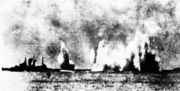
when she received an 8-inch shell hit to a boiler room and was subsequently ordered to Surabaya for repairs. The destroyer HMS Electra
was sunk covering her withdrawal. Two days later, when she attempted to reach the Sunda Strait
, she was intercepted by the Japanese heavy cruisers Nachi
, Haguro
, Myoko
and Ashigara
and the destroyers Akebono
, Inazuma
, Yamakaze
and Kawakaze
on the morning of 1 March 1942. The Second Battle of the Java Sea
ensued, now more appropriately called The Battle of Bawean Island, and Exeter was soon badly damaged by gunfire, one hit causing the loss of all power to the ship. Scuttling charges were set and she soon began sinking, initially listing to port only to be hit to starboard by a torpedo from the destroyer Inazuma which sat her back upright and rolled her to starboard before she finally sank about noon. Her escorting destroyers, HMS Encounter
and USS Pope
were also lost; Pope temporarily escaped the initial melee, only to be sunk by aerial attack a few hours later. About 800 Allied seamen, including the commander of Exeter, Captain Oliver Gordon
, were picked up by the Japanese and became prisoners of war.
The wreck was located and positively identified in February 2007. Exeter lies in Indonesian waters, at a depth of about 200 ft (60 m), 90 miles north of Bawean Island - some 60 miles from the sinking position given by her captain.
York class cruiser
The York class was the second and last class of gunned cruisers built for the Royal Navy under the terms of the Washington Naval Treaty of 1922. They were essentially a reduced version of the preceding County class, scaled down in an effort to extract more, smaller ships from the treaty limits...
heavy cruiser
Heavy cruiser
The heavy cruiser was a type of cruiser, a naval warship designed for long range, high speed and an armament of naval guns roughly 203mm calibre . The heavy cruiser can be seen as a lineage of ship design from 1915 until 1945, although the term 'heavy cruiser' only came into formal use in 1930...
of the Royal Navy
Royal Navy
The Royal Navy is the naval warfare service branch of the British Armed Forces. Founded in the 16th century, it is the oldest service branch and is known as the Senior Service...
that served in World War II
World War II
World War II, or the Second World War , was a global conflict lasting from 1939 to 1945, involving most of the world's nations—including all of the great powers—eventually forming two opposing military alliances: the Allies and the Axis...
. She was laid down on 1 August 1928 at the Devonport
HMNB Devonport
Her Majesty's Naval Base Devonport , is one of three operating bases in the United Kingdom for the Royal Navy . HMNB Devonport is located in Devonport, in the west of the city of Plymouth in Devon, England...
Dockyard, Plymouth
Plymouth
Plymouth is a city and unitary authority area on the coast of Devon, England, about south-west of London. It is built between the mouths of the rivers Plym to the east and Tamar to the west, where they join Plymouth Sound...
, Devon
Devon
Devon is a large county in southwestern England. The county is sometimes referred to as Devonshire, although the term is rarely used inside the county itself as the county has never been officially "shired", it often indicates a traditional or historical context.The county shares borders with...
. She was launched on 18 July 1929 and completed on 27 July 1931. She fought against the German pocket battleship Graf Spee at the 1939 Battle of the River Plate
Battle of the River Plate
The Battle of the River Plate was the first naval battle in the Second World War. The German pocket battleship had been commerce raiding since the start of the war in September 1939...
, suffering extensive damage that caused a long refit. Having been rebuilt, she was sent to the East Indies where she was sunk by the Japanese in 1942.
Design
Exeter was ordered two years after her sister YorkHMS York (90)
HMS York, pennant number 90, was a heavy cruiser of the Royal Navy built in the late 1920s. She mostly served on the North America and West Indies Station before World War II. Early in the war the ship escorted convoys in the Atlantic and participated in the Norwegian Campaign in 1940...
and therefore her design incorporated improvements in the light of experience with the latter. Her beam was increased by 1 feet (30 cm) to cater for increases in topweight, and the boiler uptakes were trunked backwards from the boiler rooms, allowing for straight funnels removed from the bridge rather than the raked funnels necessary in York to ensure adequate dispersal of the flue gasses. As a result, the masts were stepped straight, and the after funnel was thickened, to aid appearance. As the roof of the 8 inches (203 mm) gun turret had proved not to be strong enough to accommodate the catapult intended for York, Exeter had a pair of catapults angled out from amidships, with the associated crane stepped to starboard. Consequently, the bridge could be lowered (that of York being tall to give command over the intended aircraft arrangements), and was of a modern, enclosed design that was incorporated into later cruiser designs.
Modifications
In 1932, Exeter had side plating added amidships to the upper deck to enclose her open main deck as far as the after funnel (unlike the County class, the Yorks were not flush-deckers). This provided additional enclosed spaces for accommodation and working. In 1935, the intended multiple Vickers machine gunVickers machine gun
Not to be confused with the Vickers light machine gunThe Vickers machine gun or Vickers gun is a name primarily used to refer to the water-cooled .303 inch machine gun produced by Vickers Limited, originally for the British Army...
s were finally added, single QF 2-pounder guns
QF 2 pounder naval gun
The 2-pounder gun, officially designated the QF 2-pounder and universally known as the pom-pom, was a 1.575 inch British autocannon, used famously as an anti-aircraft gun by the Royal Navy. The name came from the sound that the original models make when firing...
having been fitted in lieu. Early war modifications/post battle damage repairs (from her engagement with the Graf Spee) and a general refit saw the bridge rebuilt and enlarged, replacement of the single 4 inches (102 mm) guns with modern twin Mark XVI models on the ubiquitous mounting Mark XIX and a single 20 mm Oerlikon gun
Oerlikon 20 mm cannon
The Oerlikon 20 mm cannon is a series of autocannons, based on an original design by Reinhold Becker of Germany, very early in World War I, and widely produced by Oerlikon Contraves and others...
added to the roof of both 'B' and 'Y' turrets. Type 286 air warning radar was added requiring the pole masts to be replaced by heavy tripods, this primitive metric set had separate transmitting (Tx) and receiving (Rx) aerials, one at each masthead. Type 284 radar was fitted to the director control tower atop the bridge to provide ranging information and spot fall of shot. A larger catapult arrangement and cranes were fitted for handling the Walrus
Walrus
The walrus is a large flippered marine mammal with a discontinuous circumpolar distribution in the Arctic Ocean and sub-Arctic seas of the Northern Hemisphere. The walrus is the only living species in the Odobenidae family and Odobenus genus. It is subdivided into three subspecies: the Atlantic...
amphibious aircraft.
Service
On completion, Exeter joined the 2nd Cruiser Squadron with the Atlantic Fleet, where she served between 1931 and 1935. In 1934 she was assigned to the America and West Indies Station and remained there, with a temporary deployment to the Mediterranean during the Abyssinian crisisSecond Italo-Abyssinian War
The Second Italo–Abyssinian War was a colonial war that started in October 1935 and ended in May 1936. The war was fought between the armed forces of the Kingdom of Italy and the armed forces of the Ethiopian Empire...
of 1935 and 1936, until 1939.
At the outbreak of the Second World War, she formed part of the South American Division with Cumberland
HMS Cumberland (57)
HMS Cumberland was a County class heavy cruiser of the Royal Navy that saw action during the Second World War.-Career:Cumberland served on the China Station with the 5th Cruiser Squadron from 1928 until 1938, returning to the UK in March 1935 for a refit...
, under Commodore
Commodore (Royal Navy)
Commodore is a rank of the Royal Navy above Captain and below Rear Admiral. It has a NATO ranking code of OF-6. The rank is equivalent to Brigadier in the British Army and Royal Marines and to Air Commodore in the Royal Air Force.-Insignia:...
Henry Harwood
Henry Harwood
Admiral Sir Henry Harwood Harwood, KCB, OBE , was a British naval officer who won fame in the Battle of the River Plate.-Early life:...
. Together with the Leander class light cruisers
Leander class cruiser (1931)
The Leander class was a class of eight light cruisers built for the Royal Navy in the early 1930s that saw service in World War II. They were named after mythological figures, and all ships were commissioned between 1933 and 1936...
Ajax
HMS Ajax (22)
HMS Ajax was a Leander class light cruiser which served with the British Royal Navy during World War II. She became famous for her part in the Battle of the River Plate, the Battle of Crete, the Battle of Malta and as a supply escort in the Siege of Tobruk. This ship was the eighth in the Royal...
and Achilles
HMNZS Achilles (70)
HMNZS Achilles was a Leander class light cruiser which served with the Royal New Zealand Navy in World War II. She became famous for her part in the Battle of the River Plate, alongside HMS Ajax and HMS Exeter....
she engaged the German pocket battleship Admiral Graf Spee in the Battle of the River Plate
Battle of the River Plate
The Battle of the River Plate was the first naval battle in the Second World War. The German pocket battleship had been commerce raiding since the start of the war in September 1939...
on 13 December 1939, which culminated in the scuttling of the Admiral Graf Spee several days later. Exeter operated as a division on her own, Achilles and Ajax as the other, in order to split the fire of Graf Spee. Exeter was hit by seven 11-inch shells and several near misses caused significant splinter damage. Sixty-one of her crew were killed and another twenty-three wounded. All three 8 inch turrets were put out of action and her speed was reduced to 18 knots (35 km/h), forcing her to withdraw from battle. Exeter made for Port Stanley
Stanley, Falkland Islands
Stanley is the capital and only true cityin the Falkland Islands. It is located on the isle of East Falkland, on a north-facing slope in one of the wettest parts of the islands. At the 2006 census, the city had a population of 2,115...
in the Falkland Islands
Falkland Islands
The Falkland Islands are an archipelago in the South Atlantic Ocean, located about from the coast of mainland South America. The archipelago consists of East Falkland, West Falkland and 776 lesser islands. The capital, Stanley, is on East Falkland...
for emergency repairs which took until January 1940, then returned to Devonport, escorted by the carrier Ark Royal, without assistance for full repairs and a modernisation refit between February 1940 and March 1941. On 10 March, 1941, during the repair and refit period, her commanding officer, Captain W.N.T. Beckett MVO DSC died at Saltash Hospital, from complications resulting from surgery related to injuries received earlier in his career. He died the day Exeter was due to be re-commissioned. His replacement was Captain Oliver Loudon Gordon
Oliver Gordon
Captain Oliver Loudon Gordon MVO RN was in command of the heavy cruiser HMS Exeter from 11 March 1941 until she was sunk in the Second Battle of the Java Sea on 1 March 1942....
.
On returning to the fleet in 1941 she was engaged on escort duty for Atlantic convoys, including the escort of convoy WS-8B to the Middle East
Middle East
The Middle East is a region that encompasses Western Asia and Northern Africa. It is often used as a synonym for Near East, in opposition to Far East...
during the Bismarck
German battleship Bismarck
Bismarck was the first of two s built for the German Kriegsmarine during World War II. Named after Chancellor Otto von Bismarck, the primary force behind the German unification in 1871, the ship was laid down at the Blohm & Voss shipyard in Hamburg in July 1936 and launched nearly three years later...
episode. After this, she went on to the Far East
Far East
The Far East is an English term mostly describing East Asia and Southeast Asia, with South Asia sometimes also included for economic and cultural reasons.The term came into use in European geopolitical discourse in the 19th century,...
.
On the entry of the Empire of Japan
Empire of Japan
The Empire of Japan is the name of the state of Japan that existed from the Meiji Restoration on 3 January 1868 to the enactment of the post-World War II Constitution of...
into the war in December 1941, Exeter formed part of the ABDACOM
American-British-Dutch-Australian Command
The American-British-Dutch-Australian Command, or ABDACOM, was a short-lived, supreme command for all Allied forces in South East Asia, in early 1942, during the Pacific War in World War II...
naval force intended to defend the Dutch East Indies
Dutch East Indies
The Dutch East Indies was a Dutch colony that became modern Indonesia following World War II. It was formed from the nationalised colonies of the Dutch East India Company, which came under the administration of the Netherlands government in 1800....
(Indonesia) from Japanese invasion.
Fate
On 27 February 1942, Exeter was damaged in the Battle of the Java SeaBattle of the Java Sea
The Battle of the Java Sea was a decisive naval battle of the Pacific campaign of World War II, that sealed the fate of the Netherlands East Indies....
when she received an 8-inch shell hit to a boiler room and was subsequently ordered to Surabaya for repairs. The destroyer HMS Electra
HMS Electra (H27)
HMS Electra was a Royal Navy 'E' class destroyer . She was ordered on 1 November 1932 as part of the 1931 Naval Build Programme; launched on 15 February 1934 at the Hawthorn Leslie Shipyard at Hebburn, Tyneside...
was sunk covering her withdrawal. Two days later, when she attempted to reach the Sunda Strait
Sunda Strait
The Sunda Strait is the strait between the Indonesian islands of Java and Sumatra. It connects the Java Sea to the Indian Ocean...
, she was intercepted by the Japanese heavy cruisers Nachi
Japanese cruiser Nachi
was the second of four Myōkō-class heavy cruisers built for the Imperial Japanese Navy — the other ships of the class being , and . She was named after a mountain in Wakayama Prefecture....
, Haguro
Japanese cruiser Haguro
|-External reference links: -External links:**...
, Myoko
Japanese cruiser Myoko
was the name-ship of the four-member of heavy cruisers of the Imperial Japanese Navy — the other ships of the class being the Nachi, Ashigara, and Haguro....
and Ashigara
Japanese cruiser Ashigara
Ashigara was a Myōkō class heavy cruiser of the Imperial Japanese Navy. The other ships of her class were Myōkō , Nachi , and Haguro...
and the destroyers Akebono
Japanese destroyer Akebono
was the eighteenth of twenty-four destroyers, built for the Imperial Japanese Navy following World War I. When introduced into service, these ships were the most powerful destroyers in the world...
, Inazuma
Japanese destroyer Inazuma
was the twenty-fourth destroyers, or the fourth of , built for the Imperial Japanese Navy in the inter-war period. When introduced into service, these ships were the most powerful destroyers in the world...
, Yamakaze
Japanese destroyer Yamakaze
was the eighth of ten s, and the second to be built for the Imperial Japanese Navy under the Circle Two Program .-History:...
and Kawakaze
Japanese destroyer Kawakaze
was the ninth of ten s, and the third to be built for the Imperial Japanese Navy under the Circle Two Program .-History:The Shiratsuyu class destroyers were modified versions of the , and were designed to accompany the Japanese main striking force and to conduct both day and night torpedo attacks...
on the morning of 1 March 1942. The Second Battle of the Java Sea
Second Battle of the Java Sea
The Second Battle of the Java Sea was the last naval action of the Netherlands East Indies campaign, of 1941–1942. It occurred on 1 March 1942, two days after the first Battle of the Java Sea...
ensued, now more appropriately called The Battle of Bawean Island, and Exeter was soon badly damaged by gunfire, one hit causing the loss of all power to the ship. Scuttling charges were set and she soon began sinking, initially listing to port only to be hit to starboard by a torpedo from the destroyer Inazuma which sat her back upright and rolled her to starboard before she finally sank about noon. Her escorting destroyers, HMS Encounter
HMS Encounter (H10)
HMS Encounter was an E-class destroyer of the Royal Navy before and during World War II, serving in home waters and in the Norwegian Campaign, before joining the Mediterranean Fleet and serving on the Malta Convoys, and then in the Eastern Fleet until sunk by Japanese warships in the Second Battle...
and USS Pope
USS Pope (DD-225)
USS Pope was a Clemson-class destroyer in the United States Navy during World War II. She was the first ship named for John Pope....
were also lost; Pope temporarily escaped the initial melee, only to be sunk by aerial attack a few hours later. About 800 Allied seamen, including the commander of Exeter, Captain Oliver Gordon
Oliver Gordon
Captain Oliver Loudon Gordon MVO RN was in command of the heavy cruiser HMS Exeter from 11 March 1941 until she was sunk in the Second Battle of the Java Sea on 1 March 1942....
, were picked up by the Japanese and became prisoners of war.
The wreck was located and positively identified in February 2007. Exeter lies in Indonesian waters, at a depth of about 200 ft (60 m), 90 miles north of Bawean Island - some 60 miles from the sinking position given by her captain.
External links
- HMS Exeter Final Days
- How H.M.S. Exeter Fought Her Last Battle, The War IllustratedThe War IllustratedThe War Illustrated was a British war magazine published in London by William Berry . It was first released on 22 August 1914, eighteen days after the United Kingdom declared war on Germany, and regular issues continued throughout World War I...
, 1 February 1946. - Photos of Exeter