

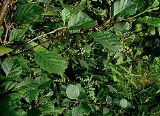
Green Alder

Encyclopedia
Alnus viridis is an alder
with a wide range across the cooler parts of the Northern Hemisphere
.
or small tree
3–12 m tall with smooth grey bark even in old age. The leaves
are shiny green, ovoid, 3–8 cm long and 2–6 cm broad. The flower
s are catkin
s, appearing late in spring after the leaves emerge (unlike other alders which flower before leafing out); the male catkins are pendulous, 4–8 cm long, the female catkins 1 cm long and 0.7 cm broad when mature in late autumn, in clusters of 3–10 on a branched stem. The seed
s are small, 1–2 mm long, light brown with a narrow encircling wing.
, some treated as separate species by some authors:
A. viridis is classed as an environmental weed in New Zealand
.
A. viridis is a light-demanding, fast-growing shrub that grows well on poorer soils. In many areas, it is a highly characteristic colonist of avalanche
chutes in mountain
s, where potentially competing larger trees are killed by regular avalanche damage. A. viridis survives the avalanches through its ability to re-grow from the roots and broken stumps. Unlike some other alders, it does require moist soil, and is a colonist of scree
s and shallow stony slopes. It also commonly grows on subarctic river gravels, particularly in northern Siberia
, Alaska
and Canada
, occupying areas similarly disrupted by ice floes during spring river ice breakup; in this habitat it commonly occurs mixed with shrubby willow
s.
on infertile soils which it enriches by means of its nitrogen-fixing
nodules, while not growing large enough to compete with the intended timber crop. A. sinuata can add 55 lbs of nitrogen per acre per year to the soil.
Alder
Alder is the common name of a genus of flowering plants belonging to the birch family . The genus comprises about 30 species of monoecious trees and shrubs, few reaching large size, distributed throughout the North Temperate Zone and in the Americas along the Andes southwards to...
with a wide range across the cooler parts of the Northern Hemisphere
Northern Hemisphere
The Northern Hemisphere is the half of a planet that is north of its equator—the word hemisphere literally means “half sphere”. It is also that half of the celestial sphere north of the celestial equator...
.
Description
It is a large shrubShrub
A shrub or bush is distinguished from a tree by its multiple stems and shorter height, usually under 5–6 m tall. A large number of plants may become either shrubs or trees, depending on the growing conditions they experience...
or small tree
Tree
A tree is a perennial woody plant. It is most often defined as a woody plant that has many secondary branches supported clear of the ground on a single main stem or trunk with clear apical dominance. A minimum height specification at maturity is cited by some authors, varying from 3 m to...
3–12 m tall with smooth grey bark even in old age. The leaves
Leaf
A leaf is an organ of a vascular plant, as defined in botanical terms, and in particular in plant morphology. Foliage is a mass noun that refers to leaves as a feature of plants....
are shiny green, ovoid, 3–8 cm long and 2–6 cm broad. The flower
Flower
A flower, sometimes known as a bloom or blossom, is the reproductive structure found in flowering plants . The biological function of a flower is to effect reproduction, usually by providing a mechanism for the union of sperm with eggs...
s are catkin
Catkin
A catkin or ament is a slim, cylindrical flower cluster, with inconspicuous or no petals, usually wind-pollinated but sometimes insect pollinated . They contain many, usually unisexual flowers, arranged closely along a central stem which is often drooping...
s, appearing late in spring after the leaves emerge (unlike other alders which flower before leafing out); the male catkins are pendulous, 4–8 cm long, the female catkins 1 cm long and 0.7 cm broad when mature in late autumn, in clusters of 3–10 on a branched stem. The seed
Seed
A seed is a small embryonic plant enclosed in a covering called the seed coat, usually with some stored food. It is the product of the ripened ovule of gymnosperm and angiosperm plants which occurs after fertilization and some growth within the mother plant...
s are small, 1–2 mm long, light brown with a narrow encircling wing.
Distribution
There are four to six subspeciesSubspecies
Subspecies in biological classification, is either a taxonomic rank subordinate to species, ora taxonomic unit in that rank . A subspecies cannot be recognized in isolation: a species will either be recognized as having no subspecies at all or two or more, never just one...
, some treated as separate species by some authors:
- Alnus viridis subsp. viridis. Central EuropeEuropeEurope is, by convention, one of the world's seven continents. Comprising the westernmost peninsula of Eurasia, Europe is generally 'divided' from Asia to its east by the watershed divides of the Ural and Caucasus Mountains, the Ural River, the Caspian and Black Seas, and the waterways connecting...
. - Alnus viridis subsp. suaveolens. CorsicaCorsicaCorsica is an island in the Mediterranean Sea. It is located west of Italy, southeast of the French mainland, and north of the island of Sardinia....
(endemic). - Alnus viridis subsp. fruticosa. Northeast Europe, northern AsiaAsiaAsia is the world's largest and most populous continent, located primarily in the eastern and northern hemispheres. It covers 8.7% of the Earth's total surface area and with approximately 3.879 billion people, it hosts 60% of the world's current human population...
, northwestern North AmericaNorth AmericaNorth America is a continent wholly within the Northern Hemisphere and almost wholly within the Western Hemisphere. It is also considered a northern subcontinent of the Americas...
. - Alnus viridis subsp. maximowiczii (A. maximowiczii). JapanJapanJapan is an island nation in East Asia. Located in the Pacific Ocean, it lies to the east of the Sea of Japan, China, North Korea, South Korea and Russia, stretching from the Sea of Okhotsk in the north to the East China Sea and Taiwan in the south...
. - Alnus viridis subsp. crispa (A. crispa, Mountain Alder). Northeastern North America, GreenlandGreenlandGreenland is an autonomous country within the Kingdom of Denmark, located between the Arctic and Atlantic Oceans, east of the Canadian Arctic Archipelago. Though physiographically a part of the continent of North America, Greenland has been politically and culturally associated with Europe for...
. - Alnus viridis subsp. sinuata (A. sinuata, Sitka Alder or Slide Alder). Western North America, far northeastern Siberia.
A. viridis is classed as an environmental weed in New Zealand
New Zealand
New Zealand is an island country in the south-western Pacific Ocean comprising two main landmasses and numerous smaller islands. The country is situated some east of Australia across the Tasman Sea, and roughly south of the Pacific island nations of New Caledonia, Fiji, and Tonga...
.
Ecology
A. viridis has a shallow root system, and is marked not only by vigorous production of stump suckers, but also by root suckers.A. viridis is a light-demanding, fast-growing shrub that grows well on poorer soils. In many areas, it is a highly characteristic colonist of avalanche
Avalanche
An avalanche is a sudden rapid flow of snow down a slope, occurring when either natural triggers or human activity causes a critical escalating transition from the slow equilibrium evolution of the snow pack. Typically occurring in mountainous terrain, an avalanche can mix air and water with the...
chutes in mountain
Mountain
Image:Himalaya_annotated.jpg|thumb|right|The Himalayan mountain range with Mount Everestrect 58 14 160 49 Chomo Lonzorect 200 28 335 52 Makalurect 378 24 566 45 Mount Everestrect 188 581 920 656 Tibetan Plateaurect 250 406 340 427 Rong River...
s, where potentially competing larger trees are killed by regular avalanche damage. A. viridis survives the avalanches through its ability to re-grow from the roots and broken stumps. Unlike some other alders, it does require moist soil, and is a colonist of scree
Scree
Scree, also called talus, is a term given to an accumulation of broken rock fragments at the base of crags, mountain cliffs, or valley shoulders. Landforms associated with these materials are sometimes called scree slopes or talus piles...
s and shallow stony slopes. It also commonly grows on subarctic river gravels, particularly in northern Siberia
Siberia
Siberia is an extensive region constituting almost all of Northern Asia. Comprising the central and eastern portion of the Russian Federation, it was part of the Soviet Union from its beginning, as its predecessor states, the Tsardom of Russia and the Russian Empire, conquered it during the 16th...
, Alaska
Alaska
Alaska is the largest state in the United States by area. It is situated in the northwest extremity of the North American continent, with Canada to the east, the Arctic Ocean to the north, and the Pacific Ocean to the west and south, with Russia further west across the Bering Strait...
and Canada
Canada
Canada is a North American country consisting of ten provinces and three territories. Located in the northern part of the continent, it extends from the Atlantic Ocean in the east to the Pacific Ocean in the west, and northward into the Arctic Ocean...
, occupying areas similarly disrupted by ice floes during spring river ice breakup; in this habitat it commonly occurs mixed with shrubby willow
Willow
Willows, sallows, and osiers form the genus Salix, around 400 species of deciduous trees and shrubs, found primarily on moist soils in cold and temperate regions of the Northern Hemisphere...
s.
Uses
It is sometimes used for afforestationForestry
Forestry is the interdisciplinary profession embracing the science, art, and craft of creating, managing, using, and conserving forests and associated resources in a sustainable manner to meet desired goals, needs, and values for human benefit. Forestry is practiced in plantations and natural stands...
on infertile soils which it enriches by means of its nitrogen-fixing
Nitrogen fixation
Nitrogen fixation is the natural process, either biological or abiotic, by which nitrogen in the atmosphere is converted into ammonia . This process is essential for life because fixed nitrogen is required to biosynthesize the basic building blocks of life, e.g., nucleotides for DNA and RNA and...
nodules, while not growing large enough to compete with the intended timber crop. A. sinuata can add 55 lbs of nitrogen per acre per year to the soil.