

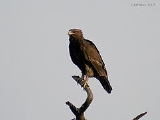
Greater Spotted Eagle

Encyclopedia
The Greater Spotted Eagle (Aquila clanga), occasionally just called the spotted eagle, is a large bird of prey
. Like all typical eagle
s, it belongs to the family Accipitridae
. The typical eagles are often united with the buteo
s (Buteo), sea eagle
s (Haliaetus) and other more heaviset Accipitridae
, but it appears as if they are less distinct from the more slender accipitrine hawks than believed.
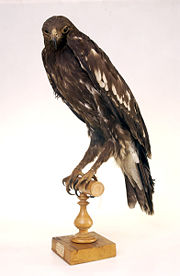 It is 59–71 cm (23.2–28 in) in length and has a wingspan of 157–179 cm (61.8–70.5 in) and a typical body mass of 1.6–2.5 kg (3.5–5.5 lb), with an occasional big female weighing up to 3.2 kg (7.1 lb). This medium-large eagle is very similar in general appearance to its closest relative the Lesser Spotted Eagle
(A. pomarina), which shares part of its range
. Head and wing coverts are very dark brown and contrast with the generally medium brown plumage
; the Lesser Spotted Eagle has a paler head and wing coverts. The head is small for an eagle. The similarities of the Greater Spotted to the Lesser Spotted often results in misidentification as being that species. This is further complicated by occasional hybrids between the two species.
There is often a less obvious white patch on the upperwings, but a light crescent on the primary remiges is a good field mark. The white V mark on the rump is less clear-cut in adults than in the Lesser Spotted Eagle. The juvenile has white spots all over its wings and lacks a lighter nape patch.
The call is a dog-like yip.
In winter, it occurs in the range of the Indian Spotted Eagle
(A. hastata). From this recently-validated relative, it can be distinguished by the darker color and lighter eye (not darker than the body plumage at distance, lighter at close range), and in juveniles, the strong spotting. It is also a bit larger – though this cannot be reliably estimated in the field – and in the winter quarters prefers wetland habitat
.
(A. pomarina) is this species' closest living relative; their common ancestor seems to have diverged around the middle Pliocene
, perhaps some 3.6 million years ago (mya), from the ancestors of the Indian Spotted Eagle
(A. hastata) that lives across Iran, Pakistan
and India. The "proto-Spotted Eagle" probably lived in the general region of Afghanistan
, being split into a northern and a southern lineage when both glaciers and desert
s advanced in Central Asia as the last ice age began. The northern lineage subsequently separated into the eastern (Greater) and western (Lesser) species of today, probably around the Pliocene-Pleistocene
boundary not quite 2 mya.
The spotted eagles as a group are quite distinct from the typical members of Aquila
, the "true eagles". They will probably be included with their putative tropical relatives in Lophaetus or Ictinaetus, or moved to a genus of their own in the near future.
s and similar, mainly terrestrial prey. It breeds from northern Europe
across Asia
, and winter
s in southeastern Europe, the Middle East
and South Asia
. Migration to breeding grounds takes place fairly late; in Bhutan
for example birds can be seen with some regularity until the end of March. This eagle lays 1-3 eggs
in a tree nest
.
Generally territorial, juveniles spend some time with their parents after fledging, until they reach sexual maturity
and seek out a territory and a mate of their own. In winter quarters, the species is more social. Small flocks of up to ten birds or so, of varying age, can be seen to patrol the land together. They also associate with other Accipitridae
in winter quarters, like local and/or migrant Black Kite
s (Milvus migrans lineatus and govinda) or Steppe Eagle
s (A. nipalensis), distinctly smaller and larger raptors, respectively.
This species is prone to vagrancy. Its regular breeding range does not reach to Germany
anymore these days, but still they are not rarely met with in that country, with a few birds seen every decade. Even young birds disperse widely; the Staatliches Museum für Tierkunde Dresden
has a specimen (C 21845) shot in November 1914 at Großgrabe near Bernsdorf in Saxony
. It is a juvenile, and though its exact age cannot be determined it is heavily spotted and probably less than 20 months old.
An adult Greater Spotted was tagged with a satellite transponder in 1993 in order to track migration
. The tagged eagle migrated a total of 5526 kilometres (3,433.7 mi) from its wintering grounds in Yemen
to it breeding grounds in western Siberia
. It moved 150 km (93.2 mi) on average each day, but this increased to 280 km (174 mi) per day as the bird flew through Mesopotamia
.
It is classified as Vulnerable to extinction by the IUCN. As of 2000, the world population of this eagle was estimated at less than 4,000 breeding pairs. The primary threats are habit degradation and habitat loss, as well as human disturbance during the mating season.
Bird of prey
Birds of prey are birds that hunt for food primarily on the wing, using their keen senses, especially vision. They are defined as birds that primarily hunt vertebrates, including other birds. Their talons and beaks tend to be relatively large, powerful and adapted for tearing and/or piercing flesh....
. Like all typical eagle
Eagle
Eagles are members of the bird family Accipitridae, and belong to several genera which are not necessarily closely related to each other. Most of the more than 60 species occur in Eurasia and Africa. Outside this area, just two species can be found in the United States and Canada, nine more in...
s, it belongs to the family Accipitridae
Accipitridae
The Accipitridae, one of the two major families within the order Accipitriformes , are a family of small to large birds with strongly hooked bills and variable morphology based on diet. They feed on a range of prey items from insects to medium-sized mammals, with a number feeding on carrion and a...
. The typical eagles are often united with the buteo
Buteo
Buteo is a genus of medium to fairly large, wide-ranging raptors with a robust body and broad wings. In the Old World, members of this genus are called "buzzards", but "hawk" is used in North America...
s (Buteo), sea eagle
Sea Eagle
Sea eagle mainly refers to Sea eagle, birds of prey of the genus Haliaeetus.It may also refer to:-Aerospace:* Sea Eagle , British, anti-ship missile* Sea Eagle * Supermarine Sea Eagle, 1920s British passenger flying boat-Sports:...
s (Haliaetus) and other more heaviset Accipitridae
Accipitridae
The Accipitridae, one of the two major families within the order Accipitriformes , are a family of small to large birds with strongly hooked bills and variable morphology based on diet. They feed on a range of prey items from insects to medium-sized mammals, with a number feeding on carrion and a...
, but it appears as if they are less distinct from the more slender accipitrine hawks than believed.
Description
Lesser Spotted Eagle
The Lesser Spotted Eagle is a large Eastern European bird of prey. Like all typical eagles, it belongs to the family Accipitridae...
(A. pomarina), which shares part of its range
Range (biology)
In biology, the range or distribution of a species is the geographical area within which that species can be found. Within that range, dispersion is variation in local density.The term is often qualified:...
. Head and wing coverts are very dark brown and contrast with the generally medium brown plumage
Plumage
Plumage refers both to the layer of feathers that cover a bird and the pattern, colour, and arrangement of those feathers. The pattern and colours of plumage vary between species and subspecies and can also vary between different age classes, sexes, and season. Within species there can also be a...
; the Lesser Spotted Eagle has a paler head and wing coverts. The head is small for an eagle. The similarities of the Greater Spotted to the Lesser Spotted often results in misidentification as being that species. This is further complicated by occasional hybrids between the two species.
There is often a less obvious white patch on the upperwings, but a light crescent on the primary remiges is a good field mark. The white V mark on the rump is less clear-cut in adults than in the Lesser Spotted Eagle. The juvenile has white spots all over its wings and lacks a lighter nape patch.
The call is a dog-like yip.
In winter, it occurs in the range of the Indian Spotted Eagle
Indian Spotted Eagle
The Indian Spotted Eagle is a large South Asian bird of prey. Like all typical eagles, it belongs to the family Accipitridae...
(A. hastata). From this recently-validated relative, it can be distinguished by the darker color and lighter eye (not darker than the body plumage at distance, lighter at close range), and in juveniles, the strong spotting. It is also a bit larger – though this cannot be reliably estimated in the field – and in the winter quarters prefers wetland habitat
Habitat
* Habitat , a place where a species lives and grows*Human habitat, a place where humans live, work or play** Space habitat, a space station intended as a permanent settlement...
.
Systematics, taxonomy and evolution
The Lesser Spotted EagleLesser Spotted Eagle
The Lesser Spotted Eagle is a large Eastern European bird of prey. Like all typical eagles, it belongs to the family Accipitridae...
(A. pomarina) is this species' closest living relative; their common ancestor seems to have diverged around the middle Pliocene
Pliocene
The Pliocene Epoch is the period in the geologic timescale that extends from 5.332 million to 2.588 million years before present. It is the second and youngest epoch of the Neogene Period in the Cenozoic Era. The Pliocene follows the Miocene Epoch and is followed by the Pleistocene Epoch...
, perhaps some 3.6 million years ago (mya), from the ancestors of the Indian Spotted Eagle
Indian Spotted Eagle
The Indian Spotted Eagle is a large South Asian bird of prey. Like all typical eagles, it belongs to the family Accipitridae...
(A. hastata) that lives across Iran, Pakistan
Pakistan
Pakistan , officially the Islamic Republic of Pakistan is a sovereign state in South Asia. It has a coastline along the Arabian Sea and the Gulf of Oman in the south and is bordered by Afghanistan and Iran in the west, India in the east and China in the far northeast. In the north, Tajikistan...
and India. The "proto-Spotted Eagle" probably lived in the general region of Afghanistan
Afghanistan
Afghanistan , officially the Islamic Republic of Afghanistan, is a landlocked country located in the centre of Asia, forming South Asia, Central Asia and the Middle East. With a population of about 29 million, it has an area of , making it the 42nd most populous and 41st largest nation in the world...
, being split into a northern and a southern lineage when both glaciers and desert
Desert
A desert is a landscape or region that receives an extremely low amount of precipitation, less than enough to support growth of most plants. Most deserts have an average annual precipitation of less than...
s advanced in Central Asia as the last ice age began. The northern lineage subsequently separated into the eastern (Greater) and western (Lesser) species of today, probably around the Pliocene-Pleistocene
Pleistocene
The Pleistocene is the epoch from 2,588,000 to 11,700 years BP that spans the world's recent period of repeated glaciations. The name pleistocene is derived from the Greek and ....
boundary not quite 2 mya.
The spotted eagles as a group are quite distinct from the typical members of Aquila
Aquila (genus)
Aquila is the genus of true eagles. It is often united with the buteos, sea eagles and other more heavyset Accipitridae, but more recently it appears as if they are less distinct from the more slender accipitrine hawks than believed...
, the "true eagles". They will probably be included with their putative tropical relatives in Lophaetus or Ictinaetus, or moved to a genus of their own in the near future.
Distribution, ecology and status
This is a species of fairly wooded country, which hunts small mammalMammal
Mammals are members of a class of air-breathing vertebrate animals characterised by the possession of endothermy, hair, three middle ear bones, and mammary glands functional in mothers with young...
s and similar, mainly terrestrial prey. It breeds from northern Europe
Europe
Europe is, by convention, one of the world's seven continents. Comprising the westernmost peninsula of Eurasia, Europe is generally 'divided' from Asia to its east by the watershed divides of the Ural and Caucasus Mountains, the Ural River, the Caspian and Black Seas, and the waterways connecting...
across Asia
Asia
Asia is the world's largest and most populous continent, located primarily in the eastern and northern hemispheres. It covers 8.7% of the Earth's total surface area and with approximately 3.879 billion people, it hosts 60% of the world's current human population...
, and winter
Bird migration
Bird migration is the regular seasonal journey undertaken by many species of birds. Bird movements include those made in response to changes in food availability, habitat or weather. Sometimes, journeys are not termed "true migration" because they are irregular or in only one direction...
s in southeastern Europe, the Middle East
Middle East
The Middle East is a region that encompasses Western Asia and Northern Africa. It is often used as a synonym for Near East, in opposition to Far East...
and South Asia
South Asia
South Asia, also known as Southern Asia, is the southern region of the Asian continent, which comprises the sub-Himalayan countries and, for some authorities , also includes the adjoining countries to the west and the east...
. Migration to breeding grounds takes place fairly late; in Bhutan
Bhutan
Bhutan , officially the Kingdom of Bhutan, is a landlocked state in South Asia, located at the eastern end of the Himalayas and bordered to the south, east and west by the Republic of India and to the north by the People's Republic of China...
for example birds can be seen with some regularity until the end of March. This eagle lays 1-3 eggs
Bird egg
Bird eggs are laid by females and incubated for a time that varies according to the species; a single young hatches from each egg. Average clutch sizes range from one to about 17...
in a tree nest
Bird nest
A bird nest is the spot in which a bird lays and incubates its eggs and raises its young. Although the term popularly refers to a specific structure made by the bird itself—such as the grassy cup nest of the American Robin or Eurasian Blackbird, or the elaborately woven hanging nest of the...
.
Generally territorial, juveniles spend some time with their parents after fledging, until they reach sexual maturity
Sexual maturity
Sexual maturity is the age or stage when an organism can reproduce. It is sometimes considered synonymous with adulthood, though the two are distinct...
and seek out a territory and a mate of their own. In winter quarters, the species is more social. Small flocks of up to ten birds or so, of varying age, can be seen to patrol the land together. They also associate with other Accipitridae
Accipitridae
The Accipitridae, one of the two major families within the order Accipitriformes , are a family of small to large birds with strongly hooked bills and variable morphology based on diet. They feed on a range of prey items from insects to medium-sized mammals, with a number feeding on carrion and a...
in winter quarters, like local and/or migrant Black Kite
Black Kite
The Black Kite is a medium-sized bird of prey in the family Accipitridae, which also includes many other diurnal raptors. Unlike others of the group, they are opportunistic hunters and are more likely to scavenge. They spend a lot of time soaring and gliding in thermals in search of food. Their...
s (Milvus migrans lineatus and govinda) or Steppe Eagle
Steppe Eagle
The Steppe Eagle is a bird of prey. It is about in length and has a wingspan of . Females, weighing 2.3–4.9 kg , are slightly larger than males, at 2–3.5 kg . Like all eagles, it belongs to the family Accipitridae...
s (A. nipalensis), distinctly smaller and larger raptors, respectively.
This species is prone to vagrancy. Its regular breeding range does not reach to Germany
Germany
Germany , officially the Federal Republic of Germany , is a federal parliamentary republic in Europe. The country consists of 16 states while the capital and largest city is Berlin. Germany covers an area of 357,021 km2 and has a largely temperate seasonal climate...
anymore these days, but still they are not rarely met with in that country, with a few birds seen every decade. Even young birds disperse widely; the Staatliches Museum für Tierkunde Dresden
Staatliches Museum für Tierkunde Dresden
The State Museum of Zoology in Dresden is a natural history museum that houses 10,000-50,000 specimens, including skeletons and large insect collections. Many are types. The collection suffered war damage and whilst catalogued the database is not computerized. Loans are possible and material can...
has a specimen (C 21845) shot in November 1914 at Großgrabe near Bernsdorf in Saxony
Saxony
The Free State of Saxony is a landlocked state of Germany, contingent with Brandenburg, Saxony Anhalt, Thuringia, Bavaria, the Czech Republic and Poland. It is the tenth-largest German state in area, with of Germany's sixteen states....
. It is a juvenile, and though its exact age cannot be determined it is heavily spotted and probably less than 20 months old.
An adult Greater Spotted was tagged with a satellite transponder in 1993 in order to track migration
Bird migration
Bird migration is the regular seasonal journey undertaken by many species of birds. Bird movements include those made in response to changes in food availability, habitat or weather. Sometimes, journeys are not termed "true migration" because they are irregular or in only one direction...
. The tagged eagle migrated a total of 5526 kilometres (3,433.7 mi) from its wintering grounds in Yemen
Yemen
The Republic of Yemen , commonly known as Yemen , is a country located in the Middle East, occupying the southwestern to southern end of the Arabian Peninsula. It is bordered by Saudi Arabia to the north, the Red Sea to the west, and Oman to the east....
to it breeding grounds in western Siberia
Siberia
Siberia is an extensive region constituting almost all of Northern Asia. Comprising the central and eastern portion of the Russian Federation, it was part of the Soviet Union from its beginning, as its predecessor states, the Tsardom of Russia and the Russian Empire, conquered it during the 16th...
. It moved 150 km (93.2 mi) on average each day, but this increased to 280 km (174 mi) per day as the bird flew through Mesopotamia
Mesopotamia
Mesopotamia is a toponym for the area of the Tigris–Euphrates river system, largely corresponding to modern-day Iraq, northeastern Syria, southeastern Turkey and southwestern Iran.Widely considered to be the cradle of civilization, Bronze Age Mesopotamia included Sumer and the...
.
It is classified as Vulnerable to extinction by the IUCN. As of 2000, the world population of this eagle was estimated at less than 4,000 breeding pairs. The primary threats are habit degradation and habitat loss, as well as human disturbance during the mating season.
Further reading
- Svensson, Lars (1987) Underwing pattern of Steppe, Spotted and Lesser Spotted Eagles, pp. 12-14 in International Bird Identification: Proceeedings of the 4th International Identification Meeting, Eilat, 1st - 8th November 1986 International Birdwatching Centre Eilat
External links
- BirdLife Species Factsheet.
- Aquila_clanga videos on the Internet Bird Collection]
- Oiseaux Photographs, text and map.