

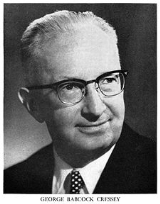
George Cressey

Encyclopedia
George Babcock Cressey was an American geographer
, author, and academic. Born in Tiffin, Ohio
, he attended Denison University
and then the University of Chicago
, where he received a PhD
in geology
. After receiving his degree, he taught at Shanghai college and traveled widely in China
. Upon his return to the United States in 1929, he completed a pioneering book on the country, China's Geographic Foundations.
In 1931, Cressey received a second PhD from Clark University
in geography. He then joined the faculty of Syracuse University
, where he remained for the rest of his professional career. At Syracuse, Cressey wrote on a variety of subjects, but focussed on "population problems as related to the worldwide distribution of land and arable resources," and primarily studied Asia, though he traveled to 75 countries on six continents (all but Australia), over the course of his career. Cressey also served as chair of the department and helped to develop the geography graduate program at Syracuse into one of the best in the country.
In addition to his academic work, Cressey consulted for the US Department of State, the Board of Economic Warfare
, and the Military Intelligence Corps
during World War II
. After the war, he was also an outspoken advocate of better relations with Communist China
and traveled widely in East Asia and the Middle East with a variety of fellowships. Cressey was also highly involved in a number of professional organizations, serving as President of the International Geographical Union
, the Association for Asian Studies
, and the Association of American Geographers
.
, on December 15, 1896. His father, Frank G. Cressey, was a Baptist minister and his mother, Frances Babcock, the first woman to graduate from the University of Chicago
, taught Latin at Denison University
. After high school, Cressey attended Denison University
, graduating in 1919 with a B.S. He then entered the University of Chicago
, where he studied under the noted geologist Rollin D. Salisbury
, receiving a Master's degree
in 1921 and a PhD
in 1923, both in geology
. His dissertation was entitled "A Study of Indiana Sand Dunes."
After receiving his degree, Cressey went to China with the American Baptist Missionary Union
and took a position at Shanghai College in Shanghai, China, teaching both geology and geography. While in China, he met Marion Chatfield, an American missionary, whom he married in 1925. The two went on to have one son and three daughters. Cressey also used his time in China to travel in East Asia, visiting Mongolia
and the Ordos Desert
with particular frequency. His trips were often dangerous and took him far from other Westerners; during one of his trips, in Hebei
, he was beaten and robbed by a group of bandits. His travels in China covered more than 30,000 miles, and formed the basis of a book he began writing, China's Geographic Foundations: A Survey of the Land and its Peoples. Cressey finished the book shortly before leaving China and gave the manuscript to the Commercial Press
in Shanghai to prepare for publication. In 1932, however, the press was bombed by the Japanese and the manuscript was lost in the ensuing fire.
. In 1931, he earned a second PhD, in geography, from Clark University
, writing his dissertation on the Ordos Desert. The same year, Cressey joined the faculty of Syracuse University
as a professor of geography and geology, and soon became chairman of the department. After the Japanese invasion of Manchuria in September 1931, Cressey's travels in Asia made him a sought-after expert and lecturer on China, and he traveled frequently, giving lectures to academic audiences and the general public. Cressey also began to reconstruct his book, China's Geographic Foundations, from his original notes, finishing it in 1934.
In China's Geographic Foundations, Cressey focused on describing the 15 geographic regions of China, but he also devoted chapters to "history, topography, climate, agriculture, and foreign trade." Writing in Political Science Quarterly
, Grover Clark called the book "a clear, comprehensive and yet comprehensible description of the land and the people's relation to it." The book went on to become "the standard work in its field." Although welcomed by the Kuomintang
, the book was "strongly criticized" by the Communist Party of China
because of Cressey's judgment that China lacked the resources to quickly become a great industrial power.
While teaching at Syracuse, Cressey continued his travels, and in 1937, he visited Moscow
, where he was invited to consult on the production of the Great Soviet World Atlas. After his trip to Moscow, Cressey traveled widely in the Soviet Union
, and after returning to the United States he spoke of the great economic potential of the country, despite anti-Soviet sentiment. As a result, he earned "the trust and gratitude of his Soviet colleagues," allowing him access to their knowledge and resources. Cressey also spent the 1930s developing the academic offerings at Syracuse, building "one of the best Master of Arts programs in geography available in the United States."
, Cressey became a consultant to several government bodies, including the US Department of State, the Board of Economic Warfare
, and the Military Intelligence Corps
. Cressey also taught and lectured on Asia, for the Army's training program at Syracuse University, and lectured publicly on East Asia throughout the country. In 1943 and 1944, he served as a special representative in China through the State Department's cultural exchange program. In that capacity, Cressey worked with the National Academy of Sciences
to help establish Chinese universities, and promote better relations with China.
During the war, Cressey also wrote his second book: Asia's Lands and Peoples: A Geography of One-Third the Earth and Two-Thirds its People, published in 1944. The book was aimed at the ordinary American as a general overview of Asia in light of rising American interest in the region due to the war. In the book, Cressey also entered into the debate on how to divide Asia
from Europe
by arguing that Europe was really only one of the six regions of Eurasia
, the other five being the Soviet Union, East Asia, Southeast Asia, India, and Southwest Asia. Cressey also made the controversial argument in the book that "the key to enduring peace in eastern Asia is a strong China." The book was well-received and Dudley Stamp wrote that it had "the sure touch of the man who has been to see for himself."
, International Geographical Union
and the Association for Asian Studies
.
During the 1950s period of McCarthyism
, Cressey's interest in China and his "outspoken comments on the shortcomings of American foreign policy" led to his inclusion on various "lists of scholars suspected of sympathy with the Communists," but the accusations were baseless and Syracuse University continued to fully support him. Ironically, at the same time that Cressey was accused of communist sympathies, the Chinese government included him on its list of its capitalist enemies.
In 1951, Cressey retired as chairman of the geography department at Syracuse and became Maxwell Distinguished Professor of Geography, a newly created position. Over the next ten years, he traveled frequently and published prolifically. He also received several honors. From 1949 to 1952, he served as President of the International Geographical Union
and in 1952 he was elected as a Vice President, a position he held until 1956. That same year, he received the George Davidson Medal
of the American Geographical Society
and in 1958 he received a distinguished service award from the National Council for Geographic Education
. In 1961-1962, he was a Phi Beta Kappa National Visiting Scholar and in 1962-1963 he was served as a Department of State Visiting Professor in Asia. Cressey also served as Honorary President of the Association of American Geographers
in 1957 and President of the Association for Asian Studies
in 1959 and 1960.
In 1955 and 1956, Cressey held a Fulbright Fellowship in Iraq
and in 1957 and 1958 he served as a Smith-Mundt Professor
in Lebanon
. From his research and travel during these fellowships, Cressey wrote the book Crossroads: Land and Life in Southwest Asia, which was published in 1960. In the first section of the book, Cressey dealt with the general geographical features of the Middle East
. The next eight chapters dealt with the specific countries of the region from Egypt
to Afghanistan
, creating a picture of the whole region. Cressey focused in detail on the role of natural resources for the countries of the region, concentrating particular attention on the role of water and water shortages. W.B. Fisher, writing in Geographical Review
, called the book "an authoritative and compelling study," and Leonard Kasdan wrote in the American Anthropologist
that the book was the "most useful single compendium of the aspects covered that exists in the literature to date."
Although he broadened his regional interests in the 1950s, Cressey remained interested in China and his "enduring concern was to restore contact between China and the United States," after the break in their relations following the Communist victory. He also promoted the study of China, hoping to educate a new generation of geographers with knowledge of China and East Asia.
Cressey died of cancer
on October 21, 1963 at his home in Syracuse, New York
.
Geographer
A geographer is a scholar whose area of study is geography, the study of Earth's natural environment and human society.Although geographers are historically known as people who make maps, map making is actually the field of study of cartography, a subset of geography...
, author, and academic. Born in Tiffin, Ohio
Tiffin, Ohio
Tiffin is a city in and the county seat of Seneca County, Ohio, United States. The population was 18,135 at the 2000 census. The National Arbor Day Foundation has designated Tiffin as a Tree City USA....
, he attended Denison University
Denison University
Denison University is private, coeducational, and residential college of liberal arts and sciences founded in 1831. It is located in Granville, Ohio, United States, approximately 30 miles east of Columbus, the state capital...
and then the University of Chicago
University of Chicago
The University of Chicago is a private research university in Chicago, Illinois, USA. It was founded by the American Baptist Education Society with a donation from oil magnate and philanthropist John D. Rockefeller and incorporated in 1890...
, where he received a PhD
PHD
PHD may refer to:*Ph.D., a doctorate of philosophy*Ph.D. , a 1980s British group*PHD finger, a protein sequence*PHD Mountain Software, an outdoor clothing and equipment company*PhD Docbook renderer, an XML renderer...
in geology
Geology
Geology is the science comprising the study of solid Earth, the rocks of which it is composed, and the processes by which it evolves. Geology gives insight into the history of the Earth, as it provides the primary evidence for plate tectonics, the evolutionary history of life, and past climates...
. After receiving his degree, he taught at Shanghai college and traveled widely in China
China
Chinese civilization may refer to:* China for more general discussion of the country.* Chinese culture* Greater China, the transnational community of ethnic Chinese.* History of China* Sinosphere, the area historically affected by Chinese culture...
. Upon his return to the United States in 1929, he completed a pioneering book on the country, China's Geographic Foundations.
In 1931, Cressey received a second PhD from Clark University
Clark University
Clark University is a private research university and liberal arts college in Worcester, Massachusetts.Founded in 1887, it is the oldest educational institution founded as an all-graduate university. Clark now also educates undergraduates...
in geography. He then joined the faculty of Syracuse University
Syracuse University
Syracuse University is a private research university located in Syracuse, New York, United States. Its roots can be traced back to Genesee Wesleyan Seminary, founded by the Methodist Episcopal Church in 1832, which also later founded Genesee College...
, where he remained for the rest of his professional career. At Syracuse, Cressey wrote on a variety of subjects, but focussed on "population problems as related to the worldwide distribution of land and arable resources," and primarily studied Asia, though he traveled to 75 countries on six continents (all but Australia), over the course of his career. Cressey also served as chair of the department and helped to develop the geography graduate program at Syracuse into one of the best in the country.
In addition to his academic work, Cressey consulted for the US Department of State, the Board of Economic Warfare
Board of Economic Warfare
The Office of Administrator of Export Control was established in the United States by Presidential Proclamation 2413, July 2, 1940, to administer export licensing provisions of the act of July 2, 1940 . Brigadier General Russell Lamont Maxwell, United States Army, headed up this military entity...
, and the Military Intelligence Corps
Military Intelligence Corps (United States Army)
In the United States Armed Forces, Military Intelligence refers specifically to the intelligence components of the United States Army...
during World War II
World War II
World War II, or the Second World War , was a global conflict lasting from 1939 to 1945, involving most of the world's nations—including all of the great powers—eventually forming two opposing military alliances: the Allies and the Axis...
. After the war, he was also an outspoken advocate of better relations with Communist China
People's Republic of China
China , officially the People's Republic of China , is the most populous country in the world, with over 1.3 billion citizens. Located in East Asia, the country covers approximately 9.6 million square kilometres...
and traveled widely in East Asia and the Middle East with a variety of fellowships. Cressey was also highly involved in a number of professional organizations, serving as President of the International Geographical Union
International Geographical Union
The International Geographical Union is an international geographical society. The first International Geographical Congress was held in Antwerp in 1871. Subsequent meetings led to the establishment of the permanent organization in Brussels, Belgium, in 1922. The Union has 34 Commissions and four...
, the Association for Asian Studies
Association for Asian Studies
The Association for Asian Studies is a U.S. society focused on facilitating contact and information exchange among scholars of Asian fields. It is the self-proclaimed largest society of its kind. The Association consists of eminent Asianists, and is a non-profit organization...
, and the Association of American Geographers
Association of American Geographers
The Association of American Geographers is a non-profit scientific and educational society founded in 1904 and aimed at advancing the understanding, study, and importance of geography and related fields...
.
Early life
Cressey was born in Tiffin, OhioTiffin, Ohio
Tiffin is a city in and the county seat of Seneca County, Ohio, United States. The population was 18,135 at the 2000 census. The National Arbor Day Foundation has designated Tiffin as a Tree City USA....
, on December 15, 1896. His father, Frank G. Cressey, was a Baptist minister and his mother, Frances Babcock, the first woman to graduate from the University of Chicago
University of Chicago
The University of Chicago is a private research university in Chicago, Illinois, USA. It was founded by the American Baptist Education Society with a donation from oil magnate and philanthropist John D. Rockefeller and incorporated in 1890...
, taught Latin at Denison University
Denison University
Denison University is private, coeducational, and residential college of liberal arts and sciences founded in 1831. It is located in Granville, Ohio, United States, approximately 30 miles east of Columbus, the state capital...
. After high school, Cressey attended Denison University
Denison University
Denison University is private, coeducational, and residential college of liberal arts and sciences founded in 1831. It is located in Granville, Ohio, United States, approximately 30 miles east of Columbus, the state capital...
, graduating in 1919 with a B.S. He then entered the University of Chicago
University of Chicago
The University of Chicago is a private research university in Chicago, Illinois, USA. It was founded by the American Baptist Education Society with a donation from oil magnate and philanthropist John D. Rockefeller and incorporated in 1890...
, where he studied under the noted geologist Rollin D. Salisbury
Rollin D. Salisbury
Rollin Daniel Salisbury was an American geologist and educator.-Biography:Salisbury was born at Spring Prairie, Wisconsin in 1858. He studied at Whitewater State Normal School in Whitewater, Wisconsin, graduating in 1877 after completing the four-year course in just two-and-one-half years...
, receiving a Master's degree
Master's degree
A master's is an academic degree granted to individuals who have undergone study demonstrating a mastery or high-order overview of a specific field of study or area of professional practice...
in 1921 and a PhD
PHD
PHD may refer to:*Ph.D., a doctorate of philosophy*Ph.D. , a 1980s British group*PHD finger, a protein sequence*PHD Mountain Software, an outdoor clothing and equipment company*PhD Docbook renderer, an XML renderer...
in 1923, both in geology
Geology
Geology is the science comprising the study of solid Earth, the rocks of which it is composed, and the processes by which it evolves. Geology gives insight into the history of the Earth, as it provides the primary evidence for plate tectonics, the evolutionary history of life, and past climates...
. His dissertation was entitled "A Study of Indiana Sand Dunes."
After receiving his degree, Cressey went to China with the American Baptist Missionary Union
American Baptist Missionary Union
American Baptist Missionary Union is an international Protestant Christian missionary society founded in 1814 in the United States...
and took a position at Shanghai College in Shanghai, China, teaching both geology and geography. While in China, he met Marion Chatfield, an American missionary, whom he married in 1925. The two went on to have one son and three daughters. Cressey also used his time in China to travel in East Asia, visiting Mongolia
Mongolia
Mongolia is a landlocked country in East and Central Asia. It is bordered by Russia to the north and China to the south, east and west. Although Mongolia does not share a border with Kazakhstan, its western-most point is only from Kazakhstan's eastern tip. Ulan Bator, the capital and largest...
and the Ordos Desert
Ordos Desert
The Ordos Desert is a desert and steppe region lying on a plateau in the south of the Inner Mongolian Autonomous Region of the People's Republic of China . The soil of the Ordos is a mixture of clay and sand and, as a result, is poorly suited for agriculture. It extends over an area of...
with particular frequency. His trips were often dangerous and took him far from other Westerners; during one of his trips, in Hebei
Hebei
' is a province of the People's Republic of China in the North China region. Its one-character abbreviation is "" , named after Ji Province, a Han Dynasty province that included what is now southern Hebei...
, he was beaten and robbed by a group of bandits. His travels in China covered more than 30,000 miles, and formed the basis of a book he began writing, China's Geographic Foundations: A Survey of the Land and its Peoples. Cressey finished the book shortly before leaving China and gave the manuscript to the Commercial Press
Commercial Press
-History:In 1897, 26-year-old Xia Ruifang and three of his friends founded The Commercial Press in Shanghai. The group soon received financial backing and began publishing books. In 1914, Xia attempted to buy out a Japanese company that had invested in the Commercial Press. Four days later he was...
in Shanghai to prepare for publication. In 1932, however, the press was bombed by the Japanese and the manuscript was lost in the ensuing fire.
Second PhD and academic career
In 1929, Cressey left China, returning to the United States for a year of study at Harvard UniversityHarvard University
Harvard University is a private Ivy League university located in Cambridge, Massachusetts, United States, established in 1636 by the Massachusetts legislature. Harvard is the oldest institution of higher learning in the United States and the first corporation chartered in the country...
. In 1931, he earned a second PhD, in geography, from Clark University
Clark University
Clark University is a private research university and liberal arts college in Worcester, Massachusetts.Founded in 1887, it is the oldest educational institution founded as an all-graduate university. Clark now also educates undergraduates...
, writing his dissertation on the Ordos Desert. The same year, Cressey joined the faculty of Syracuse University
Syracuse University
Syracuse University is a private research university located in Syracuse, New York, United States. Its roots can be traced back to Genesee Wesleyan Seminary, founded by the Methodist Episcopal Church in 1832, which also later founded Genesee College...
as a professor of geography and geology, and soon became chairman of the department. After the Japanese invasion of Manchuria in September 1931, Cressey's travels in Asia made him a sought-after expert and lecturer on China, and he traveled frequently, giving lectures to academic audiences and the general public. Cressey also began to reconstruct his book, China's Geographic Foundations, from his original notes, finishing it in 1934.
In China's Geographic Foundations, Cressey focused on describing the 15 geographic regions of China, but he also devoted chapters to "history, topography, climate, agriculture, and foreign trade." Writing in Political Science Quarterly
Political Science Quarterly
Political Science Quarterly is an American scholarly journal covering government, politics and policy, published continuously since 1886 by the Academy of Political Science. It is the oldest political science journal in the United States....
, Grover Clark called the book "a clear, comprehensive and yet comprehensible description of the land and the people's relation to it." The book went on to become "the standard work in its field." Although welcomed by the Kuomintang
Kuomintang
The Kuomintang of China , sometimes romanized as Guomindang via the Pinyin transcription system or GMD for short, and translated as the Chinese Nationalist Party is a founding and ruling political party of the Republic of China . Its guiding ideology is the Three Principles of the People, espoused...
, the book was "strongly criticized" by the Communist Party of China
Communist Party of China
The Communist Party of China , also known as the Chinese Communist Party , is the founding and ruling political party of the People's Republic of China...
because of Cressey's judgment that China lacked the resources to quickly become a great industrial power.
While teaching at Syracuse, Cressey continued his travels, and in 1937, he visited Moscow
Moscow
Moscow is the capital, the most populous city, and the most populous federal subject of Russia. The city is a major political, economic, cultural, scientific, religious, financial, educational, and transportation centre of Russia and the continent...
, where he was invited to consult on the production of the Great Soviet World Atlas. After his trip to Moscow, Cressey traveled widely in the Soviet Union
Soviet Union
The Soviet Union , officially the Union of Soviet Socialist Republics , was a constitutionally socialist state that existed in Eurasia between 1922 and 1991....
, and after returning to the United States he spoke of the great economic potential of the country, despite anti-Soviet sentiment. As a result, he earned "the trust and gratitude of his Soviet colleagues," allowing him access to their knowledge and resources. Cressey also spent the 1930s developing the academic offerings at Syracuse, building "one of the best Master of Arts programs in geography available in the United States."
World War II
After the US entry into World War IIWorld War II
World War II, or the Second World War , was a global conflict lasting from 1939 to 1945, involving most of the world's nations—including all of the great powers—eventually forming two opposing military alliances: the Allies and the Axis...
, Cressey became a consultant to several government bodies, including the US Department of State, the Board of Economic Warfare
Board of Economic Warfare
The Office of Administrator of Export Control was established in the United States by Presidential Proclamation 2413, July 2, 1940, to administer export licensing provisions of the act of July 2, 1940 . Brigadier General Russell Lamont Maxwell, United States Army, headed up this military entity...
, and the Military Intelligence Corps
Military Intelligence Corps (United States Army)
In the United States Armed Forces, Military Intelligence refers specifically to the intelligence components of the United States Army...
. Cressey also taught and lectured on Asia, for the Army's training program at Syracuse University, and lectured publicly on East Asia throughout the country. In 1943 and 1944, he served as a special representative in China through the State Department's cultural exchange program. In that capacity, Cressey worked with the National Academy of Sciences
United States National Academy of Sciences
The National Academy of Sciences is a corporation in the United States whose members serve pro bono as "advisers to the nation on science, engineering, and medicine." As a national academy, new members of the organization are elected annually by current members, based on their distinguished and...
to help establish Chinese universities, and promote better relations with China.
During the war, Cressey also wrote his second book: Asia's Lands and Peoples: A Geography of One-Third the Earth and Two-Thirds its People, published in 1944. The book was aimed at the ordinary American as a general overview of Asia in light of rising American interest in the region due to the war. In the book, Cressey also entered into the debate on how to divide Asia
Asia
Asia is the world's largest and most populous continent, located primarily in the eastern and northern hemispheres. It covers 8.7% of the Earth's total surface area and with approximately 3.879 billion people, it hosts 60% of the world's current human population...
from Europe
Europe
Europe is, by convention, one of the world's seven continents. Comprising the westernmost peninsula of Eurasia, Europe is generally 'divided' from Asia to its east by the watershed divides of the Ural and Caucasus Mountains, the Ural River, the Caspian and Black Seas, and the waterways connecting...
by arguing that Europe was really only one of the six regions of Eurasia
Eurasia
Eurasia is a continent or supercontinent comprising the traditional continents of Europe and Asia ; covering about 52,990,000 km2 or about 10.6% of the Earth's surface located primarily in the eastern and northern hemispheres...
, the other five being the Soviet Union, East Asia, Southeast Asia, India, and Southwest Asia. Cressey also made the controversial argument in the book that "the key to enduring peace in eastern Asia is a strong China." The book was well-received and Dudley Stamp wrote that it had "the sure touch of the man who has been to see for himself."
Post-war career
After the war, Cressey became chair of the newly independent Department of Geography at Syracuse, and worked to make Syracuse a top institution for the study of Asia. He brought Asian scholars and graduate students to Syracuse, and used his department's funds to send maps and books to the geography departments within Asian universities. During the years following the war, he was also active within the Association of American GeographersAssociation of American Geographers
The Association of American Geographers is a non-profit scientific and educational society founded in 1904 and aimed at advancing the understanding, study, and importance of geography and related fields...
, International Geographical Union
International Geographical Union
The International Geographical Union is an international geographical society. The first International Geographical Congress was held in Antwerp in 1871. Subsequent meetings led to the establishment of the permanent organization in Brussels, Belgium, in 1922. The Union has 34 Commissions and four...
and the Association for Asian Studies
Association for Asian Studies
The Association for Asian Studies is a U.S. society focused on facilitating contact and information exchange among scholars of Asian fields. It is the self-proclaimed largest society of its kind. The Association consists of eminent Asianists, and is a non-profit organization...
.
During the 1950s period of McCarthyism
McCarthyism
McCarthyism is the practice of making accusations of disloyalty, subversion, or treason without proper regard for evidence. The term has its origins in the period in the United States known as the Second Red Scare, lasting roughly from the late 1940s to the late 1950s and characterized by...
, Cressey's interest in China and his "outspoken comments on the shortcomings of American foreign policy" led to his inclusion on various "lists of scholars suspected of sympathy with the Communists," but the accusations were baseless and Syracuse University continued to fully support him. Ironically, at the same time that Cressey was accused of communist sympathies, the Chinese government included him on its list of its capitalist enemies.
In 1951, Cressey retired as chairman of the geography department at Syracuse and became Maxwell Distinguished Professor of Geography, a newly created position. Over the next ten years, he traveled frequently and published prolifically. He also received several honors. From 1949 to 1952, he served as President of the International Geographical Union
International Geographical Union
The International Geographical Union is an international geographical society. The first International Geographical Congress was held in Antwerp in 1871. Subsequent meetings led to the establishment of the permanent organization in Brussels, Belgium, in 1922. The Union has 34 Commissions and four...
and in 1952 he was elected as a Vice President, a position he held until 1956. That same year, he received the George Davidson Medal
George Davidson Medal
The George Davidson Medal is awarded by the American Geographical Society for the “exceptional achievement in research for exploration in the Pacific Ocean or the lands bordering therein.” In 1946, the American Geographical Society received a bequest of $5000 from his daughter Ellinor Campbell...
of the American Geographical Society
American Geographical Society
The American Geographical Society is an organization of professional geographers, founded in 1851 in New York City. Most fellows of the society are Americans, but among them have always been a significant number of fellows from around the world...
and in 1958 he received a distinguished service award from the National Council for Geographic Education
National Council for Geographic Education
The National Council for Geographic Education is a non-profit organization whose mission is to enhance the status and quality of geography teaching and learning. The NCGE was chartered in 1915 as the National Council of Geography Teachers, and adopted its current name in 1956...
. In 1961-1962, he was a Phi Beta Kappa National Visiting Scholar and in 1962-1963 he was served as a Department of State Visiting Professor in Asia. Cressey also served as Honorary President of the Association of American Geographers
Association of American Geographers
The Association of American Geographers is a non-profit scientific and educational society founded in 1904 and aimed at advancing the understanding, study, and importance of geography and related fields...
in 1957 and President of the Association for Asian Studies
Association for Asian Studies
The Association for Asian Studies is a U.S. society focused on facilitating contact and information exchange among scholars of Asian fields. It is the self-proclaimed largest society of its kind. The Association consists of eminent Asianists, and is a non-profit organization...
in 1959 and 1960.
In 1955 and 1956, Cressey held a Fulbright Fellowship in Iraq
Iraq
Iraq ; officially the Republic of Iraq is a country in Western Asia spanning most of the northwestern end of the Zagros mountain range, the eastern part of the Syrian Desert and the northern part of the Arabian Desert....
and in 1957 and 1958 he served as a Smith-Mundt Professor
Smith-Mundt Act
The US Information and Educational Exchange Act of 1948 , popularly referred to as the Smith–Mundt Act, specifies the terms in which the United States government can engage global audiences, also known as public diplomacy....
in Lebanon
Lebanon
Lebanon , officially the Republic of LebanonRepublic of Lebanon is the most common term used by Lebanese government agencies. The term Lebanese Republic, a literal translation of the official Arabic and French names that is not used in today's world. Arabic is the most common language spoken among...
. From his research and travel during these fellowships, Cressey wrote the book Crossroads: Land and Life in Southwest Asia, which was published in 1960. In the first section of the book, Cressey dealt with the general geographical features of the Middle East
Middle East
The Middle East is a region that encompasses Western Asia and Northern Africa. It is often used as a synonym for Near East, in opposition to Far East...
. The next eight chapters dealt with the specific countries of the region from Egypt
Egypt
Egypt , officially the Arab Republic of Egypt, Arabic: , is a country mainly in North Africa, with the Sinai Peninsula forming a land bridge in Southwest Asia. Egypt is thus a transcontinental country, and a major power in Africa, the Mediterranean Basin, the Middle East and the Muslim world...
to Afghanistan
Afghanistan
Afghanistan , officially the Islamic Republic of Afghanistan, is a landlocked country located in the centre of Asia, forming South Asia, Central Asia and the Middle East. With a population of about 29 million, it has an area of , making it the 42nd most populous and 41st largest nation in the world...
, creating a picture of the whole region. Cressey focused in detail on the role of natural resources for the countries of the region, concentrating particular attention on the role of water and water shortages. W.B. Fisher, writing in Geographical Review
Geographical Review
The Geographical Review is an academic journal of the American Geographical Society. Currently published quarterly in January, April, July, and October. The periodicals are devoted exclusively to geography and contain original articles on all aspects of the discipline. The "Geographical Record"...
, called the book "an authoritative and compelling study," and Leonard Kasdan wrote in the American Anthropologist
American Anthropologist
American Anthropologist is the flagship journal of the American Anthropological Association . It is known for publishing a wide range of work in anthropology, including articles on cultural, biological and linguistic anthropology and archeology...
that the book was the "most useful single compendium of the aspects covered that exists in the literature to date."
Although he broadened his regional interests in the 1950s, Cressey remained interested in China and his "enduring concern was to restore contact between China and the United States," after the break in their relations following the Communist victory. He also promoted the study of China, hoping to educate a new generation of geographers with knowledge of China and East Asia.
Cressey died of cancer
Cancer
Cancer , known medically as a malignant neoplasm, is a large group of different diseases, all involving unregulated cell growth. In cancer, cells divide and grow uncontrollably, forming malignant tumors, and invade nearby parts of the body. The cancer may also spread to more distant parts of the...
on October 21, 1963 at his home in Syracuse, New York
Syracuse, New York
Syracuse is a city in and the county seat of Onondaga County, New York, United States, the largest U.S. city with the name "Syracuse", and the fifth most populous city in the state. At the 2010 census, the city population was 145,170, and its metropolitan area had a population of 742,603...
.