


Fuel cell vehicle

Encyclopedia

Hydrogen vehicle
A hydrogen vehicle is a vehicle that uses hydrogen as its onboard fuel for motive power. Hydrogen vehicles include hydrogen fueled space rockets, as well as automobiles and other transportation vehicles...
which uses a fuel cell
Fuel cell
A fuel cell is a device that converts the chemical energy from a fuel into electricity through a chemical reaction with oxygen or another oxidizing agent. Hydrogen is the most common fuel, but hydrocarbons such as natural gas and alcohols like methanol are sometimes used...
to produce electricity, powering its on-board electric motor. Fuel cells in vehicles create electricity to power an electric motor
Electric motor
An electric motor converts electrical energy into mechanical energy.Most electric motors operate through the interaction of magnetic fields and current-carrying conductors to generate force...
using hydrogen
Hydrogen
Hydrogen is the chemical element with atomic number 1. It is represented by the symbol H. With an average atomic weight of , hydrogen is the lightest and most abundant chemical element, constituting roughly 75% of the Universe's chemical elemental mass. Stars in the main sequence are mainly...
and oxygen from the air.
Description and purpose of fuel cells in vehicles
All fuel cells are made up of three parts: an electrolyte, an anode and a cathode. In principle, a hydrogen fuel cell functions like a battery, producing electricity, which can run an electric motor. Instead of requiring recharging, however, the fuel cell can be refilled with hydrogen. Different types of fuel cells include Polymer Electrolyte Membrane (PEM) Fuel Cells, Direct Methanol Fuel Cells, Phosphoric Acid Fuel Cells, Molten Carbonate Fuel Cells, Solid Oxide Fuel Cells, and Regenerative Fuel Cells.As of 2009, motor vehicles used most of the petroleum consumed in the U.S. and produced over 60% of the carbon monoxide emissions and about 20% of greenhouse gas emissions in the United States. In contrast, a vehicle fueled with pure hydrogen
Hydrogen vehicle
A hydrogen vehicle is a vehicle that uses hydrogen as its onboard fuel for motive power. Hydrogen vehicles include hydrogen fueled space rockets, as well as automobiles and other transportation vehicles...
emits few pollutants, producing mainly water and heat, although the production of the hydrogen would create pollutants unless the hydrogen used in the fuel cell were produced using only renewable energy.
History
The first modern fuel cellFuel cell
A fuel cell is a device that converts the chemical energy from a fuel into electricity through a chemical reaction with oxygen or another oxidizing agent. Hydrogen is the most common fuel, but hydrocarbons such as natural gas and alcohols like methanol are sometimes used...
vehicle was a modified Allis-Chalmers
Allis-Chalmers
The Allis-Chalmers Manufacturing Co. of West Allis, Wisconsin, is an American company known for its past as a manufacturer with diverse interests, perhaps most famous for their bright Persian Orange farm tractors...
farm tractor, fitted with a 15 kilowatt fuel cell, around 1959. The Cold War Space Race
Space Race
The Space Race was a mid-to-late 20th century competition between the Soviet Union and the United States for supremacy in space exploration. Between 1957 and 1975, Cold War rivalry between the two nations focused on attaining firsts in space exploration, which were seen as necessary for national...
drove further development of fuel cell technology. Project Gemini
Project Gemini
Project Gemini was the second human spaceflight program of NASA, the civilian space agency of the United States government. Project Gemini was conducted between projects Mercury and Apollo, with ten manned flights occurring in 1965 and 1966....
tested fuel cells to provide electrical power during manned space missions. Fuel cell development continued with the Apollo Program. The electrical power systems in the Apollo capsules and lunar modules used alkali fuel cells. In 1966, General Motors
General Motors
General Motors Company , commonly known as GM, formerly incorporated as General Motors Corporation, is an American multinational automotive corporation headquartered in Detroit, Michigan and the world's second-largest automaker in 2010...
developed the first fuel cell road vehicle, the Chevrolet Electrovan. It had a PEM fuel cell, a range of 120 miles and a top speed of 70mph. There were only two seats, as the fuel cell stack and fuel tanks took up the rear portion of the van. Only one was built, as the project was deemed cost-prohibitive. General Electric and others continued working on PEM fuel cells in the 1970s.


Space Shuttle
The Space Shuttle was a manned orbital rocket and spacecraft system operated by NASA on 135 missions from 1981 to 2011. The system combined rocket launch, orbital spacecraft, and re-entry spaceplane with modular add-ons...
. However, the closure of the Apollo Program sent many industry experts to private companies. By the 1990s, automobile manufacturers were interested in fuel cell applications, and demonstration vehicles were readied. In 2001, the first 700 Bar (10000 PSI) hydrogen tanks were demonstrated, reducing the size of the fuel tanks that could be used in vehicles.
In 2003 US President George Bush proposed the Hydrogen Fuel Initiative (HFI), which was later implemented by legislation through the 2005 Energy Policy Act and the 2006 Advanced Energy Initiative. The HFI aimed at further developing hydrogen fuel cells and infrastructure technologies with the goal of producing commercial fuel cell vehicles. By 2008, the U.S. had contributed 1 billion dollars to this project. In May 2009, the Obama Administration announced plans to "cut off funds" for the development of fuel cell vehicles, concluding that other vehicle technologies will lead to quicker reduction in emissions in a shorter time. However, the US Congress reversed the funding cuts in its appropriations bill for 2010. The Department of Energy has proposed to decrease funding for Fuel Cell Vehicle development in its 2012 budget.
Efficiency and cost
Advancements in fuel cell technology have reduced the size, weight and cost of fuel cell electric vehicles. Fuel cell electric vehicles have been produced with "a driving range of more than 250 miles between refueling". They can be refueled in less than 5 minutes. Deployed fuel cell buses have a 40% higher fuel economy than diesel buses. EERE’s Fuel Cell Technologies Program claims that, as of 2011, fuel cells achieved a 42 to 53% fuel cell electric vehicle efficiency at full power, and a durability of over 75,000 miles with less than 10% voltage degradation, double that achieved in 2006.Professor Jeremy P. Meyers, in the Electrochemical Society journal Interface in 2008, wrote, "While fuel cells are efficient relative to combustion engines, they are not as efficient as batteries, due primarily to the inefficiency of the oxygen reduction reaction. ... [T]hey make the most sense for operation disconnected from the grid, or when fuel can be provided continuously. For applications that require frequent and relatively rapid start-ups ... where zero emissions are a requirement, as in enclosed spaces such as warehouses, and where hydrogen is considered an acceptable reactant, a [PEM fuel cell] is becoming an increasingly attractive choice [if exchanging batteries is inconvenient]". The U.S. Department of Energy (DOE) estimated that the cost of a fuel cell for an automobile in 2002 was approximately $275/kw, which translated into each vehicle costing more than 1 million dollars. In 2010, however, the Department of Energy estimated that the cost had fallen 80% and that such fuel cells could be manufactured for $51/kW, assuming high-volume manufacturing cost savings. The practical cost of fuel cells for cars will remain high, however, until production volumes incorporate economies of scale and a well-developed supply chain. Until then, costs are roughly one order of magnitude higher than DOE targets.
In a Well-to-Wheels analysis, the DOE estimated that fuel cell electric vehicles using hydrogen produced from natural gas
Natural gas
Natural gas is a naturally occurring gas mixture consisting primarily of methane, typically with 0–20% higher hydrocarbons . It is found associated with other hydrocarbon fuel, in coal beds, as methane clathrates, and is an important fuel source and a major feedstock for fertilizers.Most natural...
would result in emissions of approximately 55% of the CO2 per mile of internal combustion engine vehicles and have approximately 25% less emissions than hybrid vehicles. Other analyses conclude, however, that numerous challenges remain before fuel cell cars can become competitive with other technologies. They cite the lack of an extensive hydrogen infrastructure
Hydrogen infrastructure
A hydrogen infrastructure is the infrastructure of pipes and stations for distribution and sale of hydrogen fuel.-Hydrogen pipeline transport:Hydrogen pipeline transport is a transportation of hydrogen through a pipe as part of the hydrogen infrastructure...
in the U.S. and stating: "the large amount of energy required to isolate hydrogen from natural compounds (water, natural gas, biomass), package the light gas by compression or liquefaction, transfer the energy carrier to the user, plus the energy lost when it is converted to useful electricity with fuel cells, leaves around 25% for practical use."
Codes and standards
Fuel cell vehicle is a classification in FC Hydrogen codes and standards and fuel cellFuel cell
A fuel cell is a device that converts the chemical energy from a fuel into electricity through a chemical reaction with oxygen or another oxidizing agent. Hydrogen is the most common fuel, but hydrocarbons such as natural gas and alcohols like methanol are sometimes used...
codes and standards other main standards are Stationary fuel cell applications and Portable fuel cell applications
Portable fuel cell applications
Fuel cell applications are stationary fuel cell applications and portable fuel cell plications...
.
Automobiles
There are fuel cell vehicles for all modes of transport. The most prevalent fuel cell vehicles are forklifts and material handling vehicles. Although there are currently no fuel cell cars available for commercial sale, over 20 FCEVs prototypes and demonstration cars have been released since 2009. There are also demonstration models of fuel cell buses. Automobiles such as the Honda FCX Clarity, Toyota FCHV-adv and Mercedes-Benz F-CellMercedes-Benz F-Cell
The F-Cell is a hydrogen fuel cell vehicle developed by Daimler AG. Two different versions are known - the previous version was based on the Mercedes-Benz A-Class, and the new model is based on the Mercedes-Benz B-Class. The first generation F-Cell was introduced in 2002, and had a range of , with...
are all pre-commercial examples of fuel cell electric vehicles. Fuel cell electric vehicles have driven more than 3 million miles, with more than 27,000 refuelings.
Several of the car manufacturers have announced plans to introduce a production model of a fuel cell car in 2015. Toyota has stated that it plans to introduce such a vehicle at a price of around $50,000. Mercedes Benz announced in 2011 that it plans to move up the production of the Mercedes-Benz F-Cell
Mercedes-Benz F-Cell
The F-Cell is a hydrogen fuel cell vehicle developed by Daimler AG. Two different versions are known - the previous version was based on the Mercedes-Benz A-Class, and the new model is based on the Mercedes-Benz B-Class. The first generation F-Cell was introduced in 2002, and had a range of , with...
to 2014.
Some notable releases since 2009 include:
- Hyundai TucsonHyundai TucsonThe Hyundai Tucson , or ix35 in Europe, or Hyundai JM in Japan, is a compact crossover SUV built and marketed by the Hyundai Motor Corporation. In Hyundai's lineup, the Tucson fits below the Santa Fe and Veracruz....
-ix35 FCEV (2010) - BMW 1 seriesBMW 1 SeriesThe BMW 1 Series is an entry level sports car produced by the German automaker BMW since 2004. The 1 Series is unusual in its class as it features rear-wheel drive, 50:50 weight balance, a longitudinally-mounted engine and an advanced aluminum multilink suspension...
-fuel cell hybrid (2010) - Mercedes-BenzMercedes-BenzMercedes-Benz is a German manufacturer of automobiles, buses, coaches, and trucks. Mercedes-Benz is a division of its parent company, Daimler AG...
-F800-(2010) - Mazda 5Hydrogen RE Hybrid (2009)
- Fiat PandaFiat PandaThe Fiat Panda is a city car from the Italian automobile manufacturer Fiat. The first Fiat Panda was introduced in 1980, and was produced until 2003 with only a few changes. It is now sometimes referred to as the "old Panda". The second model, launched in 2003, is sometimes referred to "New Panda"...
-HyTRAN (2009) - Audi Q5Audi Q5The Audi Q5 is a compact crossover SUV which was released by German automaker Audi for the 2009 model year. It is built using the new Audi MLP platform which debuted in the 2007 Audi A5 coupé. The Q5 is the second Audi model in the "Q" range, after the full-size Q7...
-FCEV (2009) - Nissan X-TrailNissan X-TrailThe Nissan X-Trail is a compact crossover SUV produced by the Japanese automaker Nissan since 2001. It was one of Nissan's first crossover SUVs and was released about the same time as several other companies competing car-based compact SUVs including the Ford Escape and its Mazda Tribute sibling,...
-FCV (2009) - Volkswagen CaddyVolkswagen CaddyReleased in 1980, the first Volkswagen Caddy is a coupe utility, and van based on the Volkswagen Group A1 platform, shared with the small family car Volkswagen Golf Mk1.Volkswagen Typ is:*147 = LHD*148 = RHD-Caddy debuts internationally as a Rabbit:...
-Maxi HyMotion (2009) - Mercedes-BenzMercedes-BenzMercedes-Benz is a German manufacturer of automobiles, buses, coaches, and trucks. Mercedes-Benz is a division of its parent company, Daimler AG...
B-ClassMercedes-BenzMercedes-Benz is a German manufacturer of automobiles, buses, coaches, and trucks. Mercedes-Benz is a division of its parent company, Daimler AG...
-F-Cell (2009)
Buses
In total there are over 100 fuel cell busFuel cell bus
A fuel cell bus is a bus that uses a hydrogen fuel cell as its power source for electrically driven wheels, sometimes augmented in a hybrid fashion with batteries or a supercapacitor....
es deployed around the world today. Most buses are produced by UTC Power, Toyota, Ballard, Hydrogenics, and Proton Motor. UTC Buses have already accumulated over 600000 miles of driving. Fuel cell buses have a 30-141% higher fuel economy than diesel buses and natural gas buses. Fuel cell buses have been deployed around the world including in Whistler Canada, San Francisco USA, Hamburg Germany, Shanghai China, London England, São Paulo Brazil as well as several others. The Fuel Cell Bus Club
Fuel Cell Bus Club
The Fuel Cell Bus Club comprises the participants of the projects CUTE, ECTOS and STEP. Their website title says "the first fuel cell bus fleet"....
is a global cooperative effort in trial fuel cell buses. Notable Projects Include:
- 12 Fuel cell buses are being deployed in the Oakland and San Francisco Bay area of California.
- Daimler AG, with thirty-six experimental buses powered by Ballard Power SystemsBallard Power SystemsBallard Power Systems , located in Burnaby, British Columbia -- a suburb of Vancouver -- is a company that designs, develops, and manufactures zero emission proton-exchange-membrane fuel cells. This company has made a bus that uses only hydrogen fuel cells. These fuel cells combine hydrogen and...
fuel cells completed a successful three-year trial, in eleven cities, in January 2007. - A fleet of Thor buses with UTC PowerUnited Technologies CorporationUnited Technologies Corporation is an American multinational conglomerate headquartered in the United Technologies Building in Hartford, Connecticut...
fuel cells was deployed in California, operated by SunLine Transit Agency.
The first Brazil
Brazil
Brazil , officially the Federative Republic of Brazil , is the largest country in South America. It is the world's fifth largest country, both by geographical area and by population with over 192 million people...
ian hydrogen
Hydrogen vehicle
A hydrogen vehicle is a vehicle that uses hydrogen as its onboard fuel for motive power. Hydrogen vehicles include hydrogen fueled space rockets, as well as automobiles and other transportation vehicles...
fuel cell bus prototype in Brazil was deployed in São Paulo
São Paulo
São Paulo is the largest city in Brazil, the largest city in the southern hemisphere and South America, and the world's seventh largest city by population. The metropolis is anchor to the São Paulo metropolitan area, ranked as the second-most populous metropolitan area in the Americas and among...
. The bus was manufactured in Caxias do Sul
Caxias do Sul
Caxias do Sul is a city in Rio Grande do Sul, Southern Brazil, situated in the state's mountainous Serra Gaúcha region. Coordinates: 29°10′0″ S, 51°11′0″ W....
and the hydrogen fuel will be produced in São Bernardo do Campo
São Bernardo do Campo
São Bernardo do Campo is a municipality in the state of São Paulo, in southern Metropolitan São Paulo and São Paulo microregion. The municipality's total area is 408.45 km ² and a population estimated at 1 July 2009, according to the IBGE, was 810,979 inhabitants, which results in a population...
from water through electrolysis
Electrolysis
In chemistry and manufacturing, electrolysis is a method of using a direct electric current to drive an otherwise non-spontaneous chemical reaction...
. The program, called "Ônibus Brasileiro a Hidrogênio" (Brazilian Hydrogen Autobus), includes three additional buses.
Forklifts
Fuel cell powered forklifts are one of the largest sectors of fuel cell applications in the industry. Most fuel cells used for material handling purposes are powered by PEM fuel cells, although some direct methanol fuel forklifts are coming onto the market. Fuel cell fleets are currently being operated by a large number of companies, including Sysco Foods, FedEx Freight, GENCO (at Wegmans, Coca-Cola, Kimberly Clark, Sysco Foods, and Whole Foods), and H-E-B Grocers.Fuel cell powered forklifts provide significant benefits over both petroleum and battery powered forklifts as they produce no local emissions, can work for a full 8 hour shift on a single tank of hydrogen, can be refueled in 3 minutes and have a lifetime of 8–10 years. Fuel cell powered forklifts are often used in refrigerated warehouses as their performance is not degraded by lower temperatures. Many companies do not use petroleum powered forklifts, as these vehicles work indoors where emissions must be controlled and instead are turning towards electric forklifts. Fuel cell forklifts offer green house gas, product lifetime, maintenance cost, refueling and labor cost benefits over battery operated fork lifts.
Motorcycles and bicycles
In 2005 the British firm Intelligent Energy produced the first ever working hydrogen run motorcycleMotorcycle
A motorcycle is a single-track, two-wheeled motor vehicle. Motorcycles vary considerably depending on the task for which they are designed, such as long distance travel, navigating congested urban traffic, cruising, sport and racing, or off-road conditions.Motorcycles are one of the most...
called the ENV
ENV
The ENV is an electric motorcycle prototype powered by an hydrogen fuel cell. It is being developed by Intelligent Energy, a British company.-Specifications:...
(Emission Neutral Vehicle). The motorcycle holds enough fuel to run for four hours, and to travel 100 miles in an urban area, at a top speed of 50 mph (80 km/h). In 2004 Honda
Honda
is a Japanese public multinational corporation primarily known as a manufacturer of automobiles and motorcycles.Honda has been the world's largest motorcycle manufacturer since 1959, as well as the world's largest manufacturer of internal combustion engines measured by volume, producing more than...
developed a fuel-cell motorcycle which utilized the Honda FC Stack. There are other examples of bikes and bicycles with a hydrogen fuel cell engine.
Airplanes
BoeingBoeing
The Boeing Company is an American multinational aerospace and defense corporation, founded in 1916 by William E. Boeing in Seattle, Washington. Boeing has expanded over the years, merging with McDonnell Douglas in 1997. Boeing Corporate headquarters has been in Chicago, Illinois since 2001...
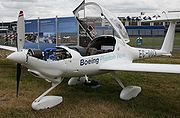
researchers and industry partners throughout Europe conducted experimental flight tests in February 2008 of a manned airplane powered only by a fuel cell and lightweight batteries
Battery (electricity)
An electrical battery is one or more electrochemical cells that convert stored chemical energy into electrical energy. Since the invention of the first battery in 1800 by Alessandro Volta and especially since the technically improved Daniell cell in 1836, batteries have become a common power...
. The Fuel Cell Demonstrator Airplane, as it was called, used a Proton Exchange Membrane (PEM) fuel cell/lithium-ion battery hybrid system to power an electric motor, which was coupled to a conventional propeller.
In 2003, the world's first propeller driven airplane to be powered entirely by a fuel cell was flown. The fuel cell was a unique FlatStackTM stack design which allowed the fuel cell to be integrated with the aerodynamic surfaces of the plane.
There have been several fuel cell powered unmanned aerial vehicles (UAV). A Horizen fuel cell UAV set the record distance flow for a small UAV in 2007. The military is especially interested in this application because of the low noise, low thermal signature and ability to attain high altitude. In 2009 the Naval Research Laboratory’s (NRL’s) Ion Tiger utilized a hydrogen-powered fuel cell and flew for 23 hours and 17 minutes. Boeing is completing tests on the Phantom Eye, a high-altitude, long endurance (HALE) to be used to conduce research and surveillance flying at 65000 ft (19,812 m) for up to four days at a time. Fuel cells are also being used to provide auxiliary power power aircraft, replacing fossil fuel generators that were previously used to start the engines and power on board electrical needs. Fuel cells can help airplanes reduce CO2 and other pollutant emissions and noise.
Boats
The world's first Fuel Cell Boat HYDRAHydra (ship)
The Hydra is a 22 person hydrogen ship, power-assisted by an electric motor that gets its electricity from a fuel cell. The debut was in June 2000 on the Rhine near Bonn, Germany....
used an AFC system with 6.5 kW net output.
For each liter of fuel consumed, the average outboard motor produces 140 times the hydrocarbonss produced by the average modern car. Fuel cell engines have higher energy efficiencies than combustion engines, and therefore offer better range and significantly reduced emissions. Iceland has committed to converting its vast fishing fleet to use fuel cells to provide auxiliary power by 2015 and, eventually, to provide primary power in its boats. Amsterdam recently introduced its first fuel cell powered boat that ferries people around the city's famous and beautiful canals.
Submarines
The only submersible applications of fuel cells are the Type 212 submarineType 212 submarine
The German Type 212 class, also Italian Todaro class, is a highly advanced design of non-nuclear submarine developed by Howaldtswerke-Deutsche Werft AG and Fincantieri S.p.a. for the German and Italian Navy. It features diesel propulsion and an additional air-independent propulsion system using...
s of the German and Italian navies. " Each Type 212 contains nine PEM fuel cells, spread throughout the ship, providing between 30 kW and 50 kW each of electrical power. The fuel cells provide distinct advantages over traditional diesel-electric power systems due to more efficient use of oxygen and quieter operation. This allows the Type 212 to remain submerged longer and makes them more difficult to detect. Fuel cell powered submarines are also easier to design, manufacture, and maintain than nuclear powered submarines.
Criticism
In May 2008, Wired NewsWired News
Wired News is an online technology news website, formerly known as HotWired, that split off from Wired magazine when the magazine was purchased by Condé Nast Publishing in the 1990s. Wired News was owned by Lycos not long after the split, until Condé Nast purchased Wired News on July 11, 2006...
reported that "experts say it will be 40 years or more before hydrogen has any meaningful impact on gasoline consumption or global warming, and we can't afford to wait that long. In the meantime, fuel cells are diverting resources from more immediate solutions." The Los Angeles Times wrote, in February 2009, "Hydrogen fuel-cell technology won't work in cars. ... Any way you look at it, hydrogen is a lousy way to move cars." The Economist
The Economist
The Economist is an English-language weekly news and international affairs publication owned by The Economist Newspaper Ltd. and edited in offices in the City of Westminster, London, England. Continuous publication began under founder James Wilson in September 1843...
magazine, in September 2008, quoted Robert Zubrin
Robert Zubrin
Robert Zubrin is an American aerospace engineer and author, best known for his advocacy of the manned exploration of Mars. He was the driving force behind Mars Direct—a proposal intended to produce significant reductions in the cost and complexity of such a mission...
, the author of Energy Victory
Energy Victory
Energy Victory: Winning the War on Terror by Breaking Free of Oil is a 2007 book by Robert Zubrin. Zubrin's central argument is that the decisive front in the War on Terror is America's struggle for energy independence...
, as saying: "Hydrogen is 'just about the worst possible vehicle fuel'". The magazine noted the withdrawal of California from earlier goals: "In March [2008] the California Air Resources Board
California Air Resources Board
The California Air Resources Board, also known as CARB or ARB, is the "clean air agency" in the government of California. Established in 1967 in the Mulford-Carrell Act, combining the Bureau of Air Sanitation and the Motor Vehicle Pollution Control Board, CARB is a department within the...
, an agency of California's state government and a bellwether for state governments across America, changed its requirement for the number of zero-emission vehicles (ZEVs) to be built and sold in California between 2012 and 2014. The revised mandate allows manufacturers to comply with the rules by building more battery-electric cars instead of fuel-cell vehicles." The magazine also noted that most hydrogen is produced through steam reformation, which creates at least as much emission of carbon per mile as some of today's gasoline cars. On the other hand, if the hydrogen could be produced using renewable energy, "it would surely be easier simply to use this energy to charge the batteries of all-electric or plug-in hybrid vehicles."
The Washington Post
The Washington Post
The Washington Post is Washington, D.C.'s largest newspaper and its oldest still-existing paper, founded in 1877. Located in the capital of the United States, The Post has a particular emphasis on national politics. D.C., Maryland, and Virginia editions are printed for daily circulation...
asked in November 2009, "But why would you want to store energy in the form of hydrogen and then use that hydrogen to produce electricity for a motor, when electrical energy is already waiting to be sucked out of sockets all over America and stored in auto batteries...?" The paper concluded that commercializing hydrogen cars is "stupendously difficult and probably pointless. That's why, for the foreseeable future, the hydrogen car will remain a tailpipe dream". In July 2011, the Chairman and CEO of General Motors
General Motors
General Motors Company , commonly known as GM, formerly incorporated as General Motors Corporation, is an American multinational automotive corporation headquartered in Detroit, Michigan and the world's second-largest automaker in 2010...
, Daniel Akerson
Daniel Akerson
Daniel Francis "Dan" Akerson, is the current Chairman and CEO of General Motors. Akerson succeeded Edward Whitacre as CEO on September 1, 2010, and became Chairman of the Board on January 1, 2011. Akerson was a Managing Director of The Carlyle Group and head of global buyout prior to joining...
, stated that while the cost of hydrogen fuel cell cars is decreasing: "The car is still too expensive and probably won't be practical until the 2020-plus period, I don't know."
In connection with the Department of Energy's efforts to shift funding away from fuel cell vehicle research in 2009, Steven Chu
Steven Chu
Steven Chu is an American physicist and the 12th United States Secretary of Energy. Chu is known for his research at Bell Labs in cooling and trapping of atoms with laser light, which won him the Nobel Prize in Physics in 1997, along with his scientific colleagues Claude Cohen-Tannoudji and...
, the US Secretary of Energy, asserted that hydrogen vehicles "will not be practical over the next 10 to 20 years". Chu told MIT's Technology Review
Technology Review
Technology Review is a magazine published by the Massachusetts Institute of Technology. It was founded in 1899 as "The Technology Review", and was re-launched without the "The" in its name on April 23, 1998 under then publisher R. Bruce Journey...
that he is skeptical about hydrogen's use in transportation because of four problems: "the way we get hydrogen primarily is from reforming [natural] gas. ... You're giving away some of the energy content of natural gas. ... [For] transportation, we don't have a good storage mechanism yet. ... The fuel cells aren't there yet, and the distribution infrastructure isn't there yet. ... In order to get significant deployment, you need four significant technological breakthroughs." The National Hydrogen Association
National Hydrogen Association
From 1989 to 2010, the National Hydrogen Association was a nonprofit organization focused on advancing the development of hydrogen technologies and their utilization in industrial, commercial, and consumer applications and promote the role of hydrogen in the energy field.The NHA was a member-based...
and the U.S. Fuel Cell Council criticized this position.
See also
- Fuel cell busFuel cell busA fuel cell bus is a bus that uses a hydrogen fuel cell as its power source for electrically driven wheels, sometimes augmented in a hybrid fashion with batteries or a supercapacitor....
- Hydrogen vehicleHydrogen vehicleA hydrogen vehicle is a vehicle that uses hydrogen as its onboard fuel for motive power. Hydrogen vehicles include hydrogen fueled space rockets, as well as automobiles and other transportation vehicles...
- Glossary of fuel cell termsGlossary of fuel cell termsThe Glossary of fuel cell terms lists the definitions of many terms used within the fuel cell industry. The terms in this fuel cell glossary may be used by fuel cell industry associations, in education material and fuel cell codes and standards to name but a few. –...
- Proton exchange membrane fuel cellProton exchange membrane fuel cellProton exchange membrane fuel cells, also known as polymer electrolyte membrane fuel cells , are a type of fuel cell being developed for transport applications as well as for stationary fuel cell applications and portable fuel cell applications. Their distinguishing features include lower...
External links
- 2005 - Fueva Europa
- Bossel, Ulf "Does a Hydrogen Economy Make Sense?" Proceedings of the IEEE, Vol. 94, No. 10, October 2006
- Heetebrij, Jan. "A vision on a sustainable electric society supported by Electric Vehicles", Olino Renewable Energy, June 5, 2009
- Ulrich Hottelet: State funding for hybrid dreams, The Asia Pacific Times, October 2009