
All Topics  
Fiat Panda


   Email Print
   Bookmark   Link


Fiat Panda


The Fiat Panda is a city car
City car

A city car is a small, moderately powered automobile intended for use in urban areas.It is comparable in size and features to a neighborhood electric vehicle , has four seats, and is typically long....
 from the Italian
Italy

Italy , officially the Italian Republic , is a country located on the Italian Peninsula in Southern Europe and on the two largest islands in the Mediterranean Sea, Sicily and Sardinia....
 automotive manufacturer Fiat
Fiat

Fiat S.p.A. Fiat based cars are constructed all around the world?the largest concern outside Italy is in Brazil . It also has factories in Argentina and Poland....
. The first Fiat Panda was made from 1980 to 2003 with only few changes, and is now sometimes referred to as the "old Panda". The second model, launched in 2003, is sometimes referred to "new Panda" or "Nuova Panda" (in Italian
Italian language

Italian is a Romance languages spoken by about 63 million people as a first language, primarily in Italy. In Switzerland, Italian is one of four Linguistic geography of Switzerlands....
), and was the European Car of the Year
European Car of the Year

The European Car of the Year award was established in 1964 by a collective of Magazines from different countries in Europe. The current organisers of the award are Auto , Autocar , Autopista , Autovisie , L'Automobile Magazine , Stern and Vi Bil?gare ....
 in 2004.

Original Panda (1980–2003)
Designed by Giorgetto Giugiaro
Giorgetto Giugiaro

Giorgetto Giugiaro is an Italian automobile designer responsible equally for a stable of supercars and several of the most popular everyday vehicles driven today....
, the Panda was designed as a modern day "peasant car": A cheap, basic, no-frills utility vehicle that would be easy to use and maintain.


Discussion
Ask a question about 'Fiat Panda'
Start a new discussion about 'Fiat Panda'
Answer questions from other users
Full Discussion Forum


Encyclopedia


The Fiat Panda is a city car
City car

A city car is a small, moderately powered automobile intended for use in urban areas.It is comparable in size and features to a neighborhood electric vehicle , has four seats, and is typically long....
 from the Italian
Italy

Italy , officially the Italian Republic , is a country located on the Italian Peninsula in Southern Europe and on the two largest islands in the Mediterranean Sea, Sicily and Sardinia....
 automotive manufacturer Fiat
Fiat

Fiat S.p.A. Fiat based cars are constructed all around the world?the largest concern outside Italy is in Brazil . It also has factories in Argentina and Poland....
. The first Fiat Panda was made from 1980 to 2003 with only few changes, and is now sometimes referred to as the "old Panda". The second model, launched in 2003, is sometimes referred to "new Panda" or "Nuova Panda" (in Italian
Italian language

Italian is a Romance languages spoken by about 63 million people as a first language, primarily in Italy. In Switzerland, Italian is one of four Linguistic geography of Switzerlands....
), and was the European Car of the Year
European Car of the Year

The European Car of the Year award was established in 1964 by a collective of Magazines from different countries in Europe. The current organisers of the award are Auto , Autocar , Autopista , Autovisie , L'Automobile Magazine , Stern and Vi Bil?gare ....
 in 2004.

Original Panda (1980–2003)


Designed by Giorgetto Giugiaro
Giorgetto Giugiaro

Giorgetto Giugiaro is an Italian automobile designer responsible equally for a stable of supercars and several of the most popular everyday vehicles driven today....
, the Panda was designed as a modern day "peasant car": A cheap, basic, no-frills utility vehicle that would be easy to use and maintain. The car can be seen as a later approach to the same niche the Citroën 2CV
Citroën 2CV

The Citro?n 2CV is an economy car produced by the France automaker Citro?n from 1949 to 1990. It is considered one of their most cultural icon cars....
 or Renault 4
Renault 4

The Renault 4, also known as the 4L , is a hatchback economy car produced by the France automaker Renault between 1961 and 1994. It was the first front-wheel drive family car produced by Renault....
 were designed to serve. Introduced in 1980, the Panda was noted for its box-like styling, which would become the house style for Fiats throughout the 1980s. Mechanically the first Pandas borrowed heavily from the Fiat parts bin. Engines and transmissions came from the Fiat 127
Fiat 127

The Fiat 127 is a supermini car produced by the Italy automaker Fiat between 1971 and 1983. It was introduced in 1971 as the replacement for the Fiat 850....
 and, in certain territories, the air-cooled 652 cc two-cylinder powerplant from the Fiat 126
Fiat 126

The Fiat 126 was a city car introduced in 1972 as a replacement for the Fiat 500. Most were produced in Poland as the Polski Fiat 126p until 2000....
. The drive for a mechanically simple car was also evident in the rear suspension, which used a dead axle suspended on leaf spring
Leaf spring

Originally called laminated or carriage spring, a leaf spring is a simple form of spring , commonly used for the suspension in wheeled vehicles....
s. Later versions of the car added various mechanical improvements but this spirit of robust simplicity was adhered to throughout the life of the model.

Many design features denote the Panda's "utility car" role. Examples include a 7-position adjustable rear seat which could be folded flat to make a bed, or folded into a V shape to support awkward loads, or easily and quickly removed altogether to increase the overall load space. The first Pandas also featured removable, washable seat covers, door trims and dashboard cover, and all the glass panels were flat making replacements easy and cheap to produce. Much like its earlier French counterparts the Panda could be specified with a full-length roll back canvas roof
Cabrio coach

A cabrio coach or semi-convertible is a type of car that has a retractable textile roof, and derives from Cabriolet . It is an inexpensive alternative to a full convertible, especially on cars with unibody designs since little or no redesign of the body is necessary....
.

The original Panda met with great success across Europe, polling 2nd in the European Car of the Year
Car of the Year

Car of the Year is a phrase usually considered to have been invented by Motor Trend magazine in the 1950s for their annual award for best automobile....
 awards in its first full year of production (pipped to first place by the Mark III Ford Escort) and staying in production in some regions until May 2003.

Mark I Original Panda: 1980-1986

The first Pandas came fitted with either a two cylinder air-cooled 652 cc engine (derived from that in the 126) — the Panda 30; or a four cylinder water cooled engine displacing 903 cc (from the 127) — the Panda 45. Sized to fit between the 126 and 127 in Fiats product line-up, it was designed to be a practical affordable car, mechanically simple and robust. In September 1982 Fiat added more engines to the line-up. The Panda 34 used an 843 cc water-cooled unit derived from that in the 850.

Fiat launched the Panda 45 Super at the Paris Motorshow later in 1982, with models of the old specification continuing as the "Comfort" trim. The Super offered numerous improvements, most significant being the availability of a five speed gearbox as well as improved trim. There were minor styling changes to the Super including the introduction of Fiat's new black plastic "corporate" grille with five diagonal silver bars. The earlier grille design (metal with slots on the left for ventilation) continued on the Comfort models until the next major revision of the line-up. A 30 Super was added to the range in February 1983, offering the Super trim but with the smaller engine.

The Panda 4x4
Four-wheel drive

Four-wheel drive, 4WD, 4x4 , or AWD is a four-wheeled vehicle with a Powertrain that allows all four wheels to receive torque from the engine simultaneously....
 was launched in June 1983, it was powered by a 965 cc engine with derived from that in the Autobianchi A112. Known simply as the Panda 4x4, this model was the first small, transverse-engined production car to have a 4WD system. The system itself was manually selectable, with an ultra-low first gear. Under normal conditions starting was from second, with the fifth having the same ratio as fourth in the normal Panda. Austrian company Steyr-Puch supplied the entire drivetrain (clutch, gearbox, power take-off, three-piece propshaft, rear axle including differential and brakes) to the plant at Termini Imerese where it was fitted to the reinforced bodyshell.

Minor revisions in November 1984 saw the range renamed "L", "CL" and "S". Specifications and detailing were modified across the range including the adoption of the Fiat corporate grille across all versions. Mechanically however the cars remained largely unchanged.

Mark II Original Panda: 1986-2003


In January 1986 the Panda received a series of significant mechanical improvements. The 652 cc air-cooled 2-cyl engine was replaced by a 769 cc (34 bhp) water-cooled 4-cyl unit, and the 903 cc by a 999 cc (45 bhp or in the 4x4) unit. Both new engines were from Fiat's new FIRE
Fully Integrated Robotised Engine

The FIRE is a series of automobile engines from Fiat. It is constructed by robot assembly plants to reduce costs. The FIRE series replaced the old Fiat Overhead valve engine in the mid-1980s....
 family of 4 cylinder water-cooled powerplants with a single overhead camshaft. The rear suspension was also upgraded, the rear leaf springs being replaced by a more modern independent suspension system using a rigid rear axle (known as the 'Omega' axle) with a central mounting and coil springs. The 4x4 retained the old leaf sprung set-up, presumably to avoid having to redesign the entire 4WD system.

Improvements were also made to the interior and the structure. The body was strengthened and fully galvanised on later models, virtually eliminating the earlier car's strong tendency to rust. The rear panel design was also revamped to include flared arches that mirrored those of the front wings, replacing the un-sculpted style seen on earlier models, and the doors received a slight redesign with the earlier car's quarter light windows being removed and replaced by a full width roll-down window. The bottom seam of the Mk II's doors unfortunately retained much the earlier car's susceptibility to rust. The revised range ran in ascending order of specification and cost: 750L, 750CL, 750S, 1000CL, 1000S and 4x4.

April 1986 saw the introduction of a 1301 cc diesel engine with 37 bhp (a detuned 127/Uno unit). Fitted as standard with a five speed gearbox it was only available in the basic "L" trim. A van variant of the Panda was also introduced, with both petrol and diesel engines. The van was basically a standard Panda without rear seats. The rear windows were replaced with plastic blanking panels and a small (always black) plastic extension with side hinged doors was fitted instead of the usual hatchback tailgate. Neither the van nor the diesel were available in right hand drive markets.

In 1987, a new entry level model badged "Panda Young" was added to the range. These were essentially an L spec car with a 769 cc ohv engine based on the old 903 cc push-rod engine and producing the same as the more sophisticated 769 cc FIRE unit. The Panda 4x4 Sisley limited edition was also released, this model was based on standard 4x4 but came with metallic paint, inclinometer, sunroof, white painted wheels, roof rack, headlamp washers, bonnet scoop, "Sisley" badging and trim.

Although originally limited to the production of only 500, in 1989 the Sisley model became a permanent model due to its popularity. The two-seat Panda Elettra, introduced in 1990, adding an all-electric power-train to the line. Batteries replaced the rear seats and occupied some of the engine bay where the DC motor was also fitted, driving through the normal clutch and gearbox. This increased the weight of the car significantly, to , necessitating stiffer suspension and uprated brakes. 1992 revisions to the Ellettra saw the power increased to and the weight reduced, though the Elettra remained significantly heavier than the standard Panda.

In 1991 the Mk II received a facelift (most visibly a new front grille with the smaller five-bar corporate badge) and revisions to trim and specifications across range. New arrivals included the ‘Selecta’, which had a continuously variable transmission
Continuously variable transmission

A continuously variable transmission is a Transmission which can change steplessly through an infinite number of effective gear ratios between maximum and minimum values....
 with an electromagnetic clutch. This advanced transmission was available either with the normal 999 cc FIRE engine (revised with single-point fuel injection and a catalytic converter
Catalytic converter

A catalytic converter is a device used to reduce the toxicity of emissions from an internal combustion engine. First widely introduced on Mass production automobiles in the United States market for the 1975 model year to comply with tightening United States Environmental Protection Agency regulations on auto exhaust, catalytic converters a...
) or an all new 1108 cc FIRE unit, fitted with electronic fuel injection and a three-way catalytic converter and producing . The new CLX trim also featured a five-speed gearbox as standard. The range now comprised the 750 Young (769 cc ohv), 750 and 750 CLX (both 769 cc FIRE sohc), 900 Dance (903 cc ohv), 1000 Shopping, CLX, CL Selecta and S (all with 999 cc sohc, available with or without SPI and catalytic converter depending on the market), 1100 CL Selecta (1108 cc sohc with SPI and cat) and the 4x4 Trekking (999 cc, again available with and without a cat depending on the market). The Elettra finished up the range.

In 1992, the 1108 cc engine, complete with SPI and catalytic converter, replaced the 999 cc unit in the 4x4 (with 50 bhp) and also in 1992 an 899 cc (with injection and catalyst) became available, in the 'Cafe' special edition. This was a reduced capacity 903 cc unit, designed to meet tax requirements in some markets.

End of production to today


From 1996 onwards, the Panda was gradually phased out across Europe
Europe

Europe is, conventionally, one of the world's seven continents. Comprising the westernmost peninsula of Eurasia, Europe is generally divided from Asia to its east by the water divide of the Ural Mountains, the Ural , the Caspian Sea, and by the Caucasus Mountains to the southeast....
, due to tightening emissions and safety legislation. The car remained in production in Italy until May 2003. Its total production run of 23 years makes the Panda one of Europe's longest lived small cars. Most Mark I models have long since succumbed to rust, but the Mark II variant remains a relatively common sight on the roads of continental Europe, and many are even still in daily use in the UK where the model ceased being available new in 1996. While the original Panda never gained the kind of cult following that similar cars such as the 2CV
Citroën 2CV

The Citro?n 2CV is an economy car produced by the France automaker Citro?n from 1949 to 1990. It is considered one of their most cultural icon cars....
 and VW Beetle
Volkswagen Beetle

The Volkswagen Type 1 is an economy car produced by the Germany auto maker Volkswagen from 1938 until 2003. The car was originally known as K?fer, the German language word for "beetle," from which the popular English nickname originates....
 enjoy, it nonetheless engendered strong feelings of attachment among many owners for its robustness, affordability, simplicity and astonishing flexibility.

With the end of production, the 4x4 version of the Panda acquired a high value among used cars: this is mostly because the 4x4 Panda was cheap, sturdy and fit to be used in rural areas, while a 4x4 version of the Nuova Panda was not planned and most of the 4x4 vehicles on the market were expensive SUVs.

The New Panda 4x4 Climbing version was introduced almost two years later, but didn't command the same success, being considered less reliable and too low to be employed in off road duty.

SEAT Panda / Marbella

Fiat Panda 1st Series Pink Vl
Spanish
Spain

Spain or the Kingdom of Spain , is a country located in Southern Europe on the Iberian Peninsula.The Spanish constitution does not establish any official denomination of the country, even though Espa?a , Estado espa?ol and Naci?n espa?ola are used interchangeably....
 car maker SEAT
Seat

Seat can refer to:A place to sit, particularly the area one sits upon , See:* Chair* Car seat* Airline seat* Saddle, a type of seat used on the backs of animals, bicycles , etc....
 also produced a version of the Panda.

Up to 1983, SEAT only made rebadged versions of Fiat cars through a licence agreement between the two firms. Thus, there existed a Spanish version of the Panda called the SEAT Panda, produced from 1980 to 1986.

After Fiat sold their share in SEAT and the licence agreement ended, the whole Fiat-based line of SEAT cars were quickly given minor facelifts, making just enough changes to ensure that Fiat could not take legal action against SEAT for patent infringement
Patent infringement

Patent infringement is the act of utilizing a patented invention without permission from the patent holder. Permission may typically be granted in the form of a licence....
. The SEAT Panda had its bonnet, bumpers and rear tailgate redesigned and from 1987 was known as the SEAT Marbella until the end of production in 1998.

As Fiat and SEAT's licensing agreement had expired in 1986 The Marbella never received the major mechanical upgrades of the 1986 Fiat Panda Mark II, instead continuing with the old pushrod Fiat-based engines, quarter light doors, un-galvanised frame and leaf-sprung suspension from the Fiat Panda Mark I. It was popular in Spain
Spain

Spain or the Kingdom of Spain , is a country located in Southern Europe on the Iberian Peninsula.The Spanish constitution does not establish any official denomination of the country, even though Espa?a , Estado espa?ol and Naci?n espa?ola are used interchangeably....
 throughout its production life, but was less popular on export markets (where the Fiat version was firm favourite) and by 1996 imports had mostly finished.

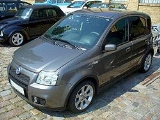
New Panda (2003–present)


Fiat Panda
The new Panda, codenamed Model 169 in its development phase, was originally intended to be called "Gingo". However, this name was considered to be too similar to the Renault Twingo
Renault Twingo

The Renault Twingo is a city car built by France automaker Renault, first presented at Mondial de l'Automobile in September 1992 and sold in left hand drive European markets beginning in 1993....
, so Fiat decided to continue with the Panda name. Successor to the Fiat Seicento
Fiat Seicento

The Fiat Seicento is a city car produced by the Italy company Fiat, introduced in late 1997 as a replacement for the Fiat Cinquecento. The Seicento did not differ much from its predecessor, retaining the same engines, chassis and general dimensions, although it did gain a minor 9 cm in length ....
, the new model also effectively replaced the old Panda after 23 years of production, although the Seicento itself proved still popular and remained in production. Like the Seicento, the Panda is manufactured only in Tychy
Tychy

Tychy ) is a city in southern Poland with a population of 132,600. It is situated in the Silesian Voivodeship ; previously, it was in Katowice Voivodeship ....
, Poland
Poland

Poland , officially the Republic of Poland , is a country in Central Europe. Poland is bordered by Germany to the west; the Czech Republic and Slovakia to the south; Ukraine, Belarus and Lithuania to the east; and the Baltic Sea and Kaliningrad Oblast, a Russian Enclave and exclave, to the north....
 by Fiat Auto Poland. A smaller, 3-door Fiat has been added to the range in 2007, the new 500
Fiat Nuova 500

A new Fiat 500 was announced by Italy automaker Fiat on May 5, 2006. Images of the new Fiat 500 were presented on March 20, 2007, and the car was launched officially on July 4, 2007, with 250,000 in attendance....
.

The high-bodied Panda takes clear styling cues from mini MPV
Mini MPV

Mini MPV is a car classification used to describe supermini car or subcompact which have taller build, fitting below the compact MPV and large MPV classifications....
s and mini SUV
Mini SUV

Mini SUV is a class of small sport utility vehicles with a length under . This class should not be confused with compact SUV, which refers to slightly larger vehicles, from ....
s, with its tail lights in particular reminiscent of much larger cars from the likes of Volvo
Volvo Cars

Volvo Cars, or Volvo Personvagnar AB, is a Swedish automaker founded in 1927 in the city of Gothenburg, Sweden — and currently owned by Ford Motor Company....
. The Panda won the European Car of the Year
European Car of the Year

The European Car of the Year award was established in 1964 by a collective of Magazines from different countries in Europe. The current organisers of the award are Auto , Autocar , Autopista , Autovisie , L'Automobile Magazine , Stern and Vi Bil?gare ....
 award in 2004.

The Panda includes an option for split rear seats, which makes the Panda a four-seater. Since September 2005, all Pandas are equipped with stability control, ABS
Anti-lock braking system

An anti-lock braking system, or ABS is a safety system which prevents the wheels on a motor vehicle from locking while brake.A rotating road wheel allows the driver to maintain steering control under heavy braking by preventing a skid and allowing the wheel to continue interacting Traction with the road surface as directed by driver...
, EBD
Electronic brakeforce distribution

Electronic brakeforce distribution or EBD or EBFD is an automobile brake technology that automatically varies the amount of force applied to each of a vehicle's brakes, based on road conditions, speed, loading, etc....
 and at least two front airbags. The gear-lever is located high on the central dashboard, which is designed to make changing gears more comfortable than with a conventional floor-mounted gearstick.

The financially troubled Fiat needed the new Panda to be a success, and indeed it was, selling half a million units by October 2005. It sells particularly well in Italy (over half of the cars produced are sold in Italy), being seen as closer to a spiritual successor to the Fiat 500
Fiat 500

The Fiat 500 is a automobile produced by the Fiat company of Italy between 1957 and 1975 . It was designed by Dante Giacosa.Launched as the Nuova 500, it was marketed as a cheap and practical town car....
 than a replacement for either the Seicento or the old Panda. The 1,000,000th new Panda was built on September 5, 2007, a red Panda 4x4 Climbing with 1.2-litre petrol engine.

In addition to the retail success, the Top Gear
Top Gear (magazine)

Top Gear is an automobile magazine published by BBC Worldwide, and named after the BBC Top Gear television show. It was first published in October 1993 and is published monthly at a price of ?3.95....
 Motoring Survey in 2006 ranked it 8th out of 152 cars surveyed for reliability, craftsmanship, ownership costs, driving experience and service received. Traditionally, Fiat have ranked at the lower end of this table, showing that the Nuova Panda is reversing the trend and suggesting a rise in quality standards for Fiat.

Official usage

The Panda is produced for police departments (the Polish police
Policja

Policja is the generic name for the police in Poland. The Polish police force was known as policja throughout the Second Polish Republic , and in modern post-communist Republic of Poland since 1990....
 have bought some blue and white Panda Actual models), military agencies (the Italian Army
Italian Army

The Italian Army is the ground defense force of the Military of Italy. On July 29, 2004 it became a professional all-volunteer force of 112,000 active duty personnel....
 uses several dark green Panda Climbing models), and forest services (the Italian forest service has dark green Panda Climbing models).

2005 revisions

In September 2005 several changes were made to the Panda, including standard fitment of ABS
Anti-lock braking system

An anti-lock braking system, or ABS is a safety system which prevents the wheels on a motor vehicle from locking while brake.A rotating road wheel allows the driver to maintain steering control under heavy braking by preventing a skid and allowing the wheel to continue interacting Traction with the road surface as directed by driver...
 and a front passenger's airbag.

2007 revisions

The Panda range received minor updates in 2007, including a new, darker dashboard. The Active model also received new darker seat fabrics of better quality and the addition of a CD player.

Editions

  • The Natural Power is a dual-fuel version, it can burn either gasoline or CNG (Compressed Natural Gas a.k.a methane). Methane results in low emissions and increased fuel economy. The chassis is the same of the 4x4, the space of the rear wheels differential is occupied by two methane tanks allowing over 240 km of autonomy on gas only.
  • The basic Actual has black bumpers, lacks electric windows and a full-size spare wheel. The Actual was introduced in January 2004.
  • The Active, introduced in May 2003, features black self coloured bumpers and front electric windows, central door locking, Radio / Cassette player, driver's airbag, power steering. Manual climate control is available as an option. Since September 2005, ABS and the front passenger's airbag have been made standard. This model has the 1100 cc "FIRE" engine and a five speed gearbox.
  • The Active Plus edition is an up-equipped Active, with a cassette / CD player as standard. Production of the Active Plus stopped in December 2003.
  • The Dynamic edition features ABS
    Anti-lock braking system

    An anti-lock braking system, or ABS is a safety system which prevents the wheels on a motor vehicle from locking while brake.A rotating road wheel allows the driver to maintain steering control under heavy braking by preventing a skid and allowing the wheel to continue interacting Traction with the road surface as directed by driver...
    , dual airbags, roof bars, power steering and a cassette player as standard. A CD & MP3 player, CD changer, alloy wheels, manual or automated climate control, glass sunroof and a semi-automatic transmission are available as options. Since September 2005, four airbag
    Airbag

    An airbag is a Automobile safety device. It is an occupant restraint consisting of a flexible envelope designed to inflate rapidly in an automobile collision, to prevent vehicle occupants from striking hard interior objects such as steering wheels....
    s have been standard in some countries, with an option for two additional side curtain airbags.
  • The Emotion (Eleganza) edition is the highest trim level. This particular trim level features significant enhancements over the Dynamic, with a standard CD player, alloy wheels with low profile tires and automated climate control. In some countries such as the UK, the Emotion is sold as the "Eleganza".


The 100hp edition is a new sporting addition to the Panda family, it uses the 1.4-litre 16-valve FIRE
Fully Integrated Robotised Engine

The FIRE is a series of automobile engines from Fiat. It is constructed by robot assembly plants to reduce costs. The FIRE series replaced the old Fiat Overhead valve engine in the mid-1980s....
 engine from the Fiat Punto
Fiat Punto

The Fiat Punto is a supermini car produced by the Italy manufacturer, Fiat, since 1993. It is currently in its third generation....
 tuned to develop through a six-speed manual transmission. It differs from other Panda by using all disc brakes, now fully ventilated at the front. The Panda features totally a new suspension with modified springs, dampers, bushes and compliance. The Panda is significantly faster than other models, with 0-100 km/h acceleration in 9.5 s, and a maximum speed of , with fuel consumption at 43.4 mpg in the EU combined cycle and 154 g/km of CO2 emissions. It comes in black, white, red, metallic blue and metallic gray while a special sub-version with red disc brakes, silver stripes and wing mirrors is available as optional.

  • The 4x4 Climbing edition, introduced in December 2004, has a higher ride height and larger wheels and tires than other editions. The four-wheel drive
    Four-wheel drive

    Four-wheel drive, 4WD, 4x4 , or AWD is a four-wheeled vehicle with a Powertrain that allows all four wheels to receive torque from the engine simultaneously....
     system also makes this edition slower than others. Features are similar to those found in the Dynamic. The Climbing, however, lacks a differential lock and transmission with reductor. The Climbing edition can be distinguished by a slightly higher suspension, additional black plastic overlays on the bumpers and a "Climbing" badge just below the "Panda" badge on the left side of the rear licence plate. Swedish magazine Vi Bilägare found in a test 2007 that Panda 4x4 is a good and economical choice for a small family who need a car with four wheel drive.
  • The 4x4 Cross edition, similar to the Climbing, features differently shaped front and rear lights and additional side cladding. Unlike the Climbing, the Cross does have a differential lock. The Cross edition became available in January 2006 in Italy
    Italy

    Italy , officially the Italian Republic , is a country located on the Italian Peninsula in Southern Europe and on the two largest islands in the Mediterranean Sea, Sicily and Sardinia....
    , and will be available in September 2006 in Poland
    Poland

    Poland , officially the Republic of Poland , is a country in Central Europe. Poland is bordered by Germany to the west; the Czech Republic and Slovakia to the south; Ukraine, Belarus and Lithuania to the east; and the Baltic Sea and Kaliningrad Oblast, a Russian Enclave and exclave, to the north....
    , over 9 months after its introduction in December 2005.


The Actual and Active are also bases for the Actual Van and Active Van, which can be used as small vans (they also have an additional safety net behind the front seats and removable rear seats). These versions can be identified by small "Van" label on the back door.

During the time, many limited editions of Panda (Active and Dynamic editions only) were produced. Each of them had additional interior fittings, differentiating them from the base model.

Prototypes & Special Editions


  • Fiat Panda Alessi
Italian Design house Alessi created a special edition featuring a two-tone paint scheme and unique trim inside and out. Fiat gave away some of the Alessi’s products (coffee machine and tin-can openers) for the special model's debut at the Ideal Home Show in the UK. It is only manufactured in Left hand drive although sold as such in Right hand drive territories.

  • Fiat Panda Jolly


The Fiat Panda Jolly is a unique vehicle created by Fiat Styling Center and Stola and inspired by boat design. It served as a special shuttle bus in Capri during the summer of 2006. The interior features innovative materials and exclusive trims.

Defined by Fiat as "a car with a fresh, light and Mediterranean look both in the colors and materials", the Panda Jolly is inspired by the interior design and yacht design worlds, and features styling elements that remind of the spirit and way of life of the 1960s.

The concept mainly came from the 600 Multipla Jolly, a car created by Carrozzeria Ghia in 1956, which could be found on the streets of Capri 50 years ago.

The interiors are created by Paola Lenti, an Italian leading company in the Interior Design sector, specialized in the research and development of innovative fabrics and materials.

All the seats are upholstered in the exclusive sailing-inspired Rope fabric.

This special material is nonallergic, nontoxic, antibacterial and resistant to UV rays.

Many structural elements like the floor, sills and various trims are made with pickled natural ash finish with white ash inlays.

  • Fiat Panda Terramare 4


Panda Terramare’s creator is Milan born Maurizio Zanisi, an independent former Iso Rivolta
Iso Rivolta

The motor company Iso Rivolta was initially named Isothermos and used to manufacture refrigeration units. The company was originally founded in Genoa in 1939 by Renzo Rivolta, an engineer....
 engineer, and his self-built amphibian is based on a Panda 4x4 chassis, but with an inflatable flotation belt, and waterjet propulsion driven off the rear axle.

On Friday 21 July 2006 the Terramare crossed the English Channel
English Channel

The English Channel is an Arm of the Atlantic Ocean that separates England from northern France, and joins the North Sea to the Atlantic. It is about long and varies in width from at its widest, to only in the Strait of Dover....
 from Folkestone
Folkestone

Folkestone is the principal town in the Shepway District of Kent, England. Its original site lay in a stream valley in the cliffs here; and its subsequent development was through fishing and its proximity to the Europe as a landing place and trading port....
 in Kent
Kent

Kent is a Counties of England in southeast England, and is one of the home counties. It borders East Sussex, Surrey and Greater London and has a defined boundary with Essex in the middle of the River Thames estuary....
 to Cap Gris Nez
Cap Gris Nez

Cap Gris Nez is a Headlands and bays on the C?te d'Opale in the Pas-de-Calais d?partement in France in northern France.It is between Wissant and Audresselles , in the commune of Audinghen ....
 in just over 6 hours.

  • Fiat Panda Luxury


At the ‘Luxury & Yachts’ show in February 2006, Fiat exhibited a one-off car based on the 4x4 called the ‘Luxury’. The outside of the car features dipped silver paintwork, precious metal trim and gleaming jewel-like mouldings with back-lit inset crystals.

The interior features dipped silver appointments, precious metal details, Jewel Alcantara upholstery and leather with mother of pearl finish. The Fiat logo is also worked on the seats with stylish studs and crystals.

  • Fiat Panda Hydrogen
The Panda Hydrogen, a car prototype driven by a hydrogen Fuel Cell, was a joint venture between Fiat Auto, the Fiat Research Centre and Fiat Powertrain Research & Technology with the support of the Research and Environment Ministries.

On the Panda Hydrogen, the Fuel Cell System is housed beneath the floorpan. The fuel cells are made up of several cells connected in series. Inside, the hydrogen and oxygen molecules are forced to react with the aid of a catalyst to produce water and heat. Electrical energy is generated with very high efficiency and zero emissions from the vehicle itself.

At full power, the Fuel Cell engine on the Panda Hydrogen delivers that allows the car to reach a top speed of more than , with acceleration from 0 to in 5 seconds. The car can also easily climb a gradient of 23% at take-off.

2006 will see the beginning of the demonstration stage of small Panda Hydrogen fleets, as a forerunner to wide-ranging demonstration programmes promoted and supported by the European Union and by the Italian Ministries and Regions. The ultimate aim is for such vehicles to be marketed within 15 – 20 years.

  • Fiat Panda Tanker


Unveiled at the Bologna Motor Show in Italy, the Panda Tanker features only three doors. And although the overall shape has remained unchanged, the two rear doors have been replaced by solid panels to free up some extra load space in the practical cabin. Rugged extras and underbody protection also help to set the Tanker apart from the standard Panda 4x4 model. Designed in conjunction with Italian extreme sport clothing manufacturer Dainese, the show star is equipped with sports seats incorporating a rigid titanium fibre shell.

Reflecting the matt paint finish of the exterior, the cabin has a back-to-basics feel. With no rear seats, the load floor offers flexible attachments for fixing sports kit, while an aluminium structure is designed to carry mountain bikes.

  • Fiat Panda MultiEco


The Panda MultiEco show-car made its world debut in Geneva 2006. Fiat sees this unit as the future of cars with a low environmental impact: the concept car represents the most advanced frontier achievable in terms of emissions and consumption, combining technologies that already exist or are ready for production..

The show-car combines an innovative ‘powertrain' architecture – an engine with dual petrol/methane fuel supply, MTA transmission and BAS device – with the use of eco-compatible materials (recycled, recyclable or of natural origin) for the exterior and interior. The result is made even more interesting by the painstaking optimisation of the aerodynamics and a significant weight reduction.

Panda MultiEco is equipped with a dual-fuel (methane and petrol) FIRE engine – future developments will also make it possible to use a methane/hydrogen mix – combined with a BAS (Belt-driven Alternator-Starter) device and a Dualogic robotised gearbox.

  • Fiat PanDAKAR


Two factory-built Fiat Panda 4x4s were prepared to contest the gruelling Dakar 2007 rally raid, which started in Lisbon.

Entered in the T2 category, the class which most closely represents production vehicles, the two Panda 4x4s, driven by Miki Biasion and former Dakar winner, Bruno Saby
Bruno Saby

Bruno Saby is a Rallying from France.In 1981, Saby became French Rally Champion in a Renault 5 Turbo. He drove for the works teams of Renault, Peugeot, Volkswagen and Lancia during his career in the World Rally Championship....
, respectively, are powered by Fiat Auto’s 1.3 litre MultiJet turbodiesel combined with a six-speed manual gearbox. The engines deliver at 4500 rpm and a peak torque of . at 2500 rpm. Apart from their small dimensions, the two cars are particularly noteworthy for their automatic all-wheel drive system with viscous coupling and locking differential, a system that provides more grip and traction on rough and soft terrain thanks to the optimal split of drive to the wheels.

The two Pandas competing in Dakar 2007 have been equipped specifically for this rally: so room has been found inside for accessories like aluminium platforms to help extricate the vehicles from soft sand, shovels, spare wheels, water reserves for the crew, and other specialised equipment useful for the occasion. The Fiat expedition to Dakar included a Fiat Sedici as service back-up, and three Iveco trucks to transport spares and technicians.

Both PanDAKAR retired on the fourth stage of the event.

  • Fiat Panda Simba


The Simba was unveiled at the Bologna Motor Show in 2002 purely as a concept car to give an idea how the following years production Panda would look.

Some of the rugged styling cues made it on the production ‘Cross’ model

  • Fiat Panda Aria
Fiat presented Aria concept in Frankfurt Motor Show 2007. The Aria is equipped with new environment-friendly technology and outputs only 69 g/km CO2. With 900 cc turbocharged straight-2 engine it produces , its also capable of using both petrol and CNG. This new engine is equipped with Fiat's Multiair technology, which uses electrohydraulic valve activation system. In monofuel (petrol) version the engine is capable of producing . The car is also equipped with Stop&Start function, which helps to reduce consumption by 10% in urban driving.

Engines

The smallest engine, the 1.1 L petrol SOHC FIRE
Fully Integrated Robotised Engine

The FIRE is a series of automobile engines from Fiat. It is constructed by robot assembly plants to reduce costs. The FIRE series replaced the old Fiat Overhead valve engine in the mid-1980s....
 engine, which is rated at and found in the Fiat Seicento
Fiat Seicento

The Fiat Seicento is a city car produced by the Italy company Fiat, introduced in late 1997 as a replacement for the Fiat Cinquecento. The Seicento did not differ much from its predecessor, retaining the same engines, chassis and general dimensions, although it did gain a minor 9 cm in length ....
, has been criticised for being underpowered for the Panda, which weighs over , and the acceleration in particular was considered to be very slow. This engine is a construction from the early 80's. However, the engine reportedly gains flexibility and power with use and is, of course, well proven. The 1,2 litre (actually 1242 cc), engine is a derivative of the 1,1 litre and gives quite adequate performance of the Panda. The higher torque is a more important advantage than higher maximum power on this engine compared to the smaller 1,1 litre.

The 1.3-litre MultiJet diesel engine is rated at and of torque; it is the most economical of all available engines. However, this engine is detuned from the Punto
Fiat Punto

The Fiat Punto is a supermini car produced by the Italy manufacturer, Fiat, since 1993. It is currently in its third generation....
 (where it develops of torque) due to the Panda's weaker transmission. Pandas with diesel engines can be easily distinguished by a "MultiJet" badge on the right side of the rear licence plate.

Introduced into the range in 2006 was the 1368 cc FIRE
Fully Integrated Robotised Engine

The FIRE is a series of automobile engines from Fiat. It is constructed by robot assembly plants to reduce costs. The FIRE series replaced the old Fiat Overhead valve engine in the mid-1980s....
 engine which had previously seen service in the Mk2B Punto Sporting (contrary to some press reports, it is not an adapted version of the 1.4 16v Starjet engine used in the Grande Punto). This FIRE
Fully Integrated Robotised Engine

The FIRE is a series of automobile engines from Fiat. It is constructed by robot assembly plants to reduce costs. The FIRE series replaced the old Fiat Overhead valve engine in the mid-1980s....
 engine has four cylinders in-line with sixteen valves actuated by belt driven double overhead camshafts. The engine is undersquare with bore and stroke of 72 mm and 84 mm respectively, running at a compression ratio of 10.8:1. Ignition is by Fiat's Jet Thrust Stochiometric system with sequential multi-point fuel injection.

Top speeds

  • 150 km/h (93 mph) with 1.1 L petrol engine
  • 155 km/h (96 mph) with 1.2 L petrol engine
  • 160 km/h (99 mph) with 1.3 L diesel engine (lower-tuned 70PS model)
  • 165 km/h (103 mph) with 1.3 L diesel engine (standard/higher-tuned 75PS model)
  • 184 km/h (115 mph) with 1.4 L petrol engine


External links

  • (for selected western European countries)
  • (for United Kingdom)
    • sub-page on
    • sub-page on
    • sub-page on
  • (in Dutch)
  • (in French)
  • (in Greece)
  • (in German)
  • (in German)
  • (in English with links for other European languages)
  • (in Portuguese)