

Freising manuscripts

Encyclopedia
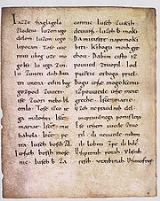
The Freising Manuscripts (also Freising Folia, Freising Fragments, or Freising Monuments; Slovene Brižinski spomeniki, Latin
Monumenta Frisingensia) are the first Latin-script
continuous text in a Slavic language
and the oldest document in Slovene.
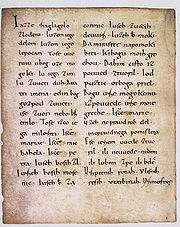 The monuments consisting of three texts in the oldest Slovene dialect were discovered bound into a Latin codex
(manuscript book) in Freising
, Bavaria
. The Slovene name Brižinski spomeniki (literally 'Brižinj Monuments') was coined by the Carinthian Slovene
philologist Anton Janežič
, who Slovenized the German name Freising to Brižinj in 1854. In 1803 the manuscript came to the Bavarian State Library
in Munich
and the Freising Manuscripts were discovered there in 1807.
Four parchment
leaves and a further quarter of a page have been preserved. Linguistic, stylistic and contextual analyses reveal that these are church texts of careful composition and literary form.
The precise date of the origin of the Freising Manuscripts cannot be exactly determined; the original text was probably written in the 9th century. In this liturgic
and homiletic
manuscript, three Slovene records were found and this miscellany was probably an episcopal manual (pontificals). The Freising Manuscripts in it were created between 972 and 1039, most likely before 1000. The main support for this dating is the writing, which was used in the centuries after Charlemagne
and is named Carolingian minuscule
.
During the time of the writing of the two manuscripts (sermons on sin and repentance, a confessional form), Bishop Abraham was active (from 957 to 994) in Freising. It is believed that the manuscripts were written in the Möll River Valley in Carinthia. For this reason some linguists (e.g. Jernej Kopitar
and Rajko Nahtigal) linked Abraham closely to the origin of the Freising Manuscripts and, without any firm evidence, attributed to him the authorship of one of the texts and suspected that he was of Slovene origin. The texts were translated into modern Slovene in 1854 by the philologist Anton Janežič.
The manuscripts are still kept at the Bavarian State Library in Munich and have left it only twice. In the 1970s they were exhibited in Vatican City
and in May and June 2004 they were exhibited at the National and University Library
in Ljubljana
.
Before the Second World War a facsimile
of the Freising Manuscripts was published by Silvester Škerl at Akademska založba in Ljubljana.
Latin
Latin is an Italic language originally spoken in Latium and Ancient Rome. It, along with most European languages, is a descendant of the ancient Proto-Indo-European language. Although it is considered a dead language, a number of scholars and members of the Christian clergy speak it fluently, and...
Monumenta Frisingensia) are the first Latin-script
Latin alphabet
The Latin alphabet, also called the Roman alphabet, is the most recognized alphabet used in the world today. It evolved from a western variety of the Greek alphabet called the Cumaean alphabet, which was adopted and modified by the Etruscans who ruled early Rome...
continuous text in a Slavic language
Slavic languages
The Slavic languages , a group of closely related languages of the Slavic peoples and a subgroup of Indo-European languages, have speakers in most of Eastern Europe, in much of the Balkans, in parts of Central Europe, and in the northern part of Asia.-Branches:Scholars traditionally divide Slavic...
and the oldest document in Slovene.
Codex
A codex is a book in the format used for modern books, with multiple quires or gatherings typically bound together and given a cover.Developed by the Romans from wooden writing tablets, its gradual replacement...
(manuscript book) in Freising
Freising
Freising is a town in Bavaria, Germany, and capital of the district Freising. Total population 48,500.The city is located north of Munich at the Isar river, near the Munich International Airport...
, Bavaria
Bavaria
Bavaria, formally the Free State of Bavaria is a state of Germany, located in the southeast of Germany. With an area of , it is the largest state by area, forming almost 20% of the total land area of Germany...
. The Slovene name Brižinski spomeniki (literally 'Brižinj Monuments') was coined by the Carinthian Slovene
Carinthian Slovenes
Carinthian Slovenes are the Slovene-speaking population group in the Austrian State of Carinthia. The Carinthian Slovenes send representatives to the National Ethnic Groups Advisory Council...
philologist Anton Janežič
Anton Janežic
Anton Janežič, also known in German as Anton Janeschitz was a Carinthian Slovene linguist, philologist, author, editor, literary historian and critic.- Life :...
, who Slovenized the German name Freising to Brižinj in 1854. In 1803 the manuscript came to the Bavarian State Library
Bavarian State Library
The Bavarian State Library in Munich is the central "Landesbibliothek", i. e. the state library of the Free State of Bavaria and one of Europe's most important universal libraries. With its collections currently comprising around 9.39 million books, it ranks among the best research libraries...
in Munich
Munich
Munich The city's motto is "" . Before 2006, it was "Weltstadt mit Herz" . Its native name, , is derived from the Old High German Munichen, meaning "by the monks' place". The city's name derives from the monks of the Benedictine order who founded the city; hence the monk depicted on the city's coat...
and the Freising Manuscripts were discovered there in 1807.
Four parchment
Parchment
Parchment is a thin material made from calfskin, sheepskin or goatskin, often split. Its most common use was as a material for writing on, for documents, notes, or the pages of a book, codex or manuscript. It is distinct from leather in that parchment is limed but not tanned; therefore, it is very...
leaves and a further quarter of a page have been preserved. Linguistic, stylistic and contextual analyses reveal that these are church texts of careful composition and literary form.
The precise date of the origin of the Freising Manuscripts cannot be exactly determined; the original text was probably written in the 9th century. In this liturgic
Liturgy
Liturgy is either the customary public worship done by a specific religious group, according to its particular traditions or a more precise term that distinguishes between those religious groups who believe their ritual requires the "people" to do the "work" of responding to the priest, and those...
and homiletic
Homily
A homily is a commentary that follows a reading of scripture. In Catholic, Anglican, Lutheran, and Eastern Orthodox Churches, a homily is usually given during Mass at the end of the Liturgy of the Word...
manuscript, three Slovene records were found and this miscellany was probably an episcopal manual (pontificals). The Freising Manuscripts in it were created between 972 and 1039, most likely before 1000. The main support for this dating is the writing, which was used in the centuries after Charlemagne
Charlemagne
Charlemagne was King of the Franks from 768 and Emperor of the Romans from 800 to his death in 814. He expanded the Frankish kingdom into an empire that incorporated much of Western and Central Europe. During his reign, he conquered Italy and was crowned by Pope Leo III on 25 December 800...
and is named Carolingian minuscule
Carolingian minuscule
Carolingian or Caroline minuscule is a script developed as a writing standard in Europe so that the Roman alphabet could be easily recognized by the literate class from one region to another. It was used in Charlemagne's empire between approximately 800 and 1200...
.
During the time of the writing of the two manuscripts (sermons on sin and repentance, a confessional form), Bishop Abraham was active (from 957 to 994) in Freising. It is believed that the manuscripts were written in the Möll River Valley in Carinthia. For this reason some linguists (e.g. Jernej Kopitar
Jernej Kopitar
Jernej Bartol Kopitar was a Slovene linguist and philologist working in Vienna. He also worked as the Imperial censor for Slovene literature in Vienna...
and Rajko Nahtigal) linked Abraham closely to the origin of the Freising Manuscripts and, without any firm evidence, attributed to him the authorship of one of the texts and suspected that he was of Slovene origin. The texts were translated into modern Slovene in 1854 by the philologist Anton Janežič.
The manuscripts are still kept at the Bavarian State Library in Munich and have left it only twice. In the 1970s they were exhibited in Vatican City
Vatican City
Vatican City , or Vatican City State, in Italian officially Stato della Città del Vaticano , which translates literally as State of the City of the Vatican, is a landlocked sovereign city-state whose territory consists of a walled enclave within the city of Rome, Italy. It has an area of...
and in May and June 2004 they were exhibited at the National and University Library
National and University Library of Slovenia
The National and University Library is one of the most important national educational and cultural institutions of Slovenia. It was established in 1774 by a decree released by the Empress Maria Theresa. It is located in the centre of Ljubljana, in a building designed by the architect Jože Plečnik...
in Ljubljana
Ljubljana
Ljubljana is the capital of Slovenia and its largest city. It is the centre of the City Municipality of Ljubljana. It is located in the centre of the country in the Ljubljana Basin, and is a mid-sized city of some 270,000 inhabitants...
.
Before the Second World War a facsimile
Facsimile
A facsimile is a copy or reproduction of an old book, manuscript, map, art print, or other item of historical value that is as true to the original source as possible. It differs from other forms of reproduction by attempting to replicate the source as accurately as possible in terms of scale,...
of the Freising Manuscripts was published by Silvester Škerl at Akademska založba in Ljubljana.
Sources
- Brižinski spomeniki - Monumenta Frisingensia. Elektronska znanstvenokritična izdaja, ZRC SAZU, Ljubljana 2007 (includes facsimiles, several transcriptions, audio recordings, parallel views, translations, English and German summary, glossary, bibliography, etc.)
- Brižinski spomeniki - Monumenta Frisingensia (Znanstvenokritična izdaja), ZRC SAZU, Inštitut za slovensko literaturo in literarne vede 2004
- A. V. Isačenko, Jazyk a pôvod frizinských pamiatok (The language and origin of the Freising manuscripts), Bratislava 1943
- http://kodeks.uni-bamberg.de/AltSloven/Quellen/ASL.Freising.htm
External links
- Freising Manuscripts (Brižinski spomeniki) - Scholarly Digital Editions of Slovenian Literature
- English translation
- Digital Version of the original manuscript (Bavarian State Library)
- An electronic text edition - F. Kortlandt, The Freising Manuscripts. Accessed on 6 March 2006.