


Free speech fights

Encyclopedia
Free speech fights are conflicts over the right to speak freely, particularly involving the Industrial Workers of the World
(the "IWW", or "Wobblies'") efforts in the early twentieth century to organize workers and publicly speak about labor issues. Wobblies, Single Taxers, and other radicals of the time were actively engaged in organizing workers and others, and their efforts were often opposed, and sometimes met with violent repression by local government and business authorities. The most notorious of these conflicts was the "San Diego Free Speech Fight
", which brought the IWW to the greater notice of the American public and was notable for the intensity of violence by anti-labor vigilantes directed at the IWW; this violence included the kidnapping and tarring and feathering
of Ben Reitman
, who was a physician, and was Emma Goldman
's lover.
More generally, a free speech fight is any incident in which a group is involved in a conflict over its speech. For instance, the Free Speech Movement
, which began with a conflict on the Berkeley Campus
in California
in the 1960s, was a "free speech fight".
, which in the United States is guaranteed by the First Amendment
, to enable them to communicate the concept of One Big Union to other workers. In communities where the authorities saw their interests in avoiding the development of unions, the practice of soapbox
ing was frequently restricted by ordinance or by police harassment. The IWW employed a variety of creative tactics, including the tactic of flooding the area of a free speech fight with footloose rebels who would challenge the authorities by flouting the ordinance, intentionally getting arrested in great numbers. With the jails full and a seemingly endless stream of union activists arriving by boxcar and highway, the local communities frequently rescinded their prohibitions on free speech, or came to some other accommodation.
The "job sharks" were so closely tied to the crew boss on many job sites that there would be "one gang coming, one gang working and one gang going." The faster the turnover, the greater the fees that could be generated. From time to time the men would ignore the IWW and seek revenge after an employment shark took someone's last dollar for a job that didn't exist. The Spokesman-Review of January 18, 1909 reported,
For the rest of the summer, IWW street meetings brought more and more working stiffs
into the IWW.
The newspaper of the IWW, the Industrial Worker
, published the following on October 28: "Wanted—Men to Fill the Jails of Spokane." Then the IWW sent out a notice to all locations, "Nov. 2, FREE SPEECH DAY—IWW locals will be notified by wire how many men to send if any... Meetings will be orderly and no irregularities of any kind will be tolerated."
The Spokane City Council arranged for rock-pile work for the prisoners.
Overflowing prisoners were lodged in the Franklin School [then located along Front Street (now Trent)], and the War Department made Fort Wright available for more. Eight editors in succession got out a copy of the Industrial Worker, and then took their turn soapboxing, and went to jail. The IWW's "rebel girl," Elizabeth Gurley Flynn
, who was fresh out of high school, delayed her arrest by chaining herself to a lamppost. She later charged that the police were using the women's section of the jail as a brothel, with police soliciting customers. When that story was printed in the Industrial Worker on December 10, the police attempted to destroy all copies. Public sympathy began to favor the strikers. When the prison guards would march the overflowing prisoners through the streets to bathing facilities, crowds would shower the men with apples, oranges, and Bull Durham
.
The victory for the free speech fight came on March 4. The licenses of 19 of the employment agencies were revoked.
In Labor's Untold Story, Boyer and Morais observed,
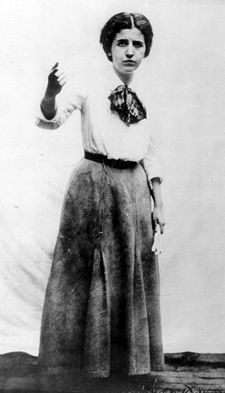 The IWW members won a free speech fight in Missoula when, on October 8, 1909, the city council decided to let the union members speak anywhere in the community, so long as they did not impede traffic.
Elizabeth Gurley Flynn
was "a striking auburn-haired 19-year-old" when she arrived in Missoula with her husband, Jack Jones in September of 1909. At Higgins Avenue and West Front Street, the Wobblies set up a soapbox. On September 22, Frank Little arrived to assist. Little and Jones were arrested on September 29. A young logger and a civil engineer then spoke, and were likewise arrested. Flynn put out the word, declaring, "we need volunteers to go to jail." Wobblies poured in from the surrounding territory, flooding the jail. They sang IWW songs, and shouted Wobbly slogans.
According to Flynn, who also was arrested, the jail was "a filthy, dirty hole under the firehouse stable, where all the filthy excrement of the place pours down upon the prisoners." Yet enough Wobblies submitted themselves to arrest—frequently just before dinner time—that the city was feeling the impact of the Wobbly tactic. After a night in jail, Wobblies were often offered their freedom before breakfast, but many refused to be released, instead demanding a jury trial.
The Western Montana Apple Show was set to open, and Missoula officials decided to "wave a white flag." The IWW had won the Missoula free speech fight, and all charges were dropped.
On February 7, 2011, the National Park Service
officially recognized Free Speech Corner at Higgens Avenue and West Front Street, adding it to the National Register of Historic Places
to commemorate the Missoula free speech fight.
; in Aberdeen, Washington
; and in Fresno, California
. In San Diego, California
, there was a particularly brutal free speech fight
between the IWW and its allies, and large groups of vigilantes supported by the authorities. Tar and feathers
, beatings, clubbings, and forcible deportations were used in addition to incarceration. The San Diego free speech fight was unique in that the IWW did not have a specific organizing campaign at stake. The IWW won all of these free speech fights.
In early 1913, IWW members in Denver, Colorado
fought a lengthy free speech fight. Denver authorities had refused to allow the Wobblies to speak on street corners, so union members filled the jails for months. The union won the right to speak to workers, and within a year had formed two Denver branches.
Other locations of free speech fights by the IWW included Duluth, Minnesota
; Portland, Oregon
; New Castle, Pennsylvania
, and New Bedford, Massachusetts
.
Walsh recruited volunteers to put together a small band, equipped with "a big booming bass drum," in order to get the IWW's message to listeners. The group practiced patriotic and religious tunes of the period, but the Wobblies wrote new words to the songs.
Industrial Workers of the World
The Industrial Workers of the World is an international union. At its peak in 1923, the organization claimed some 100,000 members in good standing, and could marshal the support of perhaps 300,000 workers. Its membership declined dramatically after a 1924 split brought on by internal conflict...
(the "IWW", or "Wobblies'") efforts in the early twentieth century to organize workers and publicly speak about labor issues. Wobblies, Single Taxers, and other radicals of the time were actively engaged in organizing workers and others, and their efforts were often opposed, and sometimes met with violent repression by local government and business authorities. The most notorious of these conflicts was the "San Diego Free Speech Fight
San Diego Free Speech Fight
The San Diego Free Speech Fight in San Diego, California in 1912–1913 was one of the most famous of the "free speech fights", class conflicts over the free speech rights of labor unions.-Introduction:...
", which brought the IWW to the greater notice of the American public and was notable for the intensity of violence by anti-labor vigilantes directed at the IWW; this violence included the kidnapping and tarring and feathering
Tarring and feathering
Tarring and feathering is a physical punishment, used to enforce unofficial justice or revenge. It was used in feudal Europe and its colonies in the early modern period, as well as the early American frontier, mostly as a type of mob vengeance .-Description:In a typical tar-and-feathers attack, the...
of Ben Reitman
Ben Reitman
Ben Lewis Reitman was an American anarchist and physician to the poor . He is best remembered today as radical Emma Goldman's lover.Reitman was a flamboyant, eccentric character...
, who was a physician, and was Emma Goldman
Emma Goldman
Emma Goldman was an anarchist known for her political activism, writing and speeches. She played a pivotal role in the development of anarchist political philosophy in North America and Europe in the first half of the twentieth century....
's lover.
More generally, a free speech fight is any incident in which a group is involved in a conflict over its speech. For instance, the Free Speech Movement
Free Speech Movement
The Free Speech Movement was a student protest which took place during the 1964–1965 academic year on the campus of the University of California, Berkeley under the informal leadership of students Mario Savio, Brian Turner, Bettina Aptheker, Steve Weissman, Art Goldberg, Jackie Goldberg, and...
, which began with a conflict on the Berkeley Campus
University of California, Berkeley
The University of California, Berkeley , is a teaching and research university established in 1868 and located in Berkeley, California, USA...
in California
California
California is a state located on the West Coast of the United States. It is by far the most populous U.S. state, and the third-largest by land area...
in the 1960s, was a "free speech fight".
"Free speech fights" and the IWW
The IWW engaged in free speech fights during the period from approximately 1907 to 1916. The Wobblies, as the IWW members were called, relied upon free speechFreedom of speech
Freedom of speech is the freedom to speak freely without censorship. The term freedom of expression is sometimes used synonymously, but includes any act of seeking, receiving and imparting information or ideas, regardless of the medium used...
, which in the United States is guaranteed by the First Amendment
First Amendment to the United States Constitution
The First Amendment to the United States Constitution is part of the Bill of Rights. The amendment prohibits the making of any law respecting an establishment of religion, impeding the free exercise of religion, abridging the freedom of speech, infringing on the freedom of the press, interfering...
, to enable them to communicate the concept of One Big Union to other workers. In communities where the authorities saw their interests in avoiding the development of unions, the practice of soapbox
Soapbox
A soapbox is a raised platform on which one stands to make an impromptu speech, often about a political subject. The term originates from the days when speakers would elevate themselves by standing on a wooden crate originally used for shipment of soap or other dry goods from a manufacturer to a...
ing was frequently restricted by ordinance or by police harassment. The IWW employed a variety of creative tactics, including the tactic of flooding the area of a free speech fight with footloose rebels who would challenge the authorities by flouting the ordinance, intentionally getting arrested in great numbers. With the jails full and a seemingly endless stream of union activists arriving by boxcar and highway, the local communities frequently rescinded their prohibitions on free speech, or came to some other accommodation.
Spokane
In A History of American Labor, Joseph G. Rayback has written,
[The Industrial Workers of the World] made its first impression upon the nation through its involvement in the "free speech" fight begun in Spokane, WashingtonSpokane, WashingtonSpokane is a city located in the Northwestern United States in the state of Washington. It is the largest city of Spokane County of which it is also the county seat, and the metropolitan center of the Inland Northwest region...
, employment center for the casual labor elements of the Pacific Northwest. The fight developed late in 1908 when the I.W.W. launched an extensive speaking campaign with the slogan "Don't Buy Jobs" in the streets around the Spokane employment agencies which had become skilled in the art of swindling men who applied for jobs.
The "job sharks" were so closely tied to the crew boss on many job sites that there would be "one gang coming, one gang working and one gang going." The faster the turnover, the greater the fees that could be generated. From time to time the men would ignore the IWW and seek revenge after an employment shark took someone's last dollar for a job that didn't exist. The Spokesman-Review of January 18, 1909 reported,
Hurling rocks and chunks of ice through the windows of the Red Cross Employment Agency, 224 Stevens St., several members of a noisy mob of between 2,000 and 3,000 idle men were about to attempt to wreck the place about 6 o'clock last evening, when James H. WalshJames H. WalshJames H. Walsh was an American labor organizer and a prominent Wobbly.-Biography:James Walsh was the leader of the overalls brigade, a group of Wobblies who referred to themselves as "red blooded working stiffs." They rode the rails from Portland to the IWW convention in Chicago in 1908...
, organizer of the IWW, mounted a chair and pacified the multitude. In the opinion of the police had it not been for the intervention of Walsh, a riot would surely have followed, as the rabble was worked up to such a pitch that its members would have readily attempted violence. Walsh discouraged violence and summoned all members of the IWW to their hall at the rear of 312 Front Ave. The police dispersed the rest... At the hall Walsh warned the crowd against an outbreak. "There were a lot of hired PinkertonsPinkerton National Detective AgencyThe Pinkerton National Detective Agency, usually shortened to the Pinkertons, is a private U.S. security guard and detective agency established by Allan Pinkerton in 1850. Pinkerton became famous when he claimed to have foiled a plot to assassinate president-elect Abraham Lincoln, who later hired...
in that crowd," he said. "All they wanted you fellows to do was to start something and then they would have an excuse for shooting you down or smashing your heads in... You can gain nothing by resorting to mob rule."
For the rest of the summer, IWW street meetings brought more and more working stiffs
Wobbly lingo
Wobbly lingo is a collection of technical language, jargon, and historic slang used by the Industrial Workers of the World, known as the Wobblies, for more than a century.-Origin and usage:...
into the IWW.
The agencies promptly countered by pressuring the city council to pass an ordinance forbidding street speaking. The I.W.W. obeyed the regulation for nearly a year, until Spokane religious groups, which habitually used the streets, secured a new regulation exempting them from the street-speaking ordinance. Angered by the discrimination on behalf of "the Christers," the Spokane I.W.W. renewed its campaign.
The newspaper of the IWW, the Industrial Worker
Industrial Worker
The Industrial Worker, "the voice of revolutionary industrial unionism," is the newspaper of the Industrial Workers of the World . It is currently released ten times a year, printed and edited by union labor, and is frequently distributed at radical bookstores, demonstrations, strikes and labor...
, published the following on October 28: "Wanted—Men to Fill the Jails of Spokane." Then the IWW sent out a notice to all locations, "Nov. 2, FREE SPEECH DAY—IWW locals will be notified by wire how many men to send if any... Meetings will be orderly and no irregularities of any kind will be tolerated."
In one day 150 men were arrested and crowded into jails that could hardly accommodate them. Reinforcements promptly arrived from the surrounding territory.
The Spokane City Council arranged for rock-pile work for the prisoners.
At the end of twenty days four hundred men had been jailed.
Overflowing prisoners were lodged in the Franklin School [then located along Front Street (now Trent)], and the War Department made Fort Wright available for more. Eight editors in succession got out a copy of the Industrial Worker, and then took their turn soapboxing, and went to jail. The IWW's "rebel girl," Elizabeth Gurley Flynn
Elizabeth Gurley Flynn
Elizabeth Gurley Flynn was a labor leader, activist, and feminist who played a leading role in the Industrial Workers of the World . Flynn was a founding member of the American Civil Liberties Union and a visible proponent of women's rights, birth control, and women's suffrage...
, who was fresh out of high school, delayed her arrest by chaining herself to a lamppost. She later charged that the police were using the women's section of the jail as a brothel, with police soliciting customers. When that story was printed in the Industrial Worker on December 10, the police attempted to destroy all copies. Public sympathy began to favor the strikers. When the prison guards would march the overflowing prisoners through the streets to bathing facilities, crowds would shower the men with apples, oranges, and Bull Durham
American Tobacco Company
The American Tobacco Company was a tobacco company founded in 1890 by J. B. Duke through a merger between a number of U.S. tobacco manufacturers including Allen and Ginter and Goodwin & Company...
.
The effort brought results: the W.F.M.Western Federation of MinersThe Western Federation of Miners was a radical labor union that gained a reputation for militancy in the mines of the western United States and British Columbia. Its efforts to organize both hard rock miners and smelter workers brought it into sharp conflicts – and often pitched battles...
declared a boycott of all goods coming from Spokane, and taxpayers began to protest against the cost of feeding, housing, and policing the prisoners. When Vincent St. JohnVincent Saint JohnVincent Saint John was an American labor leader and a prominent Wobbly.-Biography:He was born in Newport, Kentucky and was the only son of New York native Silas St. John and Irish immigrant Marian "Mary" Cecilia Magee...
publicly appealed to all Wobblies to come to Spokane to renew the struggle, city officials capitulated.
The victory for the free speech fight came on March 4. The licenses of 19 of the employment agencies were revoked.
The I.W.W. was granted freedom of assembly, freedom of the press, and the right to distribute its literature.
In Labor's Untold Story, Boyer and Morais observed,
The courts became so clogged they could handle little else but free speech cases. The fight for free speech became largely a question of endurance between the lungs and heads of the Wobblies and the stamina of the police. In MissoulaMissoula, MontanaMissoula is a city located in western Montana and is the county seat of Missoula County. The 2010 Census put the population of Missoula at 66,788 and the population of Missoula County at 109,299. Missoula is the principal city of the Missoula Metropolitan Area...
and Spokane as in most of the other towns where free speech fights were waged, any citizen could address any assemblage on any street on any subject at any time by the end of 1912.
Missoula
Elizabeth Gurley Flynn
Elizabeth Gurley Flynn
Elizabeth Gurley Flynn was a labor leader, activist, and feminist who played a leading role in the Industrial Workers of the World . Flynn was a founding member of the American Civil Liberties Union and a visible proponent of women's rights, birth control, and women's suffrage...
was "a striking auburn-haired 19-year-old" when she arrived in Missoula with her husband, Jack Jones in September of 1909. At Higgins Avenue and West Front Street, the Wobblies set up a soapbox. On September 22, Frank Little arrived to assist. Little and Jones were arrested on September 29. A young logger and a civil engineer then spoke, and were likewise arrested. Flynn put out the word, declaring, "we need volunteers to go to jail." Wobblies poured in from the surrounding territory, flooding the jail. They sang IWW songs, and shouted Wobbly slogans.
According to Flynn, who also was arrested, the jail was "a filthy, dirty hole under the firehouse stable, where all the filthy excrement of the place pours down upon the prisoners." Yet enough Wobblies submitted themselves to arrest—frequently just before dinner time—that the city was feeling the impact of the Wobbly tactic. After a night in jail, Wobblies were often offered their freedom before breakfast, but many refused to be released, instead demanding a jury trial.
The Western Montana Apple Show was set to open, and Missoula officials decided to "wave a white flag." The IWW had won the Missoula free speech fight, and all charges were dropped.
On February 7, 2011, the National Park Service
National Park Service
The National Park Service is the U.S. federal agency that manages all national parks, many national monuments, and other conservation and historical properties with various title designations...
officially recognized Free Speech Corner at Higgens Avenue and West Front Street, adding it to the National Register of Historic Places
National Register of Historic Places
The National Register of Historic Places is the United States government's official list of districts, sites, buildings, structures, and objects deemed worthy of preservation...
to commemorate the Missoula free speech fight.
Other free speech fights of the IWW
The IWW followed with other free speech fights in Kansas City, MissouriKansas City, Missouri
Kansas City, Missouri is the largest city in the U.S. state of Missouri and is the anchor city of the Kansas City Metropolitan Area, the second largest metropolitan area in Missouri. It encompasses in parts of Jackson, Clay, Cass, and Platte counties...
; in Aberdeen, Washington
Aberdeen, Washington
Aberdeen is a city in Grays Harbor County, Washington, United States, founded by Samuel Benn in 1884. Aberdeen was incorporated on May 12, 1890. The city is the economic center of Grays Harbor County, bordering the cities of Hoquiam and Cosmopolis...
; and in Fresno, California
Fresno, California
Fresno is a city in central California, United States, the county seat of Fresno County. As of the 2010 census, the city's population was 510,365, making it the fifth largest city in California, the largest inland city in California, and the 34th largest in the nation...
. In San Diego, California
San Diego, California
San Diego is the eighth-largest city in the United States and second-largest city in California. The city is located on the coast of the Pacific Ocean in Southern California, immediately adjacent to the Mexican border. The birthplace of California, San Diego is known for its mild year-round...
, there was a particularly brutal free speech fight
San Diego Free Speech Fight
The San Diego Free Speech Fight in San Diego, California in 1912–1913 was one of the most famous of the "free speech fights", class conflicts over the free speech rights of labor unions.-Introduction:...
between the IWW and its allies, and large groups of vigilantes supported by the authorities. Tar and feathers
Tarring and feathering
Tarring and feathering is a physical punishment, used to enforce unofficial justice or revenge. It was used in feudal Europe and its colonies in the early modern period, as well as the early American frontier, mostly as a type of mob vengeance .-Description:In a typical tar-and-feathers attack, the...
, beatings, clubbings, and forcible deportations were used in addition to incarceration. The San Diego free speech fight was unique in that the IWW did not have a specific organizing campaign at stake. The IWW won all of these free speech fights.
In early 1913, IWW members in Denver, Colorado
Denver, Colorado
The City and County of Denver is the capital and the most populous city of the U.S. state of Colorado. Denver is a consolidated city-county, located in the South Platte River Valley on the western edge of the High Plains just east of the Front Range of the Rocky Mountains...
fought a lengthy free speech fight. Denver authorities had refused to allow the Wobblies to speak on street corners, so union members filled the jails for months. The union won the right to speak to workers, and within a year had formed two Denver branches.
Other locations of free speech fights by the IWW included Duluth, Minnesota
Duluth, Minnesota
Duluth is a port city in the U.S. state of Minnesota and is the county seat of Saint Louis County. The fourth largest city in Minnesota, Duluth had a total population of 86,265 in the 2010 census. Duluth is also the second largest city that is located on Lake Superior after Thunder Bay, Ontario,...
; Portland, Oregon
Portland, Oregon
Portland is a city located in the Pacific Northwest, near the confluence of the Willamette and Columbia rivers in the U.S. state of Oregon. As of the 2010 Census, it had a population of 583,776, making it the 29th most populous city in the United States...
; New Castle, Pennsylvania
New Castle, Pennsylvania
New Castle is a city in Lawrence County, Pennsylvania, United States, northwest of Pittsburgh and near the Pennsylvania-Ohio border just east of Youngstown, Ohio; in 1910, the total population was 36,280; in 1920, 44,938; and in 1940, 47,638. The population has fallen to 26,309 according to the...
, and New Bedford, Massachusetts
New Bedford, Massachusetts
New Bedford is a city in Bristol County, Massachusetts, United States, located south of Boston, southeast of Providence, Rhode Island, and about east of Fall River. As of the 2010 census, the city had a total population of 95,072, making it the sixth-largest city in Massachusetts...
.
The IWW's provocative free speech message
The IWW message was particularly unpopular with the business community. IWW members believed that the capitalist system was corrupt, could not be reformed, and could only be resisted until a better society could be built for all working people. James Walsh's streetcorner speeches were therefore frequently disrupted, particularly by the local Volunteers of America and Salvation Army Bands.Walsh recruited volunteers to put together a small band, equipped with "a big booming bass drum," in order to get the IWW's message to listeners. The group practiced patriotic and religious tunes of the period, but the Wobblies wrote new words to the songs.
"To grab the crowd’s attention," the IWW band often "hid in a doorway while one member dressed in a bowler hat and carrying a briefcase and umbrella, yelled to the crowd, ‘Help! I’ve been robbed!’ The crowd rushed over only to hear, ‘I've been robbed by the capitalist system! Fellow workers ...’ He then launched into a short speech, and the makeshift band stepped out of the doorway and played their songs."
Further reading
- John Duda (editor), "Wanted! Men to Fill the Jails of Spokane: Fighting for Free Speech with the Hobo Agitators of the I.W.W. " (Chicago: Charles H. Kerr, 2009) ISBN 978-0882862705
- Philip S. Foner (editor), "Fellow Workers and Friends: I.W.W. Free-Speech Fights as Told by Participants" (Westport, Connecticut: Greenwood Press, 1981)