
All Topics  
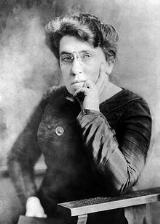
Emma Goldman

 
Emma Goldman

   Email Print
   Bookmark   Link


Emma Goldman


Emma Goldman (June 27, 1869 – May 14, 1940) was an anarchist
Anarchism

Anarchism is a political philosophy encompassing anarchist schools of thought which consider the state to be unnecessary, harmful, and/or undesirable....
 known for her political activism, writing and speeches. She played a pivotal role in the development of anarchist political philosophy in North America and Europe in the first half of the twentieth century.

Born in Kovno in the Russian Empire
Russian Empire

File:Russian Emperor Flag.jpgFile:Romanov Flag.svgThe Russian Empire was a state that existed from 1721 until the Russian Revolution of 1917....
 (now Kaunas
Kaunas

Kaunas is the second largest city in Lithuania and a Temporary capital of Lithuania. It is served by the freeways European route E67 and A1 highway ....
 in Lithuania
Lithuania

Lithuania , officially the Republic of Lithuania is a country in Northern Europe, the southernmost of the three Baltic states. Situated along the southeastern shore of the Baltic Sea, it shares borders with Latvia to the north, Belarus to the southeast, Poland, and the Russian exclave of Kaliningrad Oblast to the southwest....
), Goldman emigrated to the US
United States

The United States of America is a Federal government constitutional republic comprising U.S. state and a federal district. The country is situated mostly in central North America, where its Contiguous United States and Washington, D.C., the Capital districts and territories, lie between the Pacific Ocean and Atlantic Oceans, Borders of the U...
 in 1885 and lived in New York City
New York City

The City of New York is the List of United States cities by population in the United States, while the New York metropolitan area ranks among the List of urban areas by population....
, where she joined the burgeoning anarchist movement.


Discussion
Ask a question about 'Emma Goldman'
Start a new discussion about 'Emma Goldman'
Answer questions from other users
Full Discussion Forum


Recent Posts


Quotations


It is characteristic of theistic tolerance that no one really cares what the people believe in, just so they believe or pretend to believe.

No sacrifice is lost for a great ideal! (p. 135)

Someone has said that it requires less mental effort to condemn than to think.

Anarchism: What It Really Stands For

The free expression of the hopes and aspirations of a people is the greatest and only safety in a sane society.

The people are asleep; they remain indifferent. They forge their own chains and do the bidding of their masters to crucify their Christs. (p. 304)

The custom of procuring abortions has reached such appalling proportions in America as to be beyond belief...So great is the misery of the working classes that seventeen abortions are committed in every one hundred pregnancies.

Mother Earth, (1911)


Encyclopedia


Emma Goldman (June 27, 1869 – May 14, 1940) was an anarchist
Anarchism

Anarchism is a political philosophy encompassing anarchist schools of thought which consider the state to be unnecessary, harmful, and/or undesirable....
 known for her political activism, writing and speeches. She played a pivotal role in the development of anarchist political philosophy in North America and Europe in the first half of the twentieth century.

Born in Kovno in the Russian Empire
Russian Empire

File:Russian Emperor Flag.jpgFile:Romanov Flag.svgThe Russian Empire was a state that existed from 1721 until the Russian Revolution of 1917....
 (now Kaunas
Kaunas

Kaunas is the second largest city in Lithuania and a Temporary capital of Lithuania. It is served by the freeways European route E67 and A1 highway ....
 in Lithuania
Lithuania

Lithuania , officially the Republic of Lithuania is a country in Northern Europe, the southernmost of the three Baltic states. Situated along the southeastern shore of the Baltic Sea, it shares borders with Latvia to the north, Belarus to the southeast, Poland, and the Russian exclave of Kaliningrad Oblast to the southwest....
), Goldman emigrated to the US
United States

The United States of America is a Federal government constitutional republic comprising U.S. state and a federal district. The country is situated mostly in central North America, where its Contiguous United States and Washington, D.C., the Capital districts and territories, lie between the Pacific Ocean and Atlantic Oceans, Borders of the U...
 in 1885 and lived in New York City
New York City

The City of New York is the List of United States cities by population in the United States, while the New York metropolitan area ranks among the List of urban areas by population....
, where she joined the burgeoning anarchist movement. Attracted to anarchism after the Haymarket affair
Haymarket affair

The Haymarket affair was a disturbance that took place on Tuesday May 4, 1886, at the Haymarket Square in Chicago, and began as a rally in support of Strike action workers....
, Goldman became a writer and a renowned lecturer on anarchist philosophy, women's rights, and social issues, attracting crowds of thousands. She and anarchist writer Alexander Berkman
Alexander Berkman

Alexander Berkman was an Anarchism known for his political activism and writing. He was a leading member of the anarchist movement in the early 20th century....
, her lover and lifelong friend, planned to assassinate Henry Clay Frick
Henry Clay Frick

Henry Clay Frick was an United States Robber baron and art patron, once known as "America's most hated man"....
 as an act of propaganda of the deed
Propaganda of the deed

Propaganda of the deed is a concept that promotes physical violence against political enemies as a way of inspiring the masses and catalyzing revolution....
. Though Frick survived the attempt on his life, Berkman was sentenced to twenty-two years in prison. Goldman was imprisoned several times in the years that followed, for "inciting to riot" and illegally distributing information about birth control
Birth control

Birth control, sometimes synonymous with contraception, is a regimen of one or more actions, devices, or medications followed in order to deliberately prevent or reduce the likelihood of pregnancy or childbirth....
. In 1906, Goldman founded the anarchist journal Mother Earth
Mother Earth (magazine)

Mother Earth was an anarchist journal that described itself as "A Monthly Magazine Devoted to Social Science and Literature," edited by Emma Goldman....
.

In 1917, Goldman and Berkman were sentenced to two years in jail for conspiring to "induce persons not to register" for the newly instated draft
Conscription in the United States

Conscription in the United States has been employed several times, usually during war but also during the nominal peace of the Cold War. The United States discontinued the draft in 1973, moving to an all-volunteer United States Military, thus there is currently no mandatory conscription....
. After their release from prison, they were arrested—along with hundreds of others—and deported to Russia. Initially supportive of that country's Bolshevik
Bolshevik

Bolsheviks, originally also Bolshevists were a faction of the Marxism Russian Social Democratic Labour Party which split apart from the Menshevik faction at the 2nd Congress of the RSDLP in 1903 and ultimately became the Communist Party of the Soviet Union....
 revolution, Goldman quickly voiced her opposition to the Soviet use of violence and the repression of independent voices. In 1923, she wrote a book about her experiences, My Disillusionment in Russia
My Disillusionment in Russia

My Disillusionment in Russia is a book by Emma Goldman describing her experiences in Soviet Russia from 1920 to 1921, where she saw the aftermath of the Russian Revolution of 1917....
. While living in England, Canada, and France, she wrote an autobiography called Living My Life
Living My Life

Living My Life is the 993-page autobiography of Lithuanian-born anarchist Emma Goldman, published in two volumes in 1931 and 1934 . Goldman wrote it in Saint-Tropez, France, following her disillusionment with the Bolshevik role in the October revolution....
. After the outbreak of the Spanish Civil War
Spanish Civil War

The Spanish Civil War was a major conflict in Spain that started after an attempted coup d'?tat by a group of Spanish Army generals, supported by the conservative Spanish Confederation of the Autonomous Right , Carlist groups and the fascistic Falange, against the government of the Second Spanish Republic, then under the leadership of pr...
, she traveled to Spain to support the anarchist revolution
Spanish Revolution

The Spanish Revolution of 1936 began during the outbreak of the Spanish Civil War. Much of Spain's economy was put under worker control; in anarchist strongholds like Catalonia, the figure was as high as 75%, but lower in areas with heavy Partido Comunista de Espa?a influence....
 there. She died in Toronto
Toronto

Toronto is the List of the 100 largest municipalities in Canada by population in Canada and the Provinces and territories of Canada Provincial and territorial capitals of Canada of Ontario....
 on May 14, 1940.

During her life, Goldman was lionized as a free-thinking "rebel woman" by admirers, and derided by critics as an advocate of politically motivated murder and violent revolution. Her writing and lectures spanned a wide variety of issues, including prisons, atheism
Atheism

Atheism is the absence or rejection of belief in deity, or the explicit view that Existence of God.Many list of atheists are Skepticism of all supernatural beings and cite a lack of empiricism evidence for the existence of deities....
, freedom of speech
Freedom of speech

Freedom of speech is the freedom to speak freely without censorship or limitation. The synonymous term freedom of expression is sometimes used to denote not only freedom of verbal speech but any act of seeking, receiving and imparting information or ideas, regardless of the medium used....
, militarism
Militarism

File:CaptainJ.R.Jellicoe.jpgMilitarism is the belief or desire of a government or people that a country should maintain a strong military capability and be prepared to use it aggressively to defend or promote national interests....
, capitalism
Capitalism

Capitalism is an economic system in which wealth, and the means of producing wealth, are private property and controlled rather than commonly, publicly, or state-owned and controlled....
, marriage
Marriage

Marriage is a social, spirituality, or law union of individuals. This union may also be called matrimony, while the ceremony that marks its beginning is usually called a wedding and the married status created is sometimes called wedlock....
, free love
Free love

The term free love has been used since at least the nineteenth century to describe a social movement that rejects marriage, which is seen as a form of social bondage, especially for women....
, and homosexuality
Homosexuality

Homosexuality refers to human sexual behavior or same-sex attraction between people of the same sex or to homosexual orientation. As a sexual orientation, homosexuality refers to "having sexual and romantic attraction primarily or exclusively to members of one?s own sex"; "it also refers to an individual?s sense of personal and social identi...
. Although she distanced herself from first-wave feminism
First-wave feminism

First-wave feminism refers to a period of feminist activity during the nineteenth century and early twentieth century in the United Kingdom and the United States....
 and its efforts toward women's suffrage
Women's suffrage

The term women's suffrage refers to the economic and political reform movement aimed at extending suffrage ? the right to vote ? to women. The movement's modern origins lie in France in the 18th century....
, she developed new ways of incorporating gender politics into anarchism. After decades of obscurity, Goldman's iconic status was revived in the 1970s, when feminist and anarchist scholars rekindled popular interest in her life.

Biography


Family

Emma Goldman's Orthodox Jewish
Orthodox Judaism

Orthodox Judaism is a Jewish denominations of Judaism that adheres to a relatively strict constructionist and application of the laws and ethics first canonized in the Talmudic texts and as subsequently developed and applied by the later authorities known as the Gaonim, Rishonim, and Acharonim....
 family lived in the Lithuania
Lithuania

Lithuania , officially the Republic of Lithuania is a country in Northern Europe, the southernmost of the three Baltic states. Situated along the southeastern shore of the Baltic Sea, it shares borders with Latvia to the north, Belarus to the southeast, Poland, and the Russian exclave of Kaliningrad Oblast to the southwest....
n city of Kaunas
Kaunas

Kaunas is the second largest city in Lithuania and a Temporary capital of Lithuania. It is served by the freeways European route E67 and A1 highway ....
 (called Kovno at the time, part of the Russian Empire
Russian Empire

File:Russian Emperor Flag.jpgFile:Romanov Flag.svgThe Russian Empire was a state that existed from 1721 until the Russian Revolution of 1917....
). Goldman's mother Taube Bienowitch had been married before, to a man with whom she had two daughters – Helena in 1860 and Lena in 1862. When her first husband died of tuberculosis
Tuberculosis

Tuberculosis is a common and often deadly infectious disease caused by mycobacterium, mainly Mycobacterium tuberculosis . Tuberculosis usually attacks the lungs but can also affect the central nervous system, the lymphatic system, the circulatory system, the genitourinary system, the gastrointestinal system, bones, joints, and even the...
, Taube was devastated. Goldman later wrote: "Whatever love she had had died with the young man to whom she had been married at the age of fifteen."

Taube's second marriage was arranged
Arranged marriage

Arranged marriage is a marriage arranged by someone other than the couple getting wedded, curtailing or avoiding the process of courtship. Such marriages had deep roots in royal and aristocratic families around the world, including Europe....
 by her family and, as Goldman puts it, "mismated from the first." Her second husband, Abraham Goldman, invested Taube's inheritance in a business that quickly failed. The ensuing hardship combined with the emotional distance of husband and wife to make the household a tense place for the children. When Taube became pregnant, Abraham hoped desperately for a son; a daughter, he believed, would serve as one more sign of failure. They eventually had three sons, but their first child together was a girl, Emma.

Emma Goldman was born on June 27, 1869. Her father used violence to punish
Corporal punishment

Corporal punishment is the deliberate infliction of pain intended to punish a person or change his/her behavior. Historically speaking, most forms of punishment, whether in judicial, domestic, or educational settings, were corporal in basis....
 his children, beating them when they disobeyed him. He used a whip only on Emma, the most rebellious of them. Her mother provided scarce comfort, calling only rarely on Abraham to tone down his beatings. Goldman later speculated that her father's furious temper was at least partly a result of sexual frustration.

Goldman's relationships with her sisters Lena and Helena were a study in contrasts. Helena, the oldest, provided the comfort they lacked from their mother; she filled Goldman's childhood with "whatever joy it had". Lena, however, was distant and uncharitable. The three sisters were joined by brothers Louis (who died at the age of six), Herman (in 1872), and Moishe (in 1879).

Adolescence

When Emma was a young girl, the Goldman family moved to the village of Papile
Papile

Papile is a town in ?iauliai County, Lithuania, near the Venta River....
, where her father ran an inn. While her sisters worked, she became friends with a servant named Petrushka, who excited her "first erotic sensations". Later in Papile she witnessed a peasant being whipped with a knout
Knout

A knout is a heavy scourge-like multiple whip, usually made of a bunch of rawhide thongs attached to a long handle, sometimes with metal wire or hooks incorporated....
 in the street. This event traumatized her and contributed to her lifelong distaste for violent authority.

At the age of seven, Goldman moved with her family to the Prussian
Province of Prussia

The Province of Prussia was a Provinces of Prussia of the Kingdom of Prussia from 1829-1878 created out of the provinces of Province of East Prussia and West Prussia....
 city of Königsberg
Königsberg

K?nigsberg was after World War II in 1946 renamed Kaliningrad by the Soviet Union.The city was the Capital of East Prussia from the Late Middle Ages until 1945....
 (then part of the German Empire
German Empire

The German Empire is the name commonly used in English to describe Germany from the unification of Germany and proclamation of William I, German Emperor as German Emperor on 18 January 1871, to 1918, when it became Weimar republic after defeat in World War I and the abdication of William II, German Emperor ....
), and she enrolled in a Realschule
Realschule

The Realschule is a type of secondary school in Germany, Austria, Switzerland, and Liechtenstein. It has also existed in Croatia , Denmark , Sweden , Hungary and Russian Empire ....
. One teacher punished disobedient students – targeting Goldman in particular – by beating their hands with a ruler. Another teacher tried to molest his female students and was fired when Goldman fought back. She found a sympathetic mentor, however, in her German teacher, who loaned her books and even took her to an opera. A passionate student, Goldman passed the exam for admission into a gymnasium
Gymnasium (school)

A gymnasium is a type of school providing secondary education in some parts of Europe, comparable to English Grammar schools in the United Kingdoms or sixth form colleges and U.S....
, but her religion teacher refused to provide a certificate of good behavior and she was unable to attend.

Chernychevsky
The family moved to the Russian city of Saint Petersburg
Saint Petersburg

Saint Petersburg is a types of inhabited localities in Russia and a federal subjects of Russia of Russia located on the Neva River at the head of the Gulf of Finland on the Baltic Sea....
, where her father opened one unsuccessful store after another. Their poverty forced the children to work, and Goldman took an assortment of jobs including one in a corset
Corset

A corset is a garment worn to mold and shape the torso into a desired shape for aesthetic or medical purposes . Both men and women are known to wear corsets, though women are more common wearers....
 shop. As a teenager Goldman begged her father to allow her to return to school, but instead he threw her French book into the fire and shouted: "Girls do not have to learn much! All a Jewish daughter needs to know is how to prepare gefilte fish
Gefilte fish

Gefilte fish are Poaching fish patties or balls made from a mixture of ground deboned fish, mostly common carp or pike. They are popular in the Ashkenazi Jews Jewish community....
, cut noodles fine, and give the man plenty of children."

Goldman pursued an independent education on her own, however, and soon began to study the political turmoil around her, particularly the Nihilists
Nihilist movement

The Nihilist movement was a Russian anarchist movement in the 1860s which rejected all authorities. It is derived from the Latin word "nihil", which means "nothing"....
 responsible for assassinating Alexander II of Russia
Alexander II of Russia

Alexander II Nikolaevich , also known as Alexander the Liberator was the List of Russian rulers of the Russian Empire from 3 March 1855 until his assassination in 1881....
. The ensuing turmoil intrigued Goldman, even though she did not fully understand it at the time. When she read Nikolai Chernyshevsky's
Nikolai Chernyshevsky

Nikolay Gavrilovich Chernyshevsky was a Russian revolutionary democrat, materialist philosopher, critic, and Socialism . He was the leader of the revolutionary democratic movement of the 1860s, and was an influence on Vladimir Lenin and Emma Goldman....
 novel What Is to Be Done? (1863), however, she found a role model in the protagonist Vera, who adopts a Nihilist philosophy and escapes her repressive family to live freely and organize a sewing cooperative
Cooperative

A cooperative is defined by the International Co-operative Alliance Statement on the Co-operative Identity as an autonomous association of persons united voluntarily to meet their common economic, social, and cultural needs and aspirations through a jointly-owned and democratically-controlled business....
. The book enthralled Goldman and remained a source of inspiration throughout her life.

Her father, meanwhile, continued to insist on a domestic future for her, and he tried to arrange for her to be married at the age of fifteen. They fought about the issue constantly: he complained that she was becoming a "loose" woman, and she insisted that she would marry for love alone. At the corset shop, she was forced to fend off unwelcome advances from Russian officers and other men. One persistent suitor took her into a hotel room and committed what Goldman called "violent contact"; two biographers call it rape. She was stunned by the experience, overcome by "shock at the discovery that the contact between man and woman could be so brutal and painful." Goldman felt that the encounter forever soured her interactions with men.

Rochester

In 1885 Helena made plans to move to New York
New York

The State of New York is a U.S. state in the Mid-Atlantic States and Northeastern United States regions of the United States and is the nation's List of U.S....
 to join her sister Lena and her husband. Goldman wanted to join her sister, but their father refused to allow it. Despite Helena's offer to pay for the trip, Abraham turned a deaf ear to their pleas. Desperate, Goldman threatened to throw herself into the Neva River
Neva River

The Neva is a river in northwestern Russia flowing from Lake Ladoga through the western part of Leningrad Oblast and the city of Saint Petersburg to the Gulf of Finland....
 if she could not go. He finally agreed, and on December 29, 1885, Helena and Emma arrived at New York's Castle Garden. They moved into the Rochester
Rochester, New York

Rochester is a city in Monroe County, New York, New York State, south of Lake Ontario in the United States. The Rochester metropolitan area is the second largest economy in New York State, behind the New York City metropolitan area....
 home Lena had made with her husband Samuel. Fleeing the rising antisemitism of Saint Petersburg, their parents and brothers joined them a year later. Goldman began working as a seamstress, sewing overcoats for more than ten hours a day, earning two and a half dollars a week. She asked for a raise and was denied; she quit and took work at a smaller shop nearby.

At her new job, Goldman met a fellow worker named Jacob Kershner, who shared her love for books, dancing, and traveling, as well as her frustration with the monotony of factory work. After four months they married in February 1887. Once he moved in with Goldman's family, however, their relationship faltered. On their wedding night she discovered that he was impotent; they became emotionally and physically distant. Before long he became jealous and suspicious. She, meanwhile, was becoming more engaged with the political turmoil around her – particularly the fallout of the 1886 Haymarket affair
Haymarket affair

The Haymarket affair was a disturbance that took place on Tuesday May 4, 1886, at the Haymarket Square in Chicago, and began as a rally in support of Strike action workers....
 in Chicago and the anti-authoritarian
Anti-authoritarian

Anti-authoritarianism is opposition to authoritarianism, which is defined as a "political doctrine advocating the principle of absolute rule: absolutism, autocracy, despotism, dictatorship, totalitarianism." Anti-authoritarians believe in an equal distribution of power among all people....
 political philosophy of anarchism
Anarchism

Anarchism is a political philosophy encompassing anarchist schools of thought which consider the state to be unnecessary, harmful, and/or undesirable....
. Less than a year after the wedding, they were divorced; he begged her to return and threatened to poison himself if she did not. They reunited, but after three months she left once again. Her parents considered her behavior "loose" and refused to allow Goldman into their home. Carrying her sewing machine in one hand and a bag with five dollars in the other, she left Rochester and headed southeast to New York City
New York City

The City of New York is the List of United States cities by population in the United States, while the New York metropolitan area ranks among the List of urban areas by population....
.

Most and Berkman

On her first day in the city, Goldman met two men who would forever change her life. At Sachs's Café, a gathering place for radicals, she was introduced to Alexander Berkman
Alexander Berkman

Alexander Berkman was an Anarchism known for his political activism and writing. He was a leading member of the anarchist movement in the early 20th century....
, an anarchist who invited her to a public speech that evening. They went to hear Johann Most
Johann Most

Johann Joseph Most was a German-American anarchist and orator, who in the late 19th century began to advocate the use of violence to achieve revolutionary political and social change....
, editor of a radical publication called Die Freiheit
Die Freiheit

Die Freiheit was a long-running anarchist journal established by Johann Most in 1879. It was known for advocacy of attentat, or propaganda of the deed — revolutionary violence that could inspire people to revolution....
 and an advocate of "propaganda of the deed
Propaganda of the deed

Propaganda of the deed is a concept that promotes physical violence against political enemies as a way of inspiring the masses and catalyzing revolution....
" – the use of violence to instigate change. She was impressed by his fiery oration, and he took her under his wing, training her in methods of public speaking. He encouraged her vigorously, telling her that she was "to take my place when I am gone." One of her first public talks in support of "the Cause" was in Rochester. After convincing Helena not to tell their parents of her speech, Goldman found her mind a blank once on stage. Suddenly,
something strange happened. In a flash I saw it—every incident of my three years in Rochester: the Garson factory, its drudgery and humiliation, the failure of my marriage, the Chicago crime.… I began to speak. Words I had never heard myself utter before came pouring forth, faster and faster. They came with passionate intensity…. The audience had vanished, the hall itself had disappeared; I was conscious only of my own words, of my ecstatic song.


Goldmanberkman
Enchanted by the experience, she refined her public persona during subsequent engagements. Quickly, however, she found herself arguing with Most over her independence. After a momentous speech in Cleveland, she felt as though she had become "a parrot repeating Most's views" and resolved to express herself on the stage. Upon her return in New York, Most became furious and told her: "Who is not with me is against me!" She left Die Freiheit and joined with another publication, Die Autonomie.

Meanwhile, she had begun a friendship with Berkman, whom she affectionately called Sasha. Before long they became lovers and moved into a communal apartment with his cousin Modest "Fedya" Stein and Goldman's friend, Helen Minkin in rural Woodstock
Woodstock, Illinois

Woodstock is a city in McHenry County, Illinois, Illinois, United States. The population was 21,151 at the 2000 census, and is 25,000 as of 2008....
, Illinois
Illinois

The State of Illinois is a U.S. state of the United States, the 21st to be admitted to the United States. Illinois is the most populous and demographically diverse Midwestern United States state and the fifth most populous state in the nation....
. Although their relationship had numerous difficulties, Goldman and Berkman would share a close bond for decades, united by their anarchist principles and commitment to personal equality.

Homestead plot

One of the first political moments that brought Berkman and Goldman together was the Homestead Strike
Homestead Strike

The Homestead Strike was a labour lockout and strike which began on June 30, 1892, culminating in a battle between strikers and private security agents on July 6, 1892....
. In June 1892, a steel plant in Homestead, Pennsylvania
Homestead, Pennsylvania

Homestead is a borough in Allegheny County, Pennsylvania, Pennsylvania, USA, in the Monongahela River seven miles southeast of downtown Pittsburgh, Pennsylvania but directly across the river from the city limit line....
 owned by Andrew Carnegie
Andrew Carnegie

Andrew Carnegie was a Scotland-born United States industrialist, List of business people, and a major philanthropist. He was an immigrant as a child with his parents....
 became the focus of national attention when talks between the Carnegie Steel Company
Carnegie Steel Company

Carnegie Steel Company was a steel producing company created by Andrew Carnegie to manage business at his steel mills in the Pittsburgh, Pennsylvania area in the late 19th century....
 and the Amalgamated Association of Iron and Steel Workers
Amalgamated Association of Iron and Steel Workers

The Amalgamated Association of Iron and Steel Workers was an American trade union formed in 1876 and which represented iron and steel workers. It partnered with the Steel Workers Organizing Committee, Congress of Industrial Organizations, in November, 1935....
 (AA) broke down. The factory's manager was Henry Clay Frick
Henry Clay Frick

Henry Clay Frick was an United States Robber baron and art patron, once known as "America's most hated man"....
, a fierce opponent of the union. When a final round of talks failed at the end of June, management closed the plant and locked out the workers, who immediately went on strike. Strikebreaker
Strikebreaker

A strikebreaker is a person who works despite an ongoing strike action. Strikebreakers are usually individuals who are not employed by the company prior to the trade union dispute, but rather hired prior to or during the strike to keep production or services going....
s were brought in and the company hired Pinkerton guards
Pinkerton National Detective Agency

The Pinkerton National Detective Agency, usually shortened to the Pinkertons, was a private United States security guard and detective agency established by Allan Pinkerton in 1850....
 to protect them. On July 6 a fight broke out between three hundred Pinkerton guards and a crowd of armed union workers. During the twelve-hour gunfight, seven guards and nine strikers were killed.

Henry Clay Frick
When a majority of the nation's newspapers came out in support of the strikers, Goldman and Berkman resolved to assassinate Frick, an action they expected would inspire the workers to revolt against the capitalist
Capitalism

Capitalism is an economic system in which wealth, and the means of producing wealth, are private property and controlled rather than commonly, publicly, or state-owned and controlled....
 system. Berkman chose to carry out the assassination, and ordered Goldman to stay behind in order to explain his motives after he went to jail. He would be in charge of the deed; she of the word. Berkman tried and failed to make a bomb, then set off for Pittsburgh
Pittsburgh, Pennsylvania

Pittsburgh is the second largest city in the U.S. state of Pennsylvania with a population of 312,819. The population of the seven-county metropolitan area is 2,462,571....
 to buy a gun and a suit of decent clothes.

Goldman, meanwhile, decided to help fund the scheme through prostitution. Remembering the character of Sonya in Fyodor Dostoevsky's
Fyodor Dostoevsky

Fyodor Mikhaylovich Dostoyevsky "An Honest Thief"* "Elka i svad'ba" ; English translation: "A Christmas Tree and a Wedding"* Belye nochi ; English translation: White Nights ...
 novel Crime and Punishment
Crime and Punishment

Crime and Punishment is a novel by Russian literature Fyodor Dostoevsky that was first published in the literary journal The Russian Messenger in twelve monthly installments in 1866....
 (1866), she mused: "She had become a prostitute in order to support her little brothers and sisters…. Sensitive Sonya could sell her body; why not I?" Once on the street, she caught the eye of a man who took her into a saloon, bought her a beer, gave her ten dollars, informed her she did not have "the knack", and told her to quit the business. She was "too astounded for speech". She wrote to Helena, claiming illness, and asked her for fifteen dollars.

When he arrived in Homestead on July 23, Berkman gained access to Frick's office with a concealed handgun and shot Frick three times, then stabbed him in the legs. A group of workers – far from joining in his attentat – beat Berkman unconscious, and he was carried away by the police. Berkman was convicted of attempted murder and sentenced to twenty-two years in prison; his absence from her life was very difficult for Goldman. Convinced Goldman was involved in the plot, police raided her apartment and – finding no evidence – pressured her landlord into evicting her. Worse, the attentat had failed to rouse the masses: workers and anarchists alike condemned Berkman's action. Johann Most, their former mentor, lashed out at Berkman and the assassination attempt, claiming it was carried out to create sympathy for Frick. Furious at these attacks, Goldman brought a horsewhip to a public lecture and demanded, onstage, that Most provide evidence for his accusation. He dismissed her, whereupon she struck him with the whip, broke it on her knee, and hurled the pieces at him. She later regretted her assault, confiding to a friend: "At the age of twenty-three, one does not reason."

"Inciting to riot"

When the Panic of 1893
Panic of 1893

The Panic of 1893 was a serious economic depression in the United States that began in 1893. This panic is sometimes considered a part of the Long Depression which began with the Panic of 1873, and like that of earlier crashes, was caused by railroad overbuilding and shaky railroad financing; which set off a series of bank failures....
 struck in the following year, the United States suffered one of its worst economic crises ever. By year's end, the unemployment rate was higher than twenty percent, and "hunger demonstrations" sometimes gave way to riots. Goldman began speaking to crowds of frustrated men and women in New York. On August 21, she spoke to a crowd of nearly 3,000 people in Union Square
Union Square (New York City)

Union Square is an important and historic intersection in New York City, located where Broadway and Bowery, Manhattan came together in the early 19th century; its name does not celebrate the federal union but rather denotes the fact that "here was the union of the two principal thoroughfares of the island" and the confluence of several troll...
, where she encouraged unemployed workers to take immediate action. Her exact words are unclear: undercover agents insist she ordered the crowd to "take everything … by force", while Goldman later recounted this message: "Well then, demonstrate before the palaces of the rich; demand work. If they do not give you work, demand bread. If they deny you both, take bread." Later in court, Detective-Sergeant Charles Jacobs offered yet another version of her speech.

A week later she was arrested in Philadelphia and returned to New York City for trial, charged with "inciting to riot". During the train ride, Jacobs offered to drop the charges against her if she would inform on other radicals in the area. She responded by throwing a glass of ice water in his face. As she awaited trial, Goldman was visited by Nellie Bly
Nellie Bly

Nellie Bly was an American journalist, author, industrialist, and charity worker. She is most famous for an undercover Expos? in which she faked insanity to study a mental hospital from within....
, a reporter for the New York World
New York World

The New York World was a newspaper published in New York from 1860 until 1931. It played a major role in the history of American newspapers....
. She spent two hours talking to Goldman, and wrote a positive article about the woman she described as a "modern Joan of Arc
Joan of Arc

Saint Joan of Arc also known as the Maid of Orleans, is a national heroine of France and a Roman Catholic saint. A peasant girl born in eastern France, she led the French army to several important victories during the Hundred Years' War, claiming divine guidance, and was indirectly responsible for the coronation of Charles VII of Franc...
".

Despite this positive publicity, the jury was persuaded by Jacobs' testimony and scared by Goldman's politics. The assistant District Attorney questioned Goldman about her anarchism, as well as her atheism; the judge spoke of her as "a dangerous woman". She was sentenced to one year in the Blackwell's Island
Roosevelt Island

Roosevelt Island, formerly known as Welfare Island , and before that Blackwell's Island, is a narrow island in the East River of New York City....
 Penitentiary. Once inside she suffered an attack of rheumatism
Rheumatism

Rheumatism or Rheumatic disorder is a non-specific term for medical problems affecting the heart, bones, joints, kidney, skin and lung. The study of, and therapeutic interventions in, such disorders is called rheumatology....
 and was sent to the infirmary; there she befriended a visiting doctor and began studying medicine. She also read dozens of books, including works by the American activist-writers Ralph Waldo Emerson
Ralph Waldo Emerson

Ralph Waldo Emerson was an American essayist, philosopher, poet, and leader of the transcendentalism movement in the early 19th century. His teachings directly influenced the growing New Thought movement of the mid 1800s....
 and Henry David Thoreau
Henry David Thoreau

Henry David Thoreau was an United States author, poet, Natural history, tax resistance, development criticism, surveyor, historian, philosophy, and leading Transcendentalism....
; novelist Nathaniel Hawthorne
Nathaniel Hawthorne

Nathaniel Hawthorne was an American novelist and short story writer.Nathaniel Hathorne was born in 1804 in the city of Salem, Massachusetts to Nathaniel Hathorne and Elizabeth Clarke Manning Hathorne....
; poet Walt Whitman
Walt Whitman

Walter Whitman was an United States Poetry of the United States, essayist, journalism, and humanism. He was a part of the transition between Transcendentalism and literary realism, incorporating both views in his works....
, and philosopher John Stuart Mill
John Stuart Mill

John Stuart Mill , United Kingdom philosopher, political economy, civil servant and Parliament of the United Kingdom, was an influential liberalism thinker of the 19th century....
. When she was released after ten months, a raucous crowd of nearly three thousand people greeted her at the Thalia Theater
Bowery Theatre

The Bowery Theatre was a playhouse in the Bowery, Manhattan neighborhood of New York City. Although it was founded by rich families to compete with the upscale Park Theatre , the Bowery saw its most successful period under the populism, pro-American management of Thomas Hamblin in the 1830s and 1840s....
 in New York City. She soon became swamped with requests for interviews and lectures.

To make money, Goldman decided to pursue the medical work she had studied in prison. However, her preferred fields of specialization – midwifery
Midwifery

Midwifery is a health care profession where providers give prenatal care to pregnancy mothers, attend the Childbirth of the infant, and provide postpartum care to the mother and her infant....
 and massage
Massage

Massage is the practice of soft tissue manipulation with physical, functional, and in some cases psychological purposes and goals. The word comes from the French language massage "friction of kneading," or from Arabic massa meaning "to touch, feel or handle" or from Latin massa meaning "mass, dough"....
 – were not available to nursing students in the US. Thus, she sailed to Europe, lecturing in London, Glasgow, and Edinburgh. She met with renowned anarchists like Errico Malatesta
Errico Malatesta

Errico Malatesta was an Italians Anarchist communism and Insurrectionary anarchism. He spent much of his life exiled from his homeland of Italy and in total spent more than ten years in prison....
, Louise Michel
Louise Michel

Louise Michel was a Anarchism in France, school teacher and medical worker. She sometimes used the pseudonym Cl?mence and was also known as the red virgin of Montmartre....
, and Peter Kropotkin
Peter Kropotkin

name= Peter Kropotkin|image = Kropotkin Nadar.jpg|image_size =|caption = Kropotkin, by Nadar |birth_date = |birth_place = Moscow, Russia...
. In Vienna
Vienna

Vienna is the Capital of Republic of Austria and also one of the nine states of Austria. Vienna is Austria's primary city, with a population of about 1.7 million...
 she received two diplomas and put them immediately to use back in the US. Alternating between lectures and midwifery, she conducted the first cross-country tour by an anarchist speaker. In November 1899 she returned to Europe, where she met the anarchist Hippolyte Havel
Hippolyte Havel

Hippolyte Havel was a Czech people anarchist who lived in Greenwich Village, New York, which he declared to be "a spiritual zone of mind". He was close friends with Emma Goldman....
, with whom she began a relationship. Together they went to France and helped organize the International Anarchist Congress on the outskirts of Paris
Paris

Paris is the Capital of France and the country's largest city. It is situated on the river Seine, in northern France, at the heart of the ?le-de-France Regions of France ....
.

McKinley assassination

On September 6, 1901, Leon Czolgosz
Leon Czolgosz

Leon Frank Czolgosz was the assassin of President of the United States William McKinley. In the last few years of his life, he was heavily influenced by anarchists such as Emma Goldman and Alexander Berkman....
, an unemployed factory worker and registered Republican with a history of mental illness, shot US President William McKinley
William McKinley

William McKinley, Jr. was the List of Presidents of the United States President of the United States, and the last veteran of the American Civil War to be elected....
 twice during a public speaking event in Buffalo, New York. McKinley was hit in the breastbone and stomach; eight days later, he died. Czolgosz was arrested and interrogated around the clock. During interrogation he claimed to be an Anarchist and said he had been inspired to his action after attending a speech by Goldman. The authorities used this pretext to charge that she had planned the action. They tracked her to a residence in Chicago she shared with Havel and Abe and Mary Isaak, an anarchist couple. Goldman was arrested, along with Abe Isaak, Havel, and ten other anarchists.

First Photograph of Leon F
Earlier, Czolgosz had tried but failed to become friends with Goldman and her companions. During a talk in Cleveland, Ohio
Cleveland, Ohio

Cleveland is a city in the U.S. state of Ohio and the county seat of Cuyahoga County, Ohio, the most populous county in the state. The municipality is located in northeastern Ohio on the southern shore of Lake Erie, approximately 60 miles west of the Pennsylvania border....
, Czolgosz had approached Goldman and asked her advice on which books he should read. In July 1901, he had appeared at the Isaak house, asking a series of unusual questions. They assumed he was an infiltrator, like a number of police agents sent to spy on radical groups. They had remained distant from him, and Abe Isaak sent a notice to associates warning of "another spy".

Although Czolgosz repeatedly denied Goldman's involvement, the police held her in close custody, subjecting her to what she called the "third degree". She explained their distrust of him, and it was clear she had not had any significant contact with Czolgosz. No evidence was found linking Goldman to the attack, and she was eventually released after two weeks of detention. Before McKinley died, Goldman offered to provide nursing care, referring to him as "merely a human being". Czolgosz, despite considerable evidence of mental illness, was convicted of murder and executed.

Throughout her detention and after her release, Goldman steadfastly refused to condemn Czolgosz' action, standing virtually alone in doing so. Friends and supporters – including Berkman – urged her to quit his cause. But Goldman defended Czolgosz as a "supersensitive being" and chastised other anarchists for abandoning him. Many newspapers, meanwhile, declared the anarchist movement responsible for the murder. In the wake of these events, socialism
Socialism

Socialism refers to a broad set of economic theories of social organization advocating public or state ownership and administration of the means of production and distribution of goods, and a society characterized by equality for all individuals, with a fair or Egalitarianism method of compensation....
 gained support over anarchism among US radicals. McKinley's successor Theodore Roosevelt
Theodore Roosevelt

Theodore Roosevelt , also known as T.R., and to the public as Teddy, was the List of Presidents of the United States President of the United States....
 declared his intent to crack down "not only against anarchists, but against all active and passive sympathizers with anarchists".

Mother Earth and Berkman's release

After Czolgosz's execution, Goldman withdrew from the world. Scorned by her fellow anarchists, vilified by the press, and separated from her love, she retreated into anonymity and nursing. "It was bitter and hard to face life anew," she wrote later. Using the name E. G. Smith, she vanished from public life and took on a series of private nursing jobs. When the US Congress passed the Anarchist Exclusion Act
Anarchist Exclusion Act

The Anarchist Exclusion Act refers to two different acts passed by the United States Congress intended to keep Immigration to the United States that subscribed to Anarchism ideas from entering the country....
, however, a new wave of activism rose to oppose it, carrying Goldman back into the movement. A coalition of people and organizations across the left
Left-wing politics

In politics, left-wing, leftist, and the Left are terms applied to Social progressivism and Egalitarianism positions. Originally, during the French Revolution, left-wing referred to seating arrangements in parliament; those who sat on the left opposed the monarchy and supported Political radicalism reform....
 end of the political spectrum opposed the law on grounds that it violated freedom of speech
Freedom of speech

Freedom of speech is the freedom to speak freely without censorship or limitation. The synonymous term freedom of expression is sometimes used to denote not only freedom of verbal speech but any act of seeking, receiving and imparting information or ideas, regardless of the medium used....
, and she had the nation's ear once again.

When a Scottish anarchist named John Turner
John Turner (anarchist)

John Turner was an English people-born Anarchist communism shop steward. He referred to himself as "of semi-Religious Society of Friends descent."...
 was denied entry into the country, Goldman helped organize a group called the Free Speech League. It enlisted the aid of Clarence Darrow
Clarence Darrow

Clarence Seward Darrow was an United States lawyer and leading member of the American Civil Liberties Union, best known for defending teenage thrill killing Leopold and Loeb in their trial for murdering 14-year-old Bobby Franks and defending John T....
 and Edgar Lee Masters
Edgar Lee Masters

'Edgar Lee Masters' was an United States poet, biographer, and dramatist. He is the author of Spoon River Anthology, The New Star Chamber and Other Essays, Songs and Satires, The Great Valley, The Serpent in the Wilderness An Obscure Tale, The Spleen, Mark Twain: A Portrait, Lincoln: The Man, and Illinois...
, who took Turner's case to the US Supreme Court. Although Turner and the League lost, Goldman considered it a victory of propaganda
Propaganda

Propaganda is the dissemination of information aimed at influencing the opinions or behaviors of large numbers of people. As opposed to Objectivity providing information, propaganda in its most basic sense presents information in order to influence its audience....
. She had returned to anarchist activism, but it was taking its toll on her. "I never felt so weighed down," she wrote to Berkman. "I fear I am forever doomed to remain public property and to have my life worn out through the care for the lives of others."

Mother Earth 1912
In 1906 Goldman decided to start a publication of her own, "a place of expression for the young idealists in arts and letters". Mother Earth
Mother Earth (magazine)

Mother Earth was an anarchist journal that described itself as "A Monthly Magazine Devoted to Social Science and Literature," edited by Emma Goldman....
 was staffed by a cadre of radical activists, including Hippolyte Havel, Max Baginski
Max Baginski

Max Baginski was a German-American anarchist.Baginski was born in 1864 in Bartenstein , a small East Prussian village near K?nigsberg. His father was shoemaker who had been active in the 1848 revolution and was thus shunned by the conservative inhabitants of the village....
, and Leonard Abbott. In addition to publishing original works by its editors and anarchists around the world, Mother Earth reprinted selections from a variety of writers. These included the French philosopher Pierre-Joseph Proudhon
Pierre-Joseph Proudhon

Pierre-Joseph Proudhon was a French people politician, Mutualism political philosophy and socialist. He was a member of the French Parliament, and he was the first to call himself an anarchism....
, Russian anarchist Peter Kropotkin
Peter Kropotkin

name= Peter Kropotkin|image = Kropotkin Nadar.jpg|image_size =|caption = Kropotkin, by Nadar |birth_date = |birth_place = Moscow, Russia...
, German philosopher Friedrich Nietzsche
Friedrich Nietzsche

Friedrich Wilhelm Nietzsche was a 19th century philosophy Germans philosophy and classical philology. He wrote critical texts on religion, morality, contemporary culture, philosophy, and science, using a distinctive German language style and displaying a fondness for metaphor and aphorism....
, and British writer Mary Wollstonecraft
Mary Wollstonecraft

Mary Wollstonecraft was an eighteenth-century Kingdom of Great Britain writer, philosopher, and feminist. During her brief career, she wrote novels, treatises, a travel literature, a history of the French Revolution, a conduct book, and a children's book....
. Goldman wrote frequently about anarchism, politics, labor issues, atheism, sexuality, and feminism.

On May 18 of the same year, Alexander Berkman was released from prison. Carrying a bouquet of roses, she met him on the platform and found herself "seized by terror and pity" as she beheld his gaunt, pale form. Neither was able to speak; they returned to her home in silence. For weeks he struggled to readjust to life on the outside; an abortive speaking tour ended in failure, and in Cleveland he purchased a revolver with the intent of killing himself. He returned to New York, however, and learned that Goldman had been arrested with a group of activists meeting to reflect on Leon Czolgosz. Invigorated anew by this violation of freedom of assembly
Freedom of assembly

Freedom of assembly, sometimes used interchangeably with the freedom of association, is the individual right to come together with other individuals and collectively express, promote, pursue and defend common interests....
, he declared "My resurrection has come!" and set about securing their release.

Berkman took the helm of Mother Earth in 1907, while Goldman toured the country to raise funds to keep it functional. Editing the magazine was a revitalizing experience for Berkman; his relationship with Goldman faltered, however, and he had an affair with a fifteen-year-old anarchist named Becky Edelsohn. Goldman was pained by his rejection of her, but considered it a consequence of his prison experience. Later that year she served as a delegate from the US to the International Anarchist Congress of Amsterdam
International Anarchist Congress of Amsterdam

The International Anarchist Congress of Amsterdam took place from 24 August to 31 August, 1907. It gathered delegates from 14 different countries, among which important figures of the anarchist movement, including Errico Malatesta, Luigi Fabbri, Beno?t Broutchoux, Pierre Monatte, Am?d?e Dunois, Emma Goldman, Rudolf Rocker, Christian Corn?liss...
. Anarchists and syndicalists
Syndicalism

Syndicalism is a type of movement which aims to degrade Capitalism societies through action by the working class on the industrial front. For syndicalists, trade unions are the potential means both of overcoming capitalism and of running society in the interests of the majority....
 from around the world gathered to sort out the tension between the two ideologies, but no decisive agreement was reached. Goldman returned to the US and continued speaking to large audiences.

Reitman, essays, and birth control

For the next ten years, Goldman traveled around the country nonstop, delivering lectures and agitating for anarchism. The coalitions formed in opposition to the Anarchist Exclusion Act had given her an appreciation for reaching out to those of other political persuasions. When the US Justice Department sent spies to observe, they reported the meetings as "packed". Writers, journalists, artists, judges, and workers from across the spectrum spoke of her "magnetic power", her "convincing presence", her "force, eloquence, and fire".

In the spring of 1908 Goldman met and fell in love with Ben Reitman
Ben Reitman

Ben Reitman was an American Anarchism and physician to the poor . He is best remembered today as radical Emma Goldman's lover.Reitman was a flamboyant, eccentric character....
, the so-called "Hobo doctor". Having grown up in Chicago's tenderloin district, Reitman spent several years as a drifter before attaining a medical degree from the College of Physicians and Surgeons of Chicago
University of Illinois College of Medicine

The University of Illinois College of Medicine is the country's largest medical school with more than 2600 medical students and residents, and offers medical education programs at four geographic Illinois sites: Chicago, Peoria, Rockford, and Urbana-Champaign....
. As a doctor, he attended to people suffering from poverty and disease – particularly venereal disease. He and Goldman began an affair; they shared a commitment to free love
Free love

The term free love has been used since at least the nineteenth century to describe a social movement that rejects marriage, which is seen as a form of social bondage, especially for women....
, but whereas Reitman took a variety of lovers, Goldman did not. She tried to reconcile her feelings of jealousy with a belief in freedom of the heart, but found it difficult.

Margaretsanger Underwood
Two years later Goldman began feeling frustrated with lecture audiences. She yearned to "reach the few who really want to learn, rather than the many who come to be amused". Thus she collected a series of speeches and items she had written for Mother Earth and published a book called Anarchism and Other Essays. Covering a wide variety of topics, Goldman tries to represent "the mental and soul struggles of twenty-one years". In addition to a comprehensive look at anarchism and its criticisms, the book includes essays on patriotism, women's suffrage
Women's suffrage

The term women's suffrage refers to the economic and political reform movement aimed at extending suffrage ? the right to vote ? to women. The movement's modern origins lie in France in the 18th century....
, marriage, and prisons.

When Margaret Sanger
Margaret Sanger

Margaret Higgins Sanger was an United States birth control activist, an advocate of eugenics#Meanings and types of eugenics, and the founder of the American Birth Control League ....
, an advocate of access to contraception, coined the term "birth control" and disseminated information about various methods in the June 1914 issue of her magazine The Woman Rebel, she received aggressive support from Goldman. Sanger was arrested in August under the Comstock Law
Comstock Law

The Comstock Act, was a United States federal law which made it illegal to send any "obscene, lewd, and/or lascivious" materials through the mail, including contraceptive devices and information....
, which prohibited the dissemination of "obscene, lewd, or lascivious articles" – including information relating to birth control. Although they later split from Sanger over charges of insufficient support, Goldman and Reitman distributed copies of Sanger's pamphlet Family Limitation (along with a similar essay of Reitman's). In 1915 Goldman conducted a nationwide speaking tour in part to raise awareness about contraception options. Although the nation's attitude toward the topic seemed to be liberalizing, Goldman was arrested in February 1916 and charged with violation of the Comstock Law. Choosing not to pay a hundred-dollar fine, she spent two weeks in a prison workhouse, which she saw as an "opportunity" to reconnect with those rejected by society.

World War I

Although US President Woodrow Wilson
Woodrow Wilson

Thomas Woodrow Wilson was the List of Presidents of the United States President of the United States. A devout Presbyterianism and leading intellectual of the Progressive Era, he served as President of Princeton University of Princeton University from 1902 to 1910, and then as the Governor of New Jersey from 1911 to 1913....
 was re-elected in 1916 under the slogan "He kept us out of the war", at the start of his second term he decided that Germany's
Germany

Germany , officially the Federal Republic of Germany , is a country in Central Europe. It is bordered to the north by the North Sea, Denmark, and the Baltic Sea; to the east by Poland and the Czech Republic; to the south by Austria and Switzerland; and to the west by France, Luxembourg, Belgium, and the Netherlands....
 continued deployment of unrestricted submarine warfare
Unrestricted submarine warfare

Unrestricted submarine warfare is a type of naval warfare in which submarines sink merchant ships without warning, as opposed to attacks per Prize regulations....
 was sufficient cause for the US to enter World War I
World War I

World War I, or the First World War , was a global military conflict which involved the Great powers, organized into two opposing military alliances: the Allies of World War I and the Central Powers....
. Shortly afterward, Congress passed the Selective Service Act of 1917
Selective Service Act of 1917

The Selective Service Act or Selective Draft Act was passed by the Congress of the United States on May 18, 1917.It was drafted by Brigadier General Hugh Johnson after the United States entered The Great War....
, which required all males aged 21–30 to register for military conscription
Conscription

Conscription is a general term for involuntary labor demanded by an established authority. It is most often used in the specific sense of government policies that require citizens to serve in the military....
. Goldman saw the decision as an exercise in militarist
Militarism

File:CaptainJ.R.Jellicoe.jpgMilitarism is the belief or desire of a government or people that a country should maintain a strong military capability and be prepared to use it aggressively to defend or promote national interests....
 aggression, driven by capitalism. She declared in Mother Earth her intent to resist conscription, and to oppose US involvement in the war.

Goldman
To this end, she and Berkman organized the No Conscription League
No conscription league

No Conscription League was the name of several organizations opposed to conscription into the military:* 'No Conscription Leagues were organised by Emma Goldman, Alexander Berkman and other anarchists in United States during World War I....
 of New York, which proclaimed: "We oppose conscription because we are internationalists, antimilitarists, and opposed to all wars waged by capitalistic governments." The group became a vanguard for anti-draft activism, and chapters began to appear in other cities. When police began raiding the group's public events to find young men who had not registered for the draft, however, Goldman and others focused their efforts on spreading pamphlets and other written work. In the midst of the nation's patriotic fervor, many elements of the political left refused to support the League's efforts. The Women's Peace Party, for example, ceased its opposition to the war once the US entered it. The Socialist Party of America
Socialist Party of America

The Socialist Party of America was a Democratic socialism political party in the United States, formed in 1901 by a merger between the three-year-old Social Democratic Party and disaffected elements of the Socialist Labor Party of America which had split from the main organization in 1899....
 took an official stance against US involvement, but supported Wilson in most of his activities.

On June 15, 1917, Goldman and Berkman were arrested during a raid of their offices which yielded "a wagon load of anarchist records and propaganda" for the authorities. The New York Times
The New York Times

The New York Times is an American daily newspaper published in New York City. The largest metropolitan newspaper in the United States, "The Gray Lady"?named for its staid appearance and style?is regarded as a national newspaper of record....
 reported that Goldman asked to change into a more appropriate outfit, and emerged in a gown of "royal purple". The pair were charged with conspiracy to "induce persons not to register" under the newly enacted Espionage Act
Espionage Act of 1917

The Espionage Act of 1917 was a United States federal law passed shortly after entering World War I, on June 15, 1917, which made it a crime for a person:...
, and were held on US$25,000 bail
Bail

Traditionally, bail is some form of property deposited or pledged to a court in order to persuade it to release a suspect from County jail, on the understanding that the suspect will return for trial or forfeit the bail ....
 each. Defending herself and Berkman during their trial, Goldman invoked the First Amendment
First Amendment to the United States Constitution

The First Amendment to the United States Constitution is the part of the United States Bill of Rights that expressly prohibits the United States Congress from making laws "Establishment Clause of the First Amendment" or that prohibit the Free Exercise Clause of the First Amendment, laws that infringe the Freedom of speech in the United State...
, asking how the government could claim to fight for democracy abroad while suppressing free speech at home.
We say that if America has entered the war to make the world safe for democracy, she must first make democracy safe in America. How else is the world to take America seriously, when democracy at home is daily being outraged, free speech suppressed, peaceable assemblies broken up by overbearing and brutal gangsters in uniform; when free press is curtailed and every independent opinion gagged? Verily, poor as we are in democracy, how can we give of it to the world?
The jury saw it differently, and found them guilty; Judge Julius Marshuetz Mayer imposed the maximum sentence two years' imprisonment, a $10,000 fine each, and the possibility of deportation
Deportation

Deportation generally means the expulsion of a person or group of people from a place or country. The expulsion of natives is also called banishment, exile, or penal transportation....
 after their release from prison. As she was transported to Missouri State Penitentiary (now Jefferson City Correctional Center
Jefferson City Correctional Center

The Jefferson City Correctional Center is a maximum security prison in Jefferson City, MO, Missouri operated by the Missouri Department of Corrections....
), Goldman wrote to a friend: "Two years imprisonment for having made an uncompromising stand for one's ideal. Why that is a small price."

In prison she was assigned once again to work as a seamstress, under the eye of a "miserable gutter-snipe of a twenty-one-year-old boy paid to get results". She met the socialist Kate Richards O'Hare
Kate Richards O'Hare

Kate Richards O'Hare was a prominent American Socialist anti-war activist during World War I.As the editor of the National Rip-Saw, a socialist journal, O'Hare critiqued American society from a socialist perspective....
, who had also been imprisoned under the Espionage Act. Although they differed on political strategy – O'Hare believed in voting to achieve state power – the two women came together to agitate for better conditions among prisoners. Goldman also met and became friends with Gabriella Segata Antolini, an anarchist and follower of Luigi Galleani
Luigi Galleani

Luigi Galleani was a major 20th century anarchist. Galleani is best described as an Anarchist communism and an Insurrectionary anarchism....
. Antolini had been arrested transporting a satchel filled with dynamite on a Chicago-bound train. She had refused to cooperate with authorities, and was sent to prison for fourteen months. Working together to make life better for the other inmates, the three women became known as "The Trinity". Goldman was released on September 27, 1919.

Russia

When Goldman and Berkman were released, the first US Red Scare
Red Scare

The term Red Scare has been retroactively applied to two distinct periods of strong anti-Communism in United States history: first from 1917 to 1920, and second from the late 1940s through the late 1950s....
 was in full swing; the Bolshevik
Bolshevik

Bolsheviks, originally also Bolshevists were a faction of the Marxism Russian Social Democratic Labour Party which split apart from the Menshevik faction at the 2nd Congress of the RSDLP in 1903 and ultimately became the Communist Party of the Soviet Union....
-led Russian Revolution of 1917 had combined with wartime anxiety to produce a climate of hostility toward radicals and non-citizens. The US Department of Justice's
United States Department of Justice

The United States Department of Justice is a United States Cabinet department in the United States government of the United States designed to enforce the law and defend the interests of the United States according to the law and to ensure fair and impartial administration of justice for all Americans ....
 General Intelligence Division, headed by J. Edgar Hoover
J. Edgar Hoover

John Edgar Hoover , generally known as J. Edgar Hoover, was the first Director of the Federal Bureau of Investigation of the Federal Bureau of Investigation of the United States....
 and under the direction of Attorney General Alexander Mitchell Palmer
Alexander Mitchell Palmer

Alexander Mitchell Palmer was the United States Attorney General of the United States from 1919 to 1921. He was nicknamed The Fighting Religious Society of Friends and he directed the controversial Palmer Raids....
, conducted a series of raids
Palmer Raids

The Palmer Raids were a series of controversial raids by the United States Department of Justice and Immigration and Naturalization Service from 1919 to 1921 on suspected Far left citizens and immigrants in the United States, the legality of which is now in question....
 to arrest radicals. In a memorandum prepared while they were in prison, Hoover wrote: "Emma Goldman and Alexander Berkman are, beyond doubt, two of the most dangerous anarchists in this country and [a] return to the community will result in undue harm." Although her marriage to Jacob Kershner arguably provided her with legitimate US citizenship, the government invoked the 1918 Anarchist Exclusion Act
Anarchist Exclusion Act

The Anarchist Exclusion Act refers to two different acts passed by the United States Congress intended to keep Immigration to the United States that subscribed to Anarchism ideas from entering the country....
 and deported both Goldman and Berkman to Russia, along with over two hundred others.

Goldman had viewed the Bolshevik revolution as a positive step when it first took place. She wrote in Mother Earth that despite its dependence on Communist government, it represented "the most fundamental, far-reaching and all-embracing principles of human freedom and of economic well-being". By the time she and her fellow deportees neared Europe, however, she expressed fears about what was to come. She was worried about the ongoing Russian Civil War
Russian Civil War

The Russian Civil War was a multi-party war that occurred within the former Russian Empire after the Russian provisional government collapsed and the Bolshevik party assumed power in Saint Petersburg....
, and the possibility of being seized by anti-Bolshevik forces. The state, anti-capitalist though it was, also posed a threat. "I could never in my life work within the confines of the State," she wrote to her niece, "Bolshevist or otherwise."

These fears were justified, as she quickly discovered. Days after returning to Petrograd (Saint Petersburg), she was shocked to hear a party official refer to free speech as a "bourgeois superstition". As she and Berkman traveled around the country, they found repression, mismanagement, and corruption instead of the equality and worker empowerment they had dreamed of. Those who questioned the government were demonized as counter-revolutionaries, and workers labored under severe conditions. They met with Vladimir Lenin
Vladimir Lenin

Vladimir Ilyich Lenin , born Vladimir Ilyich Ulyanov and also known by the pseudonyms V.I. Lenin and N. Lenin, was a Russians revolutionary, a Bolshevik Communism politician, the principal leader of the October Revolution and the first head of the USSR....
, who assured them that government suppression of press liberties was justified. He told them: "There can be no free speech in a revolutionary period." Berkman was more willing to forgive the government's actions in the name of "historical necessity", but he eventually joined Goldman in opposing the Soviet state's authority.

In March 1921, strikes erupted in Petrograd when workers took to the streets demanding better food rations and more union
Trade union

A trade union or labor union is an organization run by and for workers who have banded together to achieve common goals in key areas such as wages, hours, and working conditions....
 autonomy. Goldman and Berkman felt a responsibility to support the strikers, stating: "To remain silent now is impossible, even criminal." The unrest spread to the port town of Kronstadt, where a military response was ordered. In the fighting that ensued
Kronstadt rebellion

This article is about the historical event known as the Kronstadt rebellion. For information about the similarly named punk band see Kronstadt Uprising ...
, six hundred sailors were killed; two thousand more were arrested; and thousands of Soviet troops died. In the wake of these events, Goldman and Berkman decided there was no future in the country for them. "More and more," she wrote, "we have come to the conclusion that we can do nothing here. And as we can not keep up a life of inactivity much longer we have decided to leave."

In December 1921 they left the country and went to the Latvia
Latvia

Latvia The Latvians are a Baltic peoples culturally related to the Estonians and Lithuanians, with the Latvian language having many similarities with Lithuanian language, but not with the Estonian language....
n capital city of Riga
Riga

Riga the Capital of Latvia, is situated on the Baltic Sea coast on the mouth of the river Daugava River. Riga is the largest city in the Baltic states....
. The US commissioner in that city wired officials in Washington DC, who began requesting information from other governments about the couple's activities. After a short trip to Stockholm, they moved to Berlin
Berlin

Berlin is the Capital of Germany city and one of sixteen States of Germany of Germany. With a population of 3.4 million within its city limits, Berlin is the country's largest city....
 for several years; during this time she agreed to write a series of articles about her time in Russia for Joseph Pulitzer
Joseph Pulitzer

Joseph Pulitzer was a Hungarian-American publisher best known for posthumously establishing the Pulitzer Prizes and for originating yellow journalism....
's newspaper, the New York World
New York World

The New York World was a newspaper published in New York from 1860 until 1931. It played a major role in the history of American newspapers....
. These were later collected and published in book form as My Disillusionment in Russia
My Disillusionment in Russia

My Disillusionment in Russia is a book by Emma Goldman describing her experiences in Soviet Russia from 1920 to 1921, where she saw the aftermath of the Russian Revolution of 1917....
 (1923) and My Further Disillusionment in Russia
My Further Disillusionment in Russia

My Further Disillusionment in Russia is a 1924 non-fiction book by Emma Goldman, her continuation of My Disillusionment in Russia, the original publication of which the last twelve chapters were entirely missing, including the Afterword....
 (1924). The titles of these books were added by the publishers to be scintillating and Goldman protested, albeit in vain.

England, Canada, and France

Goldman found it difficult to acclimate to the German leftist community. Communists despised her outspokenness about Soviet repression; liberals derided her radicalism. While Berkman remained in Berlin helping Russian exiles, she moved to London
London

London is the capital of both England and the United Kingdom, and the most populous municipality in the European Union. An important settlement for two millennia, History of London goes back to its founding by the Roman Empire....
 in September 1924. Upon her arrival the novelist Rebecca West
Rebecca West

Cicely Isabel Fairfield , known by her pen name Rebecca West, or Dame Rebecca West, Order of the British Empire was an England author, journalist, literary criticism and travel writer....
 arranged a reception dinner for her, attended by philosopher Bertrand Russell
Bertrand Russell

Bertrand Arthur William Russell, 3rd Earl Russell, Order of Merit , Fellow of the Royal Society , was a British people philosopher, mathematical logic, mathematician, historian, advocate for social reform, and pacifism....
, novelist H. G. Wells
H. G. Wells

Herbert George Wells , known by his pen name H. G. Wells, was an England author, best known for his work in the science fiction genre. Wells and Jules Verne are each sometimes referred to as "The Father of Science Fiction"....
, and more than two hundred others. When she spoke of her dissatisfaction with the Soviet government, the audience was shocked. Some left the gathering; others berated her for prematurely criticizing the Communist experiment. Later, in a letter, Russell declined to support her efforts at systemic change in the Soviet Union and ridiculed her anarchist idealism.

Sacvan
In 1925, the spectre of deportation loomed again, but a Scottish anarchist named James Colton offered to marry her and provide British citizenship. Although they were only distant acquaintances, she accepted and they were married on June 27, 1925. Her new status gave her peace of mind, and allowed her to travel to France and Canada. Life in London was stressful for Goldman; she wrote to Berkman: "I am awfully tired and so lonely and heartsick. It is a dreadful feeling to come back here from lectures and find not a kindred soul, no one who cares whether one is dead or alive." She worked on analytical studies of drama, expanding on the work she had published in 1914. But the audiences were "awful" and she never finished her second book on the subject.

Goldman traveled to Canada in 1927, just in time to receive news of the impending executions of Italian anarchists Nicola Sacco and Bartolomeo Vanzetti in New York. Angered by the many irregularities of the case, she saw it as another travesty of justice in the US. She longed to join the mass demonstrations in Boston
Boston, Massachusetts

Boston is the State capital and largest city of the Commonwealth of Massachusetts, and is one of the oldest cities in the United States. The largest city in New England, Boston is considered the economic and cultural center of the region, and is sometimes regarded as the unofficial "Capital of New England." Boston city proper had a 2007 est...
; memories of the Haymarket affair
Haymarket affair

The Haymarket affair was a disturbance that took place on Tuesday May 4, 1886, at the Haymarket Square in Chicago, and began as a rally in support of Strike action workers....
 overwhelmed her, compounded by her isolation. "Then," she wrote, "I had my life before me to take up the cause for those killed. Now I have nothing."

In 1928 she began writing her autobiography, with the support of a group of admirers, including journalist H. L. Mencken
H. L. Mencken

Henry Louis "H. L." Mencken , was an United States journalist, essayist, magazine editing, satire, acerbic Social criticism of American American way and Culture of the United States, and a student of American English....
, poet Edna St. Vincent Millay
Edna St. Vincent Millay

Edna St. Vincent Millay was an American lyric poetry and playwright and the first woman to receive the Pulitzer Prize for Poetry. She was also known for her unconventional, Bohemianism lifestyle and her many love affairs....
, and novelist Theodore Dreiser
Theodore Dreiser

Theodore Herman Albert Dreiser was an American novelist and journalist. He pioneered the naturalism school and is known for portraying characters whose value lies not in their moral code, but in their persistence against all obstacles, and literary situations that more closely resemble studies of nature than tales of choice and agency ....
. She secured a cottage in the French coastal city of Saint-Tropez
Saint-Tropez

Saint-Tropez is a commune in France of the Var d?partement in France in southern France , located on the French Riviera. Although it is known today for its famous and wealthy guests, its history with the iconic Brigitte Bardot, and its role in the liberation of Southern France in World War II, this commune has a long history....
 and spent two years recounting her life. Berkman offered sharply critical feedback, which she eventually incorporated at the price of a strain on their relationship. Goldman intended the book, Living My Life
Living My Life

Living My Life is the 993-page autobiography of Lithuanian-born anarchist Emma Goldman, published in two volumes in 1931 and 1934 . Goldman wrote it in Saint-Tropez, France, following her disillusionment with the Bolshevik role in the October revolution....
, as a single volume for a price the working class could afford (she urged no more than $5.00); her publisher Alfred A. Knopf
Alfred A. Knopf

Alfred A. Knopf, Inc. is a New York City publishing house, founded by Alfred A. Knopf in 1915. It was acquired by Random House in 1960 and is now part of the Knopf Publishing Group at Random House....
, however, released it as two volumes sold together for $7.50. Goldman was furious, but unable to force a change. Due in large part to the Great Depression
Great Depression

File:International depression.pngThe Great Depression was a worldwide economic Recession starting in most places in 1929 and ending at different times in the 1930s or early 1940s for different countries....
, sales were sluggish despite keen interest from libraries around the US. Critical reviews were generally enthusiastic; the New York Times, New Yorker
The New Yorker

The New Yorker is an United States magazine that publishes reportage, commentary, criticism, essays, fiction, satire, cartoons, and poetry. Starting as a weekly in the mid-1920s, the magazine is now published 47 times per year, with five of these issues covering two-week spans....
, and Saturday Review of Literature all listed it as one of the year's top non-fiction books.

In 1933 Goldman received permission to lecture in the United States under the condition that she speak only about drama and her autobiography – but not current political events. She returned to New York on February 2, 1934 to generally positive press coverage – except from Communist publications. Soon she was surrounded by admirers and friends, besieged with invitations to talks and interviews. Her visa expired in May, and she went to Toronto
Toronto

Toronto is the List of the 100 largest municipalities in Canada by population in Canada and the Provinces and territories of Canada Provincial and territorial capitals of Canada of Ontario....
 in order to file another request to visit the US. However, this second attempt was denied. She stayed in Canada, writing articles for US publications.

In February and March 1936 Berkman underwent a pair of prostate gland operations. Recuperating in Nice
Nice

Nice is a city in Southern France France located on the Mediterranean Sea coast, between Marseille, France, and Genoa, Italy, with 1,197,751 inhabitants in the 2007 estimate....
 and cared for by his companion, Emmy Eckstein, he missed Goldman's sixty-seventh birthday in Saint-Tropez in June. She wrote in sadness, but he never read the letter; she received a call in the middle of the night that Berkman was in great distress. She left for Nice immediately but when she arrived that morning, Goldman found that he had shot himself and was in a nearly comatose paralysis
Paralysis

Paralysis is the complete loss of muscle function for one or more muscle groups. Paralysis can cause loss of feeling or loss of mobility in the affected area....
. He died the next day.

Spanish Civil War

In July 1936, the Spanish Civil War
Spanish Civil War

The Spanish Civil War was a major conflict in Spain that started after an attempted coup d'?tat by a group of Spanish Army generals, supported by the conservative Spanish Confederation of the Autonomous Right , Carlist groups and the fascistic Falange, against the government of the Second Spanish Republic, then under the leadership of pr...
 started after an attempted coup d'état
Coup d'état

A coup d??tat , often simply called a coup, is the sudden unconstitutional overthrow of a government by a part of the state establishment – usually the military – to replace the branch of the stricken government, either with another civil government or with a military government....
 committed by parts of the army
Spanish Army

The Spanish Army is one of oldest active armies in the world and a branch of the Spanish Armed Forces, in charge of land operations....
 against the government of the Second Spanish Republic
Second Spanish Republic

The Second Spanish Republic was the system of government in Spain between April 14 1931, when King of Spain Alfonso XIII of Spain left the country following local and municipal elections in which republican candidates won the majority of votes in urban areas and April 1 1939, when the last of the Republican forces surrendered to Nationalist...
. At the same time, the Spanish anarchists
Anarchism in Spain

Anarchism has historically gained more support and influence in Spain than anywhere else, especially before Francisco Franco's victory in the Spanish Civil War of 1936-1939....
, fighting against the fascist forces, started an anarchist revolution
Spanish Revolution

The Spanish Revolution of 1936 began during the outbreak of the Spanish Civil War. Much of Spain's economy was put under worker control; in anarchist strongholds like Catalonia, the figure was as high as 75%, but lower in areas with heavy Partido Comunista de Espa?a influence....
. Goldman was invited to Barcelona
Barcelona

Barcelona is the capital and most populous city of the Autonomous communities of Spain of Catalonia and the second largest city in Spain, with a population of 1,615,908 in 2008, while the population of the Metropolitan Area was 3,161,081....
 and in an instant, as she wrote to her niece, "the crushing weight that was pressing down on my heart since Sasha's death left me as by magic". She was welcomed by the Confederación Nacional del Trabajo
Confederación Nacional del Trabajo

The Confederaci?n Nacional del Trabajo is a Spain confederation of anarcho-syndicalist labor unions affiliated with the International Workers Association ....
 (CNT) and Federación Anarquista Ibérica
Federación Anarquista Ibérica

The Federaci?n Anarquista Ib?rica is a Spain organization of Anarchism militants active within affinity groups inside the Confederaci?n Nacional del Trabajo trade union....
 (FAI) organizations, and for the first time in her life lived in a community run by and for anarchists
Anarchist Catalonia

Anarchist Catalonia was the self-proclaimed stateless territory and anarchist society in part of the territory of modern Catalonia during the Spanish Civil War....
, according to true anarchist principles. "In all my life," she wrote later, "I have not met with such warm hospitality, comradeship and solidarity." After touring a series of collectives in the province of Huesca
Huesca (province)

Huesca is a provinces of Spain of northeastern Spain, in northern Aragon. The capital is Huesca.Positioned just south of the central Pyrenees, Huesca borders France and the French Departments of Frances of Pyr?n?es-Atlantiques and Hautes-Pyr?n?es....
, she told a group of workers: "Your revolution will destroy forever [the notion] that anarchism stands for chaos." She began editing the weekly CNT-FAI Information Bulletin and responded to English-language mail.

Cnt Fai Flag
Goldman began to worry about the future of Spain's anarchism when the CNT-FAI joined a coalition government in 1937 – against the core anarchist principle of abstaining from state structures – and, more distressingly, made repeated concessions to Communist forces in the name of uniting against fascism. She wrote that cooperating with Communists in Spain was "a denial of our comrades in Stalin's concentration camps". Russia, meanwhile, refused to send weapons to anarchist forces, and disinformation campaigns were being waged against the anarchists across Europe and the US. Her faith in the movement unshaken, Goldman returned to London as an official representative of the CNT-FAI.

Delivering lectures and giving interviews, Goldman enthusiastically supported the Spanish anarcho-syndicalists. She wrote regularly for Spain and the World, a biweekly newspaper focusing on the civil war. In May 1937, however, Communist-led forces attacked anarchist strongholds and broke up agrarian collectives. Newspapers in England and elsewhere accepted the timeline of events offered by the Second Spanish Republic
Second Spanish Republic

The Second Spanish Republic was the system of government in Spain between April 14 1931, when King of Spain Alfonso XIII of Spain left the country following local and municipal elections in which republican candidates won the majority of votes in urban areas and April 1 1939, when the last of the Republican forces surrendered to Nationalist...
 at face value. British journalist George Orwell
George Orwell

Eric Arthur Blair , better known by his pen name George Orwell, was an England author. His work is marked by a profound consciousness of social injustice, an intense dislike of totalitarianism, and a passion for clarity in language....
, present for the crackdown, wrote: "[T]he accounts of the Barcelona riots in May … beat everything I have ever seen for lying."

Goldman returned to Spain in September, but the CNT-FAI appeared to her like people "in a burning house". Worse, anarchists and other radicals around the world refused to support their cause. The Nationalist forces
Spain under Franco

Francisco Franco became the undisputed dictator of Spain when he defeated the Second Spanish Republic in the Spanish Civil War. Franco declared an official end of hostilities on April 1 1939, and reworked the name of the republic into the ?Spanish State,? a new moniker attempting to distinguish the new regime from both the monarchy and the republic...
 declared victory in Spain just before she returned to London. Frustrated by England's repressive atmosphere – which she called "more fascist than the fascists" – she returned to Canada in 1939. Her service to the anarchist cause in Spain was not forgotten, however. On her seventieth birthday, the former Secretary-General of the CNT-FAI, Mariano Vŕzquez, sent a message to her from Paris, praising her for her contributions and naming her as "our spiritual mother". She called it "the most beautiful tribute I have ever received".

Final years


As the events preceding World War II
World War II

World War II, or the Second World War , was a global military conflict which involved a Participants in World War II, including all of the great powers, organised into two opposing military alliances: the Allies of World War II and the Axis powers....
  began to unfold in Europe, Goldman reiterated her opposition to wars waged by governments. "[M]uch as I loathe Hitler
Adolf Hitler

Adolf Hitler was an Austrian-born Germany politician and the leader of the National Socialist German Workers Party , popularly known as the Nazi Party....
, Mussolini
Benito Mussolini

Benito Amilcare Andrea Mussolini, Order of the Bath Sovereign Military Order of Malta Order of the Tower and Sword was an Italy politician who led the National Fascist Party and is credited with being one of the key figures in the creation of Fascism....
, Stalin
Joseph Stalin

Joseph Stalin was the General Secretary of the Communist Party of the Soviet Union's Central Committee of the Communist Party of the Soviet Union from 1922 until his death in 1953....
 and Franco
Francisco Franco

Francisco Paulino Hermenegildo Te?dulo Franco y Bahamonde, Salgado y Pardo de Andrade , commonly known as Francisco Franco or Francisco Franco y Bahamonde was the dictator and Head of State of Spain from October 1936, and de facto regent of the nominally restored Kingdom of Spain from 1947 until his death in 1975....
," she wrote to a friend, "I would not support a war against them and for the democracies which, in the last analysis, are only Fascist in disguise." She felt that England and France had missed their opportunity to oppose fascism, and that the coming war would only result in "a new form of madness in the world". This position was vastly unpopular, as Hitler's attacks on Jewish communities reverberated throughout the Jewish diaspora.

Death

On Saturday, February 17, 1940, Goldman suffered a debilitating stroke
Stroke

A stroke is the rapidly developing loss of brain function due to a disturbance in the blood supply to the brain. According to the National Stroke Association, a "stroke" occurs when a blood clot blocks and artery or a blood vessel breaks, interrupting blood flow to an area of the brain....
. She became paralyzed on her right side, and although her hearing was unaffected, she could not speak. As one friend described it: "Just to think that here was Emma, the greatest orator in America, unable to utter one word." For three months she improved slightly, receiving visitors and on one occasion gesturing to her address book to signal that a friend might find friendly contacts during a trip to Mexico. She suffered another stroke on May 8, however, and on May 14 she died in Toronto, Canada. The US Immigration and Naturalization Service
Immigration and Naturalization Service

The United States Immigration and Naturalization Service was a part of the United States Department of Justice and handled legal and illegal immigration and naturalization....
 allowed her body to be brought back to the United States, and she was buried in Chicago's German Waldheim Cemetery
German Waldheim Cemetery

German Waldheim Cemetery, also known as Waldheim Cemetery, was a cemetery in Forest Park, Illinois, a suburb of Chicago, Illinois in Cook County, Illinois, Illinois....
 with other labor activists and radicals, near the graves of those executed after the Haymarket affair
Haymarket affair

The Haymarket affair was a disturbance that took place on Tuesday May 4, 1886, at the Haymarket Square in Chicago, and began as a rally in support of Strike action workers....
.

Philosophy

Goldman spoke and wrote extensively on a wide variety of issues. While she rejected orthodoxy
Orthodoxy

The word orthodox, from Greek language orthodoxos "having the right opinion," from orthos + Doxa , is typically used to mean adhering to the accepted or traditional and established faith, especially in religion....
 and fundamentalist thinking, she was an important contributor to several fields of modern political philosophy. She was influenced by many diverse thinkers and writers, including Mikhail Bakunin
Mikhail Bakunin

Mikhail Alexandrovich Bakunin was a well-known Russian revolutionary and theorist of collectivist anarchism.Born in the Russian Empire to a family of Russian people nobles, Bakunin spent his youth as a junior officer in the Russian army but resigned his commission in 1835....
, Henry David Thoreau
Henry David Thoreau

Henry David Thoreau was an United States author, poet, Natural history, tax resistance, development criticism, surveyor, historian, philosophy, and leading Transcendentalism....
, Peter Kropotkin
Peter Kropotkin

name= Peter Kropotkin|image = Kropotkin Nadar.jpg|image_size =|caption = Kropotkin, by Nadar |birth_date = |birth_place = Moscow, Russia...
, Ralph Waldo Emerson
Ralph Waldo Emerson

Ralph Waldo Emerson was an American essayist, philosopher, poet, and leader of the transcendentalism movement in the early 19th century. His teachings directly influenced the growing New Thought movement of the mid 1800s....
, Nikolai Chernyshevsky
Nikolai Chernyshevsky

Nikolay Gavrilovich Chernyshevsky was a Russian revolutionary democrat, materialist philosopher, critic, and Socialism . He was the leader of the revolutionary democratic movement of the 1860s, and was an influence on Vladimir Lenin and Emma Goldman....
, and Mary Wollstonecraft
Mary Wollstonecraft

Mary Wollstonecraft was an eighteenth-century Kingdom of Great Britain writer, philosopher, and feminist. During her brief career, she wrote novels, treatises, a travel literature, a history of the French Revolution, a conduct book, and a children's book....
. Another philosopher who influenced Goldman was Friedrich Nietzsche
Friedrich Nietzsche

Friedrich Wilhelm Nietzsche was a 19th century philosophy Germans philosophy and classical philology. He wrote critical texts on religion, morality, contemporary culture, philosophy, and science, using a distinctive German language style and displaying a fondness for metaphor and aphorism....
. In her autobiography she wrote: "Nietzsche was not a social theorist, but a poet, a rebel, and innovator. His aristocracy was neither of birth nor of purse; it was the spirit. In that respect Nietzsche was an anarchist, and all true anarchists were aristocrats."

Anarchism

Anarchism was central to Goldman's view of the world and she is today considered one of the most important figures in the history of anarchism. First drawn to it during the persecution of anarchists after the 1886 Haymarket affair
Haymarket affair

The Haymarket affair was a disturbance that took place on Tuesday May 4, 1886, at the Haymarket Square in Chicago, and began as a rally in support of Strike action workers....
, she wrote and spoke regularly on behalf of anarchism. In the title essay of her book Anarchism and Other Essays, she wrote:
Anarchism, then, really stands for the liberation of the human mind from the dominion of religion; the liberation of the human body from the dominion of property; liberation from the shackles and restraint of government. Anarchism stands for a social order based on the free grouping of individuals for the purpose of producing real social wealth; an order that will guarantee to every human being free access to the earth and full enjoyment of the necessities of life, according to individual desires, tastes, and inclinations.


Goldman's anarchism was intensely personal. She believed it was necessary for anarchist thinkers to live their beliefs, demonstrating their convictions with every action and word. "I don't care if a man's theory for tomorrow is correct," she once wrote. "I care if his spirit of today is correct." Anarchism and free association were to her logical responses to the confines of government control and capitalism. "It seems to me that these are the new forms of life," she wrote, "and that they will take the place of the old, not by preaching or voting, but by living them."

At the same time, she believed that the movement on behalf of human liberty must be staffed by liberated humans. While dancing among fellow anarchists one evening, she was chided by an associate for her carefree demeanor. In her autobiography Goldman wrote:
I told him to mind his own business, I was tired of having the Cause constantly thrown in my face. I did not believe that a Cause which stood for a beautiful ideal, for anarchism, for release and freedom from conventions and prejudice, should demand denial of life and joy. I insisted that our Cause could not expect me to behave as a nun and that the movement should not be turned into a cloister. If it meant that, I did not want it. "I want freedom, the right to self-expression, everybody's right to beautiful, radiant things."


Capitalism
Goldman believed that the economic system of capitalism
Capitalism

Capitalism is an economic system in which wealth, and the means of producing wealth, are private property and controlled rather than commonly, publicly, or state-owned and controlled....
 was inimical to human liberty. "The only demand that property recognizes," she wrote in Anarchism and Other Essays, "is its own gluttonous appetite for greater wealth, because wealth means power; the power to subdue, to crush, to exploit, the power to enslave, to outrage, to degrade." She also argued that capitalism dehumanized workers, "turning the producer into a mere particle of a machine, with less will and decision than his master of steel and iron."

Originally opposed to anything less than complete revolution, Goldman was challenged during one talk by an elderly worker in the front row. In her autobiography, she wrote:
He said that he understood my impatience with such small demands as a few hours less a day, or a few dollars more a week.… But what were men of his age to do? They were not likely to live to see the ultimate overthrow of the capitalist system. Were they also to forgo the release of perhaps two hours a day from the hated work? That was all they could hope to see realized in their lifetime.
Goldman realized that smaller efforts for improvement such as higher wages and shorter hours could be part of a social revolution.

Tactics
Among the tactics that Goldman endorsed was targeted violence. Early in her career Goldman believed that the use of violence, while distasteful, could be effective in achieving a greater good. She advocated propaganda of the deed
Propaganda of the deed

Propaganda of the deed is a concept that promotes physical violence against political enemies as a way of inspiring the masses and catalyzing revolution....
 – attentat, or violence carried out to encourage the masses to revolt. She supported her partner Alexander Berkman's
Alexander Berkman

Alexander Berkman was an Anarchism known for his political activism and writing. He was a leading member of the anarchist movement in the early 20th century....
 attempt to kill industrialist Henry Clay Frick
Henry Clay Frick

Henry Clay Frick was an United States Robber baron and art patron, once known as "America's most hated man"....
, and even begged him to allow her to participate. She believed that Frick's actions during the Homestead strike
Homestead Strike

The Homestead Strike was a labour lockout and strike which began on June 30, 1892, culminating in a battle between strikers and private security agents on July 6, 1892....
 were reprehensible and that his murder would produce a positive result for working people. "Yes," she wrote later in her autobiography, "the end in this case justified the means." While she never gave explicit approval of Leon Czolgosz's
Leon Czolgosz

Leon Frank Czolgosz was the assassin of President of the United States William McKinley. In the last few years of his life, he was heavily influenced by anarchists such as Emma Goldman and Alexander Berkman....
 assassination of U.S. President William McKinley
William McKinley

William McKinley, Jr. was the List of Presidents of the United States President of the United States, and the last veteran of the American Civil War to be elected....
, she defended his ideals and believed actions like his were a natural consequence of repressive institutions. As she wrote in "The Psychology of Political Violence": "the accumulated forces in our social and economic life, culminating in an act of violence, are similar to the terrors of the atmosphere, manifested in storm and lightning."

Her experiences in Russia led her to reassess her earlier belief that revolutionary ends justified violent means. The repression and authoritarian control of the Soviet Union
Soviet Union

The Union of Soviet Socialist Republics was a Constitution of the Soviet Union socialist state that existed in Eurasia from 1922 to 1991.The name is a translation of the , romanization of Russian Soyuz Sovetskikh Sotsialisticheskikh Respublik, abbreviated ????, SSSR....
 caused a radical shift in her perspective. Indeed, by 1923 she had nearly reversed her position. In the afterword to My Disillusionment in Russia
My Disillusionment in Russia

My Disillusionment in Russia is a book by Emma Goldman describing her experiences in Soviet Russia from 1920 to 1921, where she saw the aftermath of the Russian Revolution of 1917....
, she wrote: "There is no greater fallacy than the belief that aims and purposes are one thing, while methods and tactics are another.… The means employed become, through individual habit and social practice, part and parcel of the final purpose…."

Nevertheless, she viewed the state as essentially and inevitably a tool of control and domination. As a result, Goldman believed that voting was useless at best and dangerous at worst. Voting, she wrote, provided an illusion of participation while masking the true structures of decision-making. Instead, Goldman advocated targeted resistance in the form of strikes
Strike action

Strike action, often simply called a strike, is a work stoppage caused by the mass refusal of employees to perform labour . A strike usually takes place in response to employee grievances....
, protests, and "direct action against the invasive, meddlesome authority of our moral code". She maintained an anti-voting position even when many anarcho-syndicalists in 1930s Spain voted for the formation of a liberal republic. Goldman wrote that any power anarchists wielded as a voting bloc should instead be used to strike across the country. She disagreed with the movement for women's suffrage
Women's suffrage

The term women's suffrage refers to the economic and political reform movement aimed at extending suffrage ? the right to vote ? to women. The movement's modern origins lie in France in the 18th century....
, which demanded the right of women to vote. In her essay "Woman Suffrage", she ridicules the idea that women's involvement would infuse the democratic state with a more just orientation: "As if women have not sold their votes, as if women politicians cannot be bought!" She agreed with the suffragists' assertion that women are equal to men, but disagreed that their participation alone would make the state more just. "To assume, therefore, that she would succeed in purifying something which is not susceptible of purification, is to credit her with supernatural powers."

Feminism

Although she was hostile to first-wave feminism
First-wave feminism

First-wave feminism refers to a period of feminist activity during the nineteenth century and early twentieth century in the United Kingdom and the United States....
 and its suffragist goals, Goldman advocated passionately for the rights of women, and is today heralded as a founder of anarcha-feminism
Anarcha-feminism

Anarcha-feminism combines anarchism with feminism. It generally views patriarchy as a manifestation of involuntary hierarchy. Anarcha-feminists believe that the struggle against patriarchy is an essential part of class struggle, and the anarchism struggle against the State....
, which challenges patriarchy
Patriarchy

Patriarchy can be defined as the structuring of society on the basis of family units, where fathers have primary Social responsibility for the welfare of, and authority over, their families....
 as a hierarchy to be resisted alongside state power and class divisions. In 1897 she wrote: "I demand the independence of woman, her right to support herself; to live for herself; to love whomever she pleases, or as many as she pleases. I demand freedom for both sexes, freedom of action, freedom in love and freedom in motherhood."

A nurse by training, she was an early advocate for educating women concerning contraception
Birth control

Birth control, sometimes synonymous with contraception, is a regimen of one or more actions, devices, or medications followed in order to deliberately prevent or reduce the likelihood of pregnancy or childbirth....
. Like many contemporary feminists, she saw abortion
Abortion

An abortion is the termination of a pregnancy by the removal or expulsion of an embryo or fetus from the uterus, resulting in or caused by its death....
 as a tragic consequence of social conditions, and birth control as a positive alternative. Goldman was also an advocate of free love
Free love

The term free love has been used since at least the nineteenth century to describe a social movement that rejects marriage, which is seen as a form of social bondage, especially for women....
, and a strong critic of marriage
Marriage

Marriage is a social, spirituality, or law union of individuals. This union may also be called matrimony, while the ceremony that marks its beginning is usually called a wedding and the married status created is sometimes called wedlock....
. She saw early feminists as confined in their scope and bounded by social forces of Puritanism and capitalism. She wrote: "We are in need of unhampered growth out of old traditions and habits. The movement for women's emancipation has so far made but the first step in that direction."

Other issues

As an anarchist, Goldman championed numerous human rights causes, particularly the issues of free speech and prison reform
Prison reform

Prison reform is the attempt to improve conditions inside prisons, aiming at a more effective penal system....
. Widely persecuted for her advocacy of anarchism and opposition to World War I
Opposition to World War I

World War I was mainly opposed by left-wing groups, but there was also opposition by Christian pacifism groups.The trade union and socialist movements had declared before the war their determined opposition to a war which they said could only mean workers killing each other in the millions in the interests of their bosses....
, Goldman was active in the early 20th century free speech movement, seeing freedom of expression as a fundamental necessity for achieving social change. Her outspoken championship of her ideals, in the face of persistent arrests, inspired Roger Baldwin
Roger Nash Baldwin

'Roger Nash Baldwin' was one of the founders of the American Civil Liberties Union. He served as executive director of the ACLU until 1950.Many of the ACLU's original landmark cases took place under his direction, including the Scopes Monkey Trial, the Sacco and Vanzetti murder trial, and its challenge to the ban on James Joyce's Ulysses '...
, one of the founders of the American Civil Liberties Union
American Civil Liberties Union

The American Civil Liberties Union consists of two separate non-profit organizations: the ACLU Foundation, a 501 organization which focuses on litigation and communication efforts, and the American Civil Liberties Union, a 501 organization which focuses on legislative lobbying....
.

Goldman viewed crime as a natural outgrowth of an unjust economic system. In her essay "Prisons: A Social Crime and Failure", she quotes liberally from the nineteenth-century authors Fyodor Dostoevsky
Fyodor Dostoevsky

Fyodor Mikhaylovich Dostoyevsky "An Honest Thief"* "Elka i svad'ba" ; English translation: "A Christmas Tree and a Wedding"* Belye nochi ; English translation: White Nights ...
 and Oscar Wilde
Oscar Wilde

Oscar Fingal O'Flahertie Wills Wilde was an Irish people playwright, Irish poetry and author of numerous short stories and one novel. Known for his biting wit, he became one of the most successful playwrights of the late Victorian era in London, and one of the greatest Celebrity of his day....
, and writes: "Year after year the gates of prison hells return to the world an emaciated, deformed, will-less, shipwrecked crew of humanity, with the Cain mark on their foreheads, their hopes crushed, all their natural inclinations thwarted. With nothing but hunger and inhumanity to greet them, these victims soon sink back into crime as the only possibility of existence."

Goldman was also an outspoken critic of prejudice against homosexuals
Homophobia

Homophobia is an irrational fear of, aversion to, or discrimination against homosexuality or homosexuals. Some definitions lack the "irrational" component....
. Her belief that social liberation should extend to gays and lesbians was virtually unheard of at the time, even among anarchists. As Magnus Hirschfeld
Magnus Hirschfeld

Magnus Hirschfeld was a gay German-Jewish physician, sexologist, and early gay rights advocate....
 wrote, "she was the first and only woman, indeed the first and only American, to take up the defense of homosexual love before the general public." In numerous speeches and letters she defended the right of gays and lesbians to love as they pleased and condemned the fear and stigma associated with homosexuality. As Goldman wrote in a letter to Hirschfeld, "It is a tragedy, I feel, that people of a different sexual type are caught in a world which shows so little understanding for homosexuals and is so crassly indifferent to the various gradations and variations of gender and their great significance in life."

A committed atheist, Goldman viewed religion as another instrument of control and domination. Her essay "The Philosophy of Atheism" quotes Bakunin at length on the subject, and adds:
Consciously or unconsciously, most theists see in gods and devils, heaven and hell, reward and punishment, a whip to lash the people into obedience, meekness and contentment.… The philosophy of Atheism expresses the expansion and growth of the human mind. The philosophy of theism
Theism

Theism, in its most inclusive usage, is the belief in at least one deity. Less inclusive usages specify that the deity believed in be a distinct identifiable entity, thereby contrasted with pantheism....
, if we can call it a philosophy, is static and fixed.
In essays like "The Hypocrisy of Puritanism" and a speech entitled "The Failure of Christianity", Goldman made more than a few enemies among religious communities by attacking their moralistic attitudes and efforts to control human behavior. She blamed Christianity for "the perpetuation of a slave society", arguing that it dictated individuals' actions on Earth and offered poor people a false promise of a plentiful future in heaven. She was also critical of Zionism
Zionism

Zionism is the international Jewish political movement that originally supported the reestablishment of a homeland for the Jewish People in Palestine....
, which she saw as another failed experiment in state control.

Legacy

Goldman was well-known during her life, described as—among other things—"the most dangerous woman in America". After her death and through the middle part of the 20th century, her fame faded. Scholars and historians of anarchism viewed her as a great speaker and activist, but did not regard her as a philosophical or theoretical thinker on par with, for instance, Kropotkin
Peter Kropotkin

name= Peter Kropotkin|image = Kropotkin Nadar.jpg|image_size =|caption = Kropotkin, by Nadar |birth_date = |birth_place = Moscow, Russia...
.

In 1970, Dover Press reissued Goldman's biography, Living My Life, and in 1972, feminist writer Alix Kates Shulman
Alix Kates Shulman

Alix Kates Shulman is an American writer of fiction, memoirs, and essays, as well as one of the early radical feminist activists of feminism's Second Wave....
 issued a collection of Goldman's writing and speeches, Red Emma Speaks. These works brought Goldman's life and writings to a larger audience, and she was in particular lionized by the women's movement
Second-wave feminism

The "second-wave" of the Women's Movement, Feminist Movement, or the Women's Liberation Movement in the United States refers to a period of feminism activity which began during the early 1960s and lasted throughout the late 1970s....
 of the late twentieth century. In 1973 Shulman was asked by a printer friend for a quotation by Goldman for use on a t-shirt. She sent him the selection from Living My Life about "the right to self-expression, everybody's right to beautiful, radiant things"; the printer created a paraphrase that has become one of Goldman's most famous quotations, even though she herself probably never said or wrote it: "If I can't dance I don't want to be in your revolution." Variations of this saying have appeared on thousands of t-shirts, buttons, posters, bumper stickers, coffee mugs, hats, and other items. Although the words are not explicitly Goldman's own, they capture the spirit of her belief in personal liberty and self-expression.

The women's movement of the 1970s that "rediscovered" Goldman was accompanied by a resurgent anarchist movement, beginning in the late 1960s, which also reinvigorated scholarly attention to earlier anarchists. The growth of feminism
Feminism

Feminism is the belief that women should have equal political, social, sexual, intellectual and economic rights to men. It involves various movements, Theory, and philosophies, all concerned with issues of gender difference, that advocate equality for women and that campaign for women's rights and interests....
 also initiated some reevaluation of Goldman's philosophical work, with scholars pointing out the significance of Goldman's contributions to anarchist thought in her time. Goldman's belief in the value of aesthetics
Aesthetics

Aesthetics or esthetics is commonly known as the study of senses or sensori-emotional values, sometimes called judgments of sentiment and taste ....
, for example, can be seen in the later influences of anarchism and the arts
Anarchism and the arts

Anarchism has long had an association with the arts, particularly in music and literature. It shares these traits with other political movements, such as socialism, communism, liberalism, libertarianism and even fascism....
. Similarly, Goldman is now given credit for significantly influencing and broadening the scope of anarchist activism to sexual liberty, reproductive rights, and freedom of expression.

Goldman has been depicted in numerous works of fiction over the years, perhaps most notably by Maureen Stapleton
Maureen Stapleton

Lois Maureen Stapleton was an United States Academy Awards-, Emmy Award- and two-time Tony Award-winning actor in film, theatre and television....
, who won an Academy Award
Academy Awards

The Academy Awards, popularly known as the Oscars, are presented annually by the Academy of Motion Picture Arts and Sciences to recognize excellence of professionals in the film industry, including directors, actors, and writers....
 for her role as Goldman in Reds. Plays depicting Goldman's life include Howard Zinn's
Howard Zinn

Howard Zinn is a professor, political science, history, Social criticism, democratic socialist, activist and playwright, best known as author of the bestseller A People's History of the United States....
 Emma
Emma (play)

Emma is a play by historian and playwright Howard Zinn. It was first performed in 1976.The play dramatizes events from the life of the real Emma Goldman....
; Martin Duberman
Martin Duberman

Martin Bauml Duberman is an American historian, playwright, and gay-rights activist. He is the Distinguished Professor of History Emeritus at Lehman College and the Graduate School of the City University of New York and was the founder and first director of the Center for Lesbian and Gay Studies at the CUNY Graduate School....
's Mother Earth (1991); Jessica Litwak's Emma Goldman: Love, Anarchy, and Other Affairs (Goldman's relationship with Berkman and her arrest in connection with McKinley's assassination); Lynn Rogoff
Lynn Rogoff

Lynn Rogoff is an American film and television producer, and Theatre playwright, theatre director and professor.Born in New York City, Rogoff is a graduate of New York University Tisch School of the Arts....
's Love Ben, Love Emma (Goldman's relationship with Reitman); and Carol Bolt
Carol Bolt

Carol Bolt was a Canadian playwright. She was a founding member and, for several years, president of the Playwrights Union of Canada.Bolt's best known play is the thriller One Night Stand, which was turned into a film in 1978....
's Red Emma. Ethel Mannin
Ethel Mannin

Ethel Edith Mannin was a popular British novelist and travel writer. She was born in London into a family with an Irish people background.Her writing career began in copy-writing and journalism....
's 1941 novel Red Rose is also based on Goldman's Life.

Goldman has been honored by a number of organizations named in her memory. The Emma Goldman Clinic, a women's health center located in Iowa City, Iowa
Iowa City, Iowa

Iowa City is a city in Johnson County, Iowa, Iowa, United States. As of the 2007 census estimate, the city had a total population of 67,062 making it the fifth-largest city in Iowa....
 selected Goldman as a namesake "in recognition of her challenging spirit." Red Emma's Bookstore Coffeehouse
Red Emma's Bookstore Coffeehouse

Red Emma's Bookstore Coffeehouse is a Radical left infoshop located in Baltimore, Maryland, United States and run by a worker-owner collective....
, an infoshop
Infoshop

An infoshop is a storefront or social center that serves as a node for the distribution of anarchist information, typically in the form of books, zines, stickers and posters....
 in Baltimore, Maryland
Baltimore, Maryland

Baltimore is an independent city and the largest city in the U.S. state of Maryland in the United States. Baltimore is located in central Maryland along the tidal portion of the Patapsco River, an arm of the Chesapeake Bay....
 adopted her name out of their belief "in the ideas and ideals that she fought for her entire life: free speech, sexual and racial equality and independence, the right to organize in our jobs and in our own lives, ideas and ideals that we continue to fight for, even today".

Works

Goldman was a prolific author, penning countless pamphlets and articles on a diverse range of subjects. She also authored six books, including her autobiography, Living My Life
Living My Life

Living My Life is the 993-page autobiography of Lithuanian-born anarchist Emma Goldman, published in two volumes in 1931 and 1934 . Goldman wrote it in Saint-Tropez, France, following her disillusionment with the Bolshevik role in the October revolution....
, and a biography of fellow anarchist Voltairine de Cleyre
Voltairine de Cleyre

Voltairine de Cleyre was an United States anarchist activist....
.

Books by Goldman

  • Anarchism and Other Essays. New York: Mother Earth Publishing Association, 1910.
  • The Social Significance of the Modern Drama
    The Social Significance of the Modern Drama

    The Social Significance of the Modern Drama is a 1914 treatise by Emma Goldman on political implications of significant playwrights in the late nineteenth and early twentieth centuries....
    . Boston: Gorham Press, 1914.
  • My Disillusionment in Russia
    My Disillusionment in Russia

    My Disillusionment in Russia is a book by Emma Goldman describing her experiences in Soviet Russia from 1920 to 1921, where she saw the aftermath of the Russian Revolution of 1917....
    . Garden City, New York: Doubleday, Page and Co., 1923.
  • My Further Disillusionment in Russia
    My Further Disillusionment in Russia

    My Further Disillusionment in Russia is a 1924 non-fiction book by Emma Goldman, her continuation of My Disillusionment in Russia, the original publication of which the last twelve chapters were entirely missing, including the Afterword....
    . Garden City, New York: Doubleday, Page and Co., 1924.
  • Living My Life
    Living My Life

    Living My Life is the 993-page autobiography of Lithuanian-born anarchist Emma Goldman, published in two volumes in 1931 and 1934 . Goldman wrote it in Saint-Tropez, France, following her disillusionment with the Bolshevik role in the October revolution....
    . New York: Knopf, 1931.
  • Voltairine de Cleyre. Berkeley Heights, N.J.: Oriole Press, 1932.


Edited collections

  • Red Emma Speaks: Selected Writings and Speeches. New York: Random House, 1972. ISBN 0-394-47095-8
  • Emma Goldman: A Documentary History Of The American Years, Volume 1 - Made for America, 1890-1901. Berkeley: University of California Press, 2003. ISBN 0-520-08670-8.
  • Emma Goldman: A Documentary History Of The American Years, Volume 2 - Making Speech Free, 1902-1909. Berkeley: University of California Press, 2004. ISBN 0-520-22569-4.


External links

  • at UC Berkeley* by Emma Goldman
  • at the Jewish Women's Archive
  • (1924)
  • Radcliffe Institute, Harvard University.