


Finless Porpoise

Encyclopedia
The finless porpoise is one of six porpoise
species. In the waters around Japan, at the northern end of its range, it is known as the sunameri (砂滑). A freshwater population found in the Yangtze River
in China
is known locally as the jiangzhu (江猪) or "river pig". There is a degree of taxonomic uncertainty surrounding the species, with the N. p. phocaenoides subspecies perhaps representing a different species from N. p. sunameri and N. p. asiaeorientalis.
, especially around Korea
, India
, China
, Indonesia
, Bangladesh
and Japan
. A unique fresh water population (N. p. asiaeorientalis) is found in the Yangtze River
. At the western end, their range includes the length of the western coast of India and continues up into the Persian Gulf
. Throughout their range, the porpoises stay in shallow waters (up to 50 m [160 ft]), close to the shore, in waters with soft or sandy seabeds. In exceptional cases, they have been encountered as far as 160 kilometres (99.4 mi) off-shore in the East China
and Yellow Sea
s, albeit still in shallow water. N. p. phocaenoides has wide ridge on its back and ranges from Pakistan to the Taiwan straits. N. p. sunameri has a narrower ridge, and is found from Taiwan, north to the sea of Japan. The population in coastal waters around Japan is geographically isolated by the deep waters between Japan and continental Asia.
. Instead there is a low ridge covered in thick denticulated skin.
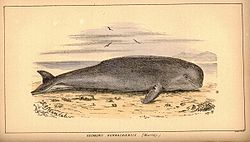
Adults are a uniform, light grey colour. Newborn calves are mostly black with grey around the dorsal ridge area, becoming fully grey after four to six months. Adults grow more than 1.55 m (5 ft) in length and up to 30–45 kg (65–100 lb) in weight. Males become sexually mature at around four to six years of age, and females at around six to 9 years of age.
 Finless porpoises are reported to eat fish and shrimp in the Yangtze River, and fish
, shrimp
and squid
in the Yellow Sea/Bohai area and off Pakistan
. In Japanese waters, they are known to eat fish, shrimp, squid, cuttle fish and octopuses. They are opportunistic feeders using various kinds of available food items available in their habitat. Seasonal changes in their diets have not been studied. They also apparently ingest some plant material when living in estuaries, mangroves, and rivers, including leaves
, rice
, and eggs deposited on vegetation.
.
period of 10–11 months. The calf clings to the denticulated area of skin on their mother's back and is carried by her as she swims. Calves are weaned at six to 15 months.
due to the lack of seaworthy fishing boats, finless porpoises have never been widely hunted in Japan. It is a species protected since 1930 at the area around Awajima Island, Takehara
and this coverage had since been extended to all Japanese coastal waters. The primary danger to the species is the environmental degradation. In addition, unlike other members of this family, finless porpoises have lived in captivity for over 15 years.
There are no well-established estimates of the animals' abundance. However, a comparison of two surveys, one from the late 1970s and the other from 1999–2000, shows a decline in population and distribution. Scientists believe this decline has been ongoing for decades, and the current population is just a fraction of its historical levels. A 2006 expedition estimated fewer than 400 animals survived in the Yangtze River.
At the end of 2006, an estimated 1400 porpoises were left living in China, with between 700 and 900 in the Yangtze and another 500 in Poyang and Dongting Lakes.
The 2007 population levels were less than half the 1997 levels, and the population is dropping at a rate of 7.3% per year. Current conservation efforts were undertaken alongside those for the recently functionally extinct baiji
. In 1990, five individuals were relocated to the Tian-e-Zhou Oxbow Nature Reserve
, and now a population of 28 currently inhabit the lake.
Sand dredging has become a mainstay of local economic development in the last few years, and it is an important source of revenue in the region that borders Poyang Lake. At the same time, though, high-density dredging projects have been the principal cause of the death of the local wildlife population.
Dredging makes the waters of the lake muddier, and the porpoises cannot see as far as they once could, and have to rely on their highly developed sonar systems to avoid obstacles and look for food. Large ships enter and leave the lake at the rate of two a minute, and such a high density of shipping means the porpoises have difficulty hearing their food, and also cannot swim freely from one bank to the other.
The Finless porpoise is listed on Appendix II of the Convention on the Conservation of Migratory Species of Wild Animals (CMS
). It is listed on Appendix II as it has an unfavourable conservation status or would benefit significantly from international co-operation organised by tailored agreements.
series, where Lettuce Midorikawa is infused with the species' DNA.
, a finless porpoise was found nearly one mile inland in a rice paddy. It was rescued and returned to the Pacific ocean
.
Porpoise
Porpoises are small cetaceans of the family Phocoenidae; they are related to whales and dolphins. They are distinct from dolphins, although the word "porpoise" has been used to refer to any small dolphin, especially by sailors and fishermen...
species. In the waters around Japan, at the northern end of its range, it is known as the sunameri (砂滑). A freshwater population found in the Yangtze River
Yangtze River
The Yangtze, Yangzi or Cháng Jiāng is the longest river in Asia, and the third-longest in the world. It flows for from the glaciers on the Tibetan Plateau in Qinghai eastward across southwest, central and eastern China before emptying into the East China Sea at Shanghai. It is also one of the...
in China
China
Chinese civilization may refer to:* China for more general discussion of the country.* Chinese culture* Greater China, the transnational community of ethnic Chinese.* History of China* Sinosphere, the area historically affected by Chinese culture...
is known locally as the jiangzhu (江猪) or "river pig". There is a degree of taxonomic uncertainty surrounding the species, with the N. p. phocaenoides subspecies perhaps representing a different species from N. p. sunameri and N. p. asiaeorientalis.
Distribution
The finless porpoise lives in the coastal waters of AsiaAsia
Asia is the world's largest and most populous continent, located primarily in the eastern and northern hemispheres. It covers 8.7% of the Earth's total surface area and with approximately 3.879 billion people, it hosts 60% of the world's current human population...
, especially around Korea
Korea
Korea ) is an East Asian geographic region that is currently divided into two separate sovereign states — North Korea and South Korea. Located on the Korean Peninsula, Korea is bordered by the People's Republic of China to the northwest, Russia to the northeast, and is separated from Japan to the...
, India
India
India , officially the Republic of India , is a country in South Asia. It is the seventh-largest country by geographical area, the second-most populous country with over 1.2 billion people, and the most populous democracy in the world...
, China
China
Chinese civilization may refer to:* China for more general discussion of the country.* Chinese culture* Greater China, the transnational community of ethnic Chinese.* History of China* Sinosphere, the area historically affected by Chinese culture...
, Indonesia
Indonesia
Indonesia , officially the Republic of Indonesia , is a country in Southeast Asia and Oceania. Indonesia is an archipelago comprising approximately 13,000 islands. It has 33 provinces with over 238 million people, and is the world's fourth most populous country. Indonesia is a republic, with an...
, Bangladesh
Bangladesh
Bangladesh , officially the People's Republic of Bangladesh is a sovereign state located in South Asia. It is bordered by India on all sides except for a small border with Burma to the far southeast and by the Bay of Bengal to the south...
and Japan
Japan
Japan is an island nation in East Asia. Located in the Pacific Ocean, it lies to the east of the Sea of Japan, China, North Korea, South Korea and Russia, stretching from the Sea of Okhotsk in the north to the East China Sea and Taiwan in the south...
. A unique fresh water population (N. p. asiaeorientalis) is found in the Yangtze River
Yangtze River
The Yangtze, Yangzi or Cháng Jiāng is the longest river in Asia, and the third-longest in the world. It flows for from the glaciers on the Tibetan Plateau in Qinghai eastward across southwest, central and eastern China before emptying into the East China Sea at Shanghai. It is also one of the...
. At the western end, their range includes the length of the western coast of India and continues up into the Persian Gulf
Persian Gulf
The Persian Gulf, in Southwest Asia, is an extension of the Indian Ocean located between Iran and the Arabian Peninsula.The Persian Gulf was the focus of the 1980–1988 Iran-Iraq War, in which each side attacked the other's oil tankers...
. Throughout their range, the porpoises stay in shallow waters (up to 50 m [160 ft]), close to the shore, in waters with soft or sandy seabeds. In exceptional cases, they have been encountered as far as 160 kilometres (99.4 mi) off-shore in the East China
East China Sea
The East China Sea is a marginal sea east of China. It is a part of the Pacific Ocean and covers an area of 1,249,000 km² or 750,000 square miles.-Geography:...
and Yellow Sea
Yellow Sea
The Yellow Sea is the name given to the northern part of the East China Sea, which is a marginal sea of the Pacific Ocean. It is located between mainland China and the Korean Peninsula. Its name comes from the sand particles from Gobi Desert sand storms that turn the surface of the water golden...
s, albeit still in shallow water. N. p. phocaenoides has wide ridge on its back and ranges from Pakistan to the Taiwan straits. N. p. sunameri has a narrower ridge, and is found from Taiwan, north to the sea of Japan. The population in coastal waters around Japan is geographically isolated by the deep waters between Japan and continental Asia.
Physical description
The finless porpoise almost completely lacks a dorsal finDorsal fin
A dorsal fin is a fin located on the backs of various unrelated marine and freshwater vertebrates, including most fishes, marine mammals , and the ichthyosaurs...
. Instead there is a low ridge covered in thick denticulated skin.
Adults are a uniform, light grey colour. Newborn calves are mostly black with grey around the dorsal ridge area, becoming fully grey after four to six months. Adults grow more than 1.55 m (5 ft) in length and up to 30–45 kg (65–100 lb) in weight. Males become sexually mature at around four to six years of age, and females at around six to 9 years of age.
Diet
Fish
Fish are a paraphyletic group of organisms that consist of all gill-bearing aquatic vertebrate animals that lack limbs with digits. Included in this definition are the living hagfish, lampreys, and cartilaginous and bony fish, as well as various extinct related groups...
, shrimp
Shrimp
Shrimp are swimming, decapod crustaceans classified in the infraorder Caridea, found widely around the world in both fresh and salt water. Adult shrimp are filter feeding benthic animals living close to the bottom. They can live in schools and can swim rapidly backwards. Shrimp are an important...
and squid
Squid
Squid are cephalopods of the order Teuthida, which comprises around 300 species. Like all other cephalopods, squid have a distinct head, bilateral symmetry, a mantle, and arms. Squid, like cuttlefish, have eight arms arranged in pairs and two, usually longer, tentacles...
in the Yellow Sea/Bohai area and off Pakistan
Pakistan
Pakistan , officially the Islamic Republic of Pakistan is a sovereign state in South Asia. It has a coastline along the Arabian Sea and the Gulf of Oman in the south and is bordered by Afghanistan and Iran in the west, India in the east and China in the far northeast. In the north, Tajikistan...
. In Japanese waters, they are known to eat fish, shrimp, squid, cuttle fish and octopuses. They are opportunistic feeders using various kinds of available food items available in their habitat. Seasonal changes in their diets have not been studied. They also apparently ingest some plant material when living in estuaries, mangroves, and rivers, including leaves
Leaves
-History:Vocalist Arnar Gudjonsson was formerly the guitarist with Mower, and he was joined by Hallur Hallsson , Arnar Ólafsson , Bjarni Grímsson , and Andri Ásgrímsson . Late in 2001 they played with Emiliana Torrini and drew early praise from the New York Times...
, rice
Rice
Rice is the seed of the monocot plants Oryza sativa or Oryza glaberrima . As a cereal grain, it is the most important staple food for a large part of the world's human population, especially in East Asia, Southeast Asia, South Asia, the Middle East, and the West Indies...
, and eggs deposited on vegetation.
Schooling
Finless porpoises are generally found as singles, pairs, or in groups of up to 12, although aggregations of up to about 50 have been reported. Recent data suggest the basic unit of a finless porpoise pod is a mother/calf pair or two adults, and schools of three or more individuals are aggregations of these units or of solitary individuals. Social structure seems to be underdeveloped in the species, and the mother/calf pair is probably the only stable social unitSocial unit
Social unit is a term used in sociology, anthropology, ethnology, and also in animal behaviour studies, zoology and biology to describe a social entity which is part of and participates in a larger social group or society....
.
Behaviour and reproduction
Like other porpoises, their behaviour tends to be not as energetic and showy as that of dolphins. They do not ride bow waves, and in some areas appear to be shy of boats. In the Yangtze River, finless porpoises are known to leap from the water and perform "tail stands". Breeding occurs in late spring and early summer, after a gestationGestation
Gestation is the carrying of an embryo or fetus inside a female viviparous animal. Mammals during pregnancy can have one or more gestations at the same time ....
period of 10–11 months. The calf clings to the denticulated area of skin on their mother's back and is carried by her as she swims. Calves are weaned at six to 15 months.
Swimming style
Although they show no acrobatics in the water, finless porpoises are believed to be very active swimmers. They typically swim just beneath the surface of the water and roll to one side when surfacing to breathe. This rolling movement disturbs very little water on the surface, so they are often overlooked when rising to breathe. Surfacing generally lasts for one minute, as they take three to four quick successive breaths, then quickly submerge into the water. They often surface a great distance from the point where they dive beneath the water's surface.Conservation
On the IUCN "red list" database of endangered species, the finless porpoise is listed as "vulnerable" due to apparent declines in the best studied populations in the Sea of Japan, and the Yangtse river basin. The fresh water subspecies in the Yangtze river is characterized as endangered. Since this species remains in coastal waters, it has a high degree of interaction with humans, which often puts the finless porpoise at risk. Like other porpoises, large numbers of this species are killed by entanglement in gill nets. Except for being briefly hunted after World War IIWorld War II
World War II, or the Second World War , was a global conflict lasting from 1939 to 1945, involving most of the world's nations—including all of the great powers—eventually forming two opposing military alliances: the Allies and the Axis...
due to the lack of seaworthy fishing boats, finless porpoises have never been widely hunted in Japan. It is a species protected since 1930 at the area around Awajima Island, Takehara
Takehara, Hiroshima
is a city located in Hiroshima, Japan., the city has an estimated population of 29,093 and a density of 246 persons per km². The total area is 118.30 km².The city was founded on November 3, 1958....
and this coverage had since been extended to all Japanese coastal waters. The primary danger to the species is the environmental degradation. In addition, unlike other members of this family, finless porpoises have lived in captivity for over 15 years.
There are no well-established estimates of the animals' abundance. However, a comparison of two surveys, one from the late 1970s and the other from 1999–2000, shows a decline in population and distribution. Scientists believe this decline has been ongoing for decades, and the current population is just a fraction of its historical levels. A 2006 expedition estimated fewer than 400 animals survived in the Yangtze River.
At the end of 2006, an estimated 1400 porpoises were left living in China, with between 700 and 900 in the Yangtze and another 500 in Poyang and Dongting Lakes.
The 2007 population levels were less than half the 1997 levels, and the population is dropping at a rate of 7.3% per year. Current conservation efforts were undertaken alongside those for the recently functionally extinct baiji
Baiji
Baiji may refer to:* The Baiji or Yangtze River Dolphin * Baiji, Iraq, a city of northern Iraq.* "Baiji" is the pinyin Romanization for Baekje....
. In 1990, five individuals were relocated to the Tian-e-Zhou Oxbow Nature Reserve
Tian-e-Zhou Oxbow Nature Reserve
The Tian-e-Zhou Oxbow Nature Reserve is an area of wetland in the Yangtze basin near Shishou city.Inside the reserve is the Tian'e-Zhou lake which was an intended sanctuary for the Baiji and is currently holding 28 Finless Porpoises....
, and now a population of 28 currently inhabit the lake.
Sand dredging has become a mainstay of local economic development in the last few years, and it is an important source of revenue in the region that borders Poyang Lake. At the same time, though, high-density dredging projects have been the principal cause of the death of the local wildlife population.
Dredging makes the waters of the lake muddier, and the porpoises cannot see as far as they once could, and have to rely on their highly developed sonar systems to avoid obstacles and look for food. Large ships enter and leave the lake at the rate of two a minute, and such a high density of shipping means the porpoises have difficulty hearing their food, and also cannot swim freely from one bank to the other.
The Finless porpoise is listed on Appendix II of the Convention on the Conservation of Migratory Species of Wild Animals (CMS
Bonn Convention
The Convention on the Conservation of Migratory Species of Wild Animals aims to conserve terrestrial, marine and avian migratory species throughout their range...
). It is listed on Appendix II as it has an unfavourable conservation status or would benefit significantly from international co-operation organised by tailored agreements.
Popular culture
The finless porpoise is specifically brought to public attention in the fictional Tokyo Mew MewTokyo Mew Mew
, also known as Mew Mew Power, is a Japanese shōjo manga series written by Reiko Yoshida and illustrated by Mia Ikumi. It was originally serialized in Nakayoshi from September 2000 to February 2003, and later published in seven tankōbon volumes by Kodansha from February 2001 to April 2003...
series, where Lettuce Midorikawa is infused with the species' DNA.
In the media
In 2011, after the 2011 Tōhoku earthquake and tsunami2011 Tōhoku earthquake and tsunami
The 2011 earthquake off the Pacific coast of Tohoku, also known as the 2011 Tohoku earthquake, or the Great East Japan Earthquake, was a magnitude 9.0 undersea megathrust earthquake off the coast of Japan that occurred at 14:46 JST on Friday, 11 March 2011, with the epicenter approximately east...
, a finless porpoise was found nearly one mile inland in a rice paddy. It was rescued and returned to the Pacific ocean
Pacific Ocean
The Pacific Ocean is the largest of the Earth's oceanic divisions. It extends from the Arctic in the north to the Southern Ocean in the south, bounded by Asia and Australia in the west, and the Americas in the east.At 165.2 million square kilometres in area, this largest division of the World...
.