

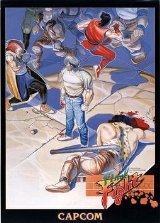
Final Fight

Encyclopedia
is a side-scrolling beat-'em-up game originally released by Capcom
as a coin-operated video game
in . It was the seventh game released by Capcom for their CP System arcade game hardware. The player takes control of one of three vigilantes who must rescue a kidnapped young woman from a ruthless street gang.
The game was originally conceived as a sequel
to the original Street Fighter
titled Street Fighter '89, but the title was changed before its release when the game's genre changed from a one-on-one competitive fighting game
to a side-scrolling action game similar to Double Dragon
or Golden Axe
. Final Fight was ported to various platforms, such as the Super NES
and Mega-CD, since its original coin-op release.
Final Fight was followed by a series of sequel
s that were produced primarily for the home console market, and some of the game's characters would reappear in later Street Fighter games.
. A former professional wrestler
named Mike Haggar
is elected as the new Mayor of the city, promising to handle the city's criminal problem in his campaign. The Mad Gear gang, the dominant criminal organization of the city, plots to bring Haggar under their control by kidnapping his daughter Jessica and using her as leverage against him. Enlisting the help of Cody, Jessica's boyfriend and a Martial Arts master himself, as well as Cody's sparring partner, a ninjutsu
master named Guy
, Haggar opts to fight the gang instead in order to save his daughter.
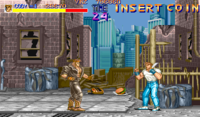 Final Fight can be played by up to two players simultaneously, with each player controlling a different character. Before the game begins, the player chooses between the three main characters, Guy, Cody, and Haggar, each with his own fighting style and attributes. Guy is the weakest but has faster attacks, Haggar is the strongest but also the slowest, and Cody has all-round attributes.
The controls consists of an eight-way joystick and two buttons for attacking and jumping. The player character can move in any of the eight directions, but can only face and attack to the left or right like in most beat-'em-ups. Pressing both buttons simultaneously performs a special move that attacks in both directions, though uses a little vitality. Players can also grab and throw opponents, as well as use various weapons such as knives, pipes, and swords.
unique to that round.
cites the arcade version of Double Dragon II: The Revenge
as his basis for Final Fight. Final Fight was originally shown at trade shows under the title of Street Fighter '89. According to Okamoto, the sales division of Capcom originally requested a Street Fighter sequel, so his team decided to promote Final Fight as a Street Fighter sequel at trade shows (going as far to refer to one of the main characters as a "former Street Fighter"). The title was changed to Final Fight before its official release after feedback from operators stating that the game was nothing like Street Fighter.
According to the developers, many elements from the game and its plot were inspired by the eighties action film, Streets of Fire
. Many members of the production staff are fans of the movie. One of the main characters from the game, Cody, was inspired by the hero of the film, Tom Cody, who was played by actor Michael Paré
. The story of the movie also dealt with the kidnapping of an attractive young woman by a city gang.
The street gang the player faces in the game, the Mad Gear Gang, takes their name from a 1987 overhead racing game by Capcom of the same name. The game was released as Led Storm outside Japan.
Many of the characters are named after 1980s rock musicians such as Axl Rose
, Slash
, Gene Simmons
, (Sid) Sid Vicious
, (Billy) Billy Idol
, (Abigail, named after King Diamond's 2nd album
and also dons facepaint similar to King Diamond) King Diamond
, Roxy Music
and Poison
, with another being from the game Forgotten Worlds
.
was released as a launch title for the platform in Japan
in and later in North America
in and then in the PAL region
in . It was released for the Wii
s Virtual Console
service in . The 2 player game mode was removed, turning the game into a single player only experience; the Industrial Area round, along with its boss Rolento, were removed; and Guy, one of the main characters, was omitted, leaving Cody and Haggar as the remaining playable characters. Most of the scene transitions were also edited out. In the arcade version, the players would be seen exiting the levels and breaking through doors unlike the SNES version.
The English localization of the SNES port was censored for its content and features several differences from its Japanese Super Famicom counterpart: the first two bosses, Damnd and Sodom, were renamed Thrasher and Katana respectively; Belger's wheelchair was redrawn to look like an office chair; Poison and Roxy, two male-to-female transvestite enemy characters, were replaced with two male punks named Billy and Sid; all alcoholic references were removed, with two health recovering items replaced; a punk's phrase of "Oh! My God" (when his car is destroyed by the player during the first bonus stage) was changed to "Oh! My Car"; the blood splash effect shown when a character is stabbed is replaced by a generic explosion; and finally, the skin tones of certain enemy characters such as Dug and Simons were lightened as well.
A revised edition of the SNES port, titled Final Fight Guy, was released in Japan in . This version replaces Cody with Guy as a selectable character (with a new opening and ending sequence explaining Cody's absence), changes the game's enemy placement and difficulty settings, and adds other new features such as two new power-up
s (a Guy/Haggar doll which grants the player an extra life and a Jessica doll which grants the player temporary invincibility), although the Industrial Area stage and the 2-Player mode were still missing from this revision. An American version of the game (featuring the same changes in the localization as in the first game) was released in June as a rental-only game that was initially available at Blockbuster stores.
released ports of Final Fight for the Amiga
, Atari ST
, Commodore 64
, ZX Spectrum
and Amstrad CPC
for the Europe
an market in . These ports were developed by Creative Materials.
computer platform was released by Capcom exclusively in Japan on July 17, . This version is a relatively close conversion of the arcade game, with the only notable changes being different music (with a choice between a MIDI soundtrack and one using the X68000's internal sound chip) and a reduced number of maximum on-screen enemies. The game came packaged with a CD soundtrack with all new remixed tunes.
under license from Capcom in 1993. This version retains nearly all the features of the arcade game which were removed in the two SNES ports (namely the 2-player game mode, the Industrial Area stage, and the ability to play as any of the three main characters), adding voice acting
to the game's opening and ending sequence, an arranged
version of the original soundtrack, and an exclusive time attack mode. Like the SNES version, the Mega-CD version was still censored for the English localization with many of the same changes. Poison and Roxy were kept this time, but were redrawn with less revealing clothing (longer shorts and shirts) to hide all nudity.
version, titled Final Fight One, was released in 2001. Final Fight One features all three characters and the Industrial Area stage that was missing from the SNES version. The 2-player cooperative mode is also featured via link cable. Dialogue scenes prior to each boss battle have been added and the Street Fighter Alpha 3
renditions of Cody and Guy are featured as hidden playable characters. The English localization of the game features the same changes as the two SNES versions. However, unlike the SNES versions, Damnd and Sodom kept their original names, but Poison and Roxy were still replaced, like they were in the SNES version.
for the PlayStation 2
and Xbox
, and in the portable version Capcom Classics Collection Remixed for the PlayStation Portable
. The game is emulated from the original CP System arcade version and features very little differences from the arcade game. The compilation includes tips, character profiles, an art gallery and a sound test as bonus features.
for the PS2 and Xbox. However, the emulation in this version was programmed by Ultracade, rather than Digital Eclipse
(the developers of Capcom Classics Collection series). The controls cannot be adjusted and the quality is lower than other emulated versions.
, for Xbox Live Arcade
and PlayStation Network. Added features include various graphic filters, including an arcade cabinet view, online drop-in multiplayer, an arranged soundtrack composed by Simon Viklund (who worked on Bionic Commando Rearmed
), and extra content such as concept art and comic pages which are unlocked by completing certain in-game challenges. The game was ported and developed by Proper Games
and released for Xbox Live Arcade for 800 Microsoft points and April 15, 2010 for PlayStation Network for $9.99. The PS3 version features a very restrictive DRM
protection which circumvents the ability other PSN games have to be shared among several PSN accounts. The DRM protection was met with a negative response as it had not been disclosed previous to the game's release.
was displayed on the cover of this issue, who took the No. 1 spot in the Top 50 Characters of the year, with Guy
in second place, Cody at No. 7, Poison
at No. 26, Sodom at No. 33, and Jessica at No. 40.
s for the SNES: Final Fight 2
in 1993 and Final Fight 3
(Final Fight Tough in Japan) in 1995, produced specifically for the home console market by Capcom's consumer division with no preceding arcade versions. A parody of the original game titled Mighty Final Fight
was released for the Nintendo Entertainment System
and featured child-like
versions of the original Final Fight characters. A competitive fighting game
spinoff, Final Fight Revenge
, was released for Sega's Titan arcade hardware in 1999, which was followed by a home version for the Sega Saturn
in Japan only. A 3D sequel titled Final Fight: Streetwise
was released in 2006 for the PlayStation 2
and Xbox
.
and its two sequels, Muscle Bomber Duo and Slam Masters II: Ring of Destruction with his daughter Jessica appearing alongside him. A few Final Fight characters would also re-emerge as playable characters in later Street Fighter games and other competitive fighting games by Capcom: Guy
and Sodom appeared in Street Fighter Alpha in , followed by Rolento in Street Fighter Alpha 2
in and Cody in Street Fighter Alpha 3
in . Guy's stage in Street Fighter Alpha 2 features several cameos of characters from Final Fight, such as Cody, Haggar, and some enemy characters. Andore would make a reappearance as a playable character in Street Fighter III 2nd Impact
under the name Hugo in . He is accompanied by Poison as his manager. Both would reappear in SNK vs. Capcom: SVC Chaos , which also features the cameo appearances of the two first Final Fight bosses, Damnd and Sodom, in Chun-Li
's ending. Guy is a playable character in Capcom Fighting Jam
while Cody, Haggar, Jessica, Hugo, and Sodom appear in the game as cameo characters. Both Guy and Mike Haggar are playable characters in the Namco-published crossover game, Namco x Capcom
, which was released for the PlayStation 2 in Japan only. Guy would be paired with Sho, a.k.a. Ginzu the Ninja, from Captain Commando
.
Both Cody and Guy are playable characters in Super Street Fighter IV
while Hugo is in a cameo in a stage and a large statue of Mike Haggar also appear in the game as well, released in 2010. Cody's musical theme is a remix of the intro music from Final Fight. There is also a downloadable Mike Haggar outfit for Zangief
in Street Fighter IV
. Rolento was considered as a playable character for Super Street Fighter IV
, but was edged out by Adon as he had slightly more interest. However, the construction site from his boss battle features as one of the stages.
The car-vandalizing bonus stage
was later used in early versions of Street Fighter II. In Super Street Fighter IV, if Cody or Guy are vandalizing the car in the bonus stage, Mad Gear member Bred will appear and complain, in the same way as he does in Final Fight.
Mike Haggar is a playable character in Marvel vs. Capcom 3: Fate of Two Worlds
. He is the first character from the Final Fight series to be featured in the Marvel vs. Capcom series. In the game, there is also a stage that takes place in Metro City with the Mad Gear gang fighting the police in the background.
Hugo, Poison and Rolento will be playable characters in the upcoming Street Fighter X Tekken
.
animated series featured an episode based on Final Fight and titled after the game, which aired during the shows second season. Adapting the plot of the game, the "Final Fight" episode centered around Cody and Guy teaming up with leading Street Fighter characters Ryu
and Ken to rescue Jessica from the Mad Gear Gang. Although, Guy and Cody were both characters in the Street Fighter series, the episode actually predates Cody's first appearance in the series as a playable character in Street Fighter Alpha 3 and depicts him in his character design from Final Fight. The episode is included as unlockable content in Final Fight: Double Impact.
The Street Fighter II Turbo comic book by UDON Entertainment
features a supplemental story arc spanning issues 6 and 7 centering around the Final Fight characters who were featured in the Street Fighter series.
The actor Robin Williams
stated that he named his son Cody Williams after a video game character, which is believed to be Cody from Final Fight.
Capcom
is a Japanese developer and publisher of video games, known for creating multi-million-selling franchises such as Devil May Cry, Chaos Legion, Street Fighter, Mega Man and Resident Evil. Capcom developed and published Bionic Commando, Lost Planet and Dark Void too, but they are less known. Its...
as a coin-operated video game
Arcade game
An arcade game is a coin-operated entertainment machine, usually installed in public businesses such as restaurants, bars, and amusement arcades. Most arcade games are video games, pinball machines, electro-mechanical games, redemption games, and merchandisers...
in . It was the seventh game released by Capcom for their CP System arcade game hardware. The player takes control of one of three vigilantes who must rescue a kidnapped young woman from a ruthless street gang.
The game was originally conceived as a sequel
Sequel
A sequel is a narrative, documental, or other work of literature, film, theatre, or music that continues the story of or expands upon issues presented in some previous work...
to the original Street Fighter
Street Fighter (video game)
is a 1987 arcade game developed by Capcom. It is the first competitive fighting game produced by the company and the inaugural game in the Street Fighter series...
titled Street Fighter '89, but the title was changed before its release when the game's genre changed from a one-on-one competitive fighting game
Fighting game
Fighting game is a video game genre where the player controls an on-screen character and engages in close combat with an opponent. These characters tend to be of equal power and fight matches consisting of several rounds, which take place in an arena. Players must master techniques such as...
to a side-scrolling action game similar to Double Dragon
Double Dragon
is a classic beat 'em up video game series initially developed by Technos Japan Corporation, who also developed the Kunio-kun series ....
or Golden Axe
Golden Axe
Golden Axe is a side-scrolling beat 'em up and hack & slash arcade video game released in 1989 by Sega for the System 16-B arcade hardware. It is the first game in the Golden Axe series....
. Final Fight was ported to various platforms, such as the Super NES
Super Nintendo Entertainment System
The Super Nintendo Entertainment System is a 16-bit video game console that was released by Nintendo in North America, Europe, Australasia , and South America between 1990 and 1993. In Japan and Southeast Asia, the system is called the , or SFC for short...
and Mega-CD, since its original coin-op release.
Final Fight was followed by a series of sequel
Sequel
A sequel is a narrative, documental, or other work of literature, film, theatre, or music that continues the story of or expands upon issues presented in some previous work...
s that were produced primarily for the home console market, and some of the game's characters would reappear in later Street Fighter games.
Plot
Chronologically set during the time of the original Street Fighter, Final Fight is set in the fictional American metropolis of Metro City, based on New York CityNew York City
New York is the most populous city in the United States and the center of the New York Metropolitan Area, one of the most populous metropolitan areas in the world. New York exerts a significant impact upon global commerce, finance, media, art, fashion, research, technology, education, and...
. A former professional wrestler
Professional wrestling
Professional wrestling is a mode of spectacle, combining athletics and theatrical performance.Roland Barthes, "The World of Wrestling", Mythologies, 1957 It takes the form of events, held by touring companies, which mimic a title match combat sport...
named Mike Haggar
Mike Haggar
, also known simply as Haggar, Mayor of Earth, is a fictional character in the Final Fight series of video games. Haggar first appeared in the 1989 Capcom arcade game Final Fight and its subsequent sequels, later appearing in the Saturday Night Slam Masters series of video games and various other...
is elected as the new Mayor of the city, promising to handle the city's criminal problem in his campaign. The Mad Gear gang, the dominant criminal organization of the city, plots to bring Haggar under their control by kidnapping his daughter Jessica and using her as leverage against him. Enlisting the help of Cody, Jessica's boyfriend and a Martial Arts master himself, as well as Cody's sparring partner, a ninjutsu
Ninjutsu
or may be:*the arts associated with espionage and assassination in feudal Japan, see Ninja*modern schools of martial arts claiming to be based in these traditions, see Modern Schools of Ninjutsu*fictional depictions, see Ninja in popular culture...
master named Guy
Guy (Final Fight)
is a video game character who first appears in the 1989 arcade beat-em-up Final Fight by Capcom. Guy would later reemerge, along with other Final Fight characters, as a fighting game character in Street Fighter Alpha: Warriors' Dreams and its sequels...
, Haggar opts to fight the gang instead in order to save his daughter.
Gameplay
The controls consists of an eight-way joystick and two buttons for attacking and jumping. The player character can move in any of the eight directions, but can only face and attack to the left or right like in most beat-'em-ups. Pressing both buttons simultaneously performs a special move that attacks in both directions, though uses a little vitality. Players can also grab and throw opponents, as well as use various weapons such as knives, pipes, and swords.
Levels
Final Fight consists of six stages or "rounds", as well as two bonus rounds. Each round takes place in a different section of Metro City such as the Slums and the Subway, with most rounds featuring more than one level. At the end of each round the player will face a boss characterBoss (video games)
A boss is an enemy-based challenge which is found in video games. A fight with a boss character is commonly referred to as a boss battle or boss fight...
unique to that round.
| Stage | Description | Boss |
|---|---|---|
| 1 | Slums | Damnd (Thrasher in the U.S version) |
| 2 | Subway | Sodom (Katana in the U.S version) |
| Bonus | Break Car | |
| 3 | West Side | Edi. E |
| 4 | Industrial Area | Rolento |
| Bonus | Break Glass | |
| 5 | Bay Area | Abigail |
| 6 | Up Town | Belger |
Development
Yoshiki OkamotoYoshiki Okamoto
Yoshiki Okamoto , sometimes credited as Kihaji Okamoto, is a video game designer credited with producing many popular titles for Konami, including Gyruss and Time Pilot, and Capcom, including Final Fight and Street Fighter II...
cites the arcade version of Double Dragon II: The Revenge
Double Dragon II: The Revenge
is a side-scrolling beat 'em up produced by Technos originally released as a coin-operated arcade game in . It is the sequel to Double Dragon, released during the previous year. A home version for the Nintendo Entertainment System was released in which differs drastically from the original arcade...
as his basis for Final Fight. Final Fight was originally shown at trade shows under the title of Street Fighter '89. According to Okamoto, the sales division of Capcom originally requested a Street Fighter sequel, so his team decided to promote Final Fight as a Street Fighter sequel at trade shows (going as far to refer to one of the main characters as a "former Street Fighter"). The title was changed to Final Fight before its official release after feedback from operators stating that the game was nothing like Street Fighter.
According to the developers, many elements from the game and its plot were inspired by the eighties action film, Streets of Fire
Streets of Fire
Streets of Fire is a 1984 film directed by Walter Hill and co-written by Hill and Larry Gross. It was described in previews, trailers, and posters as "A Rock & Roll Fable." It is an unusual mix of musical, action, drama, and comedy with elements both of retro-1950s and 1980s...
. Many members of the production staff are fans of the movie. One of the main characters from the game, Cody, was inspired by the hero of the film, Tom Cody, who was played by actor Michael Paré
Michael Paré
- Early life :Paré was born in Brooklyn, New York, the son of Joan, a homemaker, and Francis Paré, who owned print shops. He had six sisters and three brothers. Paré's father was of French-Canadian ancestry and his mother of Irish ancestry....
. The story of the movie also dealt with the kidnapping of an attractive young woman by a city gang.
The street gang the player faces in the game, the Mad Gear Gang, takes their name from a 1987 overhead racing game by Capcom of the same name. The game was released as Led Storm outside Japan.
Many of the characters are named after 1980s rock musicians such as Axl Rose
Axl Rose
W. Axl Rose is an American singer-songwriter and musician. He is the lead vocalist and only remaining original member of the hard rock band Guns N' Roses, with whom he enjoyed great success and recognition in the late 1980s and early 1990s, before disappearing from the public eye for several years...
, Slash
Slash (musician)
Saul Hudson , known by his stage name Slash, is a British-American musician and songwriter. He is best known as the former lead guitarist of the American hard rock band Guns N' Roses, with whom he achieved worldwide success in the late 1980s and early 1990s. During his later years with Guns N'...
, Gene Simmons
Gene Simmons
Gene Simmons is an Israeli-American entrepreneur, singer-songwriter, actor, and rock bassist. Known as "The Demon", he is the bassist/vocalist of Kiss, a hard rock band he co-founded in the early 1970s.-Early life:...
, (Sid) Sid Vicious
Sid Vicious
Sid Vicious was an English musician best known as the bassist of the influential punk rock group Sex Pistols...
, (Billy) Billy Idol
Billy Idol
William Michael Albert Broad , better known by his stage name Billy Idol, is an English rock musician. A member of the Bromley Contingent of Sex Pistols fans, Idol first achieved fame in the punk rock era as a member of the band Generation X...
, (Abigail, named after King Diamond's 2nd album
Abigail (album)
-Remaster bonus tracks:-Personnel:* King Diamond – vocals, producer* Andy LaRocque – guitar* Michael Denner – guitar, assistant producer* Timi Hansen – bass guitar* Mikkey Dee – drums, assistant producer...
and also dons facepaint similar to King Diamond) King Diamond
King Diamond (band)
King Diamond is the heavy metal band that King Diamond formed after the split up of his heavy metal band Mercyful Fate, and the departure of Hank Shermann. He was joined by most members of the then defunct Mercyful Fate. The Satanic focus was replaced by a focus on horror stories...
, Roxy Music
Roxy Music
Roxy Music was a British art rock band formed in 1971 by Bryan Ferry, who became the group's lead vocalist and chief songwriter, and bassist Graham Simpson. The other members are Phil Manzanera , Andy Mackay and Paul Thompson . Former members include Brian Eno , and Eddie Jobson...
and Poison
Poison (band)
Poison is an American glam metal band that achieved great success in the mid-1980s to mid-1990s. To date, Poison has sold over 30 million records worldwide and have sold 15 million records in the United States alone. The band has also charted ten singles to the Top 40 of the Billboard Hot 100,...
, with another being from the game Forgotten Worlds
Forgotten Worlds
Forgotten Worlds, originally titled in Japan, is a side-scrolling shoot-'em-up game by Capcom originally released as a coin-operated video game in...
.
Super NES
An 8-megabit port of Final Fight for the Super Nintendo Entertainment SystemSuper Nintendo Entertainment System
The Super Nintendo Entertainment System is a 16-bit video game console that was released by Nintendo in North America, Europe, Australasia , and South America between 1990 and 1993. In Japan and Southeast Asia, the system is called the , or SFC for short...
was released as a launch title for the platform in Japan
Japan
Japan is an island nation in East Asia. Located in the Pacific Ocean, it lies to the east of the Sea of Japan, China, North Korea, South Korea and Russia, stretching from the Sea of Okhotsk in the north to the East China Sea and Taiwan in the south...
in and later in North America
North America
North America is a continent wholly within the Northern Hemisphere and almost wholly within the Western Hemisphere. It is also considered a northern subcontinent of the Americas...
in and then in the PAL region
PAL region
The PAL region is a television publication territory which covers most of Asia, Africa, Australia, New Zealand, and most of Western Europe...
in . It was released for the Wii
Wii
The Wii is a home video game console released by Nintendo on November 19, 2006. As a seventh-generation console, the Wii primarily competes with Microsoft's Xbox 360 and Sony's PlayStation 3. Nintendo states that its console targets a broader demographic than that of the two others...
s Virtual Console
Virtual console
A virtual console – also known as a virtual terminal – is a conceptual combination of the keyboard and display for a computer user interface. It is a feature of some operating systems such as UnixWare, Linux, and BSD, in which the system console of the computer can be used to switch between...
service in . The 2 player game mode was removed, turning the game into a single player only experience; the Industrial Area round, along with its boss Rolento, were removed; and Guy, one of the main characters, was omitted, leaving Cody and Haggar as the remaining playable characters. Most of the scene transitions were also edited out. In the arcade version, the players would be seen exiting the levels and breaking through doors unlike the SNES version.
The English localization of the SNES port was censored for its content and features several differences from its Japanese Super Famicom counterpart: the first two bosses, Damnd and Sodom, were renamed Thrasher and Katana respectively; Belger's wheelchair was redrawn to look like an office chair; Poison and Roxy, two male-to-female transvestite enemy characters, were replaced with two male punks named Billy and Sid; all alcoholic references were removed, with two health recovering items replaced; a punk's phrase of "Oh! My God" (when his car is destroyed by the player during the first bonus stage) was changed to "Oh! My Car"; the blood splash effect shown when a character is stabbed is replaced by a generic explosion; and finally, the skin tones of certain enemy characters such as Dug and Simons were lightened as well.
A revised edition of the SNES port, titled Final Fight Guy, was released in Japan in . This version replaces Cody with Guy as a selectable character (with a new opening and ending sequence explaining Cody's absence), changes the game's enemy placement and difficulty settings, and adds other new features such as two new power-up
Power-up
In computer and video games, power-ups are objects that instantly benefit or add extra abilities to the game character as a game mechanic. This is in contrast to an item, which may or may not have a benefit and can be used at a time chosen by the player...
s (a Guy/Haggar doll which grants the player an extra life and a Jessica doll which grants the player temporary invincibility), although the Industrial Area stage and the 2-Player mode were still missing from this revision. An American version of the game (featuring the same changes in the localization as in the first game) was released in June as a rental-only game that was initially available at Blockbuster stores.
U.S. Gold versions
U.S. GoldU.S. Gold
U.S. Gold was a British video game publisher and developer from the early 1980s through the mid-1990s, producing numerous titles on a variety of 8-bit, 16-bit and 32-bit platforms.-History:...
released ports of Final Fight for the Amiga
Amiga
The Amiga is a family of personal computers that was sold by Commodore in the 1980s and 1990s. The first model was launched in 1985 as a high-end home computer and became popular for its graphical, audio and multi-tasking abilities...
, Atari ST
Atari ST
The Atari ST is a home/personal computer that was released by Atari Corporation in 1985 and commercially available from that summer into the early 1990s. The "ST" officially stands for "Sixteen/Thirty-two", which referred to the Motorola 68000's 16-bit external bus and 32-bit internals...
, Commodore 64
Commodore 64
The Commodore 64 is an 8-bit home computer introduced by Commodore International in January 1982.Volume production started in the spring of 1982, with machines being released on to the market in August at a price of US$595...
, ZX Spectrum
ZX Spectrum
The ZX Spectrum is an 8-bit personal home computer released in the United Kingdom in 1982 by Sinclair Research Ltd...
and Amstrad CPC
Amstrad CPC
The Amstrad CPC is a series of 8-bit home computers produced by Amstrad between 1984 and 1990. It was designed to compete in the mid-1980s home computer market dominated by the Commodore 64 and the Sinclair ZX Spectrum, where it successfully established itself primarily in the United Kingdom,...
for the Europe
Europe
Europe is, by convention, one of the world's seven continents. Comprising the westernmost peninsula of Eurasia, Europe is generally 'divided' from Asia to its east by the watershed divides of the Ural and Caucasus Mountains, the Ural River, the Caspian and Black Seas, and the waterways connecting...
an market in . These ports were developed by Creative Materials.
X68000
A port for the Sharp X68000Sharp X68000
The Sharp X68000, often referred to as the X68k, is a home computer released only in Japan by the Sharp Corporation. The first model was released in 1987, with a 10 MHz Motorola 68000 CPU, 1 MB of RAM and no hard drive; the last model was released in 1993 with a 25 MHz Motorola 68030...
computer platform was released by Capcom exclusively in Japan on July 17, . This version is a relatively close conversion of the arcade game, with the only notable changes being different music (with a choice between a MIDI soundtrack and one using the X68000's internal sound chip) and a reduced number of maximum on-screen enemies. The game came packaged with a CD soundtrack with all new remixed tunes.
Mega-CD/Sega-CD
The Mega-CD/Sega-CD version, titled Final Fight CD, was ported and published by SegaSega
, usually styled as SEGA, is a multinational video game software developer and an arcade software and hardware development company headquartered in Ōta, Tokyo, Japan, with various offices around the world...
under license from Capcom in 1993. This version retains nearly all the features of the arcade game which were removed in the two SNES ports (namely the 2-player game mode, the Industrial Area stage, and the ability to play as any of the three main characters), adding voice acting
Voice acting
Voice acting is the art of providing voices for animated characters and radio and audio dramas and comedy, as well as doing voice-overs in radio and television commercials, audio dramas, dubbed foreign language films, video games, puppet shows, and amusement rides.Performers are called...
to the game's opening and ending sequence, an arranged
Arrangement
The American Federation of Musicians defines arranging as "the art of preparing and adapting an already written composition for presentation in other than its original form. An arrangement may include reharmonization, paraphrasing, and/or development of a composition, so that it fully represents...
version of the original soundtrack, and an exclusive time attack mode. Like the SNES version, the Mega-CD version was still censored for the English localization with many of the same changes. Poison and Roxy were kept this time, but were redrawn with less revealing clothing (longer shorts and shirts) to hide all nudity.
Game Boy Advance
The Game Boy AdvanceGame Boy Advance
The is a 32-bit handheld video game console developed, manufactured, and marketed by Nintendo. It is the successor to the Game Boy Color. It was released in Japan on March 21, 2001; in North America on June 11, 2001; in Australia and Europe on June 22, 2001; and in the People's Republic of China...
version, titled Final Fight One, was released in 2001. Final Fight One features all three characters and the Industrial Area stage that was missing from the SNES version. The 2-player cooperative mode is also featured via link cable. Dialogue scenes prior to each boss battle have been added and the Street Fighter Alpha 3
Street Fighter Alpha 3
Street Fighter Alpha 3, known as in Japan and Asia, is a fighting game by Capcom originally released for the CPS II arcade hardware. It is the third game in the Street Fighter Alpha series, following Street Fighter Alpha: Warriors' Dreams and Street Fighter Alpha 2...
renditions of Cody and Guy are featured as hidden playable characters. The English localization of the game features the same changes as the two SNES versions. However, unlike the SNES versions, Damnd and Sodom kept their original names, but Poison and Roxy were still replaced, like they were in the SNES version.
Version in Capcom Classics Collection
Final Fight is included in the compilation Capcom Classics Collection Volume 1Capcom Classics Collection
Capcom Classics Collection is a compilation of arcade games released by Capcom for the PlayStation 2 and Xbox on September 27, 2005. It was developed by Digital Eclipse Software . A second volume, Capcom Classics Collection Vol...
for the PlayStation 2
PlayStation 2
The PlayStation 2 is a sixth-generation video game console manufactured by Sony as part of the PlayStation series. Its development was announced in March 1999 and it was first released on March 4, 2000, in Japan...
and Xbox
Xbox
The Xbox is a sixth-generation video game console manufactured by Microsoft. It was released on November 15, 2001 in North America, February 22, 2002 in Japan, and March 14, 2002 in Australia and Europe and is the predecessor to the Xbox 360. It was Microsoft's first foray into the gaming console...
, and in the portable version Capcom Classics Collection Remixed for the PlayStation Portable
PlayStation Portable
The is a handheld game console manufactured and marketed by Sony Corporation Development of the console was announced during E3 2003, and it was unveiled on , 2004, at a Sony press conference before E3 2004...
. The game is emulated from the original CP System arcade version and features very little differences from the arcade game. The compilation includes tips, character profiles, an art gallery and a sound test as bonus features.
Version in Final Fight: Streetwise
The arcade version is also included as a hidden bonus game in the game Final Fight: StreetwiseFinal Fight: Streetwise
Final Fight: Streetwise is a 3D beat-'em-up produced by Capcom, released in North America and the PAL region for the PlayStation 2 and Xbox in . It is a spin-off of the original Final Fight developed by the American team of Capcom Production Studio 8...
for the PS2 and Xbox. However, the emulation in this version was programmed by Ultracade, rather than Digital Eclipse
Backbone Entertainment
Backbone Entertainment is an independent video game development company located in Emeryville, California.Backbone Entertainment is the result of a 2003 merger between Digital Eclipse Software and ImaginEngine...
(the developers of Capcom Classics Collection series). The controls cannot be adjusted and the quality is lower than other emulated versions.
Final Fight: Double Impact
The arcade version of Final Fight was released in a two-in-one bundle titled Final Fight: Double Impact, alongside the arcade game Magic SwordMagic Sword
, fully titled as Magic Sword - Heroic Fantasy, is a side-scrolling fantasy arcade game released by Capcom in 1990. The game casts the player as a hero who must fight his way through a mystical tower in order to save the world...
, for Xbox Live Arcade
Xbox Live Arcade
Xbox Live Arcade is a type of video game download distribution available primarily in a section of the Xbox Live Marketplace, Microsoft's digital distribution network for the Xbox 360, that focuses on smaller downloadable games from both major publishers and independent game developers...
and PlayStation Network. Added features include various graphic filters, including an arcade cabinet view, online drop-in multiplayer, an arranged soundtrack composed by Simon Viklund (who worked on Bionic Commando Rearmed
Bionic Commando Rearmed
Bionic Commando Rearmed is an enhanced remake of the 1988 Nintendo Entertainment System version of Bionic Commando. It was developed by GRIN and published by Capcom for Microsoft Windows, PlayStation Network, and Xbox Live Arcade and was released on August 13, 2008...
), and extra content such as concept art and comic pages which are unlocked by completing certain in-game challenges. The game was ported and developed by Proper Games
Proper Games
Proper Games is a British video game developer based in Dundee, Scotland. Established in 2006, it is an award-winning studio employing a core group of 15 developers...
and released for Xbox Live Arcade for 800 Microsoft points and April 15, 2010 for PlayStation Network for $9.99. The PS3 version features a very restrictive DRM
Digital rights management
Digital rights management is a class of access control technologies that are used by hardware manufacturers, publishers, copyright holders and individuals with the intent to limit the use of digital content and devices after sale. DRM is any technology that inhibits uses of digital content that...
protection which circumvents the ability other PSN games have to be shared among several PSN accounts. The DRM protection was met with a negative response as it had not been disclosed previous to the game's release.
Reception
In the February 1991 issue of the Japanese coin-operated video game magazine Gamest, Final Fight took No. 1 spot as Best Game of 1990 in the 4th Annual Grand Prize. Final Fight also won the category of Best Action Game, placed No. 4 in Best Video Game Music, No. 9 in Best Graphics, No. 2 in Best Direction, and No. 5 in Best Album. The character Mike HaggarMike Haggar
, also known simply as Haggar, Mayor of Earth, is a fictional character in the Final Fight series of video games. Haggar first appeared in the 1989 Capcom arcade game Final Fight and its subsequent sequels, later appearing in the Saturday Night Slam Masters series of video games and various other...
was displayed on the cover of this issue, who took the No. 1 spot in the Top 50 Characters of the year, with Guy
Guy (Final Fight)
is a video game character who first appears in the 1989 arcade beat-em-up Final Fight by Capcom. Guy would later reemerge, along with other Final Fight characters, as a fighting game character in Street Fighter Alpha: Warriors' Dreams and its sequels...
in second place, Cody at No. 7, Poison
Poison (Final Fight)
is a fictional character in the Final Fight and Street Fighter series of video games. Created by Akira Yasuda for Capcom, Poison first appeared in Final Fight alongside a similar character, Roxy, later appearing in Capcom-produced games, media and merchandise related to the Street Fighter franchise...
at No. 26, Sodom at No. 33, and Jessica at No. 40.
Sequels
Final Fight was followed by two sequelSequel
A sequel is a narrative, documental, or other work of literature, film, theatre, or music that continues the story of or expands upon issues presented in some previous work...
s for the SNES: Final Fight 2
Final Fight 2
Final Fight 2 is a side-scrolling beat 'em up released by Capcom for the Super Nintendo Entertainment System in . It is a sequel to the coin-operated video game Final Fight...
in 1993 and Final Fight 3
Final Fight 3
Final Fight 3, released in Japan as , is a side-scrolling beat 'em up by Capcom originally released for the Super Nintendo Entertainment System in...
(Final Fight Tough in Japan) in 1995, produced specifically for the home console market by Capcom's consumer division with no preceding arcade versions. A parody of the original game titled Mighty Final Fight
Mighty Final Fight
Mighty Final Fight is a side-scrolling beat-'em-up released by Capcom for the Nintendo Entertainment System in . It is a spinoff of Capcom's arcade game Final Fight, which was previously ported to the Super NES in two different editions...
was released for the Nintendo Entertainment System
Nintendo Entertainment System
The Nintendo Entertainment System is an 8-bit video game console that was released by Nintendo in North America during 1985, in Europe during 1986 and Australia in 1987...
and featured child-like
Chibi
is a Japanese slang word meaning "short person" or "small child". The word has gained currency amongst fans of manga and anime. Its meaning is of someone or some animal that is small. It can be translated as "little", but is not used the same way as chiisana [小さな] but rather cute...
versions of the original Final Fight characters. A competitive fighting game
Fighting game
Fighting game is a video game genre where the player controls an on-screen character and engages in close combat with an opponent. These characters tend to be of equal power and fight matches consisting of several rounds, which take place in an arena. Players must master techniques such as...
spinoff, Final Fight Revenge
Final Fight Revenge
is a 1999 American-developed 3D one-on-one fighting game. The game was produced by the American division of Capcom , the same team that later produced Maximo: Ghosts to Glory and Final Fight: Streetwise. Final Fight Revenge was released for the arcades on July 1999 and ran on the Sega ST-V arcade...
, was released for Sega's Titan arcade hardware in 1999, which was followed by a home version for the Sega Saturn
Sega Saturn
The is a 32-bit fifth-generation video game console that was first released by Sega on November 22, 1994 in Japan, May 11, 1995 in North America, and July 8, 1995 in Europe...
in Japan only. A 3D sequel titled Final Fight: Streetwise
Final Fight: Streetwise
Final Fight: Streetwise is a 3D beat-'em-up produced by Capcom, released in North America and the PAL region for the PlayStation 2 and Xbox in . It is a spin-off of the original Final Fight developed by the American team of Capcom Production Studio 8...
was released in 2006 for the PlayStation 2
PlayStation 2
The PlayStation 2 is a sixth-generation video game console manufactured by Sony as part of the PlayStation series. Its development was announced in March 1999 and it was first released on March 4, 2000, in Japan...
and Xbox
Xbox
The Xbox is a sixth-generation video game console manufactured by Microsoft. It was released on November 15, 2001 in North America, February 22, 2002 in Japan, and March 14, 2002 in Australia and Europe and is the predecessor to the Xbox 360. It was Microsoft's first foray into the gaming console...
.
Appearances in other games
The character Mike Haggar is featured as a wrestler in Saturday Night Slam MastersSaturday Night Slam Masters
Saturday Night Slam Masters, known in Japan as , is a 1993 pro wrestling arcade game released for the CP System by Capcom. The game features character designs by manga artist Tetsuo Hara, famous for Fist of the North Star....
and its two sequels, Muscle Bomber Duo and Slam Masters II: Ring of Destruction with his daughter Jessica appearing alongside him. A few Final Fight characters would also re-emerge as playable characters in later Street Fighter games and other competitive fighting games by Capcom: Guy
Guy (Final Fight)
is a video game character who first appears in the 1989 arcade beat-em-up Final Fight by Capcom. Guy would later reemerge, along with other Final Fight characters, as a fighting game character in Street Fighter Alpha: Warriors' Dreams and its sequels...
and Sodom appeared in Street Fighter Alpha in , followed by Rolento in Street Fighter Alpha 2
Street Fighter Alpha 2
Street Fighter Alpha 2, known as in Japan, Asia and South America, is a fighting game originally released for the CPS II arcade hardware by Capcom. The game is both a sequel and a remake to the previous years Street Fighter Alpha: Warriors' Dreams, which is itself a prequel to the Street Fighter...
in and Cody in Street Fighter Alpha 3
Street Fighter Alpha 3
Street Fighter Alpha 3, known as in Japan and Asia, is a fighting game by Capcom originally released for the CPS II arcade hardware. It is the third game in the Street Fighter Alpha series, following Street Fighter Alpha: Warriors' Dreams and Street Fighter Alpha 2...
in . Guy's stage in Street Fighter Alpha 2 features several cameos of characters from Final Fight, such as Cody, Haggar, and some enemy characters. Andore would make a reappearance as a playable character in Street Fighter III 2nd Impact
Street Fighter III
is a fighting game in Capcom's Street Fighter series, originally released as coin-operated arcade game in . Street Fighter III was produced for the CD-ROM-based CP System III hardware, which allowed for more elaborate 2D graphics than the CPS II-based Street Fighter Alpha games , while revamping...
under the name Hugo in . He is accompanied by Poison as his manager. Both would reappear in SNK vs. Capcom: SVC Chaos , which also features the cameo appearances of the two first Final Fight bosses, Damnd and Sodom, in Chun-Li
Chun-Li
is a video game character produced by Capcom. First introduced in Street Fighter II, she has since appeared as a player character in nearly all subsequent games....
's ending. Guy is a playable character in Capcom Fighting Jam
Capcom Fighting Jam
, released in North America as Capcom Fighting Evolution, is a head-to-head fighting game from Capcom. It was originally released as a coin-operated arcade game for the Namco System 246 hardware and ported to the PlayStation 2 and Xbox...
while Cody, Haggar, Jessica, Hugo, and Sodom appear in the game as cameo characters. Both Guy and Mike Haggar are playable characters in the Namco-published crossover game, Namco x Capcom
Namco x Capcom
is an action RPG/tactical RPG hybrid game for the PlayStation 2 console, developed by Monolith Soft and featuring characters from games produced by companies Namco and Capcom.- Storyline :...
, which was released for the PlayStation 2 in Japan only. Guy would be paired with Sho, a.k.a. Ginzu the Ninja, from Captain Commando
Captain Commando
is a futuristic side-scrolling beat 'em up game originally developed and published by Capcom as a coin-operated video game, and later ported to several other platforms. It was the seventeenth title produced for the company's CP System hardware...
.
Both Cody and Guy are playable characters in Super Street Fighter IV
Super Street Fighter IV
is a 2010 fighting game produced by Capcom. It is an updated version of Street Fighter IV and has been said to mark the definitive end of the Street Fighter IV series. Having been deemed as too large an update to be deployed as DLC, the game was made into a standalone title, but given a lower price...
while Hugo is in a cameo in a stage and a large statue of Mike Haggar also appear in the game as well, released in 2010. Cody's musical theme is a remix of the intro music from Final Fight. There is also a downloadable Mike Haggar outfit for Zangief
Zangief
is a fictional character in the Street Fighter series of video games. Created by Akira Yasuda for Capcom, Zangief first appeared in Street Fighter II, later appearing in other games, media, and promotions related to the Street Fighter franchise...
in Street Fighter IV
Street Fighter IV
is a fighting game produced by Capcom. It is the first numbered Street Fighter game released by Capcom since . The coin-operated arcade game was released in Japan on July 18, 2008, with North American arcades importing the machines by August...
. Rolento was considered as a playable character for Super Street Fighter IV
Super Street Fighter IV
is a 2010 fighting game produced by Capcom. It is an updated version of Street Fighter IV and has been said to mark the definitive end of the Street Fighter IV series. Having been deemed as too large an update to be deployed as DLC, the game was made into a standalone title, but given a lower price...
, but was edged out by Adon as he had slightly more interest. However, the construction site from his boss battle features as one of the stages.
The car-vandalizing bonus stage
Bonus stage
A bonus stage is a special level within a video game designed to reward the player or players, and typically allows the player to collect extra points or power-ups. Often a bonus stage will have no enemies or hazards, or may contain them but the player character is invulnerable to attack from them...
was later used in early versions of Street Fighter II. In Super Street Fighter IV, if Cody or Guy are vandalizing the car in the bonus stage, Mad Gear member Bred will appear and complain, in the same way as he does in Final Fight.
Mike Haggar is a playable character in Marvel vs. Capcom 3: Fate of Two Worlds
Marvel vs. Capcom 3: Fate of Two Worlds
is a crossover fighting game developed by Capcom. It features Capcom's own characters and characters from American comic book company Marvel Comics. It is the fifth installment of the Marvel vs...
. He is the first character from the Final Fight series to be featured in the Marvel vs. Capcom series. In the game, there is also a stage that takes place in Metro City with the Mad Gear gang fighting the police in the background.
Hugo, Poison and Rolento will be playable characters in the upcoming Street Fighter X Tekken
Street Fighter X Tekken
is an upcoming crossover fighting game being developed by Capcom. The game was announced at the 2010 San Diego Comic-Con International by Capcom producer Yoshinori Ono. The game is set to release on PlayStation 3, Xbox 360, Microsoft Windows and PlayStation Vita sometime in March 2012. The game...
.
In other media
The American Street FighterStreet Fighter (TV series)
Street Fighter is an American animated series produced by InVision Entertainment based on the Street Fighter live action movie, which was in turn based on the Street Fighter video game franchise. The series aired as part of the USA Network's Cartoon Express and Action Extreme Team lineups...
animated series featured an episode based on Final Fight and titled after the game, which aired during the shows second season. Adapting the plot of the game, the "Final Fight" episode centered around Cody and Guy teaming up with leading Street Fighter characters Ryu
Ryu (Street Fighter)
is a video game player character created by Capcom, the main protagonist of the Street Fighter series. Having premiered in the first Street Fighter in 1987, Ryu appears as the lead character from the game along with his best friend Ken Masters participating in the Street Fighter tournament...
and Ken to rescue Jessica from the Mad Gear Gang. Although, Guy and Cody were both characters in the Street Fighter series, the episode actually predates Cody's first appearance in the series as a playable character in Street Fighter Alpha 3 and depicts him in his character design from Final Fight. The episode is included as unlockable content in Final Fight: Double Impact.
The Street Fighter II Turbo comic book by UDON Entertainment
UDON
UDON Entertainment Corporation is a studio of Asian-influenced comic book creators that provides creative services to the entertainment industry. The company is a publisher of comic books, graphic novels, and art books, as well as English editions of Japanese manga and Korean manhwa titles. Erik...
features a supplemental story arc spanning issues 6 and 7 centering around the Final Fight characters who were featured in the Street Fighter series.
The actor Robin Williams
Robin Williams
Robin McLaurin Williams is an American actor and comedian. Rising to fame with his role as the alien Mork in the TV series Mork and Mindy, and later stand-up comedy work, Williams has performed in many feature films since 1980. He won the Academy Award for Best Supporting Actor for his performance...
stated that he named his son Cody Williams after a video game character, which is believed to be Cody from Final Fight.