

Filey

Encyclopedia
Filey is a small town and civil parish in North Yorkshire
, England
. It forms part of the borough of Scarborough
and is located between Scarborough and Bridlington
on the North Sea
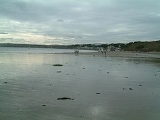
coast. Although it started out as a fishing village, it has a large beach and is a popular tourist resort. Until 1974 it was an urban district
in the East Riding of Yorkshire
.
According to the 2001 UK census
, Filey parish had a population of 6,819.
a long-distance footpath; this starts at Helmsley
and skirts the North York Moors
. It was the second National Trail to be opened (1969). It is also the northern end of the Yorkshire Wolds Way
National Trail which starts at Hessle
and crosses the Yorkshire Wolds
. Filey is the finishing point for Great Yorkshire Bike Ride. The 70 miles (112.7 km) ride begins at Wetherby Racecourse
.
Filey has a railway station
on the Yorkshire Coast Line
.
Previously Filey also had a second station Filey Holiday Camp railway station
to the south of the town serving the former Butlins
holiday camp
. This camp has now been re-developed into a 600-home holiday housing development, The Bay Filey. It is one of the largest coastal developments of this kind in the UK and the first homes began to be handed over to buyers in 2007.
In July 2007 Filey was hit by flash flood
s which caused major problems in the town, with various areas suffering damage.
Nicholas Pevsner said 'This is easily the finest church in the NE corner of the East Riding' Buildings of England.
Filey remained a small village until the 18th century when visitors from Scarborough arrived seeking the peace and quiet that Filey offered. Then in 1835 a Birmingham
solicitor
called John Wilkes Unett bought 7 acres (28,328 m²) of land and built the Crescent, later known as the Royal Crescent. It was opened in the 1850s and for 100 years it was the most fashionable address in the North of England.
English composer Frederick Delius
stayed as a boy on the Crescent with his family at Miss Hurd's boarding house
(number 24) in 1876 and 1877 and then also at Mrs. Colley's (number 24) in 1897.
In 1931 the spire of a church was damaged by the Dogger Bank earthquake
.
For more than 40 years Butlin's Holiday Camp
was a major factor in Filey's economy. Building work began in 1939 and continued through the war
during which it became an airforce station known as R.A.F. Hunmanby Moor
. In 1945 it became a popular holiday resort complete with its own railway station and by the late 1950s it could cater for 10,000 holiday makers. It closed in 1984, causing a decrease in the holiday makers visiting Filey.
have plans to build 300 houses in Filey. Scarborough council has approved plans for the £45m housing project off Muston Road by Coast & Country. Independent councillor Sam Cross, who represents Filey on the borough council, said: "The infrastructure of the town can't cope with it."
Coast and Country have replied to the concerns by stating that the houses are being built to meet a pent-up latent demand for affordable housing and other housing within the town.
constituency until the 2010 general election when it became part of the newly formed Thirsk and Malton
constituency.
North Yorkshire
North Yorkshire is a non-metropolitan or shire county located in the Yorkshire and the Humber region of England, and a ceremonial county primarily in that region but partly in North East England. Created in 1974 by the Local Government Act 1972 it covers an area of , making it the largest...
, England
England
England is a country that is part of the United Kingdom. It shares land borders with Scotland to the north and Wales to the west; the Irish Sea is to the north west, the Celtic Sea to the south west, with the North Sea to the east and the English Channel to the south separating it from continental...
. It forms part of the borough of Scarborough
Scarborough (borough)
Scarborough is a non-metropolitan district and borough of North Yorkshire, England. In addition to the town of Scarborough, it covers a large stretch of the coast of Yorkshire, including Whitby and Filey....
and is located between Scarborough and Bridlington
Bridlington
Bridlington is a seaside resort, minor sea fishing port and civil parish on the Holderness Coast of the North Sea, in the East Riding of Yorkshire, England. It has a static population of over 33,000, which rises considerably during the tourist season...
on the North Sea
North Sea
In the southwest, beyond the Straits of Dover, the North Sea becomes the English Channel connecting to the Atlantic Ocean. In the east, it connects to the Baltic Sea via the Skagerrak and Kattegat, narrow straits that separate Denmark from Norway and Sweden respectively...
coast. Although it started out as a fishing village, it has a large beach and is a popular tourist resort. Until 1974 it was an urban district
Urban district
In the England, Wales and Ireland, an urban district was a type of local government district that covered an urbanised area. Urban districts had an elected Urban District Council , which shared local government responsibilities with a county council....
in the East Riding of Yorkshire
East Riding of Yorkshire
The East Riding of Yorkshire, or simply East Yorkshire, is a local government district with unitary authority status, and a ceremonial county of England. For ceremonial purposes the county also includes the city of Kingston upon Hull, which is a separate unitary authority...
.
According to the 2001 UK census
United Kingdom Census 2001
A nationwide census, known as Census 2001, was conducted in the United Kingdom on Sunday, 29 April 2001. This was the 20th UK Census and recorded a resident population of 58,789,194....
, Filey parish had a population of 6,819.
Geography
Filey is at the eastern end of the Cleveland WayCleveland Way
The Cleveland Way is a National Trail in ancient Cleveland in Northern England. It runs 110 miles from Helmsley to Filey, skirting the North York Moors National Park.-History:The trail was opened in 1969...
a long-distance footpath; this starts at Helmsley
Helmsley
Helmsley is a market town and civil parish in the Ryedale district of North Yorkshire, England. The town is located at the point where the valleys of Bilsdale and Ryedale leave the higher moorland and join the flat Vale of Pickering. It is situated on the River Rye and lies on the A170 road, east...
and skirts the North York Moors
North York Moors
The North York Moors is a national park in North Yorkshire, England. The moors are one of the largest expanses of heather moorland in the United Kingdom. It covers an area of , and it has a population of about 25,000...
. It was the second National Trail to be opened (1969). It is also the northern end of the Yorkshire Wolds Way
Yorkshire Wolds Way
The Yorkshire Wolds Way is a National Trail in Yorkshire, England. It runs 79 miles from Hessle to Filey, around the Yorkshire Wolds...
National Trail which starts at Hessle
Hessle
Hessle is a town and civil parish in the East Riding of Yorkshire, England, situated west of Kingston upon Hull city centre. Geographically it is part of a larger urban area which consists of the city of Kingston upon Hull, the town of Hessle and a number of other villages but is not part of the...
and crosses the Yorkshire Wolds
Yorkshire Wolds
The Yorkshire Wolds are low hills in the counties of East Riding of Yorkshire and North Yorkshire in northeastern England. The name also applies to the district in which the hills lie....
. Filey is the finishing point for Great Yorkshire Bike Ride. The 70 miles (112.7 km) ride begins at Wetherby Racecourse
Wetherby Racecourse
Wetherby Racecourse is a National Hunt racecourse situated near the market town of Wetherby in West Yorkshire, England, located from Leeds city centre.-Location:...
.
Filey has a railway station
Filey railway station
Filey railway station serves the town of Filey in North Yorkshire, England. It is located on the Yorkshire Coast Line and is operated by Northern Rail who provide all passenger train services....
on the Yorkshire Coast Line
Yorkshire Coast Line
The Yorkshire Coast Line is a railway line in northern England. It runs northwards from Hull Paragon to Bridlington and Scarborough calling at other intermediate stations.-History:...
.
Previously Filey also had a second station Filey Holiday Camp railway station
Filey Holiday Camp railway station
Filey Holiday Camp railway station was a railway station built by the London & North Eastern Railway to serve the Butlins Holiday Camp just south of Filey, in the then East Riding of Yorkshire, England...
to the south of the town serving the former Butlins
Butlins
Butlins is a chain of large holiday camps in the United Kingdom. Butlins was founded by Billy Butlin to provide affordable holidays for ordinary British families....
holiday camp
Holiday camp
Holiday camp, in Britain, generally refers to a resort with a boundary that includes accommodation, entertainment and other facilities.As distinct from camping, accommodation typically consisted of chalets – small buildings arranged either individually or in blocks. Some had three or four storeys,...
. This camp has now been re-developed into a 600-home holiday housing development, The Bay Filey. It is one of the largest coastal developments of this kind in the UK and the first homes began to be handed over to buyers in 2007.
In July 2007 Filey was hit by flash flood
Flash flood
A flash flood is a rapid flooding of geomorphic low-lying areas—washes, rivers, dry lakes and basins. It may be caused by heavy rain associated with a storm, hurricane, or tropical storm or meltwater from ice or snow flowing over ice sheets or snowfields...
s which caused major problems in the town, with various areas suffering damage.
History
The oldest building in Filey is the 12th century parish church of St Oswald, on Church Hill in the north of the town.Nicholas Pevsner said 'This is easily the finest church in the NE corner of the East Riding' Buildings of England.
Filey remained a small village until the 18th century when visitors from Scarborough arrived seeking the peace and quiet that Filey offered. Then in 1835 a Birmingham
Birmingham
Birmingham is a city and metropolitan borough in the West Midlands of England. It is the most populous British city outside the capital London, with a population of 1,036,900 , and lies at the heart of the West Midlands conurbation, the second most populous urban area in the United Kingdom with a...
solicitor
Solicitor
Solicitors are lawyers who traditionally deal with any legal matter including conducting proceedings in courts. In the United Kingdom, a few Australian states and the Republic of Ireland, the legal profession is split between solicitors and barristers , and a lawyer will usually only hold one title...
called John Wilkes Unett bought 7 acres (28,328 m²) of land and built the Crescent, later known as the Royal Crescent. It was opened in the 1850s and for 100 years it was the most fashionable address in the North of England.
English composer Frederick Delius
Frederick Delius
Frederick Theodore Albert Delius, CH was an English composer. Born in the north of England to a prosperous mercantile family of German extraction, he resisted attempts to recruit him to commerce...
stayed as a boy on the Crescent with his family at Miss Hurd's boarding house
Boarding house
A boarding house, is a house in which lodgers rent one or more rooms for one or more nights, and sometimes for extended periods of weeks, months and years. The common parts of the house are maintained, and some services, such as laundry and cleaning, may be supplied. They normally provide "bed...
(number 24) in 1876 and 1877 and then also at Mrs. Colley's (number 24) in 1897.
In 1931 the spire of a church was damaged by the Dogger Bank earthquake
1931 Dogger Bank earthquake
The Dogger Bank earthquake of 1931 was the strongest earthquake recorded in the United Kingdom since measurements began. It measured 6.1 on the Richter Scale....
.
For more than 40 years Butlin's Holiday Camp
Butlins
Butlins is a chain of large holiday camps in the United Kingdom. Butlins was founded by Billy Butlin to provide affordable holidays for ordinary British families....
was a major factor in Filey's economy. Building work began in 1939 and continued through the war
World War II
World War II, or the Second World War , was a global conflict lasting from 1939 to 1945, involving most of the world's nations—including all of the great powers—eventually forming two opposing military alliances: the Allies and the Axis...
during which it became an airforce station known as R.A.F. Hunmanby Moor
Hunmanby
Hunmanby is a large village , which was classified as a town until the 1960s, and civil parish in the Scarborough district of North Yorkshire, England...
. In 1945 it became a popular holiday resort complete with its own railway station and by the late 1950s it could cater for 10,000 holiday makers. It closed in 1984, causing a decrease in the holiday makers visiting Filey.
Coast and Country Housing Limited
Coast & Country Housing LimitedCoast & Country Housing Limited
Coast and Country is a Registered Housing Provider located in the north of England and established in 2001. It took over the ownership and management of homes from Redcar and Cleveland Borough Council in July 2002...
have plans to build 300 houses in Filey. Scarborough council has approved plans for the £45m housing project off Muston Road by Coast & Country. Independent councillor Sam Cross, who represents Filey on the borough council, said: "The infrastructure of the town can't cope with it."
Coast and Country have replied to the concerns by stating that the houses are being built to meet a pent-up latent demand for affordable housing and other housing within the town.
Governance
Filey was in the RyedaleRyedale (UK Parliament constituency)
Ryedale was a constituency in North Yorkshire represented in the House of Commons of the Parliament of the United Kingdom. It elects one Member of Parliament by the first past the post system of election...
constituency until the 2010 general election when it became part of the newly formed Thirsk and Malton
Thirsk and Malton (UK Parliament constituency)
Thirsk and Malton is a constituency represented in the House of Commons of the Parliament of the United Kingdom. It elects one Member of Parliament by the first past the post system of election....
constituency.
Notable people
- Leo BlairLeo Blair (senior)Leo Charles Lynton Blair is a retired University of Durham law lecturer. He is the author of the book The Commonwealth Public Service...
, the father of Tony BlairTony BlairAnthony Charles Lynton Blair is a former British Labour Party politician who served as the Prime Minister of the United Kingdom from 2 May 1997 to 27 June 2007. He was the Member of Parliament for Sedgefield from 1983 to 2007 and Leader of the Labour Party from 1994 to 2007...
, former Prime Minister of the United KingdomPrime Minister of the United KingdomThe Prime Minister of the United Kingdom of Great Britain and Northern Ireland is the Head of Her Majesty's Government in the United Kingdom. The Prime Minister and Cabinet are collectively accountable for their policies and actions to the Sovereign, to Parliament, to their political party and...
was born in Filey.