

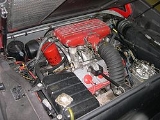
Ferrari Dino engine

Encyclopedia
The Ferrari Dino engine is a line of mechanically similar V6
, V8
, and V12
engines produced by Ferrari
for the past 40 years
Alfredo "Dino" Ferrari
, was the son of Enzo Ferrari
. Dino suggested to Enzo Ferrari the development of a V6
engine for F2 at the end of 1955. Soon afterwards, Alfredo fell ill, suffering from muscular dystrophy
. While in hospital, he discussed technical details with the engineer Vittorio Jano
. Dino would never see the engine; he died on June 30, 1956 at the age of 24.
The Dino V6 was Ferrari's first V6 engine. The Dino V8 engine was introduced later. The V8 engines all used a flat-plane crankshaft
configuration.
auto racing
series. Jano, formerly of Alfa Romeo
and Lancia
, pressed for a conventional 60° V6 but the Ferraris were open-minded.
, and were used in a number of Formula One
, Formula Two, and Grand Prix
cars from 1959 through the early 1960s. Appearing in 1958, it used a 77x71 mm bore and stroke for 1984 cc and produced 200 hp (149 kW) in the 196 S. Two larger versions were also produced, the 245 hp (183 kW) 2497 cc 246 S and 296 hp (221 kW) 2962 cc 296 S. These engines continued in the 1962 196 SP and 286 SP. The latter had a 90 mm bore and 75 mm stroke for 2863 cc and 260 hp (194 kW).
This engine was so small that very little room was available for smooth intake tracts. The Ferraris were convinced that a freer-flowing intake could result in more power, so a new design was called for.
in April 1957, where it finished in third place behind two Lancia-Ferrari V8 Formula One cars.
The result of the trios creativity was the world's only 65° V6 engine. The extra 5° between cylinder banks gave Ferrari the straight intakes he wanted, but resulted in an odd 185°/55° crankshaft
for even firing. Although the Dino V6 was discontinued with the introduction of the V8, the 65° design continues to this day: It reappeared on Ferrari's 1992 456
V12
.
The 85x71 mm 2417 cc engine used in the 246 S/I produced 280 hp (209 kW) with dual overhead camshafts pushing two valves per cylinder. The mid-engined
1961 246 SP used this same engine, as did the 156 F1.
The 65° Dino V6 quickly replaced the 60° unit in racing, and made its way to the street as well. Ferrari needed to have the engine in 500 production vehicles to homologate it for racing use. The company worked with Fiat
to develop a sports car
to house it, and the front-engined Fiat Dino
project was born.
In competition, the 1965 166 P used a tiny 1.6 L (1593 cc) version of the 65° unit. Both bore and stroke were different from the earlier engine at 77x57 mm and output was impressive at 175 hp (130 kW). Bore was up to 86 mm for the 218 hp (163 kW) 1987 cc version found that same year in the 206 SP as well as the 1966 206 S.
In 1968, Ferrari debuted its own Dino 206, the company's first mid-engined
road car. It used the 2.0 L engine from the 206 SP mounted transverse
ly between the rear wheels. After producing just 157 cars, Ferrari bumped the bore and stroke up from 86x57 mm to 92.5x60 mm for 2419 cc. This increased power to 195 hp (145 kW), but the engine block was now made of cast iron rather than aluminium.
The same V6 engine was handed off to Lancia
for use in its WRC
-champ Stratos
in the early 1970s, but Ferrari's Dino had moved on to 8 cylinders.
Applications:
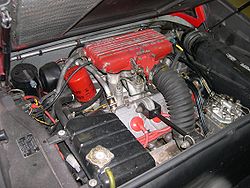 Dino's project also created a V8
engine with a conventional 90° bank angle. First appearing in 1962's 268 SP, the new V8 used the same 77x71 mm bore and stroke as the Colombo
V12. Output from the single overhead camshaft engine was 265 hp (198 kW). A smaller version was also produced, with stroke dropped to 66 mm for 2459 cc. This engine was used in the 248 SP and produced about 250 hp (186 kW).
and 1975 GTB
"308" cars. As the model name suggests, the V8 displaced 3.0 L (2927 cc) and was another DOHC 2-valve design.
Applications:
to the existing 3.0 L (2927 cc) engine.
Applications:
The 2.0 L V8 was bored out a bit (to 68.8 mm) for 1980's 1991 cc 208, but it was the 1982 introduction of the 208 Turbo that caused a stir. The 208 Turbo featured 220 hp (164 kW), more than the fuel injected
308 from the previous year.
were added for the 1982 308
and Mondial
Quattrovalvole (or QV), bringing power back up to the pre-FI
high of 245 hp (179 kW).
A very unusual Dino Quattrovalvole was used in the Lancia Thema 8.32
. It was based on the 308 QV's engine, but used a split-plane crankshaft rather than the Ferrari-type flat-plane. The engine was constructed by Ducati rather than Ferrari, and was produced from 1986 through 1991.
The Quattrovalvole was also used by Lancia for their attempt at the World Sportscar Championship
with the LC2
. The engine was twin-turbocharged and destroked to 2.65 litres, but produced 720 hp in qualifying trim. The engine was later increased to 3.0 litres and increased power output to 828 hp.
Applications:
sports car. That famous Ferrari was meant for Group B
racing, with a 2855 cc version of the 308's engine (bore was down by 1 mm to meet the regulations of the class). With two IHI turbos, a Behr intercooler
, and Weber
-Marelli fuel injection, the GTO boasted 400 hp (298 kW) from Dino's engine.
Applications:
and 3.2 Mondial
used a bored and stroked 3.0 QV V8 (to 83x73.6 mm) version called the Tipo F105CB. That naturally aspirated 3.2 L (3186 cc) engine boasted 270 hp (201 kW).
Applications:
sports car debuted with the Tipo F120A engine. The 2936 cc Dino-based engine now had an 82 mm bore and 69.5 mm stroke and 16 psi of turbo boost for 478 hp (356 kW). The F40 sold well, but was the last Dino-powered sports car.
Applications:
and Mondial t
saw the Dino V8 pushed to 3.4 L (3405 cc) with an 85 mm bore and 75 mm stroke. Power was up to 300 hp (224 kW) in that 288-based car. This version was known internally as the Tipo F119.
Applications:
included their first production 5-valve engine, and sported a 2 mm longer stroke for 3496 cc and 380 hp (283 kW). This Tipo F129B was used from 1994 through 1998. It was revised as the Tipo F129C, debuting in 1998 and used through 1999.
Applications:
retained the 85 mm bore of the F355 engine, but increased the stroke to 79 mm, to raise the displacement again to 3586 cc and 400 hp (298 kW). Modifications to the intake/exhaust and an increased 11.2:1 compression ratio produced 425 hp (317 kW) for the 360 Challenge Stradale. This Tipo F131 was produced from 1999 through 2004.
Applications:
new engine. As the name implies, this new engine is up to 4.3 L (4308 cc) with a 92 mm bore and 81 mm stroke, and is related to the new 4.2 L Maserati
V8.
The V12
variant of the Dino V6 debuted in the 1992 456
as the Tipo F116B. It is a 65° engine with an 88 mm bore and the same 75 mm stroke as the Dino V8 found in the 348
. Total displacement is 5.5 L (5474 cc) for 436 hp (325 kW). A later Tipo F116C version replaced the B in 1998 and lasted through 2002.
The same displacement produced 485 hp (362 kW) in the 1996 550 Maranello
's Tipo F133A (later the Tipo F133C). The 5.5 L V12 engine won the "over 4 liter" class of the International Engine of the Year
award for 2000 and 2001.
The F50
sports car bowed in 1995 with another Dino V12, based on the 1990 3.5 L Formula One
engine. With an 85 mm bore and 69 mm stroke, it mimicked the high-revving oversquare dimensions of the F40's
V8, but with 4.7 L, it didn't need a turbo to produce 520 hp (388 kW). Variable length intake manifold
s were used, as was 5-valve
technology.
The 2002 575 M
has a 5748 cc version of the Dino V12 known as the Tipo F133E. Bore was up to 89 mm and stroke matched the F355
V8 at 77 mm. Output was 515 hp (384 kW) for the 575M, raised to 533 hp (412 kW) for the Tipo F133F used in the 2004 612 Scaglietti
The Dino-based V12 family was replaced by an all-new V12 engine based on the shared Ferrari/Maserati V8. This new generation of V12 was introduced for the 2003 Enzo
.
Applications:
V6 engine
A V6 engine is a V engine with six cylinders mounted on the crankcase in two banks of three cylinders, usually set at either a right angle or an acute angle to each other, with all six pistons driving a common crankshaft...
, V8
V8 engine
A V8 engine is a V engine with eight cylinders mounted on the crankcase in two banks of four cylinders, in most cases set at a right angle to each other but sometimes at a narrower angle, with all eight pistons driving a common crankshaft....
, and V12
V12 engine
A V12 engine is a V engine with 12 cylinders mounted on the crankcase in two banks of six cylinders, usually but not always at a 60° angle to each other, with all 12 pistons driving a common crankshaft....
engines produced by Ferrari
Ferrari
Ferrari S.p.A. is an Italian sports car manufacturer based in Maranello, Italy. Founded by Enzo Ferrari in 1929, as Scuderia Ferrari, the company sponsored drivers and manufactured race cars before moving into production of street-legal vehicles as Ferrari S.p.A. in 1947...
for the past 40 years
Alfredo "Dino" Ferrari
Alfredo Ferrari
Alfredo Ferrari , nicknamed Alfredino or Dino, was the son of Enzo Ferrari. Enzo decided to name Alfredo after his grandfather...
, was the son of Enzo Ferrari
Enzo Ferrari
Enzo Anselmo Ferrari Cavaliere di Gran Croce OMRI was an Italian race car driver and entrepreneur, the founder of the Scuderia Ferrari Grand Prix motor racing team, and subsequently of the Ferrari car manufacturer...
. Dino suggested to Enzo Ferrari the development of a V6
V6 engine
A V6 engine is a V engine with six cylinders mounted on the crankcase in two banks of three cylinders, usually set at either a right angle or an acute angle to each other, with all six pistons driving a common crankshaft...
engine for F2 at the end of 1955. Soon afterwards, Alfredo fell ill, suffering from muscular dystrophy
Muscular dystrophy
Muscular dystrophy is a group of muscle diseases that weaken the musculoskeletal system and hamper locomotion. Muscular dystrophies are characterized by progressive skeletal muscle weakness, defects in muscle proteins, and the death of muscle cells and tissue.In the 1860s, descriptions of boys who...
. While in hospital, he discussed technical details with the engineer Vittorio Jano
Vittorio Jano
Vittorio Jano was an Italian automobile designer of Hungarian descent from the 1920s through 1960s.Jano was born Viktor János in San Giorgio Canavese, in Piedmont, to Hungarian immigrants, who arrived there several years before the birth of Jano. He began his career at the car and truck company...
. Dino would never see the engine; he died on June 30, 1956 at the age of 24.
The Dino V6 was Ferrari's first V6 engine. The Dino V8 engine was introduced later. The V8 engines all used a flat-plane crankshaft
Crankshaft
The crankshaft, sometimes casually abbreviated to crank, is the part of an engine which translates reciprocating linear piston motion into rotation...
configuration.
V6
The production Dino V6 began as a discussion between Vittorio Jano and Enzo and Dino Ferrari about the ideal 1.5 L engine for use in the 1958 Formula TwoFormula Two
Formula Two, abbreviated to F2, is a type of open wheel formula racing. It was replaced by Formula 3000 in 1985, but the FIA announced in 2008 that Formula Two would return for 2009 in the form of the FIA Formula Two Championship...
auto racing
Auto racing
Auto racing is a motorsport involving the racing of cars for competition. It is one of the world's most watched televised sports.-The beginning of racing:...
series. Jano, formerly of Alfa Romeo
Alfa Romeo
Alfa Romeo Automobiles S.p.A. is an Italian manufacturer of cars. Founded as A.L.F.A. on June 24, 1910, in Milan, the company has been involved in car racing since 1911, and has a reputation for building expensive sports cars...
and Lancia
Lancia
Lancia Automobiles S.p.A. is an Italian automobile manufacturer founded in 1906 by Vincenzo Lancia and which became part of the Fiat Group in 1969. The company has a long history of producing distinctive cars and also has a strong rally heritage. Some modern Lancias are seen as presenting a more...
, pressed for a conventional 60° V6 but the Ferraris were open-minded.
60°
Jano's 60° design incorporated some of his ideas from the Lancia AureliaLancia Aurelia
The Lancia Aurelia is a car that was produced by the Italian manufacturer Lancia. Designed by Vittorio Jano, the Aurelia was launched in 1950 and production lasted until the summer of 1958....
, and were used in a number of Formula One
Formula One
Formula One, also known as Formula 1 or F1 and referred to officially as the FIA Formula One World Championship, is the highest class of single seater auto racing sanctioned by the Fédération Internationale de l'Automobile . The "formula" designation in the name refers to a set of rules with which...
, Formula Two, and Grand Prix
Grand Prix motor racing
Grand Prix motor racing has its roots in organised automobile racing that began in France as far back as 1894. It quickly evolved from a simple road race from one town to the next, to endurance tests for car and driver...
cars from 1959 through the early 1960s. Appearing in 1958, it used a 77x71 mm bore and stroke for 1984 cc and produced 200 hp (149 kW) in the 196 S. Two larger versions were also produced, the 245 hp (183 kW) 2497 cc 246 S and 296 hp (221 kW) 2962 cc 296 S. These engines continued in the 1962 196 SP and 286 SP. The latter had a 90 mm bore and 75 mm stroke for 2863 cc and 260 hp (194 kW).
This engine was so small that very little room was available for smooth intake tracts. The Ferraris were convinced that a freer-flowing intake could result in more power, so a new design was called for.
65°
Ferrari designers began work on the first Dino V6 engine in 1956 and the engine was running by the end of the year. The engine displaced 1489 cc. This engine was installed in the Ferrari 156 F2 car and was first raced in the Grand Prix of NaplesGrand Prix of Naples
The Grand Prix of Naples was an auto racing event, held in Posillipo, outside Napoli.In its original incarnation, it began in 1934. Known as the Coppa Principessa di Piemonte in honor of Marie-José of Belgium, it continued from the same event held in 1933 in the Circuito Province Meridionale...
in April 1957, where it finished in third place behind two Lancia-Ferrari V8 Formula One cars.
The result of the trios creativity was the world's only 65° V6 engine. The extra 5° between cylinder banks gave Ferrari the straight intakes he wanted, but resulted in an odd 185°/55° crankshaft
Crankshaft
The crankshaft, sometimes casually abbreviated to crank, is the part of an engine which translates reciprocating linear piston motion into rotation...
for even firing. Although the Dino V6 was discontinued with the introduction of the V8, the 65° design continues to this day: It reappeared on Ferrari's 1992 456
Ferrari 456
The Ferrari 456 and 456 M is a front-engined grand tourer. The 456 was produced from 1992 until 2003. It was an overdue replacement for the defunct front-engined 412 as the company's premium 4-seat V12 car. The updated 456M was replaced in 2004 by the 612 Scaglietti...
V12
V12 engine
A V12 engine is a V engine with 12 cylinders mounted on the crankcase in two banks of six cylinders, usually but not always at a 60° angle to each other, with all 12 pistons driving a common crankshaft....
.
The 85x71 mm 2417 cc engine used in the 246 S/I produced 280 hp (209 kW) with dual overhead camshafts pushing two valves per cylinder. The mid-engined
MR layout
In automotive design, a RMR or Rear Mid-engine, Rear-wheel drive layout is one in which the rear wheels are driven by an engine placed just in front of them, behind the passenger compartment. In contrast to the rear-engined RR layout, the center of mass of the engine is in front of the rear axle...
1961 246 SP used this same engine, as did the 156 F1.
The 65° Dino V6 quickly replaced the 60° unit in racing, and made its way to the street as well. Ferrari needed to have the engine in 500 production vehicles to homologate it for racing use. The company worked with Fiat
Fiat
FIAT, an acronym for Fabbrica Italiana Automobili Torino , is an Italian automobile manufacturer, engine manufacturer, financial, and industrial group based in Turin in the Italian region of Piedmont. Fiat was founded in 1899 by a group of investors including Giovanni Agnelli...
to develop a sports car
Sports car
A sports car is a small, usually two seat, two door automobile designed for high speed driving and maneuverability....
to house it, and the front-engined Fiat Dino
Fiat Dino
The Fiat Dino is an exotic front-engined, rear-drive sports car manufactured between 1966 and 1973. It was an intermediate step towards creating Ferrari's "Dino" and the two are often confused...
project was born.
In competition, the 1965 166 P used a tiny 1.6 L (1593 cc) version of the 65° unit. Both bore and stroke were different from the earlier engine at 77x57 mm and output was impressive at 175 hp (130 kW). Bore was up to 86 mm for the 218 hp (163 kW) 1987 cc version found that same year in the 206 SP as well as the 1966 206 S.
In 1968, Ferrari debuted its own Dino 206, the company's first mid-engined
MR layout
In automotive design, a RMR or Rear Mid-engine, Rear-wheel drive layout is one in which the rear wheels are driven by an engine placed just in front of them, behind the passenger compartment. In contrast to the rear-engined RR layout, the center of mass of the engine is in front of the rear axle...
road car. It used the 2.0 L engine from the 206 SP mounted transverse
Transverse engine
A transverse engine is an engine mounted in a vehicle so that the engine's crankshaft axis is perpendicular to the long axis of the vehicle. Many modern front wheel drive vehicles use this engine mounting configuration...
ly between the rear wheels. After producing just 157 cars, Ferrari bumped the bore and stroke up from 86x57 mm to 92.5x60 mm for 2419 cc. This increased power to 195 hp (145 kW), but the engine block was now made of cast iron rather than aluminium.
The same V6 engine was handed off to Lancia
Lancia
Lancia Automobiles S.p.A. is an Italian automobile manufacturer founded in 1906 by Vincenzo Lancia and which became part of the Fiat Group in 1969. The company has a long history of producing distinctive cars and also has a strong rally heritage. Some modern Lancias are seen as presenting a more...
for use in its WRC
World Rally Championship
The World Rally Championship is a rallying series organised by the FIA, culminating with a champion driver and manufacturer. The driver's world championship and manufacturer's world championship are separate championships, but based on the same point system. The series currently consists of 13...
-champ Stratos
Lancia Stratos
The Lancia Stratos HF, widely and more simply known as Lancia Stratos, is a car made by Italian car manufacturer Lancia. The HF stands for High Fidelity...
in the early 1970s, but Ferrari's Dino had moved on to 8 cylinders.
Applications:
- 2.0 L
- 1966-1969 Fiat DinoFiat DinoThe Fiat Dino is an exotic front-engined, rear-drive sports car manufactured between 1966 and 1973. It was an intermediate step towards creating Ferrari's "Dino" and the two are often confused...
- 1968-1969 Dino 206
- 1966-1969 Fiat Dino
- 2.4 L
- 1969-1973 Fiat DinoFiat DinoThe Fiat Dino is an exotic front-engined, rear-drive sports car manufactured between 1966 and 1973. It was an intermediate step towards creating Ferrari's "Dino" and the two are often confused...
- 1969-1974 Dino 246
- 1973-1975 Lancia StratosLancia StratosThe Lancia Stratos HF, widely and more simply known as Lancia Stratos, is a car made by Italian car manufacturer Lancia. The HF stands for High Fidelity...
- 1969-1973 Fiat Dino
V8
V8 engine
A V8 engine is a V engine with eight cylinders mounted on the crankcase in two banks of four cylinders, in most cases set at a right angle to each other but sometimes at a narrower angle, with all eight pistons driving a common crankshaft....
engine with a conventional 90° bank angle. First appearing in 1962's 268 SP, the new V8 used the same 77x71 mm bore and stroke as the Colombo
Ferrari Colombo engine
Ferrari's earliest cars used engines designed by Gioacchino Colombo, who had formerly designed Alfa Romeos for Enzo Ferrari. These V12 powerplants ranged from the diminutive 1.5 L unit fitted to the 125S to the 3.3 L unit in the 1966 275.Enzo Ferrari had long admired the V12 engines of...
V12. Output from the single overhead camshaft engine was 265 hp (198 kW). A smaller version was also produced, with stroke dropped to 66 mm for 2459 cc. This engine was used in the 248 SP and produced about 250 hp (186 kW).
3.0
The Dino V8 (now bored to 81 mm) replaced the V6 in the next line of street Dinos to be produced by Ferrari, the 1973 GT4Ferrari GT4
The Ferrari 308 GT4 and 208 GT4 were mid-engined V8-powered 2+2 cars built by Ferrari. The 308 GT4 was introduced in 1973, supplemented by the 208 GT4 in 1975, and replaced by the Mondial 8 in 1980 after a production run of 2,826 vehicles...
and 1975 GTB
Ferrari 308 GTB
The Ferrari 308 GTB are mid-engined sports cars manufactured by the Italian company Ferrari in the 1970s-1980s. They made up the lower end of the company's range...
"308" cars. As the model name suggests, the V8 displaced 3.0 L (2927 cc) and was another DOHC 2-valve design.
Applications:
- 1973–1976 308 GT4 (branded "Dino")
- 1976–1980 308 GT4Ferrari GT4The Ferrari 308 GT4 and 208 GT4 were mid-engined V8-powered 2+2 cars built by Ferrari. The 308 GT4 was introduced in 1973, supplemented by the 208 GT4 in 1975, and replaced by the Mondial 8 in 1980 after a production run of 2,826 vehicles...
(branded "Ferrari") - 1975–1980 308 GTBFerrari 308 GTBThe Ferrari 308 GTB are mid-engined sports cars manufactured by the Italian company Ferrari in the 1970s-1980s. They made up the lower end of the company's range...
- 1977–1980 308 GTSFerrari 308 GTBThe Ferrari 308 GTB are mid-engined sports cars manufactured by the Italian company Ferrari in the 1970s-1980s. They made up the lower end of the company's range...
Fuel injection
The 1980 "i" models added fuel injectionFuel injection
Fuel injection is a system for admitting fuel into an internal combustion engine. It has become the primary fuel delivery system used in automotive petrol engines, having almost completely replaced carburetors in the late 1980s....
to the existing 3.0 L (2927 cc) engine.
Applications:
- 1980–1982 Mondial 8Ferrari MondialThe final Mondial evolution was 1989's Mondial t . It was a substantially changed model, "spearhead of a new generation of V8 Ferraris", according to Road & Track magazine. It was visually different from preceding Mondial models, the most recognisable being the redesign of the air intakes to a...
- 1980–1982 308 GTBi & GTSiFerrari 308 GTBThe Ferrari 308 GTB are mid-engined sports cars manufactured by the Italian company Ferrari in the 1970s-1980s. They made up the lower end of the company's range...
2.0
That same year, the company introduced the 208 with a tiny 2.0 L version. The bore was reduced from 81 to 66.8 mm but the stroke remained at 71 mm. Output was reduced as well, from 255 to 180 hp (190 to 134 kW) and the 2-liter Dino was not offered in Ferrari's most important market, the United States.The 2.0 L V8 was bored out a bit (to 68.8 mm) for 1980's 1991 cc 208, but it was the 1982 introduction of the 208 Turbo that caused a stir. The 208 Turbo featured 220 hp (164 kW), more than the fuel injected
Fuel injection
Fuel injection is a system for admitting fuel into an internal combustion engine. It has become the primary fuel delivery system used in automotive petrol engines, having almost completely replaced carburetors in the late 1980s....
308 from the previous year.
Quattrovalvole
4 valves per cylinderMulti-valve
In automotive engineering a multi-valve or multivalve engine is one where each cylinder has more than two valves. A multi-valve engine has better breathing and can operate at higher revolutions per minute than a two-valve engine, delivering more power.- Multi-valve rationale :A multi-valve design...
were added for the 1982 308
Ferrari 308 GTB
The Ferrari 308 GTB are mid-engined sports cars manufactured by the Italian company Ferrari in the 1970s-1980s. They made up the lower end of the company's range...
and Mondial
Ferrari Mondial
The final Mondial evolution was 1989's Mondial t . It was a substantially changed model, "spearhead of a new generation of V8 Ferraris", according to Road & Track magazine. It was visually different from preceding Mondial models, the most recognisable being the redesign of the air intakes to a...
Quattrovalvole (or QV), bringing power back up to the pre-FI
Fuel injection
Fuel injection is a system for admitting fuel into an internal combustion engine. It has become the primary fuel delivery system used in automotive petrol engines, having almost completely replaced carburetors in the late 1980s....
high of 245 hp (179 kW).
A very unusual Dino Quattrovalvole was used in the Lancia Thema 8.32
Lancia Thema
The Lancia Thema is an executive car produced by the Italian automaker Lancia between 1984 and 1994, and one of four cars to share the Type Four platform alongside the Alfa Romeo 164, Fiat Croma and Saab 9000...
. It was based on the 308 QV's engine, but used a split-plane crankshaft rather than the Ferrari-type flat-plane. The engine was constructed by Ducati rather than Ferrari, and was produced from 1986 through 1991.
The Quattrovalvole was also used by Lancia for their attempt at the World Sportscar Championship
World Sportscar Championship
The World Sportscar Championship was the world series run for sports car racing by the FIA from 1953 to 1992.The championship evolved from a small collection of the most important sportscar, endurance and road racing events in Europe and North America with dozens of gentleman drivers at the grid,...
with the LC2
Lancia LC2
The Lancia LC2 was a series of racing cars built by Italian automobile manufacturer Lancia and powered by engines built by their sister company Ferrari. They were part of Lancia's official factory-backed effort in the World Sportscar Championship from 1983 to 1986, although they continued to be...
. The engine was twin-turbocharged and destroked to 2.65 litres, but produced 720 hp in qualifying trim. The engine was later increased to 3.0 litres and increased power output to 828 hp.
Applications:
- 1982–1985 308 GTB QV & GTS QVFerrari 308 GTBThe Ferrari 308 GTB are mid-engined sports cars manufactured by the Italian company Ferrari in the 1970s-1980s. They made up the lower end of the company's range...
- 1982–1985 Mondial QVFerrari MondialThe final Mondial evolution was 1989's Mondial t . It was a substantially changed model, "spearhead of a new generation of V8 Ferraris", according to Road & Track magazine. It was visually different from preceding Mondial models, the most recognisable being the redesign of the air intakes to a...
- 1986–1991 Lancia Thema 8.32Lancia ThemaThe Lancia Thema is an executive car produced by the Italian automaker Lancia between 1984 and 1994, and one of four cars to share the Type Four platform alongside the Alfa Romeo 164, Fiat Croma and Saab 9000...
- 1983–1991 Lancia LC2Lancia LC2The Lancia LC2 was a series of racing cars built by Italian automobile manufacturer Lancia and powered by engines built by their sister company Ferrari. They were part of Lancia's official factory-backed effort in the World Sportscar Championship from 1983 to 1986, although they continued to be...
288 GTO
The turbo also served as a development platform for the forthcoming 1984 288 GTOFerrari 288 GTO
The Ferrari GTO is an exotic homologation of the Ferrari 308 GTB produced from 1984 through 1986, designated GT for Gran Turismo and O for Omologato .- Background :...
sports car. That famous Ferrari was meant for Group B
Group B
Group B was a set of regulations introduced in 1982 for competition vehicles in sportscar racing and rallying regulated by the FIA. The Group B regulations fostered some of the quickest, most powerful and sophisticated rally cars ever built. However, a series of major accidents, some fatal, were...
racing, with a 2855 cc version of the 308's engine (bore was down by 1 mm to meet the regulations of the class). With two IHI turbos, a Behr intercooler
Intercooler
An intercooler , or charge air cooler, is an air-to-air or air-to-liquid heat exchange device used on turbocharged and supercharged internal combustion engines to improve their volumetric efficiency by increasing intake air charge density through nearly isobaric cooling, which removes...
, and Weber
Weber carburetor
Weber is an Italian company producing carburetors, currently owned by Magneti Marelli Powertrain S.p.A., in turn part of the Fiat Group.The company was established as...
-Marelli fuel injection, the GTO boasted 400 hp (298 kW) from Dino's engine.
Applications:
- 1984–1985 "288" GTOFerrari 288 GTOThe Ferrari GTO is an exotic homologation of the Ferrari 308 GTB produced from 1984 through 1986, designated GT for Gran Turismo and O for Omologato .- Background :...
3.2
The 1985 328Ferrari 328
The Ferrari 328 GTB and GTS was the successor to the Ferrari 308 GTB and GTS. While largely based on the 308 GTB and GTS respectively, small modifications were made to the body style and engine, including an increase in engine displacement to 3.2 L...
and 3.2 Mondial
Ferrari Mondial
The final Mondial evolution was 1989's Mondial t . It was a substantially changed model, "spearhead of a new generation of V8 Ferraris", according to Road & Track magazine. It was visually different from preceding Mondial models, the most recognisable being the redesign of the air intakes to a...
used a bored and stroked 3.0 QV V8 (to 83x73.6 mm) version called the Tipo F105CB. That naturally aspirated 3.2 L (3186 cc) engine boasted 270 hp (201 kW).
Applications:
- 1985–1989 328Ferrari 328The Ferrari 328 GTB and GTS was the successor to the Ferrari 308 GTB and GTS. While largely based on the 308 GTB and GTS respectively, small modifications were made to the body style and engine, including an increase in engine displacement to 3.2 L...
- 1985–1989 3.2 MondialFerrari MondialThe final Mondial evolution was 1989's Mondial t . It was a substantially changed model, "spearhead of a new generation of V8 Ferraris", according to Road & Track magazine. It was visually different from preceding Mondial models, the most recognisable being the redesign of the air intakes to a...
F120A
In 1987, the F40Ferrari F40
The Ferrari F40 is a mid-engine, rear-wheel drive, two-door coupé sports car produced by Ferrari from 1987 to 1992 as the successor to the Ferrari 288 GTO. From 1987 to 1989 it was Ferrari's fastest, most powerful, and most expensive car...
sports car debuted with the Tipo F120A engine. The 2936 cc Dino-based engine now had an 82 mm bore and 69.5 mm stroke and 16 psi of turbo boost for 478 hp (356 kW). The F40 sold well, but was the last Dino-powered sports car.
Applications:
- 1987–1992 F40Ferrari F40The Ferrari F40 is a mid-engine, rear-wheel drive, two-door coupé sports car produced by Ferrari from 1987 to 1992 as the successor to the Ferrari 288 GTO. From 1987 to 1989 it was Ferrari's fastest, most powerful, and most expensive car...
3.4
The 1989 introduction of the 348Ferrari 348
The Ferrari 348 is a mid-engined, rear wheel drive V8-powered 2-seat sports car by Ferrari S.p.A., replacing the 328 in 1989 and continuing until 1995.- Overview :...
and Mondial t
Ferrari Mondial
The final Mondial evolution was 1989's Mondial t . It was a substantially changed model, "spearhead of a new generation of V8 Ferraris", according to Road & Track magazine. It was visually different from preceding Mondial models, the most recognisable being the redesign of the air intakes to a...
saw the Dino V8 pushed to 3.4 L (3405 cc) with an 85 mm bore and 75 mm stroke. Power was up to 300 hp (224 kW) in that 288-based car. This version was known internally as the Tipo F119.
Applications:
- 1989–1993 348 TB & TSFerrari 348The Ferrari 348 is a mid-engined, rear wheel drive V8-powered 2-seat sports car by Ferrari S.p.A., replacing the 328 in 1989 and continuing until 1995.- Overview :...
- 1989–1993 Mondial t
- 1993–1994 348 GTB, GTS & SpiderFerrari 348The Ferrari 348 is a mid-engined, rear wheel drive V8-powered 2-seat sports car by Ferrari S.p.A., replacing the 328 in 1989 and continuing until 1995.- Overview :...
- 1994 348 GTCFerrari 348The Ferrari 348 is a mid-engined, rear wheel drive V8-powered 2-seat sports car by Ferrari S.p.A., replacing the 328 in 1989 and continuing until 1995.- Overview :...
3.5
The 1994 F355Ferrari F355
The Ferrari F355 is a sports car built by Ferrari from May 1994 to 1999. It is an evolution of the Ferrari 348 and was replaced by the Ferrari 360. It is a mid-engined, rear wheel drive V8-powered 2-seat coupe...
included their first production 5-valve engine, and sported a 2 mm longer stroke for 3496 cc and 380 hp (283 kW). This Tipo F129B was used from 1994 through 1998. It was revised as the Tipo F129C, debuting in 1998 and used through 1999.
Applications:
- Tipo F129B
- 1994–1998 F355 Berlinetta & GTSFerrari F355The Ferrari F355 is a sports car built by Ferrari from May 1994 to 1999. It is an evolution of the Ferrari 348 and was replaced by the Ferrari 360. It is a mid-engined, rear wheel drive V8-powered 2-seat coupe...
- 1995–1998 F355 SpiderFerrari F355The Ferrari F355 is a sports car built by Ferrari from May 1994 to 1999. It is an evolution of the Ferrari 348 and was replaced by the Ferrari 360. It is a mid-engined, rear wheel drive V8-powered 2-seat coupe...
- 1994–1998 F355 Berlinetta & GTS
- Tipo F129C
- 1998–1999 F355 Berlinetta, GTS & SpiderFerrari F355The Ferrari F355 is a sports car built by Ferrari from May 1994 to 1999. It is an evolution of the Ferrari 348 and was replaced by the Ferrari 360. It is a mid-engined, rear wheel drive V8-powered 2-seat coupe...
- 1998–1999 355 F1 Berlinetta, GTS & SpiderFerrari F355The Ferrari F355 is a sports car built by Ferrari from May 1994 to 1999. It is an evolution of the Ferrari 348 and was replaced by the Ferrari 360. It is a mid-engined, rear wheel drive V8-powered 2-seat coupe...
- 1998–1999 F355 Berlinetta, GTS & Spider
3.6
The 1999 360 ModenaFerrari 360
The Ferrari 360 is a mid-engine midsize two-seater sports car produced from late 1999 until 2005. The 360 replaced the Ferrari F355 and was itself replaced by the fairly similar Ferrari F430...
retained the 85 mm bore of the F355 engine, but increased the stroke to 79 mm, to raise the displacement again to 3586 cc and 400 hp (298 kW). Modifications to the intake/exhaust and an increased 11.2:1 compression ratio produced 425 hp (317 kW) for the 360 Challenge Stradale. This Tipo F131 was produced from 1999 through 2004.
Applications:
- 1999–2004 360Ferrari 360The Ferrari 360 is a mid-engine midsize two-seater sports car produced from late 1999 until 2005. The 360 replaced the Ferrari F355 and was itself replaced by the fairly similar Ferrari F430...
4.3
The Dino V8 was retired in 2004 with the introduction of the F430'sFerrari F430
The Ferrari F430 is a sports car that was produced by the Italian automaker Ferrari from 2004 to 2009, as a successor to the 360. It debuted at the 2004 Paris Motor Show...
new engine. As the name implies, this new engine is up to 4.3 L (4308 cc) with a 92 mm bore and 81 mm stroke, and is related to the new 4.2 L Maserati
Maserati
Maserati is an Italian luxury car manufacturer established on December 1, 1914, in Bologna. The company's headquarters is now in Modena, and its emblem is a trident. It has been owned by the Italian car giant Fiat S.p.A. since 1993...
V8.
V12
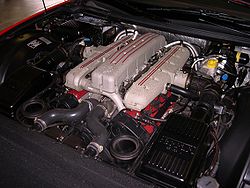 |
The V12
V12 engine
A V12 engine is a V engine with 12 cylinders mounted on the crankcase in two banks of six cylinders, usually but not always at a 60° angle to each other, with all 12 pistons driving a common crankshaft....
variant of the Dino V6 debuted in the 1992 456
Ferrari 456
The Ferrari 456 and 456 M is a front-engined grand tourer. The 456 was produced from 1992 until 2003. It was an overdue replacement for the defunct front-engined 412 as the company's premium 4-seat V12 car. The updated 456M was replaced in 2004 by the 612 Scaglietti...
as the Tipo F116B. It is a 65° engine with an 88 mm bore and the same 75 mm stroke as the Dino V8 found in the 348
Ferrari 348
The Ferrari 348 is a mid-engined, rear wheel drive V8-powered 2-seat sports car by Ferrari S.p.A., replacing the 328 in 1989 and continuing until 1995.- Overview :...
. Total displacement is 5.5 L (5474 cc) for 436 hp (325 kW). A later Tipo F116C version replaced the B in 1998 and lasted through 2002.
The same displacement produced 485 hp (362 kW) in the 1996 550 Maranello
Ferrari 550
The Ferrari 550 Maranello and 550 Barchetta are 2-seat grand tourers built by Ferrari. Introduced in 1996, the 550 was an upmarket front-engined V12 coupe of the kind not seen since the Daytona. It shared its platform and 5.5 L engine with the 2+2 456 but was positioned as the company's...
's Tipo F133A (later the Tipo F133C). The 5.5 L V12 engine won the "over 4 liter" class of the International Engine of the Year
International Engine of the Year
The International Engine of the Year is an annual competition for automotive industry internal combustion engines, judged by a panel of automobile journalists from around the world. It is organised by the United Kingdom's largest technical motoring, aerospace and traffic management publication...
award for 2000 and 2001.
The F50
Ferrari F50
The Ferrari F50 is a mid-engined range-topping sports car made by Ferrari. The F50 was introduced in 1995 to celebrate the company's 50th anniversary. The car is a two door, two seat convertible with a removable hardtop...
sports car bowed in 1995 with another Dino V12, based on the 1990 3.5 L Formula One
Formula One
Formula One, also known as Formula 1 or F1 and referred to officially as the FIA Formula One World Championship, is the highest class of single seater auto racing sanctioned by the Fédération Internationale de l'Automobile . The "formula" designation in the name refers to a set of rules with which...
engine. With an 85 mm bore and 69 mm stroke, it mimicked the high-revving oversquare dimensions of the F40's
Ferrari F40
The Ferrari F40 is a mid-engine, rear-wheel drive, two-door coupé sports car produced by Ferrari from 1987 to 1992 as the successor to the Ferrari 288 GTO. From 1987 to 1989 it was Ferrari's fastest, most powerful, and most expensive car...
V8, but with 4.7 L, it didn't need a turbo to produce 520 hp (388 kW). Variable length intake manifold
Variable Length Intake Manifold
In internal combustion engines, a variable length intake manifold , or variable intake manifold is an automobile internal combustion engine manifold technology...
s were used, as was 5-valve
Multi-valve
In automotive engineering a multi-valve or multivalve engine is one where each cylinder has more than two valves. A multi-valve engine has better breathing and can operate at higher revolutions per minute than a two-valve engine, delivering more power.- Multi-valve rationale :A multi-valve design...
technology.
The 2002 575 M
Ferrari 575M Maranello
The Ferrari 575M Maranello is a two-seat, two-door, grand tourer built by Ferrari. Launched in 2002, it is essentially an updated 550 Maranello featuring minor styling changes from Pininfarina...
has a 5748 cc version of the Dino V12 known as the Tipo F133E. Bore was up to 89 mm and stroke matched the F355
Ferrari F355
The Ferrari F355 is a sports car built by Ferrari from May 1994 to 1999. It is an evolution of the Ferrari 348 and was replaced by the Ferrari 360. It is a mid-engined, rear wheel drive V8-powered 2-seat coupe...
V8 at 77 mm. Output was 515 hp (384 kW) for the 575M, raised to 533 hp (412 kW) for the Tipo F133F used in the 2004 612 Scaglietti
Ferrari 612 Scaglietti
The Ferrari 612 Scaglietti is a grand tourer produced by Ferrari between 2004 and 2010. It is a large two door fastback coupé. The 612 Scaglietti was designed to replace the smaller 456 M; its larger size makes it a true 4 seater with adequate space in the rear seats for adults.The design,...
The Dino-based V12 family was replaced by an all-new V12 engine based on the shared Ferrari/Maserati V8. This new generation of V12 was introduced for the 2003 Enzo
Enzo Ferrari (car)
The Enzo Ferrari is a 12 cylinder mid-engine berlinetta named after the company's founder, Enzo Ferrari. It was built in 2002 using Formula One technology, such as a carbon-fibre body, F1-style electrohydraulic shift transmission, and Carbon fibre-reinforced Silicon Carbide ceramic composite...
.
Applications:
- F116B 5474 cc
- 1992–1997 456Ferrari 456The Ferrari 456 and 456 M is a front-engined grand tourer. The 456 was produced from 1992 until 2003. It was an overdue replacement for the defunct front-engined 412 as the company's premium 4-seat V12 car. The updated 456M was replaced in 2004 by the 612 Scaglietti...
- 1992–1997 456
- F116C 5474 cc
- 1998–2003 456MFerrari 456The Ferrari 456 and 456 M is a front-engined grand tourer. The 456 was produced from 1992 until 2003. It was an overdue replacement for the defunct front-engined 412 as the company's premium 4-seat V12 car. The updated 456M was replaced in 2004 by the 612 Scaglietti...
- 1998–2003 456M
- F133A and F133C 5474 cc
- 1996–2001 550 MaranelloFerrari 550The Ferrari 550 Maranello and 550 Barchetta are 2-seat grand tourers built by Ferrari. Introduced in 1996, the 550 was an upmarket front-engined V12 coupe of the kind not seen since the Daytona. It shared its platform and 5.5 L engine with the 2+2 456 but was positioned as the company's...
- 1996–2001 550 Maranello
- F133E 5748 cc
- 2002–2006 575M MaranelloFerrari 575M MaranelloThe Ferrari 575M Maranello is a two-seat, two-door, grand tourer built by Ferrari. Launched in 2002, it is essentially an updated 550 Maranello featuring minor styling changes from Pininfarina...
- 2002–2006 575M Maranello
- F133F 5748 cc
- 2004–present 612 ScagliettiFerrari 612 ScagliettiThe Ferrari 612 Scaglietti is a grand tourer produced by Ferrari between 2004 and 2010. It is a large two door fastback coupé. The 612 Scaglietti was designed to replace the smaller 456 M; its larger size makes it a true 4 seater with adequate space in the rear seats for adults.The design,...
- 2004–present 612 Scaglietti
- F133G 5748 cc
- 2005–2006 Superamerica