


Ferrari 360

Encyclopedia
The Ferrari 360 is a mid-engine midsize two-seater sports car
produced from late 1999 until 2005. The 360 replaced the Ferrari F355
and was itself replaced by the fairly similar Ferrari F430
. For the 360, Ferrari
partnered with Alcoa
to produce an entirely new all-aluminum space-frame chassis that was 40% stiffer than the F355, yet 28% lighter despite a 10% increase in overall dimensions. Along with the new frame was a new Pininfarina
body styling that broke ranks with the last decade's sharp angles and flip-up headlights, replacing them with a rounded appearance that harkened to the 1960s. The new V8 engine
, common to all versions, was only slightly larger and more powerful than the F355's at 3.6 litres and 400 bhp (300 kW) of power, but the lighter frame and added stiffness improved performance; the 0 to 100 kilometre per hour acceleration performance improved from 4.6 to 4.4 seconds. An engine replacement resulted in the V8 road model that followed, the F430
(internally referred to as the evoluzione or evo) which came out in 2004.
Three road going versions were produced:
360 Modena,
360 Spider, both of which were available with either 6 speed or F1 transmissions and
Challenge Stradale, an F1 electrohydraulic manual
360 Challenge inspired variant of a 360 Modena.
In addition to this there were the usual factory race cars:
360 Challenge, a one make series factory built customer race car based on the 360 Modena but completely stripped out and non road legal.
360 GT-C, a 360 Challenge stripped out and tuned by Veloqx-Prodive to compete in the N-GT class.
There is also one Ferrari "modificato" 360 Modena. Details are limited however it is known to have had extensive performance modifications carried out at owners request.
An additional version, 360 Barchetta, was a one-off wedding present from Ferrari to Ferrari president Luca di Montezemolo
.
, the birthplace of Enzo Ferrari
. Its six-speed gearbox is available as a manual
, or F1 electrohydraulic manual
which was only offered after late 2000. The car went into production in 1999 and remained in production until 2005 when it was replaced by the F430. The Modena was followed by the 360 Spider, Ferrari's 20th road-going convertible
. Other than weight, the Spider's specifications match those of the Modena almost exactly.
The Challenge Stradale (or CS) was a later addition to the road line. It was essentially a lightened version of the Modena, dropping 110 kilograms and drastically improving its handling through optimizations such as uprated titanium springs (lowering unsprung weight), stiffer bushes (from 360 Challenge cars) and uprated rear anti roll bar (the same anti-roll bar as used on 430 Scuderia). Changes included larger 19" BBS wheels, the use of carbon fiber
for the frames of the seats and mirrors, titanium
springs which were also 20% stiffer, and Carbon fibre-reinforced Silicon Carbide (C/SiC) ceramic
composite brake disks. A variety of option allowed for further weight reductions, including replacing the leather interior with fabric, removal of the power windows and mirrors, and deletion of the stereo. Lexan
side windows were available in Europe only. It was officially introduced in March 2003 at the Geneva International Motor Show
and went into production shortly thereafter. The CS can be compared to Porsche's GT3 RS model in design approach and many magazines have placed them head to head in road tests. Jeremy Clarkson
compared the two and chose the CS to be his favourite.
For Modena, Spider, Modena F1 and Spider F1:
For Challenge Stradale:
s lines are by many regarded as timelessly beautiful and yet sportingly aggressive.
The engineers worked hard from the start of the 360 project to lay the foundation for a Spider with exceptional torsional and flexional rigidity. They had to strengthen the sills, stiffen the front of the floorpan and redesign the windscreen frame. The rear bulkhead had to be stiffened to cut out engine noise from the cabin. The convertible's necessary dynamic rigidity is provided by additional side reinforcements and a cross brace in front of the engine. Passenger safety is ensured by a strengthened windscreen frame and roll bars.
The 360 Spider displays a curvilinear waistline. The fairings imply the start of a roof, and stable roll bars are embedded in these elevations. Due to use of light aluminium constructions throughout, the Spider weighs in with only 60 kg (130 lb) more than the coupé.
With its hood up, the Ferrari 360 Spider looks extremely aggressive. Lowering the hood totally transforms the look. Seen from the side, the 360 Spider resembles a sports racer, a sensation underlined by the length of the rear engine bay, the twin roll bars, the rear fairings and the steep windscreen.
As with the Modena version, its 3.6 litre V8 with 400 bhp is on display under a glass hood. The engine - confined in space by the convertible's top's storage area - acquires additional air supply through especially large side grills. The intake manifolds, with the classical Ferrari covers, cuddle up to each other between the air supply conduits in the Spider engine compartment, as opposed to lying apart as with the Mondena.
Despite the car's mid-mounted V8 engine Ferrari's engineers found a way of creating a hood that automatically folds away inside the engine bay, thus ensuring purity of line. The top canopy of crease free material comes in black, blue, grey and beige. The transformation from a closed top to an open-air convertible is a two-stage folding-action that has been dubbed "a stunning 20 second mechanical symphony". After a short to and fro, the entire top disappears into a closed storage area between the seating and the engine.
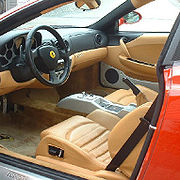
The interior of the Spider is identical to the coupé.
The spider also had the option of a performance exhaust system from Tubi Style
. The exhaust made the car sound louder and provided a modest increase in peak horsepower.
In total, the CS is up to 110 kg (243 lb) lighter than the standard Modena if all the lightweight options are specified such as deleted radio, lexan (plexiglass) rear window and Alcantara fabric (instead of the leather option). As much as 94 kilograms (207 lb) was taken off on the bodywork by stripping the interior of its sound deadening, lighter weight bumpers, carbon mirrors and the optional Modena carbon seats becoming standard. The engine and transmission weight was slimmed down 11 kg (24 lb) through the use of a smaller, lighter weight sports (yet still stainless steel) exhaust back box and valved exit pipes.
There are a lot of subtle (and some not so subtle) styling differences between the Challenge Stradale and the standard Modena.
Unlike the previous Challenge car series which utilized a previously registered F355 Road car with a 'challenge upgrade' kit applied, the 360 MC was a fully factory built affair which afforded the engineers the chance to really go to town on the weight reduction converting the road car into a viable circuit racing machine. A huge amount of attention to detail ensured that the car was drastically stripped of unnecessary weight over its road going brother and appropriate safety equipment incorporated. This led to a completely different feel to its handling and ambiance, with a fully stripped out interior and bare carbon detailing ensuring the car really did feel a world away from its road going brother. The enhanced driving characteristics (handling, braking, f1 shift speeds, etc.) and of course substantial weight reduction meant the car could comfortably out perform the road cars even though power from the 3.6 engine was claimed to be broadly similar.
The route to accomplishing all of this extra performance was good old fashioned weight reduction and increasing power through an improved power-to-weight ratio. All traces of road car luxuries which are standard on the Modena were removed including the sound system, electric toys like windows, central locking and clock. All sound deadening and interior trim, airbags, seat belts and road seats got ditched to be replaced by a spartan functional race care essentials cockpit. This sported bare aluminum painted matte black with FIA approved racing harnesses with a fixed floor mounted single bucket OMP carbon seat bolted to the floor. Even items such as the air conditioning and handbrake were removed in the pursuit of lightness. The suspension was extensively revised and the electronic adaptive comfort system of the Modena was binned for traditional fixed damping setup which was substantially stiffer and lower reducing pitching and roll at the compromise of road car comfort (certainly not a requirement on a dedicated racing car). Thicker brakes were added which could cope with constant stresses and strains of the track which incorporated air cooling ducts to prevent them overheating after constant track use with the car running on racing slicks.
The leather door panels (in fact all leather) were removed. Ultra light carbon-fiber-reinforced polymer door panels with pull cables, reminiscent of those found on the earlier F40 (which had a kevlar, carbon fiber, and aluminum interior), were adopted in place of the electric windows and glass. All in the pursuit of lowering the car's curb weight as much as possible. The dashboard itself was thinned out and leather was replaced by lightweight alcantara. The glove box was replaced, and holes here incorporated to allow the fitment of a bolt-in roll cage for safety. The road car's dashboard display was removed and replaced with an early monochrome LCD digital display encased in carbon which more suitable for racing and incorporated more relevant information. This provided the ability to both lose more weight and gain improved insight to telemetry and sensors. An OMP fire suppression system was fitted with controls inboard within the central console (also carbon).
rear engine cover cosmetically distinguished the car from the road-legal 360. The 360's advanced electronic suspension system with integrated ASR was dropped in favour of a Veloqx-Prodrive setup. These changes lowered the car by an inch over the Modena while removing the electronic safety net of the road going car.
The engine was tuned by Corsa Cliente, who increased the power from 420 bhp to 550 bhp. In the 360 GT-C the main focus is on handling, weight reduction and weight balance improvements. The GT-C was only available in F1 automatic variant, no manual cars were produced. The biggest differences in driving were attributed to the weight reduction and massive handling improvements through the use of uprated Veloqx-Prodrive springs and suspension flamblocks (bushes).
Sports car
A sports car is a small, usually two seat, two door automobile designed for high speed driving and maneuverability....
produced from late 1999 until 2005. The 360 replaced the Ferrari F355
Ferrari F355
The Ferrari F355 is a sports car built by Ferrari from May 1994 to 1999. It is an evolution of the Ferrari 348 and was replaced by the Ferrari 360. It is a mid-engined, rear wheel drive V8-powered 2-seat coupe...
and was itself replaced by the fairly similar Ferrari F430
Ferrari F430
The Ferrari F430 is a sports car that was produced by the Italian automaker Ferrari from 2004 to 2009, as a successor to the 360. It debuted at the 2004 Paris Motor Show...
. For the 360, Ferrari
Ferrari
Ferrari S.p.A. is an Italian sports car manufacturer based in Maranello, Italy. Founded by Enzo Ferrari in 1929, as Scuderia Ferrari, the company sponsored drivers and manufactured race cars before moving into production of street-legal vehicles as Ferrari S.p.A. in 1947...
partnered with Alcoa
Alcoa
Alcoa Inc. is the world's third largest producer of aluminum, behind Rio Tinto Alcan and Rusal. From its operational headquarters in Pittsburgh, Pennsylvania, Alcoa conducts operations in 31 countries...
to produce an entirely new all-aluminum space-frame chassis that was 40% stiffer than the F355, yet 28% lighter despite a 10% increase in overall dimensions. Along with the new frame was a new Pininfarina
Pininfarina
Pininfarina S.p.A. is an Italian car design firm and coachbuilder in Cambiano, Italy.Founded as Società anonima Carrozzeria Pinin Farina in 1930 by automobile designer and builder Battista "Pinin" Farina, Pininfarina has been employed by a wide variety of high-end automobile manufacturers,...
body styling that broke ranks with the last decade's sharp angles and flip-up headlights, replacing them with a rounded appearance that harkened to the 1960s. The new V8 engine
V8 engine
A V8 engine is a V engine with eight cylinders mounted on the crankcase in two banks of four cylinders, in most cases set at a right angle to each other but sometimes at a narrower angle, with all eight pistons driving a common crankshaft....
, common to all versions, was only slightly larger and more powerful than the F355's at 3.6 litres and 400 bhp (300 kW) of power, but the lighter frame and added stiffness improved performance; the 0 to 100 kilometre per hour acceleration performance improved from 4.6 to 4.4 seconds. An engine replacement resulted in the V8 road model that followed, the F430
Ferrari F430
The Ferrari F430 is a sports car that was produced by the Italian automaker Ferrari from 2004 to 2009, as a successor to the 360. It debuted at the 2004 Paris Motor Show...
(internally referred to as the evoluzione or evo) which came out in 2004.
Three road going versions were produced:
360 Modena,
360 Spider, both of which were available with either 6 speed or F1 transmissions and
Challenge Stradale, an F1 electrohydraulic manual
Electrohydraulic manual transmission
Electrohydraulic manual transmission is a type of semi-automatic transmission system, which uses an automated clutch unlike conventional manual transmissions where the driver operates the clutch. The clutch is controlled by electronic computers and hydraulics...
360 Challenge inspired variant of a 360 Modena.
In addition to this there were the usual factory race cars:
360 Challenge, a one make series factory built customer race car based on the 360 Modena but completely stripped out and non road legal.
360 GT-C, a 360 Challenge stripped out and tuned by Veloqx-Prodive to compete in the N-GT class.
There is also one Ferrari "modificato" 360 Modena. Details are limited however it is known to have had extensive performance modifications carried out at owners request.
An additional version, 360 Barchetta, was a one-off wedding present from Ferrari to Ferrari president Luca di Montezemolo
Luca di Montezemolo
Luca Cordero di Montezemolo is an Italian businessman and Chairman of Ferrari. He was also Chairman of Fiat S.p.A from 2004 to 2010 and President of Confindustria from 2004 to 2008 and FIEG. He comes from an aristocratic family from the region of Piedmont in Italy...
.
Road models
The first model of the 360 to ship was the 360 Modena, named after the town of ModenaModena
Modena is a city and comune on the south side of the Po Valley, in the Province of Modena in the Emilia-Romagna region of Italy....
, the birthplace of Enzo Ferrari
Enzo Ferrari
Enzo Anselmo Ferrari Cavaliere di Gran Croce OMRI was an Italian race car driver and entrepreneur, the founder of the Scuderia Ferrari Grand Prix motor racing team, and subsequently of the Ferrari car manufacturer...
. Its six-speed gearbox is available as a manual
Manual transmission
A manual transmission, also known as a manual gearbox or standard transmission is a type of transmission used in motor vehicle applications...
, or F1 electrohydraulic manual
Electrohydraulic manual transmission
Electrohydraulic manual transmission is a type of semi-automatic transmission system, which uses an automated clutch unlike conventional manual transmissions where the driver operates the clutch. The clutch is controlled by electronic computers and hydraulics...
which was only offered after late 2000. The car went into production in 1999 and remained in production until 2005 when it was replaced by the F430. The Modena was followed by the 360 Spider, Ferrari's 20th road-going convertible
Convertible
A convertible is a type of automobile in which the roof can retract and fold away having windows which wind-down inside the doors, converting it from an enclosed to an open-air vehicle...
. Other than weight, the Spider's specifications match those of the Modena almost exactly.
The Challenge Stradale (or CS) was a later addition to the road line. It was essentially a lightened version of the Modena, dropping 110 kilograms and drastically improving its handling through optimizations such as uprated titanium springs (lowering unsprung weight), stiffer bushes (from 360 Challenge cars) and uprated rear anti roll bar (the same anti-roll bar as used on 430 Scuderia). Changes included larger 19" BBS wheels, the use of carbon fiber
Carbon fiber
Carbon fiber, alternatively graphite fiber, carbon graphite or CF, is a material consisting of fibers about 5–10 μm in diameter and composed mostly of carbon atoms. The carbon atoms are bonded together in crystals that are more or less aligned parallel to the long axis of the fiber...
for the frames of the seats and mirrors, titanium
Titanium
Titanium is a chemical element with the symbol Ti and atomic number 22. It has a low density and is a strong, lustrous, corrosion-resistant transition metal with a silver color....
springs which were also 20% stiffer, and Carbon fibre-reinforced Silicon Carbide (C/SiC) ceramic
Ceramic
A ceramic is an inorganic, nonmetallic solid prepared by the action of heat and subsequent cooling. Ceramic materials may have a crystalline or partly crystalline structure, or may be amorphous...
composite brake disks. A variety of option allowed for further weight reductions, including replacing the leather interior with fabric, removal of the power windows and mirrors, and deletion of the stereo. Lexan
Lexan
Lexan is a registered trademark for SABIC Innovative Plastics' brand of polycarbonate resin thermoplastic. Polycarbonate polymer is produced by reacting bisphenol A with carbonyl dichloride, also known as phosgene. Lexan is the brand name for polycarbonate sheet and resin in a wide range of grades...
side windows were available in Europe only. It was officially introduced in March 2003 at the Geneva International Motor Show
Salon International de l'Auto
The International Geneva Motor Show is an annual auto show held in March in the Swiss city of Geneva. The show is hosted at the Geneva Palexpo, a convention centre located next to the Geneva Cointrin International Airport...
and went into production shortly thereafter. The CS can be compared to Porsche's GT3 RS model in design approach and many magazines have placed them head to head in road tests. Jeremy Clarkson
Jeremy Clarkson
Jeremy Charles Robert Clarkson is an English broadcaster, journalist and writer who specialises in motoring. He is best known for his role on the BBC TV show Top Gear along with co-presenters Richard Hammond and James May...
compared the two and chose the CS to be his favourite.
Engine
All models featured the same layout:- No. of cylinders: 90° V8 F131
- Bore & stroke: 85 by 79 mm (3.34 by 3.11 in)
- Total displacement: 3586 cm³ (218.8 in³)
- Redline: 8500 rpm
For Modena, Spider, Modena F1 and Spider F1:
- Maximum power: 405 PS (300 kW; 400 bhp) @ 8500 rpm
- Maximum torque: 373 N·m (275 lbf·ft) @ 4750 rpm
For Challenge Stradale:
- Maximum power: 425 PS (317 kW; 420 bhp) @ 8500 rpm
- Maximum torque: 373 N·m (275 lbf·ft) @ 4750 rpm
Modena, Modena F1 and Spider F1
Performance
- Top speed: 186 mph (299.3 km/h)
- Downforce: 180 kgfKGFKGF may refer to:*Keratinocyte Growth Factor*King George's Fields A UK set of 471 memorial playing fields and recreation grounds*Kolar Gold Fields*The IATA code for Sary-Arka Airport, Karaganda, Kazakhstan...
(1.77 kN) @ 300 km/h (without rear wing) - Lift/drag: -0.73:1
- Acceleration:
- 0-30 mph (48.3 km/h): 1.8 s
- 0-40 mph (64.4 km/h): 2.3 s
- 0-50 mph (80.5 km/h): 3.1 s
- 0-60 mph (96.6 km/h): 4.3 s
- 0-70 mph (112.7 km/h): 5.9 s
- 0-80 mph (128.7 km/h): 7.0 s
- 0-90 mph (144.8 km/h): 8.6 s
- 0-100 mph (160.9 km/h): 10.3 s
- Standing 1/4 Mile: 12.8 s/110.6 mph (178 km/h)
- Braking: 60 mph (96.6 km/h)-0 mph: 117 ft (35.7 m)
- Lateral acceleration: 0.90gG-forceThe g-force associated with an object is its acceleration relative to free-fall. This acceleration experienced by an object is due to the vector sum of non-gravitational forces acting on an object free to move. The accelerations that are not produced by gravity are termed proper accelerations, and...
- Speed through 600 ft (182.9 m) slalom: 69 mph (111 km/h)
- EPA fuel economy:
- City: 11 miles per US gallon
- Hwy: 16 miles per US gallon
- Est. range:
- City: 276 mi (444.2 km)
- Hwy: 400 mi (643.7 km)
Spider
The 360 Spider is Ferrari's twentieth road-going convertible. The model was regarded a classic even when launched in 2000. Designer PininfarinaPininfarina
Pininfarina S.p.A. is an Italian car design firm and coachbuilder in Cambiano, Italy.Founded as Società anonima Carrozzeria Pinin Farina in 1930 by automobile designer and builder Battista "Pinin" Farina, Pininfarina has been employed by a wide variety of high-end automobile manufacturers,...
s lines are by many regarded as timelessly beautiful and yet sportingly aggressive.
The engineers worked hard from the start of the 360 project to lay the foundation for a Spider with exceptional torsional and flexional rigidity. They had to strengthen the sills, stiffen the front of the floorpan and redesign the windscreen frame. The rear bulkhead had to be stiffened to cut out engine noise from the cabin. The convertible's necessary dynamic rigidity is provided by additional side reinforcements and a cross brace in front of the engine. Passenger safety is ensured by a strengthened windscreen frame and roll bars.
The 360 Spider displays a curvilinear waistline. The fairings imply the start of a roof, and stable roll bars are embedded in these elevations. Due to use of light aluminium constructions throughout, the Spider weighs in with only 60 kg (130 lb) more than the coupé.
With its hood up, the Ferrari 360 Spider looks extremely aggressive. Lowering the hood totally transforms the look. Seen from the side, the 360 Spider resembles a sports racer, a sensation underlined by the length of the rear engine bay, the twin roll bars, the rear fairings and the steep windscreen.
As with the Modena version, its 3.6 litre V8 with 400 bhp is on display under a glass hood. The engine - confined in space by the convertible's top's storage area - acquires additional air supply through especially large side grills. The intake manifolds, with the classical Ferrari covers, cuddle up to each other between the air supply conduits in the Spider engine compartment, as opposed to lying apart as with the Mondena.
Despite the car's mid-mounted V8 engine Ferrari's engineers found a way of creating a hood that automatically folds away inside the engine bay, thus ensuring purity of line. The top canopy of crease free material comes in black, blue, grey and beige. The transformation from a closed top to an open-air convertible is a two-stage folding-action that has been dubbed "a stunning 20 second mechanical symphony". After a short to and fro, the entire top disappears into a closed storage area between the seating and the engine.
The interior of the Spider is identical to the coupé.
The spider also had the option of a performance exhaust system from Tubi Style
Tubi Style
- History :Tubi Style systems are performance exhausts manufactured in Maranello, Italy. Tubi Style Italy has a history of working with top Italian marques, providing products for Ferrari and Maserati since the company's establishment....
. The exhaust made the car sound louder and provided a modest increase in peak horsepower.
Dimensions
- Overall: length 4477 mm (176.3 in)
- Overall: width 1922 mm (75.7 in)
- Height: 1235 mm (48.6 in)
- Wheelbase: 2600 mm (102.4 in)
- Front track: 1669 mm (65.7 in)
- Rear track: 1617 mm (63.7 in)
- Weight: 1350 kg (2,976 lb)
- Curb weightCurb weightCurb weight or kerb weight is the total weight of a vehicle with standard equipment, all necessary operating consumables , a full tank of fuel, while not loaded with either passengers or cargo.This definition may differ from definitions used by governmental regulatory agencies or other...
: 1450 kg (3,197 lb) - Weight distribution: 42/58% front/rear
- Fuel capacity: 95 l (25 US gal; 21 imp gal)
Challenge Stradale
The Challenge Stradale is a limited production track day focused car based on the 360 Modena. It was inspired by the 360 Modena Challenge racing car so the focus was primarily on improving its track lapping performance by concentrating on handling, braking and weight reduction characteristics, which are essential in pure racing cars. Ferrari engineers designed the car from the outset with a goal of 20% track day use in mind and 80% road use. With only a small 20 bhp improvement in engine power from the Modena (and boasting an improved power-to-weight ratio) the Challenge Stradale accelerates from 0 to 100 km/h (62 mph) in 4.1 seconds (just a couple of tenths faster than a Modena) but bald figures do not paint the full picture. For the enthusiastic driver the differences are truly staggering, genuine and systematic improvements were achieved to the setup and feel of the whole car. Throttle response from the digital throttle was ratcheted up and feedback through the steering wheel was enhanced. The responsiveness of the controls, the fine balance of the chassis, the braking performance and the driver feedback all contribute greatly to the overall driving experience and lead Ferrari to claim an impressive 2.5 seconds improvement per lap of its Fiorano circuit Vs. the Modena.In total, the CS is up to 110 kg (243 lb) lighter than the standard Modena if all the lightweight options are specified such as deleted radio, lexan (plexiglass) rear window and Alcantara fabric (instead of the leather option). As much as 94 kilograms (207 lb) was taken off on the bodywork by stripping the interior of its sound deadening, lighter weight bumpers, carbon mirrors and the optional Modena carbon seats becoming standard. The engine and transmission weight was slimmed down 11 kg (24 lb) through the use of a smaller, lighter weight sports (yet still stainless steel) exhaust back box and valved exit pipes.
There are a lot of subtle (and some not so subtle) styling differences between the Challenge Stradale and the standard Modena.
Dimensions
- Overall length: 4477 mm (176.3 in)
- Overall width: 1922 mm (75.7 in)
- Height: 1199 mm (47.2 in)
- Wheelbase: 2600 mm (102.4 in)
- Front track: 1669 mm (65.7 in)
- Rear track: 1617 mm (63.7 in)
- Dry weight: 1180 kg (2,601 lb)
- Curb weight: 1290 kg (2,844 lb)
- Fuel capacity: 95 l (25 US gal; 21 imp gal)
Performance
- 0–100 km/h (62 mph): 4.1 s
- Top speed: 300 km/h (186.4 mph)
- Downforce: about 270 kgf (2.6 kN) @ 300 km/h (without rear wing)
- Lift/drag: about -1.1:1
360 Modena Challenge
Based on the 360 Modena road car the 360MC (Modena Challenge) as the factory called it was an extensively reworked track day only (non road legal) car destined to complete in Ferrari's one making racing series called the 'Ferrari Challenge'. It was only available in F1 automated gearbox variant and no manual H-gated challenges were ever produced by the factory. At the time of launch Ferrari claimed the 360MC accelerated from 0 to 62 mph in 3.9 seconds (0.6 secs quicker than the standard 360 Modena F1) and could leave it for dead in the twisty road sections.Unlike the previous Challenge car series which utilized a previously registered F355 Road car with a 'challenge upgrade' kit applied, the 360 MC was a fully factory built affair which afforded the engineers the chance to really go to town on the weight reduction converting the road car into a viable circuit racing machine. A huge amount of attention to detail ensured that the car was drastically stripped of unnecessary weight over its road going brother and appropriate safety equipment incorporated. This led to a completely different feel to its handling and ambiance, with a fully stripped out interior and bare carbon detailing ensuring the car really did feel a world away from its road going brother. The enhanced driving characteristics (handling, braking, f1 shift speeds, etc.) and of course substantial weight reduction meant the car could comfortably out perform the road cars even though power from the 3.6 engine was claimed to be broadly similar.
The route to accomplishing all of this extra performance was good old fashioned weight reduction and increasing power through an improved power-to-weight ratio. All traces of road car luxuries which are standard on the Modena were removed including the sound system, electric toys like windows, central locking and clock. All sound deadening and interior trim, airbags, seat belts and road seats got ditched to be replaced by a spartan functional race care essentials cockpit. This sported bare aluminum painted matte black with FIA approved racing harnesses with a fixed floor mounted single bucket OMP carbon seat bolted to the floor. Even items such as the air conditioning and handbrake were removed in the pursuit of lightness. The suspension was extensively revised and the electronic adaptive comfort system of the Modena was binned for traditional fixed damping setup which was substantially stiffer and lower reducing pitching and roll at the compromise of road car comfort (certainly not a requirement on a dedicated racing car). Thicker brakes were added which could cope with constant stresses and strains of the track which incorporated air cooling ducts to prevent them overheating after constant track use with the car running on racing slicks.
The leather door panels (in fact all leather) were removed. Ultra light carbon-fiber-reinforced polymer door panels with pull cables, reminiscent of those found on the earlier F40 (which had a kevlar, carbon fiber, and aluminum interior), were adopted in place of the electric windows and glass. All in the pursuit of lowering the car's curb weight as much as possible. The dashboard itself was thinned out and leather was replaced by lightweight alcantara. The glove box was replaced, and holes here incorporated to allow the fitment of a bolt-in roll cage for safety. The road car's dashboard display was removed and replaced with an early monochrome LCD digital display encased in carbon which more suitable for racing and incorporated more relevant information. This provided the ability to both lose more weight and gain improved insight to telemetry and sensors. An OMP fire suppression system was fitted with controls inboard within the central console (also carbon).
Official Performance figures
- Power (SAE net) : 410 bhp @ 8500 rpm
- Torque (SAE net) : 286 lbft @ 4750 rpm
- 0–100 km/h (0-62 mph) : 3.9 sec
- Top speed (limited) : 185 mi/h
- Kerb Weight : 1250 kg (2,756 lb)
- Dry Weight : 1169 kg (2,577 lb)
GT-C
The GT-C was a track only car based on the 360 Modena Challenge. It was a non-road legal variant of the Ferrari 360 that shed over 200 kg (441 lb) of weight by use of carbon fibre and stripping out of all of the road car's luxuries such as interior coverings and mirrors. The car boasted a fully stripped out racing interior with full integrated welded in roll cage and fire extinguisher. Lightweight BBS 18" alloys, challenge rear grille and acrylic glassAcrylic glass
Poly is a transparent thermoplastic, often used as a light or shatter-resistant alternative to glass. It is sometimes called acrylic glass. Chemically, it is the synthetic polymer of methyl methacrylate...
rear engine cover cosmetically distinguished the car from the road-legal 360. The 360's advanced electronic suspension system with integrated ASR was dropped in favour of a Veloqx-Prodrive setup. These changes lowered the car by an inch over the Modena while removing the electronic safety net of the road going car.
The engine was tuned by Corsa Cliente, who increased the power from 420 bhp to 550 bhp. In the 360 GT-C the main focus is on handling, weight reduction and weight balance improvements. The GT-C was only available in F1 automatic variant, no manual cars were produced. The biggest differences in driving were attributed to the weight reduction and massive handling improvements through the use of uprated Veloqx-Prodrive springs and suspension flamblocks (bushes).