

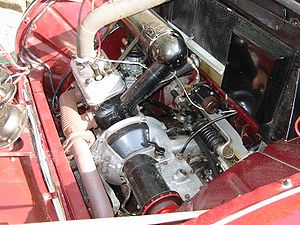
Transverse engine

Encyclopedia
Engine
An engine or motor is a machine designed to convert energy into useful mechanical motion. Heat engines, including internal combustion engines and external combustion engines burn a fuel to create heat which is then used to create motion...
mounted in a vehicle so that the engine's crankshaft
Crankshaft
The crankshaft, sometimes casually abbreviated to crank, is the part of an engine which translates reciprocating linear piston motion into rotation...
axis is perpendicular
Perpendicular
In geometry, two lines or planes are considered perpendicular to each other if they form congruent adjacent angles . The term may be used as a noun or adjective...
to the long axis of the vehicle. Many modern front wheel drive vehicles use this engine mounting configuration. (The vast majority of rear wheel drive vehicles use a longitudinal
Longitudinal engine
In automotive engineering, a longitudinal engine is an internal combustion engine in which the crankshaft is oriented along the long axis of the vehicle, front to back....
engine configuration, where the engine's crankshaft axis is parallel to the long axis of the vehicle.)
History
The first car known to use such an arrangement was a 1911 front-wheel drive car with a clutch at each end of the engine, driving the front wheels directly. The first successful transverse-engine cars were the two-cylinder DKWDKW
DKW is a historic German car and motorcycle marque. The name derives from Dampf-Kraft-Wagen .In 1916, the Danish engineer Jørgen Skafte Rasmussen founded a factory in Zschopau, Saxony, Germany, to produce steam fittings. In the same year, he attempted to produce a steam-driven car, called the DKW...
"Front" series of cars, which first appeared in 1931. After the Second World War, SAAB
Saab Automobile
Saab Automobile AB, better known as Saab , is a Swedish car manufacturer owned by Dutch automobile manufacturer Swedish Automobile NV, formerly Spyker Cars NV. It is the exclusive automobile Royal Warrant holder as appointed by the King of Sweden...
used the configuration in their first model, the Saab 92
Saab 92
Saab 92 is an automobile from Saab. The design was very aerodynamic for its time, and the cW value was 0.30 . The entire body was stamped out of one piece of sheet metal and then cut to accommodate doors and windows. Full-scale production started December 12, 1949, based on the prototype Saab 92001...
, in 1947. The arrangement was also used for Borgward
Borgward
Borgward was a German automobile manufacturer founded by Carl F. W. Borgward . The company was based in Bremen...
's Goliath
Goliath (car)
Goliath was a German car brand started in 1928 and which was part of the Borgward group. Goliath was based in Bremen and specialized in three-wheeler cars and trucks and medium-sized cars.-Early history:...
and Hansa
Hansa (car)
Hansa was a German car brand, which was part of the Borgward group. Hansa was based in Bremen.The Hansa-Lloyd company, in the Bremen suburb as Hastedt, had been established as a car and truck makers since 1905....
brand cars and in a few other German cars. However, it was with Alec Issigonis
Alec Issigonis
Sir Alexander Arnold Constantine Issigonis, CBE, FRS was a Greek-British designer of cars, now remembered chiefly for the groundbreaking and influential development of the Mini, launched by the British Motor Corporation in 1959.- Early life:Issigonis was born into the Greek community of Smyrna ...
's Morris Mini and Austin Seven
Mini
The Mini is a small car that was made by the British Motor Corporation and its successors from 1959 until 2000. The original is considered a British icon of the 1960s, and its space-saving front-wheel-drive layout influenced a generation of car-makers...
that the design gained acclaim, in 1959.
This design reached its ultimate extent starting with Dante Giacosa
Dante Giacosa
Dante Giacosa was an Italian car designer. His work covered a large range from minicars to sports cars, using all the different layouts as and when they were the best solution at the time to meet the design parameters....
's elaboration of it for Fiat
Fiat
FIAT, an acronym for Fabbrica Italiana Automobili Torino , is an Italian automobile manufacturer, engine manufacturer, financial, and industrial group based in Turin in the Italian region of Piedmont. Fiat was founded in 1899 by a group of investors including Giovanni Agnelli...
. He connected the engine to its gearbox by a shaft and set the differential off-center so that it could be connected to the gearbox more easily. The axleshafts from the differential to the wheels therefore differed in length, which would have made the car's steering asymmetrical were it not for their torsional stiffness being made the same. Now most small and small/medium sized cars built throughout the world use this arrangement.
The Lamborghini Miura
Lamborghini Miura
The Lamborghini Miura was a sports car produced by Italian automaker Lamborghini between 1966 and 1972. The car is widely considered to have begun the trend of high performance, two-seater, mid-engined sports cars...
used a transverse, mid-mounted 4.0 litre
Litre
pic|200px|right|thumb|One litre is equivalent to this cubeEach side is 10 cm1 litre water = 1 kilogram water The litre is a metric system unit of volume equal to 1 cubic decimetre , to 1,000 cubic centimetres , and to 1/1,000 cubic metre...
V12
V12 engine
A V12 engine is a V engine with 12 cylinders mounted on the crankcase in two banks of six cylinders, usually but not always at a 60° angle to each other, with all 12 pistons driving a common crankshaft....
, a configuration that was unheard of in 1965, although now more common (e.g. Noble M12, Toyota MR2
Toyota MR2
The Toyota MR2 is a two-seat, mid-engined, rear wheel drive sports car produced by Central Motors, a part of Toyota, from 1984 until July 2007 when production stopped in Japan...
, Pontiac Fiero, Fiat X1/9)
The Land Rover LR2 Freelander, along with all Volvo models from 1998 on (including V8 models), employ a transversely-mounted engine in order to increase passenger space inside the vehicle. This has also allowed for improved safety in a frontal impact, due to more front to back engine compartment space being created. The result is a larger front crumple zone
Crumple zone
The crumple zone is a structural feature mainly of automobiles. Crumple zones have also been incorporated into railcars in recent years.They are designed to absorb the energy from the impact during an accident by controlled deformation. This energy is much higher than is commonly recognized...
.
Transverse engines have also been widely used in buses. In the United States they were offered in the early 1930s by Twin Coach
Twin Coach
Twin Coach was an American vehicle manufacturing company from 1927 to 1955, based in Kent, Ohio, and a maker of marine engines and airplane parts until the 1960s. It was formed by brothers Frank and William Fageol when they left the Fageol Motor Company in 1927. They established the company in...
and used with limited success in Dwight Austin's Pickwick
Pickwick
Pickwick may refer to:*The Pickwick Papers, a novel by Charles Dickens, or its main character, Mr Pickwick**The Pickwick Papers , a british 1952-film**The Pickwick Papers ....
Nite-Coach. Transverse bus engines first appeared widely in the Yellow Coach
Yellow Coach
The Yellow Coach Manufacturing Company was an early manufacturer of passenger buses in the United States. It was founded in Chicago as a subsidiary of the Yellow Cab Company in 1923 by John D. Hertz...
719, using Dwight Austin's V-drive; they continued in common use until the 1990s, though shorter V-configuration engines in a straight in "T-drive" configuration became common in the 1960s. They were also used in the British Leyland Atlantean
Leyland Atlantean
The Leyland Atlantean is a model of double-decker bus built by Leyland in the United Kingdom from 1958 to 1986....
and in many transit buses and nearly all modern double decker buses. They have also been widely used by Scania, MAN, Volvo
Volvo Buses
Volvo Buses is a subsidiary and a business area of the Swedish vehicle maker Volvo, which became an independent division in 1968. It is based in Göteborg....
and Renault
Renault
Renault S.A. is a French automaker producing cars, vans, and in the past, autorail vehicles, trucks, tractors, vans and also buses/coaches. Its alliance with Nissan makes it the world's third largest automaker...
's bus divisions.
Position placement of transverse engines
Engines may be placed in two main positions within the motor car:- Front-engine transversely-mounted / Front-wheel drive
- Rear mid-engine transversely-mounted / Rear-wheel drive
Common types of transversely placed engines
Space allowed for engines within the front wheel wells is limited to the following:- Inline-two, Inline-three, Inline-four, Inline-five, V4V4 engineA V4 engine is a V form engine with four cylinders and three main bearings.-Automobile use:Lancia produced several narrow-angle V4 engines from the 1920s through 1960s for cars like the Lambda, Augusta, Artena, Aprilia, Ardea, Appia, and Fulvia....
and V6V6 engineA V6 engine is a V engine with six cylinders mounted on the crankcase in two banks of three cylinders, usually set at either a right angle or an acute angle to each other, with all six pistons driving a common crankshaft...
engines, some manufacturers have squeezed in inline sixes and V8s.