

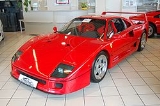
Ferrari F40

Encyclopedia
The Ferrari F40 is a mid-engine, rear-wheel drive, two-door coupé
sports car
produced by Ferrari
from 1987 to 1992 as the successor to the Ferrari 288 GTO
. From 1987 to 1989 it was Ferrari's fastest, most powerful, and most expensive car. The car had no traction control, and was one of the few to utilize turbochargers.
The car debuted with a factory suggested retail price
of approximately US$
400,000, although some buyers were reported to have paid as much as . A total of 1,315 F40s were produced.
and designed to compete with vehicles such as the Porsche 959
and Lamborghini Countach
; for Ferrari management, the vehicle was a major statement piece. Over a period of several years prior to the F40's conception, the company's dominance in racing had waned significantly, and even in Formula One, an arena they had once dominated, victories had become sparse. Enzo Ferrari
had recently turned 90 years old, and was keenly aware that time was not on his side. He wanted his new sports car to serve as his final statement-maker, a vehicle encompassing the best in track-developed technology and capable of being a showcase for what the Ferrari engineers were capable of creating. The company's upcoming 40th anniversary provided just the right occasion for the car to debut.
As Enzo had predicted it would be, the F40 was the last car to be commissioned by him before his death.
in FIA Group B
. However, when the FIA brought an end to the Group B category for the 1986 season, Enzo was left with five 288 GTO Evoluzione development cars, and no series in which to campaign them. Enzo's desire to leave a legacy in his final supercar allowed the Evoluzione program to be further developed to produce a car exclusively for road use.
turbocharged
V8 developing 478 PS under 110 kPa (16 psi) of boost. The F40 did without a catalytic converter
until 1990 when US regulations made them a requirement for emissions control reasons. The flanking exhaust pipes guide exhaust gases from each bank of cylinders while the central pipe guides gases released from the wastegate
of the turbochargers.
The suspension setup was similar to the GTO's double wishbone setup, though many parts were upgraded and settings were changed; the unusually low ground clearance prompted Ferrari to include the ability to raise the vehicle's ground clearance when necessary.
featuring panels made of kevlar
, carbon fiber
, and aluminum for strength and low weight, and intense aerodynamic testing was employed (see below). Weight was further minimized through the use of a plastic windshield and windows. Although the cars did have air conditioning, no carpets, sound system, or door handles were installed. The first 50 cars produced had sliding Lexan windows, while later cars were fitted with normal windows that could be rolled down.
.jpg) The factory never intended to race the F40, but the car saw competition as early as 1989 when it debuted in the Laguna Seca round of the IMSA
The factory never intended to race the F40, but the car saw competition as early as 1989 when it debuted in the Laguna Seca round of the IMSA
, appearing in the GTO
category, with a LM evolution model driven by Jean Alesi
, finishing third to the two faster spaceframed four wheel drive
Audi 90 and beating a host of other factory backed spaceframe specials that dominated the races. Despite lack of factory backing, the car would soon have another successful season there under a host of guest drivers such as Jean-Pierre Jabouille
, Jacques Laffite
and Hurley Haywood
taking a total of three second places and one third.
Although the F40 would not return to IMSA for the following season, it would later be a popular choice by privateers to compete in numerous domestic GT series including JGTC
. In 1994, the car made its debut in international competitions, with one car campaigned in the BPR Global GT Series
by Strandell, winning at the 4 Hours of Vallelunga. In 1995, the number of F40s climbed to four, developed independently by Pilot-Aldix Racing (F40 LM) and Strandell (F40 GTE, racing under the Ferrari Club Italia banner), winning the 4 Hours of Anderstorp. No longer competitive against the McLaren F1 GTR
, the Ferrari F40 returned for another year in 1996, managing to repeat the previous year's Anderstorp win, and from then on it was no longer seen in GT racing.
in GT1 racing but only three racing F50s were produced and none ever actually competed in a race.
.jpg) The F40's light weight of 1100 kg (2,425 lb) and high power output of 478 PS at 7000 rpm gave the vehicle tremendous performance potential. Road tests have produced 0 kilometre per hour times as low as 3.8 seconds (while the track only version came in at 3.2 seconds), with 0 kilometre per hour in 7.6 seconds and 0 kilometre per hour in 11 seconds giving the F40 a slight advantage in acceleration over the Porsche 959
The F40's light weight of 1100 kg (2,425 lb) and high power output of 478 PS at 7000 rpm gave the vehicle tremendous performance potential. Road tests have produced 0 kilometre per hour times as low as 3.8 seconds (while the track only version came in at 3.2 seconds), with 0 kilometre per hour in 7.6 seconds and 0 kilometre per hour in 11 seconds giving the F40 a slight advantage in acceleration over the Porsche 959
, its primary competitor at the time.
The F40 was the first road legal production car to break the 200 mph (89.4 m/s) barrier. From its introduction in 1987 until 1989 its only competitors were the Porsche 959 and the 1988 Lamborghini Countach (it was later overtaken by the Lamborghini Diablo
), it held the record as the world's fastest production car, with a top speed of 200 mph (89.4 m/s).
During the 2006 Bonneville Speed Week, Amir Rosenbaum of Spectre Performance managed to take his F40 with small boost and air intake modifications to 226 miles per hour (363.7 km/h).
and Jeremy Clarkson
both refer to the F40 as the "greatest supercar
the world had ever seen".
Coupé
A coupé or coupe is a closed car body style , the precise definition of which varies from manufacturer to manufacturer, and over time...
sports car
Sports car
A sports car is a small, usually two seat, two door automobile designed for high speed driving and maneuverability....
produced by Ferrari
Ferrari
Ferrari S.p.A. is an Italian sports car manufacturer based in Maranello, Italy. Founded by Enzo Ferrari in 1929, as Scuderia Ferrari, the company sponsored drivers and manufactured race cars before moving into production of street-legal vehicles as Ferrari S.p.A. in 1947...
from 1987 to 1992 as the successor to the Ferrari 288 GTO
Ferrari 288 GTO
The Ferrari GTO is an exotic homologation of the Ferrari 308 GTB produced from 1984 through 1986, designated GT for Gran Turismo and O for Omologato .- Background :...
. From 1987 to 1989 it was Ferrari's fastest, most powerful, and most expensive car. The car had no traction control, and was one of the few to utilize turbochargers.
The car debuted with a factory suggested retail price
Suggested retail price
The manufacturer's suggested retail price , list price or recommended retail price of a product is the price which the manufacturer recommends that the retailer sell the product. The intention was to help to standardise prices among locations...
of approximately US$
United States dollar
The United States dollar , also referred to as the American dollar, is the official currency of the United States of America. It is divided into 100 smaller units called cents or pennies....
400,000, although some buyers were reported to have paid as much as . A total of 1,315 F40s were produced.
Concept
Ostensibly, the F40 was conceived as the successor to the 288 GTOFerrari 288 GTO
The Ferrari GTO is an exotic homologation of the Ferrari 308 GTB produced from 1984 through 1986, designated GT for Gran Turismo and O for Omologato .- Background :...
and designed to compete with vehicles such as the Porsche 959
Porsche 959
The Porsche 959 is a sports car manufactured by Porsche from 1986 to 1989, first as a Group B rally car and later as a legal production car designed to satisfy FIA homologation regulations requiring that a minimum number of 200 street legal units be built....
and Lamborghini Countach
Lamborghini Countach
The Lamborghini Countach is a mid-engined supercar that was produced by Italian automaker Lamborghini from 1974 to 1990. Its design both pioneered and popularized the wedge-shaped, sharply angled look popular in many high performance sports cars...
; for Ferrari management, the vehicle was a major statement piece. Over a period of several years prior to the F40's conception, the company's dominance in racing had waned significantly, and even in Formula One, an arena they had once dominated, victories had become sparse. Enzo Ferrari
Enzo Ferrari
Enzo Anselmo Ferrari Cavaliere di Gran Croce OMRI was an Italian race car driver and entrepreneur, the founder of the Scuderia Ferrari Grand Prix motor racing team, and subsequently of the Ferrari car manufacturer...
had recently turned 90 years old, and was keenly aware that time was not on his side. He wanted his new sports car to serve as his final statement-maker, a vehicle encompassing the best in track-developed technology and capable of being a showcase for what the Ferrari engineers were capable of creating. The company's upcoming 40th anniversary provided just the right occasion for the car to debut.
As Enzo had predicted it would be, the F40 was the last car to be commissioned by him before his death.
Origin
As early as 1984, the Maranello factory had begun development of an evolution model of the 288 GTO intended to compete against the Porsche 959Porsche 959
The Porsche 959 is a sports car manufactured by Porsche from 1986 to 1989, first as a Group B rally car and later as a legal production car designed to satisfy FIA homologation regulations requiring that a minimum number of 200 street legal units be built....
in FIA Group B
Group B
Group B was a set of regulations introduced in 1982 for competition vehicles in sportscar racing and rallying regulated by the FIA. The Group B regulations fostered some of the quickest, most powerful and sophisticated rally cars ever built. However, a series of major accidents, some fatal, were...
. However, when the FIA brought an end to the Group B category for the 1986 season, Enzo was left with five 288 GTO Evoluzione development cars, and no series in which to campaign them. Enzo's desire to leave a legacy in his final supercar allowed the Evoluzione program to be further developed to produce a car exclusively for road use.
Drivetrain and suspension
Power came from an enlarged, 2.9 L (2936 cc) version of the GTO's twin IHIIshikawajima-Harima Heavy Industries
, formerly known as , is a Japanese company which produces ships, aero-engines, turbochargers for automobiles, industrial machines, power station boilers and other facilities, suspension bridges and other transport-related machinery....
turbocharged
Turbocharger
A turbocharger, or turbo , from the Greek "τύρβη" is a centrifugal compressor powered by a turbine that is driven by an engine's exhaust gases. Its benefit lies with the compressor increasing the mass of air entering the engine , thereby resulting in greater performance...
V8 developing 478 PS under 110 kPa (16 psi) of boost. The F40 did without a catalytic converter
Catalytic converter
A catalytic converter is a device used to convert toxic exhaust emissions from an internal combustion engine into non-toxic substances. Inside a catalytic converter, a catalyst stimulates a chemical reaction in which noxious byproducts of combustion are converted to less toxic substances by dint...
until 1990 when US regulations made them a requirement for emissions control reasons. The flanking exhaust pipes guide exhaust gases from each bank of cylinders while the central pipe guides gases released from the wastegate
Wastegate
A wastegate is a valve that diverts exhaust gases away from the turbine wheel in a turbocharged engine system. Diversion of exhaust gases regulates the turbine speed, which in turn regulates the rotating speed of the compressor. The primary function of the wastegate is to regulate the maximum boost...
of the turbochargers.
The suspension setup was similar to the GTO's double wishbone setup, though many parts were upgraded and settings were changed; the unusually low ground clearance prompted Ferrari to include the ability to raise the vehicle's ground clearance when necessary.
Body and interior
The body was an entirely new design by PininfarinaPininfarina
Pininfarina S.p.A. is an Italian car design firm and coachbuilder in Cambiano, Italy.Founded as Società anonima Carrozzeria Pinin Farina in 1930 by automobile designer and builder Battista "Pinin" Farina, Pininfarina has been employed by a wide variety of high-end automobile manufacturers,...
featuring panels made of kevlar
Kevlar
Kevlar is the registered trademark for a para-aramid synthetic fiber, related to other aramids such as Nomex and Technora. Developed at DuPont in 1965, this high strength material was first commercially used in the early 1970s as a replacement for steel in racing tires...
, carbon fiber
Carbon fiber
Carbon fiber, alternatively graphite fiber, carbon graphite or CF, is a material consisting of fibers about 5–10 μm in diameter and composed mostly of carbon atoms. The carbon atoms are bonded together in crystals that are more or less aligned parallel to the long axis of the fiber...
, and aluminum for strength and low weight, and intense aerodynamic testing was employed (see below). Weight was further minimized through the use of a plastic windshield and windows. Although the cars did have air conditioning, no carpets, sound system, or door handles were installed. The first 50 cars produced had sliding Lexan windows, while later cars were fitted with normal windows that could be rolled down.
Aerodynamics
The F40 was designed with aerodynamics in mind. For speed the car relied more on its shape than its power. Frontal area was reduced, and airflow greatly smoothed, but stability rather than terminal velocity was a primary concern. So too was cooling as the forced induction engine generated a great deal of heat. In consequence, the car was somewhat like an open-wheel racing car with a body. It had a partial undertray to smooth airflow beneath the radiator, front section, and the cabin, and a second one with diffusers behind the motor, but the engine bay was not sealed. Nonetheless, the F40 had an impressively low Cd of 0.34 with lift controlled by its spoilers and wing.Racing
International Motor Sports Association
The International Motor Sports Association is an American sports car auto racing sanctioning body based in Braselton, Georgia. It was started by John Bishop, a former employee of SCCA , and his wife Peggy in 1969 with help from Bill France, Sr...
, appearing in the GTO
IMSA GT Championship
IMSA GT was a sports car racing series organized by International Motor Sports Association. Races took place primarily in the United States and occasionally in Canada.-History:...
category, with a LM evolution model driven by Jean Alesi
Jean Alesi
Jean Alesi is a French racing driver of Italian origin. His Formula One career included spells at Tyrrell, Benetton, Sauber, Prost, Jordan and most notably Ferrari where he proved very popular among the tifosi...
, finishing third to the two faster spaceframed four wheel drive
Four Wheel Drive
The Four Wheel Drive Auto Company, more often known as Four Wheel Drive or just FWD, was founded in 1909 in Clintonville, Wisconsin, as the Badger Four-Wheel Drive Auto Company by Otto Zachow and William Besserdich.-History:...
Audi 90 and beating a host of other factory backed spaceframe specials that dominated the races. Despite lack of factory backing, the car would soon have another successful season there under a host of guest drivers such as Jean-Pierre Jabouille
Jean-Pierre Jabouille
Jean-Pierre Alain Jabouille is a former racing driver from France.-Biography:A native of Paris, Jabouille was one of the last of a breed of Formula One drivers who were also engineers....
, Jacques Laffite
Jacques Laffite
Jacques-Henri Laffite is a French former racing driver who competed in Formula One from to . He achieved six grand prix wins, all while driving for the Ligier team. He is now a TV commentator on French television TF1....
and Hurley Haywood
Hurley Haywood
Hurley Haywood is an American race-car driver who won the 24 Hours of Le Mans in 1977 , 1983 and 1994 and is the most successful driver at the 24 Hours of Daytona with 5 wins . He won the 12 Hours of Sebring in 1973 and 1981...
taking a total of three second places and one third.
Although the F40 would not return to IMSA for the following season, it would later be a popular choice by privateers to compete in numerous domestic GT series including JGTC
Super GT
The Super GT series, formerly known as the All-Japan Grand Touring Car Championship or JGTC , is a grand touring car race series promoted by the GT-Association...
. In 1994, the car made its debut in international competitions, with one car campaigned in the BPR Global GT Series
BPR Global GT Series
The BPR Global GT Series was a grand tourer-based sports car racing series which ran from 1994 to 1996 before becoming the FIA GT Championship in 1997...
by Strandell, winning at the 4 Hours of Vallelunga. In 1995, the number of F40s climbed to four, developed independently by Pilot-Aldix Racing (F40 LM) and Strandell (F40 GTE, racing under the Ferrari Club Italia banner), winning the 4 Hours of Anderstorp. No longer competitive against the McLaren F1 GTR
McLaren F1 GTR
The McLaren F1 GTR was a racing variant of the McLaren F1 sports car first produced in 1995 for grand touring style racing, such as the BPR Global GT Series, FIA GT Championship, JGTC, and British GT Championship. It is most famous for its overall victory at the 1995 24 Hours of Le Mans where it...
, the Ferrari F40 returned for another year in 1996, managing to repeat the previous year's Anderstorp win, and from then on it was no longer seen in GT racing.
Succession
The F40 was discontinued in 1992 and in 1995 was intended to be succeeded by the F50Ferrari F50
The Ferrari F50 is a mid-engined range-topping sports car made by Ferrari. The F50 was introduced in 1995 to celebrate the company's 50th anniversary. The car is a two door, two seat convertible with a removable hardtop...
in GT1 racing but only three racing F50s were produced and none ever actually competed in a race.
Performance
Porsche 959
The Porsche 959 is a sports car manufactured by Porsche from 1986 to 1989, first as a Group B rally car and later as a legal production car designed to satisfy FIA homologation regulations requiring that a minimum number of 200 street legal units be built....
, its primary competitor at the time.
The F40 was the first road legal production car to break the 200 mph (89.4 m/s) barrier. From its introduction in 1987 until 1989 its only competitors were the Porsche 959 and the 1988 Lamborghini Countach (it was later overtaken by the Lamborghini Diablo
Lamborghini Diablo
The Lamborghini Diablo is a high-performance mid-engined sports car that was built by Italian automaker Lamborghini between 1990 and 2001. It was the first Lamborghini capable of attaining a top speed in excess of . After the end of its production run in 2001, the Diablo was replaced by the...
), it held the record as the world's fastest production car, with a top speed of 200 mph (89.4 m/s).
During the 2006 Bonneville Speed Week, Amir Rosenbaum of Spectre Performance managed to take his F40 with small boost and air intake modifications to 226 miles per hour (363.7 km/h).
Reception
In Top Gear, Richard HammondRichard Hammond
Richard Mark Hammond is an English broadcaster, writer, and journalist most noted for co-hosting car programme Top Gear with Jeremy Clarkson and James May, as well as presenting Brainiac: Science Abuse on Sky 1.-Early life:...
and Jeremy Clarkson
Jeremy Clarkson
Jeremy Charles Robert Clarkson is an English broadcaster, journalist and writer who specialises in motoring. He is best known for his role on the BBC TV show Top Gear along with co-presenters Richard Hammond and James May...
both refer to the F40 as the "greatest supercar
Supercar
Supercar is a term used most often to describe an expensive high end car. It has been defined specifically as "a very expensive, fast or powerful car"...
the world had ever seen".