

Favoriten

Encyclopedia
Districts of Vienna
The districts of Vienna are 23 named city sections of Vienna, Austria, which are also numbered for easy reference. For centuries, district boundaries have changed...
of Vienna, Austria (German
German language
German is a West Germanic language, related to and classified alongside English and Dutch. With an estimated 90 – 98 million native speakers, German is one of the world's major languages and is the most widely-spoken first language in the European Union....
: 10. Bezirk, Favoriten), is located south of the central districts. It is south of Innere Stadt
Innere Stadt
The Innere Stadt is the 1st municipal District of Vienna . The Innere Stadt is the old town of Vienna. Until the city boundaries were expanded in 1850, the Innere Stadt was congruent with the city of Vienna...
, Wieden
Wieden
Wieden is the 4th municipal District of Vienna, Austria . It is near the center of Vienna and was established as a district in 1850, but borders changed later...
and Margareten
Margareten
Margareten is the fifth district of Vienna . It is near the center of Vienna and was established as a district in 1850, but borders changed later. Margareten is a heavily populated urban area with many workers and residential homes.- Description :...
. Favoriten is a heavily populated urban area with many residential buildings, but also large recreational areas and parks.
The name comes from Favorita, a semi-baroque
Baroque
The Baroque is a period and the style that used exaggerated motion and clear, easily interpreted detail to produce drama, tension, exuberance, and grandeur in sculpture, painting, literature, dance, and music...
palace complex that once served as a hunting castle but today is a gymnasium
Gymnasium (school)
A gymnasium is a type of school providing secondary education in some parts of Europe, comparable to English grammar schools or sixth form colleges and U.S. college preparatory high schools. The word γυμνάσιον was used in Ancient Greece, meaning a locality for both physical and intellectual...
(secondary school) in the 4th district (Wieden
Wieden
Wieden is the 4th municipal District of Vienna, Austria . It is near the center of Vienna and was established as a district in 1850, but borders changed later...
). The customs facilities at the original southern border of Vienna were known as the Favoriten-Linie (Favoriten Line). Also, the houses nearby were known as the Siedlung vor der Favoriten-Linie (Settlement in front of the Favoriten Line).
Favoriten is home to the stadium of record Austrian football (soccer) team FK Austria Wien
FK Austria Wien
Fußballklub Austria Wien is an Austrian association football club from the capital city of Vienna. They are considered the most successful club in Austria, having won the highest Austrian Bundesliga 23 times, the Austrian Cup 27 times and the Austrian Supercup 6 times. They also reached the UEFA...
, the Generali Arena.
District sections
The Favoriten District includes 6 sections: Katastralgemeinden Favoriten, Inzersdorf-Stadt, Rothneusiedl, Unterlaa, Oberlaa-Stadt and Oberlaa-Land, as well as small parts of the 2 sections Katastralgemeinden Kaiserebersdorf and Simmering.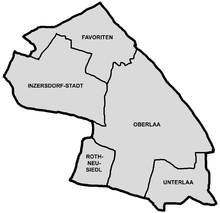
Geography
The district has the districts MeidlingMeidling
Meidling is the 12th district of Vienna . It is located just southwest of the central districts, south of the Wienfluss, west of the Gürtel belt, and east and southeast of Schönbrunn palace...
to the west, Liesing
Liesing
Liesing is the 23rd district of Vienna . It is on the southwest edge of Vienna, Austria.It was formed after Austria's Anschluss with Germany, when Vienna expanded from 21 districts to 26...
to the southwest, Margareten
Margareten
Margareten is the fifth district of Vienna . It is near the center of Vienna and was established as a district in 1850, but borders changed later. Margareten is a heavily populated urban area with many workers and residential homes.- Description :...
and Wieden
Wieden
Wieden is the 4th municipal District of Vienna, Austria . It is near the center of Vienna and was established as a district in 1850, but borders changed later...
to the north, and Simmering to the east. The Südbahn serves Favoriten in the north and Südbahnhof lies in the northeast. The rails run through Wienerberg (Vienna Mountain) and Laaer Berg (Laa Mountain) to Liesingtal (Liesing Valley) in the south, where the Lower Austria
Lower Austria
Lower Austria is the northeasternmost state of the nine states in Austria. The capital of Lower Austria since 1986 is Sankt Pölten, the most recently designated capital town in Austria. The capital of Lower Austria had formerly been Vienna, even though Vienna is not officially part of Lower Austria...
n towns of Hennersdorf
Hennersdorf
Hennersdorf my refer to:Germany:* Hennersdorf, Augustusburg, Saxony* Hennersdorf, Doberlug-Kirchhain, Brandenburg* Hennersdorf, Kamenz, Saxony* Hennersdorf, Schmiedeberg , SaxonyPoland:* former name of Jędrzychowice, PolandCzech Republic:...
, Leopoldsdorf
Leopoldsdorf
Leopoldsdorf is a municipality in the district of Wien-Umgebung in Lower Austria, Austria....
and Schwechat
Schwechat
Schwechat is a city south-east of Vienna known for the Vienna International Airport and Schwechater beer. It is also home to the refineries belonging to the Austrian national oil company OMV.- Geography :...
are.
History
In 1874, the former settlement of Favoriten was annexed by Vienna as the 10th district. The first district director was the well-known Johann Steudel, who ran a tavern in the former settlement. The district expanded its borders quickly as industries and the associated housing grew in the area. After World War IIWorld War II
World War II, or the Second World War , was a global conflict lasting from 1939 to 1945, involving most of the world's nations—including all of the great powers—eventually forming two opposing military alliances: the Allies and the Axis...
, Vienna was divided into quarters and split among the Allies
Allies
In everyday English usage, allies are people, groups, or nations that have joined together in an association for mutual benefit or to achieve some common purpose, whether or not explicit agreement has been worked out between them...
, and Favoriten belonged to the Soviet-occupied sector. Favoriten was last expanded in 1954, when the former villages of Rothneusiedl, Oberlaa and Unterlaa were annexed to the district.
Population
Data from Statistik Austria http://www.statistik.at/blickgem/vz1/g91301.pdf |
Population development
In 1869, the current area covered by the Favoriten District included only 22,340 inhabitants. Due to the huge influx of workers in the district area up to the beginning of the First World War, the district population increased 7-fold up to 1910 as 159,241 inhabitants. Thereafter, the district's population declined until the 30s, fell during the Second World War, but for the next 40 years gradually increased. Unlike many downtown districts, the population numbers grew in the 50s and 60s again, as the district had sufficient land area for new buildings, which expanded due to the housing demand. From the '70s, the population began to stagnate; however, since 2001, the number of inhabitants has increased significantly and, at the beginning of 2007, amounted to 169,578 people.Population structure
The age of the population in Favoriten from 2001 is average for Vienna. The number of children under 15 years was 14.6%, against the Vienna area average of 14.7%. The proportion of the population 15 to 59 years was 62.6% (Vienna: 63.6%), only slightly below average. This showed particularly in the younger population deficits, while the number of people aged 60 or more years with 22.8%, was above the value of Vienna (21.7%). The gender distribution in the district area was 47.7% men and 52.8% women, the number of Favoriten marriages had a share of 42.9% compared to 41.2%, above the average of Vienna.Origin and language
The proportion of foreign-district residents in 2005 was 20.2% (Vienna city-wide: 18.7%), an increase over 2001 (16.5%) as in the entire State, as a rising trend. The highest proportion of foreigners, in 2005, was represented with a 5.5% share of the district population, as nationals from Serbia and MontenegroSerbia and Montenegro
Serbia and Montenegro was a country in southeastern Europe, formed from two former republics of the Socialist Federal Republic of Yugoslavia : Serbia and Montenegro. Following the breakup of Yugoslavia, it was established in 1992 as a federation called the Federal Republic of Yugoslavia...
. Another 3.9% were Turkish
Turkey
Turkey , known officially as the Republic of Turkey , is a Eurasian country located in Western Asia and in East Thrace in Southeastern Europe...
, Bosnian 1.6%, Polish
Poland
Poland , officially the Republic of Poland , is a country in Central Europe bordered by Germany to the west; the Czech Republic and Slovakia to the south; Ukraine, Belarus and Lithuania to the east; and the Baltic Sea and Kaliningrad Oblast, a Russian exclave, to the north...
1.3%, Croatia
Croatia
Croatia , officially the Republic of Croatia , is a unitary democratic parliamentary republic in Europe at the crossroads of the Mitteleuropa, the Balkans, and the Mediterranean. Its capital and largest city is Zagreb. The country is divided into 20 counties and the city of Zagreb. Croatia covers ...
n 1.2% and 0.6% German citizens. In total, for 2001, 23.7% of the population of Favoriten were not born in Austria. Nearly 6.8% expressed as a colloquial language Serbian
Serbian language
Serbian is a form of Serbo-Croatian, a South Slavic language, spoken by Serbs in Serbia, Bosnia and Herzegovina, Montenegro, Croatia and neighbouring countries....
, but Turkish
Turkish language
Turkish is a language spoken as a native language by over 83 million people worldwide, making it the most commonly spoken of the Turkic languages. Its speakers are located predominantly in Turkey and Northern Cyprus with smaller groups in Iraq, Greece, Bulgaria, the Republic of Macedonia, Kosovo,...
7.4% and 2.6% Croatian
Croatian language
Croatian is the collective name for the standard language and dialects spoken by Croats, principally in Croatia, Bosnia and Herzegovina, the Serbian province of Vojvodina and other neighbouring countries...
.
Religious preferences
The religion of the population in the Favoriten District, in the 2001 census, had a proportion of Muslim population higher than the average of Vienna. In 2001, 47.0% of the inhabitants had membership to the Roman Catholic ChurchRoman Catholic Church
The Catholic Church, also known as the Roman Catholic Church, is the world's largest Christian church, with over a billion members. Led by the Pope, it defines its mission as spreading the gospel of Jesus Christ, administering the sacraments and exercising charity...
(Vienna city-wide: 49.2%). There were 15 Roman Catholic parishes, the City Deanery had 10 images. Nearly 11.2% of residents were Islam
Islam
Islam . The most common are and . : Arabic pronunciation varies regionally. The first vowel ranges from ~~. The second vowel ranges from ~~~...
ic faith (Vienna city-wide: 7.8%), 6.4% belonged to the Orthodox Church, and 4.1% were Protestant. Nearly 26.5% of the district population, however, belonged to no religious group, and 4.9% had no religion or other preference given.
Infrastructure
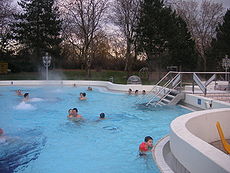
Favoriten is the most populous of the districts of Vienna. Most of Favoriten's residential area is composed of a variety of houses, that are over 100 years old, as well as community housing developments (such as the Hansson-Siedlung). The district also has numerous industries. There are recreational areas in the southern part of the district, such as the Kurpark Laaer Berg (Treatment Park of Laa Mountain), which, in 1974, joined the Kurzentrum Oberlaa (Treatment Centre of Upper Laa), a sulphur springs, and the recreational centre at Wienerberg. On the north side of Laaer Berg, a small theme park, the Böhmischer Prater, was built in 1882. Furthermore, the Ernst Kirchweger Haus (EKH), a squatted social centreSquatting
Squatting consists of occupying an abandoned or unoccupied space or building, usually residential, that the squatter does not own, rent or otherwise have permission to use....
, is situated in Favoriten.
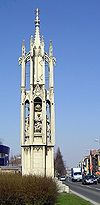 Spinnerin am Kreuz. |
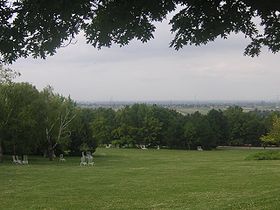 Naherholungsgebiete (recreational areas). |
Landmarks
- Spinnerin am KreuzSpinnerin am KreuzThe German name Spinnerin am Kreuz is the title given to two separate Austrian stone-tower sculptures , one in Vienna and the other in the nearby city of Wiener Neustadt . They are related to the story of a wife spinning beside a cross...
- Gothic stone tower built in 1375 - Wasserturm - Water tower (cisternCisternA cistern is a waterproof receptacle for holding liquids, usually water. Cisterns are often built to catch and store rainwater. Cisterns are distinguished from wells by their waterproof linings...
)
District Government
| District Directors from 1945 | |
|---|---|
| Eduard Friemel (KPÖ KPO Meanings of KPO:* Knowledge process outsourcing.* KPÖ , Communist Party of Austria.* Kommunistische Partei Deutschlands , Communist Party Opposition.... ) |
4/1945-7/1945 |
| Karl Kempf Karl Kempf Karl-Heinz Kempf was a German Luftwaffe fighter ace and recipient of the Knight's Cross of the Iron Cross during World War II... (KPÖ KPO Meanings of KPO:* Knowledge process outsourcing.* KPÖ , Communist Party of Austria.* Kommunistische Partei Deutschlands , Communist Party Opposition.... ) |
7/1945-1946 |
| Karl Wrba (SPÖ SPO - Technology :SPO: Microsoft SharePoint Online, Microsoft Cloud Computing, Office 365. See Microsoft Online Services-Economics:* Secondary Public Offering, an equity capital market instrument... ) |
1946-1966 |
| Emil Fucik (SPÖ SPO - Technology :SPO: Microsoft SharePoint Online, Microsoft Cloud Computing, Office 365. See Microsoft Online Services-Economics:* Secondary Public Offering, an equity capital market instrument... ) |
1966-1977 |
| Josef Deutsch (SPÖ SPO - Technology :SPO: Microsoft SharePoint Online, Microsoft Cloud Computing, Office 365. See Microsoft Online Services-Economics:* Secondary Public Offering, an equity capital market instrument... ) |
1977-1984 |
| Leopold Prucha (SPÖ SPO - Technology :SPO: Microsoft SharePoint Online, Microsoft Cloud Computing, Office 365. See Microsoft Online Services-Economics:* Secondary Public Offering, an equity capital market instrument... ) |
1984-1994 |
| Hermine Mospointner (SPÖ SPO - Technology :SPO: Microsoft SharePoint Online, Microsoft Cloud Computing, Office 365. See Microsoft Online Services-Economics:* Secondary Public Offering, an equity capital market instrument... ) |
1994-present |
As a labour
Labour
Labor might refer to:*Labor, an obsolete unit of area*Josef Labor, a composer, pianist, organist, and teacher*Labor, SloveniaLabour or labor might refer to:* Employment of any kind* Manual labour, physical work done by people...
district Favoriten is traditional political stamped Social Democratic
Social Democratic Party of Austria
The Social Democratic Party of Austria is one of the oldest political parties in Austria. The SPÖ is one of the two major parties in Austria, and has ties to trade unions and the Austrian Chamber of Labour. The SPÖ is among the few mainstream European social-democratic parties that have preserved...
so that the Socialists are represented with the District Director since 1946 all the time.
Commonly the SPÖ reached the absolute majority, which was only in danger after the rise of the FPÖ at the end of the eighties under Jörg Haider
Jörg Haider
Jörg Haider was an Austrian politician. He was Governor of Carinthia on two occasions, the long-time leader of the Austrian Freedom Party and later Chairman of the Alliance for the Future of Austria , a breakaway party from the FPÖ.Haider was controversial within Austria and abroad for comments...
.
1996 the FPÖ increased 8.6% and the absolute majority of the SPÖ was broken the first time.
Through the downfall of the FPÖ the revanche came in 2001 and the Socialists regained the absolute majority.
2010 the SPÖ lost nearly 10% the FPÖ took most advantage of this and also increased by 14%. The ÖVP
OVP
OVP is a three-letter abbreviation that may refer to:*The Office of the Vice President of the United States*The Office of the Vice President of the Philippines*OVP , a light sub-machine gun developed in Italy...
makes no odds here and reached in average not more than 12%.
Also the the Greens are under their average percent of voters here.
At the district election 2010 all parliament parties lost except for FPÖ
FPO
FPO may refer to:*Fleet Post Office, a "city" designation in military mail *Field post office, a term for military post offices in military mail systems *For position only, a designation for placeholder graphics...
and BZÖ
BZO
BZO can mean:* Bolzano Airport, with IATA code BZO* Alliance for the Future of Austria, abbreviated BZÖ...
.
| Jahr | SPÖ | ÖVP | FPÖ | Grüne | LIF Liberal Forum The Liberal Forum is a small classical liberal party in Austria. The party is currently led by Angelika Mlinar, and is a member of the Liberal International and the European Liberal Democrat and Reform Party.-Founding:... |
BZÖ | Sonstige |
|---|---|---|---|---|---|---|---|
| 1991 | 56.8 | 12.3 | 22.3 | 6.3 | n.k | - | 2.3 |
| 1996 | 45.5 | 10.6 | 30.8 | 5.6 | 5.6 | - | 1.9 |
| 2001 | 55.6 | 10.8 | 22.6 | 7.9 | 2.2 | - | 0.9 |
| 2005 | 56.7 | 12.3 | 19.5 | 8.5 | 0.4 | 1.1 | 1.6 |
| 2010 | 47.4 | 9.1 | 33.3 | 7.1 | 0.5 | 1.1 | 1.4 |
Coat of arms
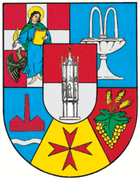
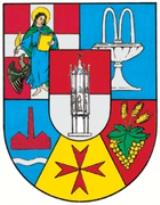
- In the upper-left corner is the coat of arms of the former village of Favoriten. It shows the Apostle John, the patron saint of the Pfarrkirche church at Keplerplatz, wearing a green cape and a blue robe. He is holding a quillQuillA quill pen is a writing implement made from a flight feather of a large bird. Quills were used for writing with ink before the invention of the dip pen, metal-nibbed pens, the fountain pen, and, eventually, the ballpoint pen...
and the GospelGospelA gospel is an account, often written, that describes the life of Jesus of Nazareth. In a more general sense the term "gospel" may refer to the good news message of the New Testament. It is primarily used in reference to the four canonical gospels of Matthew, Mark, Luke, and John...
. An eagle is shown next to him. - In the upper-right, a well made of shell stands against a blue background and symbolises Oberlaa. This reminds us of the healing springs and the treatment centres of the district.
- In the lower-left, a red kiln and a flowing stream symbolise Rothneusiedl. It reflects the importance of the brick industry at Wienerberg and Laaerberg.
- In the lower-right, Inzersdorf-Stadt is represented by golden wine grapes with spikes from the top, reminiscent of the once economically important vineyards.
- The lower part shows a red Maltese CrossMaltese crossThe Maltese cross, also known as the Amalfi cross, is identified as the symbol of an order of Christian warriors known as the Knights Hospitaller or Knights of Malta and through them came to be identified with the Mediterranean island of Malta and is one of the National symbols of Malta...
on a golden background, and symbolises Unterlaa and the Knights HospitallerKnights HospitallerThe Sovereign Military Hospitaller Order of Saint John of Jerusalem of Rhodes and of Malta , also known as the Sovereign Military Order of Malta , Order of Malta or Knights of Malta, is a Roman Catholic lay religious order, traditionally of military, chivalrous, noble nature. It is the world's...
that ruled the area until the end of the 13th century. - The centre part symbolises the district as a whole, an attribute not shared by any other district, and displays the Spinnerin am KreuzSpinnerin am KreuzThe German name Spinnerin am Kreuz is the title given to two separate Austrian stone-tower sculptures , one in Vienna and the other in the nearby city of Wiener Neustadt . They are related to the story of a wife spinning beside a cross...
, a symbol of Favoriten.
Notable residents
- Gerhard BronnerGerhard BronnerGerhard Bronner was an Austrian composer, writer, musician and a cabaret artist, known for his contribution to Austrian culture in the post-World War II period....
, Kabarettist and writer - Felix Czeike, author/historian
- Daniel Glattauer, writer
- Baron Karl
- Jakob ReumannJakob ReumannJakob Reumann was an Austrian Social Democratic politician and the first social democratic mayor of Vienna from 1919 to 1923.-Biography:...
, Mayor of Vienna from 1919-1923 - Matthias SindelarMatthias SindelarMatthias Sindelar was an Austrian footballer.He played centre-forward for the celebrated Austria national team of the early 1930s known as the Wunderteam, which he captained at the 1934 World Cup....
, footballer & captain of WunderteamWunderteamWunderteam was the name given to the Austria national football team of the 1930s. Led by manager Hugo Meisl, the team had an unbeaten streak of 14 games between April 1931 and December 1932. The style of the team was based on the Scottish school of football that focused on quick passing introduced... - Kurt Tichy
- Helmut ZilkHelmut ZilkHelmut Zilk was an Austrian journalist and politician in the Austrian Social Democratic Party.- Biography :...
, Mayor of Vienna from 1984-1994
External links
- Wiener Bezirke: Favoriten (in GermanGerman languageGerman is a West Germanic language, related to and classified alongside English and Dutch. With an estimated 90 – 98 million native speakers, German is one of the world's major languages and is the most widely-spoken first language in the European Union....
)